




Abstract
This article explores why there was no domino effect after Brexit and reflects on what this means for the health of European integration. It shows how the UK responded to the uncertainty surrounding the Article 50 talks by testing EU unity, prompting both sides to discuss a no-deal outcome. Evidence from Eurobarometer surveys demonstrates that attachment to the EU strengthened markedly during Brexit talks in the four countries considered most likely to flirt with leaving the EU. Hence Brexit changed the benchmarking process surrounding citizens’ evaluation of the prospects of getting a better deal outside the EU. Risk aversion thus explains the lack of a Brexit domino effect. However, the volatility of public opinion before and after the Article 50 talks, combined with the weaker increase in support over the EU as a whole, means there is no room for complacency over the future prospects of disintegration.
On June 23 Britain is leaving the EU and changing Europe. We will trigger a domino effect. After us, the other northern European countries will leave, starting with Denmark; followed by the Netherlands, Sweden, Austria. . . . The EU is about to collapse, disintegrating into several pieces.
Introduction: a domino effect?
Nigel Farage was by no means alone in framing the 2016 UK referendum on EU membership as the potential trigger for the unravelling of European integration. The portmanteau term ‘Brexit’ deliberately recalled the feverish speculation over ‘Grexit’ during the sovereign debt crisis. Whereas the contagion effect convulsing the eurozone revolved around investor confidence in countries’ debts, the domino theory of Brexit concerned public confidence in the EU polity itself. Would the UK’s departure and, more specifically, the terms of its new arrangement with the EU, sap faith in European integration and hasten the departure of other member states? More than three years since the vote, it is worth re-examining these predictions to understand why there has been no domino effect and reflect on what this means for the health of European integration. This article hones in on the way the Article 50 talks changed citizens’ perceptions of EU exit to explain why the departure of other northern European countries has failed to materialise. However, rejection of this option amongst risk-averse populations cannot mask the extent of antipathy towards the EU and its policies in places, notably Italy, where the political status quo is increasingly under threat. Thus the lack of EU disintegration to date is no reason for complacency or self-satisfaction.
In theoretical terms, there are good grounds to expect—dependent on the precise terms of exit—that the withdrawal of one EU member state would increase the probability of other departures. The precedent of one country would constitute the domino theory of regional integration (Baldwin 1993) in reverse. That is, if the existence of regional trade blocs increases the incentives for outside countries to join in order to avoid exclusion from the benefits provided by regional integration, an exit that provides similar benefits and fewer constraints would similarly tempt more member states to leave. Nevertheless, the EU has the ability to provide credible signals about the costs of leaving, as it did during the Greek crisis (Walter et al. 2018), and from the outset it was clear that it would only accept a new UK–EU settlement whose value was less than that of formal membership.
To take stock of the risk of EU disintegration following the UK referendum, this article proceeds as follows. It first sets out the uncertainty shrouding the UK–EU negotiations, as what could not be known beforehand was whether the EU27 would coalesce behind the negotiating gambit of forbidding UK ‘cherry picking’, that is, wanting fewer obligations but similar benefits to membership. In this context the UK sought to test EU unity, a choice of strategy that inevitably made both sides start to discuss a no-deal outcome and spell out its adverse effects. As a result, the article argues, public opinion evolved in a way that reflected aversion to the increasingly concrete risks associated with leaving the Union. Evidence from Eurobarometer is used to show that attachment to the EU strengthened markedly over the course of the Article 50 talks in the four countries identified as the ‘most likely to leave’ by Farage. This suggests that the chaotic Brexit process has radically changed voters’ benchmarks for their country’s prospects outside the EU. Yet the volatility of public support for the EU—the change in attitudes did not immediately follow the UK’s referendum result—coupled with the fact that this effect is much weaker for the EU as a whole gives pause. These findings highlight the possibility of a sudden reversal in attitudes should the EU be blamed for the consequences of a no-deal exit. Additionally, policymakers seeking to avoid future cracks in integration need to shift their attention from risk-averse countries with strong national benchmarks to ones where the status quo is increasingly being called into question. That is, the next threat to EU integrity is likely to come from countries where populists claim there is nothing left to lose—desperation, not hubris, will be the rallying cry in that case.
Negotiating under incomplete information: the nature of the Article 50 talks
It was immediately clear on 24 June 2016 that the referendum result would have EU-wide repercussions. EU leaders rapidly forged a consensus on the mandate for conducting talks, specifically forbidding bilateral negotiations with individual member states (European Council 2017). Brussels’ position from the outset was to prioritise three issues: citizens’ rights, financial liabilities and the status of the Irish border. At the same time, the mandate for the talks made clear that ‘[the EU] will prepare itself to be able to handle the situation also if the negotiations were to fail’ (European Council 2017, 1).
From a bargaining theory perspective, the EU’s negotiating guidelines for the legally mandated two-year period set out in Article 50 did not have to be taken at face value. Rather, the start of official talks opened up a space of strategic uncertainty in which it proved possible to probe for ‘private information’ about which member states would be supportive of a deal most in line with UK interests. This was because of uncertainty both over the costs to either side of an exit without a deal and over who exactly would bear them (see Fearon 1995). In these circumstances, the resolve of the EU27 to stay united over its original negotiating mandate was open to question, especially given that countries in Central and Eastern Europe had a greater domestic interest in the financial settlement and the status of their citizens living in the UK than in the Irish border issue (Turner et al. 2018).
Negotiating in a situation economists would describe as one of ‘incomplete information’ generates an incentive to misrepresent one’s own bargaining position (Ausubel et al. 2002). This in turn means that negotiating outcomes can hinge on the procurement of new information—notably about red lines or resolve—arising from interactions with other parties. The UK’s negotiation strategy reflected this, aiming to find out whether the EU could be more flexible than publicly stated. London ramped up bilateral contact with a number of European capitals considered key players in the Brexit drama; the Foreign and Commonwealth Office’s budget was increased and personnel relocated from Asia to boost access and analysis within the EU27 (UK, House of Commons Foreign Affairs Select Committee 2018, 19). Collecting private information on national capitals’ approaches to Brexit became a top priority. Key to the UK position was to test EU unity in the hope of improving on the ‘backstop’ provisions to avoid a hard border in Ireland—already agreed in principle as early as December 2017. At stake was the future balance available to the UK between frictionless trade relations and obeying EU rules. The UK feared losing the leverage to negotiate a preferential free-trade deal if the default position, that is, the backstop, became an enduring reality, whence the desire right up to the last to force a concession to make the backstop temporary (The UK in a Changing Europe 2019).
Signalling a no-deal outcome and the evolution of public opinion during Brexit talks
Both sides embarked on the Article 50 talks by making the right noises about wanting to complete a withdrawal agreement in the allotted time. Despite this congenial mood music, the EU and UK both positioned themselves early on as prepared for all scenarios, which implied inherent limits to doing a deal at any cost. As the talks stalled in 2018, Brussels and Westminster started to publicise their inability to find common ground by signalling preparations for a ‘no-deal scenario’ (Miller 2019). These signals served to demonstrate to the other side the importance of respective negotiating red lines, dispelling the notion that there might be scope for compromise, as was indicated in private. Such signals also constituted information for the public about what the terms of an EU departure could look like. That is why these signals should be read as contributing to an evolving benchmarking process for voters in the EU27 regarding the true costs of EU exit.
Benchmarks provide a means to remedy information shortfalls (de Vries 2018a). Support for leaving the EU reflects how voters think their country would fare in such a scenario, which in turn depends on their benchmark of how they rate national economic or political strength (de Vries 2018a). The more they rate their country as stronger, especially compared with their neighbours, that is, the more they have a positive national benchmark, the greater their willingness to take a chance on EU withdrawal. This helps explains the paradox of greater electoral support for hard Eurosceptic parties in more prosperous EU countries, such as Austria, Denmark, the Netherlands, Sweden and the UK, mirroring the expectations of Nigel Farage of wider post-Brexit disintegration (de Vries 2018b).
Yet in the case of assessing the consequences of leaving the EU, voters have not previously had much tangible evidence with which to form a judgement. The departure of Greenland from the European Economic Community, effective on 1 January 1985, constitutes an obscure factoid with no relevance to contemporary debates over the merits of integration. The nuances of European Economic Area membership as compared to full EU status are complex and thus politicised largely in the affected countries, while also lacking the transaction costs of leaving after being a member state (de Vries 2018b). By contrast, a no-deal outcome sends a much clearer signal to EU27 citizens about the risk of withdrawing from the EU. The possibility of a breakdown in talks dramatically illustrates the hard choices facing a withdrawing country.
The signalling of preparations for a no-deal arrangement occurred steadily over the course of 2018, in a process initiated by the EU in December 2017 (Miller 2019). The European Council meeting on 23 March 2018 ‘called on the Commission, the High Representative of the Union for Foreign Affairs and Security Policy and the Member States to continue the work on preparedness at all levels for the consequences of the United Kingdom’s withdrawal, taking into account all possible outcomes’ (Miller 2019, 21). Formal legislative undertakings to prepare for a no-deal scenario began soon after with a legislative proposal on 4 June 2018 for a regulation regarding car licensing rules for UK manufacturers should no withdrawal agreement be forthcoming. The Commission followed up with a preparedness communication on 19 July, before announcing a contingency action plan for no deal on 13 November, whose implementation began on 19 December. On the UK side, in essence prompted by the EU, the UK published a series of technical notices—107 in total—on the possibility of no deal and how to mitigate the consequences between August and October. By December 2018, the UK Cabinet had agreed to proceed with the next phase of no-deal planning even though a Withdrawal Agreement had been signed.
How then did EU publics react to developments in the Article 50 talks when considering leaving the EU as a preferable alternative to membership, and was there a change in the latter half of 2018? Denmark, the Netherlands, Sweden and Austria have characteristics in part similar to the UK in the shape of populist anti-EU political organisations combined with robust economic health. These are precisely the factors that benchmarking theory associates with a greater likelihood of imagining life outside the EU as a viable alternative (de Vries 2018b).
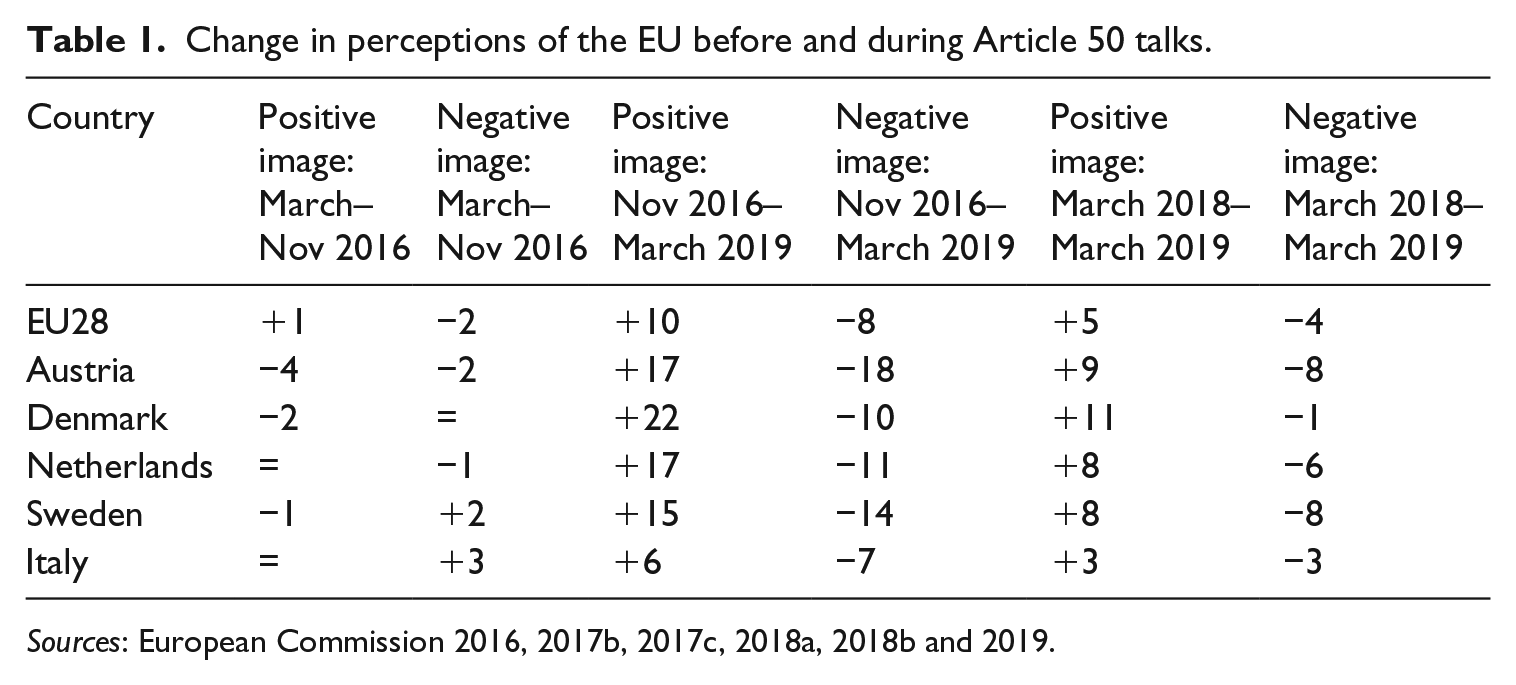
Eurobarometer polling asks citizens whether they hold a positive or negative image of the EU—an attitudinal question constituting a suitable proxy for judging satisfaction with EU membership. According to their biannual polling (Eurobarometers 86–91), in the period from November 2016 to March 2019 there was a rise in those holding a positive opinion of the EU of 17 percentage points in Austria, 22 in Denmark, 17 in the Netherlands and 15 in Sweden; negative perceptions fell by 18, 10, 11 and 14 points respectively. By comparison, the overall change across the EU28 in this period was an increase of 10 percentage points in citizens’ positive attitudes and an 8-point decline in negative ones, as shown in Table 1. Thus, all four countries earmarked as candidates for EU exit by Farage exhibited a steeper decline in negative attitudes than the EU average and a far higher than average increase in positive attitudes. What is also important to note is the way the referendum result itself did not prompt a re-evaluation of the value of EU membership. Public opinion before and after the June 2016 vote was stable. Big changes came only after the UK set out its negotiating red lines, with large changes coming between March 2018 (Eurobarometer 89) and March 2019 (Eurobarometer 91), when EU–UK negotiations became bogged down and the likelihood of a no-deal exit came closer to reality. By contrast, Italian public opinion—where benchmarks regarding the strength of the economy and governance are low—registered a lower than EU average change in attitudes, including over the period when no-deal signalling was ratcheted up.
Change in perceptions of the EU before and during Article 50 talks.
Conclusion: the prospects of future disintegration
The illusion of getting a better deal outside the EU than as a member state—that is, the populist aspiration of equal benefits with fewer constraints, such as the free movement of people—was most believable in the absence of any formal exit talks ever having taken place. The self-confidence of the UK elites who promoted Brexit, in line with the suggestion of benchmarking theory that a positive evaluation of the domestic economy and governance are related to support for an alternative to EU membership, was linked to confidence in getting a better ‘deal’ as a third country. The Article 50 talks were the crucial test of this hubris. As such, they were conducted on the basis of incomplete information, in that neither side could be certain as to how far the other would budge.
The UK approach was to use time and the prospect of an unwanted disorderly exit to try to extract concessions. For its part, the EU never sought to proffer a compromise that might weaken the integrity of its legal order—something it has an overriding institutional incentive to avoid. These moves resulted in dragging out and embittering the talks, leading both sides to publicly prepare for a no-deal outcome. In doing so, the negotiations showcased to the general public the inherent difficulties of accepting the trade-offs that come from leaving the EU. Much larger than average swings in public opinion took place in countries where confidence in the strength of the domestic economy and governance had hitherto made the possibility of life outside the EU more attractive.
Risk aversion—now that the reality of the trade-offs stemming from EU withdrawal are clear—thus explains the lack of a Brexit domino effect. However, the volatility of public opinion before and after the Article 50 talks, combined with the weaker increase in support throughout the EU as a whole, means that there is no room for complacency over the future prospects of disintegration. If the EU is saddled with the blame for a no-deal outcome there could be a sudden reversal in attitudes, especially as positive evaluations of the EU might have reached a high point. Equally, it is vital that policymakers pay more attention to countries such as Italy, where the status quo is increasingly being called into question and where the electorate has been much less struck by the Brexit talks. The fate of EU unity no longer depends on dispelling the idea that withdrawal can lead to a better deal. The great risk now is that ‘exit scepticism’ (de Vries 2018a, 78) becomes a strategy of desperation, not self-confidence, with populist parties embracing it as the last option to avert national decline. Relying on Brexit as an antidote to anti-EU sentiment will not prove sufficient; the threat of further disintegration can only be dissipated by creating positive reasons for supporting EU membership amongst populations exposed to the greatest economic and social challenges.
Footnotes
Author biography