




Abstract
There is no alternative to the megaproject we call the ‘European Union’. But it could be brought much closer to the citizens of Europe by putting the principles of subsidiarity into effect in more practical ways. This requires greater involvement by national, regional and local stakeholders. Subsidiarity means less Europe where EU-level action would not add value, but more Europe where we need Europe-wide efforts. The new Austrian government wants to shape the EU in accordance with the principle of subsidiarity. What can be done? How can national, regional and local authorities play a greater role in the legislative process? It would help if the member states could be given more time to examine whether new proposals for EU legislation conform to the principle of subsidiarity. This would mean extending the eight-week period that is currently allotted for carrying out these examinations. Directives should be preferred over regulations, and the use of delegated acts should be restricted. A ‘Green Card’ procedure could expand the political dialogue aimed at initiating new EU legislation. And efforts to improve EU legislation linked to subsidiarity should focus on reducing overregulation and bridging the gap between the ideal and the real.
Introduction
The principle of subsidiarity holds that decisions should be taken at the most immediate or local level possible and thus as close to the citizens as possible. It is one of the core organising principles of the EU and can be considered from political, legal and administrative perspectives. Politically, subsidiarity relates to a wide variety of situations. In some cases, member states make demands of supranational authorities; in others they voice reservations about EU-level entities. Member states point out that it would be better to have more extensive EU policies in some areas and less extensive policies in others. Legally, the subsidiarity principle, as laid down in Article 5(3) of the Treaty on European Union (TEU), determines whether action should be taken at the European level or at state level, thus helping to settle disputes concerning the division of competences. The procedures for monitoring compliance with subsidiarity are set out in Protocol 2 to the TEU on the application of subsidiarity and proportionality. This protocol puts national parliaments at the forefront. In terms of administrative adaptations, the European Commission and national parliaments have invested in procedures aimed at the more consistent application of certain regulatory principles to political decisions. This article gives an overview of the subsidiarity scrutiny process, the work of the Task Force on Subsidiarity and Proportionality, and Austria’s proposals. Finally, it discusses how the debate on this area is likely to go in the future.
Shaping and applying subsidiarity
The principle of subsidiarity acquired legal status in the EU when it was incorporated into the 1992 Maastricht Treaty. Since then it has become one of the fundamental principles of the EU.
Under the subsidiarity principle, in areas which do not fall within its exclusive competence, the EU shall act only if and insofar as the objectives of the proposed action cannot be sufficiently achieved by the Member States, either at central level or at regional and local level, but can rather, by reason of the scale or effects of the proposed action, be better achieved at Union level. (Article 5(3) TEU)
This means that the question of who can better achieve an objective is only applicable in areas of shared competence. A distinction is made between (1) areas that fall under the exclusive competence of the EU (e.g. trade policy and customs union policy); (2) areas shared by the member states and the EU (e.g. environmental control, consumer protection and social policy); and (3) areas which remain within the exclusive competence of the member states (e.g. significant areas of healthcare policy and defence).
Since the Lisbon Treaty entered into force in December 2009, the subsidiarity principle has been standardised in Article 5(3) and Protocols 1 and 2 of the TEU. Protocol 1 focuses on the role of national parliaments in the EU, while Protocol 2 deals with the application of the principles of subsidiarity and proportionality. The Lisbon Treaty has strengthened the subsidiarity principle by closely integrating national parliaments in EU-level legislative processes. It has done this, more specifically, by requiring the EU to provide information about European legislation to the national parliaments and through the ‘early-warning mechanism’.
According to Protocol 2 to the TEU, Article 4, the Commission must forward its draft legislative acts immediately to national parliaments. Once a legislative proposal is available in all official EU languages, an eight-week period starts for national parliaments to study the proposal. If they conclude that the proposal does not comply with the subsidiarity principle—that is, that EU-level legislation would not add value in the case in question and that the proposal should therefore be withdrawn—they have until the end of this period to submit a reasoned opinion on the issue (a ‘subsidiarity complaint’). Each national parliament has two votes, distributed on the basis of the kind of parliamentary system involved. In countries with a bicameral parliamentary system (as is the case in Austria), each of the two chambers has one vote. Depending upon the number of votes cast, there are two further processes.
First, if within the period of eight weeks at least one-third of all the votes allocated to the national parliaments have been cast against the proposal (or one-quarter in the case of draft legislative acts submitted in the area of freedom, security and justice), a ‘Yellow Card’ is triggered. In such a case the Commission must review its proposal, but it is under no obligation to modify or withdraw it. Reasons must be given for any decision on further procedures (Protocol 2, art. 7(2)).
Second, when reasoned opinions represent a majority of the votes and the draft act falls under the ordinary legislative procedure (i.e. the EU’s standard procedure for decision-making), the Commission must review its proposal and decide whether to maintain, change or withdraw it. If the Commission decides to retain its proposal, it must justify its decision: it must show that the proposal complies with the principle of subsidiarity. This is known as the ‘Orange Card’ procedure. If a simple majority of members of the European Parliament, or 55% of Council members, find that the proposal breaches the principle of subsidiarity, the proposal will not be given further consideration.
Thus far there have been three Yellow Cards (Auel and Neuhold 2018). The first one was issued in 2012 and pertained to a proposal for a Regulation on the exercise of the right to take collective action within the context of the freedom of establishment and the freedom to provide services, the Monti-II-Regulation. The second was triggered in 2013 and concerned a proposal to establish a European Public Prosecutor’s Office. The third was issued in 2016 and concerned a proposal to amend the directive on the cross-border posting of workers. In the first case, the European Commission withdrew its proposal. In the other two, it retained its proposals. The Austrian Federal Council ranks among the most active players in the subsidiarity scrutiny process (see Figure 1).
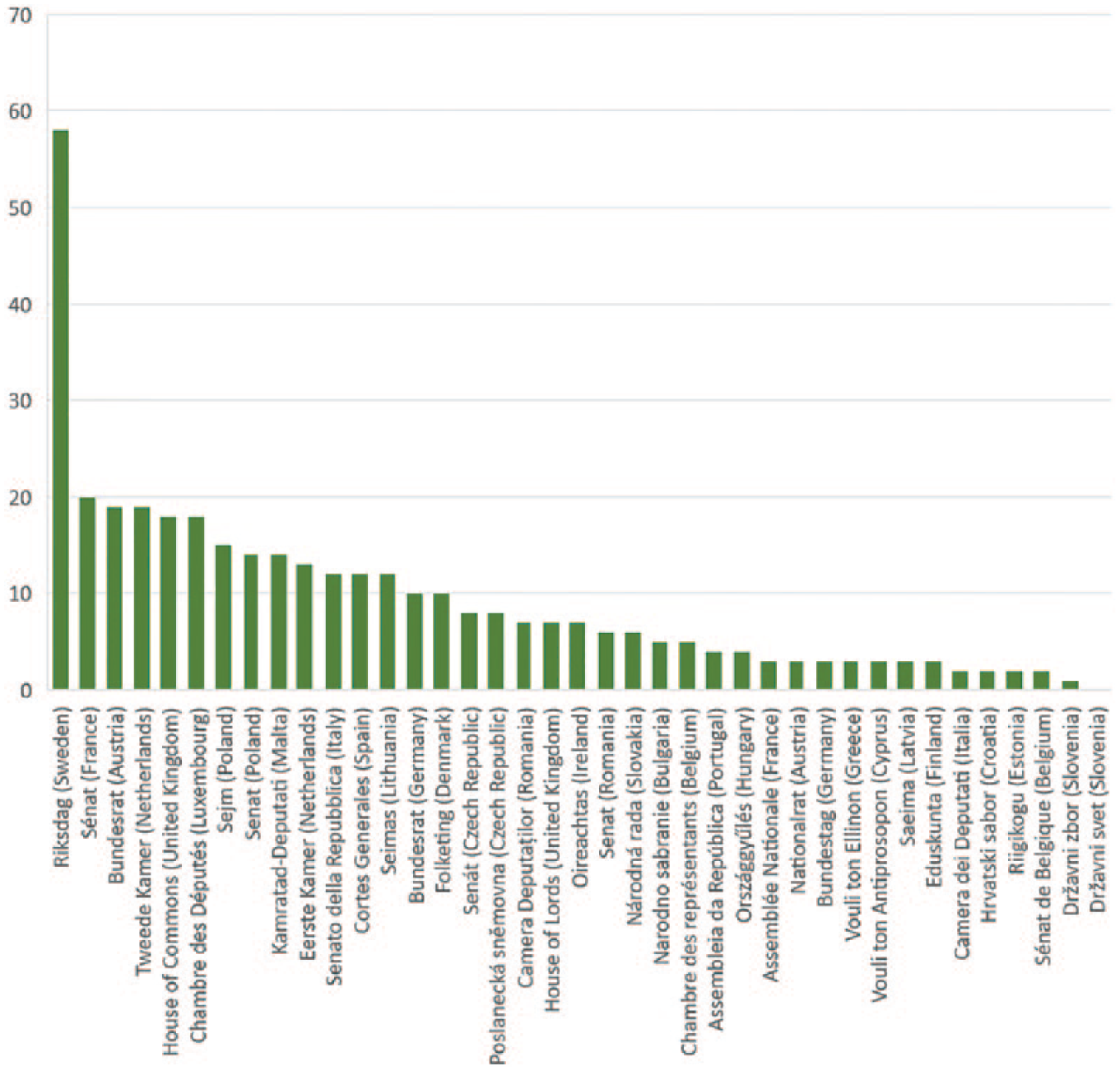
Number of reasoned opinions (early warning system) by chamber (2010–16).
Protocol 30 to the 1997 Amsterdam Treaty on the application of the principles of subsidiarity and proportionality, which ceased to be in force with the Lisbon Treaty, did not provide the national parliaments with scrutinising rights. However, it contained substantive criteria for deciding when a legislative proposal is compatible with the subsidiarity principle. Protocol 30 contained several guidelines that had to be complied with when scrutinising whether the conditions imposed by the subsidiarity principle had been fulfilled. According to Article 5 of this protocol, for Community action to be justified, it needed to be clear that ‘the objectives of the proposed action cannot be sufficiently achieved by Member States’ action in the framework of their national constitutional system and can, therefore, be better achieved by action on the part of the Community.’
To examine whether a specific legislative proposal fulfils the above-mentioned condition, Article 5 of the protocol set forth the following three guidelines:
‘-the issue under consideration has transnational aspects which cannot be satisfactorily regulated by action by Member States;
- actions by Member States alone or lack of Community action would conflict with the requirements of the Treaty (such as the need to correct distortion of competition or avoid disguised restrictions on trade or strengthen economic and social cohesion) or would otherwise significantly damage Member States’ interests;
- action at Community level would produce clear benefits by reason of its scale or effects compared with action at the level of the Member States.’
Furthermore, the Commission was obligated, except in cases of particular urgency or confidentiality, to consult widely before proposing legislation and, wherever appropriate, to publish consultation documents. The Commission also had to ‘take duly into account the need for any burden, whether financial or administrative, falling upon the Community, national governments, local authorities, economic operators and citizens, to be minimised and proportionate to the objective to be achieved’ (Protocol 30, art. 9). An equally clear legal basis for subsidiarity is not found in the Lisbon Treaty.
Better EU governance
In the last years several member states have voiced their wish for better EU governance and have looked into ways to reduce bureaucracy. At EU level, corresponding efforts have been made inter alia with the report Cutting Red Tape in Europe (High Level Group on Administrative Burdens 2018) and its attempt, which has met with mixed success, to roll back the EU’s competences and to reduce the administrative burden. In any case, the overall objective of better regulation is regarded as central, whether it is achieved through subsidiarity, proportionality, the choice of the least disruptive instrument, reducing the administrative burden or raising the quality of output. Subsidiarity is a tool for making EU policies more focused and thus more effective.
Member states routinely express support for the REFIT (Regulatory Fitness and Performance) programmes set up by the Commission to revisit periodically the stock of regulations, to ensure that, inter alia, these comply with the principles of subsidiarity and proportionality. Programmes aimed at reducing the administrative burden have been conducted under different names over the past 25 years.
The work of the Task Force on Subsidiarity and Proportionality
In November 2017 Jean-Claude Juncker, the President of the European Commission, established the Task Force on Subsidiarity, Proportionality and Doing Less More Efficiently. It consisted of nine members: three from national parliaments, three from the Committee of the Regions and three from the European Parliament. The Committee was chaired by Frans Timmermans, the First Vice-President of the European Commission. Austria was represented by the author of this article, who is also Chairman of the Austrian parliament’s Permanent Subcommittee on European Affairs. The Task Force finished its work in July 2018.
The Austrian parliament and the country’s federal provinces are strongly committed to the principles of subsidiarity and proportionality. On the parliamentary level, a specific constitutional mechanism provides for the involvement of various stakeholders. The Federal Council is required to inform the regional parliaments without delay about new legislative proposals by the EU. This gives them an opportunity to voice their opinions. Subsidiarity is also a key priority of the Austrian Federal Government. It explicitly supports further development of the EU in accordance with the guideline ‘doing less more efficiently’ and has included this position in its government programme.
Policy areas have also been identified where more competences must be transferred to the European level: the protection of external borders, defence and digitalisation. As already mentioned, subsidiarity means not only less Europe in areas where European-level action does not add value, but also more Europe in areas where we need joint Europe-wide efforts to tackle common challenges. This side of the principle of subsidiarity is often forgotten.
On the basis of its experience in these matters, Austria has contributed more proposals than any other member state on the better application of the principles of subsidiarity and proportionality The aim is to improve the involvement of regional and local levels and to identify policy areas where competences could be partially reassigned to the member states (e.g. cohesion policy, soil and nature protection). The following Austrian proposals have one goal: to avoid overregulation and to promote greater and better involvement by national and regional parliaments.
Excerpts from specific Austrian proposals 1
Extending the deadline for scrutinising subsidiarity
The eight-week period for submitting reasoned opinions set forth in Protocol 2 is considered too short by experts and Members of Parliament. It does not allow sufficient opportunity for regional or national parliaments to scrutinise proposals and coordinate opinions. As an alternative to amending this protocol, the Commission could agree to deal with opinions that arrive 12 weeks after proposals are presented. Additionally (or alternatively) the Commission could extend the deadline once a specific number of national opinions have been received.
Giving directives precedence over regulations
To avoid overregulation and to create the best possible basis for complying with the principles of subsidiarity and proportionality, the fundamental precedence of directives over regulations should be enshrined in the treaties.
The protocol to the Treaty of Amsterdam on the application of the principles of subsidiarity and proportionality includes the obligation to choose the form of Community action which least interferes with national law. This obligation is omitted in Protocol 2 to the Lisbon Treaty. Instead, this treaty quite clearly defines which form—that is, either directive or regulation—any legal act must assume. To comply with the principles of proportionality and subsidiarity, in those areas where the European legislator has freedom of choice as to the form Community action can take, directives should be preferred over regulations.
In 2000 we had 16 regulations and 34 directives. In 2017 there were 52 regulations and only 14 directives (Eur-Lex 2019a). These developments could threaten the principle of subsidiarity.
Green Card
A ‘Green Card’ procedure should be introduced that would make it possible to extend the political dialogue without amending the Treaty, that is, solely on the basis of a political agreement. In this context, a parliament should be able to make legally non-binding proposals for both new EU legislation and amendments to existing legislation. Although this is possible even today, national parliaments currently contact EU institutions only on an individual basis. In the future all national parliaments should have the opportunity to voice their support for a proposal submitted by a single national parliament. Each parliament should have two votes. Where a quarter of the votes have been cast in favour of a given proposal, the initiative should be given a Green Card status, and a joint letter from all the supporting parliaments should be sent to the European Commission.
So far there have been four such initiatives by national parliaments. The European Commission has included only one of these in its legislation. This was the Food Waste initiative (proposed by the UK House of Lords), which was included in the Circular Economy Package—and even here, this was done without a clear reference to the initiative.
Restricted use of delegated and implementing legal acts
The growing number of ‘delegated acts’ is an example of the erosion of the competence to scrutinise subsidiarity to the disadvantage of member states and their regions. Delegated acts are based on fundamental legislation enacted by the Council and the European Parliament, and concede legislative powers to the Commission. The member states have very limited opportunity to participate in these decisions, and these acts are not subject to subsidiarity scrutiny by national parliaments. A large number of the EU’s legal acts require delegated regulations, and a large number of competences are delegated to the Commission. The number of delegated legal acts increased from 38 in 2012 and 56 in 2013 to 133 in 2017—in 2018 there were 87 such acts (Eur-Lex 2019b). It is crucial that the use of these acts should be restricted.
Implementing legal acts can be used where uniform conditions for implementing legally binding Union acts are needed (Article 291 TFEU). In these cases, the relevant basic legal acts can confer implementing powers on the Commission. The power to adopt such implementing legal acts grants comprehensive rights to the Commission, and these acts should therefore be used sparingly. To give one such example, it is through implementing legal acts based on the EURES Regulation of 13 April 2016 (European Parliament and Council 2016) that the Commission has intervened in domestic labour markets—with far-reaching consequences. Moreover, a plethora of reporting obligations are being imposed upon member states (as a result of the adoption of the Performance Measurement System), without any matching added value. In the course of such efforts, the Commission has also sought to expand its data protection competence to the detriment of the member states—but the rationale for doing this is not immediately clear.
Including a definition of subsidiarity in the Interinstitutional Agreement on Better Law-Making
As an alternative to amending Protocol 2, a clear definition of subsidiarity and proportionality could be included in the Interinstitutional Agreement on Better Law-Making. This could be done by inserting the text of Protocol 30 to the 1997 Treaty of Amsterdam on the application of the principles of subsidiarity and proportionality.
Adopting a ‘Subsidiarity Pact’
The Interinstitutional Agreement needs to be complemented by a provision dealing with a subsidiarity pact between the three legislative bodies. This pact needs to ensure that the Commission restricts its proposals to those which have been previously agreed upon in the European Commission’s working programme. Furthermore, in the future the Commission needs to refrain from publishing non-binding recommendations and communications on specific subject matters, if no appropriate legal basis exists.
Final report by the Task Force on Subsidiarity and Proportionality
Some of Austria’s proposals were seen as too far-reaching and were therefore not included in the final report (Task Force on Subsidiarity, Proportionality and Doing Less More Efficiently 2018). Others, however, found wide support among the members of the task force.
The following items that Austria introduced were included in the final report:
The deadline for scrutinising subsidiarity by national parliaments should be extended from 8 to 12 weeks. The necessary treaty amendments should be adopted at the first opportunity for treaty revision. In addition, the Commission should be flexible when applying the eight-week deadline. The Commission should improve the way it deals with reasoned opinions submitted by national and regional parliaments. (Recommendations 2 and 3)
The involvement and visibility of regional and local authorities should be increased by improving impact assessment, consultations and Union legislation. (Recommendations 4 and 5)
Problematic areas linked to subsidiarity and proportionality should be identified. In its conclusions, the task force did not agree to Austria’s proposals on this issue, including those dealing with cohesion policies and the protection of the soil and nature. However, the Commission will develop a mechanism to identify and evaluate legislation from the perspective of subsidiarity and proportionality. (Recommendation 8)
The Council, Parliament and Commission should make sparing use of delegated and implementing acts, which do not fall under the scrutiny of subsidiarity by national parliaments. (Recommendation 9)
In specific policy areas, the effective implementation of existing regulations should take precedence over the creation of new regulations. (Recommendation 9)
The following items that Austria introduced were not included in the final report:
In the proceedings of national parliaments to scrutinise subsidiarity, the threshold required for a Yellow Card should be reduced from one-third to one-fourth, and that for an Orange Card from a simple majority to one-third.
A ‘Late Card’ procedure should be established which would grant the national parliaments the right to scrutinise draft legal acts a second time at the end of negotiations between the Commission, the European Parliament and the Council.
A Green Card procedure should be introduced that would allow national parliaments to extend the political dialogue aimed at initiating new EU legislation or amending existing legislation.
Directives should take precedence over regulations in order to give national and regional parliaments the chance to be involved in the legislation under discussion.
The ‘one in, one out’ principle should be made permanently effective. This means that the Commission should only be allowed to make a new proposal if a proposal to cancel an existing EU provision is made at the same time.
A subsidiarity pact should be adopted that would restrict the Commission’s activities to its working programme.
A legally binding definition of subsidiarity should be established.
Conclusion
The work of the task force has restarted the debate on subsidiarity. After the European election in May 2019, the new European Commission should continue to bridge the gap between the ideal and reality.
With the publication of the ‘Subsidiarity Package’ in October 2018, the Commission set out how the principles of subsidiarity and proportionality will guide its future work and how it can further strengthen their role in EU policymaking—especially through the ‘subsidiarity grid’ proposed by the task force and strongly supported by the Committee of the Regions. The Commission committed itself to making it easier for national parliaments to meet the deadlines for submitting their opinions on draft proposals. It said it would examine how to improve the collecting of and reporting on local and regional authorities’ views in its public consultations. It announced plans to reshape the REFIT Platform to increase the presence of local and regional authorities. The Commission also stated its intention to widen the scope of this platform, which currently focuses on the regulatory burden, to include subsidiarity and proportionality. This provides a proper basis for the new European Commission.
In its draft report The State of the Debate on the Future of Europe (European Parliament 2018, 10), the European Parliament ‘takes note of the report of the Task Force on Subsidiarity, Proportionality and Doing Less More Efficiently of July 2018, presenting recommendations on a new way of working.’ It does not, however, welcome this report. Hopefully the new Parliament will be more positive than the current one when it comes to the principle of subsidiarity.
Subsidiarity is also on the agenda of the Conference of Parliamentary Committees for Union Affairs of Parliaments of the European Union (COSAC), in which representatives of the member states and of EU-applicant countries have worked together on an interparliamentary level since 1989. The last plenary meeting of COSAC was held in Vienna in November 2018. The final conclusions emphasised that the involvement of national parliaments in policymaking and the legislative process at European level is of major importance for ensuring transparency, efficiency and public acceptance. For this reason, the conclusions go on to say, COSAC welcomes the steps being taken towards extending the eight-week deadline for the submission of reasoned opinions within the framework of the subsidiarity control mechanism. Finally, the conclusions reiterated COSAC’s approval of the Green Card mechanism as an extension of the political dialogue between the European Commission and the national parliaments (COSAC 2018).
Footnotes
Notes
Author biography