




Abstract
Introduction:
Treatment of rheumatoid arthritis (RA) has advanced with the introduction of biological disease-modifying antirheumatic drugs. However, more than 20% of patients with RA still have moderate or severe disease activity. Hence, novel antirheumatic drugs are required. Recently, drug repurposing, a process of identifying new indications for existing drugs, has received great attention. Furthermore, a few reports have shown that antipsychotics are capable of affecting several cytokines that are also modulated by existing antirheumatic drugs. Therefore, we investigated the association between antipsychotics and RA by data mining using real-world data and bioinformatics databases.
Methods:
Disproportionality and sequence symmetry analyses were employed to identify the associations between the investigational drugs and RA using the US Food and Drug Administration Adverse Event Reporting System (2004–2016) and JMDC administrative claims database (January 2005–April 2017; JMDC Inc., Tokyo, Japan), respectively. The reporting odds ratio (ROR) and information component (IC) were used in the disproportionality analysis to indicate a signal. The adjusted sequence ratio (SR) was used in the sequence symmetry analysis to indicate a signal. The bioinformatics analysis suite, BaseSpace Correlation Engine (Illumina, CA, USA) was employed to explore the molecular mechanisms associated with the potential candidates identified by the drug-repurposing approach.
Results:
A potential inverse association between the antipsychotic haloperidol and RA, which exhibited significant inverse signals with ROR, IC, and adjusted SR, was found. Furthermore, the results suggested that haloperidol may exert antirheumatic effects by modulating various signaling pathways, including cytokine and chemokine signaling, major histocompatibility complex class-II antigen presentation, and Toll-like receptor cascade pathways.
Conclusion:
Our drug-repurposing approach using data mining techniques identified haloperidol as a potential antirheumatic drug candidate.
Keywords
Introduction
The treatment of rheumatoid arthritis (RA) has advanced with the introduction of biological disease-modifying antirheumatic drugs (DMARDs), which result in approximately 55% clinical remission. However, more than 20% of patients with RA still suffer from moderate or high disease activity, 1 which indicates that conventional therapies are not effective. Hence, novel antirheumatic drugs should be identified.
Developing novel drugs is time consuming and costly. Though effective, the recently developed biological DMARDs are very expensive. Therefore, drug repurposing, an approach which attempts to identify novel indications for existing drugs, has received significant attention in recent times. In addition, drug repurposing has been actively studied in RA research. 2 In the case of RA, immune system–related processes, such as activation of T-cells and cytokines are the main focus of current research and are also known to be targeted by the antirheumatic drugs.3–5 Hence, existing drugs that act on T-cells and cytokines may be considered as antirheumatic drug candidates. A few reports have shown that antipsychotics exert an effect on cytokines, such as interferons and interleukins.6,7 Therefore, in this study, we focused on the effects of antipsychotics on RA.
Recently, several big data have been used for drug repurposing. Such an approach can identify better drug candidates at a lower cost and in a shorter period of time than the conventional experimental methods. Big data, such as real-world data in clinical settings and bioinformatics, such as omics data are available for drug repurposing-based research. Spontaneous adverse event reporting systems and administrative claim databases include real-world data. The signals obtained from data mining methods, such as disproportionality analysis (DPA) and sequence symmetry analysis (SSA), using these real-world data are evaluated as markers, which indicate the potential association between a specific drug and an outcome of interests, and have been used in pharmacovigilance research. 8 Conversely, inverse signals obtained using real-world data have generally been considered insignificant. However, several reports have noted that inverse signals between a target drug and an adverse drug reaction suggest potential alternative therapeutic opportunities; therefore, these inverse associations have been evaluated for drug-repurposing approaches.9,10 Furthermore, bioinformatics databases have been used for exploring novel molecular mechanisms and for the identification of new drugs.11,12 The bioinformatics data analysis software suite, BaseSpace Correlation Engine (BSCE) has been used to analyze large transcriptomic data sets, 13 as well as to study the effects of diseases and/or drugs based on publicly available gene expression data. 14 In addition, the usefulness of an integrative approach using both real-world data and bioinformatics databases has been reported.15,16 In this study, we employed an integrative approach to investigate the relationship between antipsychotics and RA using multiple databases.
Methods
Study design
We performed data mining using Big Data. The workflow of this study is summarized in Figure 1. First, data mining of the spontaneous adverse event reporting system and administrative claims database was performed to identify an inverse association between the investigational existing drugs and the diagnosis of RA. DPA was conducted using the spontaneous adverse event reporting system with the reporting odds ratio (ROR) and information component (IC) being used to indicate a signal. Furthermore, an SSA of self-controlled study designs using the administrative claims database was conducted with the adjusted sequence ratio (SR) being used to indicate a signal. Drugs showing significant inverse signals were identified in both the DPA and SSA. Next, the pattern of differential gene expression induced by each target drug was analyzed, and the pathway signatures based on that pattern were determined using BSCE software suite. We investigated the pathway signatures of the target drugs that showed a significant inverse association with RA. Finally, we explored their novel molecular mechanisms using pathway databases, such as Reactome, Kyoto Encyclopedia of Genes and Genomes (KEGG), and ComPath. Data management and analysis were performed using Visual Mining Studio software (version 8.3; NTT DATA Mathematical Systems Inc., Tokyo, Japan).
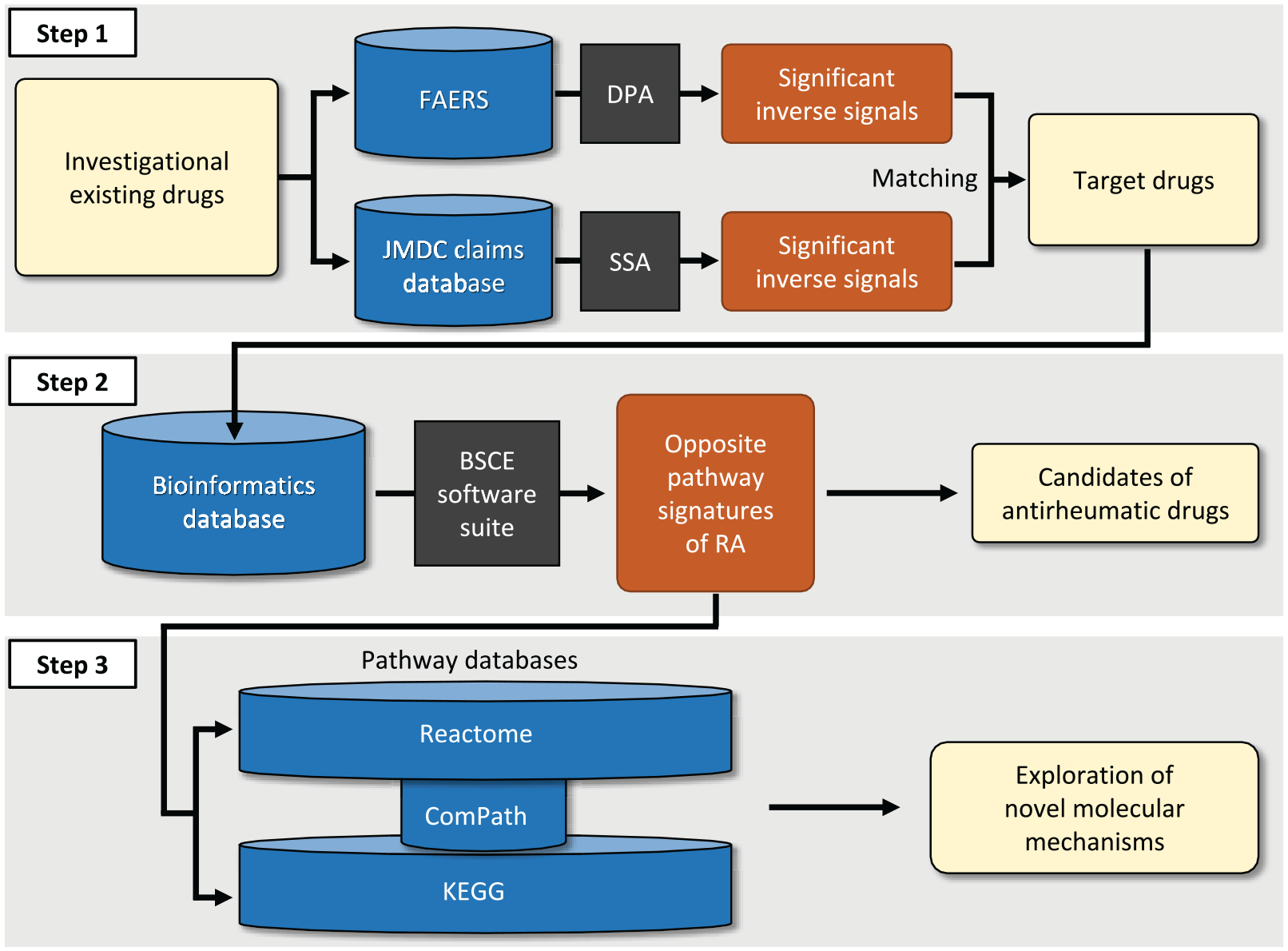
Workflow of the integrative approach. Step 1: investigational existing drugs were screened by DPA and SSA using real-world data to identify target drugs. Step 2: bioinformatics analysis using BSCE was performed to identify candidate antirheumatic drugs having signatures (up- or down-regulated biogroups associated with canonical pathways) that were negatively correlated with RA signatures. Step 3: based on the results of BSCE analysis, molecular mechanisms of candidate drugs were explored using enriched pathway signatures.
Investigational existing drugs
Antipsychotics with data sets in BSCE (chlorpromazine, fluphenazine, haloperidol, olanzapine, quetiapine, and sulpiride) were defined as investigational existing drugs. Anxiolytics having data sets in BSCE (alprazolam, diazepam, and hydroxyzine) were defined as negative comparators, and two of the existing antirheumatic drugs, methotrexate and tocilizumab, were used as active comparators to rule out any possible non-causal interpretations of our results.
Analysis of the US Food and Drug Administration Adverse Event Reporting System (FAERS) database
The FAERS database was accessed through the US Food and Drug Administration’s website (http://www.fda.gov/Drugs/GuidanceComplianceRegulatoryInformation/Surveillance/AdverseDrugEffects/). This study included data from the first quarter of 2004 through the end of 2016. A total of 7,343,647 drug-reaction pairs were obtained. Preferred terms (PTs) from the Medical Dictionary for Regulatory Activities (MedDRA®, version 20.1) were used to classify the adverse events. The FAERS database allows the registration of arbitrary drug names including trade and generic names and abbreviations. Therefore, an archive of the drug names including the names of all preparations, generic names, and synonyms of the drugs marketed worldwide was created using Martindale (https://www.medicinescomplete.com/mc/login.htm). We identified each investigational drug by linking the created archive to the FAERS database. All the records that included investigational drugs in the DRUG files were selected, and relevant reactions were then identified from the REACTION files. Adverse events in the FAERS database were coded using MedDRA PTs. The PTs associated with RA (10039073: Rheumatoid arthritis, 10039081: Rheumatoid lung, 10048628: Rheumatoid vasculitis, 10048694: Rheumatoid nodule, and 10067427: Rheumatoid scleritis) were defined as previously reported. 17
DPA-based methods, such as ROR and IC, were used to evaluate the association between investigational drugs and RA. ROR and IC with a 95% two-sided confidence interval (CI) were calculated according to the methods described previously. 18 Briefly, the signal scores were calculated using a case/non-case method. The reports containing the event of interest were defined as cases, whereas, all the other reports were considered as non-cases. Using a two-by-two table of frequency counts, we calculated the signal scores to assess an inverse association between the investigational drugs and RA. For ROR and IC, a statistically significant inverse signal was defined if the upper limit of the 95% CI was <1 and <0, respectively.
Analysis of JMDC administrative claims database
The JMDC administrative claims database is a large and chronologically organized Japanese claims database (JMDC Inc., Tokyo, Japan) that uses standardized disease classification and anonymous record linkage. 19 In total, this database (January 2005–April 2017) includes approximately 4.1 million insured persons in Japan (approximately 3.2% of the population), which mainly comprises company employees and their family members. In addition, the JMDC database provides information on the beneficiaries, including encrypted personal identifiers, age, sex, International Statistical Classification of Diseases and Related Health Problems, 10th Revision (ICD-10) codes, as well as the names of the prescribed and/or dispensed drugs. Furthermore, all the drugs were coded according to the Anatomical Therapeutic Chemical (ATC) classification of both the European Pharmaceutical Market Research Association and World Health Organization. An encrypted personal identifier was used to link the claims data from various hospitals, clinics, and pharmacies.
SSA was performed to evaluate the association between investigational drugs and RA diagnosis, and adjusted SRs were calculated as previously reported. 20 Briefly, SSA evaluates asymmetry in the distribution of an event before and after the initiation of a specific treatment. Asymmetry may indicate an association between a specific treatment of interest and the event. The crude SR is defined as the ratio of the number of newly diagnosed patients with RA after the initiation of investigational drugs relative to the number of patients before initiation. In addition, the SRs were adjusted for temporal trends in investigational drugs and events. The probability that investigational drugs were prescribed first in the absence of any causal relationship, can be estimated by a so-called null-effect SR. The null-effect SR generated by the proposed model may be interpreted as a reference value for the SR. Therefore, the null-effect SR is the expected SR in the absence of any causal association after accounting for incidence trends. Furthermore, by dividing the crude SR by the null-effect SR, an adjusted SR corrected for temporal trends can be obtained.
All users of investigational drugs and all diagnosed RA cases were identified from January 2005 to April 2017. Target RA diagnosis was defined as M05 and M06 based on ICD-10 codes. Incidence was defined as the first prescription of investigational drugs. To exclude the prevalent users of investigational drugs, the analysis was restricted to users whose first prescription was administered in July 2005 or later (after a run-in period of 6 months). Likewise, the analysis was restricted to cases whose first RA diagnosis was in July 2005 or later. Waiting time distribution analysis was performed to ensure that the analysis was restricted to incident users of investigational drugs and newly diagnosed cases of RA. 21 An identical run-in period was also applied to patients enrolled in the cohort after June 2005. Furthermore, we identified patients who were initiated on a new treatment of investigational drugs and had their first diagnosis of RA within a period of 12-, 24-, or 36-month (intervals) before or after treatment initiation. Patients who had received their first investigational drug prescription and had their first RA diagnosis in the same month were not included for the determination of SR. The 95% CI for the adjusted SR was calculated using a method for determining the exact CIs for binomial distributions. 22 A statistically significant inverse signal was defined if the upper limit of the 95% CI for the adjusted SR was <1.
Exploration of molecular mechanisms employing bioinformatics databases
The BSCE (Illumina, CA, USA) is a cloud-based solution to compare the molecular profiles from omics experiments with a large curated repository of open- and controlled-access publicly available gene expression data sets. 13 We searched BSCE with disease and target drug names to obtain differentially expressed gene sets (i.e. biosets) and investigated them in BSCE. The disease and target drug queries along with the details of biosets are shown in Supplementary Table 1. The biosets obtained were used for pathway enrichment analysis in BSCE. BSCE contains biogroups that are collections of genes associated with specific biological function, pathway, or similar properties. The resultant biogroups associated with canonical pathways were either up- or down-regulated and were prioritized based on a correlation score, which was generated by the tool based on the strength of overlap or enrichment. A numerical score of 100 was assigned to the most significant result, whereas, the scores of the others were normalized with respect to the top-ranked result. First, we selected the top-50 biogroups that were common and significantly up- or down-regulated across five RA biosets. Then, in these 50 biogroups, we identified biogroups that were significantly up- or down-regulated by target drugs. If a drug had signatures (up- or down-regulated biogroups) that were negatively correlated with those of RA, then the drug may be associated with molecular mechanisms of RA and could be a potential candidate for RA treatment. The rates of down-regulated biogroups of candidate drugs were compared using Fisher’s exact test with Bonferroni’s correction for multiple comparison. The up- and down-regulated biogroups were assigned positive and negative scores, respectively, and the sum of these scores (‘total score’) were compared between the RA and target drugs.
Correlation between the pathways of RA and that of target drugs using Reactome and KEGG pathway databases
The names of the biogroups associated with canonical pathways are defined by the Molecular Signature Database (MSigDB), 23 which refers to the pathway databases, such as Reactome24,25 and KEGG. 26 Reactome is a free, open-source, curated, and peer-reviewed pathway database, which provides tools for visualization, interpretation, and analysis of pathway information. The data structure in Reactome includes double-linked tree, where each node represents a pathway and contains links to its parent and child pathways. The KEGG pathway map is a molecular interaction/reaction network diagram, and these pathways are hierarchically classified (KEGG pathway classification). We used ComPath 27 to generate novel biological insights by identifying pathway modules, clusters, and cross-talks across these mappings. ComPath is an integrative and extendable web application for comparing pathway databases. It supports curation of pathway mappings between databases, such as Reactome and KEGG and fosters the exploration of pathway knowledge through several novel visualizations. There are other databases, such as BioCarta and Pathway Interaction Database (PID) in MSigDB. However, the pathways from these databases cannot be analyzed by ComPath; hence, the pathways contributed by these databases were excluded from further analysis. We selected pathways which were included in Reactome or KEGG from the top-50 biogroups associated with canonical pathways derived from RA biosets and visualized these selected pathways and related pathways using ComPath. Finally, we investigated how these pathways were regulated by target drugs.
Ethics statement
This study was approved by the Ethics Committees of the Kindai University School of Pharmacy, on April 15, 2017 (approval number, 17-107). Due to the anonymous nature of the data, the requirement for informed consent was waived. The report for this analysis was written in accordance with the reporting of studies conducted using observational routinely collected health data statement for pharmacoepidemiology. 28
Results
Association between antipsychotics and RA based on real-world data
A total of 33,316 RA cases were found in the FAERS database. The association between investigational drugs and RA based on FAERS database are shown in Table 1. Significant inverse signals in both ROR and IC were found for the antipsychotics chlorpromazine, fluphenazine, haloperidol, olanzapine, quetiapine, and sulpiride. The anxiolytics diazepam and hydroxyzine showed significant inverse signals in both ROR and IC; however, alprazolam did not show any significant inverse signal. Since antirheumatic drugs (tocilizumab and methotrexate) are generally used for RA treatment, the ROR and IC of these drugs were found to be >1.0 and >0, respectively.
Disproportionality analysis: the association between investigational drugs and rheumatoid arthritis based on FAERS.

FAERS, FDA Adverse Event Reporting System; CI, confidence interval; IC, information component; ROR, reporting odds ratio.
Cases, number of reports with rheumatoid arthritis; non-cases, all reports of adverse drug reactions other than rheumatoid arthritis.
statistically significant inverse signal.
The characteristics of the study population obtained from the JMDC claims database are summarized in Supplementary Table 2. The number of claims pertaining to RA during the study period was 758,464, from 121,798 patients with RA. Among these, 93,398 were newly diagnosed patients, out of which, the majority were females. Table 2 shows the associations between investigational drugs and RA. The antipsychotics chlorpromazine and haloperidol, the anxiolytic hydroxyzine, as well as the antirheumatic drugs showed significant inverse signals at all intervals. The antipsychotics, Fluphenazine, and quetiapine showed significant inverse signals at 24- and 36-month intervals, respectively, but not at other intervals. The anxiolytic, alprazolam did not show significant inverse signal at any interval. Thus, chlorpromazine, haloperidol, and hydroxyzine, which showed significant inverse signals in both DPA and SSA, were considered for further analysis.
Event sequence symmetry analysis: the associations between investigational drugs and rheumatoid arthritis.

CI, confidence interval; RA, rheumatoid arthritis; SR, sequence ratio.
All patients who initiated new treatment with investigational drugs and whose first diagnosis of RA was within 36-month period were identified. Incident users, number of patients who received their first prescription for investigational drugs. Cases with RA, number of patients diagnosed with RA among incident users.
statistically significant inverse signal.
Effect of target drugs on RA using BSCE analysis
Haloperidol, chlorpromazine, and hydroxyzine were used as target drugs in BSCE analysis. Antirheumatic drugs (tocilizumab and methotrexate) and an anxiolytic drug (alprazolam) were used for comparison. The pathway enrichment analysis identified 187 significantly up- or down-regulated RA biogroups, the top 50 of which are listed in Table 3. Most of the identified biogroups were associated with immune response–related pathways. Figure 2(a) and (b) shows the number and ‘total score’ of the top 50 significantly regulated biogroups, respectively. Supplementary Table 3 shows the p values of the results of multiple comparison for the rate of down-regulated biogroups among candidate drugs. All the top-50 biogroups were found to be up-regulated by RA biosets that were derived from Homo sapiens, with a ‘total score’ of 2637, whereas most of them were down-regulated by tocilizumab and MTX biosets that were derived from H. sapiens, with a ‘total score’ of −2390 and −1037, respectively. Furthermore, no biogroups were up-regulated by tocilizumab and MTX biosets. The number of biogroups down-regulated by MTX bioset derived from Rattus norvegicus was comparable to that derived from H. sapiens; however, the |‘total score’
Effects of target drugs on top 50 biogroups associated with canonical pathways of rheumatoid arthritis.

BCR, B-cell receptor; CTL, cytotoxic T cell; FCGR, Fc gamma receptor; KEGG, Kyoto Encyclopedia of Genes and Genomes; MHC, major histocompatibility complex; PD-1, programmed death-1; PID, Pathway Interaction Database; STKE, Signal Transduction Knowledge Environment; TCR, T cell receptor; TLR, toll-like receptor; ZAP-70, zeta-chain associated protein kinase-70; ―, not applicable.
Up- and down-pointing triangles indicate up- and down-regulated biogroups associated with canonical pathways, respectively.

Comparison between the top 50 significantly regulated biogroups associated with canonical pathways obtained by rheumatoid arthritis and target drug biosets: (a) the bars indicate the number of up- and down-regulated biogroups and (b) the bars indicate the ‘total score’ of the biogroups. Name in parentheses indicates the organism.
Exploring the mechanisms associated with target drugs using pathway databases
The identified pathways were mostly from the Reactome and KEGG databases. The associations between these pathways were visualized and analyzed using ComPath. The analysis indicated that immune system–related pathways, such as cytokine and chemokine signaling, adaptive immune system–related pathways, such as T-cell receptor signaling, CD28 and major histocompatibility complex (MHC)-mediated antigen processing, and innate immune system–related pathways, such as toll-like receptor (TLR) cascades were up-regulated by RA (Figure 3), whereas they were down-regulated by the tocilizumab bioset (Figure 4(a)). In other pathway databases, such as BioCarta and PID, signaling pathways, such as T-cell signal transduction and C-X-C chemokine receptor type-4 were up-regulated by RA, whereas they were down-regulated by the tocilizumab bioset (Table 3). Furthermore, haloperidol down-regulated several immune system–related pathways, such as cytokine and chemokine signaling, MHC class-II antigen presentation, and TLR signaling (Figure 4(b)). In addition, in the case of alprazolam, the number of up-regulated immune system–related pathways was higher than that of down-regulated pathways (Figure 4(c)).
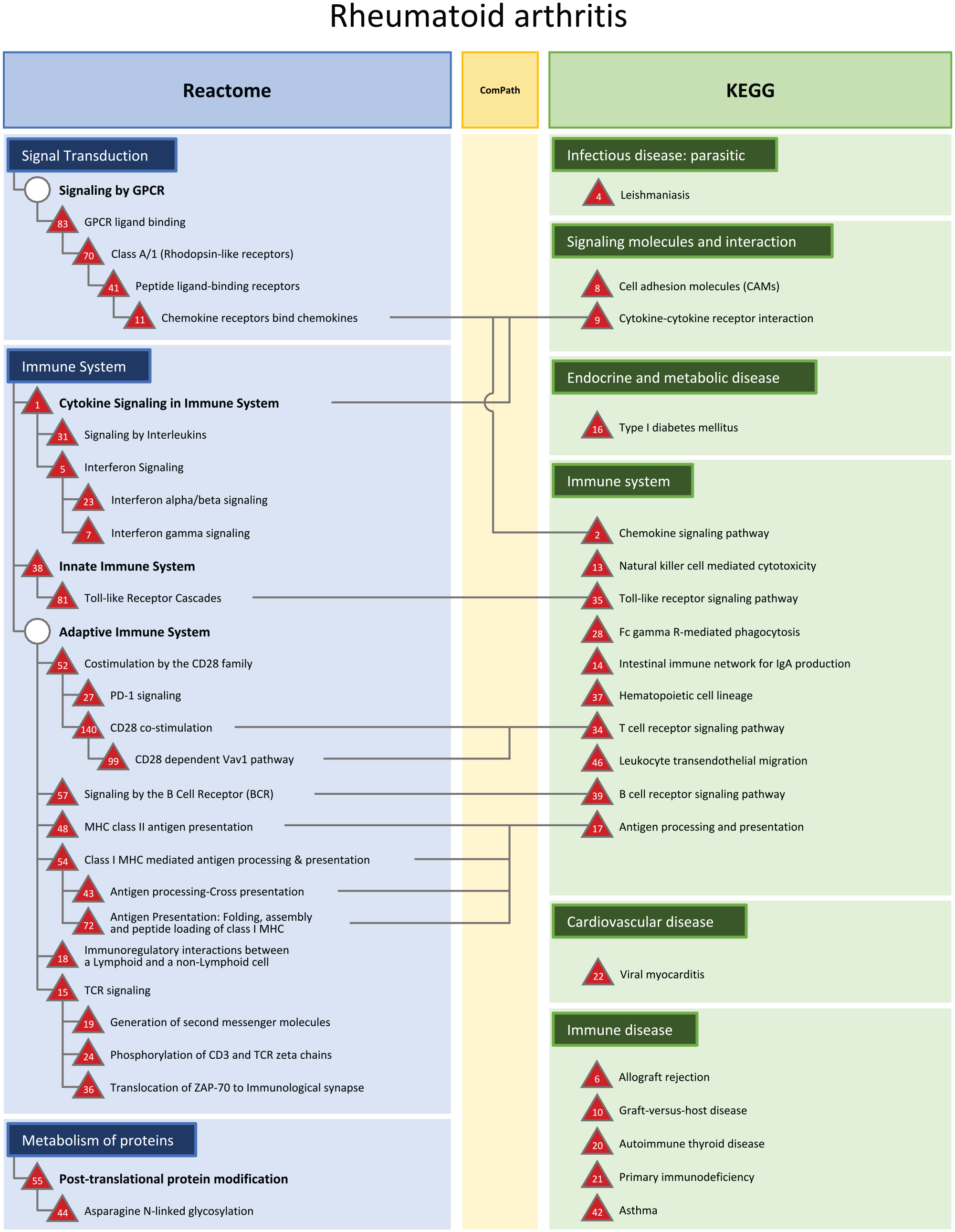
Rheumatoid arthritis–related pathway interaction networks based on Reactome and KEGG databases. KEGG pathways were connected to Reactome pathways by ComPath. Up-regulated pathways are indicated by up-pointing triangles, whereas, un-regulated pathways are indicated by circles. The numbers inside the triangles or circles indicate the rank based on the score of each biogroups associated with canonical pathways. KEGG, Kyoto Encyclopedia of Genes and Genomes.
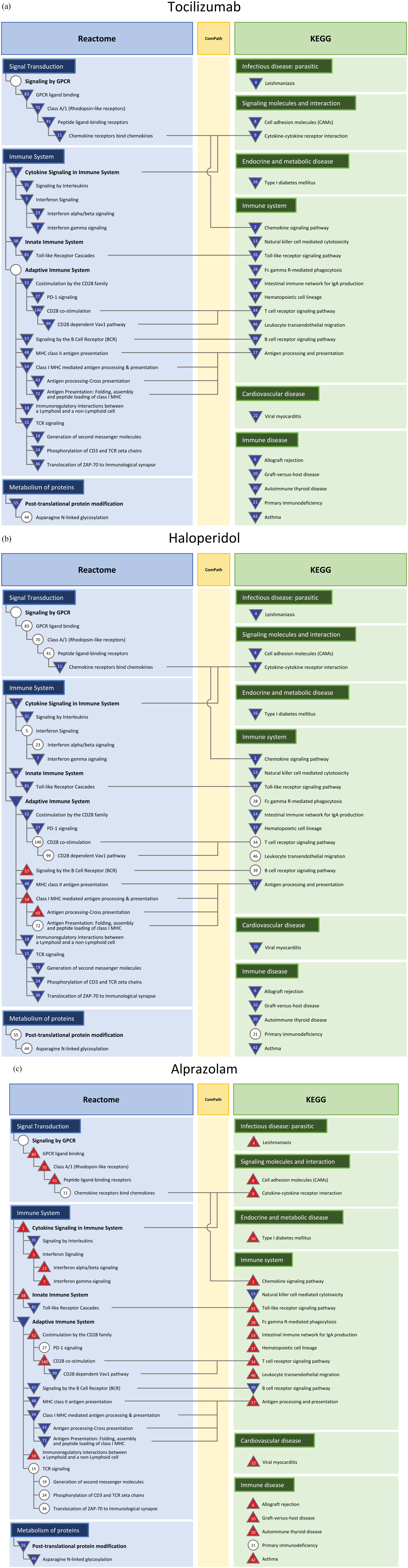
The direction of pathways regulated by (a) tocilizumab, (b) haloperidol, and (c) alprazolam in the rheumatoid arthritis–related pathway interaction networks. Up- and down-regulated pathways are indicated by up- and down-pointing triangles, respectively, whereas, un-regulated pathways are indicated by circles. The numbers inside the triangles or circles indicate the ranks based on the score of each biogroups associated with canonical pathways in rheumatoid arthritis biosets.
Discussion
In our study, using both real-world data and bioinformatics databases, potential inverse associations were found between haloperidol and RA. The results of DPA and SSA using real-world data suggested that the use of haloperidol may suppress the onset of RA. Furthermore, the results of BSCE analysis using bioinformatics databases suggested that haloperidol may exert antirheumatic effects by regulating various immune-related signaling pathways, such as cytokine and chemokine signaling, MHC antigen presentation, and TLR cascade pathways.
We first investigated the association between antipsychotics and RA by data mining using real-world data. Analysis of FAERS database revealed significant inverse signals for all investigated antipsychotics, which suggested a potential inverse association between antipsychotics and RA. Antipsychotics are mainly used to treat schizophrenia. Recently, it was reported that there is a lower incidence of RA in patients with schizophrenia, 29 at least partly due to genetic factors. 30 Therefore, the inverse signals might be due to schizophrenia and not antipsychotics. Furthermore, SSA using the JMDC claims database consistently showed significant inverse signals across all the tested intervals only with chlorpromazine and haloperidol. SSA is based on within-subject comparison, and allows the patient to serve as his or her own comparator. Thus, confounding factors from time-independent covariates (e.g. genetic factor) could be eliminated. 20 The result of the SSA raised two hypotheses: (1) the number of patients diagnosed with RA after the first indication of antipsychotics decreased and (2) the number of patients with the first indication of antipsychotics after RA diagnosis increased. By comprehensively judging the results of both the SSA and DPA, Hypothesis 2 was rejected and Hypothesis 1 was adopted. Hence, we considered chlorpromazine and haloperidol as candidates for further analysis. DPA showed significant inverse signals for anxiolytics (negative comparator), diazepam, and hydroxyzine. However, diazepam was not considered further as it had no significant inverse signal in SSA, whereas hydroxyzine was considered for further analysis as it showed significant inverse signals in SSA as well. It is unclear why hydroxyzine showed significant inverse signals in both DPA and SSA. However, hydroxyzine has been shown to be a drug-repurposing candidate for the treatment of inflammatory bowel disease, which indicates that it may be effective in treating autoimmune diseases. 15 Alprazolam, having no significant inverse signals in both DPA and SSA was used as a negative control in the current analysis.
Pathway enrichment analysis using BSCE showed that RA biosets were associated with up-regulated biogroups related to immune response including innate immunity, adaptive immunity, and cytokine signaling. Thus, drugs showing these biogroups as down-regulated with high negative scores would be ideal candidates for RA treatment. In fact, tocilizumab down-regulated 49 of the top-50 biogroups (with a ‘total score’ of −2390) that were up-regulated by RA biosets (with a ‘total score’ of 2637). However, in case of alprazolam, the negative control, only eight biogroups of the top 50 were down-regulated, whereas in chlorpromazine and hydroxyzine each, approximately 10 were down-regulated. Therefore, chlorpromazine and hydroxyzine were not considered as candidates. The number of down-regulated biogroups and their |‘total score’
ComPath was used for the analysis of pathway interaction networks between the Reactome and KEGG databases because pathways commonly found in two databases were considered to be comparatively more relevant. The pathways related to cytokine and chemokine signaling, antigen presentation, and TLR were found to be up-regulated in RA, whereas they were down-regulated by haloperidol and tocilizumab. MHC-mediated antigen presentation and T-cell signaling pathways are considered to be important for the pathogenesis of RA. In RA pathogenesis, the T-cells are activated and produce several cytokines, which are involved in antigen presentation by MHC class-II molecules. In vitro and in vivo studies have demonstrated that haloperidol suppresses the secretion of cytokines, such as interleukin 6, tumor necrosis factor alpha, and interferon gamma.31–33 Dopamine is a potent activator of resting effector T-cells (Teffs) and activates them via two independent ways, direct activation, and indirect activation by suppressing regulatory T-cells. 34 Furthermore, haloperidol has been reported to regulate immune response via D2 receptor antagonism in healthy volunteers. 35 Hence, haloperidol may have antirheumatic effects by regulating T-cells by blocking dopamine receptors. Our results showed that not all other antipsychotics were associated with RA. Therefore, haloperidol may also have a unique mechanism that is not mediated by D2 receptor. Our results also suggest that TLR and chemokine signaling pathways are involved in pharmacological effects of haloperidol. In the 1980s and late 1990s, long-term low-dose haloperidol treatment was already reported to ameliorate the disease activity of RA in clinical settings, and proinflammatory cytokines such as interleukin 1β and tumor necrosis factor alpha were reported to be suppressed by haloperidol.36–38 In our study, the results of the bioinformatics database analysis supported these reports. Furthermore, real-world data pointed toward a potential inverse association between RA and haloperidol. Further studies are needed to re-evaluate haloperidol and its potential use in RA patients.
While using the real-world data for analysis, it is possible that the reported event may not have been caused by the drug. This may be due to the limitation in the quality control of the real-world data. As FAERS database contains missing data, misspelled drug names and duplicated data, 39 we had excluded or corrected such data before performing analysis. Since the JMDC obtained its data from health insurance societies, there are proportionally fewer data from people aged over 65 compared to other age groups, and none from people aged over 75. 40 Therefore, the population studied might be biased toward younger ages. The diagnoses listed in the claims databases are provided by the physicians, hence they may not be always validated. There is a possibility of false-positive or false-negative results. Therefore, the potential sources of bias should be carefully considered while interpreting the results of SSA. 41 SSA is a method related to the self-controlled study design and has been developed to examine symmetry in the distribution of an event before and after an exposure of interest. Only patients who have experienced both the exposure of interest and the outcome of interest within designed interval periods are targeted. It is impossible to control the time-dependent confounding, and the length of interval periods have influenced the time-dependent confounding in this analysis. As the aforementioned factors that may affect the results of real-world data analysis, we defined the drug-repurposing signals as the potential inverse association confirmed by two independent methods, DPA and SSA. Furthermore, using the existing drugs for RA treatment as a positive control, the reliability of the obtained signals was improved. In the BSCE analysis, we compared the data derived from rat experiments with that from humans. However, when comparing the data between rats and humans, the rodent experimental data cannot be directly extrapolated to humans. Therefore, we used MTX data sets derived from both rats and humans to improve the robustness of the results. It is necessary to interpret the results with caution, as the data sets used were not related to rats with RA, but rather to the liver of healthy rats. Furthermore, it should be noted that in silico approaches used for the evaluation of drug molecules are not a substitute for in vivo experiments and should be performed along with the basic or clinical studies.
Our results provide a framework for uncovering and validating previously overlooked/unexplored associations between haloperidol use and antirheumatic effects using different methodologies, algorithms, and both real-world data and bioinformatics databases. Furthermore, our study suggests that haloperidol may be a potential antirheumatic drug candidate. In addition, basic research and pharmacoepidemiological studies are required for causality assessment.
Supplemental Material
sj-xlsx-1-tab-10.1177_1759720X211047057 – Supplemental material for Repurposing haloperidol for the treatment of rheumatoid arthritis: an integrative approach using data mining techniques
Supplemental material, sj-xlsx-1-tab-10.1177_1759720X211047057 for Repurposing haloperidol for the treatment of rheumatoid arthritis: an integrative approach using data mining techniques by Chihiro Nakagawa, Satoshi Yokoyama, Kouichi Hosomi and Mitsutaka Takada in Therapeutic Advances in Musculoskeletal Disease
Supplemental Material
sj-xlsx-2-tab-10.1177_1759720X211047057 – Supplemental material for Repurposing haloperidol for the treatment of rheumatoid arthritis: an integrative approach using data mining techniques
Supplemental material, sj-xlsx-2-tab-10.1177_1759720X211047057 for Repurposing haloperidol for the treatment of rheumatoid arthritis: an integrative approach using data mining techniques by Chihiro Nakagawa, Satoshi Yokoyama, Kouichi Hosomi and Mitsutaka Takada in Therapeutic Advances in Musculoskeletal Disease
Supplemental Material
sj-xlsx-3-tab-10.1177_1759720X211047057 – Supplemental material for Repurposing haloperidol for the treatment of rheumatoid arthritis: an integrative approach using data mining techniques
Supplemental material, sj-xlsx-3-tab-10.1177_1759720X211047057 for Repurposing haloperidol for the treatment of rheumatoid arthritis: an integrative approach using data mining techniques by Chihiro Nakagawa, Satoshi Yokoyama, Kouichi Hosomi and Mitsutaka Takada in Therapeutic Advances in Musculoskeletal Disease
Footnotes

Author contributions
S.Y. and M.T. designed the experiments; C.N. and S.Y. analyzed the databases and performed the experiments; C.N., S.Y., K.H., and M.T. interpreted the data and wrote the manuscript. All authors reviewed the manuscript.
Conflict of interest statement
The authors declared no potential conflicts of interest with respect to the research, authorship, and/or publication of this article.
Funding
The authors disclosed receipt of the following financial support for the research, authorship, and/or publication of this article: This work was supported by JSPS KAKENHI (grant no. JP19K16461).
Data availability statement
All data generated or analyzed during this study are included in this published article and its supplementary information files.
Supplemental material
Supplemental material for this article is available online.
References
Supplementary Material
Please find the following supplemental material available below.
For Open Access articles published under a Creative Commons License, all supplemental material carries the same license as the article it is associated with.
For non-Open Access articles published, all supplemental material carries a non-exclusive license, and permission requests for re-use of supplemental material or any part of supplemental material shall be sent directly to the copyright owner as specified in the copyright notice associated with the article.
