



Abstract
Background:
In this work, we aimed to establish a clinical target in the management of knee osteoarthritis (KOA) and to propose good clinical practice (GCP) statements for carrying out a treat-to-target strategy.
Methods:
A steering committee of seven experts had formulated a provisional set of recommendations that were exposed for discussion and modification to a technical expert panel (TEP) of 25 multidisciplinary experts from Europe, North America, South America and Asia. The level of evidence and strength of each recommendation was discussed. The TEP formulated overarching principles and GCP statements based on the level of agreement for each item with a vote using a 10-point numerical scale.
Results:
Two overarching principles and 10 GCP statements were formulated by the TEP. These GCP statements suggest: treatment should achieve clinical improvement bringing the patient to the Patient Acceptable Symptom State (PASS); pharmacological and nonpharmacological treatment should begin as early as possible, with an early diagnosis of symptomatic KOA; the patient should be evaluated every 3–6 months; risk factors of KOA progression should be identified and managed with patients at the beginning of the treatment and monitored regularly; treatment should be adapted according to patient phenotype and disease severity; healthy lifestyle must be promoted and monitored. The level of agreement average ranged from 8.7 to 9.6 on scale.
Conclusions:
The proposed overarching principles and GCP statements have the aim of involving patients, general practitioners and multidisciplinary specialists in sharing a therapeutic treat-to-target strategy for KOA management based on the best evidence and expert opinions.
Introduction
Osteoarthritis (OA) is a chronic disease that results in joint dysfunction and hypomobility, evolving to joint failure and consequently, prosthetic replacement.1,2 Moreover, the hypomobility due to OA can complicate other pathologies, such as diabetes mellitus (DM) and cardiopathy, and increases mortality in other comorbidities. 3
There are several types of pharmacological and nonpharmacological therapeutic interventions available for treating OA.4–6 As per the current recommended guidelines, some of them are still controversial.7,8 Even though many comparative studies have been conducted, predominantly against placebo, the ideal therapy for OA has not been identified, since OA is a multifactorial disease with different targets. This leads to a multimodal intervention that can vary according to different stages of disease and clinical subsets of OA patients.9–12
Trials and cohort studies on OA have investigated different outcomes such as pain, articular function or delay of radiological progression. However, the ideal clinical target to be achieved in real-world OA management has never been proposed. The ‘treat to target’ concept is based on identification and specific definition of appropriate treatment targets, using available evidence, increasing the chance of not missing an effective therapy in a heterogeneous population. In contrast, the use of the treat-to-target strategy has significantly improved the pathology management in rheumatoid arthritis (RA).13,14
Given its success in RA, the need to develop a treat-to-target strategy to be applied in knee OA (KOA) can be summarized by two fundamental justifications: the difficulty in identifying specific therapeutic targets to be used as a guide in patient follow up (specific disease markers are lacking), and above all, the absence of a uniform and shared therapeutic management algorithm in the treatment of patients suffering from KOA.
During the last International Symposium on Intra-Articular Treatment (ISIAT), held in Prague in October 2017, a multidisciplinary international technical expert panel (TEP) proposed a treat-to-target strategy for KOA to improve management of patients. ISIAT was supported by the presence of European Patients’ Academy representatives of OA patients.
Methods
The following questions were formulated as the basis of the search:
(1) Is there a reported strategy to treat on target for KOA?
(2) What are the most commonly used outcome measures of efficacy/effectiveness, safety and adherence in clinical trials and observational studies in patients with KOA?
(3) What are the cut-off levels of pain, function and quality of life or combined indices used at entry in clinical trials on KOA?
Two expert librarians performed the literature research in Medline (PubMed) and EMBASE. Inclusion criteria key words were ‘Knee OA’, ‘Randomized Controlled Trials (RCT)’ and ‘cohort’. All other articles retrieved not satisfying inclusion criteria were excluded (e.g. other SLRs). After the literature review, the steering committee formulated a provisional set of recommendations.
The scores were pooled to generate a mean agreement value for each of the principles and recommendations and the strength of agreement was classified according to the three proposed ranges: strong if the mean score was at least 7; moderate if the mean score was greater than 3 and less than 7; and weak if the mean score was no more than 3. The results were presented in a final face-to-face meeting in April 2018.
Results
Comprehensive systematic literature review
The final SLR included 1467 articles as detailed in the flowchart (Figure 1). The answers to the search questions are the following:
(1) no article was found to report a ‘treat to target’ strategy for KOA;
(2) the most commonly used outcome measures of efficacy/effectiveness in clinical trials and cohort observational studies involving patients with KOA were Western Ontario and McMaster Universities Arthritis Index complete (WOMAC) score (51.87%) and the Visual Analogue Scale (VAS) for pain (44.99%);
(3) outcome measures of safety and adherence were reported as adverse events (AEs) or serious adverse events (SAEs; 16.43%) and adherence (1.64%);
(4) the cut-off levels of outcome measures used for inclusion in clinical trials on KOA were VAS pain ⩾ 4, Numeric Rating Scale (NRS) ⩾ 4 and Lequesne’s Algofunctional Index (LFI) ⩾ 4.
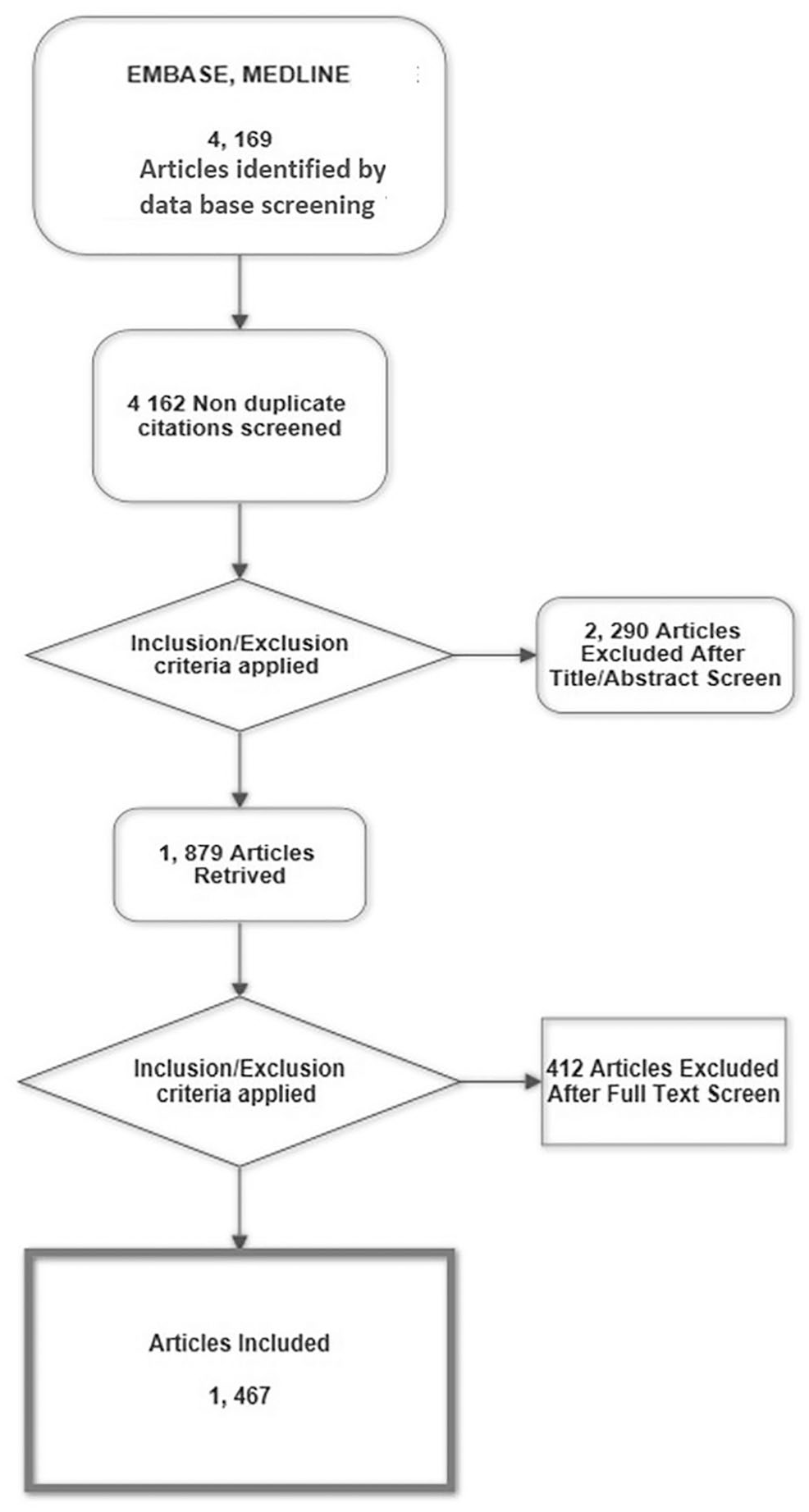
Flow chart of the systemic literature search.
The final statements proposed by the TEP encompassing two overarching principles and 10 GCP statements and their level of agreement are reported in Table 1.
GCP statements and level of agreement.

Numerical details show the degree of agreement rated from 0 to 10 and level of consensus is defined as strong and unanimous for each individual point.
GCP, good clinical practice; NSAIDs, nonsteroidal anti-inflammatory drugs; OA, osteoarthritis; PASS, Patient Acceptable Symptom State; SD, standard deviation.
Final statements
Overarching principles
(1) The treatment of KOA must be based on a shared decision between patient and physician.
A well-informed patient is able to participate in shared decision making. Being aware of the options in pharmacological, nonpharmacological and complimentary treatments and by weighing the benefits and risks, the patient may choose the most appropriate management. This also might boost self-confidence and confidence in his/her doctor. In addition, best knowledge and best information will encourage the patient to discuss a change in the current treatment. Additionlly, the identification and management of modifiable risk factors related to KOA should be shared and planned with the patient.
(2) The primary goal of treating the patient with KOA is to maximize long-term health-related quality of life through control of symptoms, prevention of evolution of structural damage, improvement of mobility and self-management.
The KOA treatment should be based on decisions that offer a good quality of life to the patient. The treatment should be personalized to suit the particular lifestyle of each individual patient and specific needs (work, sports, daily activities, leisure). The treating team of health practitioners (HPs) should work in cooperation with the patient to foster his/her well-being. Treatment should control symptoms, disease flares/relapses, maximize function, and avoid long-term structural damage and disabilities. The patient should be encouraged to acquire self-management techniques, and these should include adoption of a healthy lifestyle, cognitive and behaviour skills. 15
GCP statements
(1) The primary target for treatment of KOA should be a clinical improvement, bringing the patient to the Patient Acceptable Symptom State (PASS).
In daily clinical practice, physicians frequently ask two questions to assess the effectiveness of a treatment: ‘Are you feeling better?’ and ‘Are you feeling good?’. Unsurprisingly, it has been demonstrated that patients prioritize on feeling good than on feeling better. 16 The PASS is a clinically relevant cut-off that allows assessment of clinical status of an individual patient, at a given time, by classifying the patient as being in ‘an acceptable state’ (score ⩽ PASS threshold) or not (score > the PASS). In other words, PASS can be defined as the highest level of different symptoms [e.g. pain, Patient’s Global Assessment (PGA), functional improvements] beyond which patients consider themselves well. 17 Thus, it can be considered a clinically relevant treatment target. It is an absolute value (satisfactory or not), not a change. In 2005, Dougados and colleagues published one of the first prospective studies evaluating PASS against the three main patient-reported outcomes (PROs) used in clinical trials in knee and hip OA: VAS pain, VAS patient global assessment and WOMAC function score. They demonstrated the robustness of this index in the evaluation of the patient affected by KOA and in particular, the centrality of the patient’s role in considering disease activity because the definition of the PASS is anchored to the personal experience of the patient (satisfaction and adaptation to symptoms). 17 Patients with KOA considered their state satisfactory (PASS threshold) if their pain score was less than 32.3 mm on the 0–100 mm VAS and the PASS estimates were similar (scores of approximately 33), considering both knee and hip OA for these reported outcomes. 17 Similar results were demonstrated in other published studies,18,19 underlining the study conducted by Bellamy and coworkers, showing the importance of country-specific PASS. On the basis of the previous published results that Conrozier and colleagues considered, in patients affected by KOA treated with viscosupplementation, PASS threshold ⩽ 4/10 for WOMAC pain, <4 for patients’ global assessment of pain, and <5/10 for WOMAC function, demonstrated the utility of the PASS in patient evaluation. 16 In accordance with this last study, we proposed considering a pain cut off of 4 (PASS + ⩽4/10) as threshold of the therapeutic target to reach in patients affected by KOA.
(2) Treatment should begin as early as possible with the diagnosis of symptomatic OA and include pharmacological and nonpharmacological treatment.
Early management of KOA is recommended by several guidelines15,20,21 and supported by the National Public Health Agenda for Osteoarthritis, the Centres for Disease Control and Prevention and the Arthritis Foundation. 22 The rationale for this approach relies on the hypothesis that early interventions might modify the course of the disease including patho-anatomy and clinical features of KOA.
Improved understanding of disease pathogenesis and advances in the investigation of biomarkers could increase the ability to diagnose early OA and to manage clinical and functional consequences. Even though pharmacological agents play a key role in symptom relief, there is a growing interest in disease-modifying agents in KOA that might delay disease progression.
(3) All patients should be encouraged to maintain a healthy weight and adopt regular and appropriate physical activity.
Therapeutic exercises, particularly low-impact aerobic training, aquatic exercise and strengthening are recommended by several guidelines, as both core treatment and first-line conservative approach for KOA-related pain and disability.15,20,21 Pain must be controlled to encourage regular physical activity. Changes of appropriate lifestyle should be encouraged as soon as possible, and regular weight control should be included through the introduction of a balanced diet that needs to consider existing comorbidities (e.g. DM, hypercholesterolaemia, hypertension).
(4) The management should be evaluated every 3–6 months (depending on the patient symptoms) until the desired target is reached and continued thereafter.
As observed for other joint diseases such as RA, it has been demonstrated that close monitoring of patient compliance is an important strategy in patient management. In particular, pharmacological and nonpharmacological treatments should be scrupulously followed. 13 Symptom control can be fast acting [e.g. nonsteroidal anti-inflammatory drugs (NSAIDs) or analgesics] or slow acting [e.g. nonpharmacological treatments, symptomatic slow-acting drugs of OA (SYSADOAs), exercise or weight loss]. The suggested 3–6-month follow up is a reasonable period to achieve the therapeutic target. Thus, it is important to highlight that the use of SYSADOAs for the management of KOA is not recommended practice in North America and the UK, and is still not recommended by the Osteoarthritis Research Society International (OARSI) and remains controversial, but without doubt, it is supported by various clinical trials and positive experiences in clinical practice.
Once target is achieved, regular monitoring over time is a fundamental principle in the management of KOA, as it is a chronic disease. The periodic assessment of the patient’s disease status allows an effective evaluation of both compliance and effectiveness of the selected therapeutic strategies.
(5) Documenting measures of pain, function, physical and mental state, and consumption of painkillers (analgesics, NSAIDs, etc.) regularly to monitor clinical improvement, adherence, tolerability and safety is recommended.
Different types of PROs are used in clinical trials of KOA. A core set of three clinical measures were specified in the Outcome Measures in Rheumatology Clinical Trials (OMERACT) III Conference and ratified by the 1996 OARSI Task Force OA Clinical Trial Guidelines. This core set is generally based on evaluation of pain, physical function and patient global assessment. Pain can be evaluated on a five-point Likert scale (e.g. none, mild, moderate, severe, very severe), 11-point (0–10) NRS or on a 100 mm VAS but also, single questions can be used. It is also possible to use a part of some tools with multi-items, such as the Health Assessment Questionnaire (HAQ), or multiconcept, such as the WOMAC pain subscale, or multidimensional measures. Physical function/disability can be measured on a Likert-type scale, NRS or VAS, or multidimensional tools with a physical function subscale (WOMAC physical function subscale, the knee injury and Osteoarthritis Outcome Score function subscale) and the HAQ disability index (HAQ-DI/Improved HAQ). The third domain, the PGA status, is usually measured on a rating scale (Likert, NRS or VAS). 23
The regular monitoring of these domains is essential for evaluating the disease evolution over time, for evaluating the effectiveness of the therapeutic choices and for monitoring the patient’s drug compliance and tolerability.
(6) The patient has to be appropriately informed about the treatment options and a shared decision should be made.
The physician and the patient should discuss the condition of the disease, and the former should explain in detail the benefits of the chosen treatment and its side effects. The doctor must listen to the concerns and worries of the patient and address him/her in lay language. By this method, the patient and his doctor can codecide on the most appropriate treatment. Moreover, a scrupulous information will raise patient’s awareness and aid him/her in early recognition of side effects.
(7) Modifiable risk factors of OA progression should be identified and managed with patients at the beginning of the treatment and monitored regularly.
The management of modifiable OA risk factors such as weight loss and regular resistance-training exercises is a fundamental element in the management of the patient.
Risk factors of OA are supported by recent results drawn from the Osteoarthritis Initiative (OAI) and the CHECK studies, which confirm the relevance of modifiable risk factors such as overweight in the development of KOA.24,25
In particular, among the OAI patient population, overweight was identified as a risk factor for developing bone-marrow lesions and joint effusions. 26 The data from CHECK also suggest that body mass index (BMI) may play a role in the reduction of knee range of movement and in overall activities in patients affected by KOA. 25 Cross-sectional and longitudinal studies on KOA have consistently demonstrated a linear association between overweight and obesity as measured by BMI and waist circumference, and the prevalence and incidence of knee KOA (RR: 2.4), with obesity identified as the main modifiable risk factor.27–32 At a 10-year follow up in a population aged 24–76 years, the incidence of KOA was 7.3% [confidence interval (CI) 5.7–9.0] and a high BMI (>30) was significantly associated with KOA[odds ratio (OR) 2.81; 95%CI 1.32–5.96]. 33 Obesity may also impact physical activity, disease progression [relative risk (RR): 2.6] and disease severity, especially in terms of lifetime expectancy and survival of total knee replacement.34,35 Weight loss may improve pain, function and physical activity.36,37
Weight loss is a main task in overweight and obese KOA patients either by diet with exercise or medical intervention including bariatric surgery in patients with morbid obesity. A weight loss over 5% may improve symptoms and function. 36 This effect is observed even in patients with advanced stage of the disease. 38 Long-term maintenance of weight loss in patients with KOA is difficult to achieve and dietary advice including low-energy diet may be helpful. Obesity is also associated with sleep apnoea and steatohepatitis, which might complicate surgery options in these patients. 39
(8) Comorbidities and concomitant treatments should be systematically screened and managed.
Although treatment options and medications that can help relieve OA symptoms, primarily pain, are widely in use, it is very important to consider comorbidities before choosing how to manage KOA. The metabolic syndrome (MetS), has been observed more frequently in patients with KOA compared with the non-OA population (59% versus 23 %). 40 The presence of metabolic diseases seems to have a cumulative and negative effect on the incidence and the progression of KOA.41–43 Together with age, physical inactivity induced by OA disability and low-grade inflammation associated with KOA, MetS may contribute to increase cardiovascular (CV) disease and CV-related mortality.3,44
There is also a controversial association between type 2 DM and KOA.45–48
The concerns about an association between atherosclerosis and OA arise from several positive studies. 28 A recent meta-analysis shows that the risk of ischemic heart disease for OA patients was 1.78 (95% CI 1.18–2.69) and the risk of heart failure was 2.80 (95% CI 2.25–3.49) as compared with non-OA patients. 44 This CV risk in KOA is mainly driven by impairment of physical activity, since this risk was not observed in patients with hand OA. 49
In these elderly and overweight populations with KOA, concomitant treatment should be carefully monitored. Several drugs used in KOA can induce side effects that might be more severe due to associated comorbidities. Thus, given the different safety profiles, the choice of NSAIDs, traditional or coxibs, should be based on individual patient risk factors. 50 The reputation of acetaminophen as a safe drug has been challenged. Long-term use and high dose of acetaminophen can induce hepatic, digestive (RR 1.14–1.31) and cardiovascular AEs (RR 1.36).51–53 Before performing intra-articular injections, concomitant anticoagulants should be considered, while corticosteroid injections may aggravate DM and hypertension frequently associated with KOA.40,54 In this elderly polymedicated population, drug–drug interactions are more frequent, and NSAIDs are particularly at risk. 55 In the elderly population, the use of NSAIDs should be carefully monitored in patients taking antihypertensive drugs, such as inhibitors of angiotensin-converting enzyme and diuretics, due to the increased risk of renal failure.56,57 NSAIDs should also be carefully considered in patients with CV risk on antithrombotic drugs (i.e. low-dose aspirin, clopidogrel) due to the risk of gastrointestinal bleeding, especially for traditional NSAIDs.5,58–60 The highest average number of severe/contraindicated alerts per use was observed for NSAIDs in an elderly population taking antithrombotic drugs. 53 Similarly, the association between NSAIDs and anticoagulant therapy should be restricted. 5 In these cases, topical NSAIDs might be preferred because no serious gastrointestinal or renal AEs were observed in trials or in the general population. 61 The cumulative dose of acetaminophen used in other clinical conditions, may expose patients with KOA to greater gastrointestinal, hepatic or CV side effects 52,53 For these reasons, the benefit/risk ratio of any treatments in KOA patients, including screening for comorbidities and concomitant treatments for those comorbidities, should be regularly and systematically evaluated.
(9) The treatment should be adapted according to patient phenotype and disease severity.
The complexity of factors involved in the development and progression of OA makes it impossible to offer a standardized treatment for all individuals. There is a great deal of heterogeneity between patients, since OA pathophysiology comprises mechanical, inflammatory, metabolic, post-traumatic, molecular, genetic, epigenetic and psychological alterations, among others; 62 each factor acting alone, or in combination. Similarly, there is great variation among individuals regarding disease trajectory, with some evolving rapidly, while others remain stable for long periods of time.12,63
Several authors have proposed different OA phenotypes based on clinical or imaging findings.9–12 A recent systematic review identified distinct groups of variables that can be explored for a better definition of the phenotypes in OA. 9 Therefore, adapting the treatment according to patient phenotype and disease severity is essential for adequately treating OA patients and for achieving the best results.
(10) Surgical options should be considered for the appropriate patients.
Knee arthroplasty should be considered when both pharmacological and nonpharmacological treatments have failed. Arthroscopic lavage is not recommended for patients with degenerative pathology. 64
Total knee arthroplasty remains a valid option in patients who have advanced degenerative changes in the knee and are symptomatically severe. Such patients must be medically screened to assess their fitness for surgery before arthroplasty is offered. 65
Other surgical treatments, such as osteotomy and realignment procedures, may also be considered in appropriate patients after discussing the risks, rewards and longevity of these procedures.
Agreement
With regard to the consensus vote, both for overarching principles and GCP statements, the results show a high degree of agreement with average values no lower than 8.7 and with a level of consensus that oscillates between strong and unanimous for each individual point. The numerical details are reported in Table 2.
Overarching principles.

Numerical details show the degree of agreement rated from 0 to 10 and level of consensus is defined as strong and unanimous for each individual point.
OA, osteoarthritis; SD, standard deviation.
Discussion
To our knowledge, this is the first proposal for a treat-to-target strategy in KOA. This international interdisciplinary TEP has tried to formulate a series of GCP statements that could be of guidance for treat-to-target strategies in the management of KOA. At present, the treat-to-target strategy represents a different approach to OA management, focusing on reaching an easy and acceptable clinical target in patients rather than adopting the best ideal therapy for OA. It is also a valid contribution to KOA management, taking into account the chronicity, progression of disease and the frequent association of comorbidities that complicate the management of the patient.
The TEP’s final work consisted of two overarching principles and 10 GCP statements pertaining to the implementation of a treat-to-target strategy in the management of the patient with KOA. The overarching principles express two fundamental concepts: the importance of sharing therapeutic choices between the doctor and patient, and defining the goal of these therapeutic choices. Sharing the therapeutic strategies with the patient is the first step to ensure the patient’s compliance to choices made. If the patient does not believe and does not share the management options recommended by the physician, it will be difficult to succeed in achieving the target. The second overarching principle focuses on the objectives: the physician must explain the complexity of a chronic pathology such as KOA, emphasizing the need to monitor the patient at different levels.
The following 10 statements express more in detail the indications useful in achieving what is expressed in the overarching principles.
OA lacks a diagnosis and target biomarker, even though for many years now, research has been focused on resolving this gap. Our aim is to introduce a new approach for the management of OA, consisting of a treat-to-target concept based on SLR and expert consensus. This paper introduces PASS as a target to achieve in the management of KOA. The first suggests the use of a specific clinimetric indicator for monitoring the disease with PASS. The PASS introduces the concept of well-being or remission of symptoms and has been demonstrated a clinically relevant outcome for the patient, even though it needs further research to evaluate the robustness, temporal consistency, and age and sex dependency of the preliminary results. Dougados and coworkers were among the first to investigate the usefulness of this outcome in the evaluation of patients affected by various pathologies including KOA.17–19 The evaluation of the patient’s symptoms allows the analysis of the patient on different levels, as expressed in the overarching principles, reaffirming the centrality of the patient’s opinion. For this purpose, still with some limits, 66 PASS can be an easy and appropriate outcome as a clinical target of the patient with KOA. PASS was also considered the most reliable and simple PRO for decision of retreatment with hyaluronic acid, by the experts of the European Viscosupplementation Consensus group. 67
The proposed second GCP statement emphasizes the use of pharmacological and nonpharmacological treatments in the management of the patient with KOA as reported by several international guidelines.15,68–70 Since a clear characterization and definition of early OA stages is lacking, in 2016, an international panel of 29 physicians promoted by the Italian Society of Rheumatology, representing national societies of rheumatology of several European countries, proposed establishing an agreed clinical definition of early symptomatic KOA and simple criteria for the referral of patients with suspected KOA at the initial symptomatic stage of the disease, before the onset of radiological damage. 70 The early management of KOA, aiming to slow its course with pharmacological and nonpharmacological strategies, could be the starting point for the application of a treat-to-target strategy for KOA.
In the third GCP statement the modification of lifestyle in patients affected by KOA is highlighted. Conservative nonpharmacological strategies, particularly exercise, are recommended in the management of OA (e.g. aerobic, strengthening, aquatic and Tai Chi exercise). Obviously, the optimal exercise regimen should be determined and individualized on the basis of the stage of the disease, patient preference, comorbidities and accessibility. 71
A recent systematic review and meta-analysis provided evidence about the effectiveness of land-based exercise for people with KOA reducing joint pain and improving physical function and quality of life over the short term and for at least 2–6 months after the treatment. 72 Recently, the European League Against Rheumatism (EULAR) realized specific guidelines for the management of physical exercise in patients with KOA. 73 In the modification of lifestyle, the management of the weight and pain should also be considered, especially in elderly patients. 74
Statement number 4 suggests timing for the evaluation of the patient over time according to a follow up consistent with what has already been proposed in other pathologies such as RA. 13 The fundamental concept is that considering the chronicity of the pathology and the multilevel therapeutic approach, a regular and prolonged follow up is necessary in order to better evaluate the patient and to maintain the results over time.
In GCP statement 5, the various ‘domains’ to precisely evaluate the patient are defined. However, these domains clearly demonstrate the complexity of the KOA patient who requires a regular follow up which should be part of the treat-to-target strategy.
Along with painkillers, a multimodal approach should be chosen. When the diagnosis of symptomatic KOA is made, this includes the early use of nonpharmacological and pharmacological treatments, 75 targeting inflammation, preventing sensitization and transition to chronic pain. This may ensure maximization of the beneficial effects of therapy and may delay disease progression.
However, awareness of treatment potential side effects is mandatory. In fact, NSAIDs are associated with a risk of gastrointestinal and CV AEs. International guidelines such as those of the European Society for Clinical and Economic Aspects of Osteoporosis, Osteoarthritis and Musculoskeletal Diseases or EULAR recommendations can guide the physicians in identifying patients at risk of significant CV or gastrointestinal side effects. 76 Recently, CV risk with NSAIDs has been challenged, and it was proposed that all NSAIDs (tradional and coxibs) can induce short- or long-term CV events, including death. With coxibs, the risk is due to continuous use for more than 30 days, whereas for other NSAIDs, a heightened myocardial infarction risk can occur within 7 days. 77 For a short-term use, opioids such as tramadol may be considered for severely symptomatic KOA patients. The appropriate selection of the patient to be subjected to this kind of therapy remains crucial. 76
Statement 6 may appear redundant, as it is addressed in the first overarching principle. The TEP considered it appropriate to include this statement to reiterate the importance of the shared treatment choice between physician and patient. It also emphasizes a very important concept of giving complete information about the therapeutic choices to the patient. To assure patient compliance and safety, it is not enough to share the choices, but is also pivotal that the patient understands the characteristics and purpose of the therapeutic choices.
The risk factors are discussed in the next GCP statement. In KOA, the management of the patient risk factors is fundamental in improving the efficacy of the treatment: weight loss is the key aim in overweight and obese KOA patients. This may be achieved either by diet and exercise or medical intervention, including bariatric surgery, especially in patients who are morbidly obese.36,37,78 In these patients, sleep apnoea and steatohepatitis, usually associated with obesity, may complicate a surgical option. 30
There are rising concerns in recent studies of an association between atherosclerosis and OA. A recent meta-analysis shows that the risk of ischaemic heart disease in OA patients was 1.78 (95% CI 1.18–2.69) and the risk of heart failure was 2.80 (95% CI 2.25–3.49) as compared with nonosteoarthritic patients. 44 This CV risk in KOA is mainly driven by poor physical activity. 49 Moreover, according to a recent systematic review, 79 high-quality studies suggest that progressive resistance training improves overall physical performance in patients with early KOA, and both strength training and self-management are effective for pain relief, functional improvement and suitable for middle-aged adults with early KOA. 80
The eighth statement emphasizes the management of comorbidities. Obesity, dyslipidaemia, CV disease and DM can significantly affect the patient’s general condition. While some meta-analyses, which include studies of patients with high BMI,45,46 have found a significant and positive association between the two diseases, with an increased risk of 25%, more recent studies disputed these meta-analyses, as they reported no association between DM and KOA. 48 Despite uncertain data, the consensus suggests the management of KOA should now include the control of all comorbidities included in MetS to improve the quality of life and decrease the CV risk. Thus, the presence of any concomitant pathologies needs to be evaluated when discussing the options of management with the patient. Therefore, the treatment and the monitoring of comorbidity are crucial during the regular review of the patient, as is the modification of daily lifestyle, if applicable.
The importance of personalization of therapy based on the characteristics of each patient is discussed in GCP statement 9. The focus is on the presence of different KOA phenotypes seen in clinical practice. As described in these recommendations, the disease phenotype of the KOA should be considered in the evaluation of the patient. Several authors have proposed different OA phenotypes based on different parameters (clinical or imaging findings),11,62 and their precise identification can influence the efficacy of therapy. According to OA aetiological and molecular/biological events of the disease, a classification of OA into three subsets has been suggested. It is based on the main underlying pathophysiological mechanisms: type I, or genetically determined; type II, or oestrogen-hormone dependent; and type III, or age-related OA. 81 Moreover, the progression of disease can change one phenotype into another and so they appear interchangeable.82,83 A recent review summarizes a set of variables suggesting the existence of five different clinical phenotypes of KOA. 10 Other studies underlined importance of distinguishing clinical phenotype of KOA based on pain sensitization, psychological distress, radiographic severity, body mass index (BMI), muscle strength, inflammation and comorbidities, 9 also, taking into consideration sex, metabolic abnormalities and pattern of cartilage damage. 84 Treatment options for distinct clinical subsets of KO are still controversial. In addition, a special focus on recognizing early KOA is relevant. Langworthy and colleagues reported on the younger military population with increased risk of KOA; they highlighted the importance of viscosupplementation and multimodal approach including exercise plans, physical therapy, and weight loss, analgesics or NSAIDs on request. 85
In the early phases of disease, a wide spectrum of predictors of evaluation should be considered. Meniscal change, bone-marrow oedema, synovitis, and infrapatellar fat pad (Hoffa’s fat pad) synovitis are initially involved in the degenerative process and have been found to be predictive of radiographic change within 4 years. 84 However, still, there is no uniform characterization of the phenotypes that remain at present a topic of discussion in the scientific community.
In the last statement, there is focus on the indication of arthroplasty in patients with advanced degenerative changes and severe symptoms not responsive to pharmacological and nonpharmacological strategies. 64 Preoperative screening and a careful discussion with patients regarding indications, procedures and patient expectations should be performed to those offered arthroplasty. 65 Reconstructive surgical treatment strategies with the aim of forming a repair tissue or unloading joint compartments with articular cartilage damage can be also proposed. These surgical reconstructive techniques improving joint function could postpone the need for joint replacement; however, since no definitive data are available, an accurate discussion with the patient must be carried out.
One of the methodological limitations of this TEP is the absence in the working group of general practitioner (GP) representatives. Considering the fundamental role of the GP in managing the patient affected by KOA, involving these professionals in developing a strategy for treat-to-target in KOA to guarantee the success of what is proposed is essential. Similar projects and work plans involving patients, specialists and GPs are needed to ensure the best possible care for the patient.
Research agenda
In order to improve the ‘treat-to-target strategy’ this TEP also proposed the following research agenda to improve the customization of treatment (e.g. different treatments according to age):
(1) to investigate specific biomarkers to monitor disease;
(2) to determine the best type of physical activity according to patient phenotype;
(3) to study concomitant interactions with other diseases in patients affected by KOA;
(4) to establish the limits of acceptable BMI;
(5) to identify the subset/phenotype of patients (e.g. bone-marrow lesions);
(6) to characterize the pain phenotype of each patient;
(7) to explore the new horizons of informatics in the long-term management of OA patients (applications, telematic communications, etc.).
Conclusion
After the success exhibited by the ‘treat-to-target strategy’ in RA, this TEP suggests it is the time to consider the use of a treat-to-target strategy in the management of KOA. The experts suggest providing both pharmacological and nonpharmacological therapeutic choices shared between physicians and patients, with regular evaluation of efficacy and tolerability over time. PASS can represent a valid outcome as a clinical target in the evaluation of the evolution of the patient’s disease status. The proposed overarching principles and GCP statements are aimed at involving patients, physician specialists and GPs in sharing a therapeutic strategy for KOA and management based on the aim of achieving and maintaining a clinical and acceptable status for OA patients over a long time.
Footnotes
Funding
The authors received no financial support for the research, authorship, and/or publication of this article.
Conflict of interest statement
Abiogen Pharma Spa supported all the costs of the meeting of the authors, including travel and subsistence. No honoraria were paid to the participants. Abiogen Pharma Spa had no input in the writing or editing of the paper.
