



Abstract
Natural processes like wave action, tides, winds, storm surges, and tsunamis constantly shape the shoreline by inducing erosion and accretion. Coastlines with intact vegetated dunes, mangroves, and reefs act as a buffer zone against wave attack on beaches. This article discusses the effect of simulated seagrass on wave height attenuation and wave run-up through an experimental study. The tests were carried out with submerged artificial seagrass subjected to varying wave climate in a 50-m-long wave flume. Measurements of wave heights along the seagrass meadow and the wave run-up on a 1:12 sloped beach were taken for wave heights ranging from 0.08 to 0.16 m at an interval of 0.02 m and wave periods 1.8 and 2 seconds in water depths of 0.40 and 0.45 m.
Introduction
Coastal vegetation acts as a natural barrier to the destructive forces of wind and waves by absorbing the impact of waves, thereby delaying the flooding of inland areas which, in turn, weakens the damage caused to inland structures. It aids in shoreline protection by absorbing the energy of the waves generated by storm surges, cyclones, and tsunamis, thereby slowing down shoreline erosion. Coastal ecosystems provide protection by attenuating and/or dissipating waves; control erosion by stabilizing sediments and retaining soil in vegetation root systems; purify water by uptake, retention, and deposition of nutrients; and aid in carbon sequestration by generating biogeochemical activity (Barbier et al., 2011). With an increase in the frequency of cyclones (Webster et al., 2005), tsunamis, and storm surges, an increase in sea level rise, and our coastline being seriously threatened by erosion and flooding, there is an emphasis on the need for a sustainable and innovative approach to protect our coasts.
The presence of pockets of mud, large stands of seaweed, pile clusters, or submerged trees results in a region of localized energy dissipation at the bottom of or throughout the water column causing the incident wave field to diffract as well as attenuate (Kobayashi et al., 1993). The trunks and roots of mangroves (Massel et al., 1999), the stipes and fronds of kelp (Lovas and Torum, 2001), the reticulated structure of coral reefs (Madin and Connolly, 2006), and the leaves of seagrasses (Koftis and Prinos, 2011) are a source of friction to moving water.
Seagrasses are marine plants that have roots, leaves, and underground stems called rhizomes. They form extensive beds or meadows in shallow coastal waters with sandy or muddy bottoms. The major seagrass meadows in India exist along the southeast coast (Gulf of Mannar and Palk Bay) and in the lagoons of islands from Lakshadweep in the Arabian Sea to Andaman and Nicobar in the Bay of Bengal. Enhalus acoroides, a type of seagrass which is widespread in southern India, Sri Lanka, and the Lakshadweep Islands, has long strap-like leaves which give protection to shorelines exposed to strong waves. It is used as a food source, animal feed, and for handicrafts in the major seagrass areas of Southeast Asia. The rhizome of E. acoroides is used as an emergency food source by fishermen and the seeds are used as snacks between meals in Indonesia. Different handicraft products are made from this seagrass in the Philippines (UNEP, 2008).
Previous studies to establish the attenuation of waves due to seagrasses include wave flume studies on artificial and live vegetation. Gambi et al. (1990) carried out flume studies on Zostera marina L. and observed that the plant assemblage deflects the flow above the canopy and around the sides of the bed, which leads to a flow speed reduction through the seagrass bed. Fonseca and Cahalan (1992), using four species of seagrass, studied the percent wave energy reduction along the seagrass bed and established that leaf length has a significant contribution in reduction in wave energy. Detailed field investigations in a Spartina maritime salt-marsh (Neumeier and Ciavola, 2004) and Spartina anglica salt-marsh (Neumeier and Amos, 2006) revealed flow reduction at each level of the canopy and turbulence attenuation by the vegetation. The orbital velocity of waves was significantly attenuated by the vegetation and turbulence reduction favors settling of sediments. Stratigaki et al. (2011) conducted large-scale flume studies using artificial flexible mimics of Posidonia oceanica. Wave attenuation within the seagrass meadow depending on the seagrass density and submergence ratio was demonstrated.
Wave attenuation involves loss or dissipation of wave energy, resulting in a reduction in wave height (Park, 1999). The presence of seagrass near the surface offers frictional resistance to particle movement. The leaves of the seagrass penetrate through the layers of particle orbital velocities, leading to turbulence generation and thereby reduction in wave energy. The energy dissipation thereby causes the attenuation of the incident wave field. Kobayashi et al. (1993) assumed that the local wave height decays exponentially through the vegetation. When the vegetation interferes in the wave field as the wave passes, wave attenuation is expressed as a function of distance in the vegetation. The attenuation is approximated by an exponential decay function of the form

where Hx is the wave height at distance x in the vegetation, Hi is the wave height at the entry point of the vegetation, k is the decay constant, and x is the distance into the vegetation. In this work, an experimental study is carried out to determine the wave attenuation and transmission characteristics of simulated seagrass in a wave flume. The wave run-up characteristics on the beach are also investigated.
Objective of the study
The aim of this study is to investigate the effect of submerged artificial seagrass on wave heights within the meadow, transmission characteristics, as well as the run-up on a 1:12 sloped beach under the influence of varying wave climate.
Methods
Experimental setup and instrumentation
The experiments with submerged artificial seagrass are conducted in a two-dimensional wave flume of the Marine Structures Laboratory of the Department of Applied Mechanics and Hydraulics, National Institute of Technology Karnataka, Surathkal, India. The wave flume is 50 m long, 0.71 m wide, and 1.1 m deep and has a 6.3-m-long, 1.5-m-wide, and 1.4-m-deep wave generating chamber at one end and a built-in beach of slope 1:12 at the other end. The wave generating chamber has a bottom hinged flap controlled by an induction motor (11 kW at 1450 r/min), which, in turn, is regulated by an inverter drive (0–50 Hz) rotating in a speed range of 0–155 r/min. A flywheel and a bar chain link the motor with the flap. Regular waves of heights 0.08–0.24 m and periods 0.8–4.0 s in a maximum water depth of 0.5 m can be generated with this facility. Capacitance-type wave probes are used to measure the water surface elevation. The recorded analog data are converted into digital data and are stored in digital form by a software-controlled analog-to-digital (A/D) converter. Figure 1 gives a schematic diagram of the experimental setup.
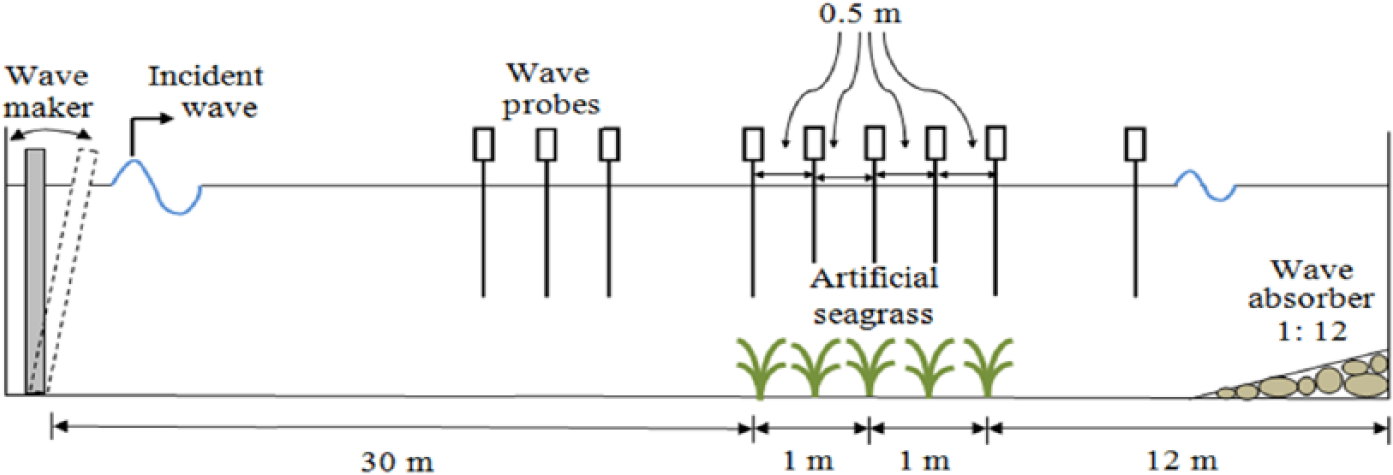
Details of experimental setup.
Test model
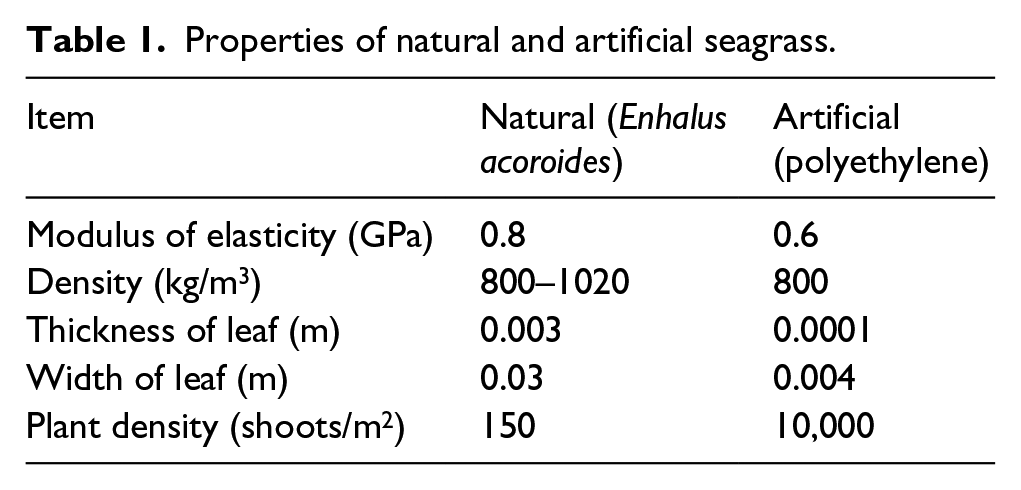
A 1:30-scaled artificial E. acoroides model (Figure 2) with 0.21-m-long leaves and 0.01-m-high stipes is prepared from 0.0001-m-thick polyethylene plastic sheets. Each artificial seagrass plant is composed of four to five polyethylene leaves and is attached to 1 m × 0.7 m × 0.02 m slabs in a staggered distribution. Two such 1-m-long slabs are placed consecutively along the length of the flume to form a 2-m-long seagrass meadow. Tests are conducted for the seagrass model of 1-m width as well as for the seagrass model of 2-m width. In order to model artificial E. acoroides, it is important to know its natural properties, including its Young’s modulus and density, which have been recorded by Folkard (2005; Table 1). The polyethylene sheets have a density of 800 kg/m3 and a modulus of elasticity of 0.6 GPa, which is comparable to the average values measured for natural E. acoroides. Even though a model scale of 1:30 is adopted to scale down the prototype values, it is difficult to identify a material with the scaled down Young’s modulus value, and therefore, the stiffness property EI is considered as a single parameter (where I is the moment of inertia of the seagrass leaf). Since the stiffness property is modeled herein, an E value of 0.6 GPa for the model (which is about 30 times the required value) is accounted for by varying the moment of inertia of the material. The dimensions of the seagrass leaves are in the range of 0.5–1.5 m. The length of the model vegetation (hs) is fixed in the range of 0.15–0.27 m, by employing the Froude model law of scaling of stiffness property.
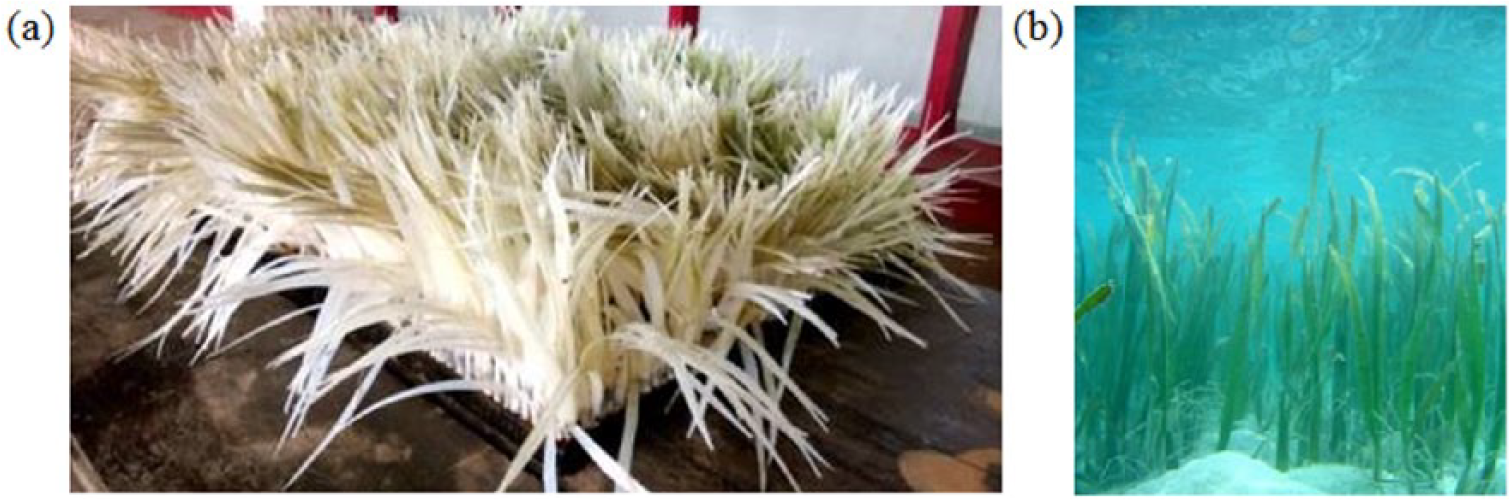
(a) Artificial seagrass and (b) natural Enhalus acoroides.
Properties of natural and artificial seagrass.
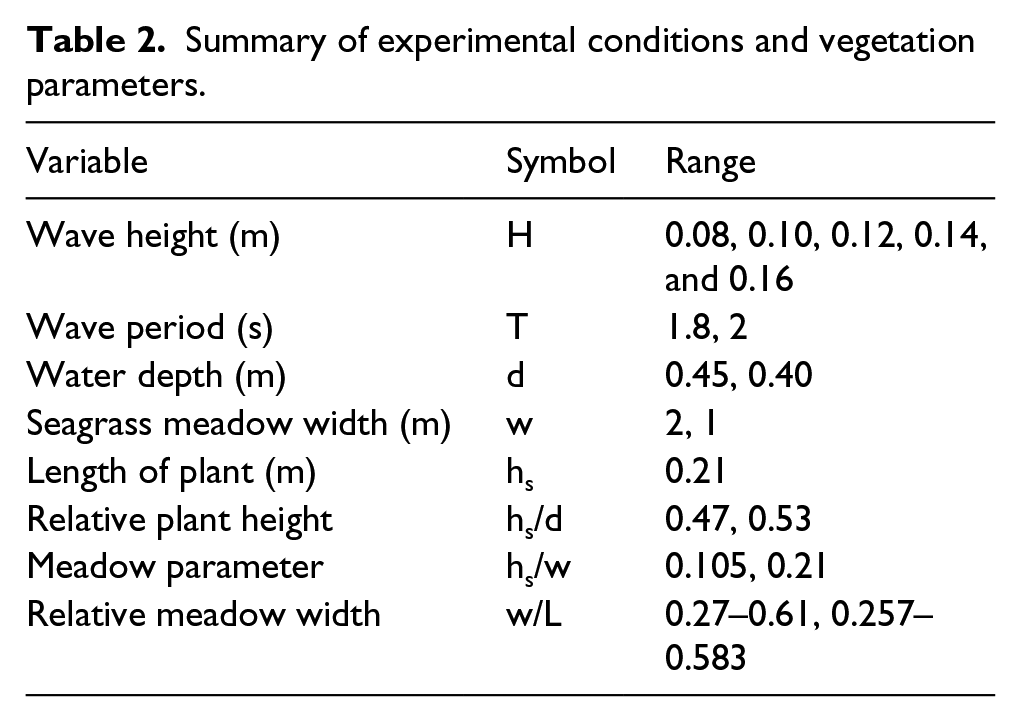
The 2-m-long test section is subjected to normal attack of waves of characteristics as described in Table 2. Wave probes record the incident wave height (Hi), the transmitted wave height (Ht), and the wave heights at five locations inside the seagrass meadow.
Summary of experimental conditions and vegetation parameters.
Results and discussion
In order to evaluate the effect of submerged seagrass on wave propagation, the variation of wave height along the meadow is measured for different wave conditions. It is observed while conducting experiments that wave transmission coefficient (Kt) increased with an increase in wave height (H) and wave period (T). Meanwhile, the value of Kt decreases with an increase in meadow width. The results are presented as graphs of wave heights (Hx) measured for every 0.5 m within the meadow, wave transmission for the entire seagrass meadow, and wave run-up, Ru/H (measured on the beach) in the following sections.
Wave height attenuation by submerged seagrass
Figure 3 illustrates the measured wave heights at locations within the artificial seagrass meadow. The wave height decreases exponentially as it propagates through the seagrass meadow.
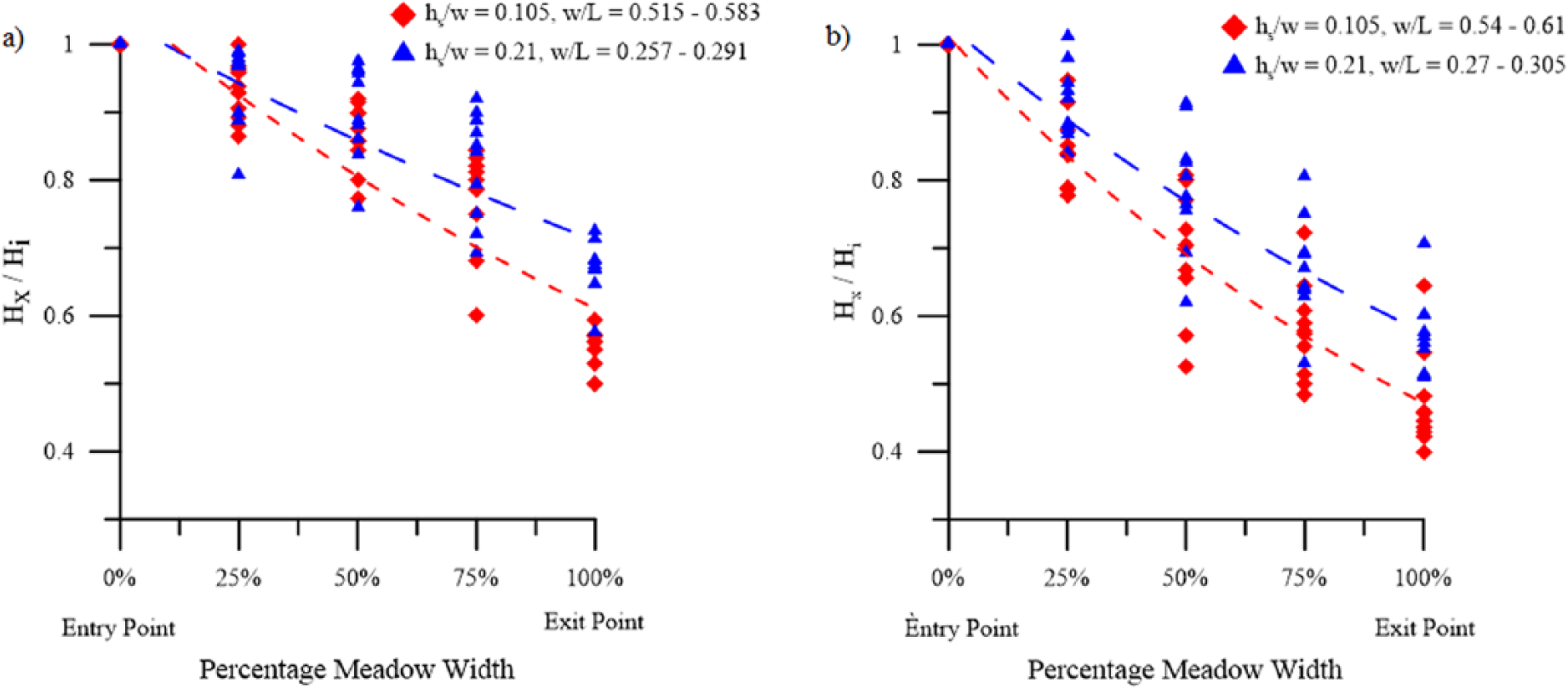
Measured wave height at locations within the seagrass meadow for (a) hs/d = 0.47 and (b) hs/d = 0.53.
For relative plant height, hs/d = 0.47, wave heights decrease within the meadow. The wave height at the end of the meadow is 72% of that at the entry point for the seagrass meadow with hs/w = 0.21 and w/L = 0.257–0.291 (where w = 1 m), while it is about 60% of that at the entry point for a wider meadow with hs/w = 0.105 and w/L = 0.515–0.583 (where w = 2 m). Similarly, for hs/d = 0.53, there is a decrease in wave heights within the meadow and at the end point of the meadow, it is only 58% of that at the entry point for the meadow with hs/w = 0.21 and w/L = 0.27–0.305 (where w = 1 m), whereas it is 48% of that at the entry point for the meadow with hs/w = 0.105 and w/L = 0.54–0.61 (where w = 2 m).
For a higher relative plant height (hs/d = 0.53), it is seen from Figure 3(b) that the wave height at the end of the meadow for the wider model (hs/w = 0.105, w/L = 0.54–0.61) is 48% which shows a better wave height attenuation for the same model with a lower value of relative plant height (hs/d = 0.47), which shows a wave height reduction in only 60% (Figure 3(a)). Considering all these test conditions, it is observed that the wider meadow (hs/w = 0.105) with a relative plant height, hs/d = 0.53, shows an increased wave height reduction and is therefore more efficient compared to the meadow of smaller width (hs/w = 0.21).
Variation of transmission coefficient (Kt)
It is seen from Figure 4(a) and (b) that Kt decreases with an increase in wave steepness, H/L. The leaves of the seagrass interfere with the wave propagation, resulting in an increase in turbulence and loss of energy, which consequently results in wave breaking. This loss of energy gives rise to a reduced wave height on the lee side, which, in turn, results in a lower value of transmission coefficient, Kt.
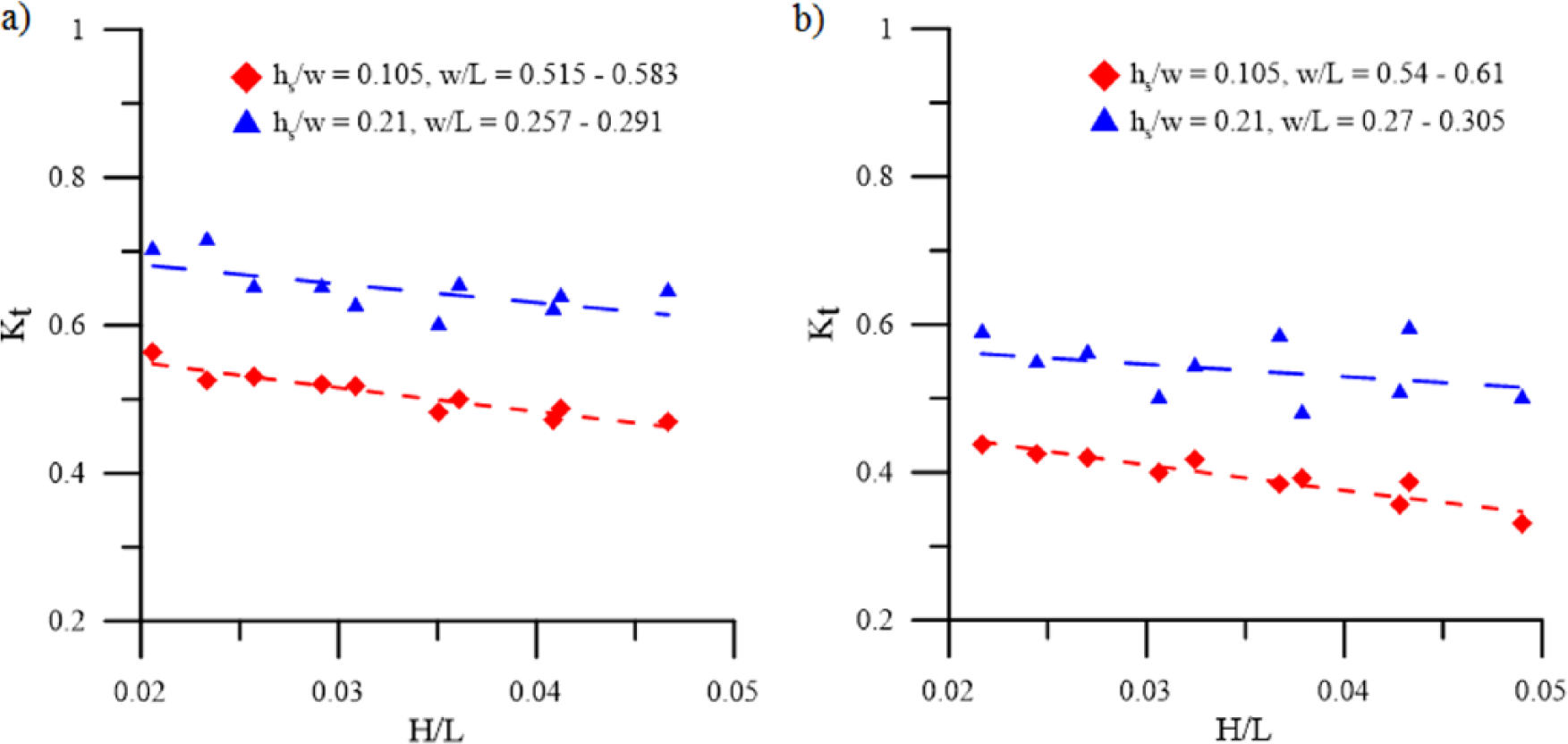
Kt versus H/L for the seagrass meadow for (a) hs/d = 0.47 and (b) hs/d = 0.53.
For a relative plant height, hs/d = 0.47, it is seen from Figure 4(a) that Kt decreases from 0.55 to 0.48 for the seagrass meadow with hs/w = 0.105 and w/L = 0.515–0.583 (where w = 2 m). Similarly, for the same seagrass model, it is seen from Figure 4(b) that Kt reduces from 0.45 to 0.36 when the depth of water is decreased (relative plant height, hs/d = 0.53). Seagrass meadow with hs/w = 0.21 and w/L = 0.257–0.291 (where w = 1 m) shows a drop in Kt value from 0.69 to 0.65 for a relative plant height, hs/d = 0.47, and from 0.56 to 0.52 for a relative plant height, hs/d = 0.53. This shows that the meadow with higher relative plant height (hs/d = 0.53) effectively reduces the wave height and thereby the wave transmission.
Effect of wave steepness on run-up
Figure 5 shows the variation of Ru/H for varying wave steepness H/L. The run-up decreases with increase in wave steepness. For a relative plant height, hs/d = 0.47, as H/L increases from 0.021 to 0.047, Ru/H varies from 0.51 to 0.3 for a seagrass meadow with hs/w = 0.105 and w/L = 0.515–0.583 (where w = 2 m), from 0.53 to 0.36 for a meadow with hs/w = 0.21 and w/L = 0.257–0.291 (where w = 1 m) and from 0.55 to 0.41 for the case without a seagrass meadow in place. Similarly, for hs/d = 0.53, as H/L increases from 0.022 to 0.049, Ru/H varies from 0.46 to 0.27, from 0.48 to 0.33, and from 0.52 to 0.39 for the three different cases—meadow with hs/w = 0.105 and w/L = 0.54–0.61 (where w = 2 m), meadow with hs/w = 0.21 and w/L = 0.27–0.305 (where w = 1 m), and for the one without a meadow in place, respectively.
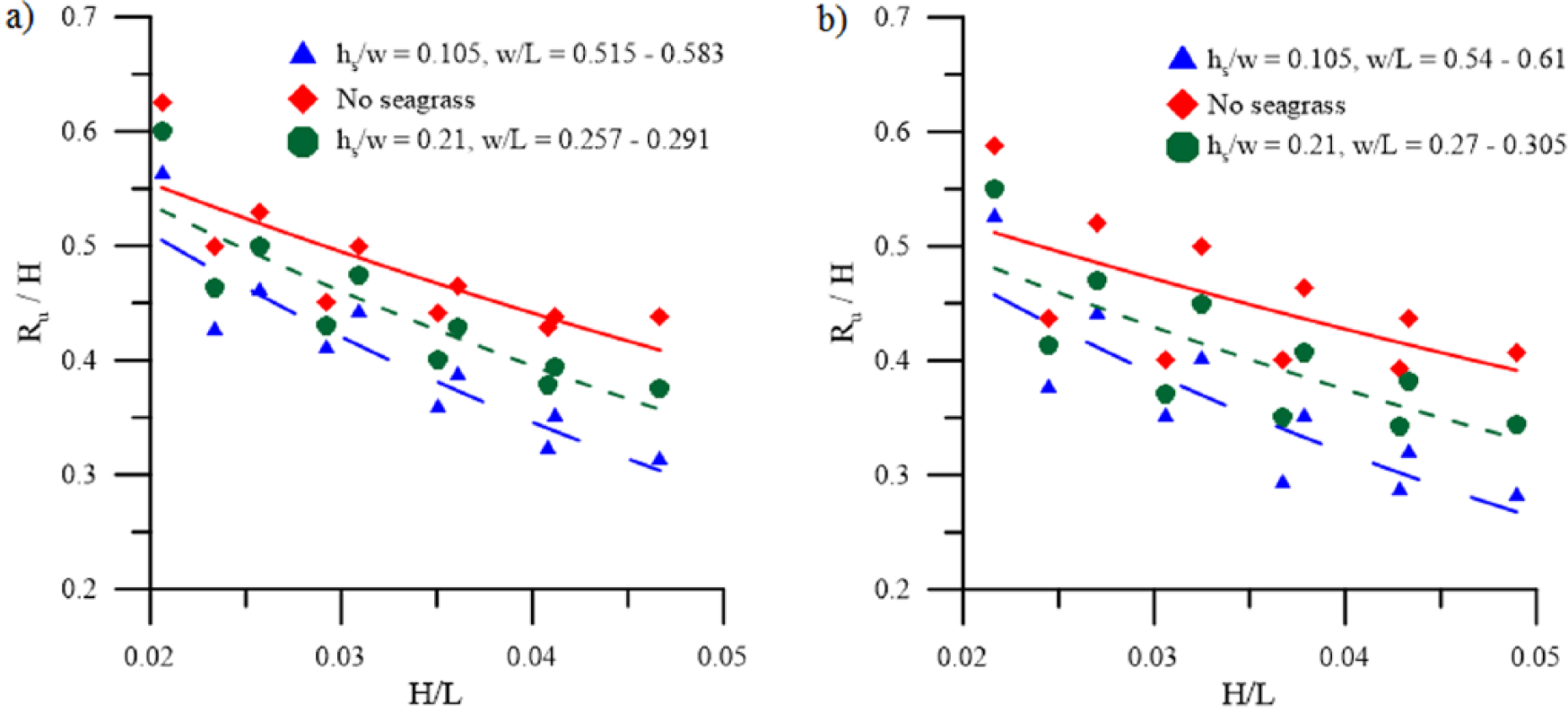
Variation in Ru/H with H/L for (a) hs/d = 0.47 and (b) hs/d = 0.53.
A higher percentage reduction in wave run-up (41%) is observed for the test condition with a wider seagrass meadow (hs/w = 0.105), a slightly lower percentage reduction in wave run-up (32%) for the seagrass meadow with hs/w = 0.21, and a notably lower reduction (25%) for the test condition with no seagrass meadow placed in the flume.
Conclusion
Based on the present experimental investigation, the following conclusions are drawn:
Wave heights decay exponentially as the wave propagates through the seagrass meadow.
The loss of energy as a result of interference of the vegetation with the wave propagation causes a reduction in wave heights and hence the transmission coefficient.
The important parameters affecting the wave transmission coefficient, Kt, are as follows: the relative plant height (hs/d), the meadow parameter (hs/w), and the relative meadow width (w/L).
As the relative plant height (hs/d) increases from 0.47 to 0.53, both the seagrass models with hs/w = 0.21 and 0.105 (where w = 1 and 2 m), respectively, exhibit increased efficiency in wave height reduction.
The seagrass model with meadow parameter, hs/w = 0.105 (where w = 2 m) and with hs/d = 0.53, is 10% more efficient in wave height reduction than the model with hs/w = 0.21 (where w = 1 m), for the same relative plant height.
The seagrass meadow with hs/d = 0.53, hs/w = 0.105, and w/L = 0.54–0.61 (where w = 2 m) is most effective in curbing wave transmission and exhibits lowest Kt values in the range of 0.36–0.45.
For a wider seagrass meadow (hs/w = 0.105), the percentage reduction in wave run-up (41%) is highest. As the width of seagrass meadow decreases (hs/w = 0.21), the percentage reduction in wave run-up also decreases (32%) and is lower (25%) for the plain beach slope condition (without seagrass meadow).
Footnotes
Declaration of conflicting interests
The author(s) declared no potential conflicts of interest with respect to the research, authorship, and/or publication of this article.
Funding
The author(s) received no financial support for the research, authorship, and/or publication of this article.