




Abstract
Introduction:
Desmoid tumors are soft-tissue neoplasms that can have profound impacts on the lives of people living with such diseases. As they are rare tumors, patients often have difficulty finding teams specialized in sarcomas and support networks. In low- and middle-income countries, the challenges are exacerbated due to a need for established networks and medication access.
Discussion:
In this setting, patient advocacy groups are important in supporting affected people. To this end, the Desmoid Tumor Brazilian Association (DTBA) was established to help mitigate those challenges. This paper highlights the perspectives of patients with desmoid tumors living in Brazil, obtained in a nationwide survey, and discusses aspects related to access to specialists, medications, education, and awareness in Brazil.
Conclusions:
The most commonly reported challenges in Brazil are access to educational material and specialists. The DTA continues to strive to improve support for people living in Brazil through initiatives such as Scientific and Educational Meetings, improving awareness, fostering science, and working on methods to facilitate access to medication and specialists.
Plain language summary
Desmoid tumors are rare tumors that can have profound impacts on the lives of people living with such diseases, as they can invade surrounding structures, leading to deformities and pain. Managing these tumors can be challenging, as treatments often have strong side effects, and finding doctors or support groups with expertise in this condition is difficult. In low- and middle-income countries like Brazil, those difficulties are even higher due to limited access to specialists and medications. To address these issues, the Desmoid Tumor Brazilian Association (DTBA) was created, providing support to patients and their families, raising awareness, and improving education about this rare disease. This article gives the perspective of the DTBA, explores the experiences of people in Brazil living with desmoid tumors, and examines the challenges they face in accessing care, treatments, and reliable information.
Os tumores desmoides são tumores raros que podem ter impactos profundos na vida das pessoas que convivem com essa doença, pois podem invadir estruturas ao redor, causando deformidades e dor. O manejo desses tumores pode ser desafiador, já que os tratamentos frequentemente apresentam efeitos colaterais fortes, e encontrar médicos ou grupos de apoio especializados nessa condição é difícil. Em países de baixa e média renda, como o Brasil, essas dificuldades são ainda maiores devido ao acesso limitado a especialistas e medicamentos. Para enfrentar esses desafios, foi criada a Associação Brasileira de Tumor Desmoide (ABTD), que oferece suporte a pacientes e suas famílias, promove conscientização e melhora a educação sobre essa doença rara. Este artigo apresenta a perspectiva da ABTD, explora as experiências das pessoas que vivem com tumores desmoides no Brasil e analisa os desafios que enfrentam para acessar cuidados, tratamentos e informações confiáveis.
Los tumores desmoides son tumores poco comunes que pueden tener un impacto profundo en la vida de las personas que padecen esta enfermedad, ya que pueden invadir estructuras circundantes, provocando deformidades y dolor. Tratar estos tumores puede ser un desafío, ya que los tratamientos suelen tener efectos secundarios intensos, y encontrar médicos o grupos de apoyo especializados en esta condición es difícil. En países de ingresos bajos y medios, como Brasil, estas dificultades son aún mayores debido al acceso limitado a especialistas y medicamentos. Para abordar estos desafíos, se creó la Asociación Brasileña de Tumor Desmoide (ABTD), que brinda apoyo a pacientes y sus familias, promueve la concienciación y mejora la educación sobre esta enfermedad rara. Este artículo presenta la perspectiva de la ABTD, explora las experiencias de las personas que viven con tumores desmoides en Brasil y analiza los desafíos que enfrentan para acceder a la atención médica, los tratamientos y la información confiable.
Background
Desmoid tumors are rare soft-tissue neoplasms, which, although they cannot metastasize, can lead to significant morbidity. 1 Treatments for desmoid have become more complex. Surgery is no longer the first line of therapy, with active surveillance being preferred for nonprogressive tumors.2,3 For progressive and symptomatic tumors, systemic treatments are often employed, which include cytotoxic chemotherapies (e.g., doxorubicin-based and methotrexate-based chemotherapies), tyrosine kinase inhibitors (TKIs), and recently US-approved nirogacestat.2,3 Local therapies, such as cryoablation and surgery, can also be employed in a subset of patients.2,3 Due to high survival rates associated with high morbidity, quality of life and the psychological well-being of patients with desmoid tumors have become more important as outcome criteria.3,4 The rarity and chronicity of this disease present multiple challenges to desmoid tumor patients, including difficulty in accessing specialists, scarcity of information, and poor support networks.
Those challenges are exacerbated in low- or middle-income countries (LMICs), where there is limited access to medications, no established referral systems, language barriers to international literature, and lack of clinical trials. For instance, in major urban centers in Brazil, surgical resection remained the primary treatment modality until 2019. 5 A similar trend is observed in other LMICs, such as India, where surgery only began to decline in 2019 but remains the predominant treatment approach, and the adoption of TKIs has been minimal. 6 This delay in the adoption of international guidelines and limited treatment availability likely contribute to poorer outcomes for patients with rare cancers and sarcomas in countries like Brazil.7,8 Establishing patient advocacy groups plays a vital role in mitigating those obstacles. 3
The Desmoid Tumor Brazilian Association (DTBA) was founded in 2021 to be a support group for patients with desmoid tumors and has expanded its goals over the years. Its focus areas now include showcasing the patient perspectives to medical providers and researchers, helping patients navigate the complex health system, supporting legal frameworks for medication and healthcare access, providing awareness and education, and driving research in desmoid tumors. In the following, we will discuss the milestones and perspectives of the DTBA, highlighting the opportunities and challenges of a patient organization in an LMIC.
Discussion
Challenges faced by people with Desmoid tumors in Brazil
Direct inquiry is the gold standard for understanding the challenges faced by patients. Considering this, the DTBA established a patient registry to survey the treatment and clinical-epidemiological landscape of desmoid tumor patients joining the organization and understand their struggles. Under the IRB 2000039084, we requested from the DTBA registry information regarding gender, age at diagnosis, tumor primary site, previous treatments, as well as personal hurdles such as pain management, difficulties in accessing treatment due to travel, and levels of trust in healthcare services, from October 2022 to November 2023. Participants were also invited to share openly their most pressing challenges and viewpoints regarding their condition following consenting to the survey. The questions included clinicodemographic aspects and qualitative patient perspectives (Supplemental Material). All responses were reviewed and systematically categorized based on recurring themes, facilitating a comprehensive analysis of the qualitative data. All data analyses were conducted manually and reviewed to ensure accuracy and consistency in the categorization process. A descriptive statistical approach was employed to summarize the data collected from the questionnaire. Quantitative variables were described using frequencies and percentages.
A total of 279 patients completed the form. Of those, 86% (240) were female, and 14% (39) were male. The age at diagnosis was 30–49 years in 53% (148), 18–29 in 28% (78), 0–17 in 11.5% (32), and 50–69 in 7.5%. 21 The primary site for the desmoid tumor was extra abdominal in 88.5% (247), while 11.5% (32) were intra-abdominal (Table 1). Those findings are consistent with the natural epidemiology of patients with desmoid tumors. However, it is noteworthy that although desmoid tumors have a prevalence of two females to one male, the participation of women in the survey was higher. 1 This might suggest that women are more inclined to participate in patient support groups.
Clinical and demographical characteristics of participants.
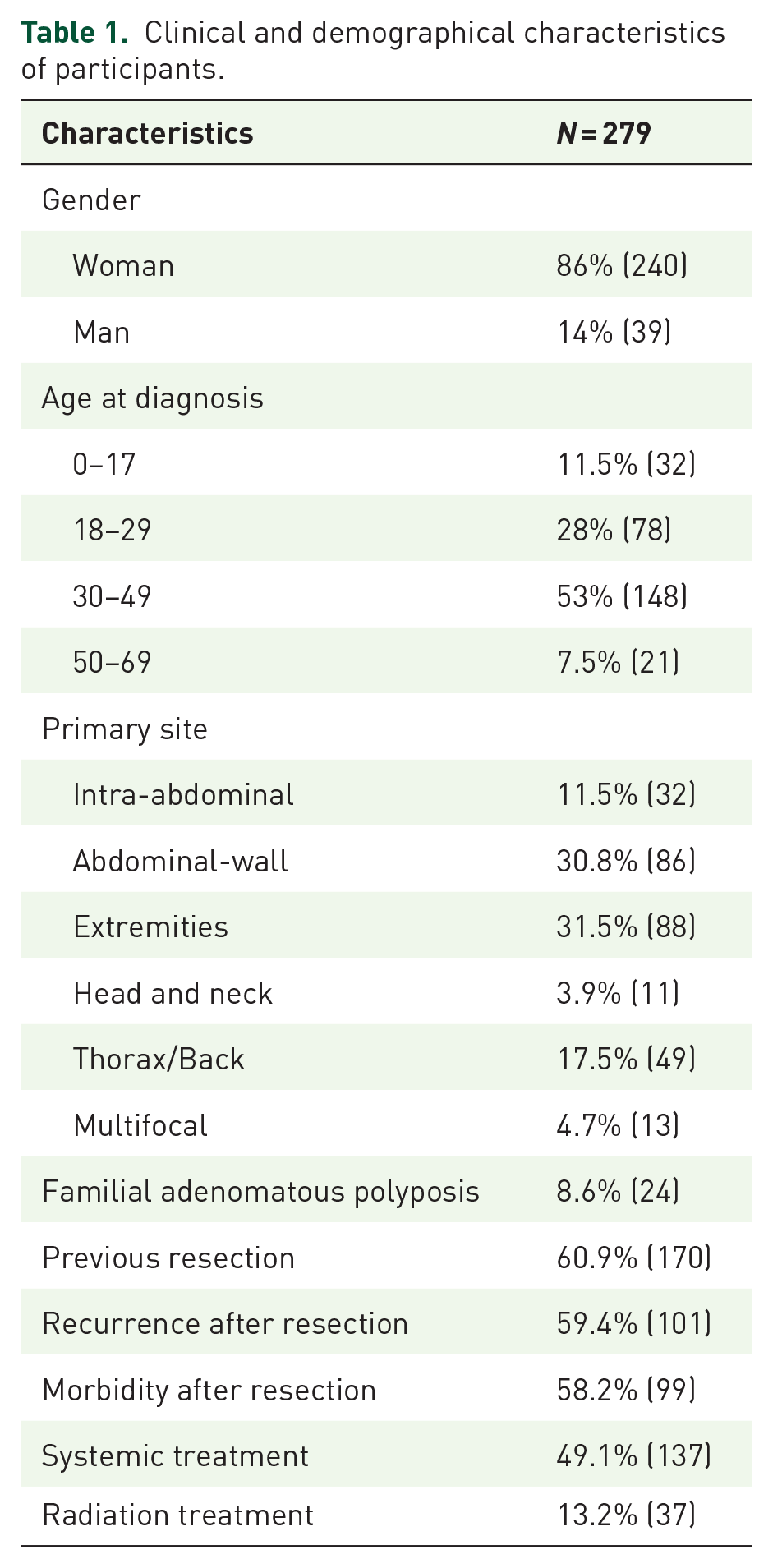
Surgery was performed in 60.9% (170) of patients. Of these, 58.2% (99) experienced a chronic decline in quality of life, and 59.4% (101) reported recurrence. Surgery is no longer the first-line therapy for desmoid tumors, largely due to the high recurrence rate and associated morbidity.1,9 Active surveillance is now preferred, with systemic therapies offered to those who progress during surveillance. 10 The substantial number of patients in our study who underwent resection likely reflects either procedures performed before the adoption of current guidelines or the absence of a specialized multidisciplinary team to manage the disease. Our findings emphasize both the high recurrence rates and the chronic decline in quality of life post-surgery.
Access to specialized care was also a recurring theme, with 58 (23.8%) reporting that the lack of a specialist team is one of their greatest barriers and 22.2% (62) expressing insecurity with their healthcare team. Many sarcoma referral centers are located in major cities, posing challenges for patients residing far from urban areas. Consequently, 43% (120) of patients reported needing to travel for treatment, further highlighting the geographic disparities in access to specialized care.
Among the 243 patients (87%) who responded to the two open-ended questions (Table 2 and Figure 1), the most frequently cited challenges were a lack of information on desmoid tumors (32.1%, 78 comments), absence of a specialist team (23.8%, 58), and psychological distress (22.2%, 54). Given the rarity of the disease, accessing reliable information has been particularly difficult for patients in Brazil, as most patient-directed resources are not available in Portuguese. The challenge of accessing a specialist team may be partially attributed to healthcare inequalities, the distance from large urban centers, and the lack of an established referral system within the public healthcare network. Finally, psychological distress is likely worsened by the rarity of the disease, which limits the development of robust patient support networks.
Qualitative assessment of challenges faced by persons affected by desmoid tumors.

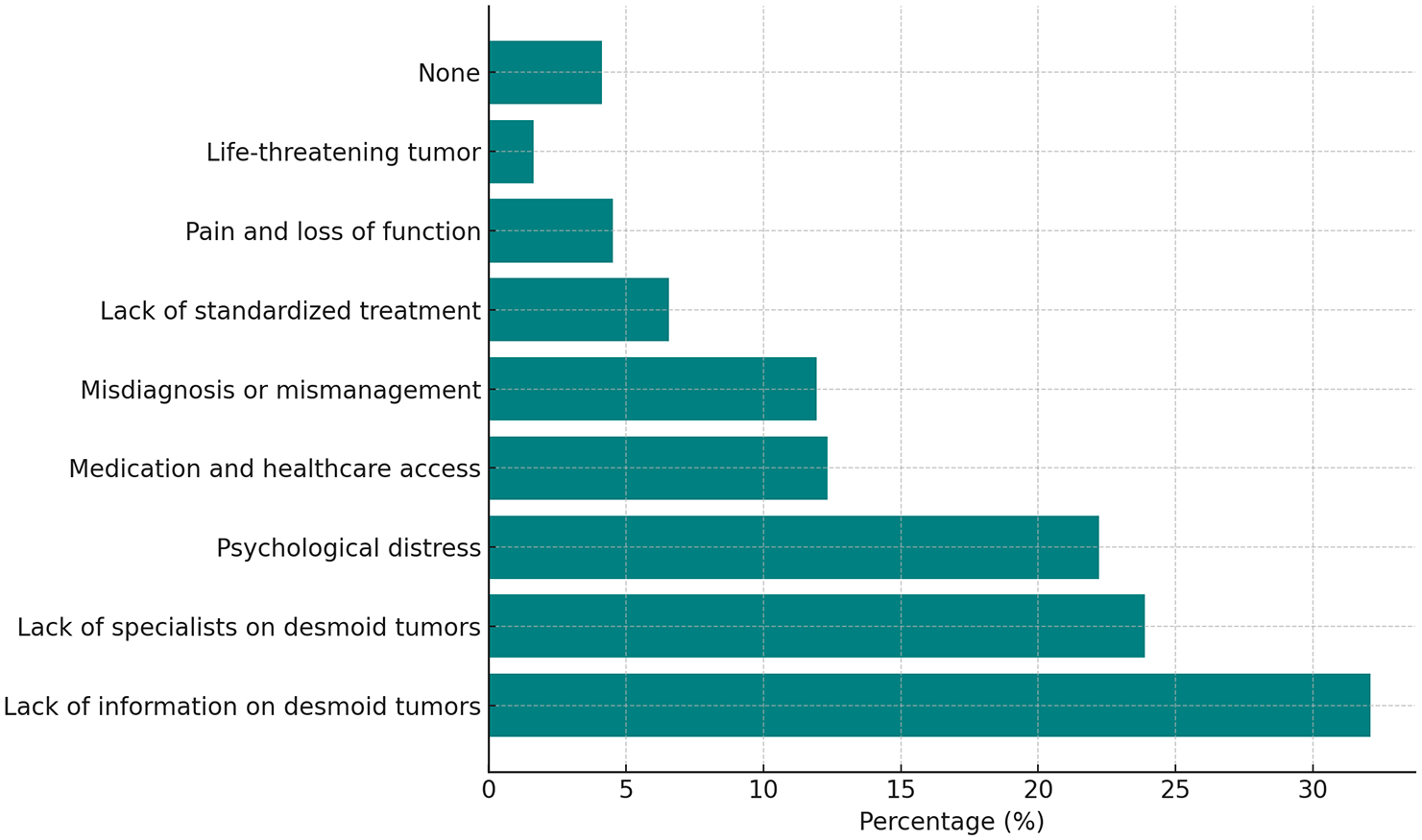
Most common challenges faced by people with desmoid tumors.
Among the 99 patients who shared their future perspectives, 24% (24 comments) expressed appreciation for the existence of a patient advocacy organization, while 21% (21) highlighted a desire for more information and support. Understanding the challenges and perspectives of individuals living with desmoid tumors in Brazil has allowed the DTBA to better shape its future strategies and initiatives.
Healthcare access
The Brazilian healthcare system operates as a hybrid of public and private sectors, with approximately 75% of the population dependent on public services, while the remaining 25% pay for health insurance. 11 Although Brazil has made notable progress in expanding healthcare access, allocating resources for rare diseases remains limited, a challenge shared by many Latin American countries. 12 This shortcoming is evidenced by the rising trend of healthcare judicialization, with a growing number of legal cases focused on access to novel cancer treatments and medications for rare diseases. 13
In this scenario, numerous opportunities arise for rare disease patient advocacy groups, which can play a vital role—especially in LMICs—by addressing issues such as delayed diagnosis, access to specialized and multidisciplinary care, and overcoming financial barriers to accessing cutting-edge treatments in the public health landscape.
Referrals and specialized teams
Brazil’s vast size affects the distribution of specialized healthcare services, leading to disparities in access for desmoid tumor patients across its five regions—North, Northeast, Central-West, Southeast, and South. In the North region, 8 out of 14 patients (57%) lack access to a local healthcare team, likely due to the area’s vast geography. In the Northeast, 28 of 62 patients (45%) must travel to receive medical attention, reflecting limited availability of specialized oncology teams in remote areas. The Central-West region shows 8 out of 22 patients (36%) without local healthcare access, attributed to its sparse population and fewer healthcare centers. Even in the populous Southeast region with advanced healthcare infrastructure, 50 of 134 patients (37%) lack access to a healthcare team in their own city, highlighting disparities in smaller or rural municipalities. In the South region, 26 out of 47 patients (55%) do not have a local healthcare team, underscoring regional disparities in the distribution of medical services despite a smaller population compared to the Southeast. These data emphasize the need for expanded access to specialized healthcare services and better support for patients who must travel long distances to receive appropriate treatment.
A broad consensus suggests that patients with sarcoma should be referred to and managed in reference centers with a high annual volume of new cases. 14 Furthermore, reference centers can form collaborative networks sharing their specialized multidisciplinary expertise, improving not only patient outcomes but also fostering clinical and translational research. However, in underserved regions, rare tumors are often deprioritized due to the pressing need to address more common diseases, such as infectious diseases. This makes it difficult to secure the necessary funding for reference centers and collaborative networks dedicated to rare cancers, as well as having accurate national-level information about sarcomas. 7 While the burden of more prevalent health issues in LMICs is undeniable, rare tumors still account for over 20% of all cancers globally, and the associated population and economic impacts should not be underestimated. 15
In a large country like Brazil, the hub-and-spoke model could be an effective solution for improving access to care. 16 This model organizes service delivery into a network with a central hub that offers a full range of services, supported by secondary establishments (spokes) that provide more limited services. Patients requiring more intensive care can be routed to the hub for treatment. When properly organized, this approach facilitates access to efficient care pathways close to home and provides numerous benefits for healthcare providers.
A well-connected network of experienced professionals could also help prevent incorrect diagnoses, which is crucial for patient care and data accuracy. Improving initial care is not solely the responsibility of specialized oncology professionals; general practitioners, especially surgeons, must recognize the signs of sarcoma and refer patients immediately to appropriate centers or consult within a well-connected network. Awareness campaigns can help disseminate information in the community, reducing delays in diagnosis and inadequate treatments. Initiatives that enhance primary care and are driven by histological insights could significantly shorten the time from suspicion to accurate diagnosis. Finally, formulating national standardized policies for managing sarcomas can improve overall survival. 17
Medication access and public regulations
Many countries lack a high-quality operational cancer control plan, contributing to poor cancer outcomes. Access to new technologies, including systemic cancer treatments, remains a significant challenge in LMICs. Most cancer drugs are initially introduced in the United States and European markets, following approval by regulatory agencies. These approvals often set a precedent for other regions, including Latin America. However, the cost of these novel therapies poses a substantial barrier to access for many Latin American healthcare systems.
For rare cancers specifically, the approval process and pathways to access new medications must be individualized. Given that only a small portion of the population requires treatments for rare diseases, these drugs are often expensive and difficult to integrate into public health systems, particularly in Latin America. To improve access for patients in these regions, immediate strategies could include expanding access programs and increasing participation in clinical trials.
Collaboration among regulatory agencies in different Latin American countries, regional researchers, and patient advocates is essential for establishing more efficient and standardized regulatory processes to ensure timely access to innovative therapies for sarcoma patients.12,18,19 Recently, more approvals have been based on phase III studies in Latin America, indicating a trend toward using more robust outcomes for these decisions. However, it is important to recognize that while these statistical benefits may be evident in the studies justifying approvals, they may not always translate into clinically meaningful patient outcomes. Additionally, trial designs for rare cancers may require a higher degree of adaptation, and regulatory agencies should take into consideration this unique landscape. Improving the quality of life is a necessary endpoint that can significantly aid in decision-making, especially for a chronic condition such as desmoid tumors.20,21
Lack of research in desmoid tumors
Globally, rare cancers receive a lower volume of investment in research. 22 The small patient populations and challenges in establishing clinical trials with sufficient statistical power contribute to limited industry interest. In developed countries, efforts are underway to address this situation through research grants specifically designated for rare cancers, such as the ATTRACT (Accelerated Together Rare Cancer Treatment) initiative in Europe. The situation is even more challenging in LMICs, which face deeper limitations in research infrastructure and funding for rare conditions like desmoid tumors.
Patient advocacy groups in developed countries play a vital role in advocating for increased funding for research into desmoid tumors. In the United States, the Desmoid Tumor Research Foundation (DTRF) has been providing research grants that have significantly advanced the understanding and treatment of desmoid tumors. In contrast, advocacy groups in developing countries often struggle to secure financial support, which limits their ability to promote research effectively. However, there is potential for advocacy groups in LMICs to facilitate partnerships among local researchers, healthcare providers, and international organizations. By connecting these stakeholders, they can create a network that shares knowledge, resources, and best practices. 23 Additionally, while raising public awareness about the disease, advocacy groups can emphasize the importance of research investments, helping to mobilize funding through governmental initiatives and private sector donors.
Establishing a high-quality patient registry is essential for successful clinical trials and other research initiatives. 24 This should be a strategic goal for any patient advocacy group focused on rare diseases, especially in Latin America, where the coverage and quality of cancer registries are known to be deficient.25,26 One of the most impactful steps taken by DTBA has been the creation of a national patient registry for desmoid tumors. By collecting comprehensive patient data—such as demographics, tumor characteristics, and treatment modalities—the association aims to provide a clearer picture of the disease in Brazil. This effort may help attract clinical trials and support the development of research initiatives similar to what the DTRF has achieved in the United States. 24
Awareness and education of patients and physicians
Awareness of rare diseases, such as desmoid tumors, remains low among healthcare professionals and the general public, not only in LMIC but also globally.27–30 Many healthcare professionals are not familiar with the early signs of desmoid tumors, leading to misdiagnoses or delayed referrals to specialists. 31 In LMICs, this issue is further aggravated by limited resources for healthcare education and training, especially concerning rare conditions. 32 To address this issue, it is essential that medical and health professions curricula be revised to highlight the importance of considering rare diseases in the diagnostic process and the critical need for early referral to specialized centers, often before any treatment is initiated. 27 For soft tissue tumors like desmoid tumors, it is recommended that cases be referred to centers with greater expertise even prior to the first biopsy. 33
In this sense, patient advocacy groups, such as the DTBA, play a crucial role in raising awareness. They provide resources and organize campaigns aimed at educating healthcare providers on the importance of early detection and treatment. DTBA, since its founding, has initiated various educational campaigns aimed at increasing awareness among healthcare providers. Through seminars on online platforms, they educate physicians, oncologists, and surgeons on the nuances of diagnosing and managing desmoid tumors. This is particularly important in creating awareness around the “watchful waiting” policy for desmoid tumors, which is currently the first recommended step in the management of most cases of the disease, 2 but may face resistance or cause discomfort for some doctors and patients.
Another accomplishment of the DTBA was successfully lobbying for the official designation of “Desmoid Tumor Awareness Day” in the Brazilian national calendar in a few states (PL-AM 875/2023). The date was chosen for a campaign aimed at raising awareness about the nature and implications of desmoid tumors, informing the public about the signs and symptoms, and reducing the stigma associated with the disease.
Enhancing patient education and fostering active engagement in their care has been shown to improve health outcomes, increase patient satisfaction with the care experience, reduce healthcare costs, and support healthcare providers in delivering more effective care. 34 In chronic diseases such as desmoid tumors, patient education is linked to better treatment adherence, fewer complications, and improved quality of life. 35 Since informed patients are more likely to follow the treatment guidelines, educating them about the safety and rationale of active surveillance in cases where desmoid tumors can be managed conservatively may also help prevent overtreatment and its associated costs. 36 Additionally, patients who understand their diagnosis and treatment tend to feel more empowered and less anxious, which is particularly important for desmoid tumor patients who often face uncertainty due to the disease’s unpredictable behavior.37,38
The DTBA, in collaboration with specialist physicians, has developed an informational booklet in layman’s terms that covers the biology of desmoid tumors, the role of active surveillance, and the available treatments for indicated cases. This booklet is distributed free of charge to all patients who join the DTBA. The association also organizes an annual educational symposium for both health professionals and patients, featuring lectures by experts in the field.
Collaborations with other organizations
Patient support groups are defined as “a group of people with common experiences and concerns who provide emotional and moral support for one another.”39,40 These groups can play a critical role by educating patients, sharing experiences, offering strength to members, raising public awareness, and fundraising. 39 In rare diseases, such as soft tissue sarcomas, these groups are particularly important due to the challenges patients face in navigating complex healthcare systems. Organizations such as the Sarcoma Patients Global Network (SPAGN, formerly Sarcoma Patients EuroNet Association (SPAEN)) were established to address these needs. 41 SPAGN is an international network comprising national sarcoma, gastrointestinal stromal tumor, and desmoid tumor patient advocacy groups. 41 As of 2024, there are nine desmoid tumor associations worldwide: the DTRF (United States), Desmoid Tumour Foundation Canada (Canada), Desmoid Fibromatosis UK Patients & Caregivers (United Kingdom), SOS Desmoide (France), Associazione Italiana Tumore Desmoide (Italy), SOS Desmoid e.V. (Germany), Contactgroep Desmoid (Netherlands and Belgium), Desmoid Tumor Denmark (Denmark), and the DTBA (Brazil). With the exception of the DTBA, all are based in high-income countries.
Those international advocacy groups frequently receive pleas for assistance from patients in LMICs seeking second opinions from specialists in high-income countries located at academic sarcoma centers.41,42 However, these second opinions often offer limited practical benefits when patients’ home countries lack the necessary treatments or specialists, leaving them without viable options for care. 41 As stated in a SPAGN position paper, “The long-term solution for cross-border healthcare cannot be medical tourism for those patients who may be able to afford it.” 41
Many aspects of current oncology practice are found almost exclusively in high-income countries, and even in those, it can be unequally distributed, being restricted to large-volume academic centers. 41 In LMICs, the challenges are even more profound due to limited financial resources, inadequate infrastructure, shortages of healthcare professionals, and insufficient access to advanced medical technologies. 41 The World Health Organization (WHO) has already documented that cancer patients in poorer countries and poorer patients in rich countries have a lower chance of survival. 41 These inequities are further magnified in the case of rare diseases.
In 2024, recognizing the lack of representation in Latin America, SPAGN partnered with the DTBA, the Sarcoma European and Latin American Network (SELNET), and the Brazilian Sarcoma Group (Grupo Brasileiro de Sarcoma) to establish Sarcomunicándonos. This network aims to connect sarcoma and desmoid tumor patients with specialists in Brazil and other Latin American countries. The goal is to facilitate the sharing of experiences and to connect patients with local experts who can establish referral centers and discuss treatment options adapted to the regional context. SPAGN’s next objective is to form a patient support group in Latin America where individuals can communicate in Portuguese and Spanish about their experiences. This initiative is particularly important, as Latino patients tend to show higher interest in such interventions compared to other groups. 43
The initial desmoid tumor consensus-based guideline was led by the DTRF and included specialists from eight countries, 10 all high-income countries. While these guidelines represent significant progress, they include recommendations that are challenging to implement in LMICs. For example, universal molecular testing for all desmoid tumors is not routinely covered in Brazil and may cause financial strain for patients paying out of pocket. 10 In November of 2023, nirogacestat was approved in the United States for use in desmoid tumors. 2 By 2024, it was under evaluation by the European Medicines Agency, but it had not been submitted for approval to any regulatory agencies in LMICs. The new consensus guideline was done in conjunction with the DTBA, which helped to provide the perspective of LMICs during its formulation. 2 Although this is a significant step, there remains an urgent need for desmoid tumor guidelines tailored to local realities, reflecting the accessibility of diagnostic tests and approved medications in Brazil and other Latin American countries.
Future perspectives
Upon analyzing the data from the questionnaire administered to DTBA’s associated patients, the association has gained insights into the complex challenges faced by Brazilian patients upon receiving a diagnosis of desmoid tumor. These challenges encompass the initial uncertainty resulting from limited information, ongoing psychological distress, difficulties in accessing medication, and coordination within the healthcare system. The findings underscore the urgent need for tailored support services, enhanced medical education, and improved communication between patients and healthcare providers within the Brazilian healthcare system. Furthermore, the voices and perspectives shared by participants highlight the resilience and determination of patients in advocating for their needs and seeking better outcomes. In light of these findings, DTBA has identified its focus areas for the next 5 years:
Promoting desmoid tumor information.
Facilitating access to specialists.
Facilitating access to novel therapies.
Fostering research and conducting research in Brazil, including translational science and clinical trials.
This strategic direction aligns closely with the identified needs of patients, aiming to bridge the gap in knowledge, improve the availability of specialized care, and empower individuals in their desmoid tumor journey.
Conclusion
In conclusion, desmoid tumors present significant challenges for patients, particularly in LMICs, where access to specialized care, reliable information, and necessary medications is limited. The establishment of patient advocacy groups, such as the DTBA, plays a critical role in addressing these challenges by providing support, facilitating access to healthcare, and raising awareness. Through its focus on patient perspectives, educational initiatives, legal advocacy, and fostering research collaborations, the DTBA continues to pave the way for improved care and support for desmoid tumor patients in Brazil. By enhancing knowledge and healthcare accessibility, patient organizations like the DTBA empower individuals and contribute to the global effort to improve the quality of life and outcomes for those affected by this rare condition.
Supplemental Material
sj-docx-1-tam-10.1177_17588359241309827 – Supplemental material for Enhancing rare cancer care in developing countries through patient advocacy: insights from the Desmoid Tumor Brazilian Association
Supplemental material, sj-docx-1-tam-10.1177_17588359241309827 for Enhancing rare cancer care in developing countries through patient advocacy: insights from the Desmoid Tumor Brazilian Association by Philippos Apolinario Costa, Carolina Menezes, Bruna Bianca Lopes David, Georgia Garofalo, Livia Prudente Barbieri and Fernando Campos in Therapeutic Advances in Medical Oncology
Footnotes
Acknowledgements
We would like to honor the memory of Dr. Celso Mello, whose invaluable expertise and unwavering dedication were instrumental in forming the Desmoid Tumor Brazilian Association. His passing is a tremendous loss to the medical community and everyone who had the privilege of working with him. Dr. Mello’s legacy of excellence in sarcoma research and his compassionate approach to patient care will continue to inspire and guide our efforts.
Declarations

Supplemental material
Supplemental material for this article is available online.
References
Supplementary Material
Please find the following supplemental material available below.
For Open Access articles published under a Creative Commons License, all supplemental material carries the same license as the article it is associated with.
For non-Open Access articles published, all supplemental material carries a non-exclusive license, and permission requests for re-use of supplemental material or any part of supplemental material shall be sent directly to the copyright owner as specified in the copyright notice associated with the article.
