



Abstract
Aim:
The study aims to utilise a strengths-based approach to investigate whether Indigenous Australian adolescents with affective engagement in their schooling and education are more resilient, and if this resilience from affective engagement in school contributes to predict the negative consequences associated with bullying at school.
Methods:
The current study comprised 490 Indigenous adolescents aged 11–16 years from four Footprints in Time: The Longitudinal Study of Indigenous Children (LSIC) waves (W8, W10, W11 and W12 – conducted between 2014 and 2019) of the ‘Longitudinal Study of Indigenous Children’ dataset. In this study, Generalised Linear Models (GLMs) were employed to examine whether affective school engagement (independent variable) was associated with the outcome variable – the study child’s resilience (measured by the validated Strong Souls Resilience subscale) and whether it varied by child’s exposure to bullying victimisation. All models were adjusted for potential sociodemographic covariates (i.e. age, sex, location and socioeconomic position).
Results:
Of the 490 participants analysed, 89.4% (n = 438) had high affective school engagement, 37.8% (n = 185) were not bullied and the mean resilience score was 19.41 (SD = 5.21). Bivariate analysis revealed that there was a significant difference in median resilience score between two categories of school engagement (p = 0.002). Longitudinal analysis using GLMs showed that high affective school engagement is a positive predictor of the study child’s resilience (p = 0.013) compared with those with low school engagement. Affective school engagement was found to be associated with resilience only among those who were bullied compared with their counterparts (p = 0.039).
Conclusions:
This study found that affective school engagement predicts resilience in Australian Indigenous adolescents. Affective school engagement may also serve as a protective factor for adolescents who have been bullied, potentially mitigating some of the harmful mental health outcomes linked with bullying. These findings underscore the potential for programmes that may promote affective school engagement in future initiatives to improve education inequities that cause health disparities for Indigenous peoples.
Keywords
Introduction
Australian Aboriginal and Torres Strait Islander Peoples are the proud custodians of one of the oldest living cultures in the world, which has persevered despite the ongoing effects of colonisation (1). While community organisations are doing important work to improve the overall health and well-being of First Nations peoples, limited government funding often forces them to work outside Indigenous ways of Knowing, Being, and Doing (2), which can contribute to the burden of disease for Indigenous communities. A strengths-based approach prioritising Indigenous knowledge and cultural protocols is needed to address the health disparities that Indigenous peoples face (3). This includes addressing inequalities across social determinants of health such as education, housing, employment and income, and access to health services. Research into the cultural determinants of health that are protective factors and support good health and well-being for Aboriginal and Torres Strait Islander people has been emerging (4). So far, strengths-based research has found and confirmed that strong family links, friends, connection to community, connection to culture and sense of identity are affirming cultural determinants of health (5).
There is a significant amount of research that suggests education and health are intrinsically linked, and that education is one of the strongest determinants of health (5). Education is not only associated with life expectancy, health behaviours and morbidity, but also plays an important role in health and wellbeing by shaping employment, income and access to opportunities (6). It has been observed across many countries – from lower-middle-income countries to highly developed ones – that children and adults with more previous educational experiences have better health when compared with their less-educated peers (7). The mechanisms through which education affects health and well-being are complex and interlinked. It is thought that the relationship between education and health outcomes can be classified by three general classes of attributes – economic, social and psychological variables, and health behaviours. Income and employment allow for access to funds to support housing, food and acute and preventive medical care (8). Social and psychological resources allow for educated people to access social support, coping resources and strategies, and typically increased problem-solving and cognitive abilities to handle stressors and consequences of ill-health. Resilience, which is defined by the ability to maintain psychological well-being in the face of adversity, is one important psychological resource. Resilience can safeguard against mental health conditions and helps navigate challenges that may increase the risk of these conditions, such as bullying or traumatic experiences. Healthy behaviours also enable educated individuals to recognise symptoms of poor health and well-being to allow for more timely seeking of appropriate medical assistance (7).
It is also well-established in both Indigenous and non-Indigenous literature that the educational opportunities and experiences that children have access to have a lasting impact on their health as adults. Given the considerable amount of time children spend in schools, the role that schools play in shaping a child’s health knowledge, behaviours and outcomes is essential. Research conducted across 26 different countries and participants of different socioeconomic status shows that the quality, length and intensity of education programmes have an impact on the well-being of children as they grow into adults (9). For example, studies have revealed that children who enrol in lower-quality schools with more limited health resources, safety and violence concerns, and a distressed school climate with low teacher support are more likely to have poorer physical and mental health in their future (10). Several other school determinants of child health have also been identified – including the physical and structural environment of a classroom, health policies, health programmes and resources available, and the composition of the school, in relation to school size, student numbers, staff gender and racial composition, and the average pupils’ socioeconomic status (9).
Dunstan et al. (15) were one of the first groups to assess affective Indigenous school engagement, which refers to a student’s emotional response to school – their sense of belonging, enjoyment and emotional investment in learning, and examine the socio-structural subjective and relational factors that influence it. They utilised one wave of the Footprints in Time: The Longitudinal Study of Indigenous Children (LSIC) data and found that positive associations with affective engagement included good peer and teacher relationships, being female, living in remote areas, and being healthier. On the other hand, peer teasing, limited positive peer interactions and internalised negative feelings about Indigenous identity were found to have negative associations with school engagement. They also found that parental employment, household income and Indigenous Relative Socioeconomic Outcomes (IRSEO) index scores were not significantly associated with affective engagement.
One of the most salient aspects of a child’s schooling experience that has been associated with youth resilience is the overall climate of the school – which includes the school norms and academic values, teacher–student relationships, family–school connections and any presence of violence or bullying. Literature across First Nations and non-Indigenous populations has shown that both a positive school climate (for example, the school being a nice place to be, teachers being approachable and friendly), and a negative school climate (for example, where there is bullying or violence) have been associated with different levels of physical and mental health in students (11). It is well known that bullying in childhood is a major public health problem that increases the risk of poor health, and social and educational outcomes in childhood and adolescence. These consequences apply to all those involved in the bullying – the bullies and victims – and are recognised to persevere well into adulthood (12). Alternatively, the importance of affective engagement in school for student outcomes has been widely recognised in education literature (13). Affective engagement refers to the student’s emotional response to school – their feeling of involvement in the school and towards learning activities as a worthwhile pursuit. This can be influenced by various subjective, relational and socio-structural factors, but overall, studies show positive associations between elements of affective engagement in school and academic achievement and health outcomes (14).
Overall, the associations between a positive schooling experience and improved resilience in both Indigenous and non-Indigenous children have been well-researched. In general, fewer published research studies have examined the association between school climate and mental health for Indigenous students, but it has long been recognised that inequalities in Indigenous educational experiences contribute significantly to the overall disadvantage experienced by Indigenous Australians (15). As such, improving educational outcomes and experiences has been identified as a priority for improving Indigenous Australians’ well-being (16). Furthermore, while both positive and negative associations between various aspects of education, school determinants and health outcomes in children have been established, there is less information available detailing the importance of a child’s perceived experience and enjoyment of school and the impact of this on their resilience and mental health, particularly in the face of adversities such as bullying.
This study aimed to utilise a strengths-based approach to investigate whether Indigenous Australian adolescents with affective engagement in their schooling and education are more resilient. It also aimed to ascertain whether this resilience from affective engagement in school is associated with the negative consequences associated with bullying at school. By adopting a strengths-based approach and prioritising Indigenous knowledge and cultural protocols, we can work towards creating more equitable health outcomes for Indigenous peoples in Australia (3).
Methods
Data source, study design and participants
This study utilises data collected for LSIC – an Australian Government initiative that provides quantitative and qualitative information from Aboriginal and Torres Strait Islander children from different locations across Australia (17–20). The overall intention of the LSIC study is to provide insight into the various aspects of the lives of Indigenous children in Australia, to guide ongoing efforts to mitigate the inequalities between health and wellbeing outcomes, between Indigenous and non-Indigenous Australians. We have applied a strengths-based approach to this perspective for this current study. In brief, LSIC uses a non-random purposive sampling design across 11 Indigenous communities in Australia, following longitudinally the growth, development and specific outcome measures of Indigenous families in urban, regional and remote settings (17–20).
The LSIC follows the development of up to 1700 Indigenous children and their families across urban, regional and remote Australia, covering a wide range of socio-economic status, rural and remote locations and cultural groups. The study recruited two cohorts of children who were aged 6–18 months (B cohort) and 3.5–5 years (K cohort) when the study began in 2008. Data have primarily been collected via annual face-to-face surveys performed by Indigenous interviewers with the child and/or their parents and teachers. Further details on the LSIC study and methodology have previously been described (18–20).
Up until now, there have been 12 waves of the LSIC. A flow chart for the selection of the analytical sample is presented in Figure 1. This study included 490 Indigenous adolescents aged 11–16 years at the time of the latest LSIC Wave 12 in 2019. We included participants who provided complete data on the outcome variable (resilience) and exposure variables (affective school engagement and bullying) in our study. Participants who did not respond to outcome and/or predictor variables were omitted (n = 908).
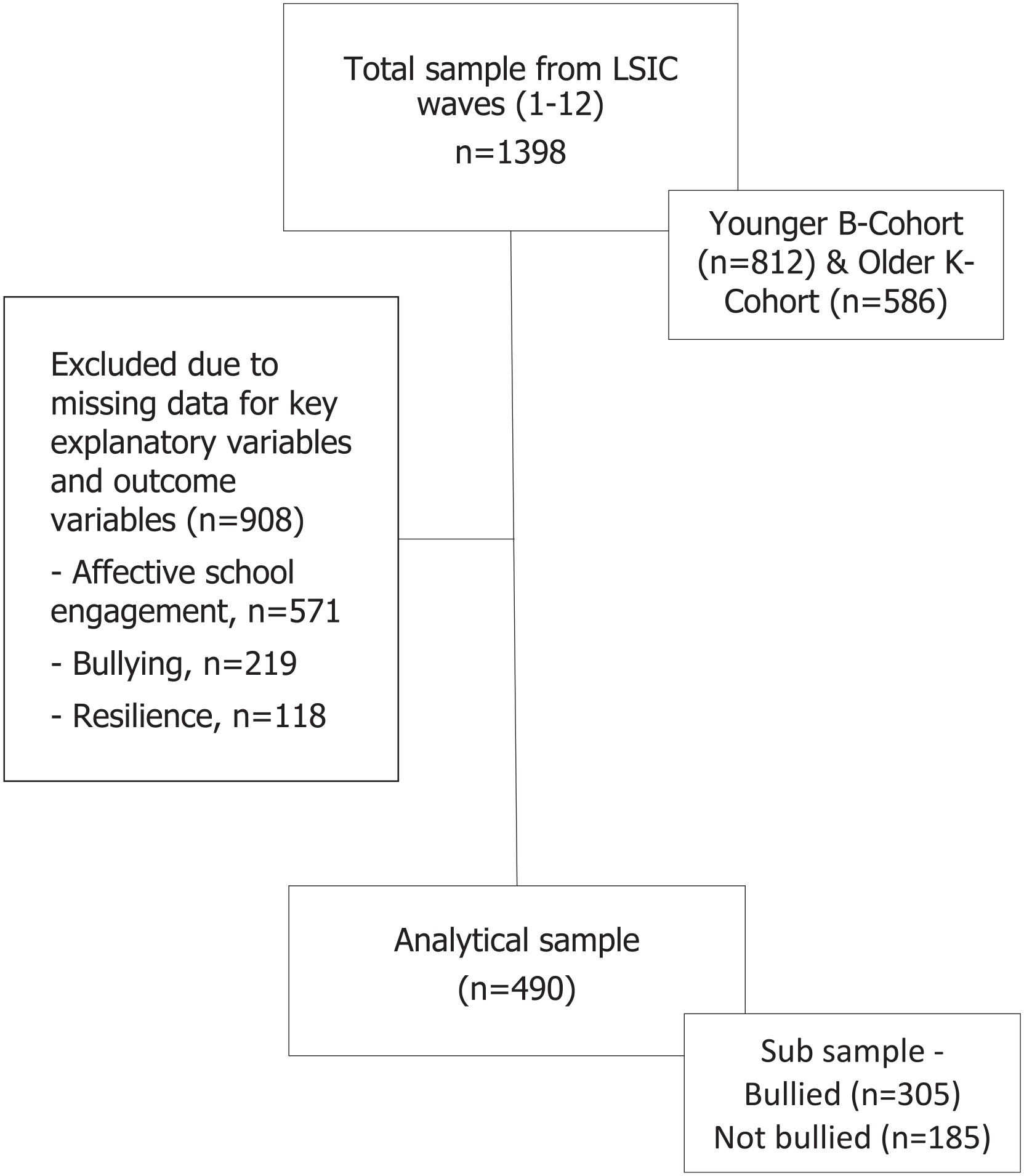
Analytical sample flow chart.
Measures
A range of variables associated with the social and emotional well-being of Indigenous adolescents aged 11–16 years were examined in this study using the ‘Positive Outcome Approach’ (21). This approach measures the association between positive factors (e.g. affective school engagement) and positive outcome variables (e.g. resilience) instead of using the deficit discourse pattern (risk factors and adverse outcomes) (21).
The following variables are included in this study (listed in detail in Supplementary material File 1 online):
Outcome variable:
Resilience of study child. The Strong Souls Resilience subscale (22) was used to measure the resilience of the study child and was reported by the parents of the study child. The following 12 strength-based items were included in the Strong Souls Resilience subscale in LSIC Wave (W) 12: something can cheer study child up; study child has a strong family; study child adjusts to changes quickly; study child laughs and jokes a lot; study child is really into something like music; study child knows about family, history and culture; study child is good son/daughter of their family; study child is good at something; study child has got an older person looking out for them; study child knows someone who is a good person; study child has lots of friends; and study child has someone to talk to when upset.
Explanatory variables:
Affective school engagement. It was measured from the responses of the following five items from LSIC W10 and W12: whether the study child is happy to go to school; whether the study child feels safe at school; whether the study child thinks that they are good at schoolwork; whether the school is good for the study child; and whether the study child has trustable people at school. The information regarding ‘Affective school engagement’ was reported by the study child.
○ Bullying. Whether the study child was bullied at school or not was extracted from four LSIC waves (W8, W10, W11 and W12) reported by the parents.
Sociodemographic covariates. Age, sex, area of residence and socioeconomic position (IRSEO Index).
Cultural integrity
This research fostered a reciprocal learning experience between Indigenous and non-Indigenous authors. It enabled Noongar/Yamatji Aboriginal co-author T. E. to enhance his research skills while allowing the team to benefit from his leadership, expertise and deep understanding of Indigenous knowledge. Additionally, the project empowered T. E. to oversee, share, preserve and expand his cultural and intellectual heritage through Indigenous ways of Knowing, Being and Doing, which guided the research process.
The current study employed a quantitative approach following an Indigenous research paradigm, which was informed by a strength-based model and incorporated elements of the CREATE Aboriginal and Torres Strait Islander Quality Appraisal Tool to uphold cultural integrity where possible (23,24). Furthermore, the Footprints in Time Steering Committee, composed of Indigenous representatives and community stakeholders, oversees the broader LSIC study. The Committee provides guidance on survey design, study planning, data collection methods, community engagement, ethical considerations, cultural sensitivity, and data analysis and interpretation prioritising Australian Indigenous knowledge and cultural protocols (17,20,25).
Statistical analysis
Initially, descriptive statistics (frequencies and percentages for categorical variables, mean and standard deviation for continuous variables) on outcome and independent variables were calculated. For the multivariable longitudinal analysis, considering the study sample (i.e. Indigenous children) were nested in households, and households were nested within clusters in LSIC (1,18–20), and the distribution of outcome of interest was slightly skewed on the right side, we first ran the Kruskal–Wallis test (non-parametric bivariate test measuring chi-square (χ2) and p-value) to examine the strength of the bivariate relationships between affective school engagement and resilience; and then we ran Generalised Linear Model (GLM) (measuring co-efficient, p-value and 95% confidence interval (CI)) to examine whether affective school engagement is a predictor of resilience among 11–16-year-old Indigenous Australians, adjusted for covariates (i.e. age, sex, location and socioeconomic position). Further, we tested whether it varied in sub-sample analysis (i.e. stratified by bullying victimisation). Variables yielding a p-value of <0.05 in the adjusted models were considered as significant. Stata/SE 14.1 (Stata Corporation, College Station, TX, USA) was used to perform all statistical analyses.
Results
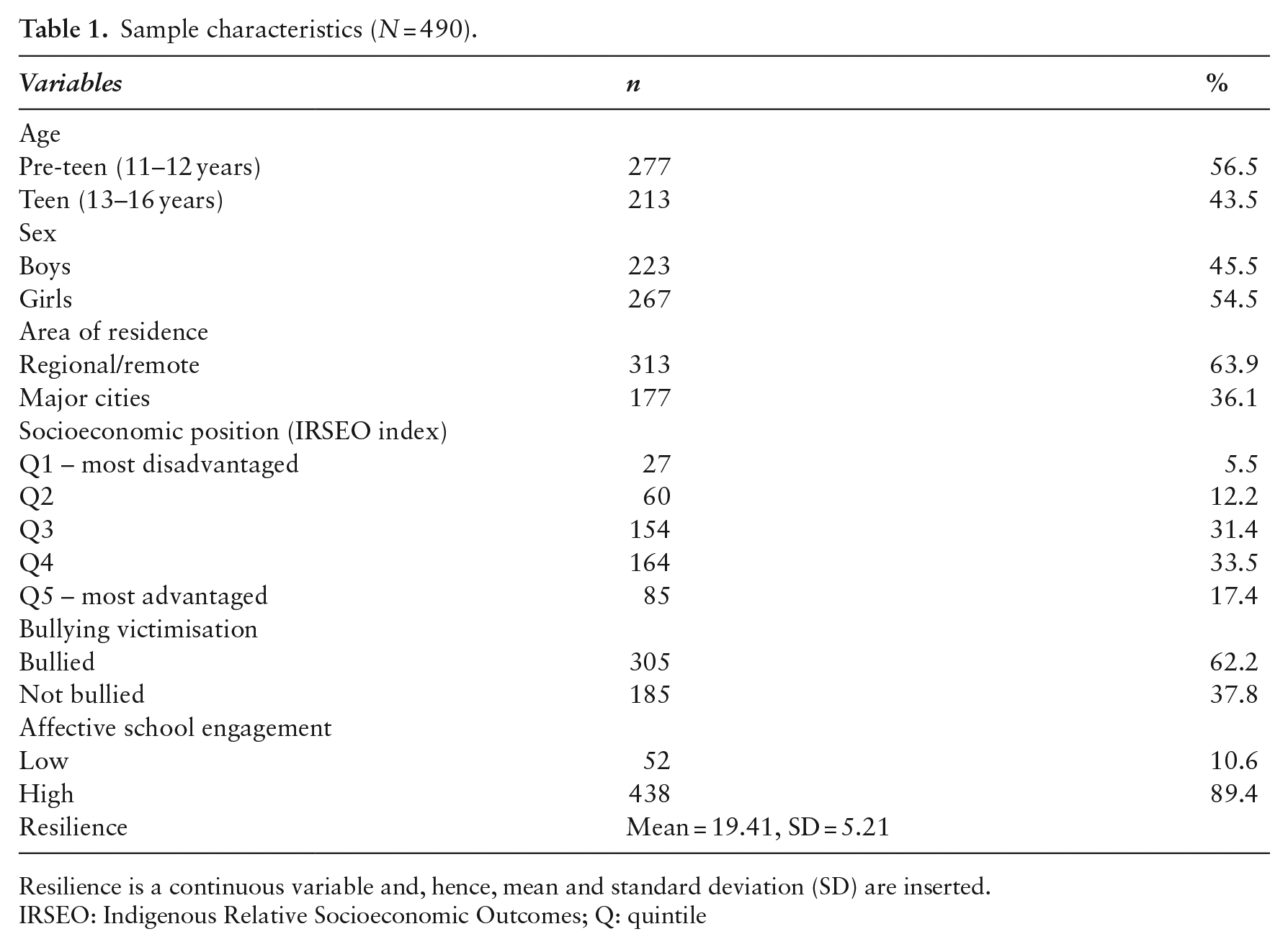
This study included 490 Indigenous adolescents aged between 11 and 16 years old who participated across Waves 8 to 12 of the LSIC. The sample characteristics are presented in Table 1. Of the 490 participants included in this study, 43.5% (n = 213) were teen-aged (13–16 years) and the rest (56.5%, n = 277) were pre-teen aged (between 11 and 12 years old). Most participants were girls (54.5%, n = 267) and lived in regional or remote areas (63.9%, n = 313). The IRSEO measures the relative socioeconomic position of Indigenous Australians living in one location to those living in another. Most participants fell between quintile 3 (31.4%, n = 154) and quintile 4 (33.5%, n = 164), where quintile 1 was most disadvantaged (5.5%, n = 27) and quintile 5 was the most advantaged group (17.4%, n = 85).
Sample characteristics (N = 490).
Resilience is a continuous variable and, hence, mean and standard deviation (SD) are inserted.
IRSEO: Indigenous Relative Socioeconomic Outcomes; Q: quintile
Table 1 also shows that 305 of the 490 (62.2%) of the study children experienced school bullying and the majority (89.4%, n = 438) of sample adolescents reported high affective engagement with school. The mean resilience score (using the Strong Souls Resilience subscale) among the sample was 19.41 (SD = 5.21).
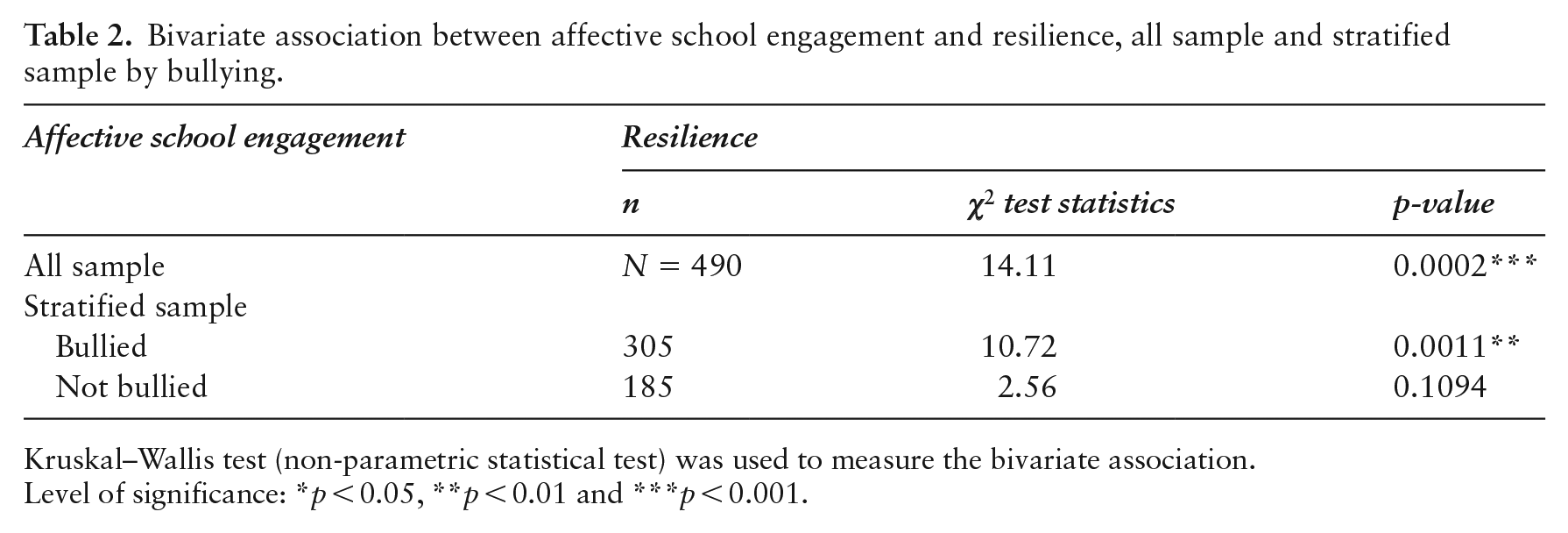
In Table 2, the bivariate analysis using the Kruskal–Wallis test depicted that the affective school engagement is significantly associated with study child’s resilience (χ2 = 14.11, p = 0.0002). Among those who were bullied, affective school engagement was also found to be significantly associated with the resilience (χ2 = 10.72, p = 0.0011).
Bivariate association between affective school engagement and resilience, all sample and stratified sample by bullying.
Kruskal–Wallis test (non-parametric statistical test) was used to measure the bivariate association.
Level of significance: *p < 0.05, **p < 0.01 and ***p < 0.001.
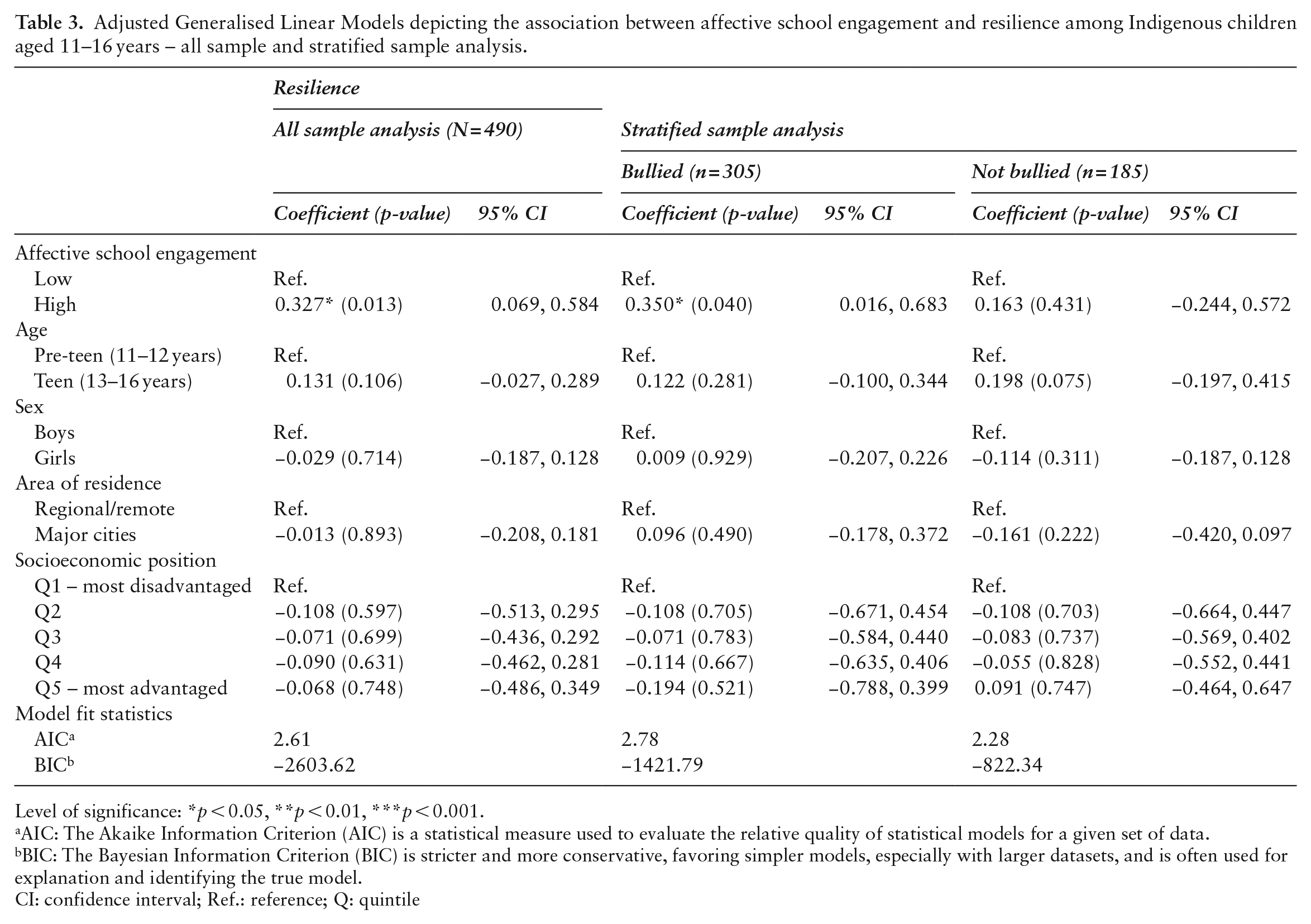
The adjusted GLMs presented in Table 3 revealed that high affective school engagement is a significant predictor variable for the study child’s resilience (coefficient: 0.327, p = 0.013, 95% CI: 0.069, 0.584) compared with those with low affective engagement at school. In the stratified analysis, among those who experienced bullying, Indigenous adolescents with high affective school engagement were found to be positively associated with a higher resilience score (coefficient: 0.312, p = 0.039, 95% CI: 0.016, 0.683) compared with those who had low school engagement; while, among those who were not bullied, affective school engagement was not found to be associated with resilience. Table 3 also found that socioeconomic covariates were not associated with the study child’s resilience.
Adjusted Generalised Linear Models depicting the association between affective school engagement and resilience among Indigenous children aged 11–16 years – all sample and stratified sample analysis.
Level of significance: *p < 0.05, **p < 0.01, ***p < 0.001.
aAIC: The Akaike Information Criterion (AIC) is a statistical measure used to evaluate the relative quality of statistical models for a given set of data.
bBIC: The Bayesian Information Criterion (BIC) is stricter and more conservative, favoring simpler models, especially with larger datasets, and is often used for explanation and identifying the true model.
CI: confidence interval; Ref.: reference; Q: quintile
Discussion
This study sought to examine the impact of affective school engagement on resilience in Indigenous adolescents and to assess how this differs for adolescents who have experienced bullying. Pleasingly, we found that a large proportion of adolescents in school had a high level of resilience. Unfortunately, most adolescents had also been a victim of bullying at some point during their school years. This proportion was higher than that found in the literature globally, where between 20% to 60% of adolescents report experiencing bullying at some point in their schooling years (26,27). The high prevalence of bullying experienced by Indigenous children found in this study is reflected in previous descriptive and qualitative studies that have detailed the variable socio-psychological and community factors that influence bullying behaviour among Aboriginal Australian youths (28,29).
In a novel finding, this study revealed that among adolescents who had experienced bullying, those with high affective school engagement are more likely to be highly resilient compared with those who had low school engagement, suggesting that strong affective school engagement may be protective in a child who has experienced bullying. Alternatively, it might suggest that more resilient adolescents continue to report affective engagement with their school despite having been bullied. Our findings may be further evidence of the importance of affective school engagement for resilience, and thus the overall social and wellbeing outcomes of youths at school, which has implications for policy strategies going forward. Increased attention should be directed towards the factors that influence affective school engagement when developing policies and interventions to improve educational outcomes for Indigenous Australians, particularly those who experience bullying. This may need to extend further than just looking at school attendance (30) and consider the cultural and social factors that influence school engagement as previously detailed. Improving engagement in school may also be considered as a channel to mitigate the negative social and well-being associations with children who experience bullying in the future. This is important because a systematic review of bullying and health-related quality of life in adolescents performed by Dubey et al. (31) established that bullying experiences led to an overall reduction in health-related quality of life (in physical, social and psychological well-being domains) and a decline in adolescent mental health. Similarly, Flaspohler et al. (32) found that children’s wellbeing was adversely affected by bullying, whether it was as a victim or perpetrator. They also found that support from teachers and peers at school served to mitigate some of the impact that bullying had on the children’s quality of life (32).
Although this study does contribute to previous literature on the association between affective school engagement and resilience in Indigenous adolescents, our findings should be interpreted with consideration of some limitations. First, the study’s sample size was small (N = 490); participants from the overall LSIC cohort were excluded due to missing responses, potentially increasing the risk of selection bias. Additionally, the sample represents only Indigenous populations, limiting its generalisability to the broader Australian population, including non-Indigenous individuals and other age groups such as adults. Furthermore, participants were not enrolled from Indigenous Protected Areas, where conditions may differ from those in other regions of Australia. Second, the study’s independent variable – affective school engagement – was categorised from a composite score derived from self-reported responses about school behaviour and engagement. These findings should be interpreted with caution, as prior research indicates that self-reported health data can lead to over- or underestimation of actual prevalence and may be subject to response bias and social desirability bias. Additionally, the data collected from questions to obtain the bullying variable in this study were broad and self-reported, a timeframe was not specified, nor was the frequency or severity of the bullying described. This reduces the sensitivity of this variable as differences in the adolescents’ experiences of bullying are unable to be detailed. Finally, it is important to note that the outcome variable, resilience, was reported by the child’s parents using the validated tool Strong Souls Resilience Subscale, which could be influenced by social desirability bias.
Conclusion
The findings from this study suggest that affective school engagement is an important predictor of resilience and may be associated with positive mental health outcomes in Australian Indigenous adolescents. Affective school engagement may also be a protective factor for adolescents who have experienced bullying and contribute to mitigating some of the negative mental health consequences known to be associated with bullying. The results from this study offer avenues to consider when trying to improve a child’s schooling and enjoyment of the experience, with the aim to protect against negative future health outcomes in Indigenous children. Interventions to improve the school climate to facilitate affective school engagement should be considered in future policies aimed at addressing education inequalities leading to health disparities in Indigenous peoples.
Supplemental Material
sj-docx-1-ped-10.1177_17579759251355518 – Supplemental material for School engagement and resilience in bullied indigenous adolescents: a strengths-based analysis of a longitudinal study
Supplemental material, sj-docx-1-ped-10.1177_17579759251355518 for School engagement and resilience in bullied indigenous adolescents: a strengths-based analysis of a longitudinal study by Connie Lam, Md Irteja Islam, Tuguy Esgin and Alexandra Martiniuk in Global Health Promotion
Footnotes
Acknowledgements
The authors gratefully acknowledge the contribution of the Aboriginal and Torres Strait Islander children and families who participated in the LSIC study and the Australian Government Department of Social Services, who have provided access to this dataset. We would also like to acknowledge all the traditional custodians of the lands and pay respect to Elders past, present and emerging.
Declaration of conflicting interests
The authors have no conflicts of interest to declare.
Funding
The authors disclosed receipt of the following financial support for the research, authorship, and/or publication of this article: There is no external and/or grant funding for this research paper. The LSIC study is supported by the Australian Institute of Aboriginal and Torres Strait Islander Studies and led by the Australian Government Department of Social Services with approval from the Government of Australia. During this research work, A. M.’s salary was supported by the National Health and Medical Research Council (NHMRC) of Australia Investigator Grant (Application Ref. No. 1195086). Other authors did not receive any specific grants from public, commercial, or not-for-profit funding agencies for this study. NHMRC had no role in study design, data collection and analysis, the decision to publish, or the preparation of the manuscript.
Ethics
The LSIC study was ethically approved by the Human Research Ethics Committee of the Australian Institute of Aboriginal and Torres Strait Islander Studies (ethics code: AIATSIS). The authorship team obtained written approval from the National Centre for Longitudinal Data (NCLD) and the Australian Data Archive to get access and conduct research using the routinely collected and entirely unidentified LSIC dataset (application ref. no. 918193). Moreover, the authors used a non-identifiable LSIC dataset and presented the results in a non-identifiable form following the National Statement on Ethical Conduct in Human Research. This type of secondary data is consistent with Outcome A of the University of Sydney Research Ethics Board and does not require additional ethics committee approval.

Supplementary material
Supplementary material for this article is available online.
References
Supplementary Material
Please find the following supplemental material available below.
For Open Access articles published under a Creative Commons License, all supplemental material carries the same license as the article it is associated with.
For non-Open Access articles published, all supplemental material carries a non-exclusive license, and permission requests for re-use of supplemental material or any part of supplemental material shall be sent directly to the copyright owner as specified in the copyright notice associated with the article.
