




Abstract
To achieve ‘Sustainable Healthy Diets’, it is critical to address the observed gender discrepancy in meal preparation time allocation. Japanese fathers spend significantly less time on food-related housework (foodwork) than mothers. This study aimed to investigate the association between fathers’ childhood meal preparation experiences and their current cooking skills in preparing healthy meals for their children, as well as their involvement in foodwork in Japan. An online cross-sectional study was conducted in November 2022 with 500 Japanese fathers living in dual-earner households with children aged 3–6 years. An analysis of covariance (ANCOVA) was used to examine the above-mentioned associations, with fathers’ age and education as control variables. This study examined 463 fathers who did not live with their children’s grandparents. We evaluated the fathers’ cooking skills on a scale and obtained an average score of 6.9, ranging from 3 to 15; foodwork involvement was assessed similarly, resulting in an average score of 4.1, ranging from 0 to 8. ANCOVA results showed that fathers with experience in meal preparation from childhood were more likely to have higher cooking skills scores (adjusted mean (SEM) = 7.8 (0.35)) than fathers with no experience (adjusted mean (SEM) = 6.5 (0.24), adjusted p < 0.05). They were also more likely to have higher foodwork involvement scores (adjusted mean (SEM) = 4.9 (0.26)) than fathers with no experience (adjusted mean (SEM) = 3.8 (0.18)) or experiences from adulthood (adjusted mean (SEM) = 4.0 (0.28), adjusted p < 0.05). Therefore, fathers’ childhood meal preparation experience may impact their current cooking skills and foodwork involvement. Hence, age-appropriate programs are required that continually encourage children to prepare meals at home.
Introduction
Fathers’ involvement in childcare and housework positively impacts children and mothers. Specifically, it affects children’s development (1) and prevents them from becoming overweight or obese (2); it also enhances maternal mental (3) and physical health (4). Fathers’ involvement contributes to achieving gender equality in Sustainable Development Goal 5 too. Regarding Sustainable Healthy Diets, which ‘encompass two dimensions–sustainability and healthiness of diets’ (5), it is crucial to address gender inequality in time allocation for preparing meals as it pertains to sociocultural aspects (5). However, Japanese fathers spend significantly less time on childcare and housework than fathers in other countries, averaging 1.90 h/day in Japan (6) compared with 3.37 h/day in the United States (7) and 2.13–3.31 h/day in EU countries (8). Moreover, while the proportion of working mothers with preschoolers has increased to 68% in Japan (9), they remain the primary household members responsible for food-related housework (foodwork), such as grocery shopping, meal planning and cooking (10).
From the perspective of children’s health and nutrition, mothers’ excessive foodwork burden must be resolved. Previous studies have reported an association between maternal work and children being overweight (11,12) and having poor diet quality (12). Working mothers lack sufficient time for foodwork (13), leading to unhealthy diets in their children (14). Additionally, time scarcity among working parents is linked to reduced confidence in preparing healthy meals and reliance on convenience food (15,16).
A father’s involvement in foodwork may be the one strategy to address the time scarcity that mothers face for foodwork. Devine et al. (17) qualitatively examined food choice coping strategies among working parents, with some seeking help from their partners to reduce the time and effort required for foodwork. Thus, understanding the factors influencing fathers’ involvement in foodwork is necessary to promote their participation at home. However, few studies have explored this topic. Nevertheless, Philippe et al. (18) and Tan et al. (19) identified several factors influencing fathers’ engagement in foodwork, including increased concern about their children’s weight, perceived responsibility for feeding, cooking confidence (skills and knowledge to prepare healthy meals for the family), marital satisfaction and low traditional gender role attitudes.
Improving cooking skills is significantly influenced by childhood experience in meal preparation. Lavelle et al. (20) reported that adults who learned cooking skills during childhood exhibited superior culinary abilities and dedicated more time to cooking than those who learned as adults. Similarly, Hagmann et al. (21) reported an association between active involvement in cooking during childhood and enhanced cooking skills in adulthood for men and women. Therefore, childhood experience with meal preparation may be a factor in Japanese fathers’ cooking skills and involvement in foodwork. However, to our knowledge, no study has examined the association between fathers’ involvement in comprehensive foodwork for the family, including cooking, grocery shopping, meal planning and cleanup/dishwashing, and their childhood experience with meal preparation.
Certain feeding practices and attitudes reportedly differ between fathers and mothers. Philippe et al. (18) found that fathers of children aged 3–6 years were less likely than mothers to encourage children to eat balanced and varied food and have motivation to buy healthy food for children. Hendy et al. (22) also found that fathers (child mean age, 4.5 years) were less likely to make fruits and vegetables available, encouraging balance and variety in meals. Given the health considerations for children’s meals, fathers require cooking skills to prepare healthy meals for children more than operational and food preparation skills.
This study aimed to investigate the association between fathers’ experiences in meal preparation during childhood and their current cooking skills in preparing healthy meals for children, as well as their involvement in foodwork in Japan. We hypothesized that fathers’ childhood meal preparation experience may be associated with greater cooking skills and involvement in foodwork than those without such experience.
Methods
This study was part of a larger study with several separate study objectives. In November 2022, we conducted an online cross-sectional study with registered users of MyVoice Communications, Inc. (Company M), a marketing research agency with approximately 1.06 million users across Japan, as our target population. We chose an online survey owing to the difficulty of locating fathers willing to participate through their children’s schools or daycares (23).
We requested that Company M recruit 500 fathers meeting specific criteria: living with a spouse, having one to three children (including at least one child aged 3–6 years), and they and their spouses being full-time employees. We provided written information to fathers in advance regarding the study’s aim, conditions and ethical considerations. We included items from the instructional manipulation check to detect unmotivated or dishonest respondents (24).
Although 686 fathers agreed to participate in our survey, we excluded 186 of them owing to their inconsistent answers about employment status and children’s age or because they were deemed to be unmotivated or dishonest respondents by Company M. We received questionnaires from 500 fathers (Figure 1) and excluded 37 of them because they lived with the child(ren)’s grandparents; this eliminated the grandparental influence on the foodwork division between fathers and mothers. Ultimately, we included 463 fathers (92.6%) in the analysis.
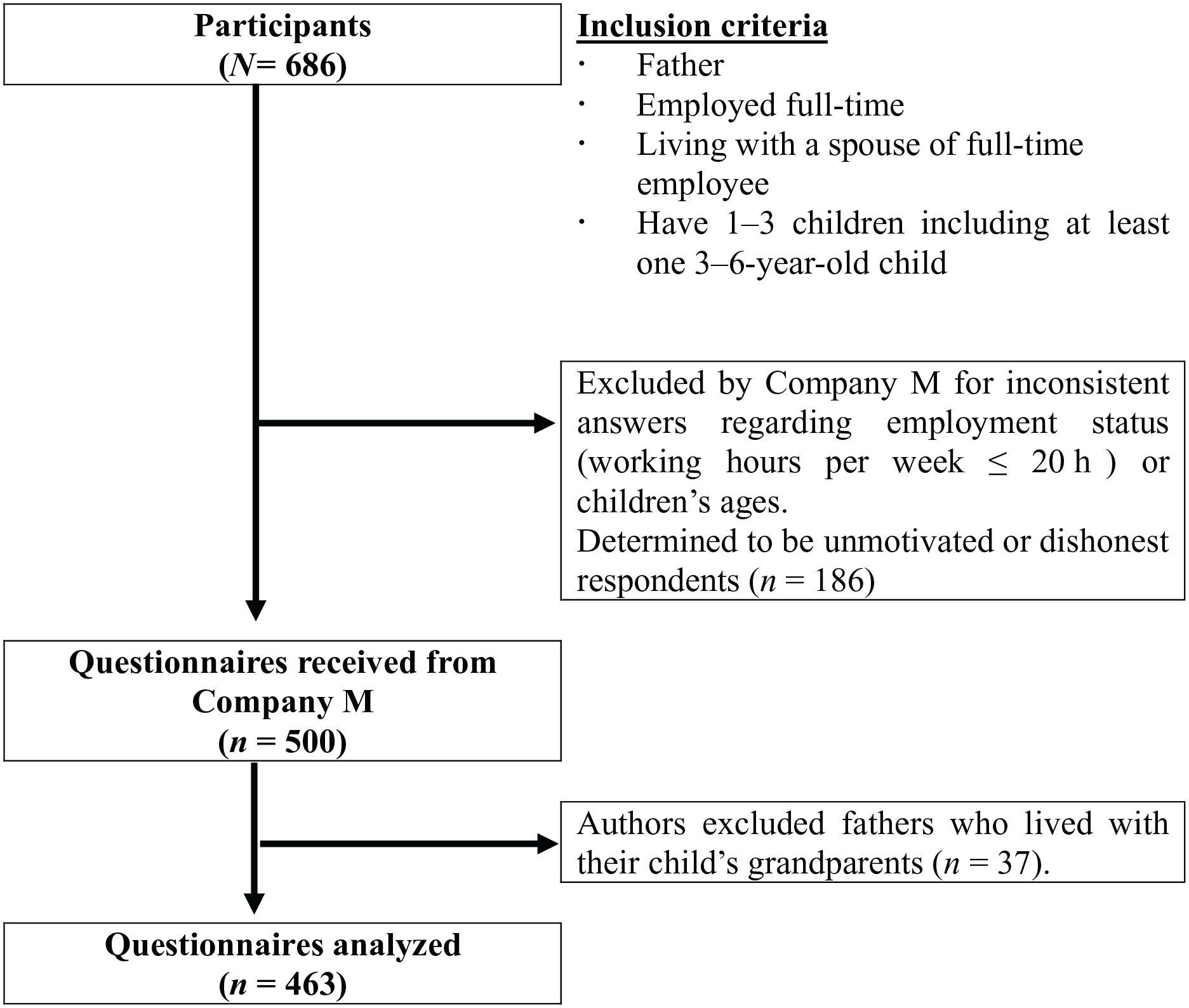
Sample size and study design.
This study was approved by the Ethics Committee of the University of Nagano (approval number: E22-8). This study was not preregistered.
Measures
In this study, we categorized foodwork into four types: grocery shopping, meal planning, cooking, and cleanup/dishwashing, referring to the design described by Philippe et al. (18). We assessed the four types of foodwork and assigned scores for the following six options: ‘mainly my spouse (0)’, ‘mainly my spouse and I help too (1)’, ‘my spouse and I equally (2)’, ‘mainly me and my spouse helps too (2)’, ‘mainly me (2)’ and ‘others (outsourced, mainly grandparents, babysitters, and housekeepers) (0)’. Subsequently, we calculated the total scores for the four foodwork types.
We assessed cooking skills using a subscale of the meal preparation literacy scale, specifically the ‘ability to prepare meals for children’ developed by Horikawa et al. (25). The assessment comprised three items (for example, ‘I find it difficult to prepare a meal for my child/children with well-balanced nutrient intake’) (25). Fathers rated their level of agreement on a five-point scale, as follows: 5 = ‘strongly disagree’, 4 = ‘slightly disagree’, 3 = ‘neither’, 2 = ‘slightly agree’ and 1 = ‘strongly agree’. We calculated the total score (a minimum score of 3 and a maximum score of 15). The associated Cronbach’s α coefficient of these fathers was 0.88.
We assessed experiences with meal preparation during elementary and junior/high school using scales developed by Komaba et al. (26). For elementary school, we used four items (for example, ‘assisting in cooking at home’). We assessed junior and high school experiences using seven items (for example, ‘cooking my meals by myself’). We evaluated bachelor days’ meal preparation experience using two items (for example, ‘habitually cooking my meals by myself’), which was developed based on the items used for assessing experience with meal preparation during junior and high school. Fathers rated their level of agreement on a five-point scale as follows: 1 = ‘strongly disagree’, 2 = ‘slightly disagree’, 3 = ‘neither’, 4 = ‘slightly agree’ and 5 = ‘strongly agree’. These items are presented in Supplementary material Table 1 online. We then calculated the mean score. The Cronbach’s α coefficients for these fathers were deemed acceptable, ranging from 0.78 to 0.95.
We collected data on the sociodemographic characteristics of the fathers and their spouses, including age, working hours per week, education, income and the number of children.
Statistical analysis
First, we conducted a hierarchical clustering analysis to cluster fathers based on three periods of meal preparation experiences. We used z-scores for each period, defined the distance matrix using Euclidean distances and applied Ward’s method as linkage criteria for grouping the clusters. We examined differences in meal preparation experience scores across clusters using analysis of variance (ANOVA). Furthermore, we conducted an independent sample t-test for each pair of clusters, and corrected the p-values from pairwise comparison using the Bonferroni post hoc test. We examined the demographic characteristics of clusters based on meal preparation experience using the χ2 test.
Subsequently, we examined the association between the meal preparation experience cluster as an independent variable and cooking skills and foodwork involvement as dependent variables using ANOVA and analysis of covariance (ANCOVA). We included fathers’ age and education as control variables; we selected age as a control variable because fathers in their mid-40s or older were part of a generation that did not study home economics in elementary school and junior high school (27), which may affect their meal preparation experience, cooking skills, et cetera. Meanwhile, we included the level of fathers’ education because an association has been reported between men with good cooking skills and their education level (28); additionally, the home environment, including meal preparation, may affect education level.
We conducted post hoc analysis using the Bonferroni test to examine the pairwise comparisons in cooking skills and foodwork involvement between two clusters. We performed all analyses using IBM SPSS Statistics 28.0 for Windows (IBM Japan, Ltd). The statistical significance level was set at p < 0.05. We calculated the sample size for this questionnaire survey in accordance with another research question. Subsequently, we conducted a post-hoc power analysis of the ANCOVA using G*Power 3.1.
Results
Approximately half of the fathers worked 41–50 h weekly, with the remaining 25% working less than 40 h or more than 51 h. Furthermore, 75% of fathers had college degrees or higher. The most common income of fathers was more than ¥6.00m (USD41,958 as of November 2022). Regarding their spouses, approximately half of the mothers worked less than 40 h weekly, 37% worked 41–50 h weekly and 8% worked more than 51 h. Furthermore, 61% of mothers had college degrees or higher. The most common income of mothers was less than ¥4.00m (USD27,972 as of November 2022).
Regarding the distribution of foodwork division between the fathers and spouses (mothers), in half of the families, mothers were primarily responsible for meal planning and cooking. The percentage of fathers involved in each type of foodwork was 63% in grocery shopping, 45% in meal planning, 50% in cooking and 64% in cleanup/dishwashing. The mean (standard deviation) score for foodwork involvement calculated based on the foodwork division was 4.1 (2.4).
Figure 2 presents the dendrogram obtained after performing the cluster analysis, suggesting the existence of three clusters based on meal preparation experience. Meanwhile, Table 1 presents cluster characteristics based on meal preparation experiences. Three clusters were identified and named as follows: ‘no experience’, ‘experience from childhood’ and ‘experience from adulthood’. Comparison of meal preparation experience scores at each time period between clusters showed significant differences at all time points (all p < 0.001). The ‘no experience’ cluster scored lower for meal preparation experience during all periods than the other two clusters (adjusted p < 0.05). The ‘experience from childhood’ cluster scored higher for meal preparation during elementary school (mean (SD) = 3.4 (0.8)) and junior/high school (mean (SD) = 3.6 (0.6)) than other two clusters (adjusted p < 0.05). The ‘experience from adulthood’ cluster scored higher only for meal preparation during bachelor days (mean (SD) = 4.2 (0.8)) than the other two clusters (adjusted p < 0.05). The ‘no experience’ cluster had more fathers in their 40s–50s (59.8%) and the ‘experience from childhood’ cluster had more fathers in their 20s–30s (57.0%) (p = 0.014). The ‘experience from adulthood’ cluster had more fathers with an education level of two years of college or equivalent (19.5%) (p = 0.027).
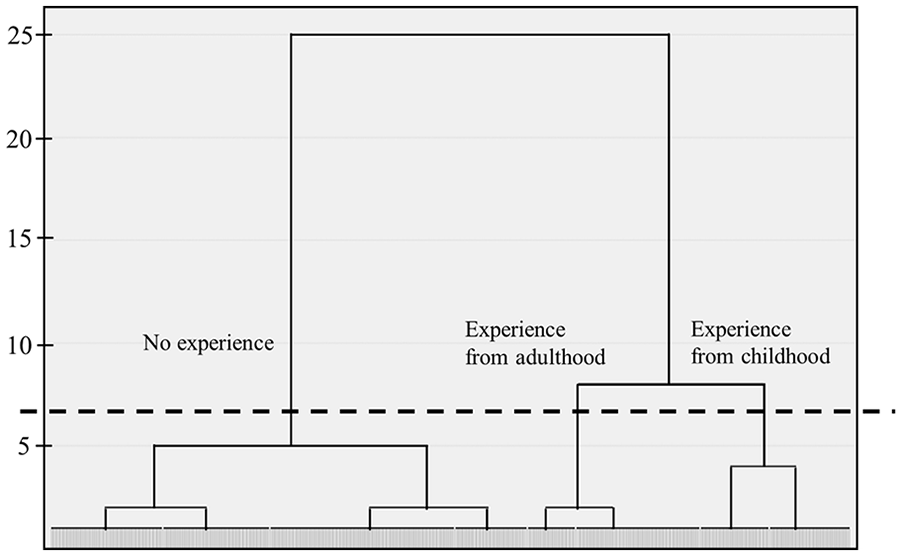
Cluster dendrogram using Ward method. Dashed line identifies three-cluster.
Characteristics of clusters based on meal preparation experience (N = 463).

Mean (standard deviation) or n (%).
Missing data for working hours is n = 1, for income is n = 10. Missing data were excluded in each analysis.
Analysis of variance test. The post-hoc Bonferroni’s multiple comparison test was applied for comparison of means across two of the three clusters based on meal preparation experience. Pairs with significant differences (p < 0.05/3 = 0.017) are shown in the post hoc test column.
χ2 test.
¥6.00million is USD41,958 and ¥4.00m is USD27,972 (as of November 2022).
Table 2 presents the association of meal preparation experience with cooking skills and foodwork involvement. The mean (SD) for cooking skills was 6.9 (3.2) and for foodwork involvement was 4.1 (2.4). There were significant differences in cooking skills (p = 0.001) and foodwork involvement (p < 0.001) among the clusters based on meal preparation experiences. Post-hoc analysis of the results revealed that fathers with experience in meal preparation from childhood were more likely to have higher cooking skills scores (mean (SD) = 7.9 (3.5)) than fathers with no experience (mean (SD) = 6.5 (3.0), adjusted p < 0.05). They were also more likely to have higher foodwork involvement scores (mean (SD) = 5.0 (2.3)) than did fathers with no experience (mean (SD) = 3.8 (2.4), adjusted p < 0.05).
Association between meal preparation experience and cooking skills and foodwork involvement assessed using analysis of variance (ANOVA) (N = 463).

Mean (standard deviation). η2 = eta-squared. ANOVA test. Independent variable: meal preparation experience; dependent variables: cooking skills and foodwork involvement. The post hoc Bonferroni’s multiple comparison test was applied to compare means across clusters based on meal preparation experience. Pairs with significant differences (p < 0.05/3 = 0.017) are shown in the post hoc test column. Cooking skills scores range from 3 to 15; high scores indicate higher cooking skills. Foodwork involvement scores range from 0 to 8; high scores indicate more involvement in foodwork.
Table 3 presents these associations by adjusting the demographic characteristics of the fathers. Fathers with experience in meal preparation from childhood were more likely to have higher cooking skills scores (adjusted mean (SEM) = 7.8 (0.35)) than fathers with no experience (adjusted mean (SEM) = 6.5 (0.24), adjusted p < 0.05). They were also likely to have higher foodwork involvement scores (adjusted mean (SEM) = 4.9 (0.26)) than those with no experience (adjusted mean (SEM) = 3.8 (0.18), adjusted p < 0.05) or experiences from adulthood (adjusted mean (SEM) = 4.0 (0.28), adjusted p < 0.05). No significant differences were found in cooking skills or foodwork involvement between fathers with no experience and those with experience from adulthood.
Association between meal preparation experience and cooking skills and foodwork involvement assessed using analysis of covariance (ANCOVA) (N = 463).

η2 = eta-squared. ANCOVA. Independent variable: meal preparation experience; dependent variables: cooking skills and foodwork involvement. The fathers’ age and education were included as control variables. The post hoc Bonferroni’s multiple comparison test was applied to compare means across clusters based on meal preparation experience. Pairs with significant differences (p < 0.05/3 = 0.017) are shown in the post hoc test column. Cooking skills scores range from 3 to 15; high scores indicate higher cooking skills. Foodwork involvement scores range from 0 to 8; high scores indicate more involvement in foodwork.
SEM: standard error of the mean
We also conducted post hoc power analysis to determine the level of statistical power achieved based on the sample size used in this study with the effect size f calculated by the obtained partial η2 in ANCOVA. Post-hoc power analysis of ANCOVA showed that the powers (= 1-β) were 0.96 for cooking skills and 0.91 for foodwork involvement.
Discussion
This study investigated the association between fathers’ experience with meal preparation from childhood and their current cooking skills to prepare healthy meals for children and their involvement in foodwork at home in Japan. After controlling for the characteristics of the fathers, we found that fathers with experience in meal preparation from childhood were more likely to have higher cooking skills and foodwork involvement than fathers with no experience or with experiences from adulthood.
Fathers experienced in meal preparation from childhood were more likely to be involved in foodwork than those with no experience or those who gained experience during adulthood, in this study. This is because experience in meal preparation at home for the family from childhood leads to the acquisition of cooking skills for the family. Indeed, fathers’ experience with meal preparation from childhood was associated with current cooking skills to prepare healthy meals for children. This is partially consistent with the findings of previous studies, which demonstrated that cooking activities or learning cooking skills at an early age are associated with general cooking skills (20,21) and spending time on preparing meals in adulthood (20). However, the current study demonstrated its strength in that fathers’ childhood experience in meal preparation proved to be beneficial not only for themselves but also for their family members, including children.
Furthermore, we suggest two reasons explaining why experience in meal preparation from childhood may impact fathers’ involvement in foodwork. First, cooking activities are enjoyable experiences for children (29,30) and enjoying cooking is positively associated with cooking skills, especially among men (28). This suggests that fathers who have experience with meal preparation from childhood may enjoy and be involved more in cooking. Additionally, the influence of role models may contribute to this positive effect. According to a previous study, learning to cook from ‘mothers’ and ‘cooking courses, books, magazines, internet, videos, apps’ were common factors in cooking skills for males and females (20,21). Men’s cooking skills are influenced by learning to cook from their fathers (20,21). The predominant notion in the Japanese population regarding ‘husbands should work outside and wives should take care of their home’ is changing; however, fathers typically work long hours outside of the home, while mothers dedicate considerable time to housework and childcare (31). Those who learned to cook from their fathers during childhood may consider their fathers, who were involved in foodwork, as role models, influencing their current roles in foodwork.
In this study, approximately half of the fathers were not involved in cooking or meal planning. To address this, it is essential to promote participation in meal preparation at home from childhood, regardless of sex. Age-appropriate programs are required that continually encourage children to prepare meals for the family at home, for example, to assist parents in cooking when of elementary school age and to plan and cook meals for family independently during junior and high school. A previous study using data from nationally representative samples in 142 countries reported the extent to which cooking meals at home remains a responsibility of women (32). Hence, the results of the current study can also be applied to other countries with similar challenges as Japan.
This study has certain limitations. First, the experience with meal preparation was evaluated using the recollection method, which may have introduced a recall bias. The possibility of overestimating or underestimating their experiences over time cannot be ruled out. Further longitudinal studies are warranted. Second, the perceived division of foodwork may differ from the actual division. A previous study demonstrated that men and women were likely to claim primary responsibility or shared responsibility for foodwork themselves (16). Third, a selection bias may have occurred as this study used registered users from a research company; hence, the generalizability of our results may be limited. For example, fathers with high sociodemographic status (e.g. education and income) participated in the survey. Finally, it is important to acknowledge that a post hoc power analysis was not conducted in the subsequent analyses using the Bonferroni test.
Nonetheless, this is the first study exploring the association between fathers’ experience with meal preparation from childhood and their current cooking skills to prepare healthy meals for children and their involvement in foodwork at home. The results highlight the need for further research to develop programs continually encouraging children to prepare meals at home. Globally, it is crucial to address gender inequality in time allocation for preparing meals; this study provides potential solutions to this challenge.
Conclusion
In this study, we found that fathers with experiences with meal preparation from childhood were more likely to have cooking skills for preparing healthy meals for their children and their involvement in foodwork at home. Encouraging children, regardless of sex, to participate in cooking at home should contribute to gender equality in terms of time allocation for preparing meals in the home later in life. Age-appropriate programs are required to encourage children to prepare meals for the family at home.
Supplemental Material
sj-docx-1-ped-10.1177_17579759241298263 – Supplemental material for The association between fathers’ childhood meal preparation experiences and current cooking skills in preparing healthy meals for children and foodwork involvement in Japan: a cross-sectional study
Supplemental material, sj-docx-1-ped-10.1177_17579759241298263 for The association between fathers’ childhood meal preparation experiences and current cooking skills in preparing healthy meals for children and foodwork involvement in Japan: a cross-sectional study by Emi Yoshii, Misa Shimpo and Rie Akamatsu in Global Health Promotion
Footnotes
Acknowledgements
We thank all fathers for participating in our study.
Authors’ contributions
Emi Yoshii: conceptualization, methodology, formal analysis, investigation, writing – original draft, writing – review and editing. Misa Shimpo and Rie Akamatsu: conceptualization, writing – review and editing
Declaration of conflicting interests
The authors have no conflicts of interest to declare.
Funding
The authors disclosed receipt of the following financial support for the research, authorship, and/or publication of this article: This work was supported by JSPS KAKENHI (grant number JP 22K20199). The sponsor had no role in the study design, collection, analysis or interpretation of the data, writing the manuscript, or the decision to submit the paper for publication.
Ethics approval
This study was approved by the Ethics Committee of the University of Nagano (approval number: E22-8).

Supplemental material
Supplemental material for this article is available online.
References
Supplementary Material
Please find the following supplemental material available below.
For Open Access articles published under a Creative Commons License, all supplemental material carries the same license as the article it is associated with.
For non-Open Access articles published, all supplemental material carries a non-exclusive license, and permission requests for re-use of supplemental material or any part of supplemental material shall be sent directly to the copyright owner as specified in the copyright notice associated with the article.
