



Abstract
Sense of Coherence (SOC) is conceptualized as promoting resistance to stress. The study aimed to assess the impact of the Big Five personality traits and Social Capital (SC) on SOC levels during COVID-19, comparing associations with the pre-pandemic period. Another aim was to explore how personality and SC relate differently to SOC domains: Comprehensibility, Manageability, and Meaningfulness, reflecting perceptions of order, resource adequacy, and life’s significance, respectively. SOC, Big Five personality traits, SC (using by the 13 items SOC scale, NEO-FFI and PSCS inventories, respectively) and demographic data were obtained from 2717 Israeli participants during the heights of the third COVID-19 wave (November 2020–March 2021). Strong relationships between SOC and personality traits have been found through regression analysis, but these associations differed between SOC domains. Big Five traits demonstrated comparable association with Comprehensibly and Manageability, but different from those with Meaningfulness, particularly in Neuroticism, Openness and Extraversion. Significant SC–SOC associations were observed, though weaker than those reported in the pre-pandemic period. Age and female sex were also associated with stronger SOC. Overall, effect sizes for SOC domains were medium to large for Big Five personality traits and small to medium for demographic variables. SC demonstrated a negligible effect size. Significant interactions of demographic, SC and personality traits were also observed. The study highlights SOC’s strong links with personality and demographics, but weaker ties with psychosocial factors. Variations across SOC domains may explain diverse crisis effects.
Introduction
The COVID-19 pandemic and the threats it poses have elevated stress and anxiety levels globally, negatively impacted mental health, and increased reports of loneliness (1). Associated with resistance to stress, Sense of Coherence (SOC), a core construct in Antonovsky’s salutogenic model of health, is conceived as the individual’s enduring though dynamic feeling that the environment is comprehensible, manageable, and meaningful (2). Numerous studies (e.g. (2); for a review, see Länsimies et al. (3)) highlight SOC’s protective effect on well-being, especially during COVID-19, mitigating negative impacts on psychological well-being among Italians (4). In addition, it serves as a protective factor against burnout (emotional exhaustion, depersonalization, and low personal accomplishment) among professionals in medical and nursing settings (5 –7).
Ongoing research investigates SOC’s role in COVID-19 reactions, yet few studies explore factors shaping SOC during the pandemic. Despite its perceived stability, SOC can change due to significant life events (2). Such fluctuation may be the result of pandemic-related changes in the individual’s personal and social situation as well as inherent personality traits. The current study’s aim was to evaluate the contribution of personality and a psychosocial factor (Social Capital, SC) to the individual differences in the levels of SOC under the COVID-19 pandemic.
The relationship between SOC and the Big Five personality traits has been studied in the past (see Barańczuk (8) for a meta-analysis). According to the widely used Big Five factor-analytic approach (9), personality is defined by the levels of five enduring traits: Neuroticism involves negative emotions, Extraversion relates to sociability, Openness involves creativity, Agreeableness refers to cooperation, and Conscientiousness pertains to self-control. Overall, the findings suggest that SOC is negatively associated with Neuroticism, and positively associated with Extraversion, Openness, Agreeableness and Conscientiousness (8,10). Regarded as enduring traits, the Big Five dimensions tend to remain stable into adulthood (11), although extreme life events might influence them (12). Recent evidence indicates potential fluctuations in some traits post-COVID-19 (13), potentially impacting SOC. However, research on Big Five–SOC associations during COVID-19 remains scarce.
SC refers to the characteristics of social organizations, such as networks, norms, and trust, that facilitate cooperation and action for mutual benefit (14). Typically, higher SC correlates with improved well-being, even amid crises like COVID-19 (15,16). Studies examining the direct relationship between SC and SOC through regression analysis have indicated a small to medium effect size association, as indicated by beta coefficients (17 –20). It has been suggested that SC may influence SOC by fostering community support and reducing feelings of isolation (21). The restrictions imposed due to COVID-19 have probably changed social environments and community support levels. However, the connection between SC and SOC during the pandemic remains underexplored. In a study involving mothers of adolescents, some experienced no change (54%) or a decrease (44%) in SOC. Notably, a medium effect size association between SC and SOC was significant only in the latter group (21). One objective of the current study was to assess the relative contribution of SC to SOC during COVID-19, compared with other personality and demographic factors.
While viewed as a cohesive concept, there is a proposition that an individual’s SOC can be segmented into three facets (2): (a) comprehensibility, reflecting the inclination to perceive the world as orderly; (b) manageability, indicating resource adequacy to confront adversity; and (c) meaning-fulness, representing life’s significance and commitment. Antonovsky (2) asserted that Meaningfulness – because of its motivational nature – is different from the other two domains (Comprehensibility/Manageability) and is the most crucial element for change. Thus, we were also curious to know how personality and psychosocial characteristics are linked to distinct SOC domains.
Previous research has suggested interactions between Big Five traits, SC, and demographic variables, notably age and gender, which may differ amid COVID-19 (22). Women tend to report higher SC levels, with protective effects differing between genders during the pandemic (23). SC indices vary with age, often increasing due to occupational factors (24). Similarly, research has highlighted significant gender differences in Big Five personality traits, with women reporting higher levels of Extraversion, Agreeableness, and Neuroticism than men (25). Age was also identified as a significant moderator of the association between Big Five personality traits and depressive symptoms during the COVID-19 pandemic (26). Because of those relationships between the study variables, interactions under COVID-19 were also tested.
The present study pursued several objectives. Initially, it aimed to investigate the varying contributions of personality traits, psychosocial factors (SC), and demographic characteristics (as well as their interactions with personality/psychosocial factors) to the disparities in SOC. Another goal was to assess whether the associations between SC, demographics, and SOC observed during the COVID-19 pandemic were comparable to those documented in the pre-pandemic period. Lastly, the study sought to determine whether the relationship between SOC and these factors differed across different domains of SOC (Comprehensibility, Manageability, Meaningfulness).
Methods
Participants
Participants were enlisted through an online panel administered by ‘Panelview,’ a prominent Israeli data collection firm (27). This panel, one of the largest in the country, comprises over 100,000 respondents and represents a diverse cross-section of Israeli society, encompassing various sectors and regions. Adhering to the ESOMAR code of conduct (28), the panel ensures ethical standards in data collection. Prospective members undergo a brief identification process, providing their phone number and email address, to join the panel, guaranteeing single participation per survey. Participants also provide demographic data. Participation rewards points redeemable for gift cards. Inclusion criteria emphasize satisfactory language proficiency. Sampling involved a two-stage process: initially, survey requests were distributed across various sectors, followed by additional outreach to underrepresented sectors for a balanced sample. See Appendix A, Table A1 for Demographic details of the 2717 individuals forming the study sample.
Measures
Sense of coherence (SOC)
We employed the short version (SOC-13) of Antonovsky’s Orientation to Life questionnaire (2). The sum of 13 seven-point semantic-differential scale items constitutes the SOC total score, indicating a stronger SOC with higher scores. In addition, we calculated scores for each component (Comprehensibility, Manageability, Meaningful-ness). The measure exhibits high test–retest reliability (29), internal consistency (Cronbach’s α: .70 to .92) (32), and cross-cultural validity (29). Internal consistency in our sample was good (α = .79).
NEO-FFI
The NEO Five Factor Inventory (NEO-FFI) is a widely used validated self-report questionnaire (30). The scale includes 60 items rated on a five-point scale, assessing five personality dimensions: Neuroticism, Extraversion, Openness to experience, Agreeableness and Conscientiousness, each measured by 12 items. Adequate internal consistency has been reported (α = .68 to .86) (31), matching the internal consistency found among the current study sample (α = .68).
Personal SC scale
The Personal SC scale (PSCS) (32) evaluates bonding and bridging social capital. Our study utilized the concise eight-item version, covering both types of capital. It demonstrated satisfactory internal consistency (Cronbach’s α = .83) (33) and strong correlation with the original version (33). In our sample, internal consistency was high (α = .82).
Demographic data were gathered through a short questionnaire.
Procedure
The research received approval from the university ethics committee (approval number AU-HEA-GZ-20200813) and adhered to ethical standards outlined by the responsible committee on human experimentation (institutional and national) and the Helsinki Declaration (1975, revised in 2000). Participants were recruited online during the peak of the third COVID-19 wave (November 2020–March 2021) at two intervals. In Israel, five waves of COVID-19 have been identified, extending from February 2020 to May 2022 (34). This research was undertaken during the third stage, which extended from November 2020 to April 2021. During this period, Israeli authorities implemented rigorous measures such as a nationwide lockdown, confining movement to a 1000-meter perimeter around homes, capping gatherings at 10 people, closing non-essential businesses, and enforcing mask-wearing in public areas. A notably stringent lockdown was enforced from January 1st to February 7th 2021, leading to the closure of all educational facilities (34). The study’s first time point was 15 December 2020 (1129 new cases of COVID-19 virus, according to the Ministry of Health reports; peak number for daily new cases at that wave was 10,114) (35). A total of 1512 participants completed the survey at that time point. Another survey was open for completion on 11th February 2021 (5083 new cases of COVID-19 virus, according to the Ministry of Health reports, 40). Another 1229 participants filled the survey at that time point.
All participants completing the study’s questionnaires gave their informed consent beforehand and were compensated for their time. The questionnaires were completed in one session (approximately 45 minutes).
Data analysis
A Pearson correlation analysis, corrected for multiple comparisons false discovery rate (36), examined relationships between variables. Four linear regression analyses followed Dawson’s approach (37). Sex and Age entered the first step, NEO personality traits and SC the second. The interaction of each trait and SC with Sex and Age entered the third step in a stepwise method. All continuous variables were standardized. Outcome variables for regressions were SOC total score, Comprehensibility, Manageability, and Meaningfulness.
Confidence intervals for independent variables in regressions were estimated using biased corrected bootstrap (2000 resamples). Following Cumming (38), beta weights were considered statistically different if confidence intervals overlapped less than 50%. In addition, we used the regression analysis standardized beta coefficients to evaluate the relative effect size of the study variables on various SOC domains (39).
Results
Normal distribution of all outcome variables was assessed using skewness and kurtosis (see Kim (40))—all outcome variables were normally distributed (SOC total, SOC–Comprehensibility; SOC–Manageability; SOC–Meaningfulness). Participant age distribution (Appendix A, Table A1) matched the age distribution as indicated by the Israeli Central Bureau of Statistics (41).
Associations between the study variables
The data reveal a medium to strong correlation between SOC and its components to four out of the five personality traits. Significant correlations were evident between SOC domains and the Big Five personality traits (excluding Openness) and SC (see Appendix B, Table B1).
Regression analyses
No multicollinearity between the study independent variables was observed (VIF < 1.6).
SOC components comprehensibility, manageability and meaningfulness
Comprehensibility scores were positively associated with Age, Conscientiousness, Agreea-bleness, and the interaction between Age and Agreeableness. Compressibility scores were also negatively associated with Openness, Neuroticism, and the interaction between Age and SC, and were higher for females than for males. These variables together predicted 36.6% of the Comprehensibility score variance (see Appendix C, Table C1).
Manageability scores were positively associated with Age, Conscientiousness, Agreeableness, SC and the interaction between Age and Agreeableness; Manageability scores were also negatively associated with Openness, Neuroticism, the interaction between gender and Neuroticism and the interaction between Age and Openness; and were higher for females than for males. These variables together predicted 36.7% of the Manageability score variance (see Appendix C, Table C2).
Meaningfulness scores were positively associated with Openness, Conscientiousness, Extraversion, Agreeableness, and SC; Meaningfulness scores were also negatively associated with Neuroticism; and were higher for females than for males. These variables together predicted 38.4% of the Meaningfulness score variance (see Appendix C, Table C3).
The associations of the total SOC score are depicted in Appendix B.
Bias-corrected bootstrap analysis
The bias-corrected bootstrap analysis reveals that Neuroticism has the highest beta weight coefficient in predicting SOC–Comprehensibility and SOC–Manageability variances, significantly differing from Agreeableness (38). However, for SOC–Meaningfulness, Conscientiousness and Neuroticism share the highest coefficients without significant difference. Appendix E, Figure E1, depicts confidence intervals for the leading two beta weights of each component, shown positively for assessment.
Effects-size evaluation
Using standardized beta coefficients as indicators of effect size (39) suggests a medium to large effect size for Big Five Conscientiousness and Neuroticism, respectively, and a low to medium effects size for demographic variables. SC demonstrated a negligible effect size on SOC component. Figure 1 depicts the study variables’ standardized beta coefficients on SOC Comprehensibility, Manageability and Meaningfulness domains.
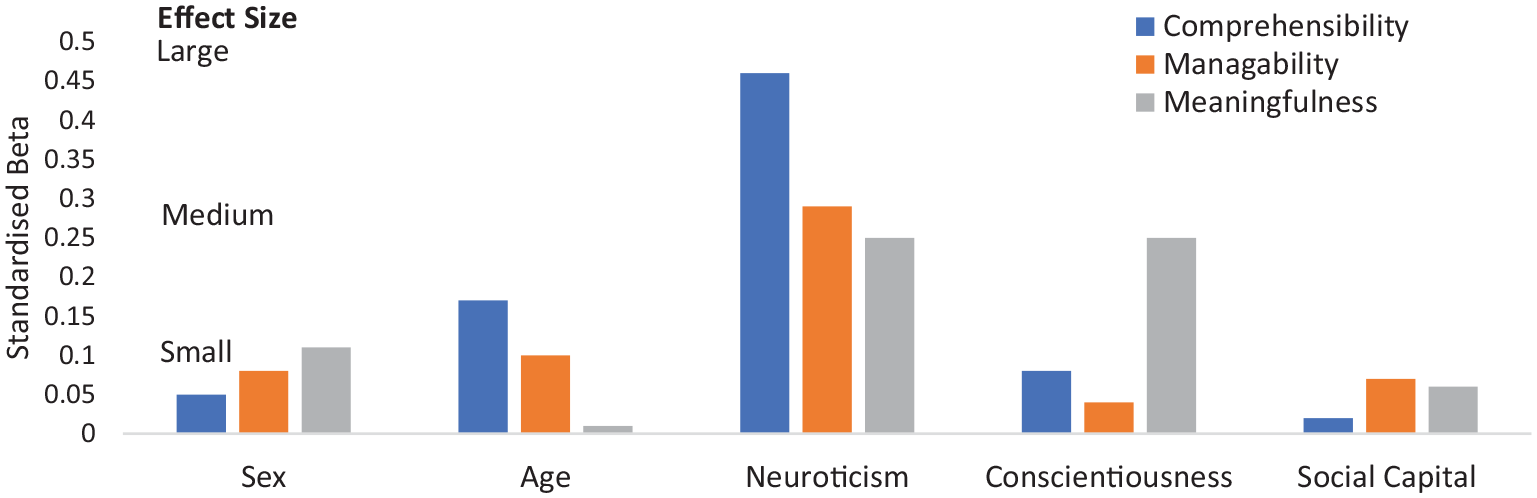
Standardized beta coefficients in the regression analyses for Sense of Coherence domains Comprehensibility, Manageability and Meaningfulness.
Discussion
SOC is conceptualized as a unique dispositional orientation that is consistent from early adulthood (2). In this study, personality, demographic and psychosocial variables significantly predicted SOC scores. However, different associations between these variables and SOC domains were found, suggesting potential distinctions between Antonovsky’s ideas of Comprehensibility and Manageability to Meaningfulness.
The strong associations observed in this study between SOC and the Big Five personality traits replicates findings from prior research conducted in the pre-COVID 19 era (8,10,31). Nonetheless, previous studies have not explored potential variations in how these factors relate to specific domains of SOC (8,31). In this study, Comprehensibility and Manageability demonstrated similar associations with Big Five traits. Higher Conscientiousness and Agreeableness predicted higher scores, while more Neuroticism and Openness predicted lower scores in both SOC domains. Similar associations were found with well-being indices, especially anxiety and depression (42). One possible interpretation of the results is that the Big Five traits that promote or hinder well-being (and, to some extent, adaptation) show a comparable association with SOC Comprehensibility/Manageability domains.
In contrast, Meaningfulness displayed a distinct relational pattern. Higher levels of Conscientiousness, Agreeableness, Openness, and Extraversion were associated with increased Meaningfulness, while heightened Neuroticism correlated with decreased Meaningfulness. Notably, three trait types exhibited significant differences in their predictive patterns across the Big Five–SOC domains. Openness demonstrated negative associations with Comprehensibility/Manageability and positive associations with Meaningfulness, while Extraversion showed positive associations solely with Meaningfulness. Conversely, Neuroticism emerged as the most potent predictor for Comprehensibility/Manageability but lacked predictive significance for Meaningfulness.
The distinctiveness of the SOC domain and the COVID-19 context could account for these differences. According to the salutogenic model, Comprehensibility, Manageability, and Meaningfulness stem from unique processes. Consistent life experiences and recurrent feelings of potency are linked to Comprehensibility and Manageability, while Meaningfulness is associated with socially valued decision-making (10). Accordingly, Openness (which was associated with being attentive to one’s feeling) (38) may have conflicting effects on various SOC domains. While being open to experience in times of crisis can increase a feeling that life is meaningful, those who are more open to the external environment and others’ fearful reactions under COVID-19 may also perceive the world as less understandable and manageable. Extraversion, reported as one of the strongest positive predictors of well-being (43,44), positively predicted only Meaningfulness, possibly suggesting that more sociability, a key feature in extraversion, is associated with perceiving the world as more meaningful.
To sum, heightened anxiety, routine changes, and government restrictions may have made the world seem less predictable, affecting Comprehensibility/Manageability more than Meaningfulness. The outcomes of the regression analysis, in conjunction with bootstrap analysis, highlight the requirement for additional investigations into the correlations between personality and psychosocial factors with Comprehensibility/Manageability, as opposed to their links with Meaningfulness.
In this study, higher SC predicted higher SOC. This finding is supported by previous research identifying SC as a Generalized Resistance Resource (23) (an individual’s characteristic that enhances effective coping with life’s adversities (2)), indicating its positive effects on SOC even under the COVID-19 pandemic. Possibly, wider and deeper connection with one’s social environment may lead to a greater sense of Manageability and Meaningfulness. However, while still statistically significant, our findings reveal a minimal, almost negligible impact of SC on SOC (with standardized betas ranging from .06 to .07), contrasting with earlier studies conducted prior to the COVID-19 pandemic which reported small to moderate effects (with standardized betas ranging from .134 to .29) (17 –20). This discrepancy, coupled with the relatively feeble correlation observed between these variables, suggests that during exceptional circumstances such as a global pandemic the direct influence of SC on SOC is marginal, despite shared conceptual elements such as trust and social support underlying both constructs (21). It is important to highlight that these findings are preliminary and require validation in future research.
Older Age was linked to elevated Comprehensibility and Manageability levels, consistent with past research (45), implying age fosters a coherent worldview. This corresponds with SOC fluctuations across lifespan (46), despite Antonovsky’s stability claim (47). In addition, our study found females exhibited higher SOC levels across all domains, contrary to mixed past findings on gender influence (48).
The current findings also highlight significant interactions between demographic and personality factors and SOC domains. Firstly, advancing Age and higher levels of Agreeableness were found to predict increased levels of SOC in terms of Comprehensibility and Manageability. In a recent study involving a sizable cohort of adults during the COVID-19 pandemic, both Agreeableness and older Age were linked to greater levels of interpersonal trust, a contract that was suggested as one of the factors comprising Antonovsky’s SOC (49).
Unexpectedly, Age–SC and Age–Openness interactions correlated with decreased Comprehen-sibility and Manageability, respectively, suggesting the need for further investigation. One hypothesis is that heightened engagement with the external world (indicated by higher SC or greater Openness) may amplify exposure to COVID-19-related stressors, diminishing Comprehensibility/Manageability. In addition, women with high Neuroticism exhibited lower Manageability, potentially exacerbating SOC reduction beyond individual effects. Notably, no interaction effects were noted on Meaningfulness, Antonovsky’s stable SOC component (2).
A limitation is the study’s use of an online platform. Although effect sizes were compared with pre-pandemic studies, a longitudinal design assessing the same sample before and during COVID-19 would have been preferable. Such a design would better elucidate the findings’ association with the COVID-19 reality. Future research should consider longitudinal designs for enhanced understanding.
The study highlights a significant implication regarding the strong link between Neuroticism and SOC, contrasting with the minimal impact of SC. Given the association between Neuroticism and heightened anxiety, interventions targeting anxiety reduction might yield higher SOC compared with efforts to enhance SC, warranting further investigation in future research
Overall, our finding suggests a large effect of personality traits (mainly Neuroticism and Conscientiousness) on SOC, along with a small effect of demographic variables, and a negligible effect of SC, considered as a psychosocial factor. The study findings denote important data and add to the conceptual perception of SOC. SOC has been suggested as one of the most important concepts in understanding human coping in the face of adversity (9), theorizing it as an individual’s innate characteristic that develops through life experience and primarily promotes effective coping with life adversities (2). The current findings, along with previous research (7), suggest that this construct, coined by Antonovsky, does not represent a unitary, detached ability, and is closely related to personality and demographic variables.
Supplemental Material
sj-docx-1-ped-10.1177_17579759241248168 – Supplemental material for Sense of coherence and its components under COVID-19: relative associations with personality and psychosocial variables
Supplemental material, sj-docx-1-ped-10.1177_17579759241248168 for Sense of coherence and its components under COVID-19: relative associations with personality and psychosocial variables by Gil Zukerman, Avishai Antonovsky, Ephraim Shapiro and Liat Korn in Global Health Promotion
Supplemental Material
sj-docx-2-ped-10.1177_17579759241248168 – Supplemental material for Sense of coherence and its components under COVID-19: relative associations with personality and psychosocial variables
Supplemental material, sj-docx-2-ped-10.1177_17579759241248168 for Sense of coherence and its components under COVID-19: relative associations with personality and psychosocial variables by Gil Zukerman, Avishai Antonovsky, Ephraim Shapiro and Liat Korn in Global Health Promotion
Supplemental Material
sj-docx-3-ped-10.1177_17579759241248168 – Supplemental material for Sense of coherence and its components under COVID-19: relative associations with personality and psychosocial variables
Supplemental material, sj-docx-3-ped-10.1177_17579759241248168 for Sense of coherence and its components under COVID-19: relative associations with personality and psychosocial variables by Gil Zukerman, Avishai Antonovsky, Ephraim Shapiro and Liat Korn in Global Health Promotion
Supplemental Material
sj-docx-4-ped-10.1177_17579759241248168 – Supplemental material for Sense of coherence and its components under COVID-19: relative associations with personality and psychosocial variables
Supplemental material, sj-docx-4-ped-10.1177_17579759241248168 for Sense of coherence and its components under COVID-19: relative associations with personality and psychosocial variables by Gil Zukerman, Avishai Antonovsky, Ephraim Shapiro and Liat Korn in Global Health Promotion
Supplemental Material
sj-docx-5-ped-10.1177_17579759241248168 – Supplemental material for Sense of coherence and its components under COVID-19: relative associations with personality and psychosocial variables
Supplemental material, sj-docx-5-ped-10.1177_17579759241248168 for Sense of coherence and its components under COVID-19: relative associations with personality and psychosocial variables by Gil Zukerman, Avishai Antonovsky, Ephraim Shapiro and Liat Korn in Global Health Promotion
Footnotes
Ethics approval statement
The study was approved by the university ethics committee review board (AU-HEA-GZ-20200813). All procedures were in accordance with ethical standards of the responsible committee on human experimentation (institutional and national) and the Helsinki Declaration (1975, revised in 2000).
Patient consent statement
All the participants in the study gave their informed consent. Participation in the study is anonymous.
Data availability statement
Data can be share upon request by writing to the corresponding author
Declaration of conflicting interests
The author(s) declared no potential conflicts of interests with respect to the research, authorship, and/or publication of this article.
Funding
The author(s) disclosed receipt of the following financial support for the research, authorship, and/or publication of this article: This work was supported by the Israeli institute for health policy research [grant number r/572/2020].

Supplemental material
Supplemental material for this article is available online.
References
Supplementary Material
Please find the following supplemental material available below.
For Open Access articles published under a Creative Commons License, all supplemental material carries the same license as the article it is associated with.
For non-Open Access articles published, all supplemental material carries a non-exclusive license, and permission requests for re-use of supplemental material or any part of supplemental material shall be sent directly to the copyright owner as specified in the copyright notice associated with the article.
