




Abstract
Using data from an intercept survey of 428 adults who received free surplus produce at five distribution sites and qualitative data from 15 interviews with site personnel, we examined facilitators (e.g. community partnerships, coalition support) and challenges (e.g. limited refrigerated storage, lack of transportation infrastructure) to operating a food recovery and distribution program in Los Angeles County. Overall, this food system intervention appeared to fill an unmet need for recipients, nearly 80% of whom were food insecure and 60% visited a site several months/year or monthly. For many living in this county’s underserved communities, this effort was instrumental in increasing access to healthy food before and during the COVID-19 pandemic. To sustain/expand this program’s reach, local governments and food assistance programs should provide greater coordination and oversight, and invest more resources into this food recovery and distribution infrastructure.
Highlights
More than 50 million Americans were food insecure during the COVID-19 pandemic.
Food recovery and distribution can be used to address food insecurity.
Distribution of recovered food appears to fill an important need in the community.
Most recipients of recovered food (80%) were food insecure.
More than half (60%) visited sites for free produce several months per year.
Background
Methane emissions from landfilled food are exacerbating our climate crisis (1). In 2018, 34% of the waste stream to California’s municipal landfills was organic waste, such as food and green waste (2). That same year, an estimated 1.1 million tons of potentially donatable food were discarded in landfills (2,3). Yet, about 250,000 households in Los Angeles County (LAC) were food insecure in 2021 (4), while in the United States (U.S.), even before the COVID-19 pandemic, nearly 50 million people were food insecure (5). The dramatic economic consequences of the pandemic have since worsened this condition, extending to households that had never experienced food insecurity before (6,7).
Food insecurity is strongly associated with other social determinants of health, including income, education, employment, and housing stability (8). It is well documented that efforts to eliminate food insecurity are unlikely to be successful without broad anti-poverty measures, including expanded employment opportunities and affordable housing (9). While these efforts to address longer term solutions are ongoing, measures should be taken to address the immediate issues of food availability among low-income communities. In LAC, even among recipients of federal assistance programs, such as the Supplemental Nutrition Assistance Program (SNAP), food insecurity was highly prevalent among low-income households before and during the pandemic (10).
The United States Department of Agriculture defines two categories of food insecurity: (1) low food security, which refers to a reduction in the quality, variety, or desirability of diet with little or no indication of reduced food intake; and (2) very low food security, which indicates disruptions in eating patterns and reductions in food intake (11). About one-third of those who are food insecure experience very low food security in the U.S. (12). Food insecurity is more likely to occur in households headed by African American or Hispanic individuals; and among those who are never married, divorced, or separated; those who rent their homes; and those with less education (8). Food insecurity has a significant impact on the health outcomes of those who experience it. In children, the condition is associated with anemia, poor nutrition, cognitive problems, and poorer general and oral health (13–18); and in adults it is associated with poor nutrition, diabetes, and overall poor physical and mental health (19–23).
Despite high levels of food insecurity, the U.S. registers high levels of food waste (24). Recovery of produce, specifically fruits and vegetables, offers an important but underutilized solution to increas-ing food access among populations experiencing food insecurity. The intervention simultaneously eliminates food waste by gleaning or rescuing excess food items from farms, large distributors, or retail grocery stores (25). Recovered produce can be repurposed and distributed by community-based organizations (CBOs) in a timely manner to those in need. Local health departments (LHDs) can help connect CBOs that may have limited experience with the food distribution system to increase access to local produce in areas with low-income households (26).
While food recovery and distribution efforts may address food waste and result in increased food access, little is known about the feasibility of scaling surplus produce distribution in a large jurisdiction comprising both urban and rural areas, and about the clients’ experience with food distribution events (27,28). This study addresses this gap in knowledge and health promotion practice by using a convergent parallel mixed method design (29) to characterize the profile and experience of clients who receive produce from CBOs in LAC (survey data), and contextualized the agency experience with the food distribution process through in-depth interviews with staff of these community organizations. Although the data were collected before the pandemic (fall 2018), they do offer valuable insights into possible policy and programmatic modifications (30) that may be needed to improve the food system/infrastructure regionally and across the U.S. after the pandemic.
Methods
Setting
Pre-pandemic data collected from households with incomes lower than 300% of the federal poverty level (FPL) suggest that in LAC 1.6 million people (16%) were living in food insecure households (31). Between April and December 2020, 34% of all households in the county were food insecure (7). To improve access to healthy food for these households, the LHD in LAC established a number of innovative partnerships to increase the availability of fresh produce, scaling a sustainable food distribution model countywide which complemented nutrition education services (31). Presently, the LHD is supporting this effort through its Supplemental Nutrition Assistance Program Education program (hereafter SNAP-Ed). The program is designed to improve nutrition and physical activity opportunities among SNAP-eligible residents in LAC. To achieve the goals of food recovery and distribution, the LHD contracted with 24 community agencies to conduct nutrition education, promote physical activity, and implement policy, systems, and environmental change interventions (PSEs) in the community – specifically in their respective Service Planning Areas, geographic boundaries that are used to guide government resource allocations in the region (32). Of the 24 contracted agencies, eight coordinated with produce recovery organizations and imple-mented free produce distribution events for SNAP-Ed-eligible target populations (⩽185% FPL).
Intercept survey
To better understand the food recovery process and client experience with accessing fresh produce, an intercept survey was conducted at food events held by five of the eight LHD partnering agencies during fall 2018; this spanned six weeks. Adult clients of these agencies were recruited from CBO-operated sites where nutrition education and other SNAP-Ed strategies were being implemented. Three of the LHD partnering agencies were not included in the survey because they did not have any produce distribution events during the sampled period. Eligible survey respondents had to reside in LAC and be >age 18 years. As part of the survey process, staff at these events also documented sex and race/ethnicity for all persons approached, and recorded whether they agreed or refused to participate. The survey itself was designed to be self-administered via paper and was available in English and Spanish. Those who completed the survey were given a $5.00 gift card to either Wal-Mart or Target. Of the 562 site clients who were invited to take the survey, 428 completed it, for a response rate of 76.2%.
The survey instrument comprised five domains of question items: demographics (age, race/ethnicity, sex, education); food insecurity status and basic needs compromises; aspects of food procurement and management (frequency of procuring food from a food bank/pantry, proportion of food procured from a food bank/pantry, duration of travel to food bank/pantry, how long food lasts, perceived food quality and variety, and cooking skills); nutritional intake; and utilization of government assistance programs such as SNAP. To collect information on the main variable of interest — food insecurity status — the survey employed the commonly used, validated two-item Hunger Vital Sign questionnaire (33). For other question items, please see Supplemental Materials online for further details.
Qualitative sample and protocol
To better understand how the produce distribution process works in practice, 15 in-depth interviews with staff from the eight eligible LHD partnering agencies were completed; this included the five sites that distributed food during the survey period. Interviewees were in management, project coordination, health education, or clinical leadership positions, and were familiar with food insecure populations and day-to-day operations. They worked in CBOs that sought to increase access to fresh fruits and vegetables by developing or expanding food distribution in low-income communities across the county. Supplemental Table-A provides a sample of questions from the protocol. Prior to conducting each interview, the lead author and a team of 10 trained graduate students from the RAND Corporation prepared background briefs on each of the CBOs — this allowed them to tailor their questions to each agency. All of the interviews were conducted by this team via telephone; each interview lasted about one hour in length. Interviewees were not offered remuneration for their participation.
Both components of the study (survey and interview) were approved (Certified Exempt) by the Human Subjects Protection Committee at the RAND Corporation. Verbal consent was obtained from all participants of the interviews.
Data analysis
To characterize the profiles of clients who received produce at the five distribution sites, we generated a series of descriptive statistics and compared them by sex and food insecurity status. Comparisons of binary variables were assessed using t-tests, while categorical variables were evaluated via chi-square tests. All analyses were performed using Stata 15 (34).
During each of the interviews, a team member served as the interviewer, while another served as the notetaker. Each interview was recorded and summarized independently by these two members. After completion, both members re-listened to the recording to ensure the notes were accurate and to extract illustrative quotes. A third team member verified the accuracy of more than half of the summaries. The summary notes were later uploaded to Dedoose, an online platform that facilitated storage, management, coding, and analysis of the qualitative data (35).
Using a two-step coding process, inductive and deductive content analyses of the interview transcripts were combined to describe the range of themes discussed and any themes grounded in the data (36). Each interview was independently coded by two team members to ensure acceptable reliability. Interpretation discrepancies were resolved by consensus. Using a sample of three interviews, coding reliability was assessed and recorded (37,38): the initial reliability was 0.74, but after reconciliation and another test with two more interviews, the reliability increased to 0.82.
Results
The majority of the survey respondents were female (78%) and the average age of the sample was 50 years (range: 18–81; Table 1). About half completed the survey in Spanish; with 69% who identified as Latino, 8% African American, 14% White, 7% Asian, 3% American Indian, and 4% other. Forty-five percent did not complete high school and 21% had only a high school diploma. Sixty-one percent of the children at home were younger than 18 years of age (~1.5 children per household).
Characteristics of intercept survey respondents at five food distribution sites in Los Angeles County (N=428).
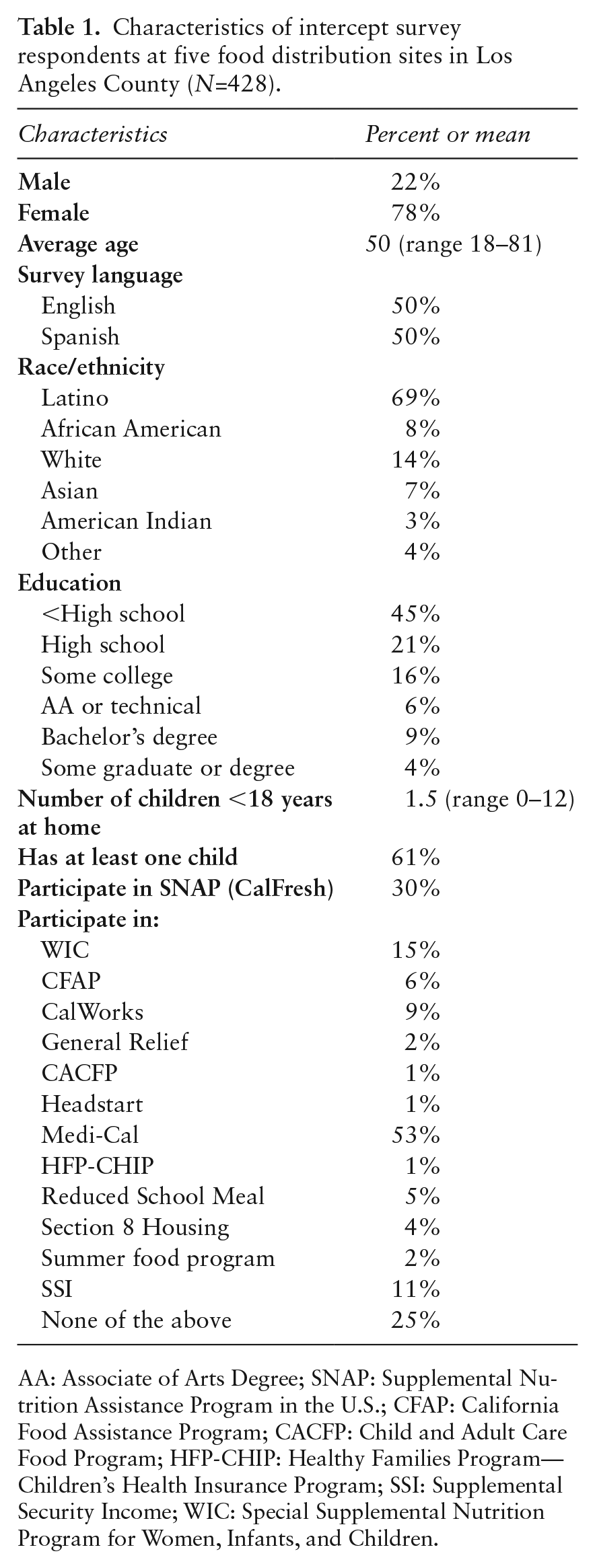
AA: Associate of Arts Degree; SNAP: Supplemental Nutrition Assistance Program in the U.S.; CFAP: California Food Assistance Program; CACFP: Child and Adult Care Food Program; HFP-CHIP: Healthy Families Program—Children’s Health Insurance Program; SSI: Supplemental Security Income; WIC: Special Supplemental Nutrition Program for Women, Infants, and Children.
Table 2 displays the variables by sex and food insecurity status. Overall, there were very few differences in responses between respondents who reported being food insecure and respondents who did not. Based on the two food insecurity screening questions, 79% worried that food would run out, and 75% said that in the past 12 months their food sometimes or often had not lasted, and they did not have money to buy more. Compared with those who were food secure, food insecure respondents were more likely to have to make monthly choices between food and medical care (26.8% vs. 5.6%) and between food and housing (38% vs. 7%).
Intercept survey responses of respondents at five food distribution sites in Los Angeles County by sex and food insecurity status, fall 2018 (N=428).
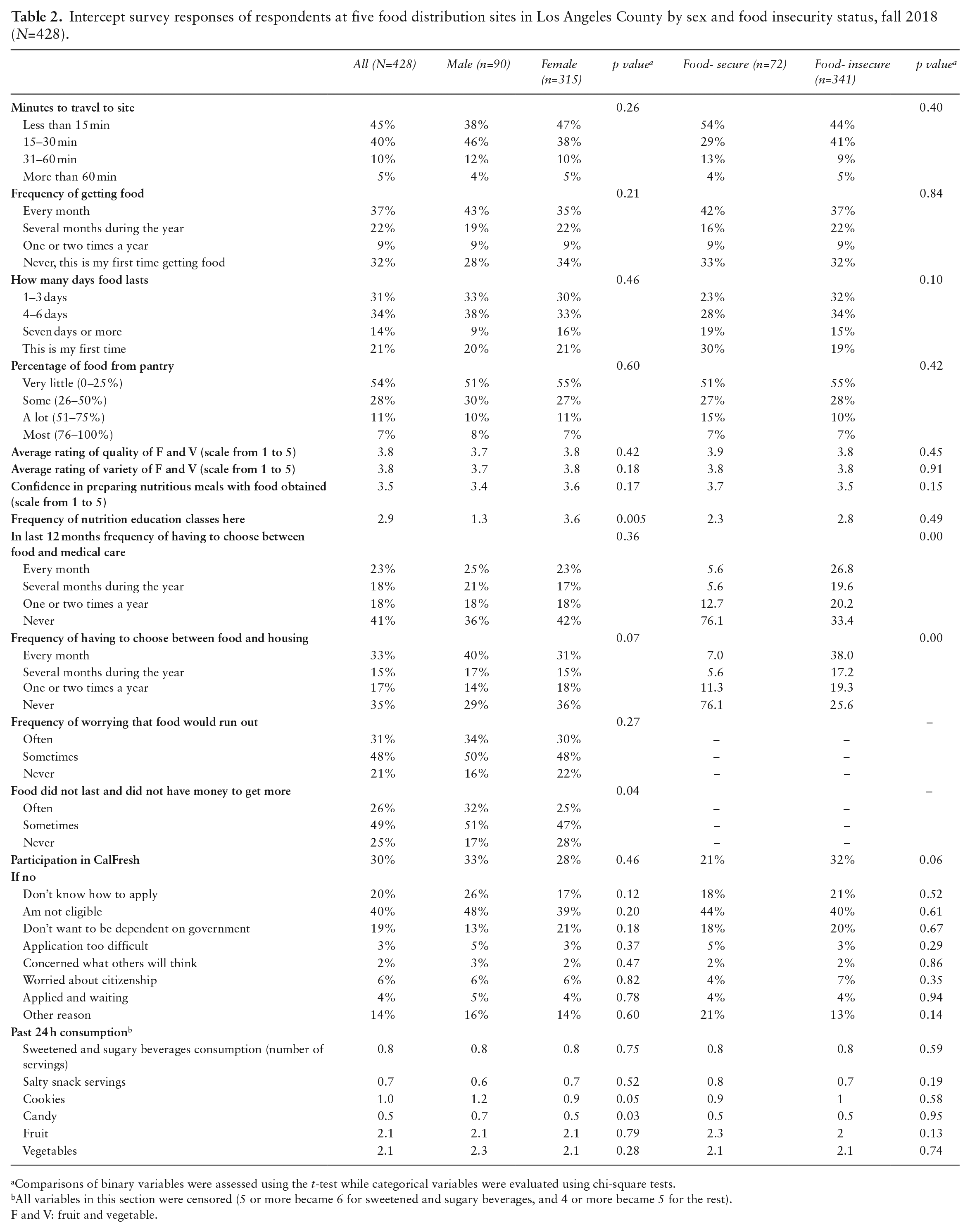
Comparisons of binary variables were assessed using the t-test while categorical variables were evaluated using chi-square tests.
All variables in this section were censored (5 or more became 6 for sweetened and sugary beverages, and 4 or more became 5 for the rest).
F and V: fruit and vegetable.
The vast majority traveled up to 30 min to get to the food distribution site, and most also reported they came either every month or every several months during the year. Nearly one-third reported that this was their first visit to the site. Food lasted for one to three days for 31% of them. On a scale of 1 to 5 the food provided was rated about 3.8 for quality and variety, corresponding to ‘average’ to ‘good.’
On average, respondents reported consuming 0.5 to 1 serving each of candy, cookies, salty snacks, and sugary beverages (junk foods) in the previous day, totaling an estimated 402 calories from these sources alone.
The majority (75%) were enrolled in some type of government assistance program: 30% in SNAP, 15% in the Special Supplemental Nutrition Program for Women, Infants, and Children (WIC), and 53% on Medi-Cal (Table 1). Participation in SNAP was higher among those who were food insecure (Table 2).
A number of themes and sub-themes emerged from the in-depth interviews. Table 3 summarizes many of these themes—also see Supplemental Table- B for illustrative/salient quotes.
Summary descriptions of the main themes from the in-depth interviews with the local health department’s food distribution partnering agencies.
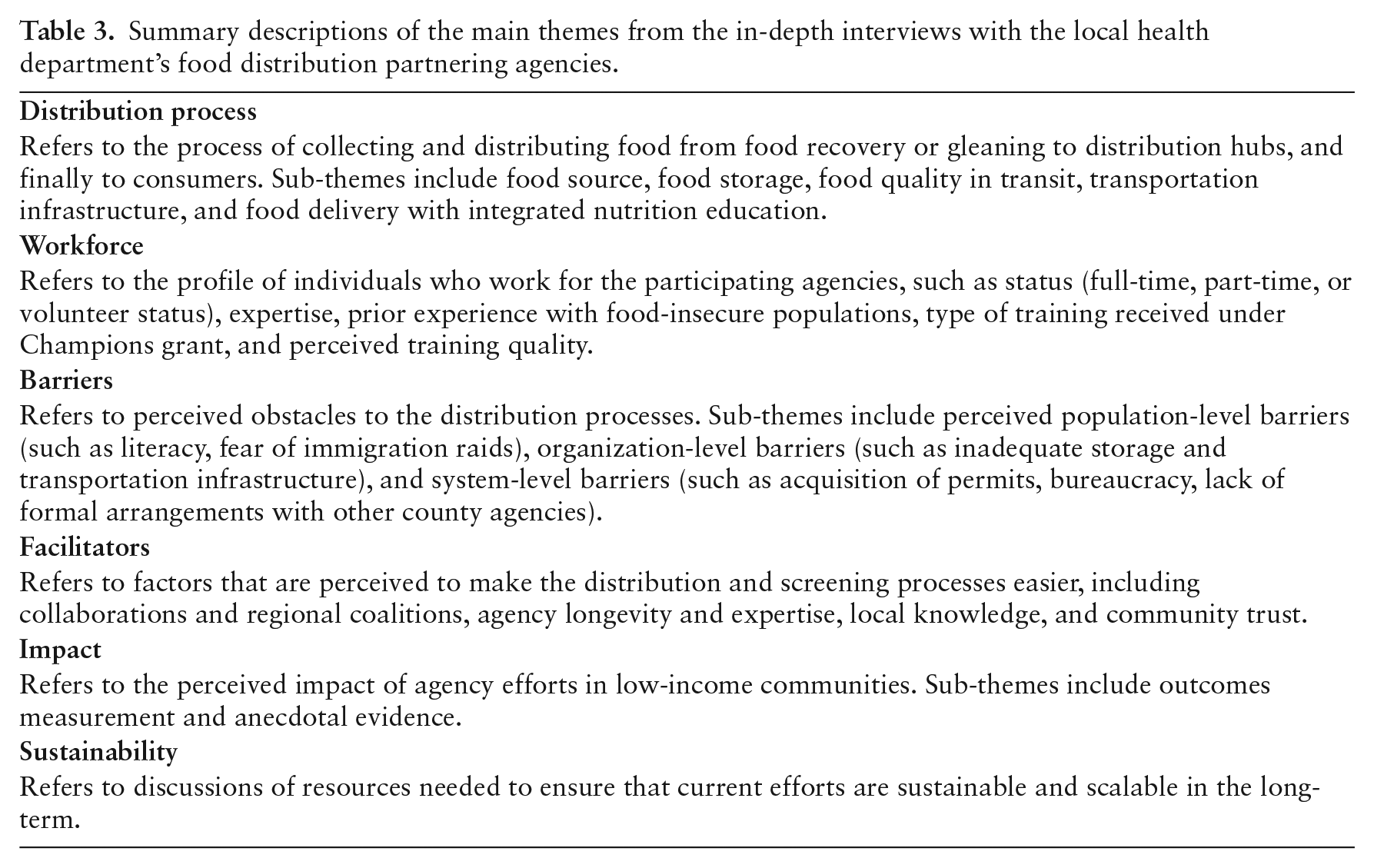
All eight partnering agencies/CBOs implemented some type of free produce distribution. These included a school district, a university, a faith-based institution, two healthcare systems, and three non-profit organizations. Interviewees discussed ‘food flow’ across suppliers in the distribution chain, including food sources, transportation, storage and packaging, sorting to address food quality issues, and integration of nutrition education as an endpoint of service. They described four stages in the distribution process: (1) food production by farms (fresh fruits and vegetables) and excess food availability from food retailers (non-perishable goods); (2) food recovery by organizations that seek to rescue perishable and non-perishable food from farmers, retail outlets, and other donors; (3) food distribution from food recovery organizations that act as hubs; and (4) food supply to consumers by community-based non-profit organizations. All agencies noted there is an underlying lack of central coordination countywide across these four stages of distribution.
Interviewees reported that their program teams for SNAP-Ed were typically small, consisting of 4–5 full-time employees. Yet their responsibilities were enormous: they tended to oversee part-time staff and volunteers, cultivate relationships with potential food suppliers and partner agencies, seek funds to support their activities, and are directly involved with distribution, including transporting produce from suppliers, sorting produce, transporting produce to consumers, organizing events, providing nutrition education, and collecting data. Training was cited as an unmet need.
While all interviewees talked about the challenges they face in their day-to-day operations, many also viewed them as opportunities to improve their implementation efforts, including reimagining their approach to resource allocation and finding better ways to collaborate with other organizations.
Perceived barriers to food recovery and distribution generally occurred at multiple levels: client, organization, system. Client-specific factors, for instance, limited attendance and retention of produce distribution events. These factors included lack of time and transportation, competing family responsibilities such as childcare, cultural/linguistic issues, limited awareness of program existence, and fear of immigration raids. Organizational barriers were primarily around logistics: inadequate or non-existent transportation vehicles, inadequate loading docks, and inadequate/non-existent cold storage space. Insufficient funding and staffing were also mentioned. At the system level, interviewees talked about administrative and bureaucratic constraints at partner sites (e.g. delays in event approvals), but also in relation to the LHD’s contracting requirements, which limited the agencies to work in a single geography even though they operate in more than one of these geographies.
All interviewees discussed factors that contributed to the success of their efforts. These included staff training, a motivated workforce, planning of distribution and nutrition education events around cultural and linguistic needs, community partner-ships, engagement by coalitions or communi-ties, and institutional longevity and expertise. Of these factors, three emerged as distinctly strong facilitators: (1) community partnerships, especially when agencies are able to locate partners that can complement certain aspects of the supply/distribution chain, such as large-scale refrigerated storage and transportation; (2) local, regional, countywide coalitions that facilitate awareness of other stakeholders’ resources and collaboration for developing and supporting more efficient allocation of resources; and (3) institutional longevity and expertise, especially agencies that have been operating for many years, with developed staff expertise, ties and trust across communities, countywide partner networks, and an infrastructure for distribution and nutrition education.
The majority did not have empirical data nor the capacity to fully assess their programs’ impact. However, most interviewees saw the value of collecting data and evaluating their programs, recommending that local governments should play a greater role in addressing this practice gap.
Discussion
Applying a mixed method design, this study examined food recovery and produce distribution barriers and facilitators at individual, organizational, and system levels, and the available opportunities for expanding food distribution efforts to better reach low-income households who are experiencing food insecurity. Emerging evidence supports the use of food recovery to address food insecurity (27,39). Several notable findings can be gleaned from this work.
First, the survey found that produce distribution events at CBO sites appeared to be filling an important need for food recipients, as up to 79% reported experiencing food insecurity, with most taking advantage of these services several months/year or monthly. Recipients of the food rated the quality of the produce at events as average to good, and most reported consuming an average of 2.1 servings of fruit and 2.1 servings of vegetables the previous day, almost at levels recommended by national authorities. However, there were some trade-offs—that is, most recipients also reported consuming an excessive amount of calories from candy, cookies, salty snacks and sugary beverages, suggesting that their diet quality was not optimal. More research is likely needed to further unpack these complexities with how produce distributions and other PSEs can complement nutrition education to influence individual dietary behaviors. This research can help strengthen future SNAP-Ed programming and contribute to local food systems’ capacity to better address food and nutrition insecurity in the community (26).
Second, at the time of the study, there were a number of media outlets that reported plans by the federal government to pass legislation to preclude citizenship for any immigrant who obtains SNAP benefits; this likely had a chilling effect on the use of these services (40). Not surprisingly, among distribution site clients who did not participate in SNAP, 6% reported that enrolling in the program would impact their citizenship. Overall, the Public Charge Rule did reduce enrollment in many safety-net programs (41); however, recent relaxation of immigration enforcement should help in easing this tension (42). Community based organizations can continue to advocate for and engage vulnerable communities by supporting alternative food initiatives alongside traditional charitable feeding programs (e.g. food pantries) (43,44).
Third, qualitative findings from this study were consistent with observations from prior studies (45,46). For example, lack of refrigerated storage and long transportation times have been identified as major challenges for perishable food recovery work (28). LHDs can facilitate and establish coalitions and collaborations to share resources and lessons learned that can address some of these challenges (47,48).
Finally, shortcomings related to program mea-surements of outcomes were generally common across the CBOs, suggesting that more formal measurement standards and external or public health assistance may be needed to address this data gap. To provide a more accurate depiction of food recovery and distribution, future work and food donation policies should incorporate a more standardized outcomes measurement plan so that program impact could be more rigorously assessed and compared across sites/regions (49).
Limitations
Although the mixed method design generated rich insights into the various issues, it has several limitations. First, the convenience sampling of the survey and the six-week data collection timeframe may have omitted vulnerable individuals who were not at the food distribution site on the day(s) that the survey was administered. Second, fears surrounding possible immigration raids likely reduced the pool of individuals available for the survey, thus reducing the data’s representativeness.
Third, our interview sample was relatively small and not necessarily representative, thus limiting our ability to generalize our findings beyond LAC. Nonetheless, the interviews yielded rich examples of how the food distribution efforts in LAC performed, drawing insights from a diverse, multicultural, and multiracial population.
Conclusions
Addressing food insecurity in the U.S. is a pressing public health challenge, especially in light of the COVID-19 pandemic’s negative impact on this condition. Food insecurity is strongly associated with social determinants of health, such as income, employment, and housing stability (12). At the same time, food waste is the largest component of municipal landfills (50). With some U.S. states, such as California, taking the lead in mandating food recovery and distribution (51), it is important to understand the full range of barriers and facilitators associated with these processes at the individual, organizational, and system levels. The knowledge gained implementing food recovery and distribution in LAC can help provide lessons for other local municipalities or unincorporated communities as they prepare to address the dramatic pandemic-related rise in poverty and associated food insecurity in the foreseeable future. Our study suggests that a policy action that could be broadened and is readily available to public health officials is the implementation and further expansion of SNAP-Ed interventions and other nutrition assistance programs. This network of food programs already exists and can be leveraged to coordinate, mobilize and improve the local food system so that it can better support food recovery and distribution in low-income communities. These programs’ abilities to organize and provide oversight and technical support to communities in need could translate to noteworthy health and social benefits for all in LAC and across the U.S.
Supplemental Material
sj-docx-1-ped-10.1177_17579759231193354 – Supplemental material for Food recovery and produce distribution as a system strategy for increasing access to healthy food among populations experiencing food insecurity: lessons for post-pandemic planning
Supplemental material, sj-docx-1-ped-10.1177_17579759231193354 for Food recovery and produce distribution as a system strategy for increasing access to healthy food among populations experiencing food insecurity: lessons for post-pandemic planning by Alina I. Palimaru, Julia I. Caldwell, Deborah A. Cohen, Dipa Shah and Tony Kuo in Global Health Promotion
Footnotes
Acknowledgements
The authors thank staff at the Nutrition and Physical Activity Program in the Los Angeles County Department of Public Health for their logistical support of the study. The content and conclusions presented in the article are those of the authors and do not reflect the views or opinions of the United States Department of Agriculture, the California Department of Public Health, the Los Angeles County Department of Public Health, RAND Corporation, or any other organizations mentioned in the text. T. Kuo’s participation in the development of the article was made possible through in-kind support from the Population Health Program at the UCLA Clinical and Translational Science Institute.
Author contributions
A. I. Palimaru (conceptualization, data curation, formal analysis, methodology, project administration, writing of the original draft); J. I. Caldwell (conceptualization, formal analysis, project administration, assisted with the writing of the original draft); D. A. Cohen (assisted with conceptualization, methodology, supervision, review and editing); D. Shah (funding acquisition, overall project administration, review and editing); T. Kuo (assisted with conceptualization, funding acquisition, supervision, res-ources, review and editing).
Declaration of conflicting interests
The authors have no conflicts of interest to declare.
Ethnical approval
Both components of the project (survey and interview) were approved (Certified Exempt) by the Human Sub-jects Protection Committee at the RAND Corporation (IRB00000051).
Funding
The authors disclosed receipt of the following financial support for the research, authorship, and/or publication of this article: This work was supported in part by the United States Department of Agriculture’s Supplemental Nutrition Assistance Program Education through a contract from the California Department of Public Health (#12-10170).

Supplemental material
Supplemental material for this article is available online.
References
Supplementary Material
Please find the following supplemental material available below.
For Open Access articles published under a Creative Commons License, all supplemental material carries the same license as the article it is associated with.
For non-Open Access articles published, all supplemental material carries a non-exclusive license, and permission requests for re-use of supplemental material or any part of supplemental material shall be sent directly to the copyright owner as specified in the copyright notice associated with the article.
