




Abstract
Education is the medium through which society can be transformed to ensure we live in a world free from discrimination and exclusion, where human beings coexist peacefully. One of UNESCO’s sustainable developmental goals is quality education that is inclusive and equitable. ‘Education for all’ and ‘places of belonging’ are therefore imperatives for educators if this goal is to be realised. This paper reports on selected educational leaders’ views on implementing inclusive approaches in teaching-learning activities. A qualitative approach was employed to collect data from 242 educational leaders from Caribbean Visionary Educators across 25 countries. Most respondents see inclusive education as beneficial. Others view it as a theoretical construct that increases workload. Lack of resources, infrastructure, administrative support and professional learning are viewed as barriers to inclusive education practices. There appears to be some incongruity between educators’ professional learning in inclusive education and their ability to implement inclusive education practices. Respondents revealed that despite receiving professional learning in inclusive education, their current level of training has inadequately prepared them to teach in an inclusive environment. Therefore, an inclusive approach requires educators to be prepared to teach all learners regardless of their challenges, and learners must become active participants in their schooling. The paper, therefore, concludes that it is necessary for leaders to operate in a transformative mode to promote inclusive education. This action should make schools become places of belonging that will benefit all learners.
Keywords
Introduction
The numerous voluble debates that the word education has attracted hints loudly at its importance in today’s societies. Undoubtedly, its involvement and complex nature are largely responsible for advancing ongoing deliberations. Its two different Latin roots offer fitting launchpads, which can take the debates in various directions while remaining etymologically sound. Herein lies the complexities that inspire differing views about education. The generally accepted Latin roots for education, educare and educere, both have the word action as the fulcrum of their operations. Educare means to train or to mould, and educere, means to lead out (Craft, 1994; cited in Bass and Good, 2004: 162). Training and moulding suggest ‘the preservation and passing down of knowledge’, whereas leading out is associated with preparing ‘a new generation for the changes that are to come… questioning, thinking, and creating’ (p. 162). Both pathways are desirable. However, the question that this situation prompts is: How can schools make maximum use of both functions?
In the spirit of maximising the above-mentioned education functions, the authors perceive education as the medium through which social transformation can thrive as society continually transforms itself. Biesta (2015) states that the purpose of education is multidimensional, seeking to achieve qualification, socialization and subjectification. While he acknowledges that education helps one to achieve knowledge and skills, he emphasises that there must be a balance between the three domains. Education must, to fulfil its purpose, go beyond simply qualifying individuals to produce caring human beings who are mindful of the impact they can have on society. The need to live in an inclusive, peaceful and just world has never been more acute than this present time (Fox et al., 2023; Kikabhai, 2022). It is also on this premise that the paper links leadership to inclusivity, as it reports on educators’ perceptions of implementing inclusive education practices in the classroom, thus highlighting the relationship between inclusion and leadership. The issue on which the paper focuses is a topical one. In 2015, UNESCO launched the Sustainable Development Goals (SDGs). One of the mandates countries must achieve is quality education that is inclusive and equitable. It is expected, therefore, that all societies should promote education for all, and that schools should become places of belonging, where all students have opportunities to maximise their potential. As alluded to by Antonio Guterres in the SDGs Report 2022, the attainment of the SDGs looks even gloomier. Guterres (2022) refers to ‘the destructive impacts’ of world crises on the achievement of the SDGs and opines: We need an urgent rescue effort for the SDGs… urgent steps needed to achieve the 2030 Agenda’ (p. 2), making a case for educational leadership as a catalyst for social transformation as addressed in this paper, is not the ‘urgent rescue effort’ needed for saving the SDGs. However, the authors contend that this leadership focus is one of the ‘urgent steps needed’ to get positive results from actioning SDG 4 – Quality Education and SDG 10 – Reduced Inequalities.
The idea for this research came directly from participants’ requests at the end of a two-day virtual International Conference entitled Inclusive Educational Practices in the Caribbean, which was held from 24 to 25 August 2022 and hosted by the Caribbean Visionary Educators (CVE) in collaboration with Inclusion Expert – The International Forums of Inclusion Practitioners (IFIP) to co-organise the conference.
From conference feedback, the objectives were realised. However, it was generally acknowledged that the conference was a mere ‘drop in the bucket’ regarding addressing the complexities of inclusive education. Seventy per cent (70%) of the participants on both days indicated that the conference benifitted them, and 100% stated their desire for future engagements with CVE and their interest in learning more about inclusion. It was out of this acknowledgement that the idea for this study developed, and authors used the main themes from the conference (Caribbean Visionary Educators, 2022) to frame the following four research questions: 1. How do educational leaders conceptualise inclusive educational practices? 2. What do educational leaders say are the factors that affect the implementation of inclusive education practices in the classroom? 3. What support do educational leaders identify as necessary to enact inclusive education practices in the classroom? 4. How do educational leaders’ responses show support for social transformation?
This paper provides a broader conceptual framework for discussion and begins with a framework that aids understanding the main issue researched. Next, it explains the methodological approaches used in the research. This is followed by an explanation of the reason for the research and the significance of it. The following three sections concentrate on the research findings and discussion, summary, implications for practice, and concluding remarks. Within the closing remarks is the assertion that there is a need for educational leaders to support an inclusive approach if schools are to become places of belonging.
Literature review
This research sought to provide an understanding, not an in-depth discussion, of other concepts which were highlighted at the conference (Caribbean Visionary Educators, 2022).
Educational leadership, transformational leadership, social transformation, inclusive education, and places of belonging are the concepts being discussed.
Educational leadership
It is not unusual to have the expressions educational leadership and school leadership used interchangeably in texts. The interrelationship between the terms is perhaps strengthened by the notion that the main leader in a school/institution is the headteacher or the principal. While this notion is generally accepted, it leaves unexplained the dynamics and interconnections within and around the different kinds of leadership. However, it brings attention to the need for a robust discussion about the importance of educational leadership at every level of a given teaching-learning institution, including learner levels. Within this realm, the scope of educational leadership becomes wide-ranging. Within this scope, the paper aligns with Spillane’s (2004) assertion: ‘… the main responsibility of school leaders should be the improvement of teaching and student learning’ (p. 344).
Education leadership has many shades of meaning and therefore means different things to different people (Allix and Gronn, 2005; Yukl, 2002), but all suggest some degree of activity. Beaudoin (2003) contends: ‘Leaders must create conditions conducive to energy, initiative and innovation in their particular milieu…’ (para. 36) Beaudoin takes this view further by suggesting that actions that leaders initiate should not begin and end with them, but that the actions should ‘bring others along, both above and below them in the organisational hierarchy’ (para. 36). Bringing others along suggests a degree of ongoing assistance and support that should result in positive changes. However, it is necessary to be mindful that the assistance and support given should be appropriate for the situation. This is especially relevant considering the claim that Western leadership theories ‘can be easily transported and legitimated within education systems elsewhere’ (Miller, 2013: 183). Despite the dominance of Western perspectives of educational leadership (Al-Dabbagh and Assaad, 2010), leaders must interpret educational leadership within Indigenous knowledge and practicalities that are framed within the learners’ cultural traditions and mores.
For educational leadership to be effective, leaders must make rational and logical decisions, be pragmatic and realistic, and possess the ability to use their influence to produce constructive changes.
Transformational leadership
On a conceptualisation level, transformational leadership bears just as high a level of complexity as leadership itself, which has attracted much scrutiny in social science research (Hijazi et al., 2017; Kala, 2014). This implies that if educational systems are to be transformed, leadership remains crucial in planning, processes and outcomes. Dhanhani and Abdullah (2022), from research work, note that transformational leadership had a significant positive effect on job performance and a significant positive effect on mission.
Binnie et al. (2005) employ a yacht metaphor to explain what transformational leaders are expected to do. They contend that leaders ‘cannot always change the context (the wind, the waves, the tides and the rocks) but, skillfully, they can chart a safe passage and reach the desired destination’ (p. 9). The position taken here suggests a need for skills, for knowledge alone cannot bring about desired results. It follows that leaders who focus on transformation should actively seek to ‘chart a safe passage’ through the maze of the changing educational landscape. Given that changes in education systems and teacher training are inevitable, it becomes imperative for education leaders to espouse transformational leadership, which not only allows them to identify the need for adjustments but also assists them in being visionary, inspirational, and committed to bringing out the best in learners. Cherry (2010); Creswell (2006, 2009); Ponce and Pagán- Maldonado (2015) affirms that transformational leadership can influence positive changes in followers, not simply for the energy, enthusiasm and passion that transformational leaders show, but more so that they want their followers to be successful. Shotte (2013: 29) refers to Alger’s (2008) claim that transformational leadership is desirable for school leaders who strive for improvement, struggle to raise awareness, and value institutional goal attainment.
Learners can be considered leaders, too, and they, too, need to be deliberate in their actions if they are to achieve positive results. For teaching-learning situations in a formal education context, the end goal is to assist learners in becoming constructive contributing citizens in society. Kellner (2000) offers critical pedagogy as a catalyst. Kellner (2000) explains it as a practice that ‘considers how education can provide individuals with the tools to better themselves and strengthen democracy, to create a more egalitarian and just society, and thus to deploy education in the process of progressive social change’ (para. 2).
Practicing critical pedagogy in a transformational leadership environment seems a practical way forward in empowering learners to use their thinking abilities and problem-solving skills in both in-school and out-of-school situations. Similarly, principals, head teachers and heads of departments can empower those they lead to be pedagogically sound, to create opportunities for them to embrace transformational leadership.
Social transformation
The basic tenets of social transformation show it to be intricately related to education and to transformational leadership. Rangaswamy (2022: 906) sees social transformation as being used ‘to indicate the transformations that take place in human interactions and interrelations’ and because society is generally accepted as community or national groups of people who have common backgrounds, interests and endeavours, Rangaswamy continues: ‘social transformation means transformation in the system of social relationships’, which should be comprehended ‘in terms of social processes and social interactions and social organization’ (p. 906).
Education institutions are examples of places where social processes and interactions are played out. Education is an enabler of positive changes and a facilitator of prospects for ambitions, targets, and goal achievement. Teachers, therefore, have a crucial role to play in ensuring that social transformation reaps the rewards. As crucial as the role is, there is an acute awareness that the teachers and the education system, share the same wider society. Whatever changes occur in that wider society affect all educators concerned (Rangaswamy, 2022; Rao, 2007). The seemingly small interconnection runs through and on all societal levels. This truth can prove to be a hindrance or a promoter of social transformation. However, since teachers are tasked with equipping societies with future leaders, they must prepare their students to fit into a variety of leadership roles.
Natural and man-made disasters, social criminal activities and the fallout of global issues negatively impact societies. Educators, although adversely affected, are expected to bring about a level of normalcy. Responding positively to challenging situations can go a long way in keeping students’ achievement motivation to a reasonable degree. Smith (2013) proposes transformational leadership for challenging times. But given its symbiotic relation to social transformation, this, too, is vital for educators in difficult times. Society is the fulcrum for leaders, teachers and learners, so social transformation is an ongoing venture which should not be slighted if today’s children are to become tomorrow’s leaders.
Inclusive education
The United Nations Convention on the Rights of the Child (UNCRC) Article 28 states: ‘State Parties recognise the right of children to education’ and ‘should take all appropriate measures to ensure that school discipline is administered in a manner consistent with the child’s human dignity’ (United Nations Children Fund United Kingdom (UNICEF UK, nd). It is in this article that the principles of inclusive education rest. UNICEF explains the meaning of inclusive education in this way: An education system that includes all students, and welcomes and supports them to learn, whoever they are and whatever their abilities or requirements. This means making sure that teaching and the curriculum, school buildings, classrooms, play areas, transport and toilets are appropriate for all children at all levels. Inclusive education means all children learn together in the same schools. No-one should be excluded. Every child has a right to inclusive education, including children with disabilities (UNICEF, 2017).
Inclusive education has proven to be one of the most contentious and tedious areas of classroom practice that teachers must deal with (Hollings, 2021; Kuyini et al., 2018). However, to affect workable inclusive education practices, inclusive education systems are needed. Unfortunately, systems tend to fall short because it seems that they continue to borrow Western ideologies concerning ‘inclusive education policies instead of developing more culturally informed policies’ (Hollings, 2021: 29). Similarly, Brown and Lavia (2013), in exploring inclusive education from a postcolonial stance, acknowledge that headteachers encounter ‘dilemmas, barriers and opportunities… in their effort to manage, lead and sustain inclusive schools’ (p. 45–46). The use of the word opportunities gives hope, especially when linked to Hollings’ comment. Brown and Lavia recognise the importance of cultural relevance ‘, especially in a world in which knowledge considered important is defined by Western industrialised societies’ (p. 47).
Inclusive education, although frothed with in-house challenges and external barriers, is desirable for all children. Present and future societies stand to benefit greatly if all educators ‘pull out all the stops’ to beat the odds of inclusive education.
Places of belonging
To return to the earlier mentioned Latin roots for education, educare and educere, there is a general expectation among educators that schools should accommodate the two functions. However, implementing curriculum material favours the use of educare (Bass and Good, 2004; Rose and Gallup, 2000). This situation denies learners the opportunity to acquire the leadership skills necessary for personal and national development (Abulhul, 2021; Mardiana, 2020). Given that both roots are operationalised within teaching-learning environments and that schooling is considered an enabler of national development, the need for balance in their uses is quite acute. National development suggests personal identity and a sense of belonging. The questions this notion prompts are: are schools places of belonging? Are they responsible for promoting a sense of belonging?
Riley (2017) contends that people’s sense of belonging is shaped by their own lives and histories, along with the encounters that they face daily. Many individual stories make up schools’ experiences, so individual and collective contributions are shared in schools’ reports. Not surprisingly, schools are considered stable places for many youngsters. Riley further notes that educators should acknowledge ‘the pivotal role that schools play in helping young people develop their sense of personal identity…’ (p. 11). Hence, educators should endeavour to set up spaces that eventually become places of belonging for all learners. A sense of identity can be, therefore, created within the wider community and national situations. In this way, schools, as places of belonging, should be able to empower learners to become productive participating citizens.
Methodology
The purpose of this research was to determine how educational leaders view the need for social transformation via inclusive educational practices and transformational leadership. The authors used an online survey to gather data. For convenience, the survey was open for four (4) weeks. Two hundred, forty-two (242) educational leaders from CVE’s affiliates across twenty-five (25) countries comprising teachers, deans, heads of departments, and principals from the basic education and higher education systems, as well as other educators, participated in the survey.
The survey comprised twenty-one (21) items, ten (10) of which were closed-ended, three (3) open-ended and three (3) resembled the Likert-scale question. Five (5) items were to elicit responses about participants’ demographics. The use of different question types enhanced internal consistency. Further, the open-ended, closed-ended and Likert-type items facilitated a mixed-method approach (Johnson et al., 2007). The mixed-methods approach offsets weaknesses in either qualitative or quantitative methods (Creswell, 2006, 2009; Ponce and Pagan-Maldonado, 2015). A mixed approach is used because this study focuses on understanding meanings and interpretations of respondents’ actions and lived experiences, and the study is ‘qualitatively driven’ (Schoonenboom and Johnson, 2017). Consequently, the qualitative interpretive approach (Arnett, 2007; Denzin and Lincoln, 2005) is given more weight. The research favours a thematic analytical approach, which allows for identifying and interpreting common threads and repeated patterns of meaning (Creswell, 2014; Denscombe, 2007). For comparison, the authors used descriptive statistics, and in particular, percentages were used to analyse closed-ended responses and open-ended responses that were quantified.
In keeping with qualitative research, the study utilises research questions that allow for data gathering and, more so, respondents’ ‘voice’ (Hannan, 2007; Silverman, 2010). Participants’ voices facilitate the association between perception and practical experience in their specific environment (Berkes, 2004). Hence, the data collected helped the authors produce a ‘thick description’ by ‘describing and interpreting observed social action’ within the context of the research (Creswell, 2013; Ponterotto, 2006, p. 543).
The following research questions framed from the inclusive education conference guided the study: 1. How do educational leaders conceptualise inclusive educational practices? 2. What do educational leaders say are the factors that affect the implementation of inclusive education practices in the classroom? 3. What support do educational leaders identify as necessary to enact inclusive education practices in the classroom? 4. How do educational leaders’ responses show support for social transformation?
The literature reviewed for this paper not only supports the use of the chosen methodology but also strengthens the framework for conceptualising the main ideas and contextualising the findings.
Limitations
The authors recognise that sample bias is possible because of respondents’ affiliation with CVE. Similarly, responses could have been chosen for the sake of completing a CVE survey, rather than chosen to relate a particular lived experience. However, the advantages of time, accessibility, affordability and convenience outweighed the prospect of using an alternative method.
Why this study?
Inclusive education is a concept that appears to generate many controversial issues. Attempts to put it into practice seem filled with issues, challenges and frustrations. So, any research that seeks to examine this concept can prove to be advantageous to students, teachers and other institutions in the wider village or town community.
A study of this nature should be able to highlight the issues that respondents face as well as identify strategies that should be able to address these issues. It is likely that well-informed and well-equipped educators can cater for the many and varied students’ dispositions and abilities. This study advances the process for further investigations and can potentially benefit educators and learners alike.
Findings
Summary of identified themes.
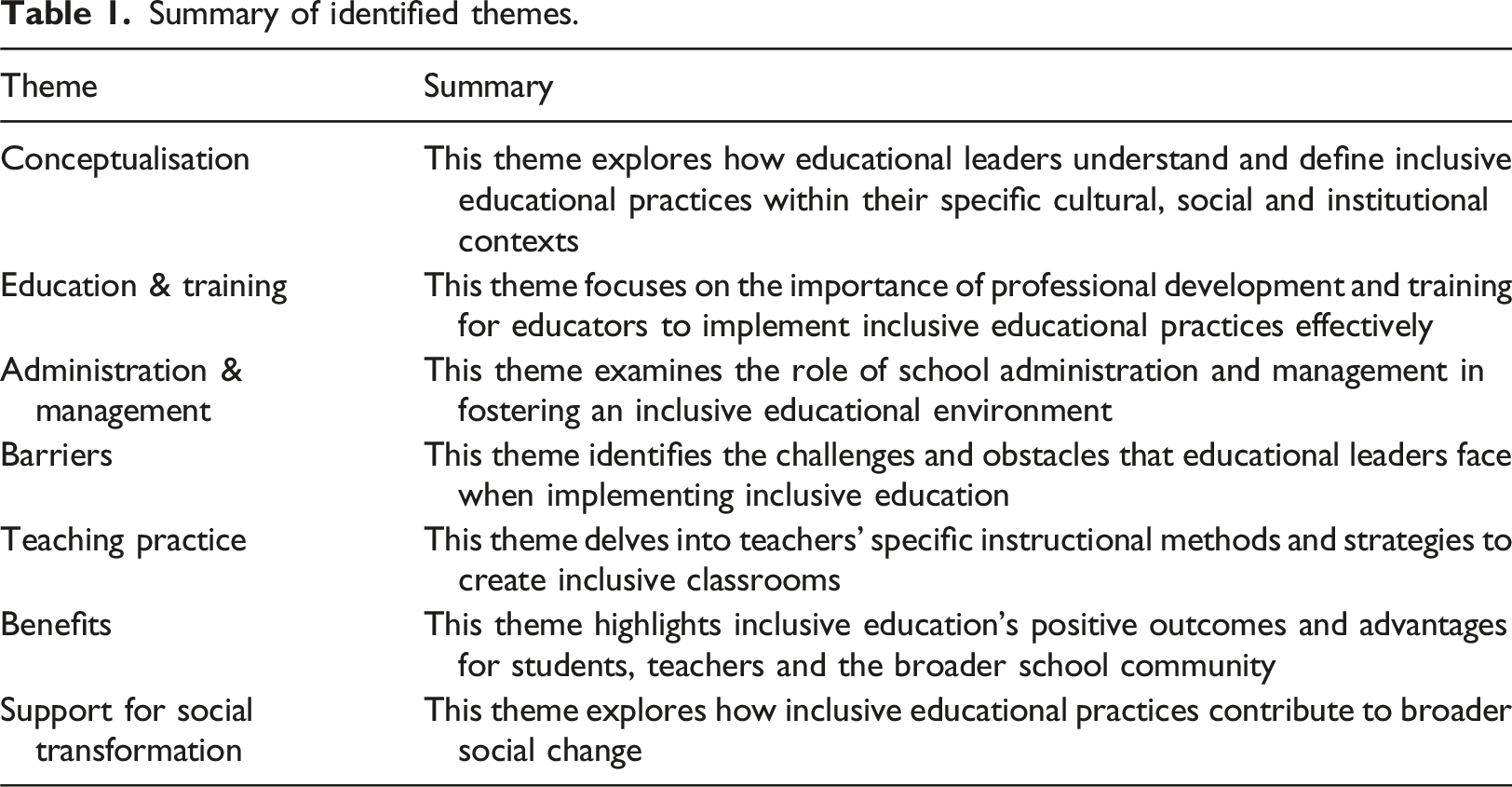
Thematic table
Conceptualisation
The majority (80.2%) of participants’ understanding of inclusive education is education for all (UNESCO, 2015), the integration of students and equity of access. This conceptualisation augurs well for schools to become places of belonging and a process to bring all students together in one classroom and school, regardless of their strengths and weaknesses (UNICEF UK, nd; UNICEF, 2017) or abilities in any area. This positive view of inclusive education indicates a strong consensus among education leaders regarding the fundamental goal of inclusive education. Designing lessons based on learners’ learning needs was conceptualised as inclusive education by 19% of the participants, while just about 1% saw inclusive education as a manner of instruction in which information is presented directly from teacher to learners.
Participants, like UNICEF, embrace a mainstream approach, where inclusion is not only through the curriculum and curriculum delivery but also on the appropriateness of, for example, play areas, the school building, classrooms and toilet facilities.
Education and training
Fifty-one per cent (51%) of the participants received professional learning (professional development sessions) in inclusive education, while 49% did not. Most participants’ exposure to training, 59%, indicated that professional training prepared them adequately to teach in an inclusive environment. Nonetheless, a significant number of participants, 96%, were interested in learning more about inclusive education. These participants seem to embrace education (training and professional development) as the medium to provide individuals with the tools to deliver education for ‘progressive social change’ (Kellner, 2000: para. 2).
Of the ten participants who were not interested in learning more about inclusion, eight were either exposed to professional training or their current level of training prepared them adequately to teach inclusion. Noteworthy, two of the ten participants did not receive professional learning in inclusive education, were not trained adequately and were not interested in learning more about inclusive education.
Some participants were unsure about learning more about inclusive education practices, while others wanted to learn about all aspects of inclusive education. Others indicated their interest in acquiring knowledge to advocate for ‘policy change’, ‘technology integration’, teaching strategies and methodologies, classroom arrangement and management, adapting to limited space and resources, addressing special needs and assessment. Other areas indicated were relationships, communication among stakeholders, and processes such as lesson planning. Participants also stated their interest in gifted students, for example, ‘…maximizing the potential of gifted students’ and ‘how to cater for special education needs learners without hampering the progress of typical and gifted learners’. Participants’ thinking of special needs learners and gifted students in inclusive education is congruent with the conceptualisation of inclusive education and supports the view that social transformation requires the interactions of all through social relationships (Rangaswamy (2022). Thus, with transformation, where the school helps students to develop ‘their sense of personal identity’ (Riley, 2017: 11), the school becomes a place of belonging (UNICEF, 2017).
Among participants’ responses regarding areas of development to foster inclusion in school are professional learning for all with 79.3%, technological and financial support each, 66.1%, collaboration among stakeholders, 61.6 %, and teaching aides, 61.2%. These developmental areas seem to be of interest across contexts and are not peculiar to any specific geographic area.
The prominence of professional learning relates to participants’ belief that continuous professional development is critical to the inclusive agenda.
Administration and management
While participants conceptualised inclusive education as students learning together, as supported by UNICEF (2017), about 37% of the participants, the minority (28.5% agree and 8% strongly agree), believed that gifted students and those with disabilities must be facilitated in special separate settings – an administrative and management issue. This perception is contrary to UNICEF’s (2017) position and reflects incompatibility between participants’ acknowledgement of the positives of inclusion and its implementation.
Barriers
Barriers to implementing inclusive education.
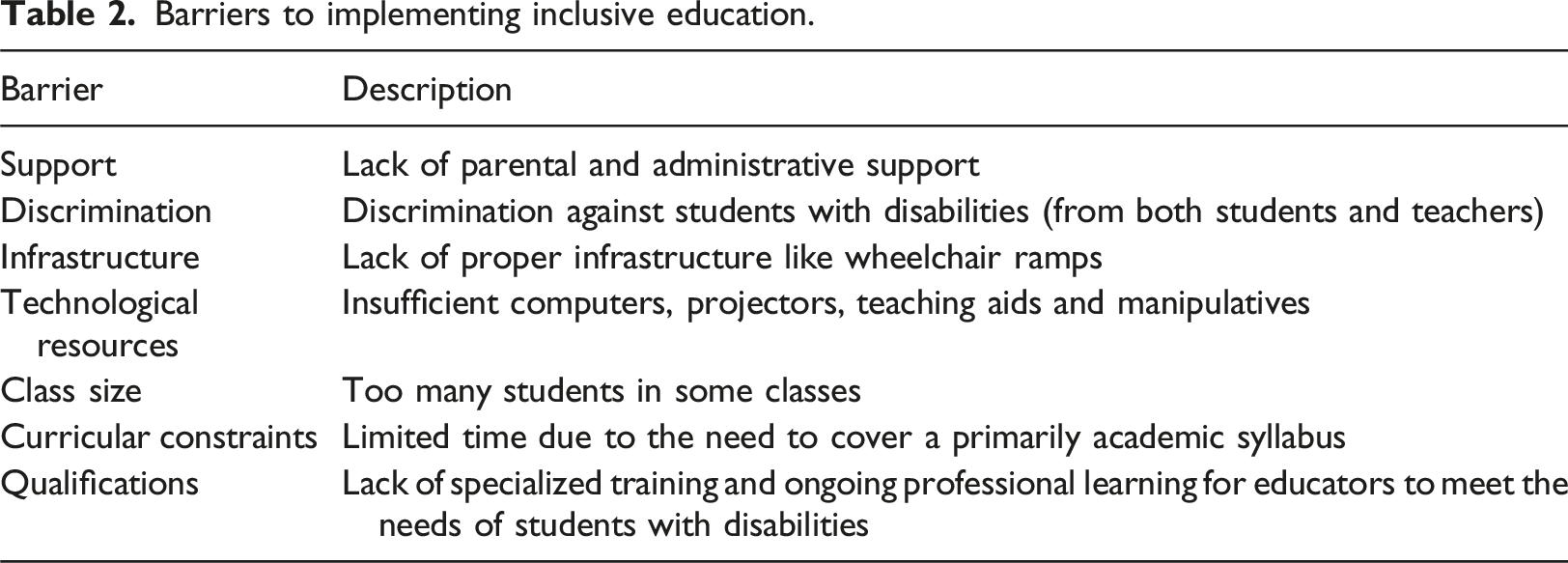
Implementing inclusive education in the classroom presents a myriad of challenges, as highlighted by participants in the study. Specifically, participants said: There is insufficient time for ‘syllabus requirements (timeline), students who demand lots of special attention’, considering ‘class size’, and ‘students with severe reading/comprehension difficulties’ or ‘learning disabilities’.
Also, the paucity of ‘trained teachers with the right skill set to teach the various abilities and needs in class’ and the ‘lack of resources to facilitate students with disabilities’ such as ‘an aide, for example, to go to the toilet’ or to assist ‘students with behavioural problems’.
Participants also believed that ‘inappropriate curriculum’, ‘inadequate funding’, and infrastructure such as the ‘physical layout of the classroom’ and ‘medical requirements’ are barriers to inclusion.
Another barrier mentioned was the ‘lack of parental engagement’. This engagement is fundamental to inclusion practice in schools (Rangaswamy, 2022). Additionally, participants stated another barrier was the issue of attitude as there was, sometimes ‘discrimination amongst students’ and ‘teacher resistance to different approaches to instruction and the focus on high stake examination preparations’. Additionally, the avoidance attitude of school principals/headteachers who ‘instead of dealing with issues that will help students in the classroom…thinks the problem will be solved (sic) by overloading teachers with more paperwork’.
Teaching practice
A significant majority (74%) of educational leaders advocate for a comprehensive approach to information delivery, combining multiple methods. They indicated that information should be presented to students through the following methods: • Lecture • Multisensory approaches (real experiences, physical activity and manipulatives) • Infographics, real objects, images, TikTok and other videos, interactives on devices • Blogs, wikis and online tools
Additionally, 23.6% of educational leaders specifically emphasized the importance of a multisensory approach, while 2.5% highlighted using digital and interactive tools such as infographics and videos. These findings suggest a growing recognition of the benefits of varied instructional methods and the need to integrate modern technology into teaching practices.
Additionally, there seems to be scepticism among a notable portion of educational leaders regarding the practical feasibility of inclusive educational practices as 36.8% of them believe that inclusion sounds good in theory but does not work in practice, suggesting that there are concerns about the implementation challenges and effectiveness of inclusion strategies in real-world educational settings.
Educational leaders also appear to doubt the adaptability of inclusion strategies in environments with limited resources and high student-to-teacher ratios as 40.5% think that inclusion will not work in schools that have too many students in a class. Additionally, 71.5% feel that inclusion will increase their workload, underscoring the perceived impact of inclusive education on the workload of education leaders.
Benefits
Based on the findings, educational leaders recognised the benefits of implementing inclusive educational practices in the classroom. The data reveal strong support for its positive impact on diverse student groups and overall academic improvement, with 86.8% of educational leaders believing inclusive education benefits gifted students, students from remote areas, students from affluent families and students with special needs. This belief was further reflected in participants’ statements about the benefits students at their schools could gain if teachers implemented inclusive education practices. Some of the statements shared include, ‘It would raise the students’ morale in the classroom’, ‘Inclusive practices would mean greater equity in the pedagogical process’, and ‘Students would learn empathy and how to collaborate with persons who are differently abled which is a real-life situation’, ‘The students are socially tolerant and able to interact and cooperate effectively. Bullying is unheard of. Students display genuine concern and empathy for each other. Learning is more enjoyable and engaging’, ‘No student would feel left out’, and ‘Helps develop friendship, social skills, problem-solving and respect for others’.
This recognition underscores the potential of inclusive practices to provide equitable opportunities and tailored support for all students in a supportive and collaborative learning environment. Ultimately, educational leaders believe that inclusive education helps students flourish academically and socially, preparing them to contribute positively to society.
Nonetheless, while educational leaders recognise the benefits of implementing inclusive education practices, their perception of inclusion reveals a divided stance. A slight majority (53.3%) disagree or strongly disagree that inclusion is only theoretically good, indicating a belief in the practical benefits of inclusive education.
Conversely, a small minority (7.1%) view the academic benefits of inclusion as limited to specific groups, and 46.7% agree or strongly agree that inclusion, while a good idea, faces practical implementation challenges. This group of educational leaders may have encountered obstacles such as inadequate resources, lack of training and insufficient support, contributing to their scepticism about the effectiveness of inclusion in practice.
The data implies the need for a balanced approach to effectively support all teachers in implementing inclusive practices. This approach includes providing comprehensive professional development, ensuring adequate resources, and fostering a school culture that values and prioritises inclusion.
Furthermore, the perceived impact of class size on inclusion reveals a significant concern among educational leaders. A majority (62%) agree or strongly agree that inclusion is less effective in large classes, while 38% disagree or strongly disagree that inclusion will not work in schools with too many students, indicating variability in teacher confidence and support for inclusion. These educational leaders likely have developed effective strategies or received adequate support for inclusive practices even in larger classes.
Social transformation
Participants seem to support social transformation, where the highest number of them (93%) stated, as a possible premise, that inclusive education will improve the academic performance of all students. Congruent to this premise, participants (95.9%) indicated their interest in learning more about inclusive education and, for example, relationships and communication among stakeholders, processes such as lesson planning, teaching, and learning strategies, and classroom management, ‘technology integration’, and how to advocate for ‘policy change’.
Another indicator of support is the 61.6% of participants who stated that collaboration among all stakeholders will encourage inclusive education, and specifically, the 80.2% of participants who recognised the need to bring all students together in a classroom regardless of their strengths and weaknesses, and those, 0.4%, who felt the need for the involvement of parents in promoting social transformation.
Participants, however, showed scepticism regarding operationalising social transformation in schools and pointed to the increase in workload and human, material and financial barriers as some of the impeding factors.
Through professional learning, transformational leadership can influence positive changes in followers, not simply for the energy, enthusiasm and passion that transformational leaders show, but more so that they want their followers to be successful (Cherry, 2010). Additionally, Shotte (2013: 29) refers to Alger’s (2008) claim that transformational leadership is desirable for school leaders who strive for improvement, struggle to raise awareness levels and value institutional goal attainment.
Further, participants recognised that the social relationships and interactions Rangaswamy (2022) necessary for inclusive education involve all stakeholders, including educators, parents and the community.
The results suggest that educational leaders are interested in learning more about inclusive education and recognise its potential to improve academic performance, promote diversity and foster collaboration among stakeholders. Overall, data analysis concerning education leaders’ conceptualisation of inclusive educational practices reveals a complex landscape of attitudes and perspectives. While there is consensus on the benefits of inclusion, there are also divergent views on its implementation, effectiveness and practical considerations.
Discussion
Participants’ views on inclusive education augur well for schools becoming places of belonging as it aligns with UNICEF’s (2017) definition of inclusive education as a system that includes all students, welcoming and supporting them in their learning. The majority view inclusion as a holistic process that unites all students within a communal learning space, valuing their individual strengths and weaknesses. This view reflects a deep-seated belief in the potential of every student and an aspiration to cultivate an environment where students’ potential can be maximized. With this progressive view of inclusive educational practices, schools can be transformed into vibrant communities of belonging that promote equality and respect, enhance student engagement, and as a corollary, may lead to improved academic outcomes for all students.
The factors participants identified affecting the implementation of inclusive practices infer systemic challenges – resource constraints, infrastructural needs, the attitudes of students, parents and education leaders, and the necessity for community-wide support. Notwithstanding the barriers, participants recognised the advantages of implementing inclusive educational practices in the classroom. However, there seems to be a disconnect between their acknowledgement of its benefits and the actual application of these practices, which highlights headteachers’ ‘dilemmas, barriers and opportunities… in their effort to manage, lead and sustain inclusive schools’ (Brown and Lavia, 2013: 45–46). These findings emphasize the complexity of enacting inclusive education and highlight the multifaceted approach required to overcome these barriers. Generally, if the barriers were to be addressed, they would enable inclusive practices in schools and constitute support for the inclusive agenda.
From the findings, there is a consensus on the need for collaborative engagement among all stakeholders. For example, 61.6% of participants felt stakeholders’ collaboration encouraged inclusive education, and 80.2% and 0.4% recognised the need to bring all students together and involve parents, respectively. This consensus for stakeholders’ collaboration concurs with Beaudoin’s (2003) view that actions leaders initiate should not begin and end with the leaders but that the actions should ‘bring others along, both above and below them in the organizational hierarchy’ (para. 36). In other words, emphasis on the engagement of all stakeholders underlines the importance of a collective effort among parents, students, administrators, and the wider community, and recognition that the implementation of inclusive educational practices extends beyond the individual teacher’s responsibility. It highlights the critical need for each party to play their role in creating an environment where all students feel valued and supported.
It is also important to note that there appears to be a significant gap between the professional learning provided to educators on inclusive education and their perceived readiness to teach in an inclusive environment. Further, the concern about participants’ ability to implement inclusive educational practices suggests that current professional learning programs may not fully address the practical needs of educators or the diverse requirements of students within inclusive classrooms. From a leadership context, this concern emphasises the importance of aligning training with the practical realities of teaching diverse learners and ensuring that educators are equipped, supported and confident in their ability to foster inclusive classrooms.
Finally, the responses from educational leaders resonate with a commitment to social transformation. The results suggest that educational leaders are interested in learning more about inclusive education and recognise its potential to improve academic performance, promote diversity and foster collaboration among stakeholders. By embracing inclusive education principles and advocating for collaborative approaches, educational leaders are crucial in driving social transformation within educational settings and beyond. Participants’ beliefs about inclusive education support assertions by researchers such as Kellner (2000), Riley (2017) and Rangaswamy (2022) that education plays a pivotal role in attempts made to create a more egalitarian and just society.
Educational leaders’ support for inclusive education signals that they are ready to embrace their role as champions of social transformation. This support is not merely a pedagogical preference but a reflection of a desire to create a society that promotes equity, embraces diversity and endeavours to uplift every learner. The high levels of interest in further education on inclusivity, alongside the belief in its positive impact on all students’ academic performance, signal a readiness to lead education systems into a more inclusive future.
Conclusion
This study illuminates the perceptions and convictions of educational leaders regarding inclusive educational practices. Educational leaders envision inclusivity as an educational imperative characterised by the unification of all students within a learning environment that celebrates and accommodates diversity in all its forms. Educators’ conceptualisation extends beyond mere physical integration, advocating for a systemic approach to learning that seeks to maximise the potential of each student.
Educational leaders identify multifaceted challenges that hinder the implementation of these practices. They range from tangible issues, such as the scarcity of human, financial, and material resources, to more nuanced concerns, such as insufficient parental and administrative support, discrimination, and infrastructural inadequacies. These hurdles are compounded by the realities of large class sizes and the pressures of an academically rigorous syllabus, which leaves little room for the additional demands of inclusive education.
Regarding support, the data indicate a consensus on the need for comprehensive strategies that include professional learning, stakeholder collaboration and appropriate technological and pedagogical resources. The leaders acknowledge that fostering an inclusive classroom is not a solo endeavour but requires a concerted and collaborative effort across all levels of the educational landscape.
Moreover, the educational leaders’ responses reflect an endorsement of inclusive education as a catalyst for social transformation. Their belief in the power of inclusive practices to improve academic performance and promote equality signifies a commitment to reforming educational systems. This commitment is not just about enhancing academic outcomes but also about effecting real, fundamental societal changes that align with equity, inclusivity and opportunity for all.
Through their collective voices, educational leaders have charted a path forward that requires courage, collaboration and a steadfast commitment to the principles of inclusive education. The study, therefore, serves as a call to action for all stakeholders in shaping the educational narratives of the future.
Footnotes
Declaration of conflicting interests
The author(s) declared no potential conflicts of interest with respect to the research, authorship, and/or publication of this article.
Funding
The author(s) received no financial support for the research, authorship, and/or publication of this article.

Data availability statement
Data sharing not applicable to this article as no datasets were generated or analyzed during the current study.