




Abstract
This study examines perspectives of seven Jamaican primary school teachers on the degree to which their principals’ leadership behaviours include emphasizes recognition, promotes participation in decision-making, takes account of their diverse skills, and demonstrates openness to criticism. The study further explores whether teachers consider the principal’s behaviour as contributing to the culture of the school. The study found that teachers value expressions of recognition and opportunities to participate in decision-making. The study also found that while teachers are consulted, they are of the view that their contributions are not sufficiently considered. Instructively, all respondents held the view that while all members of staff were responsible for shaping the culture of the school, the principal had a leading role to play. The findings of the study suggest the need for post-training executive coaching component be implemented which would involve periodic structured conversations about growth, leadership, interpersonal relationships, and culture leadership, among other issues. This mechanism would allow the principal to reflect critically on how he/she in shaping the culture of the school. This coaching exercise would have an even greater impact if it were reinforced by confidential 360° performance reviews focussing on various aspects of cultural leadership.
Introduction
Culture is the vessel which directs the course of and ethos of an organization or community. Handy (1999) suggests that culture conveys ‘…the feeling of a pervasive way of life or set of norms’ (p. 181). Within the context of an organization, culture, according to Handy, denotes ‘…beliefs about the way work should be organized, the way authority should be exercised, people rewarded, people controlled’ (p. 181). In this regard, culture defines the ethos of an organization. These perspectives are shared by Hoy and Miskel (2012) define culture as shared organizational characteristics which hold the organization together. If culture is the vessel and glue in which, and by which, an organization exists, then the practices, traditions, ideologies, and beliefs portray the personality of the organization. This personality is the phenomenon staff and visitors meet and to which they relate on an ongoing basis.
One of the realities with which the Jamaican education system is grappling is how to strengthen the leadership capacity of principals. More focused efforts in this regard were implemented in 2010 with the establishment of the National College for Educational Leadership (NCEL) which has been providing training in leadership (and other competencies) for both existing and aspiring principals. One of the modules in the six-module Aspiring Principals’ Programme (APP) deals extensively with the issue of school culture and the principal’s role in shaping it. The question of the school principal’s role in shaping school culture must be located in the broader question of the nature of school leadership. Among the components of the leadership question with which the Jamaican education system struggles are staff motivation and involvement in decision-making.
Miller (2018) examines the issue of school leadership from a multi-cultural perspective and argues that there are several elements. Among the elements of school leadership identified by Miller are that it is personal, internally motivated, and change oriented. He further states that it is subject to economic factors, geography, politics, relationships, and the environment. Miller’s position on the personal dimension of school leadership is supported by Hutton (2017), who argues that a leader’s personal qualities are critical elements of his or her leadership effectiveness. These analyses of factors which affect school leadership are applicable to school culture which is the vessel which directs the course and ethos of an organization, as Handy (1999) and Hoy and Miskel (2012) posit.
If culture leadership is a task of the school principal and culture directs the course and ethos of an organization, then the chief question which arises is how the principal leads in constructing the culture and ethos of the school. Thompson (2015) contends that the principal of a school of the Chief Culture Shaper (CCS); thus, if Thompson’s assertion is credible and supported, the answer to the question is that the principal is chiefly responsible for the culture of the school.
Organizational cultures may be classified as healthy or unhealthy. Lunenburg and Ornstein (2012) identify the characteristics of healthy school cultures as including one in which the principal: is visible to all stakeholders, communicates regularly and purposefully, accepts responsibility for the school’s culture, and empowers others appropriately. Addressing the issue of empowerment, Thompson and Samuels-Lee (2020) found that among the actions of leaders which result in empowerment were encouragement to staff and commendations on their work. They also found that disempowerment (the opposite of empowerment) was synonymous with demotivation, and relying on the seminal works of Herzberg (1987) and McClelland (1967), note that among the actions of leaders which create feelings of disempowerment (i.e., demotivation) among staff are limited, or lack of, access to opportunities for involvement in decision-making (Herzberg) and space to bring their creative capacities to bear on the work and thus feeling a sense of achievement (McClelland) and the concomitant experience of recognition (Herzberg) that would follow achievements.
If the principal is the chief culture shaper of a school, then his or her actions will influence, if not be definitive in determining, whether the school possesses and portrays a healthy or unhealthy culture. What is deemed a healthy or unhealthy school culture will be, in large measure, a function of the perceptions, expectations, and experiences of stakeholders, particularly staff and students.
It is against this background that this research seeks to explore the experiences of teachers in four schools to understand what their assessments of the culture of their schools are, and what are the behaviours of the principal which, in their experience and assessment, contribute to the culture (the personality) of the school.
Paradigm RePaDO refers to Recognition (Re), Participation (Pa), Diversity (D), and Openness (O), Thompson (2017). The construct represents the top four variables which defined teachers’ expectations of principals’ leadership approach, derived from a study using a sample of 97 Jamaican teachers. Paradigm RePaDO examines whether leaders recognize the contributions of team members, create pathways and systems for meaningful participation in decision-making, celebrate and embrace the diverse gifts and talents which team members bring to the organization, and are open to criticism and feedback for members of the organization. Using these defined qualities of leaders as found by Thompson (2017), this qualitative study seeks to explore the experiences seven teachers from four schools in Jamaica with respect to Paradigm RePaDO.
Problem definition and research questions
Teachers in Jamaica experience high levels of demotivation. Hewitt (2012) contends that teachers in Jamaica experience lack of respect and regard for their competencies. Hewitt also highlights that teachers feel disempowered. The Caribbean Centre for Educational Planning (CCEP, 2022) conducted a survey in 2022, designed to understand the factors driving teacher migration. The survey polled as sample of one hundred and fifty-eight teachers, 45.9% of whom had left classrooms in Jamaica and 41.4% of whom were ‘seriously contemplating migration’. The survey found that the quality of leadership was the third highest driver of teachers deciding to leave (with salaries and working conditions being number one and two respectively). It is this question of leadership with which Miller (2018) seeks to grapple and to which this study seeks to contribute, using the lenses of school culture.
The combined effect of a chronicle of perceived disrespect, high levels of attrition due to concerns about the quality of leadership, and apparent outright fear clearly demonstrate that there likely exist unhealthy cultures in some schools in Jamaica. Relying on Thompson (2017), this study will examine whether there is a perceived relationship between selected school leaders’ practice of the elements of Paradigm RePaDO and the culture of the schools. The paper will seek to answer six questions, as follows: (1) What do teachers regard as recognition of their work and contributions to the school and do they feel that their work and contributions are sufficiently recognized? (2) How do teachers perceive their level of involvement in decision-making at their school? (3) What are teachers’ opinions of the degree to which their diverse gifts and talents are utilized by their schools and how do they feel about the utilization of their gifts? (4) How do teachers assess their principals’ attitude to criticisms and openness to debating issues and what are their assessments of his/her attitude to criticism on the climate of the school? (5) What are teachers’ views on the culture of their schools, and do they see a relationship between the behaviour of their principals in respect of recognition, facilitation of involvement in decision-making, utilization of their diverse gifts, and openness to debate, on the one hand, and the culture of their schools, on the other? (6) Whom do teachers regard as being chiefly responsible for shaping the culture of the school and what are some of the behaviours that they regard as being most pivotal in shaping the culture of the school?
Significance of the study
This study is significant for at least three reasons, namely: (1) Paradigm RePaDO has been receiving attention by scholars globally in works such as Dimopoulos (2020), Dickens et al. (2021), and Tierney (2020), and a continuing examination of its usefulness is necessary as many school leaders appear to doubt the necessity of the implied behaviours for their leadership practice. (2) The appreciation of the relationship between leadership and organizational culture, though widely presumed to exist, does not appear to be a settled question. Indeed, some of the interviewees in this study do not agree that their principals’ behaviours inform the culture of their schools. Thus, there is need for a conversation around, and exploration of, this issue – which is what this study seeks to do. (3) As indicated in the second reason, the fact of this exploration will add to the body of knowledge by hopefully broadening and deepening the conversation around the relationship between leadership and culture.
Literature review
Definition of culture
Deal and Peterson (2003) describe culture as the patterned ways in which an organization does what it does and suggest, by the very title of their work, that shaping school culture is the heart of leadership. They suggest that culture constitutes a collective programming of the thoughts and behaviours patterns of members of an organization, and that it is these patterns of behaviour among members of an organization which distinguish one organization from another. See organizational culture as a system of shared orientations which hold the organization together, while Thompson (2015) contends that culture constitutes a mutable system of organizational identity which is the leadership of the organization can shape and remake.
Leaders shape culture
The quality of patterned (and thus ongoing) behaviours is what makes a set of behaviours cultural and reflective of an organization’s ‘personality’ as distinct from some odd occurrence. Thus, the issue of what enables a leader to consistently model behaviours, which influence the behaviours of others and eventually come to define the organization, arises. The question of the source of that modelling capability is fundamental to an understanding of culture and, more specifically, the relationship between leadership and organizational culture.
Day et al. (2009) list what they describe as 10 strong claims about successful school leadership. At the top of the list is the claim that ‘head teachers are the main source of leadership in their schools’. This claim suggests, among other things, that the direction and vision of a school is located largely in how the principal leads. But the question of what determines the content of the model presented by the principal, or what is the source of his or her leadership again arises. Day, Sammons, and Hopkins answer this question with the third claim, that the values of the head teacher are the sources of his or her success. In essence, it is the core beliefs of the principal which are the fount of his or her leadership behaviour. This view is supported by Hutton and Johnson (2017) who argue that a principal’s personal beliefs provide a compass for his or her leadership. Thus, a principal’s capacity to influence and shape a culture is rooted in who he or she is, which determines what he or she does and how.
The idea behaviour is rooted in being is a classical concept in philosophy which was articulated by Lehmann (2006). Lehmann’s basic argument, understood the context of leadership, is that the starting point of leadership is not what one ought to do, but who one is. In this regard, it is the who that determines the what. Thus, as a leader makes his or her imprint on an organization, that which is conveyed is personality and persona. Therefore, that given that the leader is the chief culture shaper (not sole), Thompson (2015) and the main source of leadership (not only, Day et al. (2009), the collective selves which make up an organization become the collective selves which are expressed in the culture of that organization.
Employee engagement in shaping culture
While the principal is the chief culture shaper and the main source of leadership in the school, an organization’s culture cannot be built around one person. But there have been cases in which a leader makes him of herself so prominent and dominant in the life of an organization that after he or she leaves there is major destabilization and chaos. In those circumstances, it may be concluded that the culture of those organizations is what Handy (1999) calls a ‘person’ culture, which may also manifest itself as a cult of personality. A cult of personality exists when a leader is enabled to position himself or herself as having heroic or messianic qualities deemed singularly responsible for all the good things which occur in an organization or country and thus becomes the object of adulation and frequent flattery. Such leaders often claim to be able to single-handedly turn their schools around. Thompson and Wilmot (2022) have shown no individual working in an organization is ever exclusively responsible for the fortunes of that organization, even though, as Thompson (2015) and Day et al. (2009) affirm, the leader plays a critical role in the fortunes of an organization.
There are three important upshots of the foregoing. The first is the need to reiterate that the culture of a school is a shared creation (Hoy and Miskel, 2012). The second upshot is that if a positive and desired culture of a school is to be sustained, there must be distributed leadership. Day et al. (2009) state in their ninth claim about leadership that successful school leaders distribute leadership progressively. The essence of this claim is supported by Spillane and Camburn (2006) who articulate the theory of distributive leadership, and Thompson and Wilmot (2022) who examined the perspectives of Jamaican teachers on the practice of empowerment in their schools. The fundamental positions of Spillane and Camburn (2006) who, and Thompson and Wilmot (2022) are reinforced by Kumar and Kumar (2017), Hossein et al. (2012), Alam and Farid (2011), Devadass (2011), and Kitiltepe (2008).
The third, and perhaps most important implication of assertion several stakeholders are involved in the creation of school’s culture and that inescapably there must be the sharing of power, is the issue of healthy versus healthy school cultures. Rooted in this issue are the characteristics of healthy versus unhealthy school cultures as outlined by Lunenburg and Ornstein (2012). In creating the contrasts, they note that, among other things, healthy school cultures are characterized by a principal who does four things. These four things are: visibility to all stakeholders, regular and purposeful communication, acceptance of responsibility for the school’s culture, and empowerment of others appropriately.
Trust
The issue of trust in leader-led (including principal – staff) relationships has been meaningfully explored and some helpful insights have emerged from recent research. The foundational questions of ‘why the need to trust?’ and ‘what is trust?’ have been helpfully examined by Savolainen and Hakkinen (2011), who highlight the pivotal importance of trust for all relationships. They argue that distrust affects an organization’s performance negatively and high levels of trust affect performance positively. Savolainen and Hakkinen are supported by Rezaei et al. (2012) who posit that trust is vital to every valued relationship and is one of the most critical assets of a leader. They further suggest that the health and well-being of an organization and its employees depend on trust and the leader’s trust and trustableness profile is the most critical individual contribution to the trust levels in an organization.
Trust may be viewed as a fickle and fluid yet formidable component of relationships. Hurley (2006) defines it as confident reliance on someone when one is in a position of vulnerability. This definition appears to be aligned to the maxim that trust requires vulnerability. The element of vulnerability is consistent with the assessment that trust is fickle. What this definition of trust means for a leader (in the context of this paper, the school principal), is that the sharing of power, and other behaviours necessary to create a desired school culture, requires that he or she becomes vulnerable to staff members. Vulnerability results in shifts in the power dynamics of a relationship. Sharing power means giving the other with whom the power is shared space to exercise power, the exercise of which could conflict with the will and wish of the one who shared the power with another.
Mayer et al. (1995), concur with Hurley, characterizing trust as the willingness to be vulnerable to the actions of another. The decision to make oneself vulnerable despite having power, which to some degree serves as a defence against some forms of vulnerability, is done when a rationally acting person perceives that the route of vulnerability is a necessary path to the attainment of some other objective, or some need being met. This interpretation is supported by Rousseau et al. (1998) who describe trust as a psychological state in which one in anticipating that some needs will be met, but accepts vulnerability based upon positive expectations of the intentions or behaviour of another.
The conclusion to this discourse is that sharing power, among other behaviours, is necessary for creating a sustainable and healthy school culture, but the sharing of that power makes a principal vulnerable, as sharing power necessitates the exercise of trust and trusting creates vulnerability. The decision to be vulnerable is not an easy one and many leaders seek to circumvent the power-sharing, trusting, vulnerability-creating state for themselves. The consequence of this decision is that many schools operate in unhealthy cultural environs. This paper inquiries into the experiences of seven teachers, from four schools, about the culture of their schools. This inquiry is done to establish whether teachers perceive that there is a relationship between the culture of their schools and the principals’ behaviours.
Research methodology
Research design
This study employed a qualitative design using the data collection method of interviews conducted in a focus group discussion context. Focus group interviews allow for gathering large amounts of data in short time and enable the researcher to utilize the responses of interviewees to deepen the probe and improve understanding of the issue being studied. Nyumba et al. (2018) notes that focus group discussions are frequently used as a qualitative approach to gain an in-depth understanding as they provide a rich and detailed exposure to the perceptions, thoughts, feelings, and impressions of people, as asserted by Stewart and Shamdasani (1990) as cited by Dilshad and Latif (2013).
Qualitative designs are used when a researcher wishes to obtain a deeper understanding of the lived experiences of people whose realities are being explored, according to Creswell (2018) and this study, which seeks to enter the lived realities of teachers in their day-to-day contexts is best undertaken using such a design.
Sampling technique and description of participants
The sample for this research was conveniently chosen from four schools in two parishes in Jamaica. A sample of eight teachers was sought but seven were available. In conducting qualitative research, sample sizes normally range from between six and 30, and the exact number will depend on the research purpose. Creswell (2013) emphasizes that it is purpose of the research which determines sample size.
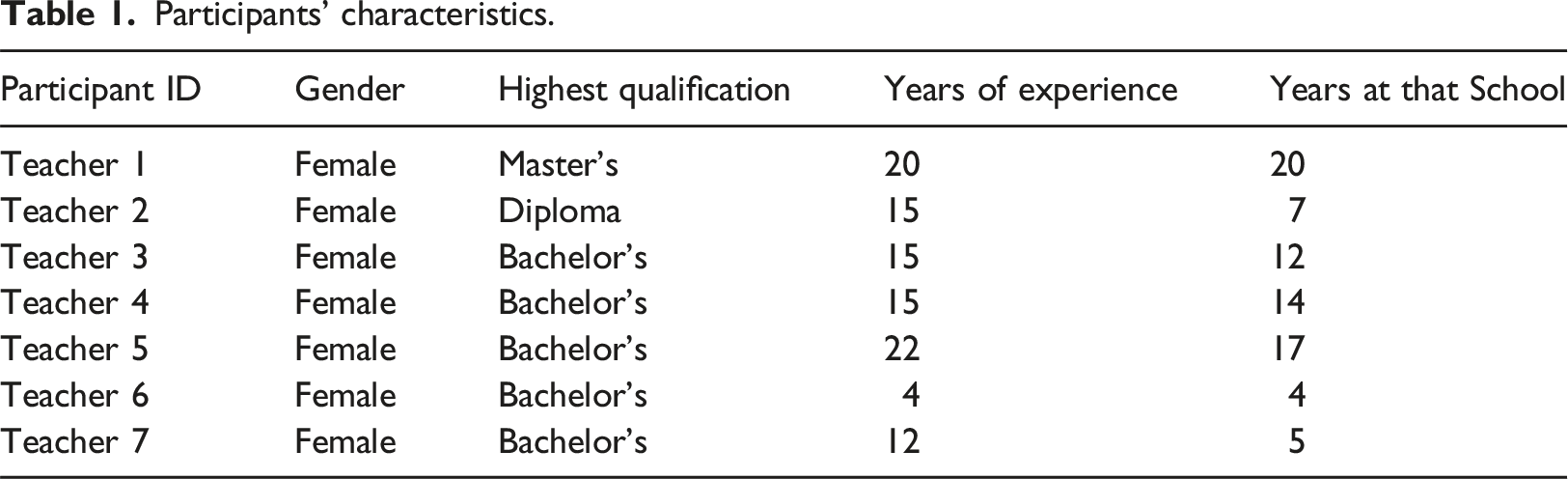
Having decided on the sample size, a researcher assistant was engaged to assist in identifying eight (8) teachers (two from each school) who were willing to participate in the study. A brief description of the research was provided orally to the research assistant (who also served as a proxy for the researcher) who then canvassed the interest of colleagues after which a written description was sent to the proxy. The participants were mostly unknown to the researcher. The characteristics of the participants are outlined in the table below.
As shown in the table above, all of participants were females. This is not surprising as most classroom teachers are males and difficulty was encountered in securing the participation of male teachers. That the highest qualification for the majority is a bachelor’s degree reflects the reality in the general population.
Data collection and analysis procedures
Data were collected using the zoom recording system as well as by notetaking. There were two sessions, each with four participants. This was done to create an environment in which participants could speak freely, without fear of their colleague from their school repeating what he or she said. Participants were asked, at the start of the focus group discussion, to commit to not sharing information about fellow participants or what they said.
The foregoing protocols, while normal when probing matters of a sensitive nature, were even more necessary, given that a major concern of some of the would-be participants was anonymity and confidentially as they were concerned that if their comments got back to their principals, they could face repercussions. To ensure participants’ anonymity and the confidentiality of the information they shared, three additional measures, as detailed below were taken, in addition to assigning each the labels indicated in Table 1. (1) All communication with the would-be participants was done through the proxy, including the provision of the zoom link. (2) Participants were asked to log onto the zoom link using the name assigned to them. (3) The version of the transcript shared with participants (for their review and validation) had the teacher-number identifier removed. Participants’ characteristics.
The data were analyzed manually by identifying the responses which corresponded to the research questions as well as the interview items and themes from their responses highlighted.
Reliability and validity
The reliability and validity of the research is founded in four elements, namely: (a) the same interview items were asked of all participants in the same order; (b) participants were not given the research questions or items ahead of time and thus could not prepare responses, they spoke spontaneously; (c) participants were given the generic name ‘Teacher’, with the number used to distinguish them, thus allowing them the space to speak freely; and (d) the verbatim transcription of the interviews was shared with participants for validation or member-checking (Birt et al., 2016). All participants confirmed that their contributions were captured accurately.
Ethical considerations
One of the key ethical considerations informing this study was the issue of confidentiality. In addressing this issue, provision was made for the anonymity of respondents. This was assured through using the label Teacher (# as shown in Table 1) to refer to the interviews. In addition, in presenting the findings, quotes were not attributed to teachers directly as interviewees who read the published paper may be able to identify who said what and may disclose to a third party who was the author of specific comments.
Findings
Recognition
The first research question addressed the issue of recognition and examined what teachers defined as recognition and whether they felt recognized.
Teachers reported that publicizing of their work and contributions within the school community and the district, (such as teacher of the term or year), with certificates or plaques; receiving incentives and commendations; and public praises and rewards are among the ways in which they believe their principal should show recognition. In addition, the view was expressed that increased responsibility such as being asked to lead training of other teachers or being given higher level assignments were identified as constituting acts of recognition.
Except for one teacher who said she did not feel highly recognized, giving an assessed score of ‘4 or five’ out of 10 on a self-created scale, most other teachers gave a favourable rating. One teacher stated: ‘On a scale of 1–5 with 5 highest, I would give three or 4. I get lot of commendations but nothing tangible’; another teacher asserted: ‘Using the scale of 1 to 10, with 10 highest, 10, I would give a 10’, and yet another stated, ‘I give seven out of 10’. A fourth teacher used a qualitative measure saying she feels ‘moderately’ motivated but that more can be done.
Involvement in decision-making
In examining the issue of involvement in decision-making, which was the second research question, it was found that four of the seven teachers expressed the view that they should be involved in decisions on curriculum planning. An identical number said they should be involved in all decisions which affect them, and one person added that they should be involved in human resource management matters such as new hires. With respect to actual issues in which they are involved, three teachers said that they are involved in decisions of the Guidance Committees and lesson planning. One teacher indicated that she was involved in fundraising activities.
The overall picture which emerged is that teachers had a high expectation of being involved in decision-making at their schools and for the most part, they were involved. More critically, they were of the view that their involvement in decision making contributed to the well-being of the school, ‘made work lighter’ – as one teacher stated, and created a ‘culture’ of participation, as another teacher added. This characterization of a culture being created, as claimed by one teacher, was disputed by another who contended that a culture was not being created, as her principal believed in ‘command and control’ and even when staff are consulted, the principal makes his/her decisions which do not reflect the views of staff.
Utilization of diverse gifts
Six of the seven teachers report that they have a wide range of additional gifts and talents which they happily seek to deploy to advance students’ holistic development and growth. One of the six reported that her gifts are not utilized adequately, and the seventh teacher said she has no gifts beyond her gift of teaching. These gifts and talents include painting and decorating, music, visual and performing arts, and strong sense of discipline.
The five teachers indicate that when these gifts are utilized by the school in explicit ways or when the school gains recognition in cultural competitions, they feel a great sense of accomplishment and pride. The one teacher who reported that her gifts are not adequately utilized argues that placement in higher levels of responsibility is one way in which the principal should show that he/she values those gifts.
Principals’ attitude to criticism and debate
Of the seven respondents, five indicated that their principal shows openness to criticism but of the five, one suggested that the principal appears to listen but is not thoughtfully engaged. One teacher assessed that: ‘He is very understanding and is calm in the face of criticism, and willing to make changes. This says a lot for the school and the principal’s attitude is critical’. Another of the five said, ‘He listens and takes it well…the culture is to ensure that all teachers and students are happy-peace and unity’. Another teacher reported that her principal tends to be ‘very defensive’ when offered feedback or criticism. Another teacher shared that she had worked under four principals, some of whom listened well and some of under the leadership of those who did not listen well, the school ‘went through a lot’ and is now ‘trying to build from a (sic)toxic…the toxicity came in part from attitude to criticism’. Another respondent argued that there was a culture of ‘deception’ in the portrayal of the image her school. She contended that while the school had an aura of a ‘top model’ school, the environment was toxic.
School culture
Of the five teachers who were available to respond to the question on culture, three said they saw no relationship between the leadership behaviours of the principal and the culture of the school, while two said they saw a relationship. One of the two described the culture as toxic, explaining that the school was in a rebuilding mode, seeking to recover from the toxicity.
Another teacher described the culture ‘emerging to being a supportive culture’.
All the participants who answered this question said that the principal is chiefly responsible for the culture of the school. They emphasized that everyone had a role to play but that the principal had an important role and was very ‘influential’. One respondent noted that the principal of her school ‘… insists on his vision of the school’ and ‘carries out his mandate but not always for the benefits of staff and student’.
Respondents did not identify any behaviours which they regarded as being most pivotal in shaping the culture of the school.
Analysis and discussion
The centrepiece of the theoretical frame of this study are the assertions by Day et al. (2009) and Thompson (2015) that the principal is the chief source of the culture of the school. The notion of ‘chief’, versus sole, is critical. Encircling this proposition that the principal is the chief source of a school’s culture is the affirmation that others, stakeholders (staff, students, and sponsors) have a role to play. This position is confirmed by Hoy and Miskel (2012). The final layer of this paradigm is the contention that for others, particularly staff, to be effective contributors to the shaping of the school’s culture, power must be shared with them. The importance of this layer is highlighted by Thompson and Wilmot (2022), Kumar and Kumar (2017), Hossein et al. (2012), Alam and Farid (2011), Devadass, (2011), Kitiltepe (2008), and Spillane and Camburn (2006), all of whom emphasize the need for empowerment of team members, through structured and consistent power sharing.
Miller’s (2018) analysis which is based on the finding that the elements of school leadership are personal, internally motivated, and change oriented, and Hutton’s (2017) contention that the personal qualities of the leader are critical determinants of leadership effectiveness, highlight an important dimension in understanding culture. The implication is that by the same token that leadership is personal and change oriented, the leader’s capacity to effect change is rooted, at least in part, in the personal dimensions of his or her leadership engagements. Serving as motif which runs through all three layers of this theoretical frame and anchoring its sustainability is the issue of trust which Salehi et al. (2012) and Savolainen and Hakkinen (2011), posit is vital to every valued relationship and is one of its most critical assets.
The findings of this study are aligned with the foregoing body of literature which argue that the head of an organization, and more specifically, the principal of a school is chiefly responsible for the tone set in the school and the culture and climate of the school (Day et al., 2009; Hoy and Miskel, 2012; Thompson, 2015). While the respondents in this study were generally of the view that the principal was chiefly responsible for shaping the culture of the school, there was no unanimity in their positions as to whether the prevailing culture of the school was attributable to the principal. It was, however, instructive that two respondents asserted that the toxic climate of their schools was attributable to the leadership behaviour of the principal.
While it is to be readily assumed that the mix of behaviours and leadership attributes which shape a school’s culture is wider than the four elements of Paradigm RePaDO, the study found that the respondents placed high value of each of these and that their experience of them shapes the quality of their experience. The findings in relation to all four elements of Paradigm RePaDO, confirm this.
In relation to recognition, (Re), the study found that teachers placed a high value on recognition and reported feeling inspired and motivated when their work was recognized. They articulated some specific ways in which they expected their principals to recognize them. Instructively, one of the ways emphasized was being assigned higher levels of responsibility. This expected expression of recognition is consistent with the findings of Herzberg (1987) who found that giving staff increased responsibility was a major form of motivation.
The issue of participation (Pa) in decision-making was also seen by teachers as being an important contributor to the quality of their work environment. Teachers were specific about the ways in which they felt they could contribute to decision making and thus experience grater empowerment. Their assessments are consistent with the characterizations of Spillane and Camburn (2006) who articulate the theory of distributive leadership. The act of sharing the responsibility for a matter by having others contribute their wisdom, is distributing leadership. It is also a form of sharing power, as Thompson and Wilmot (2022) argue, and serves as a tool of motivation as Kumar and Kumar (2017), Hossein et al. (2012), Devadass (2011), and Kitiltepe (2008) suggest. The issue of principals’ embrace of diversity (D) of teachers’ skills and abilities appears to be strong with most teachers reporting that they feel free to deploy their other skills to serve the school. That apparent freedom is indicative of sharing of power. The issue which appears to present the greatest challenge and highlights a cultural characteristic of some of the schools is response to feedback, (the issue of Openness – O), which suggests leadership’s grappling with authentic power-sharing.
Conclusions
This paper found that teachers place a high premium on being recognized for their work and expect that their principal will express recognition in many ways, including tangible and public forms. The study also found that teachers expected to be involved in decision-making though there are differences in expectations about the levels of decision-making in which they would be involved. Notwithstanding there are some areas which all respondents believe should have their input. It is clear, from the findings, that teachers’ desire for involvement in decision-making is not for cosmetic purposes but based on their strongly held views that they can make meaningful contributions to their schools. The findings reveal that teachers are proud of their capacity to contribute to their schools in various ways.
The issue of responsiveness to criticism, on the part of leaders, is an area deserving of further examination. The respondents who spoke about toxicity of their school environments appear to highlight a deep-seated area of concern which is not to be presumed to be isolated to the schools they represent and as such may require system-wide conversation and intervention, with the training of leaders. While respondents were reluctant, for the most part, to assert that the behaviours of their principals shaped the culture of their schools, they confirmed that this was the case somewhat indirectly, while also indicating that the climate of the school was influenced by the principal’s leadership.
Implications and recommendations
This study has implications for how principals are trained for the job of leadership and are enabled to become aware of the relationship between their behaviours and the environment it creates for their schools. Thus, it is recommended that the Ministry of Education, through the entity established to train principals, the National College for Educational Leadership (NCEL), integrates the issue of leadership of, and shaping school culture, across all its modules.
In addition, it is recommended that a post-training executive coaching component be implemented which would involve periodic structured conversations about growth, leadership, interpersonal relationships, and culture leadership, among other issues. This mechanism would allow the principal to reflect critically on how he/she in shaping the culture of the school. This coaching exercise would have even greater impact if it were reinforced by confidential 360° performance reviews focussing on various aspects of cultural leadership.
Footnotes
Declaration of conflicting interests
The author(s) declared no potential conflicts of interest with respect to the research, authorship, and/or publication of this article.
Funding
The author(s) received no financial support for the research, authorship, and/or publication of this article.
