




Abstract
A large and growing body of literature has attempted to devise discussion frameworks for school education. However, conceptualizing deliberation able to appreciate the expression of socially disadvantaged people has received relatively little attention. Since the voices of culturally and linguistically depreciated populations would disappear in the institutionalized deliberation process, this paper aims to extend the meaning of democratic deliberation capable of putting forward marginalized accounts. The paper proposes and builds a temporal speech stage named ‘generating deliberation’ on which superiority-based claims can weaken through ‘expressive speech’ anchored in the democratic value of equality. The paper also addresses how expressive speech requires truth-telling based ‘mindful speech’ as a basis for the democratic value of freedom and a more attentive dialogue of generating deliberation. The article first explores divergent assumptions associated with democratic deliberation and their potential dilemmas in foregrounding socially marginalized people. Next, it examines the concept of critical awareness put to work through Rancière’s ideas of dissensus and equality, followed by Foucault’s parrhesia and freedom. Whilst navigating the magnitude of freedom and equality, the paper theorizes generating deliberation as an expressive/mindful conversation that illuminates the socially invisible. The process of generating deliberation would ultimately enrich deliberation participants’ formative experiences of democracy and education.
Introduction
The concept of deliberation is varied and complex. Deliberation could mean a refined discussion for collaborative problem-solving. It may also denote a dialogue of conflict or confrontation to gather broader ideas from the overall society. Despite its diverse meanings and implications, the profundity of deliberation lies where democracy and education meet together and develop a critical distance from remaining balanced, homogeneous and stable. Dialogical exposure to ‘the Other’ under the ‘shared condition’ (De Lissovoy, 2015: 156) enables deliberation participants to lend themselves to the growth of democracy from the pedestal of the educational sphere. According to Ford (2018: 6), the primary responsibility of democracy is to make people ‘babble endlessly, express themselves constantly, who feel that if we are not exposed, then we do not exist’. Democratic deliberation aims to navigate and expand the ground of equality, freedom, togetherness and responsibility. It encourages expressions of not only the socially visible but also the veiled, whom mainstream society often labels ‘deviant’, in the ‘opposition to the histories of great names and events’ (Rancière, 2004: 33). As Dewey’s book Democracy and Education: An Introduction to the Philosophy of Education published in 1916 initially opened up the applicability of democratic concepts in education, democracy and education can be interwoven through citizenship experiences, attending to ‘the expression of a collective political capacity to constitute the state or the public space’ (Balibar, 1996, cited in Ruitenberg, 2015: 4).
Nevertheless, when deliberation gives way to static reasoning (e.g. instrumental rationality), it remains in institutionalized pedagogy and schooling infused with the regulative principles and limited choices. On this occasion, democratic values of freedom and equality do not flow from the nonconformist perspectives of teachers, students and administrators. Instead, hypervigilance and emotional suppression would represent symptoms of disciplinary schooling. School and classroom deliberation might turn into a means to show off the outcomes of speech activities instead of signifying the crescendos of interactive conversations. Education eventually serves as a ‘dividing’ tool for evaluating human expressions, just as Dragojevic et al. (2018) demonstrate that language differences can contribute to social categorizations when listeners classify and convey stereotypes towards the presumed speakers.
According to Taylor (2019), any form of exclusion is dehumanizing because it denies the foundational equality of human beings. When human beings’ power to raise voices is suppressed, they are more vulnerable to ‘the technology of power that [produces] the subject, as power enacts that subject into being’ (Butler, 1997: 12). In society, institutional power structures such as governments, economic policies, laws and educational institutions can fortify specific values, beliefs and attitudes to buffer against ingroup anxiety and fear (Maunder et al., 2020). Those mainstream structures sometimes overlook social prejudice and stereotypes to prevent marginalized groups from expressing their preferences and hardships in increasing social mobility and equality. As a result, the majoritarian views perpetuate long-standing subjection, fear and stigma entrenching algorithms of oppression (Noble, 2018) whose goal is to define legitimate behaviours and interactions.
My paper suggests that our contemplating the concept of democratic deliberation can counteract the power of anti-democratic speeches undergirded by the sense of superiority and authority. Above all, the school and classroom communities may participate in the process of deliberation whilst serving as polities, loci of citizenship and ‘laboratories for democracy’ (Castro and Knowles, 2017: 293) as ‘democratic sites for social transformation’ (Giroux and McLaren, 1986: 215), in which education participants such as teachers, students and administrators experience the inseparable democratic values of freedom and equality. Engaging in deliberation facilitates open-ended learning (Fallace, 2016) and rewrites democracy as an educational moment for alterity, casting doubts on ‘symbolizing the Same and the Other’ (Rancière, 2010: 104). Moreover, as several studies have pointed out deliberation’s possibilities of silencing socially excluded populations (Sant, 2019), the paper posits that deliberation frameworks pursuing convergence-seeking or goal-oriented reasoning may not produce meaningful suggestions for the socially disenfranchised. Socially vulnerable people’s participation in deliberation (external inclusion) needs to be consistent with deliberation appreciating those people (internal inclusion). The paper thus seeks to reconceptualize the meaning of deliberation as a democratic and educational journey for marginalized voices and silences.
Specifically, I first critically examine divergent assumptions associated with democratic deliberation and democracy’s possible intimacy with convergence-seeking tendencies. As a concept, deliberation may be democratic in itself; however, as a practice, deliberation runs a risk of acquiescing to overwhelming discourse in society through participants’ desire for conformity and strong ingroup identity. Secondly, I examine the potential of critical awareness to envisage deliberation as an art of collective and self-formation. Critical awareness cuts through political subjectification, allowing deliberation participants to recognize their implicit beliefs and intentional actions instead of confirming the generalization of self and others. I then develop analytical perspectives elicited from Rancière’s concept of equality and dissensus, followed by Foucault’s freedom and parrhesia, to theorize generating deliberation in which discriminatory claims can be withstood through dissensus-based ‘expressive speech’. I also explore how the confrontational aspect of dissensus requires ethics of care and responsibility-based ‘mindful speech’, giving primacy to expressing the truth to others. Through the blending of expressive and mindful speeches, generating deliberation would create knowledge and situations to move from the sealed space of repetition or copy to the universe of freedom and equality. Lastly, I conclude the paper with the main implications of the study.
Deliberation in a trap of fear and performance
Habermas (1971) contends that rational speaking subjects’ actions unveil the underlying mechanisms of institutionalized decision-making. Rational people can look through social reality by critically examining the dominant system’s discursive structures and their intentional content ‘on the level of public communication, habitual interaction, and observable expression’ (Habermas, 1971: 226). Habermas (1984) develops two primary communicational spheres in society, the lifeworld and the system, to establish the public sphere where counter-hegemonic discourses restrain the dominant system’s colonization of the lifeworld. Habermas (1996: 385) notably states that ‘in virtue of its internal relation to law, politics is responsible for problems that concern society as a whole’. The communicative power is a kernel of politics, narrowing modern societies’ interstices between facts and norms ‘via the medium of law’ (385), ‘the filters of the institutionalized procedures of democratic opinion-and will-formation’ (371).
For Habermas (1996: 371), it is instrumental in building a sound civil society built on ‘an already rationalized lifeworld’; a rule-based and dialogically functional deliberative public sphere defies ‘populist movements’ and ‘capitalist modernization’ through its communicative power. In this way, ‘the influence of informal public discourses’ ‘must have an effect on the democratically regulated deliberations of democratically elected assemblies and assume an authorized form in formal decisions’ ‘to generate political power’ (371–372). However, it should also be considered that if politics is ‘a constitutionally regulated action system’ (385), politics emerging from communicative action can stabilize civil society through the consent of the governed, which offers the existing system the justifiable power to delegitimize civil disobedience. The mainstream system would thus successfully discourage citizens from the direct politics of power under the banner of social integration and security.
In fact, Habermas sees ‘“neoliberal transformation” as a pathological development of modern societies that arises from money (or power)’ (Vohland et al., 2019: 2, original emphasis). However, his valuable points regarding the potential of the civil society’s communicative power lead us to ponder deliberation orientations that may accommodate ‘liberal and communitarian models for politics’ that ‘seek to neutralize political resistance either by instilling shared civic virtues or by reinforcing consent to existing institutions’ (Luxon, 2013: 21). Above all, as liberal democracy underlines economic freedom, individual stability, prosperity and loyalty towards the given systems, it shares the current neoliberal narratives prioritizing private accumulation and performance-based individual accountability. In such a manner, when assumed to disrupt communicative action, discredited language and its linguistic features such as intonations and dialects would disappear in the process of majority rationality-seeking deliberation.
When people blindly follow the benefits of the primary system (e.g. neoliberal capitalism), their deliberation may focus on the coexistent possibilities between the system and the lifeworld rather than problematizing the system itself. The lifeworld agents could perhaps autonomously and voluntarily participate in the leading system whilst accepting their subjugation to the dominance of social structures (see also Jost, 2020, for more about a theory of system justification). In reality, as Castro and Knowles (2017: 293) put it, citizenship processes may not receive attention from underprivileged communities when they neglect marginalized individuals’ ‘daily tasks of survival’ without ‘necessary social, economic, and cultural capital to play politics’. In such a situation, tensions between the institutionalized ‘norms’ and the ever-changing ‘facts’ gleaned from varied individuals’ lifeworld contexts cause psychic friction manifested as fear and anxiety.
As Wolin professes, fear conceals its appearance and camouflages itself as an ‘eminently rational’ form, as ‘a system of control whose power feeds on uncertainty’ (Hedges, 2015: 2). The ‘system of control’ engenders a tension between ‘fearful’ anxiety and a ‘stable’ sense of conformity under the metanarratives of reasonable and liberating progress for all. People possessed by fear would be prone to follow the given systems instead of genuinely privileging the quality of civic rationality. For instance, their fear of departing from the neoliberal social order may bring the idea of democracy primarily calling attention to economic freedom and marketization, which triggers outcome‐driven debates for the capitalist system, believed to bring about prosperity for those able to prove their qualifications.
Secondly, just as the suffering of fear controls individuals’ internal subjectivity, the individuals’ exposure to conflicting interests and identities can be discarded as an unnecessary barrier to reaching a convergent agreement. This exclusion mechanism in fact dissects the kinetics of social cohesion, wherein discursive performance is more valued than underpinning the truth claims. Deliberation may not foster reciprocal relationships because the tacit allowance of the ‘rational’ norm would allow the instrumental system to speak and act through participants’ speeches. Ball (2003: 224) states that ‘performance has no room for caring’. When performance-oriented conversations become the benchmark of deliberation success, ‘the democratic quality of interaction’ (Backer, 2017: 6) relies more on objectives and goals of speech activities than the ‘promise of self-rule’ (Taylor, 2019: 18) guiding collective responsibility against ingroup benefits and individual accountability. In that case, socially and linguistically depreciated cultures and people would be treated as passive recipients who cannot decide their best interests rather than influential meaning‐makers capable of contributing to deliberation from its beginning.
No matter what inclusive perspectives people have, emphasizing the deliberative public agreement may rob vulnerable populations of expressing their unresolved fear of being isolated from the common ground. Likewise, given that social prejudice towards communities and individuals facing inequalities can stem from ‘outgroup threat’ (Rothgerber, 1997), which increases avoidance attitudes towards seemingly non-mainstream members of society, the rationality-seeking deliberation and its ‘liberal narrative of “all good things going together”’ (Geis and Müller, 2013: 19, original emphasis) would not unfold varied voices and silences in society. Democracy and education thus need deliberation conditions recognizing human fear, inequal positioning and possibilities of politics.
Deliberation as an art of generation
Ross and Vinson (2011) explore the struggle of citizens performing the democratic project of freedom. As ‘social and economic inequalities and oppression resulting from neoliberal capitalism’ (Ross, 2017: 49) have led the lifeworld to be isolated, anxious and fearful, critical awareness problematizes the predominance of social order. According to Ross and Vinson (2011: 161), dangerous citizenship has three foundational generalities – political participation, critical awareness and intentional action – that embrace ‘the imperatives of resistance, meaning, disruption, and disorder’. Although these three concepts are involved complementary rather than separated, critical awareness would navigate an alternative mode of deliberation whilst allowing a variety of ‘interested stakeholders’ to ‘understand (a) how things are, (b) that things can be different, and (c) how things might or should be’ (Ross and Vinson, 2011: 162).
Critical awareness reads the ways in which being ‘here’ identifies, sustains, and transforms the utterance of power and subjectivity. The ethos of critical awareness is intrinsically generating because it abstains from ‘an integration of force relations’ that otherwise remain ‘“unbalanced, heterogeneous, unstable” and without form’ (Foucault, 1978, as cited in Ziarek, 2001: 21). The generation of critical awareness underpins intentional struggling, striving to make sense of the truth-value of what is being said through history, thereby contemplating the present possibilities of utterance. Specifically, Foucault’s essay, What is Enlightenment? examines how ‘critical ontology’ points to the problem of speaking. To respond to Kant’s inquiries concerning criticism, Foucault (1984) insists that critical tasks arising from human experiences should not be parallel with transcendental discourses. Instead, histories allow people to acknowledge varied discursive situations; critical reflection arises by recognizing ‘ourselves as subjects of what we are doing, thinking, saying’ (Foucault, 1984: 46). Critical ontology is therefore ‘a historico-practical test of the limits that we may go beyond, and thus as work carried out by ourselves upon ourselves as free beings’ (Foucault, 1984: 47).
In this view, the act of generation imbues critical projects to reflect on what ‘I’ am doing, thinking, and saying here with others. Generating subjectivity guides the self into concrete self-formation over the topography of relational history. It relocates the ‘self-imposed yoke of immaturity’ where ‘relations of speech, dependency, and authority’ (Luxon, 2013: 178) command the rise of multifaceted moments. Indeed, Foucault’s understanding of transformable subjectivity relates to Rancière’s (2010: 7) idea of the ‘distribution of the sensible’ representing the power of people in breaking with ‘the “natural” order that destines specific groups and individuals to rule, to the public or private life, and that delineates between friend and enemy, by pinning bodies down to a certain time and space’. For Rancière (2010), creative actions engender polemical senses, ‘heterogeneous forms of the sensible’ (143), ‘to a new landscape of the visible, the sayable and the doable’ (149).
Moreover, modulating the prescriptive order has proximity to Deleuze’s idea of ‘immanence’, which implies the exploration of the universal abnormality and its de-territorializing power of ‘becoming’. Whereas metaphysicians mainly observe social processes ‘in the distant ideality of the origin’, people with critical awareness read that progression as ‘the concrete body of becoming; with its moments of intensity, its lapses, its extended periods of feverish agitation, its fainting spells’ (Foucault, 1999: 373). Critical awareness awakens the body preceding the templates of meaning-making technologies. In this process, deliberation-seeking ‘demos’ could contemplate how their immanent ‘ethos of becoming’ (Ziarek, 2001: 15) lures them to either dominate a power or ‘be dominated by a power external to oneself’ (Butler, 1997: 2).
As Foucault’s understanding of critical ontology illuminates its inessentiality through the inseparable imbrications between historical contingencies and critical awareness, generating deliberation serves temporality enclosing the unity of contingency, transition and incompletion. The act of speech passes through the past and the future when it withdraws from the coincidence with ‘the order of appearance and displaces the subject from the normative “I”’ (Ziarek, 2001: 128, original emphasis). The time of critical awareness interrupts the normative ‘I’ against its unilaterally identifying the self and others. In this sense, it serves equality that acts towards otherness. However, it will lose its fluidity and degenerate into a uniform time when it removes its distance from the time of self‐referential equality, which in the end flattens others’ differences.
Generating deliberation as an art of expressive speech
In Democracy in America, Tocqueville calls attention to how people’s passion for equality shapes their moral character. According to Tocqueville (1835/2003), our moral characters are germane to innate human nature that makes human history lean towards equality. In essence, equality devotes to human legacies of relational belonging. The tacit agreement that each individual has the same right is a mighty truth people share with every other human being. The possibility of equality resides in the rule of democracy, endowing any individual with the right to express their voice. However, whilst being co-opted with equality, people can also blur the boundaries between entitlement and justification. What Tocqueville (1835/2003) witnessed in America’s democracy was based not so much on Socratic equality in which reason and conscience were geometrically in the same line as on arithmetic equality verging on a platitude. Ironically, the dissolution of ideal life-forms pushes people into the existential anomic condition, ushering them into the quagmire of political rhetoric by which they feel more safe, assertive and confident. Accordingly, the passion for unlimited freedom and equality could invite ‘unlimited despotism’ (Beardsley, 1942: 273). For Tocqueville, citizens need to cultivate their moral and intellectual habits. Cultivation adds to the weight of people willingly sharing their power over the terms of individual existence towards democratic life.
Likewise, when demos seek democracy for their private security and entitlement, democracy is degraded into what Sartre calls ‘a trap for fools’ (Ross, 2011: 88). Democracy has a chance to devalue self-authority when demos do not critically examine the majoritarian views. As the public would mainly focus on the issues that might jeopardize the ingroup membership, it transforms into factions, misleading ‘the fundamental principles of democratic communication’ (Lo Schiavo, 2019: 217) based on facts, reason, tolerance and solidarity for the public life. This social phenomenon of cognitive dissonance between personal beliefs and the knowledge of reality displays Crouch’s (2019) one layer of post-democracy. Demos may abandon their moral obligation to be responsible citizens with an anxious desire for self-affirmation, bringing about ‘another kind of tyranny: that of the people’ (Siemens, 2009: 25, original emphasis).
Nietzsche (1886/2001) indicates that democracy disregards individuals’ exceptional originality. Nietzsche’s criticism of democracy concerns democracy’s proximity with moral equality encouraging uniform visions. Moral equality is a relational concept, one of the bases of modern democracy. It acknowledges individual differences as the fundamental and the same qualities that ensure political equality for all (Zakaras, 2009). However, the desire for equality may enervate ‘any special claims, special rights, or privileges’ (Nietzsche, 1886/2001: 90) through the universal protection and application of laws and policies accelerating uniformity. For Nietzsche, the fundamental moral uniformity overlooks individuals’ uniqueness and results in mediocre human beings as ‘the perfect herd animal’ (92) with equal status. When individuals block a pathway to ‘creative self-restraint’ (Siemens, 2009: 22), they become enmeshed in habitual norms, reinforcing their conformity and obedience to rules and collective wills rather than exerting their inherent creativity.
The problem here is that social orders and law are not always on the side of moral equality. They can separate and uniformize individual differences such as gender, race, ability and economic status for control. In other words, when moral equality obfuscates, individual creativity may not even appear because expressing alternative, or ‘exceptional’ visions demands equality embracing others’ very essence of singularities. Specifically, Zinn (1968) sheds light on how the birth of modern law-abiding citizens naturalizes the existing status quo. In reality, people’s desire for the rule of law justifies the nation-state controlling social disorder, wherein individuals’ psychological makeup ‘corrects’ the social abnormality. Intensified interventions in the makeup of ordinary life legitimate traditional invocations of legal systems and laws and exclude those deemed to cause the anomie state of society, such as participants in civil disobedience. As a result, ‘the gap between law and justice’ widens (Zinn, 1968: 21).
People’s rules and expressions in a democracy can be an aqueduct of controlling society, where democratic citizens’ civic responsibility to rectify injustice shifts to each individual’s entrepreneurial performance. The democracy’s canonical statement of ‘the rule of people’ (Brown, 2011: 45) loses its strength and buzz through observation and evaluation. The banner of laws for each individual appears as a more accurate exhibition to delineate a modern democracy, tamed and dominated by an oligarchy of control. Insofar as people have difficulties recognizing democratic values of freedom and equality beyond the policing capitalist (or communist, or the third) systems, they would democratically destroy democracy by letting money and the market (or the leader and the political party) police their lives without contemplating their actions and inactions.
Lo Schiavo (2019: 218) particularly underscores that populist rhetoric gives rise to ‘post-truth political communication’, advancing authoritarian regimes’ mass communication control. Crouch (2019) warns that democratic citizens’ ingroup favouritism shows up in populism as a function of collective control to exploit democracy, bearing a very close relationship to ‘a post-democratic, manipulative and top-down use of social media’ (136). Namely, social media can dismantle the space of democratic deliberation when it promotes self-absorption and ‘the illusion of naturalism’ to distort users’ reality and obscure the boundary between the truth and entertainment (Crick, 2002: 87).
Ross (2021: 41) explains populism as a response to ‘a neoliberal spectator democracy’ in which people’s capacity to sustain public life becomes constrained as the public serves as spectators. Ross (2021: 41) remarks that the protagonist of democratic social transformation should be ‘the public’ managing and ‘controlling its own affairs’. Dewey (1916/1997) implies that the public is juxtaposed with conjoint activities establishing collaborative networks. Mutually dependent individuals share their problems, needs and feelings with a sense of ensemble, which bridges the vicissitudes of private experiences with public affairs. Then, the pressing task for these spectators is to set up a curtain behind the social stage and perform interactive storytelling to translate and speak about what they have looked at and experienced: ‘It is the only art whose existence is certain without spectators (Appia, 1960, cited in Rancière, 2013: 203, original emphasis).
Rancière (2011) accentuates that democracy should be scandalously provocative for ‘the absence of superiority’ (38). For Rancière, democracy is not founded on the common ground but on ‘the common different’ (80), breaking from deeply entrenched prejudices and stereotypes, which mislead where individual thoughts should converge. Through the mode of ‘ignorance’ of supremacy, democracy and education could envisage interpersonal possibilities. Democratic deliberation correspondingly strives to open up an uninvited time through which educational participants experiment with the moments of history without claiming their exceptional superiority and authority. In this sense, generating deliberation is distant from convergence-oriented forms of deliberation. It does not search for preordained reality as it appreciates formative awareness and dissensus. Figure 1 above represents the conceptual interventions for the movements of generating deliberation. The conceptual interventions for the movements of generating deliberation.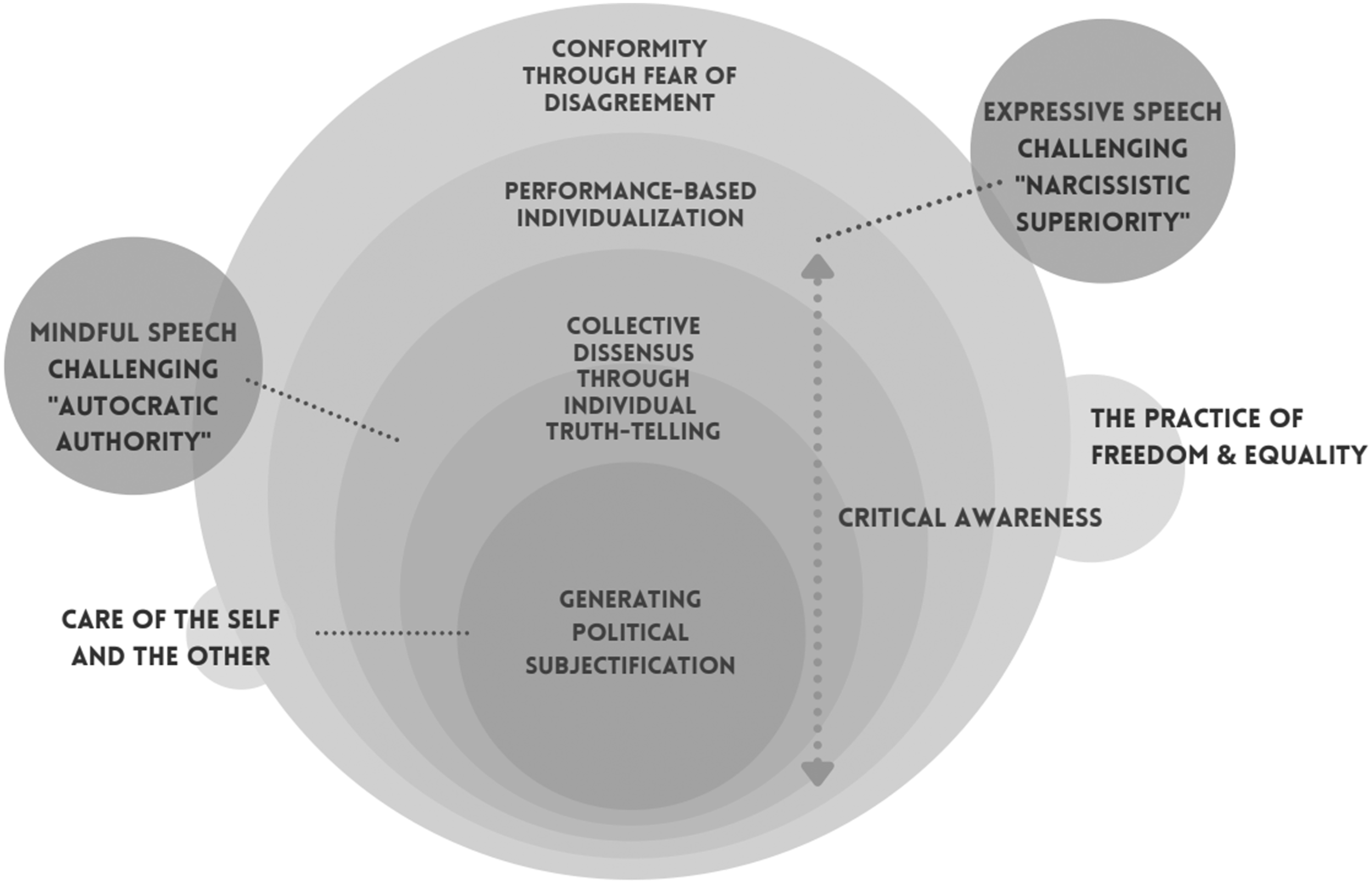
For Rancière, social reality is not hidden or discovered, but rather it emerges through people’s involvement with politics. Although Rancière does not depreciate people’s capacity to interpret and recast meanings of the world, his translation of reality does not also intend to address intersubjective rules, norms and commonalities. Instead, for Rancière (1999), social reality is no more than a political force realizing people’s participation in the world with their immanent equality. Rancière (2004) conceives this audacious process of intervening in the social arrangement as ‘politics’ that visualizes those who have only been allowed to utter a cloistered monologue behind the stage scene.
Politics is not mainly situated within the negotiations and agreements but through an experience of dissensus, cutting through an effort to relocate assigned identity and positionality. Politics brings about the deviation from ‘adorned’ formalities and questions any authoritative and superiority-based speech defining the specific individual and group bodies. It endeavours to challenge the common-sensical order and process, shading ‘the polemical space of a demonstration that holds equality’ (Rancière, 1999: 89). As an art of visualizing those who have been minimized, unwanted, forgotten and otherwise silenced, ‘politics, before all else, is an intervention in the visible and the sayable’ (Rancière, 2010: 37). Rancière’s politics thus involves artistic craftsmanship able to disrupt the ‘universal’ world for the (re)inscriptions of the commonly avoided.
In short, politics revolves ‘around who has the ability to see and the talent to speak’ (Rancière, 2004: 8) 1 in expectation of interjecting the general ways of thinking, saying and doing. Seeing and speaking express political subjects’ ‘polemical verification, a case, [and] a demonstration’ of equality (Rancière, 1992: 63). Through interplays with seeing and speaking, equality cuts a trail across diverse gazes and expressions from others and unlearns the entitlement fuelling a desire for superiority over others. Therefore, practicing equality keeps distance from ‘any sort of complacency or comfort relative to the dominant status quo’ (Ross, 2017: 50) and its ideologically motivated identification of socially deprived and isolated people. When equality sustains each unique lived subject through ‘the withdrawal of force, which in itself is neither visible nor articulable’ (Ziarek, 2001: 21), it becomes a concept that includes invisible silences embedded in seeing and speaking.
The presence of equality for dissensus
According to Rancière, equality does not act as an objective at which democratic citizens should aim. Instead, equality is ‘an initial axiom—or it is nothing’ (Rancière, 2002, cited in Ruitenberg, 2015: 2). Rancière’s understanding of an ‘immanent’ condition of equality articulates that equality can never be a form of democratic norms because equality already persists ‘here’ to raise the advent of political subjects. 2 For Rancière, equality is deeply concerned with an egalitarian classroom discussion mode wherein speakers are perceived as equally ‘ignorant’, having the same right as other classroom participants (Ruitenberg, 2015). In such a mode, those with marginal power and no qualification in a classical order equate to the equal protagonists of deliberation.
On the one hand, these protagonists can be demoted to ‘deficient’ objects needing special attention or care for being the same as the majority. On the other hand, those protagonists come to the front as ‘respectable’ agents capable of preserving and changing their surroundings against the background of the social stage. Specifically, in their research on primary school teachers’ narratives on children with migrant backgrounds (CMB), Farini and Scollan (2022) shed light on the power of teachers’ trust in positioning CMB within two distinct paradigms. Firstly, teachers’ trust rooted in ‘the children’s needs paradigm’ involves ‘categorical inequalities’ attending to ‘the stability of the organization’ and ‘pedagogical routines’ (55), which level out CMB into the same. In contrast, ‘the children’s interests paradigm’ disrupts ‘a superior epistemic authority’ (60) by ‘personal trust’attributed to ‘interpersonal affective relationships that mobilise trust through a process of mutual disclosure’ (56, original emphasis). Therefore, whereas the former paradigm assumes inadequacies of CMB, the latter paradigm expects interpersonal expressions from CMB.
The mutual trust would guide ‘affective relationships’ among deliberation participants as well when speaking becomes a channel to encounter ‘personal expressions’ of others rather than others’ ‘role performances’ (Farini and Scollan, 2022: 58). This channel catering to the otherness is able to resist ‘a broadly impersonal, rationalized modern politics that corrodes trust’ (Luxon, 2013: 34). Whilst deliberation participants share their trust through equality, they can have ‘the competences and autonomy’ (Farini and Scollan, 2022: 56) to reflect on the public and personal habits blocking the ways to the socially disadvantaged. By trusting the bridge of equality, deliberation moves its universe from the status of confirmation into the formative process of recognition. The multiple junctures of recognition, which temporally interrupt the rigidity of the self, become situated ‘within the institutions of a given order’ (Ruitenberg, 2015: 3), but at the same time, beyond the order’s ‘structures of feeling’ (Williams and Orrom, 1954) insofar as it harbours interests towards the otherness. In other words, dissensus occurs at the moment that recognition invites marginalized silences and voices without assimilating them into the models designed for instrumental categorizations.
The inscription of inequality in fact presupposes supremacy and performance, making marginalized experiences pathologized, thereby covering inner narratives of the invisible. This de-coding process can effectively depoliticize isolated subjectivity as a mere ‘object of fear and rejection’ (Rancière, 1992: 63). However, deliberation participants’ recognition may compensate for what lacks in evaluative superiority, which is inaction. Whilst participants’ recognition and dissensus play on the social stage, they also engage in undoing the always able bodies, always self-affirming and fully determinate objects. Expressive speech thus puts forward deliberation participants’ political subjectification, which aims to craft a passageway ‘between having a part and having no part’ or no voice (Rancière, 1999: 36). Political subjectification hardly leaves traces that may construct cosmopolitan inter-group cultures or ‘common ingroup identity’ (Gaertner and Dovidio, 1977) to integrate alienated voices. Instead, it relies more on the collective recognition of individuals’ inherent power within the situated ‘topography of the common’ (Rancière, 2010: 213), whereby democracy puts the disparate parts of the universe together in ways that fit loosely with one another.
Overall, democratic deliberation’s situated equality should not be considered mere opposition to the social order. For the democratic participants, creating any next scene on the social stage for dissensus might facilitate ‘conflictual consensus’, ‘consensus on the ethico-political values of liberty and equality for all, dissent about their interpretation’ (Mouffe, 2005: 121). Agonistic deliberation thus creates an exchange between rejection and acceptance, allowing progressive continuity of the old and given self, who has simultaneously been a dissimilar new adversary, the Other. However, instead of focusing on conflicts or similarities between diverse values, concerns or desires, generating deliberation pragmatically embraces dissensus for ‘a dispute about what is given, about the frame within which we see something as given’ (Rancière, 2004: 304) and within which we may also marginalize anything as not given. When the act of generation replaces a sensible phenomenon of social agreement, which might be ‘cemented through the fear of society grouped around the warrior state’ (Rancière, 2010: 106), this ‘warrior state’ could be questioned more than understood by virtue of democratic citizens’ trust in the self and others.
Generating deliberation as an art of mindful speech
The expressive speech empowering an unsettling account of dissensus elevates the role of the lifeworld facing the existing structures of communication. Rancière (2010: 73) believes that any form of resistance situated outside the lifeworld perpetuates ‘wrong’. ‘Infinitizing wrong’ manifests no freedom but faithfulness to ‘the rights of the Inhuman’, which may ‘[rule] out any dreams of “human emancipation”’ (74). Dissensus, as dialogic resistance, is ‘the endless work of mourning’ (Rancière, 2010: 200) to be the penetrating part of the lifeworld and vibrate its larger whole. Rancière (1999: 77) declares that ‘freedom cannot exist as the part of those who have no part, as the empty property of any political subject’; namely, ‘power is exercised only over free subjects, and only insofar as they are free’ (Foucault, 1983: 221). The condition of freedom exercises ‘the refusal to comply with more of the same’ (Pais and Costa, 2020: 12) or more of remaining in a hollow part; freedom inevitably embodies its questioning of conventional logic of subject and history to occupy the status quo. 3 It extends a site of unremitting politics to seize and dwell an ‘inglorious moment’ in the ‘modern play of coercion over bodies’ (Foucault, 1979, cited in Ball, 2003: 118). Politics is therefore a commitment to putting elements from those shamed and disempowered into the universe stage.
Like Rancière, Foucault (2011) states that ‘the consensus of culture has to be opposed by the courage of art in its barbaric truth’ (189). As a courageous truth-telling, parrhesia hints at a crack in regularized discourse to foresee an alternative past in the future. Britzman (1998: 119) argues that the power of ‘hope’ and ‘courage’ creates ‘difficult knowledge’. Since these terms remember helplessness and loss of subjects, they can break with habitual patterns of avoidance and anxiety. The temporal nature of hope and courage bridges situational disempowerment (continuity) with a vision of democratic entitlement (expectation) to invigorate relational mindfulness ushering in the very moment of conversation. Considering that freedom and equality are crucial complementary components for the evolution of democracy (Taylor, 2019), 4 expressive speech advancing the presence of equality intersects with the individual practice of freedom; it embodies mindfulness in its words and styles.
The presence of freedom for truth-telling
Although collective dissensus repudiates standardizing criteria for deliberation, Rancière (1999) indicates that democracy rests on ‘the empirical circulation of good and bad, pleasure and pain; by the sole equality (the sole inequality) of more and less’ (62). Expressive speech evades the logic of unreflective hatred and indiscriminate distrust of any authority. Through a sense of trust and recognition, it navigates a proper mode of dissensus resistant to the ‘dominant current’ (Rancière, 2010: 201) that would intentionally edge people towards validation-seeking populist discourses. Democratic deliberation participants should be wary of the unduly permissive entitlement to human equality by generating their critical, trustful and truthful relationships.
Meanwhile, Foucault (2011) stresses that truth-telling bears no relation to delivering the truth that the speaker routinely believes. Instead, parrhesiastes speak ‘the personal opinion’ (10) at the risk of offending, irritating and provoking their interlocutors, who could be positioned in the higher echelons of the institution and society. 5 For Foucault, parrhesia is irrelevant to delivering the objective truth, nor blindly following the populist mode of politics. In this regard, parrhesia shares similar operational contingencies with Rancière’s dissensus. Whereas Rancière finds the bedrock of dissensus from the process of equality, Foucault’s parrhesia more pertains to freedom grounded in the technology of the self, acting as a condition of counter-conductive, not ‘counter-balancing’ expressions (Foucault, 2011: 14).
On the one hand, Rancière allows people to release their ‘desire for a particular democratic mode of human togetherness’ (Biesta, 2011: 142). When people share their desire and passion, they may be ready to take political actions with ‘a capacity for enunciation not previously identifiable within a given field of experience’ (Rancière, 1999, cited in Biesta, 2011: 150). Political actions involve reframing the reality in which relational trust fosters social reconciliation. Inasmuch as Rancière’s political subjects guide universal equality, political subjectification shields people from becoming monolithic objects losing sight of the dynamic expressions of the public. Foucault then offers these individuals a conceptual tool to recognize self-formation with ‘confidence in self, in others, and in what can be done together’ (Foucault, 2011: 335).
Foucault’s freedom concerns individuals’ conscious struggle and disputing discourses towards consensual silences. The process of freedom resounds through one’s time of disagreement: ‘Freedom is a practice and not a given, an a priori, something antecedent to the subject’ (Mendieta, 2014: 113). Freedom does not necessarily involve liberating subjects from the oppressors’ power; it is neither good nor bad. Instead, it serves as a condition of valuing worthiness to sketch out another scene of politics, in which people continuously draw up room for ‘impotentiality’, 6 for the claim of one’s otherness over ‘the system of control’ (Hedges, 2015).
Just as Rancière’s understanding of the universe shows, for Foucault (1984: 50), freedom eludes the logic of transcendental being, ‘a permanent body of knowledge that is accumulating’ the orders of the same everydayness. Instead, freedom plays the condition of deciding where to erase the line between the self-rule and the common rule and take responsibility for condoning autocratic exclusion. In this way, responsibility binds the self with the other as “an infinite responsibility of the one for the other, or the signification of the Infinite in responsibility” (Levinas, 1974/1998: 161–162). The mindful speech calls for responsibility through indecision over a choice, doctrine and the post-truth wrought by daunting authority, as parrhesia transforms into marginalized people’s dissensus of remaining in the unnoticeable position.
Like the Cynic mode of action, parrhesia opens up the ‘scandalous manifestation of the truth’ (Foucault, 2011: 183). 7 It may empower disadvantaged individuals to preserve their archetype of the Heroes (McLaren, 2018). When deliberation’s Cynic missions take the form of scandalous and more secular speaking, deliberation opens the time of ‘telling the truth without concealment, reserve, empty manner of speech, or rhetorical ornament which might encode or hide it’ (Foucault, 2011: 10). In the context of parrhesia, philosophical heroism functions as the underlying impetus for a ‘displaced and transformed form of philosophical life’ (211). It creates a distance from the discernible patterns of the sameness. As if the Cynic practice of philosophical heroism, mindful speech is a rhythmical flow of doing and undoing consensus, dramatizing the mundane life to improvise an unceasing refrain of freedom.
Furthermore, parrhesia intends to vibrate the whole instead of simply defending local interests and conflicts. The stance of ‘radical destitution’ (Foucault, 2011: 354) would be a Cynic condition for the care of the self ‘so as to be able to take care of others’ (278). Parrhesia fades away with egoistic entitlement, which chases performative and competitive advantage at the expense of others. Instead, it appears as a truth-telling action with its attentiveness towards the world, whereby deliberation participants exert individual ‘ethos’ and ‘will’ inherent in their mindfulness. This self-formative response to the world encourages people to reconsider the ‘balance of life processes’ condensing the governmental ‘games of strategy’ (Foucault, 1996: 447), which may incarcerate democracy within the language of prosperity and liberation.
Under the condition of intentional destitution, democratic citizens act as parts of the universal community of the governed. Their intentional hunger for the truth would serve freedom, allowing them to be governed in an alternative way, a way of untying the bonds of what Max Weber calls ‘traditional authority’ buttressed by ‘irreconcilable aspects of comprehensive doctrines’ (Lo, 2017: 4) and dogmas ‘resting on an established belief in the sanctity of immemorial traditions’ (Weber, 1968: 215). Freedom would be everywhere intertwined with every kind of lived experience insofar as deliberation participants ‘know what things they should and should not fear’ (Foucault, 1996: 438) to not wield their power over others. Through the exploration of ‘knowing’ people’s fear and power, politics would embrace that freedom does not always arise from safety, certainty or firm actions. Freedom rather lies in the ways we exercise power, not to decide anything for ‘power over’ but to have ‘a strong sense of “power to” and “power with”’ (Duffy, 2015: 189, original emphasis).
Generating deliberation as co-moments of freedom and equality
Deliberation can emerge from both parrhesia and dissensus, each imbricating with the interlaced, co-dependent democratic values of freedom and equality. Whilst attempting to reconceptualize the meaning of deliberation, I have developed the concept of generating deliberation with an aim to ‘cut’ the taken-for-granted knowledge of democracy and deliberation. 8 For Nietzsche (1886/2001: 91), democracy is ‘an abased form (more specifically a diminished form) of humanity’, undesirable in itself because it has all sorts of potential pitfalls to lower human values through ‘an abased form of political organization’. The systems in democracy can neutralize human creativity through canonical laws, regulations or stereotypes. Those apparatuses may act for people and on their behalf within the paradigm of ‘needs’ riddled with ‘categorical inequalities’ ‘replacing [people’s] agency with control’ (Farini and Scollan, 2022: 54). Moreover, democracy would be at risk of the collateral damage of the current expansion of neoliberal capitalism and other systems of autocratic control, so long as it recedes from a civil society where the rules need to be backed by varying channels of citizens’ speech manifesting their awareness of the multiplicity, exemplified by classical Athens’s collective self-governance by ‘an extensive and socially diverse body of citizens’ (Ober, 2017: 14).
For Rancière, democracy should elevate collective dissensus for non-negotiable equality, and, for Foucault, democracy should be threatened by the individual practice of parrhesia. Both philosophers critically reflect on the meaning of democracy to allow democratic citizens to ponder the specific operations and contexts for dissensus that pass through from their practice of truth-telling. In other words, democracy can open up different possibilities when equality guides the operations of social dissensus, and freedom expands a strategic and communal sphere of citizenship where people realize truth-telling. Whilst putting forward freedom and equality, generating deliberation emerges as expressive/mindful conversations in which deliberation participants stage participatory democracy and spotlight their civic life through democracy. In such a manner, generating deliberation illustrates democracy based on individual responsibility (parrhesia) and collective responsibility (dissensus), seeking to shape an educational ‘relationship between individual and collective’ (Miller, 2002: 163).
Moreover, generating deliberation eludes the logic of deliberative convergence that may build fear among the socially marginalized whilst giving prominence to a performance-oriented subjectivity. As it accompanies with political subjectification sustained by interpersonal trust and recognition, deliberation can also provoke inactive actions to hinder the convergence process of prejudices and stereotypes. In this light, generating deliberation positions itself in the ‘ethos of becoming’ (Ziarek, 2001: 15), suggesting that raising ostracized voices is equivalent to raising one’s own voices. It wrestles with underlying forces of self and others for the mutual narratives of individual histories.
The political subjectification, namely, crafting a meaningful self, helps socially marginalized people place themselves as protagonists undertaking democratic citizenship work and social movements into and out of normative order. Social movements here are a long way from dislocated populist democracy. They act as the moments of democracy and education within which overall civil society’s enhanced ‘political literacy/participation aimed at cultivating social change rather than maintaining and reproducing social relations’ (Carr and Thésée, 2017: 2) redraws ‘the borders of the demos’ (Ruitenberg, 2015: 4) under the resonance of ‘situated knowledge’ (Haraway, 1988). The democratic participants’ expressive and mindful dialogues do not belong to the educational agendas hiding behind dividing governmentality to chase the instrumental, bureaucratic or capitalist truth. As an alternative, their generating deliberation enlarges society’s multivocal ‘edges’ and ‘borderlines’ for the uncharted passages of the withdrawal of force, the redistribution of the sensible, and an ethos of becoming. Thus, ‘knowing’ from a web of otherness permanently challenges the boundaries of democratic deliberation to generate the other way round.
Finally, it is time which unlocks democratic citizens’ possibilities of self-formation – subjectification for “the ‘coming into presence’” (Biesta, 2011: 150) – with the moments of others. Democracy and education recount a critical awareness of the past to dilute the axiomatic end of social marginalization through their combined faculty to reflect on ‘where’ and ‘from whom’ democratic deliberation might occur and ‘how’ to harmonize and transfer its budding knowledge for society’s growth. The dynamics between democracy and education can capture democratic deliberation whose words are not within democracy per se but cutting across the pedagogic journey of public extension amid tensions between uniformity and creativity. As Ross’s (2014: 175) illustrations of social studies education indicate, generating deliberation should not be ‘about “showing” life to people, but bringing them to life’. The act of generation springs from our expressions and mindfulness to preserve and cultivate the unknown self and otherness. Then, what this paper offers might be incomplete theoretical provocations for the educational project of democracy, synthesizing through our cornucopia of voices and silences, our civic responsibility of equality, and our holistically heroic life for freedom despite ‘the neutralization of every sacrificial body’ (Rancière, 2010: 34).
Footnotes
Declaration of conflicting interests
The author(s) declared no potential conflicts of interest with respect to the research, authorship and/or publication of this article.
Funding
The author(s) received no financial support for the research, authorship and/or publication of this article.
