




Abstract
Using qualitative data, this article unleashes the narratives of teachers (n = 20), engaged in the universities and colleges of Kashmir, about synchronous online teaching. Their narratives were replete with a range of negative emotions regarding the pedagogical, political and personal domains of online teaching. These negative emotions have been broadly framed within the notion of teacher alienation. Four predominant themes: “am I audible?”; “Lack of proximity”; “Talking with the walls”; and “it is just a formality” emerged from the data. Conversely, they highlight the constitutive features of real classrooms lacking in online teaching, such as control, proximity, attention, and authenticity. The article treats these feelings as significant to teacher alienation in online teaching. These themes reflect lived dimensions of online teaching confronted during the top-down implementation of online classes during the recent crises situation. This adds to the theory of teacher alienation and identifies the pedagogical bottlenecks in online teaching.
Introduction
Exceptional circumstances necessitate extraordinary choices. The COVID-19 outbreak put mankind to the test in this regard. The suspension of normal life necessitated the development of solutions that would minimize the risk to the greatest extent possible. Education, which was the worst damaged by the pandemic, was able to escape as well, thanks to many online interfaces that came up throughout the crisis. Historically, teaching has been considered an act that entails face-to-face interaction between a teacher and students as an essential feature. However, the emergency has redefined teaching as an act that involves anonymous and remote interaction. Emergency Remote Teaching (ERT) became a very predominant method to connect to students during the pandemic lockdown (Hodges, et al., 2020). In comparison with regular online education, which is planned and designed to be delivered online, ERT is a temporary shift of classroom instruction to an alternate delivery method as a result of a crisis (Bond et al., 2021).
However, the efficacy of the online teaching process needs empirical probes and queries. This study explored features of ERT that generate or have the potential of generating a range of negative feelings among university and college-level teachers, which we refer to as alienation. This is done not only to add to the concept of teacher alienation but to identify the pedagogical bottlenecks in the ERT process through the use of instructors’ experiences.
Several concerns may be raised about the basic tensions that underpin the operations, ethics, politics, and theory of web-based synchronous education. Apart from that, online instruction cannot replace the criticality of campus presence in providing much-needed socialization through informal learning venues. The very immediate source of alienation in ERE was its rapid introduction on such a large scale that most teachers were either unprepared or under-skilled (Plummer et al., 2021). It is obvious that educational innovations alienate instructors, especially when they bring unexpected mutations to the existing teaching setup (Pugh and Zhao, 2003). However, the pandemic created an entirely new educational landscape in which ERE was now the norm. The narratives from teachers were replete with a range of negative emotions regarding the pedagogical, political, and personal domains of ERT. These negative emotions have been broadly framed within the notion of teacher alienation. The four predominant themes identified from the data am I audible?; Lack of proximity; Talking with the walls, and it is just a formality reflected the underlying discontent and disappointment of teachers with ERE. Conversely, this article identified certain aspects of actual classroom teaching generally lost in online teachings and particularly in ERE such as control, proximity, attention, and authenticity. A trouble with these essential qualities of teaching creates the risk of teachers experiencing disenchantment and disaffection. More importantly, the feeling of “talking with the walls” reflects the underlying tensions experienced by teachers, as ERE upsets the basic standards of pedagogic interaction. A sense of inauthenticity about virtual teaching among teachers is tantamount to alienation. Teachers’ narratives bear resemblance to the aspects of alienation proposed by Seeman (1959, 1975). While technology glitches may have an influence on teachers' satisfaction with ERE, the real roots of alienation are the radical changes in the parameters that fundamentally characterize the teaching process.
Emergency remote teaching
ERE was globally enacted to cope with the lockdown measures implicated due to the Covid-19 pandemic. During the crises situation, educational institutions were forced to resort to virtual classes. This was done to ensure continuity of educational services as in-person on-campus teaching was not possible in this unprecedented situation. In the case of India ERT was widely introduced following the directions of the central government in 2020 (Selvaraj et al., 2021). Online teaching has been variously referred to as remote teaching, virtual teaching, and distance education. It can be performed synchronously or asynchronously using web-based applications such as Zoom and Wise App 1 . Hodges, et al., (2020), contrasted regular online education with ERT, the latter entails a distinguished set of educational strategies enacted to cope with the pandemic situation. While online substitutes to in-person education have been used in reaction to some endemic crises, the COVID-19 pandemic is the first instance that ERT has been enacted on a worldwide basis. The design and execution of ERT are certainly influenced by a variety of contextual and psychological variables. Availability of ICT facilities, like internet speed, motivation for online learning, pedagogical assistance provided, and defined rules by institutions or governments all have an influence on ERT (Hodges et al., 2020). No doubt, ERT differs from regular online teaching, there are fundamental similarities, as the media employed for communication remain the same.
Speaking generally, the role of teachers is very crucial in online teaching and their acceptance significantly determines its effectiveness (Wingo, Ivankova and Moss, 2017). Existing research has highlighted the incongruence between the high expectation of administrators and the critical perspectives of teachers about online education (Allen and Seaman, 2015; Betts and Heaston, 2014).
Teachers’ beliefs about web-based synchronous teaching are influenced by a range of factors such as pedagogical orientations, personal qualities, and larger institutional factors (McCarthy, Glassburn and Dennis, 2021). The research from Hong Kong indicates that the teachers differed on the basis of their motivational response to ERT. Teachers in one group appeared to thrive, indicating mainly favorable impacts of ERT on their motivation, whereas other teachers seemed to be merely coping, reflecting predominantly negative effects (Moorhouse and Kohnke, 2021). Such findings are further supported by some research indicating that ERT may have positive professional effects on teachers and their educational outlook (Rodgers, 2021). It has been observed that ERT may not be as effective in some fields requiring physical presence such as in the case of social work as it may fail to instill the professional skills needed among such practitioners (McCarthy, Glassburn and Dennis, 2021). It may run well with the neoliberal model of education which focuses on the outcomes of the educational process rather than on the actual process (Reyes and Segal 2019). Some scholars contend that online teaching may have positive professional effects on teachers and their educational outlook (Rodgers, 2021).
Defining alienation
The concept of alienation was brought to academics by Marx and his associates. In his writings, alienation may be referred to as a state of existence in which a person is separated from the potential of being human (Marx, 1959). Alienation may entail a variety of unpleasant phenomenological states caused by undesirable working conditions.
Seeman (1959) outlines five dimensions of the alienation experience: (a) powerlessness – the sense of a lack of control over events; (b) meaninglessness – the sense that personal and social affairs lack significance and purpose; (c) normlessness – the sense of a lack of commitment to shared social conventions of behavior; (d) isolation – the perceived inability to identify with a community or organization; and (e) self-estrangement – engagement in activities that are not intrinsically rewarding or self-fulfilling. However, Blauner (1964) argues that Seeman’s conception of normlessness does not match Marx’s conception of alienation, although normlessness and alienation may be related. Due to the similarity of normlessness and isolation, Blauner combines the two and suggests four dimensions of alienation experience: powerlessness, meaninglessness, isolation, and self-estrangement. In general, the definitions of these dimensions are similar to those proposed by Seeman (1959).
Among the very few studies conducted on teacher alienation in the Indian context, powerlessness, meaninglessness, and isolation were found as the most significant dimensions with powerlessness appearing almost indistinguishable from the overall notion of alienation. It has been further analyzed that alienation is negatively associated with professional commitment among college teachers (Rao and Ramana, 1986). Much of the alienation in the contemporary setup can be attributed to the impersonal social relationships created by the predominant political economy (Kalekin-Fishman and Langman, 2015). The current system encourages competition, impersonality, deterioration of community, and decreasing role of personal and moral influences as sources of control (Seeman, 1975). Recent studies on the alienation concept argue for its context-bound understanding (Hascher and Hadjar, 2018). More importantly, it relates to the definition of alienation in specific contexts such as student learning experiences in higher education (Dar and Jan, 2021). This is in the wake of increasing ambiguities regarding the definition of alienation reported across a range of studies.
Teacher alienation
Teacher alienation is a major problem in the contemporary educational system that needs more attention. Much of teacher alienation in contemporary times has been a result of neoliberal performativity, the latter is a very pervasive system of outcome-oriented policies enacted through high stakes accountability regimes (Ball, 2003). Due to pro-performative reforms, teachers experience tensions in their professional life consequently causing a sense of estrangement (Meng, 2009). Neoliberalism encourages rational choice, ultra-individualism and competition, therefore deemphasizing the role of emotions and care in the process of teaching (Tsang and Qin, 2020). Through a qualitative engagement with school teachers, it was found that top-down leadership regimes are the main cause of alienation (Brooks et al., 2008). The top-down implementation of educational policies reduces teachers’ freedom in matters of curriculum enactment and evaluation process, thereby increasing a sense of fear and failure (Brooks et al., 2008).
Other sources of teacher alienation can be the actual teaching experiences, nature of the employment, and position in the institutional hierarchy. For example, some teachers experienced alienation due to excessive non-teaching work which lacks an educational and creative value forced on them in the institution (Tsang, 2016). Another source of alienation lies in the inability of teachers to find meaningful pedagogical value in “non-instructional work” implicated due to neoliberalism by encouraging a non-pedagogical role of teachers (Tsang and Qin, 2020). Levinsson, Norlund and Beach (2020), argue that neoliberalism has turned pedagogical actors into “Alignment Slaves” and “Audit Puppets,” which reflect existential displeasure experienced by the teachers. These phrases refer to the centralized system of policies that do not offer any scope for teachers’ voices in curricular development and enactment.
A large majority of teachers are either not satisfied with ERT or were not intrinsically motivated by it (Boer and Asino, 2022). It was enacted primarily because it became a matter of administrative compliance and there was no other alternative to continue the teaching process during the lockdown. Most teachers describe online teaching as a stressful activity. Problems with establishing meaningful connections with students, resilience to technological interruptions, and a sense of rhythm are the most challenging aspects of online teaching (Plummer et al., 2021). Many have debated that the crisis situation was used in many places to further legitimize neoliberal reforms which tend to disenchant teachers (González-Calvo et al., 2021). Virtual classes do not offer personal contact with students and immobilize many of the interpersonal skills defining classroom teaching, It has not only disillusioned teachers about their future professional practice but created unprecedented tensions in their pedagogical engagements (González-Calvo et al., 2021). Some research asserts that the sudden demand synchronously online teaching has significantly influenced the social and professional isolation (Kutoane et al.,2021; Bissessar, 2022) motivation, and well-being of higher education teachers (Wong and Moorhouse, 2020). This is why we are now running the risk of de-professionalization of teaching.
Methodology
This study is based on data collected from discussions with college and university faculty members during the pandemic lockdown of 2020–2021. The data were collected through a mix of online and offline interactions. Given the limitations implicated by lockdown, fieldwork and data collection have become challenging tasks. However, “anthropology from home” has been proposed as a timely framework to cope with such a situation (Góralska, 2020). It “talks about research in the pandemic times–that is, geographically restricted but digitally-enabled” (Góralska, 2020). Patchwork ethnography has been suggested as a similar framework to allow for the much-needed flexibility in data collection during a situation like a pandemic (Gökçe et al., 2020). However, they should not be used as instruments to escape the epistemic obligations associated with the tradition of more engaged fieldwork in anthropology. Applying information communication technology (ICT) to data collection offers the possibilities of multivocality and multicitedness to our approach (Akemu and Abdelnour, 2020). As this study used technology as an alternative to collect data, we acknowledge the limitations of this method and treat it simply as a product of crises situation and the political and professional order implicated by neoliberalism (Gökçe et al., 2020). Major portion of the data were collected via telephonic conversations as well as SMS services. During the pandemic, these media were critical in avoiding the risk of catching the virus through in-person interviews. As this study is focused on very deep emotional and attitudinal dispositions, unstructured interactions were key to unleashing such phenomenological states. The data for this study were collected using a mix of technology-mediated and face-to-face interactions. A purposive sampling technique was used for the purpose of this study. A total of 50 college and university teachers from Kashmir were reached out during the year 2021. All the teachers were employed in the Main Campus of Kashmir University and its affiliated colleges. Most of the 50 participants were personally known to the author Out of them, a total of 20 teachers agreed to share their opinion about ERT. These 20 participants included 15 males and five female teachers. Thirteen of them taught undergraduate courses at the college level and seven taught at the university level.
The study followed Braun and Clarke’s (2012) six phases of thematic analysis, as demonstrated by (Kigera and Varpio, 2020). The narratives of teachers were in the form of transcribed interviews and text replies on WhatsApp.
Data analysis
Based on a thematic analysis approach, four themes were induced from the qualitative data: Am I audible; Lack of proximity; Talking with the walls, and it is just a formality. These four phrases summed up and reflected the underlying alienation with ERT. These themes bear considerable similarity to the dimensions of alienation as illustrated by Seeman (1959). They represented situations where the teachers experienced a phenomenological disjuncture between classroom teaching and online teaching. They were used to outline the experiences of teachers who worked in Kashmir’s higher education institutions. Kashmir is a Muslim-dominated area of India’s Jammu and Kashmir state (J&K). J&K is India’s northernmost state, famed for its beautiful landscapes as well as political history.
Am I audible?
A feeling of lack of control has been the bottom line of alienation as theorized by Seeman (1959) and on the contrary feeling of control defines classroom teaching. To be more precise, this control does not refer to controlling students’ freedom but rather a sense of directing them through the lecture. This section shall focus on the situations in ERT where teachers predominantly experience such a feeling. Control is significant to classroom management and teaching. This is primarily because the higher education students are only extrinsically motivated by their course curriculum. Controlling their attention becomes relatively challenging because they often opt for their courses based on market demands rather than on any intrinsic motivation. There are two sites in ERT where such a sense of control becomes relevant.
First, it refers to the sense of overdependence and the subsequent lack of trust or incertitude on technologically mediated communication. This attitude may come from previous disappointments caused by network problems and other related issues. Overdependence refers to the fact that the efficacy of a lecture is mainly dependent on technology as a medium of communication. Because network problems are beyond the control of a teacher a feeling of dubitation and uncertainty is obvious. From voice clarity to the visibility of the materials presented a lack of trust in the technological media is a significant source of ennui for teachers. “Online teaching is a bit tougher than offline teaching. Some people will say that in online teaching the only thing you have to do is to keep on speaking while the video is on or while something is being displayed on the screen, but you are also supposed to ensure that students can hear you. I have to often stop while I am speaking, asking students ‘am I audible’?” (Institute: college; age: 35; faculty: social science; male). “Just when I start enjoying my lecture the network problems come to play. It is sometimes very frustrating that you did everything right still your students were not able to learn anything or they just couldn’t hear me. Sometimes my students try to stop me in the middle just when I am on a rhythm, telling me that they were not able to listen to anything. That is a very frustrating situation” (institute: college; age: 39; faculty: social science; male).
These excerpts explicate the subjective feelings of lack of control over the technology. Teachers explain that sometimes online teaching becomes very frustrating particularly when network glitches break down teaching rhythm. The basic point that needs elaboration is the fact that technical problems do not constitute the alienating experience but only cause it. Imagine a student undesirably interrupting a lecture, such an act in itself may not be alienating for a teacher but their sense of feeling that such an interruption is beyond their control is alienating. Inability to be audible to students despite doing everything right reflects a sense of powerlessness on the part of teachers which may be potentially detrimental to their teaching behavior. “Am I audible” therefore subsumes the existential ennui and helplessness experienced during online classes. It is sufficient to reflect the distrust of teachers with online teaching.
Second, in synchronous virtual classrooms, teachers are often concerned about their ability to maintain order and control. This sense of control, on the other hand, is not only about gaining students’ engagement; it is also about the effectiveness and efficacy of communication. This loss of control might be mirrored in instructors’ perceptions of unruliness in virtual classrooms. This involves the inability to keep learners’ attention and create order in the classroom. This may be shown in the example below, which illustrates teachers' failure to manage students’ conduct during online classes. “Sometimes online teaching becomes very frustrating for a teacher. Last week I was teaching and one of the students accidentally got his microphone switched on and to my surprise, the guy was on a playground. These things one cannot control, the only thing that I could do for the guy was to remove him from the class. I have had many such experiences that demotivate me a lot” (institute: university; age: 45; faculty: education; female).
This narrative underlines the fundamental predicament experienced by teachers during virtual classes. Teachers experience plenty of problems that relate to disciplining participant learners in the online environment. Effective teaching demands discipline and commitment from learners but a sense of unruliness prevails during online classes. Teachers’ motivations are significantly influenced by background noise and other related interferences, which are beyond teachers’ control (Joshi et al., 2020).
Lack of proximity
Proximity has been reported to be a critical factor in teaching quality. Proximity refers to the physical nearness between students and teachers. The concept of proximity is a crucial part of nonverbal behaviors. This may be due to the reason that physical proximity influences mental proximity (Kale, 2008). The reasons for this are very obvious. The social and epistemic dimensions of a physical classroom are entwined with its spatial domain. Physical nearness between students and teachers plays a significant role in effective communication, which in turn is crucial for an immersive engagement in an act of teaching and learning. Teachers’ facial reactions to students’ responses are crucial to the act of teaching (An et al., 2018). Studies within the field of proxemics reveal that teachers’ position and movement within a classroom can significantly influence student engagement (Chin et al., 2017). The element of space is finely imbricated with the phenomena of classroom teaching and learning. Teachers use elements of “classroom proxemics” to profoundly shape and design their pedagogical approach (Martinez-Maldonado et al., 2020). Feelings of distance in online teaching become a very dominant theme in teachers’ narratives about ERT. Just when the Covid-19 lockdown happened, the admission process for the new batch of our PG students was going on, as a result, we could not meet them in person and on-campus. I faced a lot of problems teaching my first semester students because I had never seen them before. That made me realize the importance of physical interaction with students. They hardly spent any time on the university campus. I mean in-personal interactions are very foundational to the evolution of the chemistry between teachers and students (institute: university, age: 35, faculty: social science). In my classroom I am in full control of the class, I see my students, I feel their presence and I understand their moods. If my students leave their places in the classroom I can direct them on when to move. Everything is in front of my eyes. In my online classes, I have no information about where my students are; I just do not feel like teaching (institute: college; age: 34; faculty: science; male). In my physics class, I know what my students feel and think. I know where and when students need my attention, a tap on the shoulder, and a bit of praise. I look through their eyes, I understand what they feel so think I am more involved with them. Online teaching does not offer me these things (institute: college; age: 42; faculty: science; male).
Through these narratives, the teacher discusses how a lack of proximity in online teaching deprives teaching of some very important qualities (Ferri et al., 2020). Lack of proximity strips online education of its heart and spirit, limiting it to a mere act of blind speaking. Teachers use proximity to distribute their care and attention among students, which is an important aspect of teaching (An et al., 2018). Because it lowers feelings of community and comradeship, a sense of alienation in the online community makes teaching a little less enjoyable (Rovai and Wighting, 2005). Teacher alienation has been linked to a lack of proximity since it deprives teachers of the most basic instruments for engaging and encouraging students. Teachers can also use distance and proximity technologies to help students learn. For example, teachers may wittingly or unwittingly, rely on nearness during teaching while distancing during evaluation for effectiveness (Shvidko, 2021). What I now realize is that classroom teaching is not all about lectures, informal learning that occurs through physical interaction is equally important. Moreover, we get to know about each other’s expectations when we are physically together (institute: college; age: 35; faculty: social science; male). I think it means a lot as a teacher to be in the classroom. One can watch them from a very close, catching their attention and making them feel the intensity of our teaching. The physical classroom has a rhythm and order of its own and it is very hard to achieve such a sense of order in an online class (Institute: College; age: 36; Faculty: Social Science; female).
Physical proximity that the classroom offers can be an effective tool for evoking positive values from teachers and students towards the process of teaching and learning. It offers a sense of comfort and agency to teachers in terms of controlling and directing classroom activities. The teacher’s agency is usually connected with contexts such as social structure and the tools available (Kayi-Aydar, 2015). The narrative above illustrates that proximity is essential to a teaching agency. Teachers can exercise their agency in the physical classroom through some relational practices, such as empathizing, amusing, affiliating, supporting, and smiling (see for discussion on teachers’ agency Rogers and Wetzel, 2013). These affiliative practices are employed to control and shape a convenient environment to embed the social as instructional aspects of teaching (Shvidko, 2021). Through such a fine imbrication teachers synchronize self and work. Any disruption to such integration may be termed alienating.
Talking to walls
Attention has been one of the most fundamental features of classroom teaching. From students’ involvement in the classroom interaction to the teacher’s ability and responsibility to attend to the problems of students’, attention is a defining feature of classroom teaching. In a classroom, everyone is locked together by an obligation of involvement and attention. The body of every individual in the classroom is embedded in a sort of ritualistic order, where everyone allocates his/her interest and attention to a certain focus of interaction and any allocation of attention to any alternative object is considered as discourtesy or indiscipline. Inability to ensure a meaningful commitment from participants often results in a sense of estrangement among the teachers. Talking to walls reflects a lack of attention and authenticity experienced by teachers during virtual classes. A person feels valued when he/she sees that he/she is being listened to, attention gives personal motivation to an individual. In online teaching, it feels humiliating that you keep speaking and have no information on whether your students are listening. It sometimes feels like talking to walls. Speaking for one hour without any information about your students is very disturbing (Institute: university; age: 38; faculty: Behavioural science; male).
In a classical article Goffman (1957) illustrated how a process of interaction can be a source of alienation. Recent work on alienation further highlights that alienation is a result of a distorted and disturbed system of communication (Kalekin-Fishman and Langman, 2015; Jaeggi, 2014). Teaching is essentially characterized and influenced by teachers’ perception of students’ attentiveness. “From the perspective of facework theory (Goffman, 1955), lack of attention is potentially face-threatening”, and can have detrimental effects on a teacher’s perception of his/her public image. Attention is undoubtedly the defining feature of classroom teaching. The relationship between teacher motivation and student engagement in the classroom is reciprocal, affecting each other (Skinner and Belmont, 1993). Teachers experience a whole lot of feelings in online teaching which are fundamentally related to an absence of attention on the part of learners. Online teaching can be very frustrating for most teachers. A look at my students inside the classroom gives a soothing experience, there are smiles all around and there is a feeling of liveliness. I see their face; I look through their eyes and there is a lot more going on in the class which is not there in the online classes. There are no feelings and there is no involvement everything is artificial in online classes (Institute: university; age: 45; faculty: social science; male).
There is a lot of facework going on in physical classroom interactions (Payne-Woolridge, 2010). Teachers feel artificiality in online classes. Shvidko, (2021), identified two types of interactional resources employed by the teachers in physical classroom settings: “teacher nonverbal immediacy” which includes facial expressions, body language, eye contact, and physical nearness; and “face-threat mitigation techniques” which includes a range of tactful verbal expressions reducing risks of public image damage.
These have been identified as essential for sustained and meaningful involvement in the interaction process. Based on the narratives above, they may be considered a fundamental requirement of any pedagogic relationship, it makes the interaction more euphoric and interesting to both teacher and the student. Nothing can be more satisfying for teachers than a meaningful commitment from participants and a sense of congruence between “face” and “line” (Goffman, 1955). Teachers sum up their feeling during virtual classes as ‘talking to walls’, which reflects self-perceived disregard and neglect, invoked by a lack of nonverbal immediacy, and a set of face-threat elements.
It is just a formality
Self-estrangement as a core dimension of alienation is a negative feeling in which an individual’s actions become an instrument of extrinsic purpose. This section highlights how teachers feel self-estrangement due to a lack of intrinsic motivation for this brand of teaching. The feeling that online teaching was implemented under desperation and that the intrinsic meaning and motivation for teaching was lost. The sudden switch over to online mode made teaching just a formality for finishing the curriculum and giving students a feeling of busyness and continued engagement. This resulted in the focus of teaching away from the act of teaching toward outcomes. We are very helpless, I understand that this is the only alternative left with us, but it appears that everything is being done to keep students engaged, I don’t think it helps them much unless they are highly motivated. We just keep on teaching and have no idea whether we are being taken seriously by students? (Institute: college; age: 45; faculty: humanities; male).
The account above expresses the dissatisfaction of teachers with online teaching. Teachers asserted that they were told to teach online since their bosses thought they did not have anything else to do. They concluded that unless a student is highly motivated to take the lectures seriously, the learning outcomes from online teaching are poor. The narratives predominantly reflected that online education is merely a formality and that there are more effective ways to engage pupils than online education. The different technological, pedagogic, and social challenges faced by teachers in online teaching have been broadly described above using the narratives of teachers (Ferri et al., 2020).
Theorizing teacher alienation in online teaching
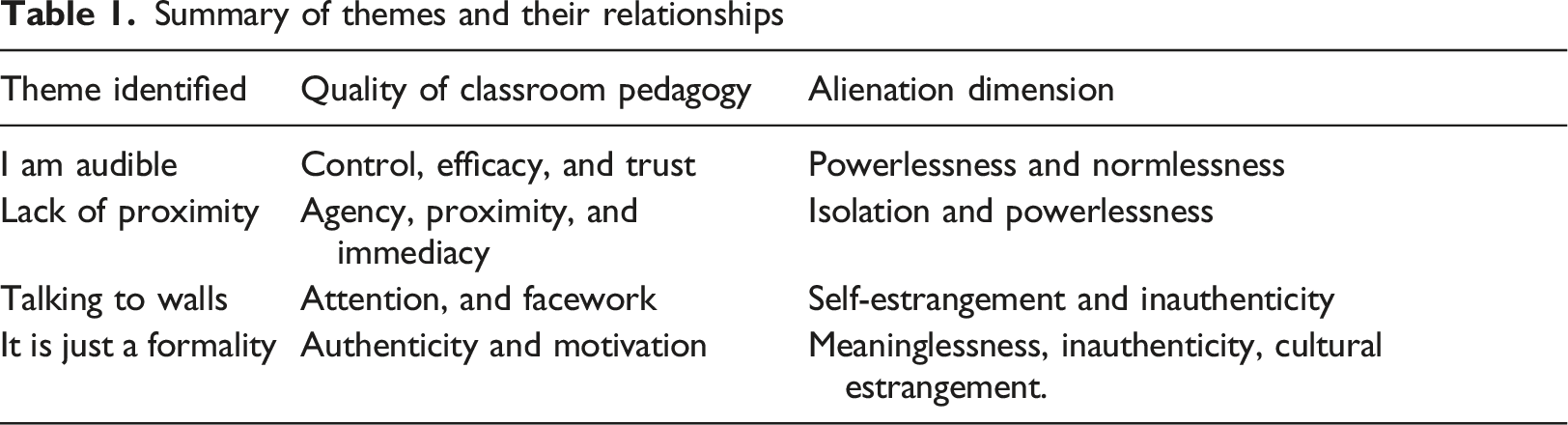
Summary of themes and their relationships
First, it demonstrates how online education disrupts the fine-tuning of self and work. According to Marx (1959), labor has a basic and close link with human nature. Labor satisfies the productive and heuristic demands of the human self. An inside-out motivation for work becomes an optimal situation for a human being to realize herself/himself and align the outcomes of activity with their inner self’s desires (Israel, 1979). Teachers endure existential ennui, a sense of powerlessness, or a lack of control over the process and products of their job as a result of emergency remote teaching. Given that education is ultimately a relational act (Shvidko, 2021), online teaching has the potential to be disruptive in terms of disturbing the sync between self and work that is otherwise achieved in a classroom setting. Physical classroom proximity enables instructors to use a variety of affiliative strategies to make pedagogical relationships more joyful and agentic, resulting in a synergy of identities and experiences. They gain a sense of fulfillment when their speech is valued by people in an actual classroom situation, but virtual classrooms portrayed as talking to walls, deprive teachers of such satisfaction. This is because of their inability to see their audiences' faces or instant reactions to whatever is being spoken. This is based on Goffman’s (1955) work on “face” and “facework,” which asserts that people are overwhelmingly concerned about what others think of them—"face.” Facework refers to the agentic practice of aligning one’s actions to other people’s expectations (Vedder-Weiss et al., 2019).
Second, with the help of teachers’ narratives, alienation has been visualized as a fundamental framework to understand teachers’ dissatisfaction with online pedagogy. By bringing about significant shifts in the way teachers teach, it shakes the social, emotional, personal, normative, and discursive qualities that traditional teaching offers (Ferri et al., 2020). Four predominant themes: “am I audible?”; “Lack of proximity”; “Talking with walls”; and “it is just a formality” emerged from the data. These four themes summed up and reflected the underlying alienation of teaching folk with online teaching Table 1. These themes bear similarity to the framework of alienation provided by Seeman (1959 and1975) and Dean (1961). For example, lack of proximity entails social isolation and deprives teachers of exercising facework agency. A lack of sense of control reflects powerlessness and trustlessness over technologically mediated interaction. The feeling of Talking to walls has been related to a lack of meaningful attention from participants in online teaching. This feeling ensembles a mix of powerlessness and cultural estrangement. “It is just a formality” reflects the meaninglessness that pervades online teaching. Collectively, they all reflect the “inauthenticity” inherent in online teaching (Kim, et al., 2017). Authenticity or the need for acting as per one’s convictions is a highly valued aspect of personal identity (Wood, et al., 2008). One way scholars have defined alienation has been in terms of a discrepancy between expectation and reality. Alienation has been defined In terms of a person’s sense of loss or frustration with a situation relative to an existing setup (Jessor, Jessor and Finney 1973).
Third, teachers' accounts latently represented the elements that distinguish online teaching and actual teaching. Teachers highlighted several features of classroom instruction that remote instruction does not provide. Teachers report that attention, control, immediacy, authenticity, proximity, interaction, and agency in the classroom have historically been internalized and normalized. Remote education disrupts the fine-tuning of the internalized rhythms of classroom instruction, leading to instructors’ disappointment and unhappiness. These characteristics of asynchronous teaching are critical for the development of mutual understanding, caring, belonging, mutual respect, a sense of fulfillment, and the meaningfulness of teaching and learning activities (Symeonides and Childs, 2015). Alienation is extremely visible because online classes often do not provide any of these.
Conclusion
Undoubtedly in-person interaction between the teachers and learners has no match, in terms of micromanagement of students, close coordination, understanding of mutual abilities, trust, and delivery outcomes, nevertheless online teaching lacked most of these qualities (Mohmmed et al., 2020). Activities behind closed cameras and mute mics seriously affected the reception process and related quality aspects. The instructors were helpless in eliciting a meaningful response, let alone debate from the other side of the spectrum, and the disinterested learners juggled between various applications installed on their machines (Bond et al., 2021). Assignments and evaluations become casualties. Overall, the spectrum proved less worthwhile than the conventional learning process, which is time-tested and underscores that direct human-to-human interaction is a basic prerequisite of teaching.
The teachings of pandemic pandemonium were ridden with feelings of disillusionment, estrangement, and powerlessness. Teachers were forced to resort to online teaching without much deliberation and preparation. Given that directions for implementation were the result of a top-down process, teachers were disenchanted with their position and the existential awareness of the context in which they were asked to function. It is perhaps the only way to reach out to your students in situations where it becomes impossible to take offline classes. However, a lack of control over things happening online can sometimes be frustrating, if not altogether devastating. Add to it the necessary know-how of the online classes; how they are conducted; and how to use all of their features, required both by the teacher and the learner, and it becomes a challenge to run such classes for prolonged periods when you have only unpredictable data connectivity. Plus, one is not sure of the outcome of the online classroom transactions given the fact that it is easy for the students to just log in to the classes simply to mark attendance without actually sitting through the entire sessions. Having said that, online teaching is becoming unavoidable and the more and faster we get used to it and adapt ourselves to this changed scenario the better the chances for success.
Finally, it is suggested that teachers’ opinions are considered in defining future pedagogic responses to emergency circumstances. These findings are significant in terms of comprehending contemporary circumstances that have compounded the already disenchanted teaching community. As a result, it is argued that ERT, and for that matter online education, has evolved into an instance of neoliberalism within neoliberalism. This is due to the fact that teachers’ voice and agency have been further stifled, this time with the evangelism that ERT was nearly unavoidable. More crucially, this article demonstrates how ERT, or more broadly, synchronous online education, requires advanced features to ensure that teachers do not feel like they are not audible or that ERT is a formality. Future technologies could focus on assisting teachers in shaping the online space as if it is a virtual physical space.
Footnotes
Declaration of Conflicting Interests
The author(s) declared no potential conflicts of interest with respect to the research, authorship, and/or publication of this article.
Funding
The author(s) received no financial support for the research, authorship, and/or publication of this article.
