




Abstract
When school closure was mandated due to COVID-19, staff at a university lab preschool in Trinidad rapidly switched to remote teaching. Although the six teachers were experienced early childhood educators, they were unfamiliar with teaching remotely using video conferencing tools and websites. Guided by a consultant and an educational technologist, an indigenous remote early childhood program for 3- to 4-year-old learners was introduced using the Padlet platform and Zoom. This qualitative descriptive case study investigated the challenges teachers experienced and how they adapted to provide continuity in teaching in a changed pedagogical context. Using the Resilience in Human Development theoretical framework the research questions asked: What were the challenges experienced by early childhood teachers in delivering their first emergency remote teaching program? And, how did teachers overcome the challenges which arose in delivering emergency remote teaching to young learners? Guided by Creswell’s (2016) recommendation to collect and analyze data from multiple sources, teacher questionnaires, written teacher reflections, parent questionnaires, and feedback provided by a consultant were the data sources. Findings revealed themes related to five teacher challenges and four parent challenges. The strategies used to overcome the challenges included: Becoming proactive, Introducing Innovations, and Tapping into motivation. Policy implications and recommendations to support continuity in teaching during emergencies at the school and national levels are included.
Keywords
Background
The COVID-19 pandemic caused a rapid migration to remote teaching and learning worldwide. Teachers of young children shifted from physical classes to supporting parents or caregivers to teach young learners at home. This shift posed a particularly serious challenge for teachers because young learners need constant adult supervision. Additionally, the challenges for schools in Trinidad, a developing country, were greater than for schools in developed countries with access to more resources. The United Nations Development Program UNDP (2020) noted that countries with lower levels of development are less able to respond to school closures such as experienced during the pandemic, than countries with high human development. For example, during the second quarter of 2020, 86% of children in primary education were out of school in lesser developed countries. In comparison, 20% did not receive schooling in countries with very high human development.
At the University of the West Indies (The UWI) laboratory early childhood center (lab school) in Trinidad, when school closure was mandated, management decided to complete the term virtually. Teachers, though initially perturbed, soon focused on navigating the changed pedagogical context. They saw an opportunity to design flexible teaching options for learners and their families. Since no known model existed, staff accepted voluntary professional assistance to develop a pedagogical model to deliver remote teaching via the Padlet platform and Zoom. The main challenge was to improvise and adopt quick solutions while maintaining the high-quality teaching for which the school had a 38-year reputation. This study reports on challenges teachers experienced, and how they were overcome to teach young learners.
An important reason for this study was the limited research in emergency remote teaching from developing countries like Trinidad and Tobago. Further, research studies in early education is even more limited but necessary in the Caribbean context where emergencies like floods, periodically disrupt schooling. Additionally, the developing world needs studies that can provide valuable information about support services for similar emergency teaching situations. This study is intended to fill that gap.
Problem statement
The rapid switch from face-to-face to remote teaching, during the COVID-19 pandemic, presented challenges which teachers worldwide had to overcome. Teachers at The UWI preschool experienced challenges in delivering the curriculum for 3- to 4-year-old children remotely. This study investigated the specific challenges experienced by a staff of teachers at The UWI Children’s Centre in Trinidad and uncovered how the teachers overcame those challenges.
Purpose of the study
The purpose of this study was to categorize the views of six teachers about the challenges they experienced in switching to remote teaching during a pandemic. The study analyzed data sources which included teacher reflections, to identify ways in which the challenges experienced were overcome. This investigation will provide empirical data on teaching challenges and strategies implemented for teaching children 3–4 years old, at one early childhood center in Trinidad, during a period that required emergency remote teaching.
Research questions
What were the challenges experienced by early childhood teachers in delivering their first emergency remote teaching program?
How did teachers overcome the challenges which arose in delivering emergency remote teaching to young learners?
Literature review
The review distinguishes among ERT, typical distance education, and online teaching. It then explores literature on teaching challenges related to ERT and technologies and strategies for ERT. Parents’ role in supporting children during ERT is also investigated.
Emergency remote teaching and its challenges
Emergency remote teaching (ERT) is an alternative, temporary method of teaching that evolved in response to a specific crisis (Hodges et al., 2020) and thus differs from typical distance education. “By definition, distance education is characterized by the distance in time and/or space between learners and learning resources. While remote education refers to spatial separation, distance education considers distance within the perspective of different angles and strives to explain it through transactional distance” (Bozkurt and Sharma, 2020: 2).
Research shows that effective distance or online teaching (OLT) results from careful instructional design and planning, using a systematic instructional design and development model. This careful design process is absent in most emergency shifts (Hodges et al., 2020). Further, examples of education in crises show that teachers need to become creative and generate solutions that meet the new needs of the learners (Istenič, 2021; Johnson et al., 2022; Kalloo et al., 2020; Tomei, 2016).
Some countries respond to school closures in times of crisis by implementing models like blended learning solutions (Kukulska-Hulme et al., 2022). In a study of education’s role in fragility and emergency situations, the Inter-Agency Network for Education in Emergencies (Hodges et al., 2020) examined case studies. One case during conflict in Afghanistan used radio education and DVDs to safely maintain and expand educational access (Hodges et al., 2020).
It is noteworthy that although there are many digital resources for ERT (Hernandez-De-Menendez and Morales-Menendez, 2019), access to resources for those without finance or a reliable internet could become scarce resources. Further, although specific aspects of a lesson, like the evaluation, can use several digital resources and tools, instructors need to know: where to find the resources and how to use them (Aguilera-Hermida et al., 2021; Ferdig et al., 2020). Teachers therefore need professional development, to support the switch from in-class to online teaching (Abaci et al., 2021).
Technologies and emergency remote strategies for teachers
At the onset of the pandemic, new strategies were needed to continue teaching young learners. Chase and Taylor-Guy (2020) described that period as the Immediate Response Phase, when continuity of learning and teaching is the focus. They suggested actions that encompass Auditing, Planning, and Introducing strategies to reduce the pressure of the experience.
Price (2020) similarly recommends a focus on planning, advising that teaching plans be directed toward achieving learning outcomes, instead of being led by online platforms and tools. Further recommendations include providing opportunities for children to maintain social connections with peers and school. Also having formative and summative assessments. Teachers should develop their knowledge base for online teaching and 21st century learning strategies. They should also work in partnership with parents and families.
A survey study, conducted by Jelinska and Paradowski (2021), found that teachers were more likely to manage the transition to online teaching during the pandemic: if they previously taught using remote instruction, or in the higher education, or if they had previously used real time synchronous modalities to teach (p. 303). Additionally, Kim et al. (2014) found that students in online mathematics courses needed to interact with their peers to benefit from the social learning support needed to overcome difficulties. When there was no interaction some critical teaching principles did not transcend the medium. Consequently, teachers were challenged to maintain high-quality instruction in the online environment. Al Hadhrami and Al Saadi (2021) found that technical challenges for teachers and internet inefficiency affected learning in Omani schools.
Donohue (2015) suggests that technology be appropriately used by educators who understand the tools and how best to use them. They should follow the principle that children’s engagement with the media should support whole child development, even in the online environment (Donohue, 2015). Donohue further explained the problems of having teachers functioning at analog capacity in a digital age. Additionally, Arnett (2021) identified a gap which usually occurs between adopting a new technology and understanding how to incorporate its use. First, educators tend to use accustomed methods. Thereafter they can better explore new possibilities. Nevertheless, Ostro (2020) cautions that educators must meet children’s educational requirements which remain constant across settings and may be even more critical during remote learning when the learning environment is diminished. Studies show that children’s passive interaction during screen time was negatively associated with achievement in mathematics, science, executive functioning, and social skills (Hu et al., 2020; Neumann, 2014). Teachers therefore need skills to deliver interactive teaching experiences during remote teaching.
Supporting parents to teach young learners in emergency remote teaching mode
During the pandemic, most parents felt unprepared for their new teaching role. In a study by Dong et al. (2020), 3275 Chinese parents’ beliefs and attitudes toward their young children’s remote learning were investigated. Most beliefs were negative regarding the benefits of remote learning as parents preferred traditional classroom learning. These beliefs seem to contradict the then existing view, that young children were very interested in media and technology (Sharkins et al., 2016) and that Chinese children were curious and excited about digital programs (Dong and Mertala, 2019; Jiang and Monk, 2015).
The researchers Dong et al. (2020) noted that parents tended to resist online learning for three main reasons. These were: shortcomings of learning online and negative effects on the children’s development, young children’s limited ability to self-regulate, and parents’ lack of time and professional knowledge to support children’s online learning (Oktavianingsih and Arifiyanti, 2021). A noticeable exception were parents who owned private businesses and freelance workers. This may have been because they had more flexible time to work with their children, than those working in public organizations. Further, Nikken and Jansz (2006) and Dias and Brito (2021) found that parents who are more positive about using technology were more supportive than parents who held negative views about technology.
Another study conducted by Haas et al. (2022) on remote early childhood STEAM education for 4- to 6-year-old students in Luxembourg was designed to develop a conceptual framework on parent-assisted remote teaching using educational technology supported by cycles of design-based research. Findings included that interactions between parents and children were comparable to interactions between teachers and students. Parents actively participated with their children, questioned STEAM contents, experimented with scaffoldings, and connected to each other. Students were highly motivated. Children and parents benefitted from active learning technology which included social interactions and communication channels with professional support.
The findings imply that educational authorities should prepare parents, for online learning. Additionally, improved program designs which accommodate parent needs would assist parents to effortlessly use internet technologies and tools.
The guiding framework of the study
This study draws on a theoretical framework of Resilience in Human Development. Southwick et al. (2014) define this concept as the capacity of dynamic systems to successfully adapt to disruptions which threaten how they function, their viability, or their development.
Resilience incorporates the interaction of processes across multiple levels of functioning. The main theoretical framework for resilience research with children draws on developmental systems theory (Thelen and Smith, 1998; Lerner, 2006), the principles of developmental psychopathology (Masten, 2006), and Bronfenbrenner’s ecological model of development (Bronfenbrenner, 1979, 1986). Though human resilience research initially focused on children and families, it now provides guidelines for planning and recovery (Masten and Obradovic, 2008). The theory is therefore applicable to interpreting the impact of major traumatic situations such as natural disasters, on child development and also on the functioning of a system with multiple interacting networks.
The Resilience in Human Development theoretical framework was used to design this study of teacher challenges in providing education continuity during the COVID-19 pandemic. The functioning of a lab school which had multiple interacting systems such as teachers, parents, and the community was investigated. The framework guided every aspect of the study including, defining the problem, the literature reviewed, the research questions and methodology, and the discussion of findings and conclusions. In this way the framework helped to determine challenges experienced, and how the school adapted to maintain its functioning, throughout the change period studied.
Methodology
A qualitative descriptive case study design (Creswell, 2016; Yin 2003) was used to investigate the views of six female teachers (each referred to as “Aunty” in the setting) concerning the challenges they experienced in switching to remote teaching during the pandemic, and how those challenges were overcome. The teachers worked at a university laboratory school. Data were collected from 18 parents, who consented and responded to the parent questionnaire sent via Google Forms. One U.S. based educational consultant and one IT educator voluntarily supported the school’s ERT program. Teachers had at least a Bachelor’s Degree in Education. The consultant had a PhD with qualifications in developing appropriate instructional strategies, project management, and distance learning and assessments. The researchers were faculty members one of whom was on the school board.
The study was conducted during the second school term over the period from March 2020 to April 2020 when teachers initially switched to emergency remote teaching to complete the term. School closure was mandated by the education ministry in accordance with health restrictions, to curtail the spread of the deadly COVID-19 virus.
Guided by Creswell’s (2016) recommendation that good quality qualitative case study research collects and analyses data from multiple sources, data were obtained from: teacher questionnaires, written teacher reflections, parent questionnaires, and feedback from a consultant. First an open-ended questionnaire containing eight questions designed on Google Forms was sent to teachers at the end of the term to elicit their views about the change from face-to-face to a virtual classroom. The questions asked included: What best describes your feelings about your job at that time? What changes do you think would improve the quality of the activities to be delivered? What would remain the same? And, what type of support would assist you to do a better job for the term ahead?
The questionnaire was found to be more appropriate than interviews, since person-to-person contact was not allowed and teachers were working from their homes. The questionnaire was first piloted with two colleagues to improve readability and then sent to the teachers who all consented to participate in the study.
A second data collection method was through a review of staff reflections which three teachers wrote to explain their experiences from the start of remote teaching to the end of the term. The reflections included challenges they experienced and how those challenges were overcome. Parent questionnaires designed on Google Forms was the third data collection method. The questionnaires which elicited parents’ opinions about the conduct of remote teaching were sent at the end of the term.
The final method of data collection was from feedback provided by a consultant to improve the Emergency Remote Teaching Program. These multiple data sources allowed for methodological triangulation to compare the results from different data sources. This approach can extend the levels at which an issue is studied (Flick, 2007).
Analysis
Guided by the qualitative analysis process (Creswell, 2016), an inductive approach was used to move from raw data to codes (or sub-themes) and then themes. The two researchers individually applied codes to teacher and parent questionnaire responses. The researchers then collaborated over a 4-week period to read through and reduce overlapping codes, and group them to arrive at a 100% intercoder agreement on codes assigned. The teachers’ reflections and the recommendations from the consultant were similarly coded. The aim was to systematically categorize the data by identifying similarities, differences, and relationships (Gibson and Brown, 2009) across the four data sets, to respond to the two research questions. Codes were either “in vivo codes” or labels made up by the researchers to represent chunks of data. Broad themes were then applied to group similar codes (or sub-themes). Additionally, quotes were selected to represent themes and to provide evidence for writing the qualitative report.
Ethical considerations
University guidelines for obtaining ethical clearance to conduct the study were followed. Additionally, all participants completed an online consent form prior to data collection. The form provided an overview of the study, explained the purpose, and provided details of data collection procedures. Participants were advised about how confidentiality would be maintained in data storage and retrieval and also that pseudonyms would be used to protect their identities. They were further advised of their right to withdraw from the research at any time.
Findings
The first research question asked: What were the challenges experienced by early childhood teachers in delivering their first emergency remote teaching program? Two overarching themes emerged—Teacher Challenges and Parental Challenges. Teacher Challenges were the difficulties teachers experienced during the switch to ERT. This theme subsumed five sub-themes (See Table 1). The second overarching theme—Parental Challenges, incorporated three sub-themes. This theme represented difficulties parents experienced.
Themes and sub-themes representing challenges.
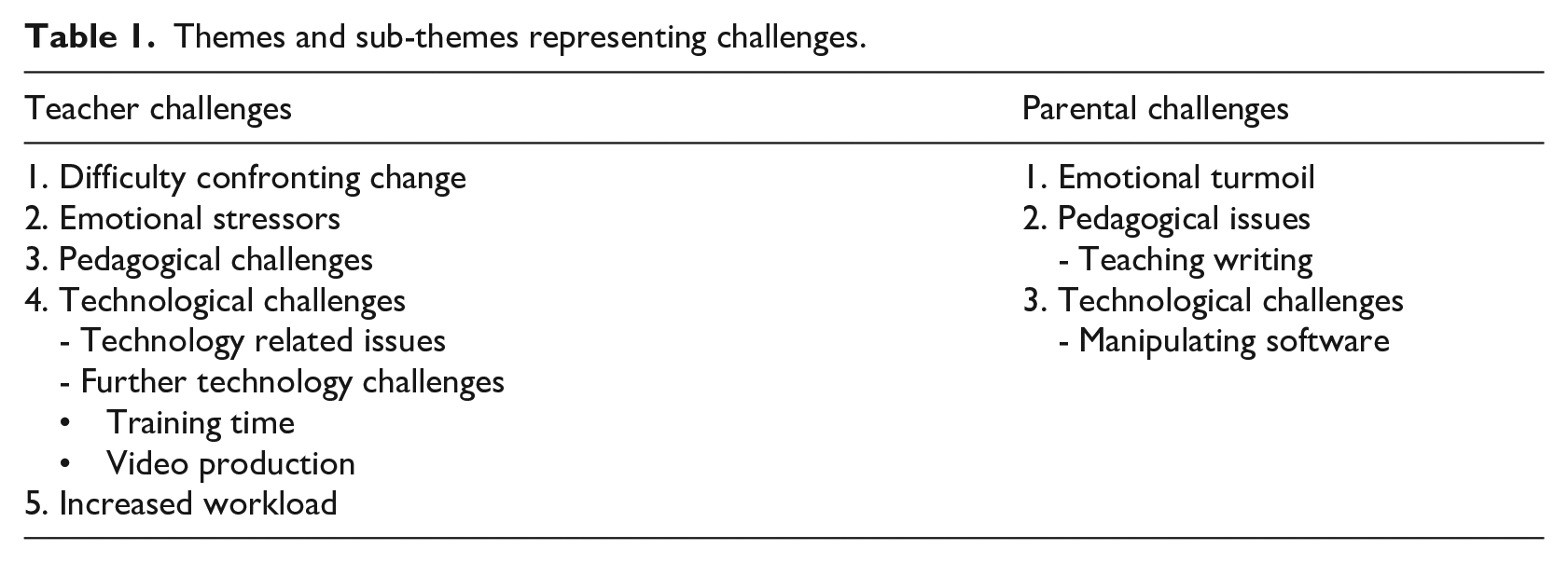
The first Teacher Challenge was Difficulty confronting Change. Teachers initially hesitated to switch to remote teaching. Aunty (Teacher) C explained that “when information came in, that we had to work remotely from home, most teachers did not volunteer to prepare teaching videos or contribute to virtual parent/ teacher meetings.” Also, “Only two teachers accepted the challenge to learn to use the Padlet.” Along with Zoom, Padlet was the platform selected for delivering the emergency remote program. Aunty C stated that “it was a very nerve-wracking situation.”
The second challenge was the Emotional Stressors they experienced. This was the strongest theme as every teacher mentioned experiencing stress on more than one occasion. These included the uncertainty of transitioning to the new remote teaching mode. Aunty C explained that the sudden switch to teaching remotely was “fearful.” She added, “I did panic to some extent as I was not techno savvy. . . . understanding the Zoom was new to me.” The stress was sometimes overwhelming. She said, “I was confronted to become a producer of short educational videos overnight. This was new and at the time very challenging.”
Teachers also reported that personal issues like homes with limited space for teaching and no teaching resources, increased teaching preparation demands. Further, job and peer relationship problems also surfaced. Additionally, the school was at that time preparing some learners to transition into the Primary school. Teachers had to ensure that they acquired necessary concepts. Aunty C added that teachers held additional meetings to produce videos and collaborate which made them “extremely tired.”
Then there were Pedagogical challenges. Initially the teaching strategies were inappropriate for remote teaching. Teachers posted activities based on randomly selected online worksheets and resources. Further, problems arose during synchronous sessions, when devices failed or strategies were inappropriate. Also, teachers could only manage limited instructional differentiation. For example, some learners who were not developmentally ready for writing received the same activities in whole class sessions.
The fourth sub-theme—Technological Challenges were compatibility issues related to the browser, media and the platform that was used. Sometimes, teacher-made YouTube videos were not published because the content violated copyright guidelines. Further, Internet service interruptions resulted in canceled sessions. Additionally, devices with limited capability sometimes malfunctioned. Teachers also experienced difficulty manipulating the software (Zoom). There were also “Further technological challenges” which teachers felt was caused by the short training period for remote teaching and lack of post training support. Problems included videos being too long or teachers not meeting the deadline for submitting them for upload.
The final sub-theme was Increased workload caused by additional duties from sources which included when videos were incompatible with the virtual spaces and had to be re-done. Also, longer videos increased the upload time. Teachers complained that preparation for teaching was tedious.
The second overarching theme—Parental Challenges had three sub-themes. Parents experienced “Emotional Turmoil,” “Pedagogical issues,” and “Technological challenges.” The “Emotional Turmoil” resulted from the uncertainty parents felt, when the daily routine of dropping their children off to school was disrupted. Also, they felt unable to plan for future schooling due to uncertainty in the changed teaching context. Additionally, there was the general fear of contracting COVID-19. Schooling during the pandemic involved online teaching with an adult to supervise 3+ or 4+ learners during remote learning. Parents felt stressed. One parent explained that, “multi-tasking, working from home and separating my work and [from] the children’s work is hard.”
“Pedagogical challenges” arose because parents realized they lacked the skills to teach. For example, Aunty R. noted that, “Parents found writing and fine motor activities difficult because some of the children’s fingers were a bit weak to pursue such tasks.” One parent stated that she developed an “added respect for all teachers.”
“Technological Challenges” was the third theme identified. This occurred when parents expressed difficulties with manipulating the software. The learning process was sometimes interrupted when teachers had to send WhatsApp messages to advise parents how to reconnect or turn off their microphones. Parents also sometimes experienced challenges uploading work to the Padlet.
The second research question was: How did teachers overcome the challenges which arose in delivering emergency remote teaching to young learners? The four themes which emerged to explain strategies used by teachers were as follows:
Becoming proactive
Introducing innovations
Accessing support, and
Tapping into motivation
Table 2 shows the themes, their sub-themes, and matches them to the challenges identified in response to research question one. The first theme “Becoming proactive” represents activities teachers devised to adapt and function, in spite of multiple challenges in a changed teaching environment. The first subtheme was Taking Initiative. Faced with teaching remotely, though untrained, teachers planned virtual activities. Asynchronous lessons were videotaped mostly using teachers’ cell phones. They also sourced indigenous materials like leaves to substitute for school resources like building blocks. Teachers also directed parents to online activities and worksheets for teaching concepts.
Themes showing how teachers overcame challenges matched to challenges experienced.
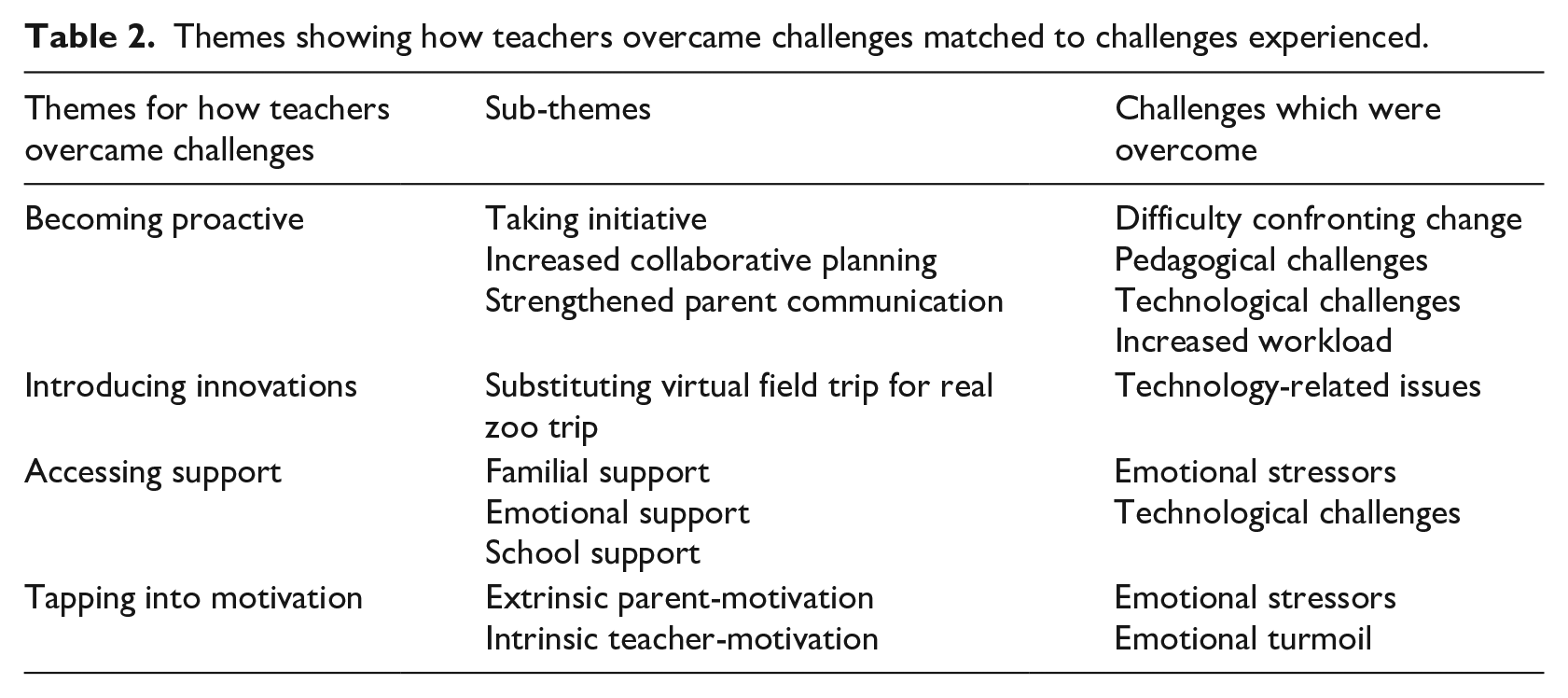
Teachers Increased collaborative planning—the second subtheme, to make the teaching transition possible. Via the Padlet platform they communicated the activity schedule to parents. Teachers used feedback from a consultant and the administrator to ensure that learning goals and outcomes for children were clearly stated. They also used their creativity to plan virtual teaching experiences for teaching concepts. Co-teaching was sometimes done. In spite of the added responsibilities teachers kept all their teaching commitments. Aunty E explained that,
Each child was given an opportunity to highlight his/her learning for the term . . . in the form of a portfolio compiled by the children and their parents. Some children seemed quite excited to showcase their portfolio, while a few of them were shy.
Strengthened Parent Communication is the third sub theme. Parent conferences were re-designed to provide a virtual experience for discussing each child’s progress. Open communication with parents was encouraged. Parents spoke about their teaching experiences and sought advice from teachers. They recommended that teachers only improve their use of technology since content coverage was good. Also, parents wanted more interactive sessions and more activities for children to work on their own.
“Becoming proactive” was therefore the strategy teachers used to address the Challenges of: Difficulty confronting sudden change, Emotional Stressors, Pedagogical Challenges, Technological Challenges, and the Increased Workload.
The second theme: “Introducing Innovations” refers to alternatives to traditional face-to-face events on the school’s calendar. A Virtual Field Trip replaced the annual trip to the zoo. With the public zoo closed, one teacher, assisted by her son, walked through a neighbor’s mini backyard zoo. She gave information, and asked questions about the animals. The other teachers, parents, and young learners, dressed up wearing special clothes, including sunglasses, and munching from bags of snacks, used Zoom to connect from their homes. Another innovation was a Virtual Graduation which involved families submitting creative segments of a pre-taped graduation speech, which was edited and combined with music. Children recited memorized lines while walking down a staircase or being pushed on a swing.
As time progressed and teachers received training in video production, they were better able to let the pedagogy guide the technology instead of vice-versa as was happening at the start. Teachers innovated as they integrated the tools (videos) in synchronous sessions with children and at parent meetings. These innovations assisted with overcoming some of the challenges of Technology related Issues and Pedagogical Challenges.
The third theme was “Accessing Support.” Teachers initially depended on Familial support. They got technological assistance from family members. For example, one teacher got help from her son to videotape lessons and edit videos. They also got Emotional support in the form of positive criticism to improve teaching. School Support was another important source of assistance. This included supervisory review of teaching plans, and weekly staff meetings to assist with planning and implementation. Teachers also got short training sessions on how to conduct synchronous and asynchronous sessions. As a consequence, they learned easily available tools and developed online teaching skills. Even though teachers stated that they needed additional support and training, School Support and Familial support helped to alleviate the Emotional Stressors teachers were experiencing as well as the Emotional Turmoil parents were experiencing.
“Tapping into motivation” was the fourth theme. The first sub-theme was Extrinsic Parent- motivation. This is where teachers benefitted from positive parent feedback. When parents praised the easy to follow layout of the Padlet, it helped to regulate teachers’ emotions. Recommendations from the consultant which were adopted also assisted. Further, compliments from teachers to parents about their efforts to follow teaching plans served to motivate parents. Aunty E explained that, “The educators congratulated the children and the parents on a job well done.”
The second sub-theme Intrinsic Self-motivation was related to each teacher reflecting on her own inner thoughts and new understandings to motivate herself. Aunty C said, “I had to stay positive and glad.” She explained that she came to the realization that “learning can still continue remotely.” As remote teaching skills were increasingly acquired mainly through practice, teachers better understood the process. Aunty C explained that over time she became more comfortable and “excitement grew.” Drawing on “self” was important for addressing the Emotional Stressors teachers were experiencing and also parents’ Emotional Turmoil.
In summary, the findings revealed that there were Teacher and Parent challenges which teachers had to overcome to continue teaching during the emergency remote teaching period.
Discussion
This study draws on a theoretical framework of Resilience in Human Development. Southwick et al. (2014) define this concept as the capacity of dynamic systems to successfully adapt to disruptions which threaten how they function, their viability, or their development. The challenges which teachers experienced as a result of the COVID-19 disruption were first of all Difficulty Confronting Sudden Change and second Emotional Stressors. Chase and Taylor-Guy (2020) described that initial period of responding with emergency remote teaching as the Immediate Response Phase where the focus is on continuity of learning and teaching. They recommended following a comprehensive, systematic set of strategies starting with auditing what is available, including technology. Thereafter introduce strategies to reduce the pressure of the experience. Further, consider staff and student skills with technology use, free educational technology tools, and prioritizing curriculum for teaching.
The school had no plans in place for emergency remote teaching as this was a new experience in a developing country which never experienced such an educational disruption. It seems that Chase and Taylor-Guy’s (2020) recommendations for continuity in learning would have helped. However, with no protocols in place, teachers experienced Difficulty Confronting Sudden Change and Emotional Stressors. The Pedagogical and Technological Challenges teachers experienced were understandable considering the views of Dill et al. (2020). They advanced that normally, instructors need time to evaluate the technologies to determine its effectiveness for purpose. However, with the rapid switch to emergency remote teaching, there is limited time for that process causing instructors to maintain accustomed practices.
Aunty C’s description of her “fearful” online teaching experience seemed to imply a problem with teachers needing technological skills to cope with the change. Applying the theoretical framework of Resilience in Human Development (Southwick et al., 2014), teachers within the school system were not adequately resilient initially, when they experienced several challenges because their accustomed teaching mode was disrupted. The challenges were not however unique to the setting studied. Abaci et al. (2021) noted that ERT caused by the pandemic highlighted an urgent need for professional development worldwide. Comprehensive guidelines like those developed by NAEYC and Fred Rogers (2013) recommend that all teachers and administrators understand technology tools and how best to use them.
Teachers also need digital skills (Donohue, 2015). The situation at the centre with unskilled teachers seemed to highlight this point. It contributed to the technological challenges and the Increased workload experienced. A further contributing factor was the lack of a support system to quickly upskill teachers. Although the lab school had access to the university’s technology department, increased campus-wide demands limited its ability to provide ERT support. This seems related to Hodges et al.’s (2020) view that even though resources may exist to support OLT, when ERT becomes necessary, resources become stretched due to the scale of the change required.
Data also revealed Parental Challenges. The reasons parents gave for the challenges experienced were similar to the main reasons articulated by Chinese parents (Dong et al., 2020). Drawbacks of learning online included difficulty with young children’s self-regulation, parents’ lack of time, and insufficient professional knowledge to support their children’s learning. Additionally, this study revealed that parents had difficulty supervising their children during online school. These challenges contributed to parents’ Emotional Turmoil. In examining parent challenges through the theoretical framework (Southwick et al., 2014), there was also the need for building resilience to support children’s learning. The need for addressing parent resilience seems especially critical for parents to facilitate young children’s online learning.
Further, although there were no protocols for ERT, teachers addressed the challenges as best they could. The teachers’ philosophy was that they had a “commitment” to continue teaching. They became proactive in their planning and engagement with parents and children. This allowed them to innovate and seek technological assistance. They also drew on internal strength and positive parent feedback to remain motivated. Teachers’ responses as they became more familiar with online teaching could be interpreted as ways they showed resilience (Southwick et al., 2014) in spite of challenges experienced.
While the effort expended by teachers was commendable, looking at the broader ecological context within which the school and educating the young child is nested, the sources of support for overcoming the challenges were very limited. At the start of the pandemic mainly teachers and their families, and parents provided support. These were within the Microsystem in Bronfenbrenner’s (1979) Ecological system’s model which addresses how aspects of a child’s environment is interrelated and affects the child’s development. Due to social distancing, interactions in the Mesosystem were not physical but confined to virtual meetings with families and among classmates.
The university’s technological department and the consultant’s voluntary assistance could be placed within the Exosystem, the third tier of the ecological system model which though not directly involved in teaching provided support which impacted the quality of teaching. Teachers did not mention any support coming from the Macrosystem, which would include government policies and interventions. These could have mobilized among others, national health and technological assistance to minimize emotional stressors and technological challenges experienced.
Although Trinidad and Tobago is a developing nation, adopting practices used in developed countries like Spain and China could help. Digitization of teaching in Spain during COVID-19 was possible due to prior systems in place and national support (Albó et al., 2020). Similarly, prior preparedness helped China to implement their policy of “Suspending Classes Without Stopping Learning” during the COVID- 19 pandemic (Zhang et al., 2020). The analysis seems to indicate that to provide teaching continuity through educational emergencies, resilience for adapting to changes in curriculum delivery should be boosted to: reduce teaching challenges, support parents’ ability to facilitate children’s learning, and to provide resources or guidelines, which national agencies and international sources can contribute.
Limitations
One limitation was that the research was a qualitative case study which investigated the experiences of six teachers at one early childhood centre. Although data were collected from multiple sources, the findings cannot be applied to preschools in general. However, they can inform planning where similar settings exist. A further limitation was that a laboratory preschool was investigated, where the respondents were from more privileged backgrounds. As a result, the responses would have reflected the experiences of those parents who chose to and could afford to send their children to the University’s preschool. The study also captured a short snapshot in time and did not extend to when systems may have been implemented to better cope with the change. Finally, due to social distancing and disruptions, data were mainly collected from teacher and parent questionnaires and written teacher reflections. While this method provided rich data, focus group interviews, even if virtual, should be included in future research. Future studies can use a mixed method approach and study several schools. Studies can also explore overcoming challenges over a longer period of time.
Implications for the future
As we become increasingly vulnerable to large-scale teaching disruptions, it seems important to plan for maintaining a functional Early Childhood Care and Development system during national emergencies. To this end, the following recommendations are proposed:
Teachers should receive professional development to improve their digital skills for remotely teaching and using technological tools in their teaching.
A flexible or blended learning model should be considered for EC teachers to be able to shift quickly and seamlessly to remote teaching when necessary.
Professional development to strengthen teachers’ emotional and social wellbeing and resilience should be provided.
Training for parents to teach and support their children’s learning at home is needed.
Schools should develop policies to access resources from community and state agencies during ERT.
Policy development re: ERT should be grounded in research data.
This study seemed to have highlighted that the extent of prior preparedness not just at the school level but also at the national level, affects teachers’ and parents’ experiences, their resilience, and ultimately the quality of teaching and learning provided for young learners during ERT.
