




Abstract
The comparative, mixed methods international and cross-cultural study aimed to determine the factors that motivated teachers in Jamaica, Poland and Turkey to choose teaching as a career and ascertain what motivated the teachers at different stages to remain in teaching. Data were collected through the use of the questionnaire, which experts validated and had an overall reliability coefficient of 0.77 and focus group interviews. A total of 186 teachers participated in the quantitative phase of the study, whilst 75 participated in the qualitative phase. The findings showed that extrinsic, intrinsic, and altruistic motivation, roles and responsibilities, and opportunities were the main reasons teachers in the three countries chose the teaching profession. Teachers in the different stages of their careers remain in the profession because of a strong sense of vocation, a passion for teaching, a need to make a positive difference in students’ life, job satisfaction, and connected with its rewards of being a teacher. It was recommended that researchers interested in this area could use a more representative sample size to generalize the findings.
Introduction
It is currently noticeable that many countries seek to improve their schools in order to respond to higher social and economic expectations. As the most significant and costly resource in schools, teachers are seen as a priority for public policy and are likely to become even more so in future years. Improving the quality of schools mainly depends on ensuring that competent people want to work as teachers and their teaching is of high quality. Motivation for choosing teaching as a career is considered an essential effective premise for joining and staying in the profession. According to Amos and Loko (2015), ‘... teachers need supports that encourage their intrinsic, or internal, motivation; such as achievement, recognition, and career development’ (p. 10). Amos and Loko (2015) stated that extrinsic versus intrinsic incentives are an important issue for teacher motivation in the developing world... (p. 10).
This issue of teachers’ reasons for entering teaching as a profession is an example of a worldwide issue that is especially significant in times of teacher shortage and in times of struggling to attract and keep effective teachers (Darling-Hammond, 2017; European Commission/EACEA/Eurydice, 2015; Han and Yin, 2016; Kyriacou and Coulthard, 2000; Organization for Economic Co-Operation and Development [OECD], 2005; Skilbeck and Connell, 2003).
Rationale
Despite the endless challenges, many teachers in different stages of their careers in education are still motivated to teach. Teacher motivation has been studied widely. The existing literature supports this claim. The justification for undertaking this study was that a few comparative studies explained teacher intrinsic, extrinsic and altruistic motivation types and career development in developing economies such as Jamaica, Poland and Turkey. Furthermore, the researchers were equally interested in examining why some teachers are motivated to choose teaching and remain in the profession using a comparative sequential mixed methods design.
Several organizations classify world economics such as the World Situation Economic Situation and Prospects [WESP] (2014) and WorldData.Info (n.d.). Both were used to ascertain how countries of the world were classified. According to the WESP classification, all countries of the world are grouped into three broad categories: developed economies, economies in transition, and developing economies. This is done based on the basic economic country conditions, such as the economics by gross national product (GNP) or per capita and the gross national income (GNI).
Statement of the problem
Worldwide, teachers, in general, face challenges such as working conditions, classroom situations, teaching resources and infrastructure, maintaining student behaviours, motivating students, inadequate parental involvement, large class sizes, low staff salary, heavy workload, high demand for accountability on student performance, the expectation of providing quality education, public image of the profession, just to mention a few (Amos and Loko, 2015; Edward et al., 2016; Ewiss, 2020; Iliya and Simdet, 2013; Lawal, 2012; Suresh and Kumaravelu, 2017; Wright, 2020). Another emerging challenge is the digital gap due to the shift in teaching modality in developing countries (Khalaif and Salha, 2020). Despite these challenges, many teachers in different stages of their careers in education are still motivated to teach. The literature review showed the absence of comparative, mixed methods international and cross-cultural study on the factors that motivated teachers in high-income developing economies such as Poland and upper middle income such as Jamaica and Turkey. Therefore, this study was done to fill this gap in the literature.
The following research questions guided the study: 1. What factors are responsible for choosing teaching as a career? 2. What motivates teachers in their different career stages to remain in the profession?
Context: Teachers in Jamaica, Poland, and Turkey
Comparison of Jamaica, Poland and Turkey economies.
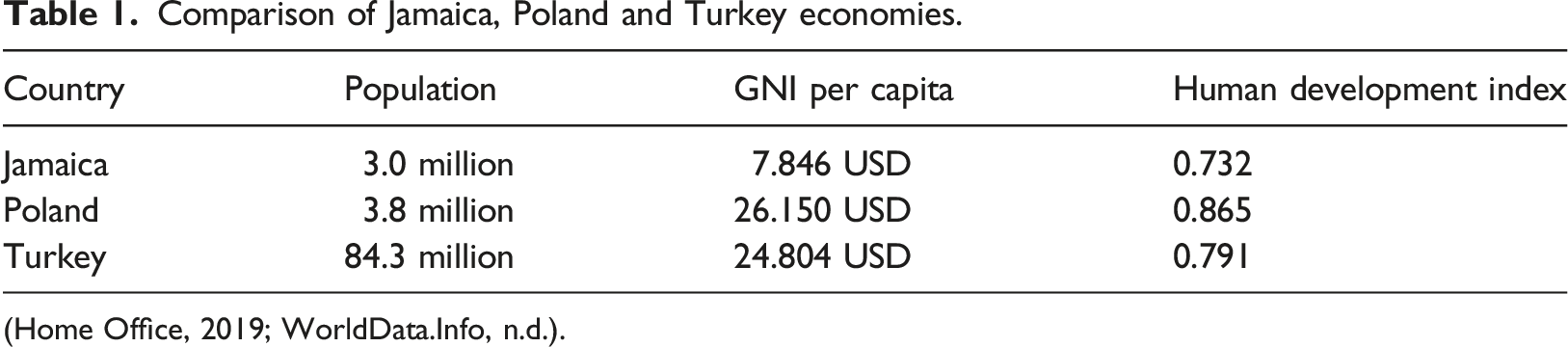
As shown in Table 1, the human development index provided by the United Nations Development Programme [UNDP] (2018) showed that the three countries have a high human development index (HDI). According to UNDP (2018), this index is to capture ‘human progress, combining information on people’s health, education and income in just one number’ (p. iii). It is also used as ‘a comparative tool of excellence, and as a reliable platform for vigorous public debates on national priorities’ (p. iii).
Jamaica
Jamaica is the largest island in the English-speaking Caribbean and the most populated, with 2.93 million people. It is classified as an upper middle income economy, with a GDP per capita of USD 5582 (Home Office, 2019). Teachers may teach in four levels of education: early childhood, primary, secondary and tertiary. At the pre-primary level, teachers teach children below age six, whilst at the primary level, from 6 to 12 years, and it is compulsory and free (Home Office, 2019). At the secondary level, teachers teach from ages 12 to 18. Finally, at the post-secondary level, teaching is offered to students from 16 years (Ministry of Education, 2012). According to the World Bank (2022), the student-teacher ratio at the primary school level for Jamaica is 24.79. Instruction is in English at all levels of education.
All teachers employed to teach in public schools are under the Ministry of Education, Youth and Information. These teachers are expected to possess at least a bachelor’s degree in their teaching area (Task Force on Educational Reform Jamaica Report, 2004). Teachers may be employed to teach either in government-funded or private schools (Home Office, 2019). In the government (public) educational institutions from the early childhood to the secondary. According to the Statistical Institute of Jamaica Website (n.d.), the total number of teachers in the aforementioned levels by 2016 was 23,811 (i.e. early childhood = 1143; primary = 9834; and secondary = 12,834). Of the 23, 811, there were 4942 (20.8%) male and 18,869 (79.2%) female teachers.
Teachers who teach in government-funded schools in Jamaica are paid based on their qualification type and years of service. Hutchinson (2021) gave a breakdown of teachers’ salaries as follows: • For a teacher with a degree, the annual basic pay is US$1,299,336, and the monthly basic pay is US$108,278. • For a teacher with a diploma, the annual basic pay is US$1,003,449, and the monthly basic pay is US$83,620.75. • A trained teacher with a degree earns, after 11 years of service, an annual basic pay of US$1,615,213, whilst the monthly basic pay is US$134,601.08. • A teacher with a diploma, after 11 years of service, is paid US$1,247,396 annually, whilst the monthly basic pay is US$103,949.67.
The Education Act guides the teachers and their educational leaders, also referred to as The Education Regulations (1980). This Act which was amended in 2010 (The Jamaica Gazette Supplement: Proclamations, Rules, and Regulations, 2010), is still under review (Bryan, 2018). The Act provides guidelines for the hiring of teachers, contracts, probationary period, roles and responsibilities, rights and privileges, disciplinary measures and procedures to be observed by the School Boards where teachers are employed in Jamaica (The Education Regulations, 1980). For example, according to the Regulations, the probationary period for teachers is 1 year. However, this is subject to certain conditions, such as if there is a clear vacancy and the teacher’s performance was satisfactory after an appraisal.
The teaching profession is regulated by the Jamaica Teaching Council (JTC), which was established in 2008 to regulate the teaching profession by ‘maintaining and enhancing professional standards, regulating, registering and licensing teaching professionals’ (Ministry of Education, 2015). Hence, all teachers are required to register with the Council.
Apart from the Teaching Council, teachers who are employed in public schools are also required to register with the Jamaica Teachers’ Association (JTA). In contrast, teachers employed at private institutions can request the services of JTA as the major trade union for teachers in Jamaica. The JTA is a body that is responsible for matters related to industrial relations, business services, and professional services.
It is important to note that since the education transformation process began in 2004, a lot has happened in Jamaica to improve the teaching and learning environment for students and teachers in the early childhood, primary, and secondary schools. These include but are not limited to curriculum reform and implementation, accountability through school monitoring, and improving teaching and learning support (Task Force on Educational Reform Jamaica Report, 2004). As it pertains to motivation, studies by Bastick (2000a, 2000b) and Griffin (2010) showed that student teachers and teachers in Jamaica had extrinsic, intrinsic, and altruistic motivations for choosing the teaching profession. The study also showed that extrinsic motivation was the most crucial motive for choosing the profession.
Poland
Poland is a country in Central Europe with an area of 312,696 km2 and over 38 million persons. Poland is the fifth-most populous member state of the European Union. The World Bank classified it as a high-income economy, with a GDP per capita of USD 15,656,18 (World Bank, 2020).
The main legal basis for the school education and higher education systems is provided by the Constitution of the Republic of Poland of 2 April 1997 (Constitution, 1997). Its provisions referring to fundamental freedoms and citizens’ rights state that every person has the right to education, and education is compulsory until 18 (Art. 70). The obligation to continue education until the age of 18 is carried out in school (full-time compulsory education) or non-school settings (part-time compulsory education). Education in public schools and higher education institutions (HEIs) is free. The 1997 Constitution of the Republic of Poland guarantees that public authorities ensure universal and equal access to education and, to this end, provide financial and organizational support to pupils and students. Parents are free to choose schools other than public ones for their children. Citizens and institutions have the right to establish primary, lower secondary, upper secondary and post-secondary schools, and the higher education institutions and childcare centres.
Since the latest reform in 2017, the system of school education comprises pre-school education for children aged 3 to 6/7 years (pre-school education is not yet compulsory), 1-year compulsory pre-primary education for 6-year-old children, 8-years primary school (for children and young people aged 7–15 years), and secondary schools to 4–5 years (for young people aged 15–18 years). In terms of curriculum design, education at primary school is divided into two stages: • Stage I, Grades I–III: integrated early school education, which corresponds to the first 3 years of primary education (ISCED 1); • Stage II, Grades IV–VIII: subject-based education, which covers the fourth year of primary education (ISCED 1) and 4-years lower secondary education (ISCED 2).
In the school year 2019/2020, there were 25,895 schools, including 20,494 public and 5401 non-public schools at all levels of the school education system. In the schools, there were 4,893,386 pupils, including 4,380,404 (89.5%) in public schools at all levels (GUS, 2020; Madalińska-Michalak, 2021). Poland has one of the lowest pupil-to-teacher ratios in the World and the fourth lowest in the European Union, with 10.2 pupils at the primary schools to each teacher in 2017 (World Bank, 2018).
In Poland, teachers are one of the largest professional groups, differentiated by several characteristics such as age, gender, education, length of service as a teacher, place of work, degree of professional promotion, type of employment, position, salary and others. Therefore, teachers constitute about 1.8% of the total population of Poles and 2.7% of the professionally active population (Madalińska-Michalak, 2021). Teachers who work in the public sector of school education are under the Ministry of Education and Science. These teachers are expected to possess at least a bachelor’s degree if they want to teach in pre-school education or primary schools. Teachers who would like to teach at secondary schools must obtain at least a master’s degree in the area they teach. The teaching profession is dominated by teachers with higher education: bachelor’s and master’s degrees (97.5%). In addition, 0.8% of teachers (5500 people) had a PhD degree or the post-doctoral degree of doctor habilitated, 0.9% had post-secondary education, 0.5% secondary and 0.2% other.
In 2019, 621,409 teachers were employed in public schools, of which 509,315 were female (82% of the total). The disproportion between women and men working in the profession is highest at the pre-school level, where women accounted for as much as 98.15% of the total number of teachers employed. The average age of all teachers employed in Polish education in 2019 was 45 years old (Madalińska-Michalak, 2021: 73–74). In 2019, public kindergartens employed 62,294 teachers, which is 10.02% of the total number of teachers in Poland. Nearly half of all Polish teachers, almost 300,000 people, worked in public primary schools, and almost 91,600 (20%) in secondary schools.
The status of teachers is regulated by the provisions of the Act of 26 January 1982 – Karta Nauczyciela (Teachers’ Charter). The provisions of this Act, together with the implementing regulations, the Labour Code, and general criminal or civil law, have a decisive influence on the teacher’s labour relations and their attitudes towards work and the duties they perform. The system for the professional advancement of teachers was introduced by the Act of 18 February 2000 on the amendment of the Act – Teachers’ Charter and the amendment of some other acts. Introduced in the school year 2000/2001, four basic grades of professional promotion: trainee teacher, contract teacher, appointed teacher, certified teacher, are linked both to the basis of employment and to the level of teachers’ remuneration. These basic grades of professional promotions are therefore primarily motivational, both in financial terms (salary increase) and professional development. The title of professor of education has an honorary character and may be awarded to a qualified teacher with at least 20 years of work in the teaching profession, including at least 10 years as a qualified teacher, and has significant and recognised professional achievements.
Teaching is a profession of public trust, and it means that persons who practice teaching have a responsibility to act at all times in a manner that is consistent with the teaching profession’s expectations. The special status of teachers is defined in a Teachers’ Charter. Teachers can be employed as career civil servants or as employees with contractual status. In Poland, the teaching profession is highly regarded in educational law documents. Research reports from the Polish Public Opinion Research Center, CBOS, regarding the prestige of the professions, conducted since the early 1990s, indicate the stability of the high social status perception of the teaching profession (Piwowarski, 2018; CBOS, 2019: 8). These surveys show the teaching profession placed between fifth and seventh in ranking among the other professions in Poland. Concerning respondents’ opinions about the integrity and reliability of 24 professions in Poland, the first position was scientists, the second was nurses, the third was ICT specialists, and the fourth position was teachers (CBOS, 2019). On the other hand, it is possible to observe among teachers a feeling of decline in the social prestige of the teaching profession related primarily to low wages and government policy. The average teacher salary in Poland froze in 2012, and the average teacher salary and the average in the national economy equalized in 2017 (Madalińska-Michalak, 2019; Piwowarski, 2018). Over the past two decades, the minimum teacher earnings were at the national average level (for appointed teachers), above it (for certified teachers) and below it (for the teachers at the beginning of their career: trainee teachers and contract teachers). It is difficult to argue that such salaries would meet the ambitions of one of the best-educated professional groups in Poland (Madalińska-Michalak, 2019).
Teaching is a very popular study choice, and motives for entering teaching as a career are mainly internally motivated. Many Polish teachers perceive their profession as an occupation and a social mission. However, candidates for teaching sometimes seem not well oriented in the reality of teachers’ work and working conditions (Dróżka and Madalińska-Michalak, 2016).
The achievements of Polish school education noted in the first two decades of the 21st century were connected with a series of school reforms that began in the late 1990s. Thanks to the reforms, the education system in Poland has been able to cope with unprecedentedly and increasingly high educational aspirations of citizens in the last two decades. This results in its outstandingly high levels of participation in education at higher levels, that is after the completion of compulsory education, as compared to the highly developed countries. Poland has achieved one of the best results in Europe in terms of participation of young people aged 15–24 in education at the ISCED 1−6 levels (from primary education to doctorate programmes), the number of young people holding upper secondary qualifications, and the reduction in the number of early school leavers, which is one of the measurable objectives of the strategy Europe 2020. Between 2000 and 2011, Poland made the most rapid progress in the EU with regard to increasing the number of young adults holding higher education qualifications in the 30−34 age group. Poland has dramatically reduced the number of poorly performing students and, in the 2009 PISA tests, ranked among the top 15 OECD countries (OECD, 2010).
Turkey
Turkey is classified as an upper middle income economy, with a GDP per capita of USD 8635 (World Bank, 2020). With a population of approximately 85 million, Turkey is among the countries with the highest number of students in terms of its population in Europa. The total number of pre-school to secondary education students is 18 million, which corresponds to about a quarter of the total population (MoNE, 2021). Formal education practices include early childhood, primary, secondary and tertiary education. Although education is compulsory from primary to secondary education in Turkey, pre-school education is not yet compulsory. Compulsory education consists of 12 years, of which 4 years are in primary school, 4 years in secondary school, and 4 years in high school education. Even though early childhood, primary and secondary education is managed by the Ministry of National Education (MoNE), the Council of Higher Education (CoHE) manages tertiary education. Instruction is in Turkish at all levels of education.
In Turkey, education is public and privately funded; however, it is mostly public. The school system is centralized with a lack of school and local autonomy (Schliecher, 2018). Decisions regarding budget, curriculum, hiring and dismissing of teachers at public schools from pre-primary to secondary education are made by the MoNE centrally. In addition to that, textbooks are provided free of charge to students and teachers from pre-primary to upper secondary schools by MoNE all around the country. Following undergraduate education, teachers at the public school are hired by MoNE centrally depending on the written and oral exams on content knowledge, pedagogical knowledge, general ability, and general knowledge. The teaching profession is guaranteed by the basic law of national education. The teacher in the relevant law is defined as ‘the person who is an expert and who performs the duties regarding education and administration assigned by the state’ (MoNE, 1973: 5109). Teachers are employed with contractual status in the first 4 years of teaching, and then, depending on their performance, they work as permanent civil servant officers. Throughout their careers, teachers in Turkey only have teacher candidate and teacher career. The number of total teachers in Turkey is more than one million. The teacher career is mostly preferred by female teachers in Turkey. The proportion of female teachers increased from 54% to 58%. In addition to that, 75% of prospective teachers enrolled in the Faculty of Education are female teachers. A trend of an increasing number of women in the teaching profession in Turkey is visible now. The teaching profession is dominated by teachers with higher education: bachelor’s 90.85%, master’s 9% and 0.15% of teachers have a doctorate in Turkey (Çelik et al., 2019).
The academic year consists of two semesters. Each semester includes one mid-term break, including 5-week days. The first semester, namely the Fall semester, terminated at the end of January. Following the 10-week daybreak, the second semester begins in January and ends in June. During the academic year, teachers work 182 working days. From the beginning of July to August, teachers take a summer vacation. As there is no specific career path for teachers in Turkey, average salary is more or less similar for the teachers at the beginning and at the end of their careers. Teacher salaries in Turkey average 30,740 dollars per year, which is below the average of OECD countries (Yurdakul et al., 2021).
The in-service teacher training curriculum is designed and planned annually by MoNE. Local education authorities located in each city offer seminars, workshops, and other teacher training activities for teachers from public schools. In-service teacher education is voluntary. Previous studies underline that teachers have negative attitudes towards in-service teacher training (Can, 2019; Celen et al., 2016; Karasolak et al., 2013).
Recently, significant steps have been taken in education by MoNE. For instance new school buildings have been added, and reducing the number of students per teacher. Most of the classrooms have been equipped with smart boards at public schools, expenditure on education was increased, and the number of teachers needed in schools was decreased. In addition to that, student-teacher ratios have been decreasing steadily over the past decade. Currently, the number of students per teacher is 13 in primary education and 16 for secondary education (Yurdakul et al., 2021). However, problems related to education and the teaching profession have remained despite the fundamental improvements. In Turkey, teachers’ perception of the teaching profession is underwhelming (Tedmem, 2014). Teachers in Turkey do not have professional autonomy, and teachers’ autonomy is below the OECD countries’ average (OECD, 2018). Teachers experience burnout, lack of motivation, and lack of job satisfaction because of a heavy workload, work pressure, indifference, collegial relations, teaching environment, insufficient salary and lack of administrative support (Ari and Sipal, 2009; Durak and Seferoglu, 2017; Ipek and Kanatlar, 2018; Seferoglu et al., 2014).
Historically and culturally, the teaching profession has been among the most valued professions in society from past to present in Turkey. The meaning and value attributed to the teaching profession still maintain their importance today. Studies conducted on the teaching profession’s prestige revealed that the teaching profession still maintains its prestige.
According to a study conducted by Sunar et al. (2015), all around Turkey, the teaching profession ranks fourth among 126 professions and is among the most prestigious professions. Although the teaching is a profession that is respected by the society, it is observed that the social status of the teaching profession has decreased recently (Aydın et al., 2018; Unsal and Bagceci, 2016; Yurdakul et al., 2016). This is connected with a negative image of the teaching profession in the media, negative political discourse that damages the social status of the teaching profession, continuing professional development and disputable economic conditions of teacher service (relatively low salaries) (Atmaca, 2020; European Commission, 2019). In addition, in Turkey, some other reasons such as entry requirements to the profession, professional training, socio-economic conditions across regions, characteristics of schools (public or private) and teacher qualifications also play a significant role in lowering the social status of the teaching profession (Aydın et al., 2018; Durdukoca, 2018; Mutluer, 2018; Ulutas, 2017).
In conclusion, there are some commonalities and differences among the three countries compared to Jamaica. The main differences are how teachers are highly regarded in Poland and Turkey and other is on the funding of public and private schools in Poland and Turkey. One significant similarity is in the educational policies and acts governing teachers and education.
Review of the literature
Teacher motivation
Contextual and cultural issues are important factors to be considered in cross-cultural comparative research, such as the current study involving developed and developing countries, which may play a role in teacher motivation. Investigating contextual and cultural issues is not new in teacher education studies. It has been studied by scholars such as Chivore (1988) in Zimbabwea et al. (2016) in China, Su et al. (2001) in China and the and Yong (1995) in Brunei Darussalam. It was concluded that teacher motivation in developed countries could differ from that in developing countries. Teachers in developing countries tend to be more extrinsically motivated due to social and economic factors (Han and Hongibiao, 2016).
Motivation is a key driver underpinning human actions and behaviour. It is also the initiator of learning. In the educational context, motivation is essential not only for students to learn (Tella, 2007) but also for teachers to compete with the challenges and meet the requirements of the teaching profession (Madalinska-Michalak, 2016). 1 Teacher motivation has been defined as the ‘willingness, drive or desire to engage in good teaching’ (Michaelowa, 2002: 5) and is considered a critical factor in teachers’ performance and the professionalisation of teaching (Madalinska-Michalak, 2016).
Motivation for choosing to teach as a career is considered an essential premise for motivation, inspiration and enthusiasm in the teaching profession and a lasting and satisfying career (Madalinska-Michalak, 2016). The kind of motivation is an important factor not only in admission to progression in and graduation from a teacher education programme (Blömeke et al., 2012) but also in explaining why teacher education graduates do not enter the profession or drop out after a short period of time (Drozka and Madalinska-Michalak, 2016; Manuel and Hughes, 2006; Rots et al., 2010; Thomson et al., 2012; Watt and Richardson, 2008).
Choosing to teach as a career and remain in the profession
In the literature, teacher motivation is cited in several studies (Bentea and Anghelache, 2012; Fokkens-Bruinsma and Canrinus, 2014; Han et al., 2016; Liu and Onwuegbuzie, 2014; Watt and Richardson, 2012). Some theories of motivation applied to teacher motivation include expectancy-value theory, achievement theory, and self-determination theory. Hence, there is an abundance of the application of motivational theories to teachers and teaching. Nonetheless, other ways theories of motivation have also been applied to teachers and teacher education. For instance, in a study conducted by Dornyei and Ushioda (2011), two dimensions of teacher education were highlighted. These are the motivation to teach and stay in the profession.
There are several studies on reasons for joining the teaching profession. These include studies by Balyer and Özcan (2014) in Turkey; Bastick (2000a, 2000b) in Jamaica; Bergmark et al. (2018) in Sweden; Davis and Hughes (2018) in Wales, du Preez (2018) in South Africa, Krečič and Grmek (2005) in Slovenia, and Yüce et al. (2013). Several of these studies revealed intrinsic, extrinsic, and altruistic reasons.
For this reason, in this study, we relied on the cognitive evaluation theory of motivation for the theoretical framework. In this theory, there are two motivation systems: intrinsic and extrinsic motivators (Deci and Ryan, 1985). In the study by Curtis (2012), passion for teaching a subject was one of the intrinsic reasons many teachers decide to remain. Concerning extrinsic motives such as job security, high income, career position, and respect (Heinz, 2015; Zumwalt and Craig, 2008) were used to understand and explain why teachers choose and remain in the teaching profession. Another extrinsic reason is getting long holidays which was reported by Papanastasiou and Papanastasiou (1998) in a study done in Cyprus. In another study by Lingham (2010), the results revealed that student teachers in New Zealand stated the following reasons for joining the profession: working with children, peer or teacher influence, finding it satisfying, having the opportunities to travel and work abroad, and job security. Similarly, Richardson and Watt (2006) found that in North America, the reasons for joining the profession were social mobility, influencing others, working with young students, job security, and other benefits such as pensions and vacations. However, some other studies pointed to altruistic motivation (worth or value of teaching others), which has been reported as one of the key reasons persons have chosen the teaching profession and remained (Chiong et. al., 2017; Pop and Turner, 2009; Richardson and Watt, 2006; Struyven et al., 2013), as well as job commitment (Chang, 2006; Sinclair and Woodward, 2007; Yong, 1999). According to Chang (2006), committed teachers stay in the profession. Although Bakar et al. (2014) found intrinsic, extrinsic and altruistic motivation, among student teachers, the dominant factor was altruistic motivation. This was also the case in the by doe by Balyer and Özcan (2014), which found altruistic-intrinsic reasons as mostly the reason for choosing to teach as a profession.
Perceptions of the teachers and the teaching profession
Lawal (2012) described the teaching profession as ‘one of the oldest activities or professions….’ (p. 119). This profession, however, has attracted many different views from the general public. These divergent views have been documented by authors such as Adeyemi (2001) and Achimugu (2005) in Nigeria, who stated that years ago, teachers were highly regarded in the society. However more recently, that view has changed when compared to other professions such as law, engineering, and medicine. This view was also expressed by Fauziah et al. (2021) who stated that teachers were seen as ‘disadvantaged population who cannot fully take part in the social and economic activities due to the fact that their salary is very low compared other public servants’ (p. 545). Lawal (2012) stated that these views changed over the years across different countries. In a study conducted in Nigeria by Lawal (2012), the findings showed that teachers had a higher perception compared to their parents. Students also had a higher perception of the profession when compared to the parents. Furthermore, teachers had higher perceptions than the students.
Career stage model
There is extensive literature on models of teacher development from the student-teacher training phase to becoming a professional teacher (Cain, 1994; Caruoso, 1977; Fessler and Christensen, 1992; Field, 1979; Fessler, 1985; Greogorc, 1973; Huberman, 1989; Katz, 1972; Steffy et al., 2001; Steffy and Wolfe, 2001; Unruh and Turner, 1970). Several of these models were reviewed; however, the Huberman’s (1989) schematic model was used in this study. According to Huberman (1995), this model explains teachers’ progression through their careers. This progression was described by Huberman (1995) as ‘plateaus, discontinuities, regression, spurts, and dead-ends’ (p. 196). These are the reasons why this model was used in this study. Firstly, it was used because it focused specifically on the professional work of teachers. Secondly, it was used to examine why teachers in the different career stages remain in teaching. Huberman’s schematic model has five stages: career entry, stabilisation, diversification/stocktaking, serenity/conservatism and disengagement.
The career entry stage is within the first 3 years. At this stage, the teachers are still discovering themselves by learning how to teach and manage students (Huberman, 1989). Stabilisation is the second phase which is between 4 and 6 years of teaching. At this phase, teachers are said to commit to teaching as a career (Huberman, 1989). The third phase, which occurs during years 7 and 18, is called diversification/stocktaking because of the parallel pathway between the two. It means that teachers diversify and take stock of their teaching accomplishments whilst exploring their options for a career change. Furthermore, during this phase, teachers have some control over their work; they may experiment with teaching and assessment strategies (Huberman, 1989). The next stage is referred to as serenity/conservatism, which occurs during the years of 19 and 30. It also has a parallel pathway since teachers are usually older and more resistant to innovation, and are said to have a considerable amount of control of their teaching. The last stage is referred to as disengagement. Teachers are between years 31 and 40 of their teaching career (Huberman, 1989). They may not be fully committed to the teaching profession. It was felt that to compare the reasons why teachers in Jamaica, Poland and Turkey remain in the profession, the different stages of the Huberman (1989) model should be used to ascertain the extent of the differences and similarities.
Methodology
Design
An explanatory sequential mixed methods design was used to conduct this comparative, mixed methods international and cross-cultural study comparative study. This design also called a two-phase model (Creswell and Plano Clark, 2017) because the quantitative data is collected first before the qualitative data, which is then used to explain the quantitative results. Due to the design used, more weighting was given to the quantitative data (Creswell and Guetterman, 2018).
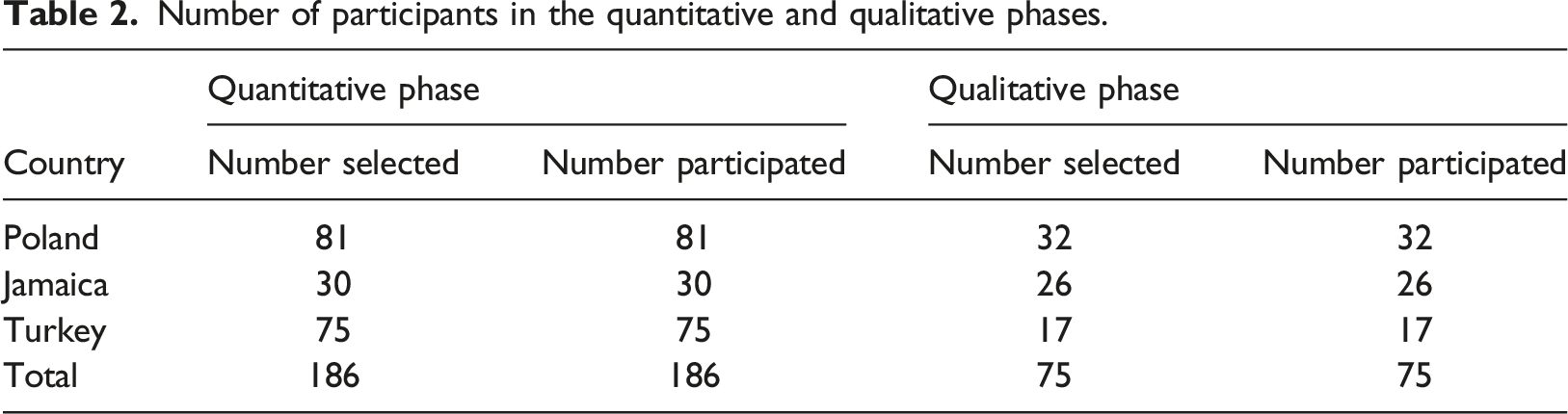
Sites and selection of participants
Number of participants in the quantitative and qualitative phases.
Data collection
Two data collection methods were used, namely, questionnaires and focus group interviews. The questionnaire is described first.
Questionnaire
The questionnaire was first designed in English after reviewing the literature on becoming a teacher and motivation. The three researchers contributed items (section A and section B, items 21–29) based on the review of the existing literature on the topic. However, the Likert-type items (section B items 1–20) were created based on the work of Cruickshank et al. (2006), see items 1–12, and Alexander et al. (1994), items 13–20. The Likert-type items had a four-point response format, ranging from strongly disagree with a value of ‘1’, to strongly agree with a value of ‘4’. The third section contained two open-ended items.
The questionnaire was administered in two ways, namely online (Google Forms) and in-person methods. The online method had the necessary security features to ensure the security of the questionnaire and the responses from each participant. Those who used the online method were provided with an option to consent or not to consent to participate. Those who used the hard copy were given a consent form to sign before data were collected. The hard copy of the questionnaire was used to accommodate some of the Jamaican teachers’ preferences and limited access to the internet. However, this was not the case in Poland and Turkey, where only the online questionnaire was administered. Leedy and Ormrod (2019) stated that both approaches had several advantages, including being more cost-effective. Furthermore, Fowler (2002) recommended using mixed modularity to reduce the non-response rate (in his book “Survey research methods” (2002).
Reliability and validity
Reliability coefficients for the participating country.

As shown in Table 3, the reliability coefficient for Jamaica was higher when compared to Poland and Turkey. In the psychometric literature, factors that could affect reliability may include cultural, motivational and environmental factors (the nature of the scale, the group responding, and the environment (Ursachi et al., 2015). In this study, the researchers were unable to determine which factors impacted the reliability coefficients of teachers in Poland and Turkey.
Validation
Since the researchers developed the questionnaire, it was essential to go through the validation process, which included using experts (teacher educators for face validity and a psychometrician on item construction for content validity, and pilot testing, which is described later in this section. The back-translation method of validation was not used. The expert opinion technique is recommended by Ozolins et al. (2020). The experts reviewed the questionnaire items and provided comments on item clarity. Each researcher also documented the changes made due to the multilingual nature of the three different populations used in the study. These were done before the questionnaire was translated from English to Polish and Turkish main languages. This was necessary to ensure that the questionnaire measured what it was intended to measure (Cook and Beckman, 2006). To establish validity in the qualitative phase, the researchers agreed on the interview codes and themes during the analysis stage, and validation checks were done by the participants (Fereday and Muir-Cochrane, 2006).
Pilot testing
The researchers piloted their version of the questionnaires in the three countries. However, due to the small number of volunteers used, the reliability coefficient could not be computed. However, suggestions made were used to change some terminologies used in section A for better understanding across the three countries. Three items in section B that were double-barrel, were changed to single items.
Focus groups
The focus group schedule was developed after the quantitative analyses were done based on the type of sequential explanatory mixed methods design used. For this phase of the research, the participants at the career entry and stabilisation stages of the Huberman’s model were purposefully selected for the focus group interviews. These interviews were conducted at several locations acceptable to both the interviewer and the interviewees. To ensure that each researcher collected comparable data, the researchers agreed on the issues addressed during the focus group interviews. The purpose of the qualitative phase of the study was clarified.
Data analyses
The questionnaire data were imported from the Excel sheet, which was generated from the Google platform used and was imported into the SPSS programme (version 21). Those collected as hard copies were coded and entered into the SPSS and analysed using descriptive statistics (cross-tabulation, mean and standard deviation) and factor analysis, which was computed at the 0.05 level of significance.
The focus group interviews were transcribed and coded by each researcher. The three-cycle coding method by Saldana (2009) was used. In the first cycle, initial (open) coding was done by using ‘the direct language of the participants as codes rather than researcher-generated words and phrases’ (Saldana, 2009: 48). This involved identifying the emerging categories (Theron, 2015; Saldana, 2013). In the second cycle, focused coding was done. This involved identifying the most frequent or significant categories, main and subcategories to understand the relationships among them. In the last cycle, the main emerging themes were used to compare the participants from the three countries, thereby looking for differences and similarities among the teachers’ responses and then writing the narratives.
Ethical issues
Each researcher obtained ethical clearance from their research ethics committee (REC) before collecting data. As indicated earlier, two methods of informed consent were used (an e-informed consent form and a hard copy format). All participants received a letter that explained the purpose of the study, confidentiality, privacy, the right to withdraw from the study, the role of the participants and the reason for the informed consent form. Both consent methods required the participants to first consent before being allowed to participate. The use of the informed consent form was a requirement in obtaining the ethical clearance from their research ethics committee. In addition to that, to achieve confidentiality, the participants’ actual names and some demographic information were excluded during the presentation of the qualitative findings. Instead, participants’ country names, gender and career stage of participants were specified at the end of the quotes.
Results and discussion
In this section, the results and discussions are presented according to the mixed methods design used in the study. The participants’ characteristics for the quantitative and qualitative phases are presented first. This is followed by the results and discussions from the quantitative phase; then, the qualitative phase is presented.
Research sample characteristics
Quantitative phase
To understand the demographic profiles of the teachers who participated in phase one from the three countries, data were collected using the questionnaire on the following variables: gender, age range, work experience, qualification, level of teaching and school classification.
Gender and age range
Gender and age range of teachers by country in the quantitative phase.
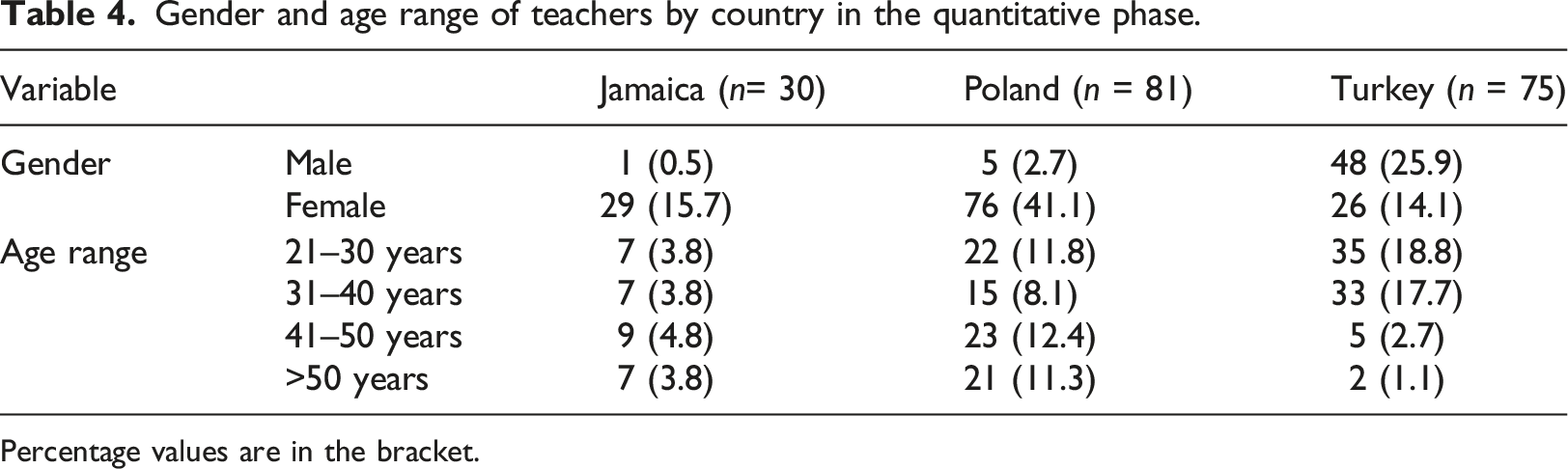
Percentage values are in the bracket.
Teaching experience
Years of teaching experience of teachers by country in the quantitative phase.
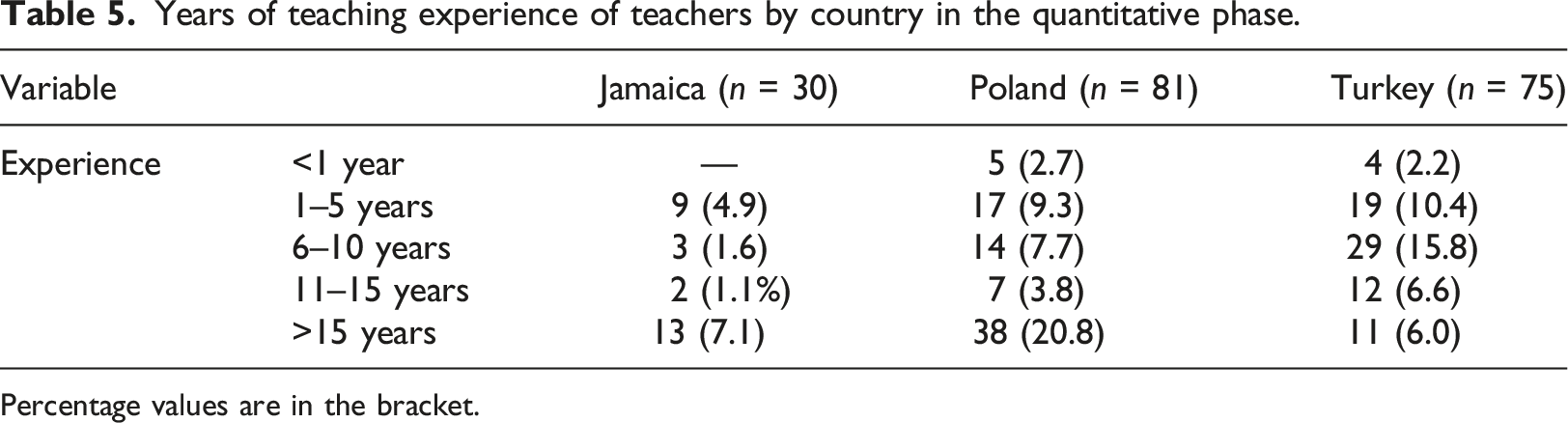
Percentage values are in the bracket.
Qualification and school type
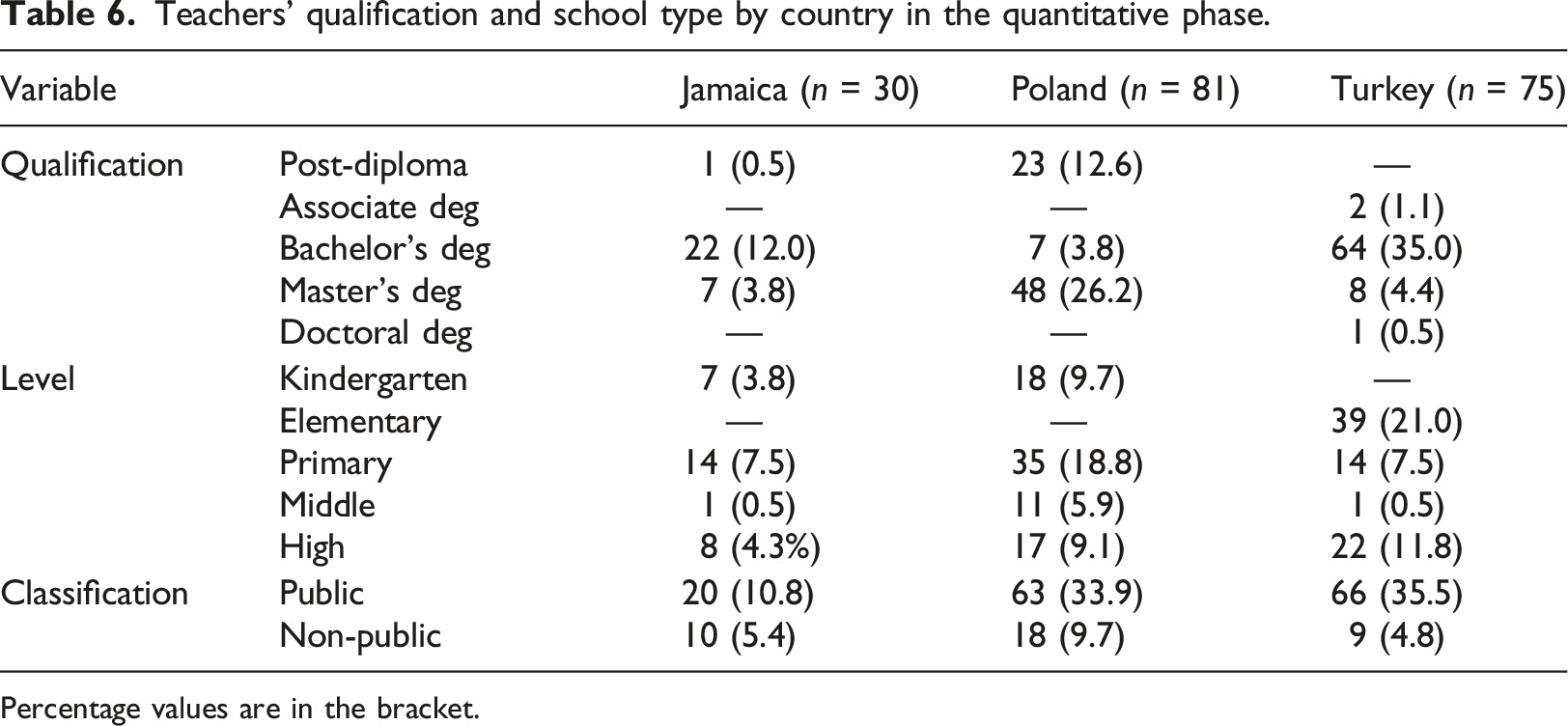
Teachers’ qualification and school type by country in the quantitative phase.
Percentage values are in the bracket.
One hundred and two (54.8%) of the teachers taught at the elementary or primary school level, whilst 146 (79.8%) taught at public schools and 37 (20.2%) were employed at non-public schools.
Qualitative phase
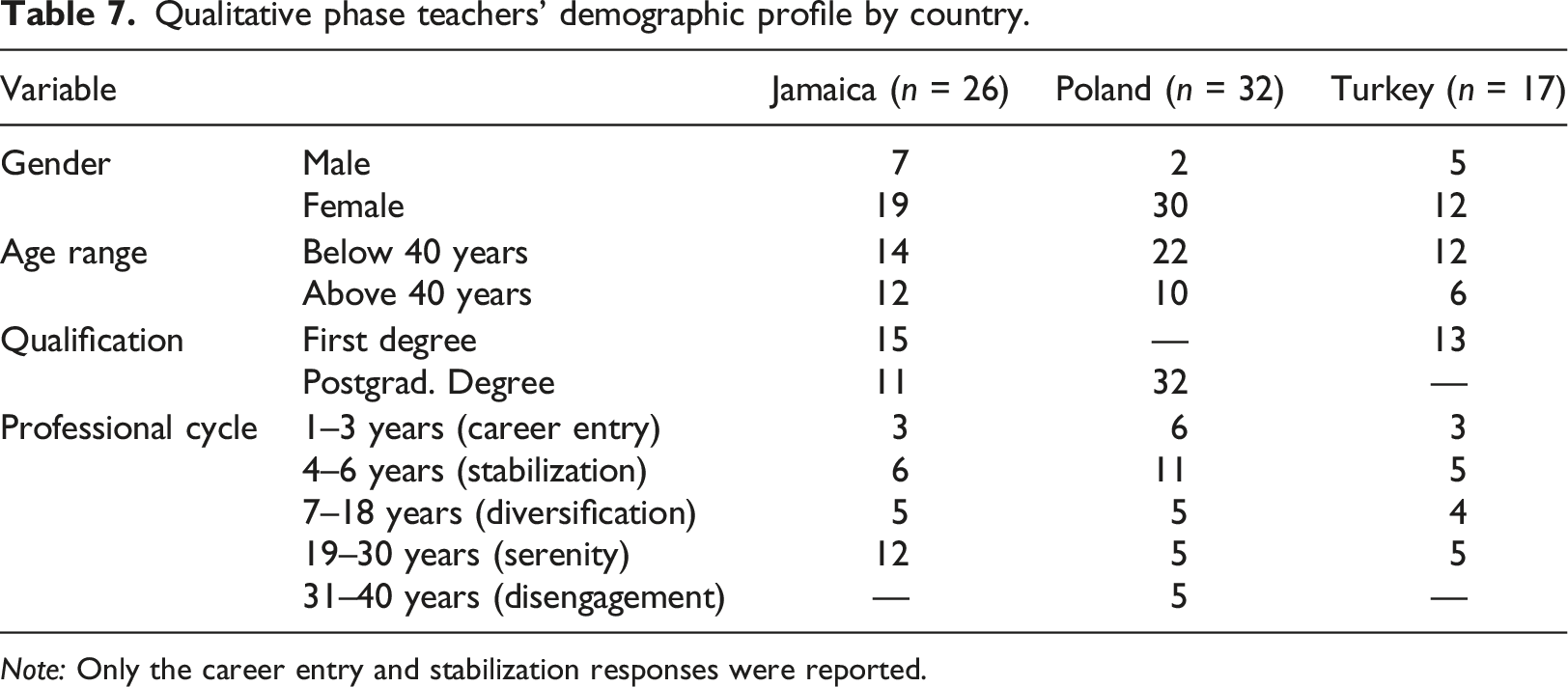
Qualitative phase teachers’ demographic profile by country.
Note: Only the career entry and stabilization responses were reported.
As shown in Table 7, 14 male and 61 female teachers participated in the focus group interviews across the three countries. Thirty-four of the 75 teachers were between 21 and 30 years, and a majority (39) had a Master’s degree. In terms of their career based on the Huberman’s schematic model, 12 teachers were at the entry stage, 22 were at the stabilization stage, whilst another 22 were at the serenity/conservatism stage.
Factors responsible for choosing teaching as a career
Research Question One: What factors are responsible for choosing teaching as a career?
Quantitative and qualitative data were collected, and the findings are presented below, beginning with the quantitative phase.
Quantitative phase
To determine the factors responsible for choosing teaching as a career, data were collected through the use of the 28 Likert-type items with four options in the questionnaire and analysed by using descriptive statistics and exploratory factor analysis. To determine the level of agreement for these 28 Likert-type items, the items were recoded into dichotomous variables. The results of the descriptive statistics are reported first.
The responses to eight items indicated a high percentage of agreement by the teachers from the three countries (see Supplement Appendix B). These eight items are seen as the main motives for choosing the teaching profession. These include (a) I would like others to enjoy the subject(s) I teach (97.8%), (b) I want to help others succeed (95.1%), (c) I like being around students/pupils (94.6%), (d) I enjoy working with children/students (94.1%), (e) I can exercise individuality and creativity (93.5%), (f) I enjoy being a lifelong learner (93.0%), (g) I enjoy the subject(s) I teach (92.4%) and (h) I have found the act of teaching pleasurable (91.9%). These reasons are somehow similar to the findings by Lingham (2010), who examined the student teachers’ reasons for choosing the teaching profession in New Zealand.
Besides the descriptive analysis, factors analysis was conducted to determine the underlying factors and their relationships. The Kaiser-Meyer-Olkin (KMO) measure of sampling adequacy was first calculated. It was 0.83, which indicating that the data used was suitable for factor analysis as the value was greater than 0.50 (Stern, 2010). The eigenvalue of 1 as the cut-off point and based on the scree-plot was examined. The factor analysis revealed five factors that accounted for 55.1% of the total variance among the 186 responses across the three countries for choosing teaching as a career.
Factors accounting for choosing teaching as a career.
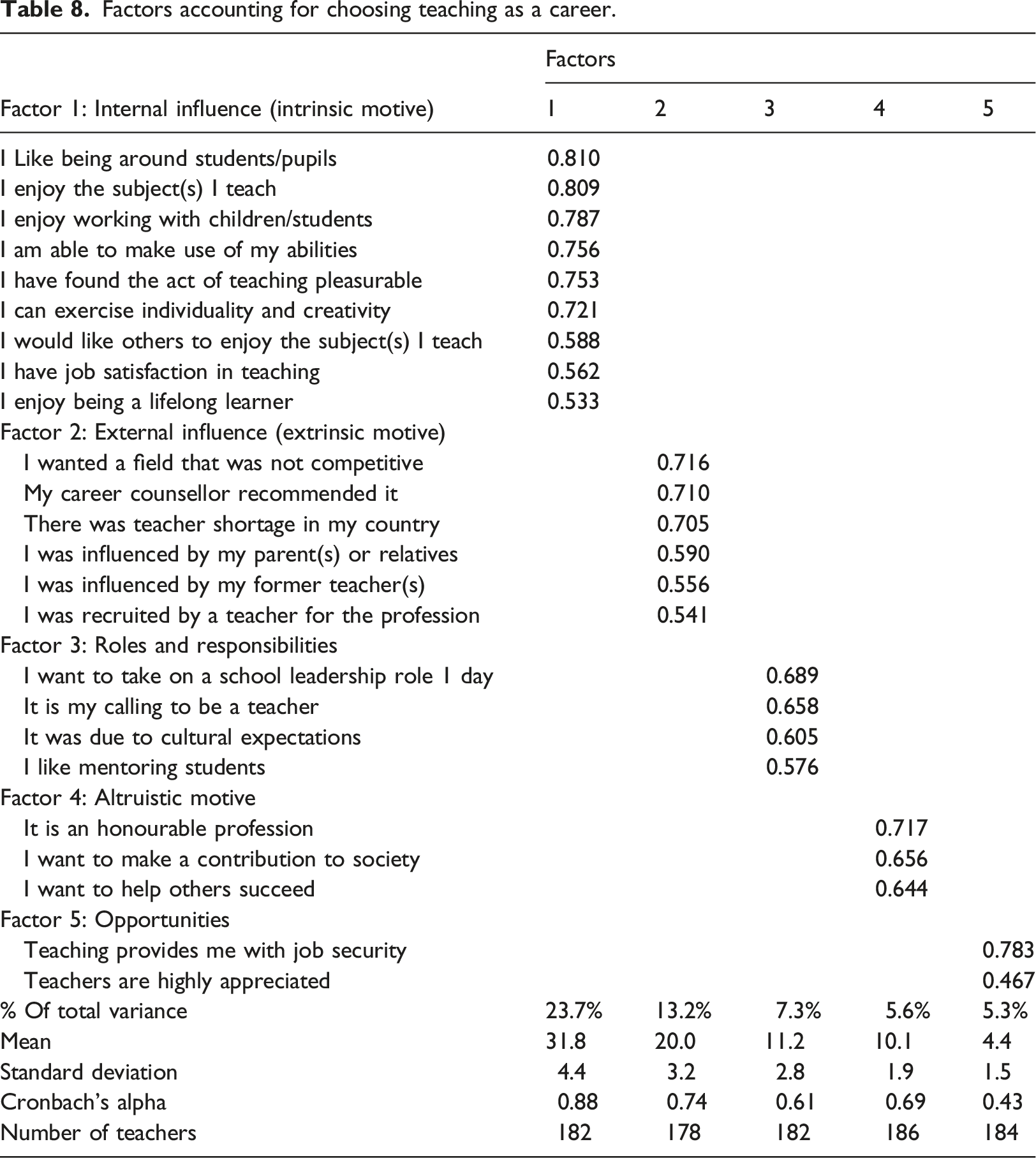
As shown in Table 8, the most dominant factor influencing the teachers in the three countries to choose teaching as a career was factor one (M = 31.8, SD = 4.4). This is followed by factor two (M = 20.0, SD = 3.2). Both are related to both intrinsic and extrinsic motivation, respectively. The findings were consistent with the results of the studies involving student teachers (Bakar et al., 2014; Balyer and Özcan, 2014; Bastick, 2000a, 2000b; Bergmark et al., 2018; Davis and Hughes, 2018; Du Preez, 2018; Yüce et al., 2013). Among other things, extrinsic, intrinsic and altruistic motivation as well as self-actualization were the main reasons for choosing the profession.
The results of the analysis of variance of the five factors showed that there were significant differences at 0.05 levels for four of the five factors with respect to the participants’ country. For factor one (F (2179) = 7.59, p = 0.001; factor three (F (2179) = 21.81, p = 0.001; factor four (F (2183) = 22.87, p = 0.001 and factor five (F (2181) = 15.59, p = 0.001. There was no significant difference for factor two (F (2175) = 1.18, p = 0.310. No study was found to support this finding.
Qualitative phase
Themes for choosing teaching as a career in the three countries.
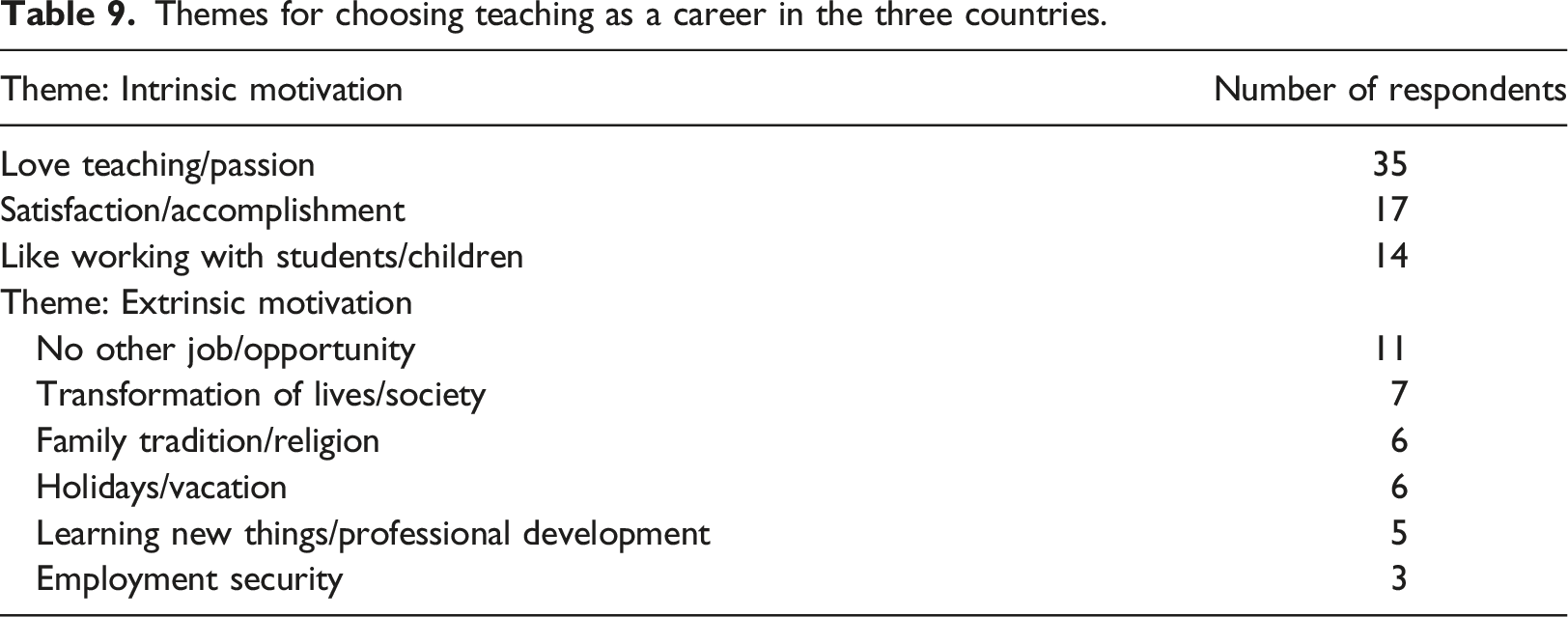
A total of 75 teachers participated in the focus groups across the three countries. The themes presented in Table 9 were merged based on the similarities of the teachers’ responses and were considered noteworthy to the study. The two overarching themes are described below.
Intrinsic motivation
Regarding the sub-theme of Love Teaching/Passion, one teacher in Jamaica stated that ‘I love my job’. A teacher in Poland stated that ‘Teaching is my passion; it makes me happy and gives me joy’, whilst another teacher stated that ‘I always dream about being a teacher’. A teacher from Turkey said ‘I like teaching’.
Regarding the sub-theme of Satisfaction/Accomplishment, a teacher in Jamaica stated that ‘Teaching gives me a lot of satisfaction’; a teacher from Poland said “I have great satisfaction when I see the educational results of my students and how happy and thankful their parents are;” while a teacher from Turkey stated that “teaching gives me happiness.”
For the sub-theme Like Working with Students/Children, a teacher in Jamaica stated that “I like teaching students and impacting their lives; a teacher from Poland stated that, my students make me smile even when I have a worse day”; and another stated “I love to work with the youngster,” whilst in Turkey, a teacher said, “I like teaching my students and being a role model.”
Extrinsic motivation
Regarding the sub-theme of No other job/Opportunity, one teacher in Jamaica stated that ‘I could not get another job’. In contract, a teacher in Turkey stated, ‘If I had the opportunity, I would leave at the first opportunity’. For the second sub-theme of Transformation of lives/society, a teacher in Jamaica stated that ‘I teach students and influence their lives as they grow and develop’. In Poland, a teacher said, ‘It is an opportunity to support youngsters to enter the adult’s life’. In contrast, a teacher in Turkey stated, ‘To raise good citizens’, and another Turkish teacher stated, ‘I contribute to the development of my nation’.
Regarding the sub-theme of Family Tradition/Religion, a Jamaican teacher ‘It is my family tradition’, and in Turkey, a teacher stated, ‘I went into teaching because of my religion’. On the sub-theme Holidays/Vacation, a Jamaican teacher stated that ‘teaching allows me to have long holiday/vacation and the time to be with my family’. A similar view was expressed in Poland, where a teacher stated, “I have holidays;” and another said “It enables me the opportunity to work part-time and do other things that interest me,” whilst in Turkey a teacher said “I joined teaching because I have holidays.”
Regarding the sub-theme of Learning New Things/Professional Development, a teacher in Jamaica said, ‘It enables me the opportunity to learn new things”; in Poland, a teacher stated, ‘I can learn and develop’, and another Polish teacher said, ‘It is an opportunity for personal development’. On the sub-theme of Employment Security, a Jamaican teacher said, ‘I went into teaching for employment purposes‘; a Polish teacher stated that ‘It gives me employment security’, whilst a Turkish teacher stated, ‘I teach for economic reasons’.
These themes from the qualitative phase were consistent with the findings from the quantitative phase and supported by other studies (Akar, 2012; Bakar et al., 2014; Balyer and Özcan, 2014; Bastick, 2000a, 2000b; Bergmark et al., 2018; Davis and Hughes, 2018; Du Preez, 2018; Krečič and Grmek, 2005; Keow, 2006; Yüce et al., 2013).
Motivates for remaining in the profession
Research Question Two: What motivates teachers in their different career stages to remain in the profession?
To answer this question, quantitative and qualitative data were collected, and the findings are presented below, beginning with the quantitative phase.
Quantitative phase
Percentage of teachers who had a career outside the teaching profession.

As shown in Table 10, 53 (28.5%) of the teachers across the three countries were in other jobs before teaching. The follow-up question on their original career showed the common fields among the teachers from the three countries. These included careers in translation, business, human resources, computing and administration. This finding also showed that a majority of the teachers began their careers as teachers. According to Powers (2002), a career change may be due to a person’s desire to become a teacher but due to life circumstances, such dreams may not be fulfilled when they may have wanted it.
Furthermore, concerning their views on remaining in the teaching profession. Seventy-two (38.7%) of the teachers from Poland, 29 (15.6%) from Jamaica and 66 (35.5%) from Turkey said ‘yes’. This indicated that a majority (89.8%) would like to continue teaching. In a study done by Gomba (2015) in rural Zimbabwe, the findings showed that teachers remained in the profession ‘to support their families, job security, unmarketable, support from colleagues and administration, and self-sacrifice leadership by principals’ (p. 55). However, a few of the teachers said ‘no’. Boyd et al. (2009) concluded that teachers leave the profession due to several factors. However, those who leave tend to be less effective (Boyd et al., 2009; Goldhaber et al., 2007; Hanushek et al., 2005).
Qualitative phase
Furthermore, to understand more what motivates teachers to remain in teaching, focus groups were conducted with teachers at different career stages based on the Huberman’s (1989) schematic model: career entry, stabilisation, diversification/stocktaking, serenity/conservatism and disengagement. The analysis of the focus group data showed that the teachers reported different reasons for choosing teaching as a career. In this section, the responses provided by the teachers in the three countries at the career entry and stabilization stages are presented. Furthermore, illustrative quotations were used to present the responses of the teachers.
The responses from the focus group interviews revealed some common themes among the teachers from the three countries, namely, a strong sense of vocation, a passion for the teaching, a need to make a positive difference in students’ life, job satisfaction and connected with it rewards of being a teacher. These motives for staying in the profession were similar to the reasons for entering the profession found in phase one of the study. The teachers’ responses given during the focus group interviews taken together define an idealistic group of people who share these significant qualities.
Although the teachers in Jamaica, Poland and Turkey may be rated low, the financial attractiveness of their profession do not discourage them from the profession. Across the three countries, the results showed teachers have a strong sense of the profession, a passion for teaching, and a need to make a difference in the life of their students, which are the assets that money cannot buy. Characterizing their profession and its meaning for themselves, teachers use non-economic categories, pointing to its high social usefulness and job satisfaction. A sample of the teachers’ voices from the focus are quoted below.
I am very enthusiastic about my job. I see how many things I can do for the others. It is my calling (Polish teacher, female, career entry stage). The teaching profession is very significant, and no one doubts this. However, we see high expectations, but the salary is rather low (Polish teacher, female, stabilisation stage). I am passionate about teaching. My parents were teachers, and I always wanted to be a teacher. The joy of teaching and mentoring students is what makes me happy. (Jamaican teacher, female, career entry stage). Teaching is a low paying job, but it is rewarding when you make a difference in the lives of the students you teach When you are in other professions you are going to have a monotonous life, you are going to do the same thing everyday, but we are constantly changing here; for example, I am a class teacher, every day I teach something different (Turkish teacher, female, career entry stage).
Another theme that emerged from the study showed that teachers remain in the job is their commitment to students and their learning. For example the teachers from Jamaica expressed this reason in the following ways. As a teacher, I care a lot about my students. I am committed to helping them learn; that is why they are at school (Jamaican teachers, female, career entry Stage). I go beyond my call of duty to ensure that my students are doing their best in school (Jamaican teacher, male, stabilisation stage).
In a similar way, teachers from Poland and Turkey described their stories and motivations. There were no differences in teachers’ experiences in teaching. I am very happy to be teaching. I am delighted to teach a person. When students learn, I get even more motivated. So, I enjoy the teaching profession (Turkish teacher, male, career entry stage). As long as I get to know the children, I teach them something, I have affection for them, I love this profession very much, and I teach with great pleasure (Turkish teacher, male, stabilization stage). Some of my colleagues have decided to find a job outside the school, even if they have the right qualifications for teaching. I understand their choice, but for me, teaching and working for young people has always been a priority and my value (Polish teacher, female, career entry stage). Well, once I asked myself if the school is the right place for me for the next 20 years. The answer was simple: yes. The children need my support, my commitment – as long as I am able, I will work for them and their growth. Even the conditions for teaching are not appealing (Polish teacher, female, stabilization stage).
One of the observations of the study is that teachers mentioned the factors that help or hinder their motivation to remain in the teaching profession. Among them are the family histories, the culture of the school, the school leadership, the students, the effects of the government’s policies and reforms, the relationships with students, parents, colleagues from work, and the wider community, and the teachers’ knowledge, skills, and competencies. The study participants indicated that in the era of knowledge expansion, globalisation, high technology and rapid social transformation, the role of teachers has changed, and the aim of teaching is now more focused on helping learners become independent learners who are reflective skilled and critical thinkers. Expectations directed towards teachers are getting higher and higher. On the other hand, the growing teacher’s workload and work stress influence their lives inside and outside the workplace. At the beginning of their career, teachers mentioned that even though they enjoy their work and its challenges, they are not prepared for such high demands and working conditions. The conditions are not satisfactory, and they can lead to a situation in which lots of young talented teachers will leave their profession. One of the Polish teachers stressed that in Poland, since the school year 2016/17, when the new reforms of education were introduced, we can observe a new trend. Lots of well-qualified young teachers seek to find jobs, not at schools. They are brave enough to work in different public and non-public sectors.
Conclusion
The purpose of this comparative (explanatory) mixed methods study was to determine the factors that motivated teachers in Jamaica, Poland and Turkey to choose teaching as a career, and explore the motivation of the teachers in the different stages of their profession to remain in teaching. The quantitative phase of the study showed that the dominant factors that influenced the teachers in the three countries to choose teaching as a career were internal influence (intrinsic motive), external influence (extrinsic motive), roles and responsibilities, and altruistic motive and opportunities. In the qualitative phase, Huberman’s schematic model was used to hear the voices of the teachers in two different stages of their careers and the reasons they remained in the profession. The findings showed that the teachers stay in the profession due to their strong sense of vocation, passion for teaching, need to make a positive difference in students’ lives, job satisfaction and the rewards of being a teacher.
Even though the teachers in Jamaica, Poland and Turkey are from different geographical contexts and represent a mix of developed and developing countries located on different continents, their strong sense of profession, need for appreciation, autonomy and affiliation. Together with recognition and a sense of belonging to a cadre of like-minded people motivate them to enter the teaching profession and make a difference in the life of their students by remaining in the profession. The study findings show that no matter what the context of education is, teachers in Jamaica, Poland and Turkey remain committed due to their passion for the profession, despite the fact that they are burdened with excessive expectations from the society and rather unfavourable working conditions they experience during the different stages of their career.
Limitations of the study and recommendations
The limitation of this study is worth noting. Due to the small sample size used, the numbers of teachers in the three countries were not adequately represented in the two phases of the study. Therefore, the findings cannot be generalized to all teachers in Jamaica, Poland and Turkey.
Despite this limitation, this study will contribute to new knowledge to the understanding of the reasons teachers join and stay in the profession from international and continental perspectives. Future studies could examine these factors with a more representative sample size from a comparative angle.
Implications for policy and practice
The results of this study are important for both policy and practice. The results show that teachers choose to teach primarily due to internal and external reasons. Therefore, this has implications for policymakers in the ministry of education and the employers of the teachers in the three countries, who should continue to improve practices that would recognise and support the teachers who choose to teach to ensure that they remain. The result also showed that a majority joined teaching as a second career. This has implications for a policy at the national level for persons who may join teaching as a second career to ensure quality teaching and career commitment among this group.
The presented study also directs our attention to teacher education, teacher development, and the proper support for teachers as they move through the various stages of their careers. The responsibility of teacher education and teachers themselves from the beginning of their career is connected with developing teachers’ personal/professional mission – being a teacher means that teachers must develop a critical perspective of their role as a teacher within society (Madalinska-Michalak, 2018; Michalak, 2007).
Supplemental Material
Supplemental Material – Teachers’ motivation to choose teaching and remain in the profession: A comparative mixed methods study in Jamaica, Poland and Turkey
Supplemental Material for Teachers’ motivation to choose teaching and remain in the profession: A comparative mixed methods study in Jamaica, Poland, and Turkey by Cynthia Onyefulu, Joanna Madalinska-Michalak and Bunyamin Bavli in Power and Education
Footnotes
Declaration of Conflicting Interests
The author(s) declared no potential conflicts of interest with respect to the research, authorship, and/or publication of this article.
Funding
The author(s) received no financial support for the research, authorship, and/or publication of this article.

Supplemental Material
Supplemental material for this article is available online.
Note
References
Supplementary Material
Please find the following supplemental material available below.
For Open Access articles published under a Creative Commons License, all supplemental material carries the same license as the article it is associated with.
For non-Open Access articles published, all supplemental material carries a non-exclusive license, and permission requests for re-use of supplemental material or any part of supplemental material shall be sent directly to the copyright owner as specified in the copyright notice associated with the article.
