




Abstract
Interpretive frameworks may be helpful to understand narratives, yet they also risk displacing unique information of the research context. In this paper, we argue that such is the case in narrative inquiry studies of English language teaching set in the Asian context, perhaps due to the pressure to use familiar interpretive frameworks that are sanctioned by scholars. Through meta-ethnography, we examined recent narrative inquiry studies set in Asia. It was observed that the research findings do not offer any critical insights about the context of the study; instead, they add to the prevalence of broad constructs of English language education, such as the components of identity. For future narrative inquiry research, we recommend researchers to consider utilizing local meanings pertinent to the study context as an analytical lens, as a means to Asianize the field.
Introduction
The representation of Asia in qualitative studies—be it the people or context—has been critiqued for the tendency of conveniently viewing it as a monolithic cultural group or locality constructed from essentialist attributes (e.g., Chang and Holt, 2010; Miike, 2006; You, 2019). The telling of narratives is also in itself challenging, not only because narratives are told by researchers who do not belong to the narrative context, but these narratives have been shaped to fit into story-telling structures sanctioned by “imperial scholarship” (Iftikar and Museus, 2018). Recognizing this concern, some qualitative scholars have taken concerted efforts to Asianize the field, such as that seen in critical tourism studies (Oakes, 2021). According to Chang (2019), “Asianizing the field” is a call to support ethnically Asian researchers to engage critically with research, for the purpose of deconstructing the field and offering insider perspectives. For English language teaching in Asia, how this call is answered remains elusive and minimally discussed (see Valdez, 2020). This paper, then, considers the prospect of interpreting narratives through meaningful concepts from the sociocultural contexts of the research site.
Narrative inquiry in English language teaching research
More than three decades ago, there was a resurgence of narrative inquiry as a tool to represent participants’ voices and stories, especially of those who had experienced marginalization. This resurgence may be referred to as the “narrative turn” (Atkinson, 1997; Rouse, 1990). In the study of English language teaching in Asia, the resurgence may be seen through numerous narrative inquiry studies on the lives and development of English teachers, students, classrooms, schools, and even materials. Kumaravadivelu (2013) states that “narrative inquiry has been found to help teachers develop their pedagogic concepts. Such an inquiry enhances teachers’ vision, and empowers their voice […] to share locally-generated narrative stories of ‘best practices’ among more global communities of practitioners” (318). In applied linguistics, narrative inquiry has emerged as a viable tool to support ‘the activity of storytelling’ (Benson, 2014; see also Norton and Early, 2011; Pavlenko, 2007). This points towards the unique experiences that teachers have, but it also allows them to interact and confront their context of teaching. Narrative data may come in different forms, such as reflections or published biographies, or even conversations (Benson, 2014). These different forms recognize the potential discursive spaces where story-telling takes place (Norton and Early, 2011). Taking into account the form not only shapes the understanding of the narrative, but it also influences the beliefs and actions, and the setting found in the narrative (see “narrative knowledging” by Barkhuizen, 2011). As such, narrative inquiry is not only interested in observable incidents from the teacher’s life, or in his or her classroom; it is also deeply invested in what may not be immediately visible but made apparent through storytelling (Bell, 2002).
It may be useful, then, to perceive a narrative as a door into the inherent assumptions held by the story-teller, or that found in the context of the narrative. These assumptions, however, are suggested to be “unlocked” with a key—the interpretive framework (see Spector-Mersel, 2010). Typically, these keys for interpretation are identified from relevant literature (see Murray, 2009) and due to the open nature of narrative data, researchers may have different keys to choose from. This leads to multiple possibility interpretations of a narrative, which, unfortunately, may not be a fair or complete narrative representation of the research context and it is one that is tension-filled, as researchers find suitable ways to represent the narrative to a larger audience (Clandinin, 2006). Josselson (2006) describes this situation as “tentative understandings transmuted in someone else’s paper [as] something that resembles fact” (5), which has been a long-standing issue in qualitative research. It is also at this point where the local representation of the research context may be skewed or diminished, perhaps due to misinterpretation by the teller of a narrative that is not his or hers, or when the space for sharing expects the narrative to be interpreted in particular ways perceived as academically rigorous (to meet conventions of publishing). For the latter issue, narrative researchers may face the dilemma of using particular interpretive keys that may distort meanings of the research context. This dilemma is discussed succinctly and critically by Beals et al. (2020). They argue that qualitative researchers often find themselves in a space Krebs (1999) refers as the “mythical” center, where researchers are made to believe that stories from within the research context can only be understood through interpretive frameworks taken for granted as objectives means to establish truth. To avoid being stuck in the mythical center, Beals et al. (2020) propose that researchers should strive to bring together emic perspectives without having to filter them through any interpretive framework. In doing so, “new stories” may be told, which will be of greater value to how a social phenomenon may be understood.
A brief examination of some recent publications
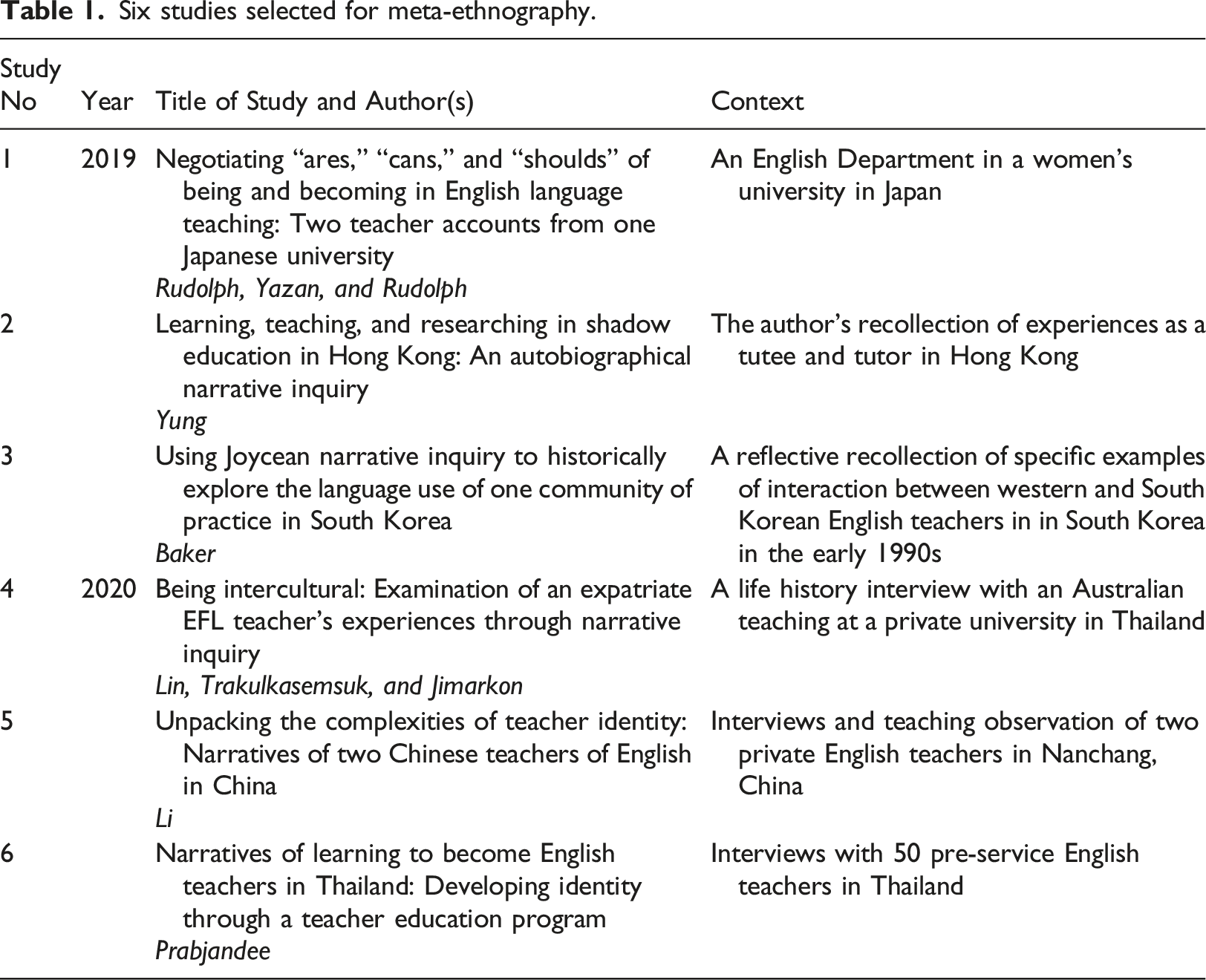
This section presents an examination of selected narrative inquiry studies on English language teaching in the Asian context from 2019 to 2020. Meta-ethnography was used as the method to facilitate this examination. The purpose of meta-ethnography is to offer a reconceptualization of meanings through the synthesis of qualitative studies, that is, to extend the borders of meanings beyond unique research contexts. According to Doyle (2003), this allows qualitative researchers to value the uniqueness of individual contexts, in light of the larger collective. Hence, for this think-piece, we sought to see how these studies could reveal aspects of Asia through the deconstruction of its interpretive framework and research context.
Six studies selected for meta-ethnography.
Interpretive frameworks and summary of findings.
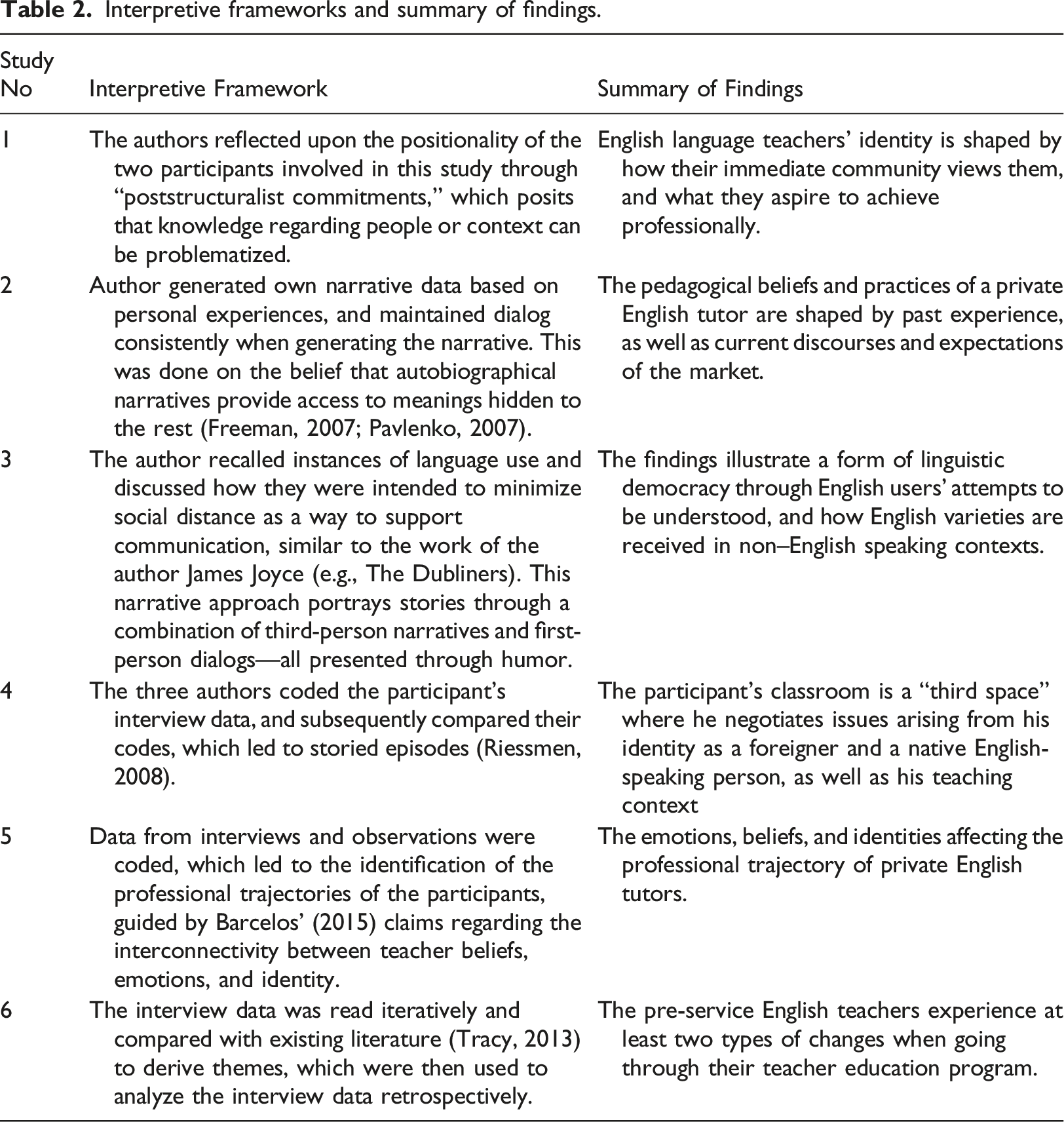
Based on the interpretive frameworks and the findings, these six studies analyzed narratives as what Spector-Mersel (2010) consider treatment of stories as the object for examination. In this sense, the narratives were understood from within. However, such analysis leads researchers to become preoccupied with meanings in the narratives and possibly the narrators, but not necessarily from the context where the narratives take place. As such, even though a narrative inquiry study may be set in Asia (such as those examined above), it does not call for any significant consideration for the context since the object for examination is on the people whose narratives were being studied. Consequently, the findings from these studies were relevant only to broader issues in the field of English language teaching. For instance, these studies discussed professional identity in terms of (1) being an English language teaching professional, such as the development of intercultural identity (Lin et al., 2020); issues affecting women in ELT (Rudolph et al., 2019); and the development trajectory of pre-service teachers (Prabjandee, 2020); or (2) being in different professional settings, such as working as a private tutor in the shadow education sector, as seen in the studies of Yung (2019) and Li (2020). The remaining study, on the other hand, sought to discuss the intersection of English varieties in a non-native English–speaking context (Baker, 2019). By focusing on broader issues, the possibility of taking a critical disposition is minimized. This also assumes that the context where the narratives originate is devoid of meaning, and that acceptable or valuable meaning comes only from the examination of the narrators’ discursive practices through the use of frameworks deemed objective, or those preferred by scholars in the field.
An alternative: Using context for the interpretation of narratives
As mentioned earlier, there are calls for scholars to use local perspectives from the context for the interpretation of narratives (or other forms of data). This approach offers a more insightful view of the context of the narrative, especially in terms of illustrating the intersections of local meanings with broader research agendas. An example is a recent narrative inquiry study in the area of educational management and leadership by Ferguson (2021), who used stories to examine the perceptions of Thai university leaders regarding the notion of “siwilai” (from the English word, civilized) and “internationalization.” Ferguson justified the use of narrative as it can represent and elevate voices that may be marginalized. Ferguson’s narrative inquiry study presented a reflection of endeavors to attain a form of internationalization that is “rooted in local life”; specifically, how internationalization of a Thai institution of higher education is not driven primarily from the use of English, but from the use of English as a tool to build global citizenship. What Ferguson did in his study, is what we think others should consider adapting, that is, to take on local meanings from the context to the level of theoretical frameworks for the interpretation of narratives. With Ferguson’s study as an example to aspire to, we believe that narrative inquiry studies in English language teaching can finally acknowledge the tensions or vulnerabilities that arise from the teaching of a global communication tool (see also Loo and Sairratanain, 2021; Day et al., 2021). Doing so will destabilize the implicit obligation to comply with standards defined by imperial scholarship (Iftikar and Museus, 2018). Consequently, narrative inquiry researchers, especially in Asia, will be at ease to provide an authentic representation of their teaching context, without being compelled to “flag-wave” (see Walsh and Lehmann, 2021), just for the sake of fitting in by means of utilizing familiar theoretical conventions.
Final remarks
This think-piece intended to point out what has been lost in narrative inquiry studies done in Asia, possibly due to the pressure to engage with western-based scholarship (see Lao, 2019; Ortiga et al., 2018). Furthermore, as Larson (1997) argued, “researchers often over-value the use of explanatory theory to make meaning of the lives they study. They often view the insights that narrating subjects have into the meaning of their own lives skeptically, and they retreat into the power and clarity of their theories.” (467). Instead of complying in order to “play safe,” narrative inquiry researchers should consider strongly advocating for methodologies or interpretation approaches that take into account the historical, cultural, and socio-political context of the narrator and the narrative. Thus, narrative researchers should be mindful of the risks of filtering narratives through interpretive conventions. Doing so will also hinder efforts to Asianize the field due to the removal of contextual meanings and the focus on narrative characteristics that appear objective or neutral.
Footnotes
Declaration of conflicting interests
The author(s) declared no potential conflicts of interest with respect to the research, authorship, and/or publication of this article.
Funding
The author(s) received no financial support for the research, authorship, and/or publication of this article.
