




Abstract
The worldwide utility and status of English have given it enormous cachet in Korea. English education has been heavily emphasized in Korean middle and high schools as a means to foster a globally-oriented, linguistic diversity-aware citizenry. Yet the predominant model for language learners in Korea remains an idealized speaker of British or American English – the so-called ‘native speaker’ model. A World Englishes (WE)-informed model of English language teaching would be more in line with the Ministry of Education's stated vision, but uptake of this paradigm has been slow in Korean schools. We therefore investigate the perceptions and attitudes of Korean middle and high school English language teachers about the place of WE in Korea's English education system. Specifically: (a) What are Korean English teachers’ perceptions towards WE?; and (b) What challenges and barriers do they perceive in integrating WE into Korea's English education system? Survey data from 106 Korean middle and high school English teachers, supported by a subset of eight interviews, show that the sample view English as a global mode of communication among all its users, though they often view the ‘native’ varieties of English as more prestigious than those from other countries. They acknowledge the desirability of incorporating a WE-informed paradigm into Korea's English education system, but the varieties which they advocate are all from Anglophone countries. They also identify numerous challenges to implementing WE in Korea's classrooms. One is the need for teachers to prepare their students for high-stakes examinations which are uniformly constructed around British and American English. Another is the perceived community pressure to emphasize American English in their teaching. Finally, the absence of any WE-informed teacher education resources limit their knowledge about WE and how to teach it to students.
Keywords
Introduction
The contemporary global utility and status of English have given it enormous cachet in Korea. English education has been emphasized in Korean schools as part of a government drive to foster ‘values and attitudes required to be a member of […] global communities’ (Ministry of Education, 2015: 3) and develop ‘understanding of linguistic and cultural diversity’ (Ministry of Education, 2015: 4).
The Korean government's aims for educating its people call for an English curriculum which illuminates: (a) how English functions as an international lingua franca; (b) the legitimacy and utility of all different English varieties; and (c) how English users from different linguistic and cultural backgrounds and varying proficiencies communicate. That paradigm, detailed ahead, has been broadly termed World Englishes (WE) (Kirkpatrick, 2020). The emergence of WE-informed paradigms constitutes an important conceptual shift for English language teaching (ELT), because such approaches make learners aware of English's variable and pluricentric nature so that they can communicate effectively with users of a range of English varieties and proficiencies across the world (Jenkins, 2014; Kirkpatrick, 2007a; Matsuda, 2019). Yet in Korea, as elsewhere, uptake of any WE paradigm has been slow (Dogancay-Aktuna and Hardman, 2018), suggesting a disconnect between the Ministry of Education (MoE)’s vision for a globalized, diversity-conscious populace and the way English is conceptualized and taught in Korea's classrooms.
This paper therefore investigates how Korean English language teachers at middle and high schools perceive the place of WE in Korea's English education system. Specifically:
How aware are Korean English teachers of WE and what are their perceptions of that paradigm? What challenges do Korean English teachers perceive in integrating WE into English classrooms in Korean middle and high schools?
This paper first outlines some key conceptualizations of English which will inform the discussion at hand. It then reviews how English is conceptualized in the Korean English education system. After detailing the methodology, it examines three strands of findings: Korean middle and high school English teachers’ awareness of WE; their perceptions of how WE might fit into the Korean English education system; and the challenges these teachers perceive.
Literature Review
What Does WE Mean?
English has been infused with local linguistic and cultural influence across its various spheres, leading to nativized varieties with distinctive linguistic features in each location. These established and emergent varieties of English are increasingly conceptualized collectively as WE (Kachru, 1985; Kirkpatrick, 2007a). English is also an international lingua franca for commerce, finance, diplomacy, defence and scholarship, among other functions. 80% of conversations in English worldwide are between people using English as an additional language (EAL) (Prodromou, 1997). In such a complex sociolinguistic landscape, language learners can expect to encounter interlocutors speaking a range of varieties at varying proficiency levels. They need to learn communication strategies to negotiate meaning using their immediately available linguistic resources (Faerch and Kasper, 1983): requesting repetition or clarification, paraphrasing, candidate completions, among others (Kirkpatrick, 2007b).
For conceptualizing the pluricentric spread, patterns of acquisition and functions of English worldwide, we refer to Kachru's (1992) ‘concentric circles’ model, which comprises three circles representing spheres of English. The Inner Circle means countries where the majority first language (L1) is English (e.g. Britain and America). In the Outer Circle, English exists alongside other indigenous languages and may have an official status (e.g. India and the Philippines). Countries where English is a non-official foreign language are in the Expanding Circle (e.g. Korea), where English proliferates due to globalization (Galloway and Rose, 2015) and is taught extensively in public education systems (Jenkins, 2014). A caveat: the global mobility of many English users has arguably blurred the boundaries between the three circles (Bruthiaux, 2003; Jenkins, 2014; Rose et al., 2020), so Kachru's model is only used here to broadly classify English varieties rather than for any contrastive analysis of different Englishes.
WE-Informed Teaching Models
Several broadly similar WE-informed ELT paradigms have emerged in response to the shifting global linguistic landscape. One approach is teaching English as an international language (Matsuda, 2019), which encourages exposure to multiple English varieties and culturally diverse materials, teaching strategies for communication among EAL users, and apprising learners of the political elements that shape English as an international language. Another approach is English as a lingua franca (ELF)-aware pedagogy (Bayyurt and Sifakis, 2015), which advocates formal training to increase teachers’ awareness of ELF (Jenkins, 2009; Seidlhofer, 2011). Classroom practice is thereby aligned with ELF principles where feasible, for example, EAL learners may be allowed to produce non-standard but comprehensible discourse to facilitate second language communication (Bayyurt and Sifakis, 2015). Perhaps the most comprehensive model is global English language teaching (GELT) (Galloway and Rose, 2015). GELT calls for exposing learners to WE and ELF paradigms, emphasizing the value of multilingualism and cultural diversity, teaching communicative strategies for optimizing comprehension in situations where English is the lingua franca, and ending the practice of recruiting teachers based on their ‘nativeness’. The models outlined above raise learners’ awareness of the sociolinguistic landscape (Sharifian, 2013), foster self-confidence in learners’ own English varieties (Galloway and Rose, 2015; Matsuda and Matsuda, 2017), and prepare learners for future interactions with culturally and linguistically diverse interlocutors (Matsuda and Matsuda, 2017; McKay, 2012).
The impact of these models in mainstream ELT classrooms around the world – including Korea, as we discuss ahead – has been uneven (Dogancay-Aktuna and Hardman, 2018). Part of the issue is that non-codified Englishes are more difficult to teach because fewer materials exist, compared to the slew of published resources that reinforce ‘standard’ English norms (Rose et al., 2020). In addition, few teacher training programmes currently mention World Englishes-informed paradigms (Bayyurt and Sifakis, 2017). So even when English teachers are aware of the global sociolinguistic landscape, the plethora of English varieties, and the worldwide utility of English as a lingua franca, they may be unaware of the principles for teaching that these paradigms underpin, or how they relate to teachers’ own contexts (Sifakis and Bayyurt, 2015).
English Education in Korean Schools
Given the above, a key question is how English is conceptualized in Korean English education. English has been compulsory in Korea from grade three onward since 1997, part of the MoE's avowed drive for a globally-oriented, linguistic diversity-aware citizenry. Yet although the government's aims align with the WE-informed pedagogies outlined above, Korean English teaching materials still present and prescribe native English varieties, particularly American English (Park, 2017; Shim, 2020). Indeed, a guideline published by the MoE-affiliated Korea Institute for Curriculum and Evaluation (KICE), which oversees English language materials development and examination delivery nationwide, recommends that Korean English textbooks should use standard English as spoken in English-speaking countries, excluding expressions that would sound unnatural to native English speakers (Korea Institute for Curriculum and Evaluation, 2015). American and British English are the only varieties used in high-stakes university entrance tests such as the College Scholastic Ability Test (CSAT) (Park, 2009). Similarly, the National English Listening Ability Test used only American English until 2010, when British English was also introduced (Park, 2017). No other varieties are represented.
Why is American English dominant in Korea? The origin is America's socio-cultural and politico-economic impact on Korea since post-colonial liberation and the Korean War. When English became a high school subject in the 1950s American English was the obvious teaching model (Ahn, 2017). Later in the 1960s, American-educated Koreans formed a powerful new political, economic and social class. English proficiency and American degrees were equated with social mobility and affluence (Cho, 2020). These factors, as in other countries, cemented the notion of American English as a prestigious variety for Koreans to emulate. Even when the 6th National Curriculum reconceptualized English as an international language in 1992 (Shim, 2015), the position of American English was unchanged.
English Teachers’ Attitudes Towards WE
Previous studies have investigated Korean English teachers’ attitudes towards WE (e.g. Ahn, 2017; Hwang and Lee, 2015; Kim, 2018; Lee et al., 2019; Shim, 2015; Sung, 2018). Pre-service English teachers in studies by Sung (2018) and Lee et al. (2019) acknowledged the importance of teaching WE. But social pressure, and their limited knowledge about WE, made them adopt American English as their teaching model. Ahn's (2014) study identified a conflict between Korean in-service English teachers’ broadly progressive attitudes to WE and their classroom practice, driven by a need to teach students the American English prevalent in government-mandated high-stakes tests. Teachers in another study (Shim, 2015) were receptive towards different English varieties, yet viewed their own Korean English as an interlanguage to be developed rather than a legitimate variety.
Similar results are found in other Asian countries (Matsuda, 2019; Sadeghpour and Sharifian, 2019). Japanese English teachers acknowledge WE but cleave to an Inner-Circle model in classes, and devalue their own English pronunciation (Uchida and Sugimoto, 2019). Japanese English coursebooks mostly present Inner-Circle varieties (Sugimoto and Uchida, 2018), and teachers doubt the feasibility of introducing WE into future texts (Takahashi, 2017). Cambodian English teachers in Lim's (2016) study hesitate to incorporate WE into classrooms because students expect an Inner-Circle model. Even in Hong Kong, where English is an official language and the medium of instruction at most universities, high school teachers prefer Inner-Circle teaching models (Wong, 2018).
Native Speaker Model
The native speaker model refers to English varieties spoken in countries such as Britain, the United States, or Australia, where it is the L1. The primary reason for the model's dominance is its prestige value, since it reflects the political, economic and cultural influence associated with these countries. Also, for language educators, ‘native’ Englishes have the advantage of being highly codified, enabling mass publication of English teaching and learning resources such as textbooks and online materials. These codified varieties also provide a yardstick for assessment and evaluation of English learners (Jenkins, 2014; Kirkpatrick, 2007a). But scholars warn that the native speaker model fails to reflect the complex sociolinguistic landscape of contemporary English varieties, norms and functions (Jenkins, 2014; Kirkpatrick, 2007a; McKay, 2012), and the notion of ‘native-like’ proficiency has been derided as unrealistic and irrelevant (Davies, 2004; Holliday, 2009). Yet these arguments have yet to change the mindset of ELT industry stakeholders, particularly in Asia.
Methodology
Participants
Participants in the current study are Korean English teachers employed at Korean middle or high schools. Their practical understanding of Korean English classrooms, learners and curricula comes from ground-level experience in the pedagogical milieu. 106 teachers – 83 females and 23 males – were sampled, their gender disparity reflecting the disproportionate ratio of female to male teachers in Korea. 63 participants are employed at middle schools and 43 at high schools. Two-thirds have between five and 24 years of experience, while the remaining third have less than five or more than 25 teaching years. Among the 43 high school teachers, 30 were at general high schools (the most common type of institution, with a comprehensive curriculum), 11 taught at special-purpose high schools (institutions for high achievers, with specialized study streams such as science or foreign language learning), and two taught at trade-oriented vocational high schools. 59 of the participants had previously studied or lived in an English-speaking country.
Survey
An online survey investigated the participants’ awareness of and perceptions towards different English varieties, and the perceived challenges to incorporating WE into Korea's English education curriculum. The survey is adapted from similar instruments used in previous studies of English education in Korea and elsewhere in Asia (Ahn, 2017; Choi, 2008; Shim, 2015; Sung, 2018). Completed by all 106 participants, it consisted of three sections. The first was an information and consent protocol. The second elicited participants’ background information, including years of teaching experience, type of school employed at, and experience of English-speaking countries (Q1–5). The third section comprised 14 5-point differential rating scale items which explored: (a) participants’ understanding of the global status of English (Q6, Q12–13); (b) their perceptions of the ownership of English and the legitimacy of different English varieties (Q7–11, Q19); and (c) their beliefs about incorporating WE into Korea's English education curriculum (Q14–18). One short-answer question was added for clarifying numerical responses (Q20).
Interviews
Post-survey interviews were conducted with eight participants to further probe their awareness and perceptions of WE and the perceived challenges to applying it in Korea's English education system. For systematicity, these were semi-structured: pre-formulated lines of questioning were supplemented with ad hoc questions as appropriate (Dornyei, 2007). Interviews were conducted online and lasted approximately 30 minutes. The medium was Korean – the L1 of the participants and the first author – for optimal information transfer. Interview data were then translated into English by the first author.
Data Analysis
The online survey data were quantitatively analysed using SPSS. Descriptive statistical tools identified general patterns in the data (outlined ahead). As to qualitative analysis, all interviews were transcribed. After an initial reading for gist, emergent themes were identified and coded using NVivo 12. These descriptive data were then mapped against the quantitative data, providing a nuanced picture of the participants’ consciousness and perceptions of WE in Korea's middle and high school English curriculum.
Results
We here report the results of our analysis: about Korean teachers’ awareness of WE; their perceptions about incorporating these into an English language curriculum; and the challenges they perceive.
Awareness of WE
We first examine the participants’ awareness of the status of English and its utility for Korean English users.
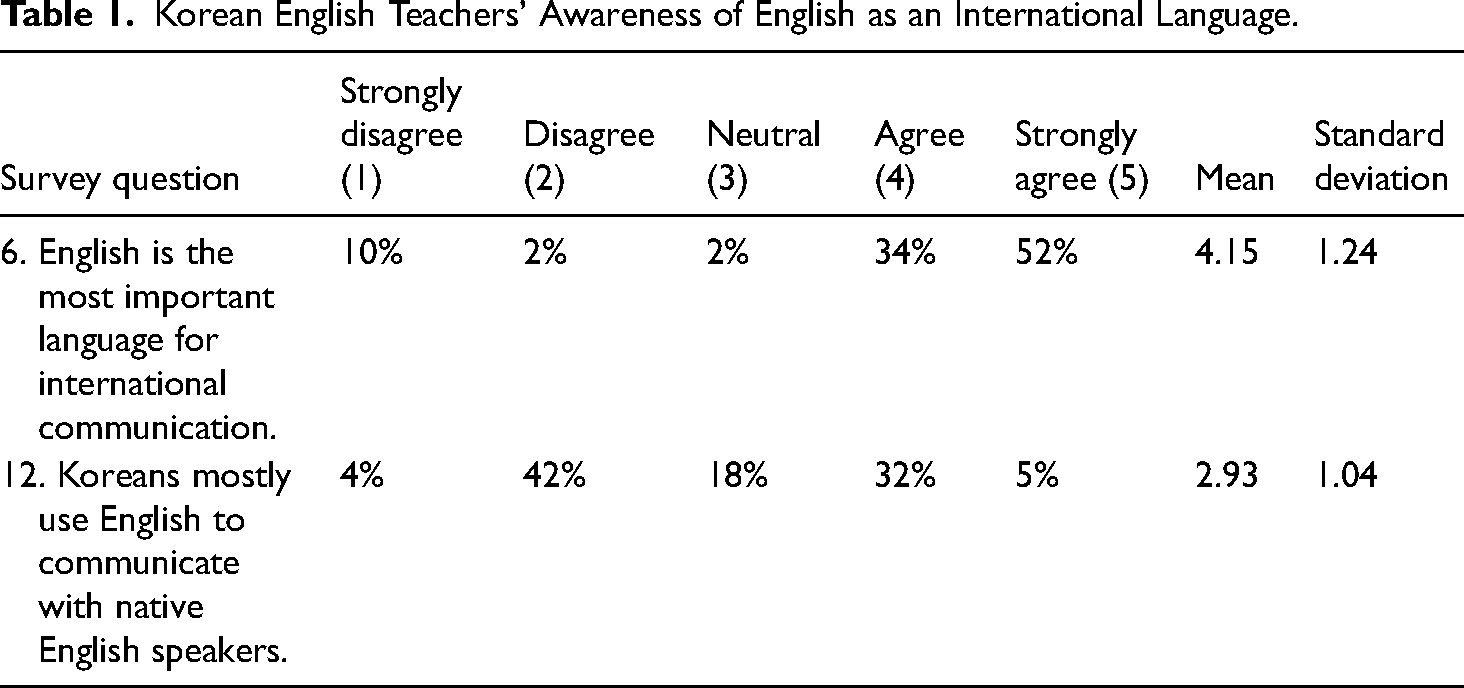
91 participants (86%) affirm the importance of English for international communication (mean (M) = 4.15, standard deviation (SD) = 1.24, see Q6 on Table 1), echoing previous Korea-focused studies (e.g. Kim, 2018; Shim, 2015). Interviewed participants elaborate, framing English as a pathway to enhanced mobility and competitiveness in the global market. They also point to the large amount of online information in English which learners can access provided they can comprehend it. Yet only 48 participants (46%) perceive that Koreans may use English to communicate with other users of English as an additional language (M = 2.93, SD = 1.04, see Q12 on Table 1). Thirty-nine participants (37%) expect to use English primarily with native speakers, even though most interactions in English globally are among people using it as a lingua franca (Crystal, 2003).
Korean English Teachers’ Awareness of English as an International Language.
We next examine how the current participants conceive various Englishes in terms of ownership, legitimacy and advantage.
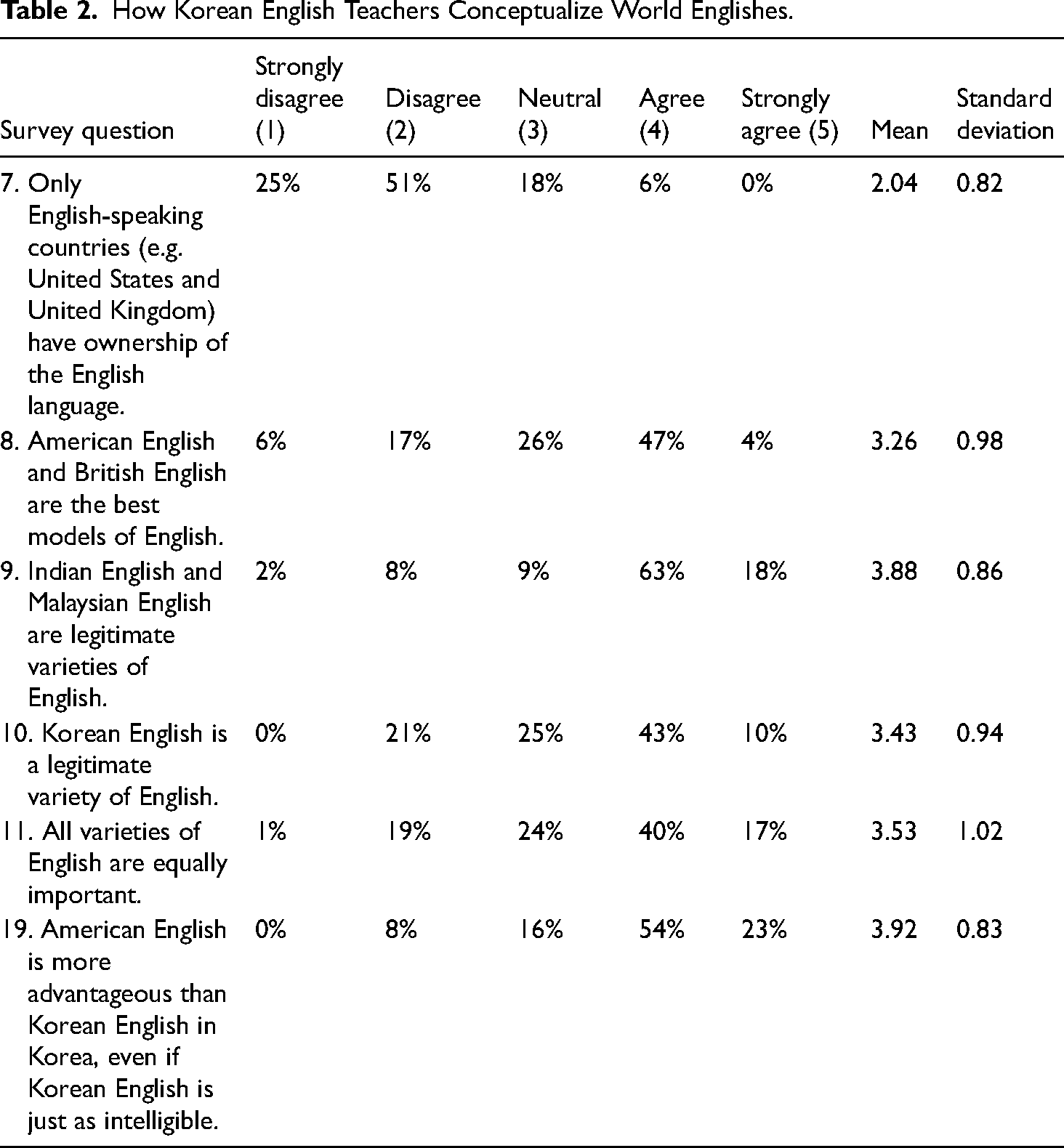
There is considerable variation in ratings for many items in Table 2, suggesting that the sample's notion of legitimate or valued English varieties is far from unified. An initial reading appears positive: 81 participants (76%) view English as a universal resource for all its users, rather than belonging to Anglophone countries (M = 2.04, SD = 0.82, see Q7 on Table 2), echoing previous studies of English teachers in Korea and elsewhere (e.g. Hwang and Lee, 2015; Matsuda, 2003; Shim, 2020). Such an understanding may shape English teachers’ decisions about appropriate models for ELT, as well as the value they ascribe to diverse English varieties generally. But responses to Question 11 (‘all varieties of English are equally important’) are spread more widely across the scale (SD = 1.02), indicating a broader range of opinions about the value of different English varieties. Teachers’ attitudes to their own Korean variety of English are often negative, both in comparison with Inner-Circle and non-Inner-Circle varieties: 86 participants (81%) viewed Malaysian English and Indian English as legitimate English varieties, but only 57 participants (53%) said the same of Korean English. So despite recognizing English as a universal resource (Jenkins, 2014; Kirkpatrick, 2007a), the participants sometimes doubted the value of ‘non-standard’ English varieties, particularly their own (cf. Shim, 2015; Uchida and Sugimoto, 2019).
How Korean English Teachers Conceptualize World Englishes.
Incorporating WE into ELT Classrooms
Teaching English to speakers of other languages and applied linguistics scholars advocate incorporating WE into English classrooms to raise learners’ awareness of the broad variation between Englishes, and to train them to negotiate this variation in international communication (Jenkins, 2014; Kirkpatrick, 2007a; Matsuda, 2003; Rose et al., 2020). But what do the sample of Korean English teachers think?
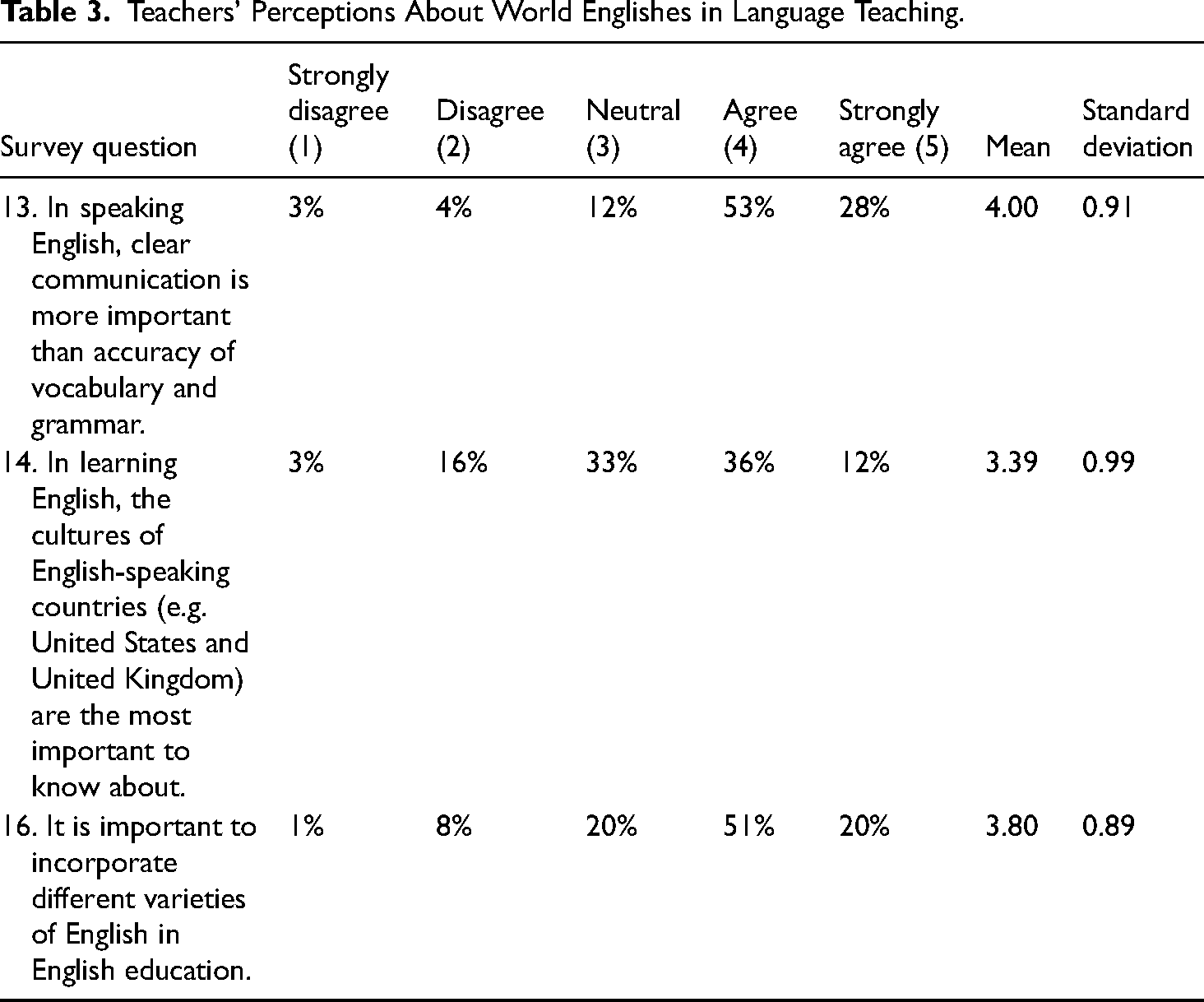
Overall, the data in Table 3 suggest a progressive outlook. 75 participants (71%) affirm the value of incorporating WE into Korea's English education system (M = 3.80, SD = 0.89, see Q16 in Table 3). They confirm the necessity of exposing language learners to different English varieties, a finding supported by previous research in Korea (Park, 2017; Shim, 2015; Sung, 2018). Respondents perceive that increasing English learners’ awareness of WE also boosts their sense of the legitimacy of their own English variety. One interviewee says: Often students hesitate to speak English because they think their pronunciations are not American-like. [If they learn about WE and ELF] they will realize that native-like pronunciation is not always superior. [Interviewee 7]
Teachers’ Perceptions About World Englishes in Language Teaching.
Another says that: Korean students tend to consider Korean English as wrong English. They need to realize that Korean English does not have any problem in terms of intelligibility. [Interviewee 8]
These comments recall Matsuda's (2003) study about Japanese English learners: lacking knowledge about how English functions as an international language, they were insecure about their own English variety and how to manage interactions with users of other varieties. Conversely, Japanese English learners who participated in a course on global Englishes were more confident about their own variety of English (Galloway, 2013). So, incorporating WE into Korea's English curriculum may afford learners greater confidence in their own English variety.
But interviewee responses vary as to which varieties to incorporate into a revised curriculum. Five say that their students should encounter the maximum varieties possible. Two propose a focus limited to lower-profile Inner-Circle varieties such as Australian English. Another is practical: ‘It should be decided depending on the countries’ population and how much trade and commerce they have with Korea.’ [Interviewee 5]. A similar pattern emerges from the questionnaire data in terms of teaching aspects of English culture in classrooms: 51 participants (48%) advocate prioritizing the cultures of ‘native’ English-speaking countries rather than those where English is an additional language (M = 3.39, SD = 0.99, see Q14 in Table 3).
86 participants (81%) also value intelligibility more highly than lexico-grammatical accuracy in English communication (M = 4.00, SD = 0.91, see Q13 in Table 3). This finding echoes previous Korean studies: Hwang and Lee (2015) examined how Korean English teachers perceived the characteristic linguistic features of lingua franca English (Seidlhofer, 2007) (e.g. non-standard tag questions, or using articles or pronouns intermittently). They found that Korean English teachers recognize these as normal features of international communication, acceptable in learner talk provided they do not inhibit comprehensibility. (Though they may still correct them in classes.) So, the current findings are further evidence that Korean English teachers recognize linguistic variation among different Englishes, and that mutual intelligibility is key to communicating across these varieties.
Perceived Challenges to Incorporating WE
We here examine the participants’ concerns about applying a WE paradigm in practice.
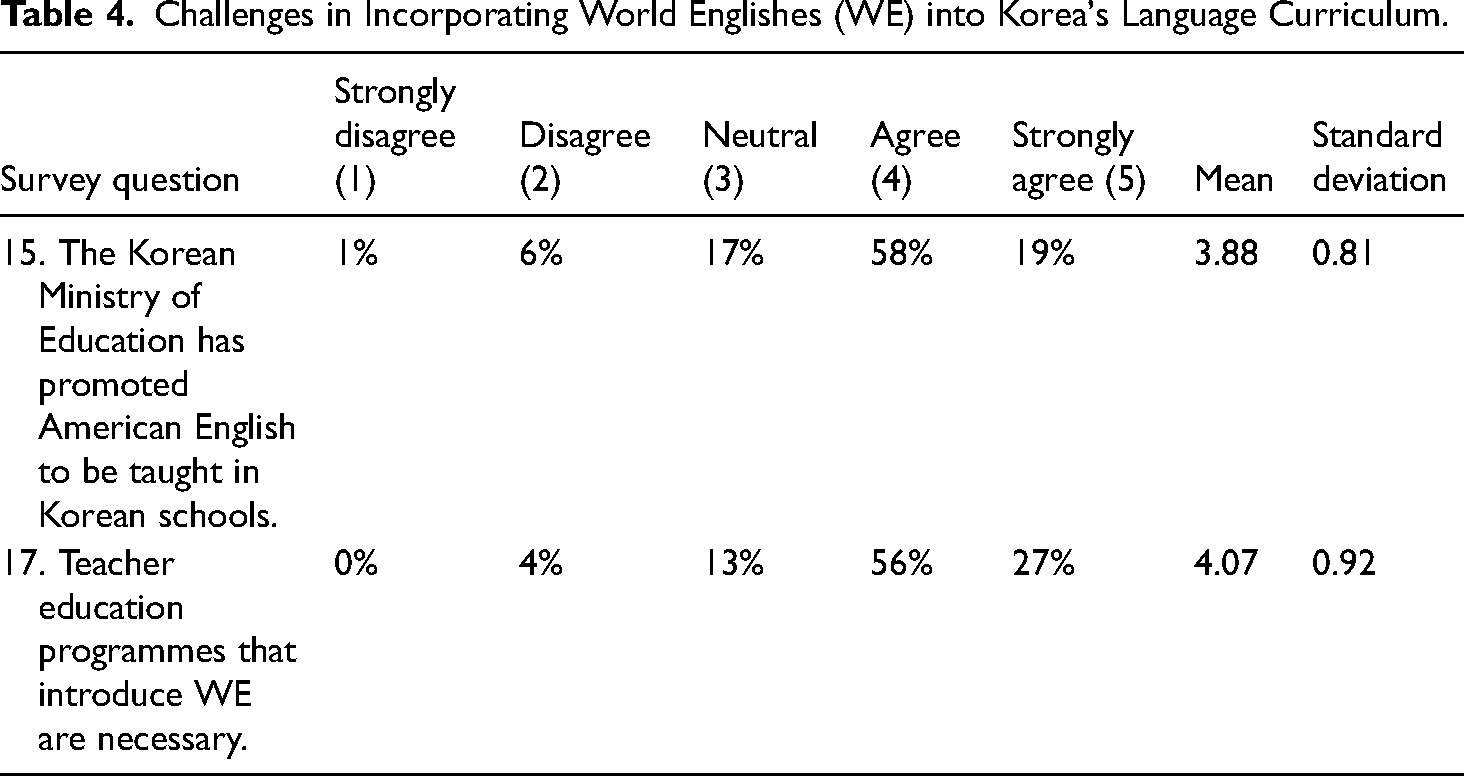
Numerous obstacles emerge from both the survey and interview data. One is the majority agreement (81 participants, or 77%) that Korea's MoE has promoted American English as a standard variety in middle and high schools (M = 3.88, SD = 0.81, see Q15 in Table 4). Native-speaker norms frequently dominate in ELT materials (Kirkpatrick, 2007a; McKay, 2012), and Korea's English resources are no exception (Kong and Sung, 2021; Kwon and Lim, 2018). Follow-up interviews point to Korean English textbooks and government-mandated English tests, particularly CSAT, as catalysing factors: All of the English textbooks and listening materials are in American English. […] About 95% [of the CSAT listening section] is American English. The 5% that are non-American accents and pronunciations do not really have any significant effect on students’ ability to decide the answer. [Interviewee 3]
Challenges in Incorporating World Englishes (WE) into Korea's Language Curriculum.
Scholars agree that this practice disadvantages Expanding-Circle English learners (Matsuda, 2003; Shim, 2020). Students learning in a monolingual environment are reliant on textbooks and other classroom materials to raise their awareness of different English varieties and how to negotiate international communication contexts. Resources that primarily promote a single variety do not reflect the global linguistic landscape which language learners will need to negotiate in the future. So clearly, conflicting narratives are in play: the MoE, while professing to foster global citizens (Ministry of Education, 2015), simultaneously has all new English textbooks vetted by KICE, the agency responsible for developing and administering CSAT testing, to ensure that these follow Inner-Circle norms. Far from raising learners’ consciousness of the existence and legitimacy of different Englishes (Matsuda and Matsuda, 2017; McKay, 2012), Korean English education materials perpetuate the fallacy that Inner-Circle English is the standard from which all other varieties deviate.
A second obstacle pertains to teacher education. 88 participants (83%) support programmes to educate pre-service and in-service teachers about WE (M = 4.07, SD = 0.92, see Q17 in Table 4). All the current interviewees indicate that they would engage in such programmes if offered. But they are unaware of any such programmes and the literature offers no evidence that these even exist in Korea. Their data chime with Sung's (2018) earlier study of Korean trainee English teachers, who were aware of WE but received no training in how to teach such a model or conduct assessment. This is a deficit: numerous studies have affirmed the advantages of WE-informed teacher education programmes for increasing teachers’ awareness of the place of different English varieties in language education (Nguyen, 2017; Sifakis and Bayyurt, 2015). The absence of such programmes is another hurdle to incorporating WE into Korea's English education system.
Discussion
Two obstacles to a WE-informed curriculum in Korea's middle and high schools warrant discussion. The first is the above-mentioned emphasis on examination performance and its ramifications for classroom teaching and learning (Ahn, 2014). The second is entrenched community attitudes favouring Inner-Circle Englishes (Lee et al., 2019; Sung, 2018), which can sway language-in-education policy at all levels (e.g. Kan et al., 2011 regarding Hong Kong).
CSAT-Oriented English Education
Interviewed teachers in the current sample mention an obligation to teach the standard American English that appears on compulsory, high-stakes CSAT examinations (cf. Ahn, 2017): It is hard to teach World Englishes in middle or high school since preparing for CSAT is the most important priority for students. So, none of students would be welcoming to incorporating World Englishes. [Interviewee 7]
Existing studies concur: Lee et al. (2019) found that Korean pre-service English teachers were reluctant to include non-native English varieties in their ELT listening materials because high-stakes listening tests only presented Inner-Circle varieties.
The importance of CSAT as a higher education pathway cannot be overemphasized. 70% of Koreans aged between 25 and 34 are tertiary-educated, the highest rate among Organization for Economic Co-operation and Development countries (Organization for Economic Co-operation and Development, 2020). Prestigious universities lead to social mobility and economic affluence (Lee, 2020; Park, 2009; Seth, 2002), while lack of qualifications bodes ill for one's future prospects (Seth, 2002). So Korean English teachers face a conundrum: whether to adhere to the MoE's mandate for a global workforce, or to satisfy stakeholder demand for a test-oriented pedagogy that boosts examination performance. Korea's English education system is not built for this kind of duality: one path is at the expense of the other. These issues, documented elsewhere in Asia (e.g. Galloway, 2017; Matsuda, 2003), clearly afflict Korea's middle and high school English education system as well.
This over-focus on high-stakes examinations generates a dual washback effect at classroom level (Choi, 2008; Hwang, 2006; Rushbrook, 2019). One effect is to focus Korean students on formal aspects of the language such as grammatical structure (Kim, 2018) rather than functional aspects such as spoken proficiency, which is not tested in CSAT. The other effect is that Korean students may focus only on English varieties used in CSAT to enhance their performance. In the current sample, Interviewee 1 anticipates pushback from students exposed to non-tested English varieties: If my students are exposed to, for example Singaporean or Indian English, they will not understand why they should be exposed to such varieties. They might think ‘Why should I waste my time on the things that will not be on the exam?’
Washback impacts curricula and materials use as well. Sections of Korean English textbooks which are unrelated to CSAT might be omitted from classroom activities (Hwang, 2006; Rushbrook, 2019). Timeslots intended for communicative activities can be given over to further training in CSAT-related content or test-taking strategies. The upshot is that a language system which potentially unlocks worldwide communication is taught as a purely academic subject, with detrimental consequences for learners’ eventual communicative competence (Choi, 2008). The current participants recognize the anomaly: CSAT English, it is too academic […] with difficult vocabulary and complex sentence structures. Students will never use this CSAT English in real-life situations. It is a very sad reality. [Interviewee 7]
Societal Attitudes
The preference in Korean schools for American English is driven by entrenched social attitudes (Kim, 2018; Shim, 2015), a factor frequently mentioned in the current interview data. Participants feel constrained to emphasize Inner-Circle varieties in their classrooms because the community favour these, even when the teachers themselves are receptive to WE-informed models. ‘Schools are places that provide educational services and where students’ and their parents’ needs should be met.’ [Interviewee 4, emphasis added]. Parents, and by extension the wider community, equate proficiency in language learners with sounding ‘native-like’ (Park, 2009), particularly American-like. Interviewee 7 explains: America, the name of the country itself gives a positive impression to Koreans […] Many Koreans still believe America is always superior to Korea in all aspects. So, using American English becomes a symbol of wealth and intelligence for Koreans.
We have discussed above how the Korean community embraces the linguistic variety associated with the American cultural and economic model. Interviewee 6 expands on the theme by referring to the Korean cultural ideology of sadaejuui, which means subservience to power for political ends: ‘Sadaejuui still remains in Korea. So, Koreans perceive that only English users with native-like pronunciation are good English speakers.’ Sadaejuui traditionally refers to powerful countries, but here the term connotes bias toward prestigious ‘native’ language varieties (language sadaejuui). Such prevalent social ideologies make the MoE more reluctant to incorporate WE into the school curriculum.
Conclusion
This study has investigated the awareness and perceptions of a sample of Korean middle and high school English teachers towards WE, and the challenges they perceive in incorporating that paradigm into Korea's English education system. The participants acknowledge the global status of English as a shared mode of communication among all its users. Yet they often view Inner-Circle English varieties as more prestigious than other varieties – about which they may have scant knowledge. The participants also acknowledge the desirability of incorporating a WE-informed paradigm into Korea's English education system, yet the varieties which they advocate teaching are all Inner-Circle varieties.
The obstacles they perceive to implementing a WE-informed pedagogy include teachers being compelled to prepare learners for high-stakes examinations at the expense of developing their communicative competence (Ahn, 2014). They also mention the pre-eminence of standard American English, superseding all ‘non-native’ varieties, including Korean English (Shim, 2015). Teachers in the current sample feel pressure from the community to teach American English, an issue exacerbated by an MoE-endorsed reliance on American English-oriented textbooks. Finally, there are no teacher education resources to broaden teachers’ knowledge about WE so that they can introduce it to their students.
Given the current study's findings, the challenge is to bring Korea's English education system into line with the realities of English use globally, and with the MoE's objectives for a globally-focused, diversity-aware populace. Any consciousness-raising initiative will need to reach students, teachers and administrators in middle schools and high schools, as well as the communities serviced by these institutions. Matsuda (2003), discussing similar issues in Japan, suggests awareness-raising initiatives through institution-level forums such as open-campus days, parent–teacher interviews, or parent–teacher association meetings where curriculum innovations can be discussed. Public and social media are other means of raising stakeholders’ consciousness about WE. Such forums should highlight two points: (a) exposure to Outer- or Expanding-Circle Englishes would not supplant the Inner-Circle Englishes that currently furnish the curriculum, but supplement them (Matsuda, 2012). Students could continue to learn the standard English forms needed to negotiate standardized testing systems such as CSAT; and (b) the Korean government has stated goals of fostering English-competent adults to manage Korea's global financial, commercial, diplomatic, industrial and scientific interests. Korean middle and high school English learners, as future drivers of these goals, need a curriculum that accurately reflects the global linguistic landscape, and to be trained to communicate with other multilingual English users whom they will encounter in future interactions (Galloway, 2017).
Limitations and Extensions
A limitation is that the current sample is unevenly divided between teachers at middle schools and high schools. A future study might investigate high schools specifically, perhaps sampling equal numbers of teachers at general, special-purpose, and trade-oriented institutions. Researchers might also compare perceptions among teachers at different ages, qualifications, or levels of experience. Also valuable would be a contrastive analysis of viewpoints from teachers who have lived in English-speaking countries, those who lived in non-anglophone countries where English is a common lingua franca, and those who have always lived in Korea. Finally, future studies might investigate the attitudes of higher-level school administrators towards a WE-informed curriculum. After all, such administrators have agency to initiate change – if they choose.
