




Abstract
Schools are unique institutions where structural and cultural dynamics shape the actions of humans. Power is everywhere, and the structures of schools channel power in ways that shape the identities of teachers. Yet, teachers find ways to challenge existing dynamics and in their confrontations with power can create new ways of being. This study uses a grounded theory approach to analyze interviews and observations of seven New York City public school teachers. Emerging from their words and re-tellings is a picture of teaching as an act of self-creation within the rigid dynamics of schools. As teachers sought their own answers, they showcased a transformative growth, a “becoming,” to build new identities through their work with students and the community.
Institutions shape people. By directing actions, legitimizing power, structuring relationships, and communicating values, institutions guide the formations of modern subjects. Individuals, of course, are creators of these dynamics, but more often they are the products (Evans, 2004; Portes, 2012). The work of teachers exists at an important juncture within institutions because they are both creators and products of power, and in this article I explore how this unique location changes who teachers are. This qualitative study is an exploration of how the identities of one group of individuals transformed through their experiences as public school teachers.
Public schools are unique institutions. Characterized as a “loosely coupled” system (Ingersoll, 2003), the endless rules and hierarchies of management for the work of teachers give schools a rigidity that coexists alongside a vagueness in the purposes and products of education (Lortie, 1977). The massive human scale makes control both necessary and difficult to enact; teachers experience pockets of autonomy within a lattice of discipline and surveillance. In such a place, power is everywhere. It is alluring and mesmerizing to consider how power can convey strength and direct the actions of people, yet it also can spawn resistance, agency, and redefinitions of the self (Sennett, 1980).
I will begin in this introduction by reviewing the literature on the complex relationships between identity and power. They are fluid, multi-dimensional, and related concepts and I will describe how they interact as people seek to become a “certain kind of person.” Next, I will describe the methods used to interpret the stories of my participants. Then, I will share how different aspects of teaching such as competence, adopting racial labels, and enforcing power, contributed to the formation of teacher identities. I will close by highlighting how confrontations with power can support moments of “becoming” where teachers could exercise their newfound agency to create identities on their own terms.
The concept of identity defies a singular and static definition; different theories of identity agree only on its dynamic and fluid nature. Identity can simultaneously be a statement of individuality, a collection of social responsibilities, and a set of socially ascribed labels (Appiah, 2010). Authors have linked the development of identity to theories of the self, of emotion, and discursive practices. From this complexity, identity emerges as both a product and process. It is a product insofar as it can be interpreted as a semi-concrete collection of the varied ideas that momentarily define how a person acts, understands, and exists. It can be seen as a process because identity is made through experience and practice (Beauchamp and Thomas, 2009). Identity, then, is constantly renegotiated. Even the variety of verbs used to describe how identity comes about—produced, constructed, developed, shaped, built, formed—point to an uncertainty about its genesis.
Gee (2000) describes identity as “being recognized as a certain ‘kind of person,’ in a given context,” (p. 99). There is a core identity perceived to be fixed and surrounded by other aspects that are situationally dependent. An individual may be born with a certain sex or from a specific place and these traits form parts of ourselves that are more concrete, while others might be imposed, ascribed, or adopted. Institutions can impose identities through their official labels and quasi-scientific designations (Hacking, 2002). An identity can be bred through voluntary (or involuntary) participation in groups that share an affinity for interests like working in the community or playing sports. Lastly, identities can be brought forth and reinforced through social relationships and self-descriptions that ascribe to a person certain traits like “caring,” “intelligent,” or “thoughtful.” Identity is thus socially constructed and subject to the dynamics of power; identities are products of competing discourses which are promoted within a field of power relations that allow certain descriptions to eventually prevail (Gee, 2000, 114–115).
Such notions of identity are historically recent; the very concept of the self has only recently emerged as some institutions have broken down while others have filled the void to give rise to self-awareness (Baumeister, 1987). In the absence of social roles that are assigned at birth and future trajectories that are written in scripture, modern identities are created through social norms, institutional structures, and individual agency. A part of the development of individuals is the “discovery” of a self, or realization that “this is who I am.” This knowledge of one’s self, rather than given, is found through interactions with the world.
Given its social nature, identity is related with power. Though Foucault did not use the term “identity,” his writings on power show a deep concern with selfhood. His work probed the forms of society through which “human beings are made into subjects,” (Foucault, 1982, 777). Bodies of governance used scientific practices, rationality, discourse, discipline, and a host of other means of managing populations to ultimately produce knowledge of an individual (Foucault, 1982, 1995). To participate in modern society was to be created through different forms of power which, in another of his neologisms, he termed “subjectification.” He meant that to be measured, defined, and described by experts and officials was to be produced by the state as a certain person, a subject with definable qualities. Modern social technologies emerging in the nineteenth and twentieth centuries allowed newly created experts and officials to measure, and precisely describe individuals in ways that allowed the ranking, ordering, and control of populations. Some have suggested Foucault’s work—like postmodernism in general—insinuates that the very idea of individual agency is lost in the discursive creation of power structures (Olsen, 2008, 11; Stetsenko, 2017, 74–76); but Foucault’s argument was not that individuals disappeared, rather that the “individualizing power” of the state could create a personhood sketched along the predetermined outlines of a bureaucratic apparatus. Other theorists have sought to reclaim the formation of identities from disembodied structures of power by arguing we are not just passive products of impersonal machinery but co-creators of our identities through communal acts. Stetsenko (2017) claims that Foucault could not rescue the individual from structures of power because he failed to see the “agency and resistance of individuals and communities,” (218). Identity is not created in isolation; it is inseparable from the social world.
Schools are institutions where power permeates every aspect of its functioning (Delpit, 2006). Institutions are structures that organize and shape human actions through formal and informal expressions of power. They operate symbolically through rituals and myths but the consequences are very real in the ways the workings of power establish legitimate means of control (Beckert, 2010; Evans, 2004; Portes, 2012). Yet, though the work of teachers is greatly managed, they are not passive agents and there are many ways they can wield power to exert their own influence through the structures of a school (Narayanan, 2021). For this reason, Ingersoll (2003) has described schools as “loosely coupled” organizations where teachers’ work is highly constrained while they also enjoy a measure of independence. It is in this dual institutional nature of schools that identity can become fascinating; people are very much shaped and produced by institutional structures yet in their resistance to these structures they can create themselves in new ways. In confrontations with power, identity can become more than simple biographical details, membership in a group, or an institutional definition; it can be something individuals create through their situated interaction with complex and multi-faceted social worlds (Lave and Wenger, 1991).
Methods
Study participants.
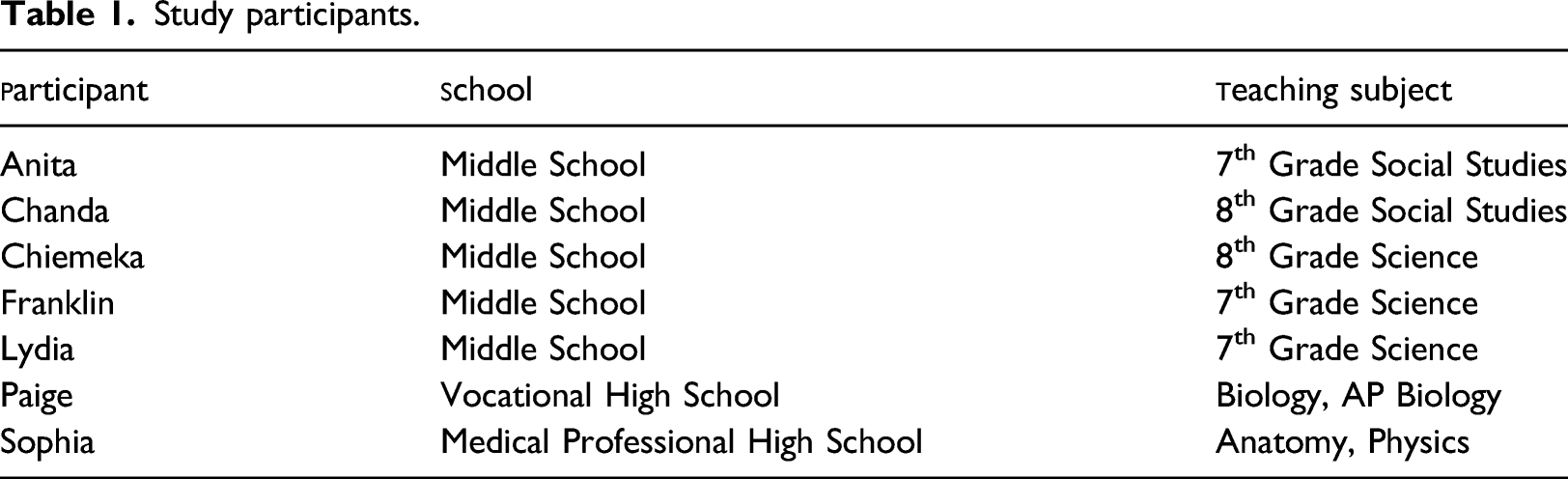
For each participant, I first conducted a lengthy semi-structured interview to learn about their perceptions of identity, past experiences, and beliefs about education. Then, I visited their classrooms to observe their teaching and interactions with students. Following each classroom observation, I conducted a debrief interview where we investigated interesting moments from the lesson. Finally, I led participants in a focus group where we compared experiences from the research process and shared reflections on teaching. All interviews were recorded, transcribed, and coded.
The methodology of this study is based in grounded theory. Grounded theory foregrounds the knowledge, ideas, and conceptions of participants; it offers “systematic, yet flexible guidelines for collecting and analyzing qualitative data to construct theories ‘grounded’ in the data themselves,” (Charmaz, 2006, 2). Thus, though I was initially interested in power and institutions, themes of identity emerged after repeated analysis of the interviews. This challenges us to question how we impose formal theories and frameworks on our observations of the world, and even what we consider as real knowledge. A grounded theory approach encourages researchers to expand their epistemological view to include knowledge that is personal, practical, and connected through narratives to past and future experiences (Biesta, 2010; Clandinin, 1985; Fenstermacher, 1994). Indeed, one of my main arguments is that the stories of my participants generated a unique, highly personalized and contextual knowledge of identity that challenged institutional norms.
Findings
Though rarely mentioned explicitly, and though I never asked about it outright, identity was everywhere in the words of my participants. Whether I asked questions about why they were teachers, their reasons behind certain instructional choices, or how they managed the different demands of teaching, my participants consistently raised issues of how they perceived themselves, who they wanted to be as people, and how their self-conceptions were changing. These descriptions were often entangled with the swirling dynamics of power and the institutional context of their school; together, they showed both the highly dynamic nature of identity as well as the variety of forces influencing its development.
Teacher identities and self-knowledge
My questions were largely about how teachers navigated relationships of power, yet my participants frequently responded with clues about their developing professional identity. One way this was apparent was through the use of specific language; after over 2 years of being a teacher, their speech was laden with educational jargon. A passage from Chiemeka illustrated the extent to which this way of speaking was ingrained: I try to have a lot of turn and talks, keep the engagement up, [use] “Everybody Writes.” So, I’ll do the “Do Now,” then right after that they have to write about something, they turn and talk about it, then going into the quick mini lesson, independent practice, exit ticket, something like that. I’m just going to say labs…inquiry based, where they actually doing a lab, it’s not just me talking, lectures, so that keeps the engagement up. They love discussions, this group loves discussion, so I have a lot of discussions, so they ask a lot of questions, which sort of kills time a lot.
Chiemeka was responding to my question about how he keeps students engaged, and in response he rattled off a collection of terms (mini-lesson, “turn and talks,” etc.) specific to teachers. My interview transcriptions are filled with the verbal currency of educators, including references to “Do Nows,” learning objectives, standards, differentiation, and unit plans. This education-specific jargon is an example of the way institutional efforts, supported by administrators, fellow teachers, and the larger education community, normalize and reinforce the use of a common discourse. The ease with which teachers use this discourse is also a symbol of a growing affinity with the teaching profession and a solidifying professional identity as a “teacher” (Gee, 2000; Olsen and Buchanan, 2017).
More than evidence of a specific teacher identity, my participants peppered their interviews with self-descriptions that showed a developing knowledge about who they were as people. A clue to these descriptions was the frequent use of phrases such as “I am,” and what followed would often be a declaration of their personality, their beliefs about education, and their competence.
These statements could come in passing. In discussing her grading policy, Anita responded by saying “I’m not going to let you fail.” When I asked Sophia how she handled the rampant talking in her class, she responded “I’m not that kind of teacher just because I don’t want to shut down their curiosity.” After I asked Chiemeka about why his co-teacher was yelling in class, he said “Me? I’m more chill. It’s true. I am very laid back, I know myself. I’m really, really, laid back.” Through interacting with rambunctious students, Chiemeka found out (or re-affirmed) that he was calm, and so he can say with confidence “I know myself.” At the surface, these are literal responses to questions about teaching, but they are also affirmations of who they are (or who they want to be) as people.
Sometimes, these self-descriptions existed alongside bureaucratic identities. “I’m big on life,” Paige told me as she gave me a tour of her classroom. Ostensibly, she was describing the many plants and class pets that filled her classroom, but this was also a reflection of her passionate teaching. She was a high school biology teacher who was well-respected by her principal and colleagues. She cared about good lessons, her classroom was joyous and student-centered, and she formed strong bonds with her students. Interestingly, when I explicitly asked her to describe herself as a teacher she did not refer to any of these characteristics and instead chose to respond by saying “I’m highly effective.” This was the highest official designation based in the state-created four tier classification of teacher effectiveness. Through formal observations of her instruction, her principal had granted her this distinction. Not only was it one that would be entered into her official employment records, it also became part of her own self-knowledge. Paige worked at a large vocational high school staffed by mostly veteran teachers; it had chaotic hallways, low graduation rates, and few students continuing on to college. Describing the school culture, Paige told me “I would say, 60% of the staff doesn’t lesson plan. And when I walk into other classrooms, it’s not that I’m saying that they’re poor teachers…” She did not need to complete the sentence; even still, in a place where she had little respect for the institution, she valued the official title.
Franklin, a middle school science teacher, similarly referenced the official label, though in his case it was to indicate that he had not reached full competence: I’m just going to call myself the leader. It’s been implied by administration because…I have some sort of favor [with] administration. Not that I’m the most highly effective teacher but, I like to get my hands dirty. I have the best class management out of all the teachers.
Like Paige, the official label mattered to Franklin. But he also showed how the perceived opinion of his supervisors had an impact on his identity; he had begun to think of himself as the leader of his team at the school not through an official designation but through feelings of competence in creating an ordered classroom. Lydia also discussed how her perceived ability to manage students had changed her self-conception. Initially she felt like she was not taken seriously because of her youth and because, as someone who identified as a Latina, she did not meet the image of a stereotypical science teacher. Now in her third year, she felt like she had a different presence in the school: I think people respect my connection with my students. Even admin has said to me, the way that students react, just for instance, if I walk out to that hallway right now, the kids will move out of the way. There is a sentiment there, a command of respect.
Lydia saw herself as someone who carried a certain authority and could make their presence felt in the hallways. This perception is reinforced by the words of administrators who commented on her effect on students.
These examples of a growing self-knowledge are united by the way they are created through interactions with power. For some, how they graded or disciplined students created a form of self-knowledge. For others, it was a sense of competence by virtue of their command of authority, one legitimated by their administrators, that shaped their professional identity.
Emerging racial and gender identities
Rather than official designations or self-descriptions, “identity” is commonly interpreted as referring to demographic markers like gender, race, and ethnicity. These markers, seemingly fixed, emerged or gained prominence through teaching as my participants grew to better understand themselves. Franklin, for example, described himself like this: “I’m black. I started dabbling in Pan-Africanism, so I say I’m African. I’m Haitian, and I’m, that’s about it.” Franklin was born in New York City, the child of immigrants, an avid basketball player, yet he chose this way to describe himself. He also drew power and authority in his teaching from this identity. This came out as he related the story of R.J, a student he said frequently misbehaved and rarely did classwork. Yet, Franklin had found a way to connect with this student: [R.J.] loves the attention, so as you can see, we’re talking about things that who else is going to teach him this stuff? He’s like “Yo, I picked out my hair today,” so, that’s like a black boy moment with a black older man that you can’t get nowhere else. “You picked out your hair? Good, why you always got fuzz in your hair?” I always groom him, I’m always picking fuzz out of his hair, it’s the only time I can show him that I love him.
Shared grooming, typically associated with girls, are gestures of intimacy (Thorne, 1993: p. 95) thoroughly based in Franklin and R.J.’s shared cultural ground. In using the word “love,” Franklin takes another gendered word and combines it with an image of toughness. The added dimension of race to the act of picking fuzz from hair became a legitimate bonding moment that deepened Franklin’s sense of blackness and maleness and was also a way to bluntly coerce R.J.: “I show him favor, that’s one of the kids with bad behavior that I show favor, because he can act up and he’ll get yelled at and when I yell at him, I yell at him. I don’t care if it’s inappropriate.” R.J. was a student who was frequently suspended and had arrived at this school after being expelled from a local charter school. Franklin’s admission of using raw power through yelling is contrasted with his earlier description of being tender. Through sometimes showing affection and sometimes flexing his power, Franklin found his blackness, or rather his blackness and maleness, to be surfacing and solidified.
For Paige, it was her gender that became increasingly prominent through her teaching. She was half-Mexican and fluent in Spanish, yet her teaching had made her realize the impact of being female: “My gender definitely has - the fact that I’m a woman, I get - not get away with - I can interact with students in a very different way than my male colleagues.” The vocational high school where she worked had an almost 80% male population, and though she stopped herself, she could in fact get away with different types of behavior. Here is an example she gave: We have a lot of students who are very easily triggered by males, and if they say something a certain way those kids just go off, like, there’s full-fledged breakdown mode, but I can say, like, not snarky, you know, teasing things to kids, or say, like, this morning I had a kid and I stopped because he was saying something over me and he never talks over me. And I kind of stopped, and I made like a little more of a scene than I usually would. And I was like, “What’s happening now? What is happening to the world?” And he laughed, he thought it was funny…but if a male had done that to him…if I were a man I could not have behaved that way.
Such interactions had shaped how she viewed herself in her work with students: “I think I am, like, more motherly,” she said as she described her teaching. She noted how students would make requests of things typically expected of mothers: “They’ll ask me to, like, clean stuff for them, or ‘Oh, can you sew this for me?’ Just traditionally things that parents would do, and I often honestly do it, like …fine, I can sew.” The maternal role is one that Paige embraces even as she relishes the juxtaposition with her position as a scientist who can confidently and competently raise animals and plants and also lead the school’s challenging Advanced Placement classes. Paige had found a femininity that allowed her to build a trust and closeness with her mostly male students that could likely have not have been generated were she male.
New demographic identities can also be created through teaching. Chanda was a middle school social studies teacher; she described herself as British and Indian, but through her teaching, this rather straightforward identity subtly changed to include new descriptions in solidarity with her students: Well, we talk a lot about ethnicity and race, I tell them all the time that I’m Indian and that I’m from England…Race is very difficult to talk about. [Students] have a lot of misconceptions. They do a lot of light skin/dark skin amongst the Dominicans, where if they are light skinned they think they are white. They’ll point at a clearly Dominican student who is fairer and say “But, he’s white,” …I don’t know where they got it from but they thought this their entire life, and I’ll say “Nope, we’re all people of color.”
Chanda’s school was in an immigrant section of the Bronx with many students who were from the Dominican Republic. Her explanation is a fascinating example of how she used her authority as the teacher to shape her students’ ideas about identity by challenging distinctions of light and dark skin. Yet, her own self-conception was changed as she created the space in her work with students to share an identity, saying “we’re all people of color.” This was a new label, one which Chanda had only begun to use after working as a teacher and one that, though her life experiences were vastly different than her students, brought her into solidarity with them.
Identities in transition
Whether managing a class, navigating racial lines, or interacting with administrators, the examples above show how teachers constantly create their identities within the structures of schools. But the development of identities is not linear or obvious and can involve a great deal of personal uncertainty.
In his reflections, Chiemeka showed how doubt can be a central part of being a teacher. As we were wrapping up our final interview I asked him if there was anything he wanted to add about his background. He paused for several seconds, considered my question, then responded:
I think I am always myself, in a sense. But, I feel, like, that nagging “Education is important,” that nagging “Respect is important.” And, I have caught myself many times this week, like, almost blowing up at kids because of stuff like the talking back, like, oh my god, it boils my blood! I just feel like that insubordination drives me nuts, because, how can they get away with that? If someone’s older than me, it’s “Sir” and “Ma’am.” That is just how my culture is, it’s just respect. So, how you telling me “No?”
Earlier, Chiemeka had said “I know myself.” He carried his athletic build with an assured grace, conveying a calm strength in his firm and even tone. Yet through teaching, there were times when he found fundamental parts of himself challenged. He commented “I think I’m always myself, in a sense,” a strange self-description (how can you be anything but yourself?). He had to catch himself “almost blowing up,” an image of his identity literally being destroyed, and he went on to share why as he related an incident from earlier that week. It occurred while conducting his required “circular 6” professional duty (called “C6”) of patrolling the hallways: Even yesterday, I had C6, and I told a student, “Go to class! You don’t need to be out here.” “One minute, 1 minute,” [the student said]. Like, it just, I don’t know why, it just bothers me, like, “What?! Go to class!” I’m still telling in a nice tone, “Go to class,” you know, you’re late already. And she said something, like, “Why are you bothering me?” What?! And I did yell at her, ‘cos I don’t know why, I yelled at her. I apologized later because I always apologize, but it’s more, like, you gotta understand this is my job right now!
He became animated in his re-telling, impersonating the attitude of indifference and disdain as he voiced the student’s comments. His voice climbed in exasperation and frustration as he shared his reaction—“What?!”—and he showed real confusion when he said “I don’t know why, it just bothers me.” As he continued, the sense of dislocation in his identity became clear: I don’t get mad easily, but when I do, it’s just a weird feeling. Cos I don’t get mad a lot of times, so it’s like when it happens it’s very, very, weird for me. Like “Why am I...?” It’s a weird feeling and I don’t like it. So I try to catch myself if it does go that far...Outside of teaching I don’t get mad. I don’t really get mad.
In his work as a teacher in the institution of schools, with all the regulations and requirements, Chiemeka discovered a new reaction that he did not know was possible. He is a person who “doesn’t get mad easily,” yet in this moment he found himself in unfamiliar emotional territory, and in reflecting on it he realizes that “I don’t like it.” It is unclear what or how exactly Chiemeka is changing, but there is an uncertainty in how he understands himself—he uses the word “weird” three times.
Chanda offered an illuminating example of an identity being dissolved and recreated. Perhaps the most regimented of my participants, she shared with me a moment where a brief window opened up in her classroom and she stepped into the space to create a new selfhood. Chanda was normally at home with being an enforcer of order and could effortlessly dispense directions and consequences. Once, while trying to coerce her class into good behavior she dangled the incentive of calling her mother to share that this class was her favorite class. This was a somewhat frivolous incentive, the type of corny game that shared her personal life in a way her eighth graders enjoyed. At one point, though, students began asking more about her family: Last week, Tuesday, was my birthday…I absolutely did not want to teach, um, so I taught all day and by the time I got to 802 [the name of this class], I was like, “No!” They were working, and someone asked me about my home in London, or something...so I went on Google Maps, showed them my house, showed them London, my school, and we spent the whole lesson, talking about my school. And then I just told them, “Well, this is what my school was like, this is what we did,” and they had 10,001 questions. And then, it was the end of the day…I loved it. I mean I would do it all the time, but obviously there is a lot of work to do. It’s just, it’s different, you’re not, it doesn’t feel like you’re a teacher and they’re a student anymore. I don’t know, it just felt good.
Through an unexpected change in her teaching practice, Chanda had momentarily found a new way of being in the classroom. She briefly changed the equation of power in her work and no longer felt like a teacher or considered the people in front of her to be children, she had opened up a new type of space where her students’ non-academic questions were valid and worthwhile, and her own personal background became relevant knowledge. The pressures of the work to be done were still lingering in the background, but Chanda’s reflection on this small moment show how teachers can learn ways of being, of “knowing,” in conjunction with their students. This was only a short interaction; it was soon gone and replaced by other more predictable ones. But it lingered with Chanda as she recalled the feeling of having a different type of relationship with her students which she noted by commenting “I don’t know, it just felt good.” She was not fully sure what to make of the experience, but she liked it, and she uses an affective description that appears nowhere else in her transcripts.
These were both small moments; Chiemeka’s uncertainty about his nature and Chanda’s discovery of a new way to be a teacher lasted only briefly. But they came about directly because of the complicated nature of teaching in modern institutions. Along with the other examples of emerging racial identities or growing self-knowledge, they show how identities are transformed out of teacher confrontations with the dynamics of power inherent in their work in schools.
Discussion
My interest was initially about power in schools. Sprawling and thoroughly bureaucratized institutions like massive urban public school systems can be alienating and disempowering places (Nolan, 2011; Ingersoll, 2003; Lortie, 1975) and I was particularly interested in how teachers made sense of power in such a setting. As I adopted a methodology based in grounded theory, what emerged through repeated listenings and readings of the words of my participants was an undercurrent of novice teachers grappling with who they were, what they believed, and how they wanted to shape their own futures. While my interviews were designed to learn more about their experience of power, the responses of my participants revealed their dynamic identities transforming as they confronted the realities of power in their work. I encountered instances of teachers developing a sense of agency as they sought to create their own paths in the impersonal world of public education. This discovery of personal agency was a transformative process, a “becoming” (Stetsenko, 2017).
Foucault sought to build a theory of how power can create individuals, but it did not fully account for the possibility of human agency in resisting structural forces (Stetsenko, 2017; Marshall, 1997). Agency is seen throughout this paper as teachers made intentional choices and conscious efforts to support their students and question the unbalanced relationships of authority that have come to define modern schooling. Agency and identity are closely linked; creating an identity that one can confidently embrace is a critical step in empowerment (Beauchamp and Thomas, 2009). Whether adopting the formal labels of the institution, embracing the feeling of respect that came with competence, or reinforcing personal identity through interacting with students, what stood out is how people were fundamentally changed by their interactions with power. That is, teachers actively created new subjectivities both in response to and through enacting power. Whereas Foucault’s subjectivity can leave individuals helpless in the shadows of power, Stetsenko (2017) has countered such a dualistic and disempowering view of the individual to argue that people can act in concert with the world around them to create transformational change. New selfhoods are carried out jointly in communities of practice working toward shared goals: “People come to know themselves and their world and ultimately come to be human in and through (not in addition to) the processes of collaboratively transforming their world in view of their goals and purposes.” (Stetsenko, 2010: p. 8, p. 8)
Teaching can be considered a situated practice taking place within a school community. In this sense, more than the typical transactional definitions of teaching, it is an identity-making activity, an embodied and socially situated learning experience (Lave, 1996). Lave argues that we can reject a dualistic portrayal of knowledge and learning to see teaching, which is essentially a form of learning-through-action, as a process of becoming: Crafting identities is a social process, and becoming more knowledgeably skilled is an aspect of participation in social practice. By such reasoning, who you are becoming shapes crucially and fundamentally what you “know.” “What you know” may be better thought of as doing rather than having something – “knowing” rather than acquiring or accumulating knowledge or information. “Knowing” is a relation among communities of practice, participation in practice, and the generation of identities as part of becoming part of ongoing practice, (157).
Identity is no longer a static trait but constantly re-created through learning. Insofar as teaching is a process of significant learning, “learning thus implies becoming a different person,” (Lave and Wenger, 1991, 53). What I have tried to show in this study is how participating in institutions brings us face to face with the exercise and experience of power, and in those moments our identity has the potential to be transformed.
Through confronting the challenges, rituals, restrictions, and possibilities of teaching, and most of all through engaging with their students and colleagues, my participants were also writing stories about themselves that went beyond an institutionally defined professional identity (Lave, 1996). Particularly in moments when they rejected outright the traditional bounds of school-based relations of authority, their stories allowed for new possibilities of what the work of education could be. Consider typical institutional expectations of the work of teachers; the professional identities of teachers often exist within the specific and narrow policy context of managing classrooms, teaching content, and preparing students for required exams; (Buchanan, 2015). By challenging sanctioned relationships of authority within schools, my participants found moments to redefine the act of teaching. The classroom became more than a place of “academic” learning (and sometimes academic learning was rejected altogether). Instead, it became a site of caring, of community building, of learning about each other. Beyond passive spectators, my participants harnessed communal pursuits to push against the deterministic limits of power. Foucault himself acknowledged the possibility of agency when he suggested that “critical ontology” was our best way out of domination, a commitment to investigating “the events that have led us to constitute ourselves and to recognize ourselves as subjects of what we are doing, thinking, saying,” (Foucault, 1984, 45–46).
These experiences can be characterized as a sort of Becoming, a dynamic transformation of identity in relationship with our social worlds through active practice (Stetsenko, 2017). In turns exercising, re-forming, reproducing, and resisting power, sometimes conceding and other times undermining institutional expectations, my participants interacted fluidly with their students and schools to co-create new selves. More than just inhabiting the pre-determined institutional role of a “teacher,” my participants evolved into new people through their confrontations with power; they transformed and created the spaces for new ways of being in our institutionalized world.
Footnotes
Declaration of conflicting interests
The author(s) declared no potential conflicts of interest with respect to the research, authorship, and/or publication of this article.
Funding
The author(s) disclosed receipt of the following financial support for the research, authorship, and/or publication of this article: This article was supported by Doctoral Student Research Grant, City University of New York.
