




Abstract
Student–teacher relationships have been largely explored in literature from the perspective of successful relationships, i.e., what constitutes a successful relationship and how teachers build them. However, in moments of student defiance, resistance or pushback, how do teachers react? When teachers recount such moments, is the narrative one describing the teacher’s attempt to maintain authority and order, or do teachers provide a different narrative when recounting how they dealt with these difficult moments with students? This study seeks to identify narratives of power in teachers’ discourse within their stories about challenges in their relationships with students. Challenging relationships among teachers and students can stem from a struggle with power. Findings from the study examine how teachers use discourse to position themselves and their students within structures of power when reflecting on difficult or challenging relationships with students. The stories in this study contain some evidence of students’ resistance in refusing to meet teachers’ expectations or by pushing back on a teacher’s behaviour. Yet, teachers struggled to balance their authority and share power with students to negotiate a solution.
The work of teachers is highly relational. Teachers must manage relationships with their students in order to balance internal and external demands on instructional quality, design and practice. These relationships are essential for effective teaching; successful efforts from teachers to build and sustain relationships with students can impact students’ behaviour and attitudes towards learning (Jeffrey et al., 2013; Midgley et al., 2000; Noddings, 2013). Student–teacher relationships have also been linked to successful learning outcomes, including motivation and engagement (Aultman et al., 2009; Wentzel, 2009, 2012). These relationships can affect students’ perceptions and expectations of their own academic success (Wigfield and Eccles, 2000), along with their beliefs about their intelligence and abilities to improve and grow (Blackwell et al., 2007).
Yet, building relationships is one of the most difficult skills for a teacher to master (Wideen et al., 1998). Teachers receive limited guidance on effective relational practices, while faculty in teacher education programs typically stress the importance of the student–teacher relationship, they may not provide direct instruction for teacher candidates on how to cultivate these relationships (Phillippo et al., 2018). This can lead to school environments in which challenging relationships with students cause frustration, given the limited resources available from preservice training or current supervision to address issues in the relationship or give teachers direction on how to improve the relationship. As a result, teachers’ job satisfaction can be in peril, depending on the perceived quality of the teacher–student relationship (Veldman et al., 2013).
Student–teacher relationships have been largely explored in literature from the perspective of successful relationships, i.e., what constitutes a successful relationship and how teachers build them (Murray and Zvoch, 2011; Pianta et al., 2012). However, little attention outside of the literature on student discipline has been given to teachers’ perspectives about relationships with students that are difficult or challenging (Aultman et al., 2009), particularly in the nuances of negotiations among teachers and students that define the work of teaching.
In moments of student defiance, resistance or pushback, how do teachers react? When teachers recount such moments, is the narrative one describing the teacher’s attempt to maintain authority and order (McFarland, 2001), or do teachers provide a different narrative when recounting how they dealt with these difficult moments with students? This study seeks to identify narratives of power in teachers’ discourse within their stories about challenges in their relationships with students. Challenging relationships among teachers and students can stem from a struggle with power (McHugh et al., 2013). This study examines how teachers use discourse to position themselves and their students within structures of power when reflecting on difficult or challenging relationships with students.
Teachers’ stories revealed use of ordered events, or events occurring in a particular timeline or sequence (Labov and Waletzky, 1967), voicing, (Wortham, 2001) and language choice (Gee, 2005) to position themselves and their students in narratives of power, as they construct answers to several implicit questions: who had more power in the relationship, how did teachers’ positionality in their roles contribute to a struggle for power and how did students and teachers negotiate power. The following was the research question guiding this study: how do teachers use stories to describe what happens when relationships with their students include barriers, such as power struggles or pushback?
Conceptual framework
Narrative structures in discourse
Speakers use language to establish a recognized identity. Social language can be utilized by speakers to express identities that are socially significant, including who you are within your profession. Through discourse, words and interactions allow the enactment of socially situated identities (Gee, 2005). Wortham (2001) discusses how voice can establish ‘socially relevant’ positions for narrated characters (p. 40). Teachers continually grapple with their positionality as authority figures, professionals and relationship builders. In studies of urban classrooms in the United States, there appear to be two discourse models at play in the student–teacher relationship: one that is mainly utilitarian and pragmatic in the transmission of knowledge, and another in which the utilitarian purpose is situated in a caring relationship (Ogbu, 2003). In a detailed analysis of teachers’ stories for this study, we focused on the topics described by the teachers, the social dimensions of the teachers and students and their roles in the stories, and the ways in which the teachers positioned themselves and others (van Langenhove & Harré, 1999).
The stories that people share are situated in the context of historical and institutional forces, and provide a great deal of insight about the individual who is telling the story (Rymes, 2001). How a person chooses to tell a story – by the selection of certain words, tone of voice or repetition – can create a presentation of the person’s identity and how they perceive themselves and others. Stories can also be intricately designed to create a particular impression for the listener. As Rymes (2001) argues, stories allow for creation of both meaning and identity. The ‘self’ of the narrator occurring through a story tends to emerge through relationships with others. Therefore, stories about relationships can be revealing of the assumptions and moral understandings of the speaker.
Indeed, stories can allow the speaker to make sense of what is occurring in the events and with the individuals that are described. Labov and Waletzky (1967) outline a process for analysis of stories that examines that narrative structure shared through discourse. Elicited narratives typically include an orientation (place, time, people), a complication, an evaluation and a coda, in which the storyteller provides a resolution and message that links all ordered events together into a coherent narrative.
It is important to note that the speaker’s choices of a linear ordering of events in a personal narrative can differ significantly from the actual order of these events in time. These clauses may provide a variety of functions, such as making reference to other events, characters and feelings that are considered by the speaker to be central to the narrative (Johnstone, 2016). An example of this occurs in one of the stories in this study, in which a teacher describes a past conversation with her husband (Table 1):
The day after, I come in and say, ‘I’m sorry. Let’s do this lesson over. What can we do today?’ My husband’s always like, ‘You do it with your students, stop taking your bad days out on me, too’. But it’s those things that they push me in that sense, ‘You’re right, I’m in a terrible mood, but you guys don’t deserve this. No one learns in this situation’.
Teacher interview 2.
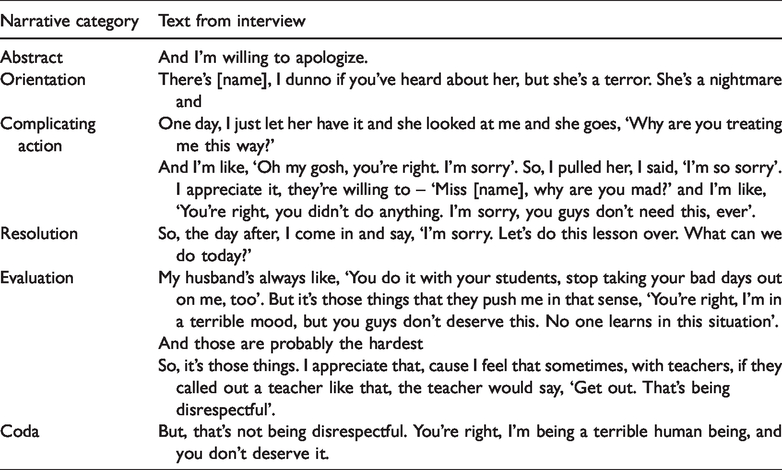
While the teacher chose to include this anecdote in the middle of her narrative, it did not occur sequentially in time in the middle of her incident with the student. For this speaker, the evaluation of the event was that the student did not deserve it when she lost her temper. Therefore, the ‘evaluation’ stage of the narrative may occur at any time in the course of the narrative.
Power and identity in discourse
The position of a classroom teacher has traditionally been upheld as a position of power, yet students still have the capacity to question authority and negotiate with teachers. Foucault (1980) describes how the self is not fixed in a set of socialized roles, but instead is repositioned constantly through discourse. According to Foucault, the vehicle for this discourse is power. Baxter (2002) posits that this power in relationships is ‘constantly shifting’ (p. 829), and subjects may find themselves powerful at times and powerless in others. Speakers can adopt multiple voices as they shift positions in power; these positions can be formalized and institutionally acknowledged (teacher/student), or be culturally produced (conformist/rebel) (Baxter, 2002), or both.
Similarly, critical discourse analysis uncovers ways that social relationships and power are situated in discourse (Rogers, 2001). One dimension within critical discourse analysis is social; examining the relationships between texts and social practices can lead to a better understanding of how power differences occur and are socially reproduced. Critical discourse analysis can uncover how power structures are sustained and potentially changed to the advantage of those who are dominated by it.
While students may find space to actively share or negotiate power with teachers, the field of teaching remains rigidly grounded in defining elements of authority and control. The use of language and other ‘ways of being in the world’ (Gee, 2005, p. 7) constructs this larger discourse of being ‘teacher’. For instance, teachers enter the field with predisposed concepts of what a ‘good’ teacher might look and sound like (Beijaard et al., 2004). The identity of ‘good’ teaching may very well intersect with values of teachers as being in control, students as compliant and authority maintained through speech and positioning of power.
The way teachers tell stories about their experiences can provide an important window into the phenomenon of teacher-student relationships. Rymes (2001) described stories in narrative as shaped by cultural and institutional forces, with the stories often ‘intricately crafted to create a particular impression’ (p. 24). The act of narrating events through stories creates an emergent identity for the speaker. A story can shape the ‘source of the self’ that emerges through relationships with others (Rymes, 2001). By use of stories, teachers can develop their identity as a teacher in response to cultural views of good teaching and their own sensemaking of how they enact their role as a teacher. Making sense of challenging situations through stories opens dialogue to explain how their role as a teacher and the role of the student contributed to their decision-making, and, ultimately, the resolution of the challenging event.
As mentioned previously, the concept of power in the teacher–student relationship is largely shaped by institutional and cultural constructions. Teachers can begin to make sense of these constructions, along with their position within them, by telling a story. Stories are historically situated in the human experience as narratives with moral overtones. The very act of telling a story can be what Rymes calls a ‘moral impulse’. Through stories, teachers can reveal assumptions, positions and moral understandings of their profession, along with how students are expected to act and behave. Stories may create a flow of events that do not always fit together smoothly, but are ordered in a particular way to help listeners understand the speaker’s evaluation of what happened (Rymes, 2001).
Developmental relationships and self-determination
The quality of relationships among teachers and students can be developmental in nature. Developmental relationships help young people experience the primary three needs posited by self-determination theory – autonomy, belonging and competence (Ryan and Deci, 2000). For students, a sense of power or autonomy in their relationships with teachers is critical for positive engagement and academic outcomes. Students’ perceptions of their teachers’ autonomy support can predict increases in autonomous self-regulation, perceived competence and interest (Black and Deci, 2000).
Developmental relationships include five elements that strengthen young people’s autonomy, belonging, and competence, and through those impacts, help young people realize positive developmental outcomes, including successful adaptation and achievement in school, stronger social-emotional skills and greater commitment to contributing to community (Pekel et al., 2018; Roehlkepartain et al., 2017; Scales et al., 2019). Based on extensive literature reviews and pilot studies, these elements (Table 2) have been identified as expressing care, challenging growth, providing support, sharing power and expanding possibilities (Pekel et al., 2018; Roehlkepartain et al., 2017; Scales et al., 2019). While all elements are impactful in shaping teacher-student relationships, sharing power is particularly salient in shaping students’ experiences of feeling self-directed or autonomous (Graça et al., 2013).
The developmental relationships framework.
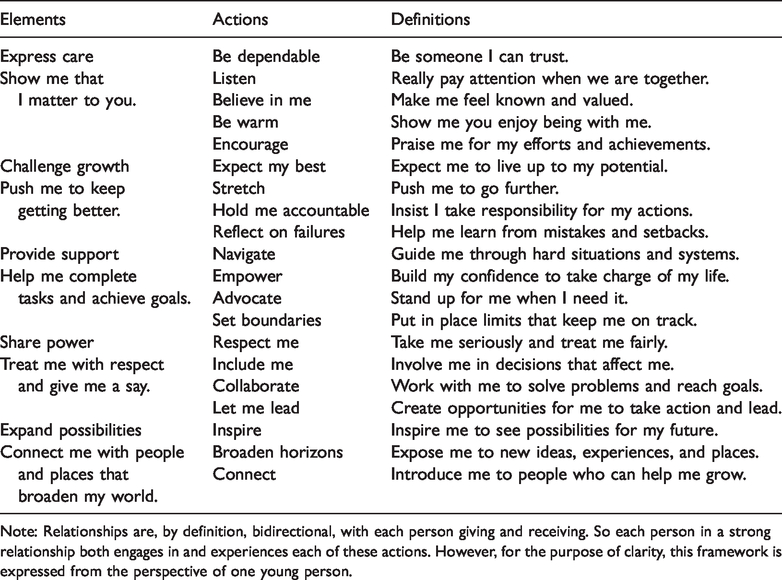
Note: Relationships are, by definition, bidirectional, with each person giving and receiving. So each person in a strong relationship both engages in and experiences each of these actions. However, for the purpose of clarity, this framework is expressed from the perspective of one young person.
When these five relational elements are experienced, students experience psychological, social-emotional, behavioural and academic benefits. Thijs and Fleischmann (2015) observed that students who reported high levels of closeness with their teachers tended to also exhibit higher levels of mastery goal orientation than their peers, promoting higher achievement. In addition, when the quality of a student’s relationship with their teacher increases over the academic year, students also demonstrate increases in their academic motivation and perceptions of belongingness (Martin and Dowson, 2009; Scales et al., 2019, 2020).
Emotionally supportive teachers and classrooms provide environments conducive to building self-determination and autonomy (Ryan and Deci, 2000). Students who experience self-determination report increases in engagement and motivation throughout the school year (Ruzek et al., 2016; Ryan and Deci, 2000). Yet, when students do not experience positive relationships, students may demonstrate resistance to their teachers or other school staff members in authority. This behaviour can be interpreted by teachers as defiant (Nakkula and Toshalis, 2006). Self-determination theory points to student resistance as the communication of an outstanding need, a reaction to teachers who are not providing students what they need to feel emotionally supported (McHugh et al., 2013).
Teachers and students negotiate their relationships through language and behaviour. The choice of language to use in communicating with one another, and the understanding of this language, is co-constructed and often interpreted through the lens of who holds the power (Davis, 2003; Myer and Turner, 2006). Relationships are, by nature, bi-directional (Pekel et al., 2018; Roehlkepartain et al., 2017), and student–teacher relationships continually evolve as the actors negotiate and evaluate their roles in the relationship and what they want out of their relationship (Davis, 2006).
Contributions of the current study
In a contribution to the field of student–teacher relationships, this study explores teachers’ personal stories about challenging relationships with individual students. The stories enlighten understanding of the ways teachers grapple with how teachers or students are meant to act within a relationship, how they respond to or repair a relationship when it becomes adversarial or difficult, and how teachers make meaning of what occurs when a relationship with a student is not positive or constructive.
This study is situated in a United States context, well before the global COVID-19 pandemic of 2020 dramatically altered the nature of how schooling is delivered around the world. Although some of the findings may be specific to the U.S. context, the broader lessons of how students’ developmental needs are negotiated in a learning setting with an adult authority figure are likely to resonate across multiple cultural contexts, and most especially in industrialized societies and those with more individualistic as contrasted with collectivist traditions.
Methodology
This paper reports on a longitudinal study of student–teacher relationships and motivation, focusing on the perspective of teachers. The larger study (see details in Scales et al., 2020 and Scales et al., 2019) involved more than 1500 middle and high school students and nearly 200 teachers over two school years and included quantitative student and teacher surveys, student focus groups and teacher interviews at the beginning and end of one school year, and at the beginning of the second school year. The intent of the study was to examine how the quality of student–teacher developmental relationships affects students’ academic motivation, connectedness to school, perceptions of the quality of curriculum and performance (grades and test scores).
As part of this study, students were recruited for focus groups to explore their experiences of relationships with teachers. Researchers worked with a trusted school staff member to recruit students for their representativeness of the overall school population and also to reflect a range of academic performance. This trusted school staff member personally invited students to participate and emailed their parents/guardians about the opportunity. Three focus groups of students were recruited to participate in this study: one 6th-7th-grade group (6 students), one 8th-grade group (5 students) and one 9th to 11th-grade group (6 students). Students participated in three 1-hour focus groups during the 2017–2018 school years.
In the first focus group, participating students were asked to identify and nominate teachers who built strong relationships with them and motivated them in school. Four middle school and four high school teachers were chosen based on student input and were interviewed three times each during the 2017–2018 school years. As part of the interviews, teachers were asked to consider their relationships with students, including changes in the relationship over the course of a school year, their perceptions on what occurs when relationships go well or experience challenges and their insights on relational practices they intentionally employ. (For more on longitudinal student themes see Scales et al., 2019).
The five stories discussed in the current analysis were selected from the three sets of teacher interviews and revealed teachers’ perspectives on past and current relationships and what actions they took to improve relationships with students. The analysis in this study does not include the entirety of the interview; rather, it focuses on stories in which teachers described a specific incident with a student that was challenging or presented a barrier to their relationship. Stories were chosen based on the following criteria: (a) the story contained an interaction between a teacher and an individual student, as opposed to more than one student or general statements about students; (b) the teacher described a tension they identified in the relationship; and (c) the story’s events were recounted in their entirety, with an identifiable conclusion or resolution.
Participants
The eight teachers who participated in this study were recruited from a middle school and high school in a large suburb contiguous to a major Midwest city. In this district, 19.2% of students were Hispanic or Latino, 17.8% of students were Black or African-American, 6% were Asian, Native Hawaiian or other Pacific Islander and 48.3% of students were White. The district serves a free and reduced lunch population of 41.2%. Moreover, 13.8% of students were English learners, and 16.2% were enrolled in special education services.
Teachers in this district are generally highly experienced in their field. In addition, 89.4% of teachers have three or more years of experience, and 73.6% hold advanced degrees beyond a bachelor’s degree. In comparison with student demographics, less than 1% of teachers are Hispanic or Latino, 1% are Black or African-American and 94.7% are White. All of the teachers who participated in the study are White, and the majority of them have been teaching for more than three years.
Of the eight teachers who were interviewed, four shared stories that were used for the purposes of this analysis. Three were teachers employed at middle schools in the district, with two white females who taught math and one white male who taught English. The fourth teacher was a white male who taught English at a high school within the district.
Analytical approach
Each story was examined by identifying each element of the story’s structure, as described by Labov and Waletzky (1967). The participants’ choices to orient their stories in a particular structure were considered in relation to their stance-taking towards their students and their own identities through power (Stivers, 2008). Drawing on Labov and Waltzky (1967) and Rymes (2001), the analysis seeks to explore how teachers choose to construct a narrative, through stories, of the role of power dynamics in difficult relationships with their students.
Table 3 illustrates a comparison of the stories through a thematic analysis of storylines within them (Braun and Clarke, 2013; Rytivaara and Frelin, 2017). A thematic approach highlights themes that were common or different among the stories, and how these themes were situated in teachers’ discourse of power with students and their positionality and social language of the profession. The aim is to stay open to participants’ interpretation of their experience. This provides a portrait of their perception of what was happening in their relationships with students, alongside a deeper dive into their choices of discourse and storytelling.
Storylines of challenging relationships with students.
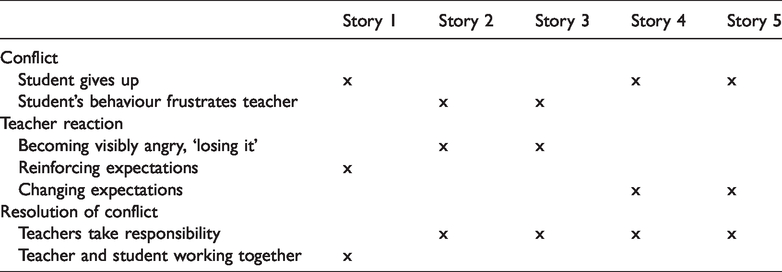
Quotes from teachers’ stories are original; any omissions are marked with an ellipses notation: ‘ … ’ and any clarifications are marked with brackets: [].
Findings
Evaluation of conflict through storytelling
Teachers structured their stories with diverging storylines, beginning with a conflict they had with a student, revealing their own reaction to the conflict and concluding their story with how the conflict was resolved. In each teacher’s story, the classroom was the setting where these tensions occurred. Some teachers shared their personal philosophy of managing relationships in the classroom as part of storytelling, weaving the story as an evaluation of their own philosophy. As a result, distinct storylines emerged (Table 3). Tensions between teachers and students were presented as originating from the students: students’ refusal to complete work, or their behaviour as negatively impacting the teacher in some way. An example of behaviour having a negative impact is in the case of one student vandalizing school property using a pen they borrowed from the teacher (Table 4). Another teacher shared that her student’s behaviour in general ‘drives me insane’ (Table 5).
Teacher interview 3.
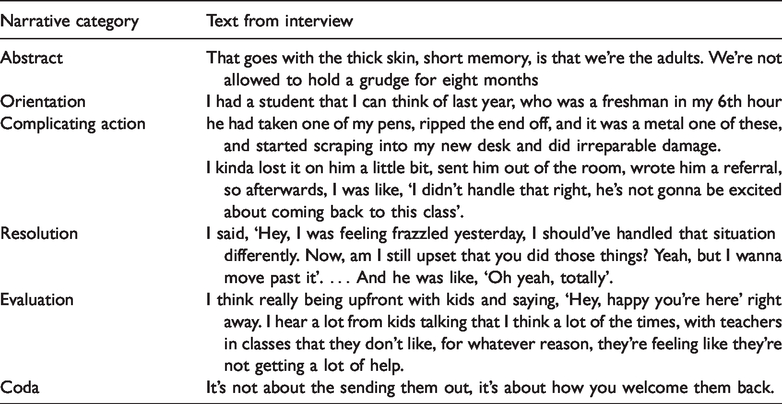
Teacher interview 4.
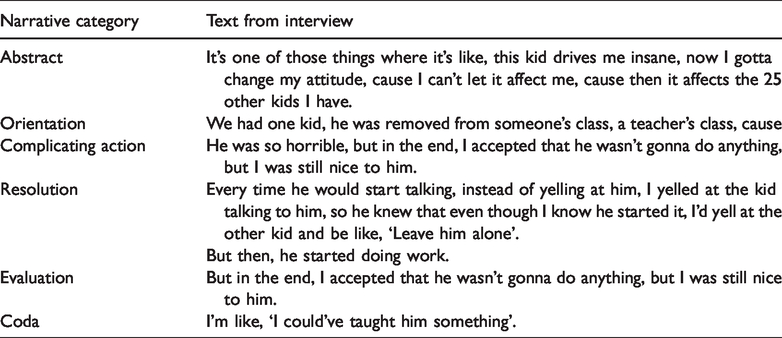
The stories from teachers revealed varying reactions to the identified conflict, including two who admitted to ‘losing it’ or ‘I let her have it’, indicating a loss of control of their own anger (Tables 1 and 4). One teacher described a student who was ‘not meeting expectations’ and noted that she was going to ‘get to her somehow’, or get through to her, without changing her expectations (Table 6). Others who noticed a student ‘giving up’ did change their expectations, modifying their own classroom rules to be accommodating in some way. In one story, a teacher describes how she let a student sit by themselves in class and not do the in-class work, while others completed it. If this student was distracted, the teacher decided to discipline the student who was interacting with them, rather than the distracted student (Table 7).
Teacher interview 1.
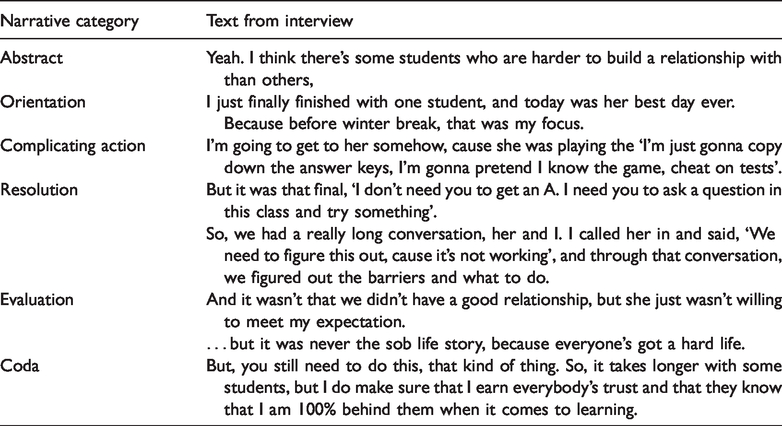
Teacher interview 5.
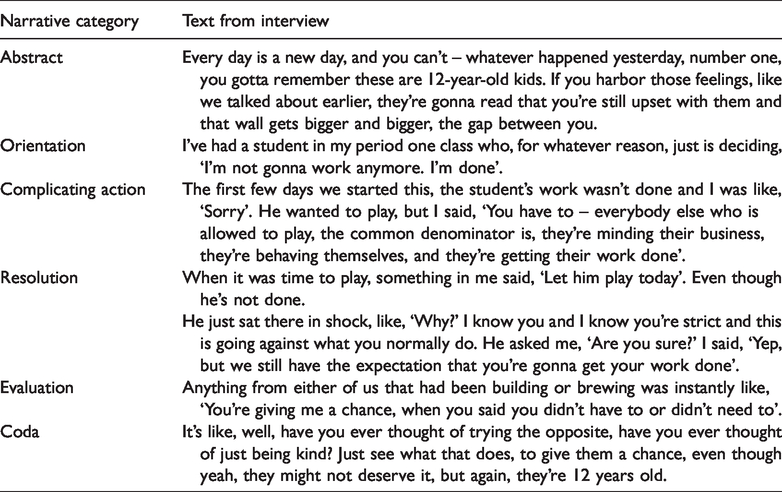
Teachers shared two types of evaluations to explain why the conflict was resolved. In the case of the teacher who did not change her expectations, she goes on to describe how she and the student worked together to find a solution. The teacher notes, ‘ … it takes longer with some students, but I do make sure that I earn everybody’s trust’ (Table 6). In the other four stories, teachers described how they took responsibility for the outcome. The teachers who ‘lost’ their temper or visibly showed anger to their students shared that they felt remorse for this choice, and felt an urgency to rectify the situation with an apology. For the teachers who changed their expectations, they too believed the responsibility was with them to find a solution for a student who may otherwise not be engaged. One teacher described his thought process in this way: ‘ … give them a chance, even though yeah, they might not deserve it, but again, they’re 12 years old’ (Table 7).
Rymes (2001) notes that the use of story form can contribute to meaning, because the speaker’s choice to order events in a certain pattern, or work with a form to bring context to certain elements, can suggest causal relationships. Labov’s narrative structure also helps illuminate how the speakers ordered a story in an evaluative way and provided their own meaning to the events. For instance, when one teacher says, ‘it wasn’t that we didn’t have a good relationship’, she is evaluating the relationship as ‘good’, even when the rest of the details of their relationship in this story may suggest otherwise (Table 6).
The stories teachers shared were from their point of view. Dialogue was imagined and ventriloquized (Bakhtin, 1981), with teachers sharing their own thoughts through dialogue, along with supposing what their students were thinking and saying out loud. Teachers’ evaluation of their reaction and resolution to a conflict were commonly interwoven with discussion of their beliefs and observations regarding building relationships with students. These utterances reflected four themes: (a) teachers sometimes give up on their students; (b) relationships take time; (c) the teacher is the adult and should act that way and (d) there is a ‘gap between you’ – a gap of trust between teacher and student that can be made worse or better.
Teachers’ and students’ voice and positionality
Wortham (2001) discusses how voice can establish ‘socially relevant’ positions for narrated characters (p. 40). The teachers use interactional positioning to describe their own roles in their stories, along with how their students are oriented in the narrative. One teacher (Table 1) describes the student in the story as a ‘terror’ and a ‘nightmare’. She attempts to establish comradery or agreement with the interviewer by qualifying this description with, ‘I dunno if you’ve heard about her’.
Teachers’ deliberate positioning in relation to their students is an act of ‘double voicing’ or ‘ventriloquation’. Ventriloquation is described by Bakhtin (1981) as the way storytellers communicate the meaning of an experience by not only in positioning themselves in relation to others, but also positioning those others by representing their imagined speech. Bakhtin argues that speakers author their own version of events in a similar way as novelists. When a speaker tells a story, they juxtapose the voices of others in order to adopt a social position of their own. Therefore, dialogues between the speaker and others in stories have similar meaning in adopting positionality.
One teacher (Table 6) does not describe the student in her story much beyond the ventriloquism of her voice: ‘I’m just gonna copy down the answer keys, I’m just gonna pretend I know the game, cheat on tests’. By using ventriloquism, the teacher is establishing a position for herself in the story as a tested authority figure. Her own voicing later, ‘We need to figure this out’, is a solution to the conflict, voiced by the student: ‘I’m gonna copy … cheat’. The student depicted here is voiced as conniving, and the voice the teacher has chosen for her is discussing ways to undermine her teacher. The student is then characterized as someone who has made a conscious decision to break the rules. ‘I know the game’ and ‘cheat’ suggest a student who is seen as having knowledge and autonomy in their decisions and has used this agency to circumvent the teacher’s authority.
While the first teacher does not use a qualification of a ventriloquized voice to describe the student in the orientation of her story, the use of the words ‘terror’ and ‘nightmare’ are a strongly negative evaluation. Both ‘terror/nightmare’ and a student who cheats are ways to set up the stories for the teachers to be in a defensive position, one who is responding to the students’ choices to act contrarily to their teachers’ expectations, rather than being a teacher who contributes to their student’s choice in any way. The second teacher says of her student, ‘I’m going to get to you somehow’. ‘Getting to’ a student is in reaction to their poor behaviour, with the teacher representing herself as an authority figure who needs to control the student’s choices for a desirable outcome.
The stories diverge in the voicing of the complicated action. The second teacher describes the student’s bad choices as the core of the story, while the first teacher uses voicing and ventriloquizing to cast herself as the one who has made a bad choice. She says she ‘let her (the student) have it’. Despite calling the student a ‘terror’ and ‘nightmare’ earlier in the story, the teacher voices the student in a seemingly reasonable way: ‘Why are you treating me this way?’ Her ordering of her reaction to the student’s utterance is immediate in the story with an apology: ‘Oh my gosh, you’re right, I’m so sorry’. This voicing places ownership of the mistake squarely on her shoulders. While the student’s reaction to her behaviour might seem reasonable on its own, an audience could also interpret the teacher’s ‘letting her have it’ as reasonable from a positioned defensive stance to a student who is a ‘terror’. The teacher might be depicting her apology to the student as even more of a feat, considering what she had been experiencing prior to ‘letting her have it’.
Rymes (2001) notes that the setting and complicating action can often dominate a story, minimizing the author’s voice. This is not the case in these narratives. The teachers in these stories insert their voice often, providing the ‘raw material’ (Wortham, 2001) to position themselves in the interactions. After establishing a defensive stance, one teacher notes that she appreciates when her students tell her she has crossed a line. She repeats the ventriloquation of her student: ‘Miss … why are you so mad?’ These are questions she is appearing to ask herself, and they may or may not have been uttered by a student in these exact ways. In a sense, she is asking herself these questions: Why is she treating them this way, and why is she so mad?
An additional voice that is present in this teacher’s story is her husband, who says she takes her ‘bad days’ out on him and the students. By including this additional voice, she may be further evaluating her actions as harming those around her when she gets angry. Her story appears to have regret, with phrases such as ‘You’re right … you guys don’t deserve this’, and adding that ‘no one learns in this situation’.
Discourse of teaching authority
Gee (2005) describes how speakers use language to establish a recognized identity. There are several instances in each story where the teachers are ‘bidding’ to be recognized as authority figures in their classrooms. The identity of an authority figure appears to be central when they are presented with challenging relationships. One teacher’s positioning in her story (Table 6) places her voice and ideas as the driving force behind the change in her student’s behaviour. She established that her student was breaking rules, they needed to talk to resolve it, and excuses were not allowed as a resolution. The student’s voice gets lost; we are not able to know what the student said in their conversation. The teacher mentions that she is ‘100% behind them’, but it appears largely driven by her own authority.
Another teacher, in comparison (Table 1), attempts to establish her teaching identity as one who is sensitive to students’ concerns when she hurts them with her actions. While she chooses to include her authority as part of the narrative: ‘I just let her have it’, she also creates an identity for herself as a teacher who is willing to accept feedback and change course. She also acknowledges that she cares about her students’ opinion of her, even with the authority she maintains: ‘You’re right, I’m in a terrible mood … no one learns in this situation’.
The onus appears to be on the teacher in the stories as an authority figure to use varying degrees of flexibility in their expectations to repair relationships with students or motivate them. The identity as rule-maker and enforcer is heavily established, to the point where one student is surprised when his teacher bends the rules for him (Table 7): ‘ … he just sat there in shock, like, why? I know you and I know you’re strict and this is going against what you normally do’. Yet, this is still the teacher’s reflection of their own authority: ‘ … we still have the expectation that you’re gonna get your work done’.
Student agency and power.
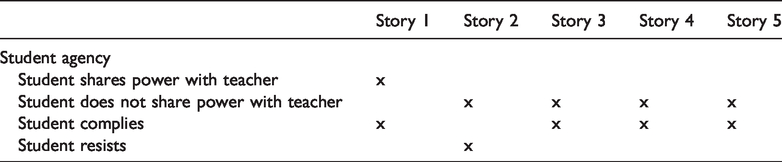
We do not learn how other students responded to the teachers’ initial reaction to the conflict, even when the teacher’s response reflected a loss of control. The student’s voice only comes in later, during the resolution, in which the relationship is repaired, or the student is compliant. One story simply includes a descriptor that a student started doing what the teacher had asked him to do. Others included teachers prompting a conversation with students, asking to ‘figure out the barriers’ or ‘move past [the conflict]’. Teachers may have left diverging student voices out of the story deliberately, to place the focus again on the teacher’s control and ability to resolve the situation. If students were not actively involved in the negotiation of how to resolve the conflict, it may not have seemed relevant to include their reactions or other responses to the conflict.
Discussion
The stories in this study contain some evidence of students’ resistance in refusing to meet teachers’ expectations or by pushing back on a teacher’s behaviour. In examination of the stories using tools from Wortham (2001) and Rymes (2001), the teachers appear to be voicing their position as teachers in an authoritative stance. Their descriptions of students in the beginning of their stories are negative in their evaluation, perhaps to show how the teachers needed to exercise power to maintain authority and legitimacy. It is also a moral stance, suggesting that students produce negative behaviour that must be corrected by a teacher.
Foucault (1980) notes that roles are repositioned constantly though discourse. Through the lens of critical discourse analysis, power can also be repositioned to the advantage of those who are dominated by it. Some teachers included details of allowing students to push back or bend the rules, but not all were provided this opportunity. There was disagreement among the stories about who was at fault for the complicating action, yet the teachers still positioned students in their stories as having some agency to change, work together with the teacher, or call upon the teacher to explain their own behaviour.
While it is unclear how much power students are granted in schools, teachers did reflect on their efforts to respect students’ points of view or admitting their own fault. Data from other interviews in this study suggest that teachers were willing to share power in other ways by utilizing student feedback to adjust their practice. However, teachers shared their power with students so long as the stakes did not threaten their authority and they could initiate the sharing of power. When students asserted themselves or challenged this authority, teachers repositioned their power in order to take control of rebuilding the relationship, all while continuing to maintain the authority granted by their role as a teacher.
While the act of complying or resisting to a teacher’s ultimate authority fits the discourse of teachers as authorities within their profession, it does not provide the freedom necessary for a student to safely resist, give their opinion or lead in any way. Roehlkepartain et al. (2017) report that young people tend to share that they typically experience higher levels of adults expressing care, challenging their growth and providing support, with lower levels of expanding possibilities and sharing power, results also replicated in other studies of student–teacher relationships (Scales et al., 2019). This runs parallel to the findings in this study; the teachers shared that they were expressing care (‘I was still nice to him) challenging growth (‘ … we still have the expectation that you’re gonna get your work done’) and providing support (‘I could’ve taught him something’). However, there is only one example of a teacher sharing power through collaboration (Table 4), and it was within the context of a teacher initiating and setting the agenda for a conversation about classroom expectations (challenging growth).
Li and Julian (2012) posit that one of the qualifications for a relationship to be developmental is for a shift in the balance of power to occur to provide young people more autonomy as they grow. Young people have shared that is important to them that the adults in their lives respect them, include them, collaborate with them, and give them opportunities to lead (Pekel et al., 2018). In describing challenging relationships with students, teachers have not provided evidence in their stories that this shift in power is actively occurring. Students did not appear to have been given opportunities to collaborate and lead when conflicts were being resolved by the teacher. Instead, teachers exercised their authority to make decisions for the student, and students either resisted or complied. Without shared power between students and teachers, particularly in situations that challenge a teacher’s authority, an opportunity is lost for the student to feel in control or autonomous, and to be part of the solution. This sense of power or autonomy is critical for academic and social-emotional outcomes, such as interest in the class or learning how to self-regulate behaviour (Black and Deci, 2000). In establishing their role as sole regulator and enforcer of rules and norms, teachers inhibit students from growing in their ability to negotiate power with others and share ownership for expectations and consequences.
The students’ perspective of whether they had agency and power in their relationships with teachers remains unknown in the context of this study. As noted by Scales et al (2019), students report that they experience share power and expand possibilities less frequently in developmental relationships between teachers and students. Moreover, although these findings were seen in a U.S. context, research has shown that only a bare majority, 52%, of youth worldwide in an aggregate database of 30 countries report having good developmental relationships with their teachers and other school adults (Scales and Roehlkepartain, 2017). Future research would benefit from exploring students’ perceptions of challenging relationships with their teachers, and the factors that allow a student to feel as though they are able to resist teachers, share power with them or collaborate in creating and maintaining classroom expectations.
The findings in this study provide implications for teachers’ practice in sharing power with their students during situations of conflict or resistance. Teachers can consider reflecting on their role as an authority figure within the profession and how their desire to control a difficult situation may prevent students from contributing to a solution. Students ultimately grow and benefit from sharing power with their teachers and learning to negotiate agency, rather than relying on a teacher to regulate an outcome. It is certainly more difficult to give up power during a power struggle; yet, teachers remember their students’ voices of resistance. How much power a teacher or a student has to resolve a conflict is ultimately up to the teacher. By sharing this responsibility, both teachers and students benefit from a stronger relationship, a collaborative resolution and a more equitable environment.
Footnotes
Declaration of Conflicting Interests
The authors declared no potential conflicts of interest with respect to the research, authorship, and/or publication of this article.
Funding
The authors disclosed receipt of the following financial support for the research, authorship, and/or publication of this article: This work was supported by the U.S. Institute of Education Sciences (grant number R305H170078).
