




Abstract
This study considers the issue of absenteeism in Norwegian high schools with a particular focus on the new controversial 10% ceiling, which began in August 2016. Data was obtained through documentary sources and participant observation in one high school with one of the highest absenteeism rates in the capital, Oslo. Employing Foucault’s ‘panoptic gaze’, the study also interrogates schools’ growing dependence on technology in self-reporting absence and enacting more effective forms of ‘disciplinary power’. The study argues that each school and each individual case warrant careful attention before macro-policies on a national level are enacted by politicians, who at best have a superficial familiarity with the challenges and uncertainties that constrain these students’ academic progress.
Introduction
This study considers the issue of absenteeism and truancy in one Norwegian high school, with a particular focus on the new controversial 10% ceiling, which began in August 2016. In 2008, the then Minister of Knowledge, Kristin Halvorsen, of the Norwegian Socialist Left Party, abolished the earlier practice (the Møglestu-modellen) where schools adhered to varying absenteeism limits ranging between 10% and 20% (Ruud, 2016). The current Conservative coalition government passed a law in August 2016 stating that students whose absenteeism rate is more than 10% in any given subject will fail to secure a grade in that subject. However, according to the Norwegian Directorate for Education and Training (2016), the new rule gives some latitude to school heads to grant grades to students whose absenteeism is in the 10–15% range. According to Kearney (2016: 2), absence from school can either be excused or unexcused. Illness, hazardous weather conditions, a family emergency or travel, for instance, constitute excused absence, while unexcused absences refer to those that are illegal. Truancy, according to Kearney, constitutes illegal, unexcused absence from school; the term is sometimes applied to youth absenteeism marked by surreptitiousness, lack of parental knowledge or child anxiety, criminal behaviour and academic problems, intense family conflict or disorganization, or social conditions such as poverty. (Kearney, 2016: 3)
The school is located in a borough with the second-largest prevalence of minorities in Oslo (32.5%) and the highest dropout rate (12.3%). There is a consensus that the current high rates of absenteeism are unacceptable, but political parties and stakeholders in education are divided in arriving at optimal solutions. Several studies have highlighted the pernicious long-term effects that absenteeism can have on school performance (Kearney, 2016; Calderon et al., 2009; Henry, 2007). Even a 12% absence in a school year may impact negatively on health, self-efficacy, self-perception and developmental competence (Schwartz et al., 2009). According to the annual Organisation for Economic Co-operation and Development (OECD, 2016: 46) report Education at a Glance, Norwegian students performed below average in the number expected to complete upper secondary school in 2014. While countries such as Israel, Hungary, Latvia and Chile – which invest less than Norway in education – were above the OECD average of 85%, Norway was below the average (c.82%). Thus, while the government’s efforts at grappling with this challenge are laudable, this study argues that the introduction of a new 10% ceiling may favour quantity over quality, for two main reasons: (1) teachers’ bureaucratic workload is increased, with less time for actual teaching, and (2) the ruling does not recognize the challenges specific to students from minority backgrounds, whose numbers have seen a 52% increase in just four years (2009–2013) (Thomas and Breidlid, 2015; Thomas et al., 2016). The following quote puts the changing demographics into perspective: In 2004, the total number of upper secondary students with an immigrant background in Norway was 13,800 (85% nationally). Last year (2013), this student cohort stood at 22,300 comprising a 52% increase over the course of just 4 years (2009–2013). On a national basis, Statistics Norway predicts, based on the figures for 2010, that 22–28% of the population of Norway will be from immigrant backgrounds in 2060 (Statistics Norway, 2010). The majority of the 14.9% of immigrants have roots in Africa and Asia (8.5%). (Thomas and Breidlid, 2015: 350)
While the socio-economic and historical trajectories of Norway and the UK are different, there is some overlap in terms of the particular struggles that certain students from immigrant/refugee backgrounds face. Reid (2012b: 219), one of the foremost authorities on truancy and absenteeism, states: ‘Further research to explore pupils’ views about their own attendance and behaviour is another fruitful avenue for research’. It is precisely such concerns that underpin this study.
The discourse of absenteeism
A further distinction needs to be made with respect to absenteeism and students who drop out. As a teacher in upper secondary, the lead author’s concern was with fravær, or student absence from classes irrespective of the reasons behind the absence. The objective of reducing absence with the help of several professionals, such as psychologists, nurses and even representatives from the employment office (the Norwegian equivalent of a UK Job Centre), was to avoid students dropping out. A student who drops out loses her right to study at that particular high school, which is perceived as a drastic final resort. Such is the concern with students dropping out that the authorities are now permanently stationing more professionals at a growing number of upper secondary schools in the hope that these students continue with their studies and not be a burden to society. These representatives, although not in the teaching profession, become an integral part of the school apparatus.
There is no consensus in the literature about the term ‘absenteeism’ or what percentage of absence should be considered problematic or chronic absenteeism. Researchers consider an absence of more than 15% as chronic absenteeism, and argue for early identification and intervention (Askeland et al., 2015: 1) . Norway’s adoption of a 10% cut-off benchmark may be may be influence by what some countries (for example, the USA) refer to as Tier 2 problematic absenteeism (Skedgell and Kearney, 2018) . In Germany, Pflug and Schneider (2016) used online self-reporting websites to collect data from high school students because of the existing difficulties in consensually defining absenteeism and methodological weaknesses in data collection. They found that ‘[a]bsent students lived less often with both parents, were on average of lower socioeconomic status, and reported more emotional problems, behavioural problems, and less prosocial behaviour than attending students' (Pflug and Schneider, 2016: 427).
In Norway, high school students are awarded two grades – one that reflects the student’s academic grades and another that reflects their attendance rate. Prior to the new 10% absenteeism ruling, students with very high absenteeism rates (for example, 50%) could still expect to receive an academic grade. With the new ruling, however, students with more than 10% absenteeism fail to receive an academic grade. Many students often work part-time in the evenings, weekends and during the summer holidays. Teachers are expected to warn students that employers often consider their absenteeism rates before employing them. In Norwegian high schools, the term bortvist (‘expelled’) is used to denote expulsion from the classroom and school premises for just one school day, not ‘permanent expulsion’, such as in the UK. By ‘dropping out’, we mean those high school students who opt to discontinue their studies and forfeit their place in either the first, second or final year. There are no consequences, as enrolment in high school is not mandatory in Norway, although the Socialist Left Party has argued that high school attendance should be mandatory until the age of 18, given the paucity of skilled jobs in the market (Dagens Næringsliv, 2016) .
Of concern, and pertinent to Foucault’s analysis of power, is the nature of the discourse disseminated through the new 10% ruling. Discourse is fundamental to Foucault’s (1977) understanding of the way in which society frames a particular subject. Who are the beneficiaries and the disadvantaged in this new ruling supported and perpetuated by a network of politicians and professionals associated with education? Foucault contends that power works through discourse to shape popular attitudes towards phenomena such as crime, madness or sexuality. If ‘expert discourses established by those with power or authority can often be countered only by competing expert discourses’ (Giddens, 2001: 676) , then this study seeks to query the machinations of the way in which power and knowledge are linked to technologies of surveillance, enforcement and discipline.
Theoretical framework
Foucault and the regime of discipline
Foucault (1977) employs the British philosopher Jeremy Bentham’s panopticon – a 19th-century design for a model prison – as a metaphor to explore the manner in which institutional apparatuses exercise power. In the panopticon, the cells of inmates were arranged around a central tower, with the architecture conveying the sense that they were perpetually under observation, although this may not have been the case. The human body was entering a machinery of power that explores it, breaks it down and rearranges it. A ‘political anatomy’, which was also a ‘mechanics of power’, was being born … They were at work in secondary education at a very early date, later in primary schools. (Foucault, 1977: 138)
Furthermore, secondary schools furnished perfect enclosures that were heterogeneous to others upon which monastic discipline was exerted. Ultimately, the aim is to reach a state where students internalize the norms, rules and laws of the school without the constant presence and supervision of teachers. ‘Foucault’s view is that educational practices that may appear more democratic, participatory, or progressive may in fact be more effective forms of disciplinary power’ (Anderson and Grinberg, 1998: 331). It would be simplistic to suggest that schools should not expend effort in exploring ways to ameliorate absenteeism. Foucault has been critiqued by, among others, Said (1986: 151) , who contended that ‘Foucault seemed to have been confused between the power of institutions to subjugate individuals, and the fact that individual behaviour in society is frequently a matter of following rules of conventions’. However, commensurate with this study’s argument is Foucault’s concern with society’s obsession with constantly developing cheap and easy techniques of regulation and supervision – hence Bentham’s panopticon. Schools, for instance, aim to standardize practices of reporting absence by employing smartphones, but these gadgets do not recognize students’ differential socio-economic status. While all ‘participate’, there is nothing to commend this as ‘progressive’ (Anderson and Grinberg, 1998: 331). While other studies caution that it is still too early to draw conclusions, most agree that the number of vulnerable students who drop out has risen (Bjørnset et al., 2018) . Like the panopticon, then, the co-option of technology (for example, smartphones) in the surveillance and visibility of students becomes a moot point. While not denying the need for some form of regulation and conformity in schools, Foucault’s (1977) concern with the manner in which society’s disciplinary capacity (carceral) may be counterproductive is salient.
It must be kept in mind, however, that Foucault’s disciplinary regime does not entail a totalizing ‘master narrative’. Indeed, this would be antithetical to the spirit of postmodern thought. Rather, Foucault conceives of power as both repressive and productive – there is latitude for ‘acts of transgression’. To Foucault, the nexus of power and knowledge is to be analysed synchronously as the one entails the other in a matrix-like, shifting scenario. Jettisoning one regime of truth runs the risk of establishing another: The role of the intellectual is not to tell others what they have to do … it is through the analyses that he carries out in his own field, to question over and over again what is postulated as self-evident, to disturb people’s mental habits, the way they do and think things, to dissipate what is familiar and accepted, to re-examine rules and institutions. (Foucault, 1980b: 265)
Methodology
This research was threefold. The first part involved the analysis of official documents in the public domain. These electronically available websites (for example, minOsloskole.no) report statistics on absenteeism rates, entrance scores and dropout rates, and a host of other figures for each high school in Oslo. The availability of every high school’s data on figures such as entrance scores, dropout rates and completion rates, among others, is a recent phenomenon in Norway and runs contrary to the cherished spirit of egalitarianism. Affluent families, for instance, seize on these figures to avoid underperforming schools, resulting in a further exacerbation of the ‘east–west’ divide. Hence, rather than wielding its considerable power and influence to redress the growing educational divide in Oslo, the authorities, perhaps inadvertently, become the handmaiden of the wealthy. A crucial consideration in this regard is the nexus between governmentality and the manner in which the modern state exercises social power in comparing and ranking schools according to distinct registers of ‘domination’, ‘exploitation’ and ‘subjectification’ (Foucault, 1983: 213) . Foucault employs the metaphor of the ‘police’ to give expression to this multi-pronged administration that is concerned with how the population lives. The meticulous attention to figures and statistics that purport to be ‘neutral’, and in the interest of the public at large, aligns with Foucault’s designation of the modern state as the ‘pastor’ concerned with the ‘good of the soul’ (Carrette, 1999: 139) . The maintenance of these statistics – a ‘pastoral technology’ – is made possible through a bureaucracy tasked with a multifarious portfolio that includes absenteeism rates.
The data generated in the second part of the research was gained through in-depth interviews conducted when was employed as a full-time teacher at the high school for a period of one year. Permission was obtained from the head teacher and the data was anonymized. Twenty-one students were interviewed. The Norwegian Centre for Research Data (2017) stipulates with regard to children: ‘Depending on the project, common practice is an age limit of 15 to give consent, and 16–18 when gathering sensitive personal data’. All of the interviewees were over 16 and gave verbal consent to be interviewed and for their data to be processed. Hence, the need for parental consent was waived, which was just as well because the majority of the students interviewed had come alone to Norway. Furthermore, informed consent can be verbal or written, according to the Norwegian Centre for Research Data. That the students were physically present and willingly gave of their time attests to this verbal consent. Prior to each interview, the students were clearly informed about their right to withdraw and the use which their data would be put to.
The students filled out a standard form, which constituted the basis for a one-on-one conversation with the teacher. Often, many students answered these questions with expressions like ‘I am happy in this school’, ‘Nothing to discuss, really!’ and ‘Yes’ or ‘No’. Given the brevity of these responses, the follow-up ‘interviews’/conversations were intended to flesh out the students’ responses. The oral responses were transcribed verbatim. In the coding process, embryonic phrases were underlined and served as guidelines for constructing individual storylines (a narrative report). This was, in turn, used to distil concepts through a comparative iterative coding process of in-case and across-case analysis, commensurate with a grounded theory approach (Glaser and Strauss, 1999 ; Corbin and Strauss, 2008 ).
The third approach employed in generating data was participant observation, understood as a form of autoethnography. Cohen et al. (2007: 404–405) outline several aspects of participant observation: a substantial period of time; recording events; taking a role in the situation; sharing supervision; participating in school life; and recording impressions, conversations, behaviour, activities and the views of the participants. Hammersley (2006: 102) also highlight the salience of field notes as a key component of participant observation and crucially add that the interpretation of interviews, for instance, is often impacted by impressions created during participant observation – for example, non-verbal cues. It is obvious that some of the data elicited in this study was only possible through the lead author’s privileged access as a participant observer. This data includes the following: field notes soliciting students’ ethnic backgrounds and length of stay; notes jotted down during staff meetings about students’ absenteeism and potential remedies; students’ comments about the stress generated by smartphones (in the service of the absenteeism regime); and information about the theft of teachers’ laptops and smartphones. The note about a parent who lived in the vicinity of the school without knowing its precise location was also gleaned through participant observation. More importantly, we use the term ‘participant observation’ to draw attention to the reflexive process involved in developing a ‘double awareness’ of being a full-time teacher and researcher simultaneously – through note-taking at the end of the day, for instance. Using self-narrative, practitioner scholars can engage in and document their reflexive processes regarding their involvement in the research endeavor as both researcher and practitioner. Furthermore, examination of these narratives can reveal points of leverage, moments, or conditions in which shifts in their negotiation of the participant observer process might yield more favorable outcomes. (Kennedy-Lewis, 2012: 112)
The data collection involved, for instance, a biannual one-on-one discussion with each student employing a ‘student form’ with predetermined questions about students’ ‘progress’ (elevskejma), which all lead teachers are expected to fill out and archive in students’ files. In particular, it was during these discussions that high absenteeism rates were raised with the student and alternatives to ameliorate the absenteeism explored. It is the lead teacher’s responsibility to ascertain which code (for the list, see the ‘findings’ section) students will be assigned at the end of the day. The study, therefore, has relied on the absenteeism record equivalent to one year of data from the digital educational platform itslearning. Furthermore, five meetings (firkant møte or a meeting involving four stakeholders) were held between the section leader, school advisor, social services representative and lead teacher, where students with high absenteeism and solutions were on the agenda. To complement the above, some background information, albeit limited, was obtained through the biannual teacher–parent meetings.
Of particular concern is the faith placed in modern technology, as evidenced in the case of students self-reporting their absence using smartphones, for instance. There is the unquestioned belief that deploying technology in this manner will translate into higher rates of attendance and the corollary of higher rates of completion. Foucault (1980b) notes how institutions reorganize and redefine the objects of their investigation (for example, the child). Power acting on the action of others is what he calls ‘deployment’. To his mind, this is often triggered by a crisis or ‘urgent need’, as is the case with the 10% ruling. The new ruling conforms to a vision that links physical presence in the classroom to successful educational reform. The right-wing neo-liberal political ideology from which it emanates is not made explicit, nor is the impact on the unified subject. The ruling has mobilized various professionals from disparate fields of expertise (for example, nurses, psychologists, social workers and even Job Centre staff) to work in schools and rub shoulders with teachers on a daily basis; they have been allocated offices on a long-term basis, reminiscent of Bernauer’s (1990: 145) description of deployment: ‘A heterogeneous ensemble of discourses, institutions, architectural arrangements, administrative procedures, and so forth’. This deployment, it is argued, reduces the purposes and quality of education, especially for the more vulnerable students who obsess about absenteeism.
Teacher as researcher
The teaching practicum has traditionally valorized content knowledge, skills and teaching practices to the detriment of the social and educational context. In recent years, however, the teacher-as-researcher methodology has provided a scientific basis for teachers, often in collaboration with researchers, to generate new knowledge by building on their own experiences at the ‘classroots’ level (Houser, 1990; Cochran-Smith and Lytle, 1999; Hopkins, 2014). The latter is commensurate with Dewey’s concern with enhancing the judging abilities of practitioners as a catalyst for intelligent action. The ‘teacher research’ approach that guided this study is captured in the following definition: Teacher Research refers to the inquiries [of] K–12 teachers and prospective teachers, often in collaboration with university-based colleagues and other educators. Teacher Researchers work in inquiry communities to examine their own assumptions, develop local knowledge by posing questions and gathering data, and in many versions of Teacher Research work for social justice by using inquiry to assure educational opportunity, access and equity for all students. (Somekh 2009, p. 40)
Clearly, the teacher as researcher might produce its own ‘regime of pedagogy’. From the perspective of students, this shift in role – from teacher to researcher – is immaterial; the teacher is still perceived as an integral part of the school system, with all the disciplinary power this entails. Foucault did not consider power to be an evil. While justifying the institution of pedagogy that transmits knowledge and communicates skills, his concern was with ‘the effects of domination which will make a child subject to the arbitrary and useless authority of a teacher’ (Foucault, 1988: 18) . Assuming the role of teacher as researcher reinforced the preoccupation with ‘normalization’, understood in this research as documenting and explaining why so many deviate from the acceptable ‘standard’ of 10%. Such standards, following Foucault, are obviously arbitrary and contingent on the political parties in power. The teacher as researcher, then, can be perceived as an extension of the techniques of surveillance. That the method generated data from official documents, interviews, classroom discussions and information provided by social workers, for example, is commensurate with Foucault’s (1977) view that power relations are capillary and tentacle-like: local, unstable, diffuse and emanating from several sources. While it would be duplicitous to deny the above, and the extent to which the students embraced our endeavour as sympathetic to their cause remains ambivalent, it is argued that some of the concerns were ameliorated in adopting a Foucauldian analytics of power. As Gore argues: Attempting to understand those processes and remove those that are harmful cannot, in my view, be any more dangerous than maintaining what already exists … The microlevel focus of Foucault’s analytics of power, therefore, not only is useful for understanding power’s operation in specific sites … but also has clear potential in addressing possibilities. (Gore, 1998: 249)
Findings
Absenteeism and minority demographics
With regard to the high schools in Oslo (see Table 1), non-private high schools were selected as the majority of students attend such schools and, more importantly, the bulk of students from minority backgrounds attend publicly funded schools in the main. The schools listed as official were taken from the Oslo Municipality website (Oslo Kommune, 2015–2016). The percentage of minorities in each school is based on the statistics available for the borough where the school is located (Dzamarija, 2014: 49). The average dropout rate for all upper secondary schools in Oslo is 2.8% (Oslo Kommune Utdanningsetaten, 2015–2016). Three schools – Edvard Munch, Blindern and Eikelund – were omitted because no statistics were reported. The other schools that were not included were schools that catered for students with special needs (for example, Kirkeveien).
Types of high school in Oslo.
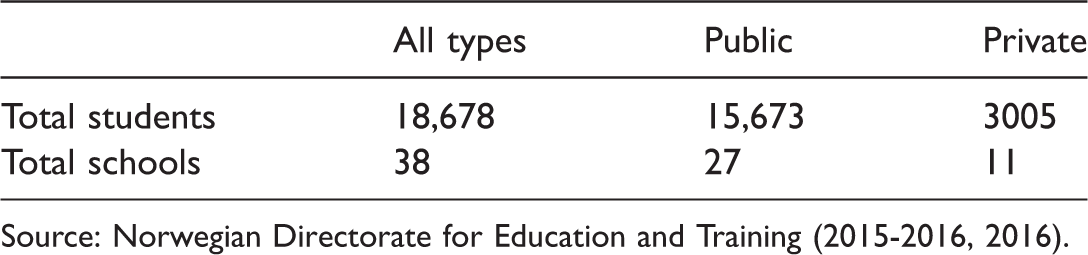
Source: Norwegian Directorate for Education and Training (2015-2016, 2016).
The statistics published by the school authorities do not register figures based on ethnicity. The figures in Table 2 were solicited through two sources: minOsloskole.no and Statistics Norway. The former publishes publicly accessible data on several indices, including absenteeism and dropout rates for each high school in Oslo. The latter gives a breakdown of the ethnic composition in each borough in Oslo. Juxtaposing the two variables, along with dropout rates, allows for some analysis and conclusions to be drawn, albeit with caveats. One important caveat is that the category for minorities says nothing about age, gender, length of stay and the parental-education level of the group. As the following quote indicates, children born in Norway to immigrant parents tend to do better than those who were born abroad: ‘There is still a clear disparity between immigrant and Norwegian-born to immigrant pupils. While 39% of the immigrant pupils completed within the nominal study period, the corresponding figure for Norwegian-born to immigrant parents was 57%’ (Statistics Norway, 2016).
Absenteeism, minorities and dropout rates in Oslo Kommune Utdanningsetaten (2015).
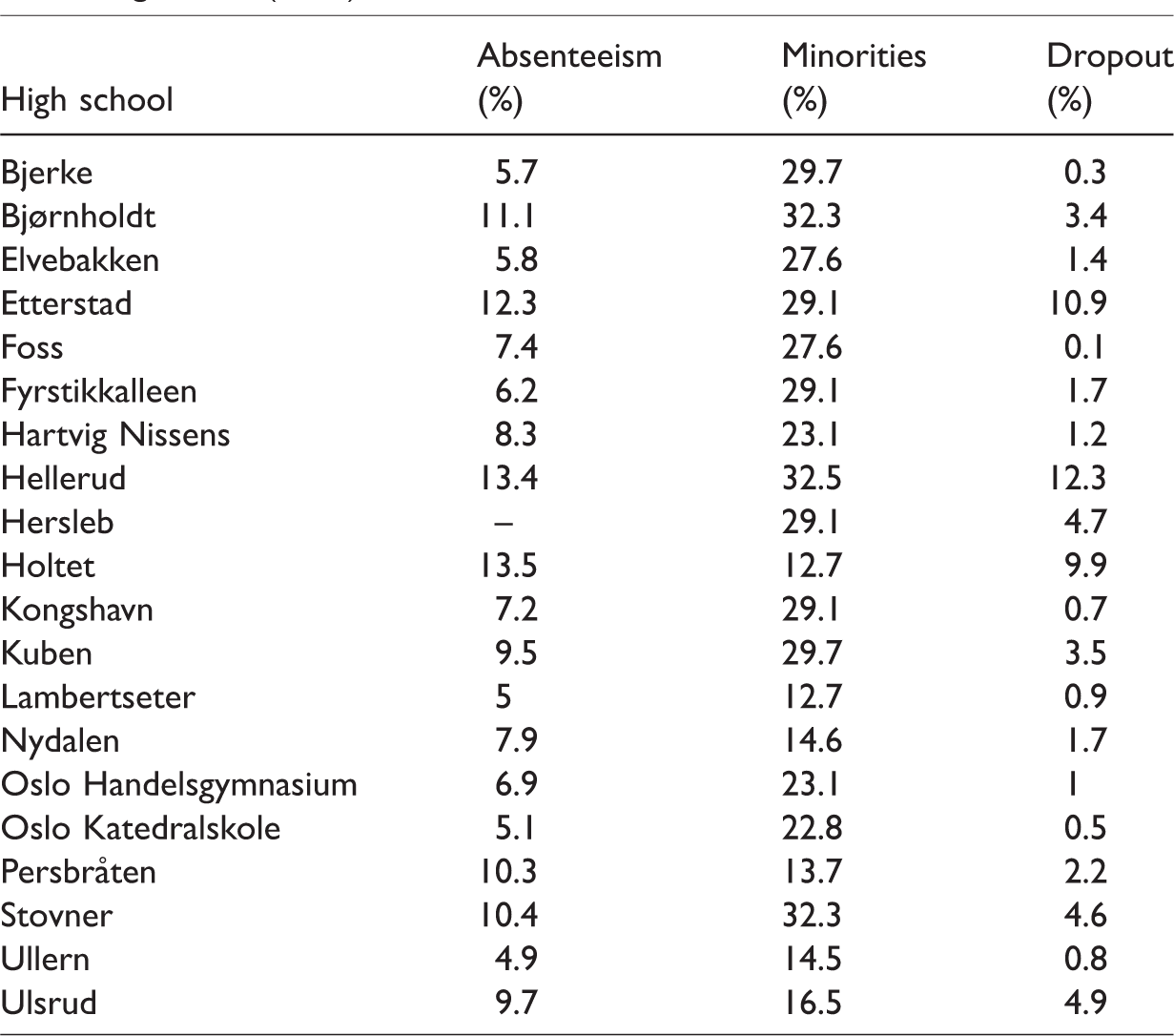
The heading ‘minority’ in Table 2 does not refer to ‘enrolment’ but to the percentage of minorities resident in the borough. Schools are not allowed to divulge statistics on students’ ethnic backgrounds, but one can surmise from the numbers of minorities in the various boroughs of Oslo roughly what ethnic percentages can be expected. The boroughs of Holtet and Ulsrud are anomalies. These schools have lower minority enrolment compared to boroughs with higher minority numbers resident, but the numbers are nevertheless high when one considers that these are upmarket areas with some of the highest incomes in Oslo (for an overview of average earnings in the various districts, see Oslo Kommune Statistikkbanken, 2017 ). While the average annual earnings for Holtet and Persbråten were US$89,000 and US$105,000, respectively, those of the district where this study was conducted were less than US$39,700. Several of the educators who were consulted were of the opinion that although minority uptake is lower in Holtet, Persbråten and Ulsrud, for example, minority background students do aggravate absenteeism rates.
From a macro-exploration of high school absenteeism and minority rates in Oslo, the next section considers one high school class where the lead author was lead teacher for the 2015–2016 academic year.
Absenteeism in one class: snapshot of a week
Johnson High (pseudonym) is a high school with one of the highest minority concentrations in Oslo. Whereas the best schools in Oslo require an entrance score of 50, Johnson High operated with less than 31 in 2015 (the average for all high schools is 39.7). High schools in Oslo operate with average and minimum entrance scores. The average entrance score refers to the average score of the total number of students who apply to each high school. Generally, the more popular high schools will invariably score a higher average, as the competition to enrol is high. Many high schools also operate with a minimum entrance score. This reflects the score of the student with the lowest total score, and is additionally contingent on the relationship between the total number of applicants and the total number of places available, which means that the minimum entrance score varies annually. For instance, Persbråtan high school, although situated in an affluent district, had the lowest minimum entrance score of 30 points for the 2017–2018 academic year, while Nydalen had 50.4, the highest minimum entrance score in Oslo (Oslo Kommune, Nedre poengrense, 2017 ). Johnson High operates with the following absenteeism codes from its Teacher’s Handbook. Although the handbook may be accessed electronically, the source is not divulged as the school’s name appears on the front page (all translations from the Norwegian are ours):
U = the absence is not documented; has consequences for behaviour (remark; i.e. negative comment that has consequences) L = the student has informed the teacher (no remark) D = documented (reasons subsumed under point 8 of the Teacher’s Handbook; e.g. health; participation in political work; responsibilities as class prefect; volunteer work; court summons; maximum of two days of leave granted for religious holidays; no remark) R = religious holiday (no remark) E = doctor’s note. This absence is deducted at the end of the year (no remark) B = Expulsion. Remark may appear in the school leaving certificate A = Other agreed teaching/assignment. E.g. work as school prefect or leave for exam study (students in Norway can claim leave to study if selected for exams; no remark) In case of absence, the student alerts the lead teacher through SMS [text], email or telephone. Students must do this at the moment they were expected to be at school … If the total absence is more than 8 days/40 hours [i.e. before the Christmas break], the lead teacher calls the student in for a meeting. Before the autumn break, the student must be called in if absence exceeds 3 days/6 hours. The purpose of the meeting is to explore ways of reducing absence.
The handbook makes clear that students are expected to constantly monitor the codes, with a deadline of one week to report back to the lead teacher in case of error. This implies that all students have access to mobile phones with an Internet connection. All teachers are given state-of-the-art smartphones through which they monitor student messages and update the register accordingly. Some of the codes overlap, with teachers experiencing some ambiguity about the difference between a D and an E, for instance. According to the handbook:
U, for instance, constitutes all absences where the student either fails to notify the teacher or the absence is invalid. Let us say, as was often the case, that a student simply failed to show up for a lesson. The teacher enters a U. In a few cases, the lead author decided to follow up on the reasons given for absence and discovered that the students had lied. For instance, a student had reported an appointment at the dentist. In such a situation, the teacher enters an E (a doctor’s note). However, on calling the dentist’s surgery, it was discovered that such an appointment never transpired, and that the note was a forgery. Obviously, given the gravity of the deception, the case was referred to the appropriate staff. The student was informed that a B (expelled) would be entered on his attendance record and he would have to stay away from school on the following day. The code L comprised the majority of attendance entrances. L stands for ‘legitimate’ absence. All a student had to do was send a text stating why they should get an L and not a U. The students generally put in some effort to avoid or reduce an A code. This is because a certain number of A codes (approximately eight days in total) will affect the student’s remark on ‘Behaviour’. High school students receive two grades/evaluations on their certificates – one for their academic performance and the other for behaviour. A student who sends a text explaining why they are unable to attend (for example, severe delays because of construction work) will receive an L code. The L does not affect ‘Behaviour’ but the total number of L codes is nevertheless there for a potential employer to consider. Eight out of the 21 (38%) students in the author’s class (August–December 2015) exceeded the ceiling of eight days before the first semester ended. Whereas 105 hours came under the category U, only 14 were registered as L.
The above encapsulates Foucault’s (1977: 167) argument that discipline is ‘cellular (by the play of spatial distribution)’ and ‘it arranges “tactics”’. Discipline, according to Foucault, involves the drawing up of tables, coding of activities and prescription of movements, among other things. The term ‘partitioning’ is also apposite in this context (Foucault, 1977: 143). In seeking to mould what Foucault (1977) calls ‘docile bodies’, absence is codified and hierarchized. At regular intervals, a number of professionals – teachers, section leaders, social workers, school advisors and Job Centre representatives – scrutinize the codes and prescribe action contingent on the severity of the absence. It is worth quoting Foucault at length to appreciate the aspiration of disciplinary space: One must eliminate the effects of imprecise distributions, the uncontrolled disappearance of individuals, their diffuse circulation, their unusable and dangerous coagulation; it was a tactic of anti-desertion, anti-vagabondage, anti-concentration. Its aim was to establish presences and absences, to know where to locate individuals, to set up useful communications, to interrupt others, to be able at each moment to supervise the conduct of each individual, to assess it, to judge it, to calculate its qualities or merits. (Foucault, 1977: 143) In this great tradition of the eminence of detail, all the minutiae of Christian education, of scholastic or military pedagogy, all forms of ‘training’ found their place easily enough. For the disciplined man, as for the true believer, no detail is unimportant, but not so much for the meaning that it conceals within it as for the hold it provides for the power that wishes to seize it. (Foucault, 1977: 140)
The next section considers findings related to the high absenteeism rates. The data was collected over the course of two years, as a subject teacher of English in the first year and then as a lead teacher (lead author), through several meetings with the students, the parents of those under 18 and the support apparatus at the school.
Reasons underpinning high absenteeism rates at Johnson High
Under the heading ‘Routine for following up student absence’, the Teacher’s Handbook states:
4.a. Measures that can be initiated to reduce further absence: regular meetings between the student and lead teacher, drawing up a contract, closer monitoring/follow-up [tettere oppfølging] in collaboration with parents/guardians or detention at the ‘Learning Centre’ in agreement. 4.b. When deemed necessary, the lead teacher consults the school advisor, nurse, minority affairs advisor, section leader, etc. 5. If the absence continues despite meetings and follow-up, the case is referred to the school advisor.
Before the end of each semester, lead teachers prepare a report with the names of the students with high absenteeism rates. Those with 15–30 Us end up with the remark ‘NG’ (Nokså God), which approximates to the English ‘Quite Good’, while ‘LG’ (over 30 Us) stands for Lite God (‘Poor’). This can impact negatively on students’ future employment prospects. On several occasions, the leadership has warned students during assembly that even those seeking short-term summer jobs could find their applications jeopardized by a poor attendance record. Students who bring a note from the diverse school-based support staff, or even a medical doctor, have the right to be marked with the code L. Significantly, the total number of Ls for the entire year appears on the final leaving certificate. Although not perceived as a form of truancy, it could potentially raise several questions in a future job interview. This could, for instance, prompt a potential employer to dig deeper and perhaps expose health-related problems. In what follows, some of the reasons underpinning the high absenteeism rates are explored. All of the absenteeism rates are for the 2015–2016 academic year. Non-traceability in educational/social research cannot be guaranteed (Cohen et al., 2007: 64), but, where possible, the information has been suppressed to enhance anonymity. Some of the notes below have been taken verbatim from reports prepared after conversations with these students. The typical findings have been thematized and are followed by a discussion.
Brevity of stay and linguistic challenges
39 days and 249 hours of absence. The student has been in the country for less than five years. Although relatively fluent in oral Norwegian, his academic performance was very poor. After several rounds of consultations with support staff, the student agreed to try his hand at a vocational trade. It also emerged that the student’s parents were unaware of his struggles at school.
64 days and 195 hours of absence. The student has been commended by several teachers for her overall courtesy and all-round good behaviour. Unfortunately, her academic progression has been seriously hampered due to linguistic challenges linked no doubt to the brevity of her stay in Norway (three years). After a few rounds with the advisor and department head, the student has now enrolled in another high school, where she will study catering.
During several meetings with various staff assigned to monitor the progression of students, subject teachers would warn that these students were on the verge of failing the subject due to a poor command of the language. During the interviews and biannual discussions with these students, it emerged that some were born in Norway but their parents enrolled them in schools in Africa or Asia for reasons related to religion, a perceived lack of discipline or simply a desire for better cultural competence. The above challenges amplify the already severe challenges associated with the recent influx of refugees from countries like Syria and Eritrea. A recent documentary on national television drew attention to the plight of students from Somalia who were forcibly enrolled in religious schools in Somaliland, provoking a national outrage, with the lead author being invited to discuss the issue with the then Minister for Immigration and Integration.
At this particular school, teachers voiced concern at what they perceived as a ‘dilution’ of academic standards generally in several high schools in the east of Oslo. The teaching staff at this school have often rebuked students for speaking in their mother tongue and bemoaned the poor standard of Norwegian heard in classrooms and on campus. This resonates with figures from the authorities that show an exponential rise in the number of high-school-aged students coming from refugee/immigrant backgrounds and attending high school in the last few years. For example: ‘Preliminary figures in autumn 2012 show an increase of 5 700 pupils in upper secondary education from the previous year. Fifty per cent of the increase is due to higher participant rates of immigrants in upper secondary education’ (Statistics Norway, 2012). On the other hand, the teachers at this school have often felt conflicted with regard to these students because, although linguistically challenged, there was some consensus that they were courteous and better behaved than students who had been born and brought up in Norway alone.
Refugees who come alone
10 days and 84 hours of absence. The student always does well when he sits for tests and exams. However, he often has to attend meetings with diverse representatives of the government – police, nurses and housing, among others, because of his vulnerable status as a recent refugee.
It was noted earlier that children born in Norway to immigrant parents perform better educationally than those who were born abroad (Statistics Norway, 2016). Of the 475,340 who are registered as non-European (i.e. from Asia, Africa, South America and Oceania), the bulk (359,085) are immigrants who were born abroad. In addition, the last few years have seen a sharp rise in the number of immigrants who have come to Norway seeking asylum or refugee status from war-torn or unstable countries like Syria, Somalia and Eritrea. Statistics Norway (2015) reports that ‘[t]he net immigration of non-European citizens increased from 14 700 in 2014 to 17,100 in 2015, increasing their share from 38% in 2014 to more than half (54%) in 2015’. When these figures are seen in conjunction with findings from other contexts, such as England (Reid, 2003), the authorities can expect high absenteeism to correlate strongly with student cohorts from minority backgrounds for some time to come. Clearly, Reid’s (1999, 2003) observation that efforts to address absenteeism levels at the national level must take cognizance of the home background and existing demographic and cultural changes is relevant in the Norwegian context.
Lack of home support
13 days and 86 hours of absence. The student came to Norway alone four years ago as a refugee. He is eager to learn and is popular among classmates. The bulk of SMS text messages he has sent revolve around meetings with the police, housing agents and social services. He is working on securing his residence permit. Given the precariousness of his situation, it is understandable that he is unable to give undivided attention to his studies.
20 days and 129 hours of absence. Born and bred in Norway; average academic results. Severe problems on the domestic front. The student has had to sleep rough and rely on the charity of friends. He has now secured shared accommodation and is making every effort to attend classes regularly. Still relies heavily on the school support apparatus.
As lead teacher, it was obvious that pastoral care for such students had to take precedence over their cognitive and academic development, echoing Reid’s (2003) observation in the English context. Student 5, for example, would often require a teacher’s assistance in properly articulating his problems to the police, housing authorities and other official representatives. Seven of the eight students with the highest rates of absenteeism either came to Norway alone or lived with a single parent, often the mother. Over the course of the year, the text messages they sent in order to avoid a U code (absent without a legitimate reason) contained some of the following: ‘appointment with police today’; ‘appointment with NAV [social services]’; ‘appointment with school nurse’; ‘appointment with psychologist’; ‘stomach ache’; ‘headache’; and ‘helping mother/father/sibling’. These findings resonate with Carroll’s (2000) study, where the aforementioned challenges have been traced to socio-economic factors that aggravate absenteeism, and Havik and Ertesvåg’s (2015) study on subjective somatic reasons, such as headaches.
On one occasion, the lead author, who was familiar with the background of a second-year student who had not been heard of for several weeks, contacted the student’s mother and offered to drive her to school, which was just eight minutes away. This student was born in Norway and had lived uninterruptedly in the country. Hence, the challenge is not limited exclusively to those who have lived in the country for a short time.
Foucault, technology and resistance
With regard to self-reporting absenteeism, it is of interest that the smartphone (iPhone, Samsung and the like, with Internet access), so emblematic of youth culture where the serious and the frivolous coexist, has been effectively co-opted as a tool in the service of schooling in high schools in Oslo. Each time a student discovers that they are unable to attend school, they are expected by law to text their lead teacher, documenting their absence. The students clearly dreaded seeing the aforementioned U code entered onto their record. As the findings section indicates, ‘U = the absence is not documented; has consequences for behaviour (remark; i.e. negative comment that has consequences)’. Furthermore, and as the data from the Teacher’s Handbook shows, while accumulating too many L codes does have negative consequences in the long run, it was the lesser of the two ‘evils’, according to the students. While the students were kept under pressure with this coding system that regulated their absence, the teachers were also reminded about the overall poor statistics for the school, using data from websites like minosloskole.no . A comparative snapshot of schools is shown in Table 2 in the findings section. Hence, while the students learned to internalize and self-regulate their behaviours through the system of codes in the Teacher’s Handbook, the teachers, in turn, internalized and self-regulated their practice, being reminded of the school’s poor absenteeism statistics in staff meetings – hence the proliferation of a chain of hierarchical accountability.
The law takes for granted that all students have access to smartphones and, equally important, will log onto the omnipresent World Wide Web promptly. It is mandatory for students to register their mobile numbers with the school’s reception at the start of the academic year. It is argued that this is a prime example of contemporary advances in technology augmenting the school’s panoptic surveillance regime (Foucault, 1977) – what can be called a ‘pan-mobile-optic gaze’, to update Bentham’s and Foucault’s uses of the term. In contrast to earlier times, when absenteeism was concretized in an immobile physical register with the teacher marking attendance with a pen, the subtlety of the new ‘political anatomy’ is evident in the appearance of the ‘freedom and flexibility’ it grants students to text lead teachers. ‘Foucault’s view is that educational practices that may appear more democratic, participatory, or progressive may in fact be more effective forms of disciplinary power’ (Anderson and Grinberg, 1998: 331). It is, nevertheless, just as efficient in producing a docile body that internalizes the rules of absenteeism.
Whereas the school enclosure and home domain were clearly demarcated earlier, these spaces have now become blurred. Several students have reported over the years that the sight of their smartphones triggers a sense of foreboding – a record of their absenteeism. The stressful memories of being unable to access their phone or the Internet distilled such a view: a battery that had run out when the train failed to arrive on time; a mysteriously disconnected Internet service when reporting absence; texting an illness only to find that their phone was nowhere to be seen, and so on. The codes (or lack thereof) are checked on a daily basis by students, who often dispute a U or an L, producing evidence in the form of earlier text messages documenting their version of the story.
Foucault’s (1977: 200) aphorism ‘Visibility is a trap’ takes on a new meaning in the manner in which schools have capitalized on adolescents and their seemingly inseparable mobile phones. The school supplants the central tower of Bentham, with each smartphone being the cell that ensures behaviour does not deviate from the tableaux vivants or the ‘fetish of taxonomization’ of absenteeism codes that ‘inspect men, observe their presence and absence’ (Foucault, 1977: 148). The word fravær (‘absence’) becomes the sergeant’s command, invoking a bodily response. The teachers were told to constantly remind students that potential employers would take a serious interest in their attendance record – the regime of codification and regimentation required that the students memorized the meaning of each code and its consequences. Regrettably, the teachers were fully aware of the particular challenges these students faced, which only served to increase the sense of frustration and powerlessness they felt. The data from the findings gives expression to this conundrum:
10 days and 84 hours of absence. The student always does well when he sits for tests and exams. However, he often has to attend meetings with diverse representatives of the government – police, nurses and housing, among others, because of his vulnerable status as a recent refugee.
The teachers, too, discovered to their chagrin that more of their time was consumed ascertaining and allotting the right absenteeism code to students. The first order of the day consisted of perusing several text messages and making changes to the digital record of the previous day or days. Twice a year, the lead teachers were called for a meeting with the department head and education welfare personnel, where they had to report on absenteeism trends. Prior to this, email reminders were sent out to those subject teachers who were lax in keeping attendance records. On one occasion, virtually all of the teachers’ smartphones and laptops were stolen, leaving the teachers, especially those who were prone to procrastination, with the Herculean task of consulting and trusting students to report on their attendance in the period in question. Of concern is the debasing effect such dry, mechanical routines have on the professionalism of teachers, whose task is further saddled with an avalanche of text messages given the new 10% regime of absenteeism – the apotheosis of Weber’s (1978) consternation about the triumph of bureaucracy.
To recap, high school students are now monitored by the school system using the all-pervasive technology of the smartphone. Unwittingly, parents are circumvented in this process, unless the absence reaches threatening levels. It is this novel way of monitoring students’ absence (the school’s ‘gaze’) which is reminiscent of Foucault’s ‘panopticon’. The system coerces teachers to play the role of ‘benign’ monitors, who check their smartphones daily for text messages from students, who report miscellaneous reasons for their absence. The above analogy is not presented to denounce the status quo, but to draw critical attention to the manner in which technology is co-opted in instilling discipline.
Finally, the above by no means entails the passivity and mindless acquiescence of students and teachers in this matrix-like panopticon of absenteeism. Students have always found ways to engage in Foucault’s (2013 : 60)‘acts of transgression’, which ‘incessantly crosses and recrosses a line which closes up behind it in a wave of extremely short duration, and thus it is made to return once more right to the horizon of the uncrossable’. Four strategies, among a host of others, have been noted in this regard: (1) creatively inventing pretexts to secure an L where there should have been a U; (2) keeping careful tabs on their absenteeism rates so as to strategically feign an illness, for example, knowing that they have a quota before the ceiling is reached; (3) availing themselves of religious holidays to apply for a maximum of two days’ leave annually (code R), even when not intending to observe/celebrate (one student made sure to conceal the ostensibly large Christian cross he normally wore around his neck before applying for Ramadan leave); and (4) becoming adept at procuring notes from nurses, advisors and psychologists when late to class or to coincide with tests.
Two years have elapsed since the passage of the 10% absenteeism rule in high schools in Norway. In a report commissioned to study the consequences of this law, Bjørnset et al. (2018) comment that students employ various strategies, such as understanding which teachers are strict and which use discretion in registering absenteeism. In addition, some students interpret the 10% rule as a ‘legal right’ of absence, which can be saved and converted into ‘free days’ towards the end of the school year. Others endeavour to obtain medical evidence to cover extended days of absence going simultaneously backwards and forwards in time, which can be used over and over again – what the researchers call carte-blanche sick notes from a doctor. The report documents that the well-being of students has declined as a result of the new law, as some have had to attend school despite being unwell. In addition, trust between students and teachers has deteriorated. They conclude: ‘This indicates that resistance towards the absenteeism ceiling is about trust and stress as much as it is about difficulties in adjusting to the new laws’ (Bjørnset et al., 2018: 9).
The resistance to the new law has seen some students resort to measures leading to criminal convictions. Two students, one of whom received a 21-day conditional prison sentence, confessed to forging 35 to 40 doctor’s sick notes, which they found on the Internet and submitted to their teachers over a period of 13 months (Mikkelsen, 2018) . Such stories are not isolated and – with time and experience – students are finding more creative ways of outwitting the new law.
Conclusion
This study has critically explored the new 10% absenteeism ceiling for high school students in Norway, which came into effect in August 2016. Schools with the highest numbers of students from minority backgrounds also appear to have higher absenteeism rates. This seems to be true even in more affluent boroughs where entrance scores are low and hence the numbers of minority students are high. A case study of one such high school suggests that some of these students struggle with a myriad of challenges that, in the main, appear to stem from the brevity of their residence in Norway and a lack of home support. The upshot is poor academic competence, which negatively impacts on attendance. This study argues that each school and each individual case warrant careful attention before macropolicies on a national level are enacted by politicians who, at best, have a superficial familiarity with the challenges and uncertainties that constrain these students’ academic progress.
In addition, attention has been drawn to the manner in which new technology has been employed in monitoring absenteeism. It is argued that the 10% rule will further erode valuable time that could have been better spent on measures that would address the challenges these students face. As of writing, hardly a week goes by without the news media in Norway reporting on the resourceful ways students (and those who seek to exploit them) seek to circumvent the new ceiling. For instance, one news website, fraværsattest.no, offers students a video consultation with qualified doctors who, for a fee of 199 Norwegian kroners (roughly US$25), can issue a medical certificate (De Rosa and Melgård, 2016). According to its founder Christopher Smith, the website came into existence as a direct result of the new 10% absenteeism rule. Smith states that general practitioners are overwhelmed by students coming in with minor health issues, which runs the risk of leaving less time for patients with more serious health issues . A major national newspaper, Verdens Gang, ran the headline: ‘Teachers frustrated by absence rule – steals time and creates more work’. The paper states: ‘In Oslo, the new absence rules came together with a new computer system. The teaching manual for this system is 46 pages’ (Ertesvåg, 2016).
In light of the above obfuscation, it is hoped, in the spirit of Foucault, that rather than telling others what to do, our modest analysis will raise questions about that which is ‘postulated as self-evident, to disturb people’s mental habits, the way they do and think things, to dissipate what is familiar and accepted, to re-examine rules and institutions’ (Foucault, 1980a: 265).
Footnotes
Declaration of Conflicting Interests
The authors declared no potential conflicts of interest with respect to the research, authorship, and/ or publication of this article.
Funding
The authors received no financial support for the research, authorship, and/or publication of this article.