




Abstract
This article examines the challenges involved in attempting to build collaboration and implement change in a partnership of schools during a period characterised by neoliberal education policy. The partnership was located in a relatively isolated coastal and rural area in the north of England with significant areas of disadvantage and comprised 18 schools, all but two of which provided education for children aged 4–13. Based on research with schools and the local community, the article explores the difficulties of building consensus for cultural change in schools when neoliberal education policy’s paradoxical dual emphasis on marketisation and neoconservative traditionalism militates against the realities of such coalition-building. It uses new social movement theory to examine the difficulties involved in mobilising schools in a dysfunctional partnership and concludes that, despite its emphasis on school-to-school support, the forms of neoliberalism and neoconservatism imposed on schools in England magnify the contextual disadvantages that impede the development of effective collaboration.
Introduction
Although policy often suggests otherwise, schools find it difficult to work together to improve. This article explores the challenges involved in attempting to build collaboration and implement change in a partnership of schools during a period characterised by uncertainty, fragmentation and neoliberal education policy. These challenges were magnified by the partnership’s location. One research participant described it as ‘hindered by geography’ in its location in the north of England, being both coastal and rural – characteristics associated with disadvantage and thus underinvestment and educational underperformance (Hargreaves, 2009; Centre for Social Justice, 2013) – and distant from local authority or teaching-school support. It was also unusual in operating a three-tier system, with first and middle schools preceding a single high school, rather than the two-phase primary–secondary model usual in England. Overlaid on top of all this were the high-stakes accountability pressures characteristic of neoliberal education policy, redesigned from 2010 in a way which both amplified the effect of these contextual factors and made it more difficult to take them into account (Leckie and Goldstein, 2017). The article draws on research into school partnership and collaboration, which have been promoted by successive UK governments as part of neoliberal policy approaches of varying intensities since the 1980s, to examine the challenges the schools faced in working together. Aware of the limitations of such research in getting to grips with the difficulties of building and maintaining partnerships, it also draws on new social movement (NSM) theory as a means of exploring how schools attempted to negotiate the demands of a neoliberal education system and the challenges of a singular context to collaborate. Before justifying this theoretical borrowing, it is important briefly to outline the recent history of school partnerships in England and of the three-tier school system in which the partnership under examination operated.
Partnership and collaboration among schools in England
Although schools have always been involved in partnerships, collaborations and networks (the terms are often used interchangeably), the nature of and impetus behind such partnerships in the UK has been influenced and affected by successive waves of neoliberal education policy. neoliberalism has been described as an ideology driven by ‘a preference for the market over the state as a means of resolving problems’ (Crouch, 2011: 7). As Hindmoor (2018: 33) has stated, neoliberalism extends classical liberalism by ‘arguing that competitive free-market solutions can be applied to and within the state’. However, in his work on pedagogic identity, Bernstein (2000: 87) argued that the deregulation resulting from what he called a ‘decentred market’ approach is often tempered ‘by recontextualising selected features from the past to stabilise the future through engaging with contemporary change’. Thus, neoliberal education policy in England in particular has attempted to temper the instability caused by its increasingly market-driven approach by retaining, or reinstating, elements of traditional pedagogy and curriculum. However, as Whitty and Power (2002: 105) have emphasised, these identities are ‘both complementary and contradictory’. This paradoxical movement of marketisation and traditionalism – neoliberalism and neoconservatism – can be seen as early as the 1988 Education Reform Act, which purported to increase school autonomy through the introduction of local management of schools in England, Wales and Northern Ireland, while at the same time attempting to maintain standards and traditions through the implementation of a national curriculum, a national testing system and school inspection services. Local management of schools allowed head teachers and their governing bodies to be funded directly by central government and to bypass local authority oversight, giving them more control of whom they worked with. The paradoxical movement of (apparent) local autonomy and increased national control was a result of the wider opening of the public sector to marketisation and competition by the increasingly neoliberal Conservative governments of the 1980s and 1990s.
The Labour government elected in 1997 retained these performativity measures (Ball, 2001) and continued to promote school autonomy in England, along with a range of public sector policy drivers which included a much stronger emphasis on collaboration and partnership (Glendinning et al., 2002). However, partnership remained curiously elusive conceptually. Powell and Glendinning (2002) described it as ‘a “Humpty Dumpty” term (“when I call something a partnership, by definition it is one…”)’ (2), before advancing a minimal definition which states that partnership requires ‘the involvement of at least two agents or agencies with at least some common interests or interdependencies and … a relationship between them that involves a degree of trust, equality or reciprocity’ (3). It is this definition that has guided the development of this article, not least in its concluding emphasis on trust, equality and reciprocity. From 1997, collaborations and partnerships were formalised in a series of initiatives, many of which were designed to address underachievement in schools in disadvantaged contexts (Chapman, 2008; Hadfield and Jopling, 2011). These included education action zones (Ofsted, 2003) and federations (Chapman and Muijs, 2014), and considerable investment was put into three city challenge programmes in London, Manchester and the Black Country area of the West Midlands (Hutchings et al., 2012), in which school collaboration was a key feature. A different form of partnership was created in what were initially called ‘city academies’ in 2000. Intended to replace schools regarded as failing, they were also taken out of local authority control and sponsored by organisations external to education. However, despite this epidemic of change, local authorities remained responsible for the overwhelming majority of schools and for brokering engagement in these collaborative initiatives.
The election of the Conservative-led Coalition government in 2010 and the introduction of extensive public sector budget cuts was accompanied by a more extreme form of neoliberalism, signalled most clearly by the Schools White Paper, The Importance of Teaching (Department for Education, 2010). One of its central objectives was to ‘create a school system which is more effectively self-improving’ (Department for Education, 2010: 73; see also Hargreaves, 2010), supported by a number of policies including a renewed neoliberal emphasis on school autonomy and collaborative ‘school to school support’ (Earley and Greany, 2017) and more ‘traditional’ neoconservative forms of curriculum and assessment. From 2010, all schools in England were encouraged to become academies and Department for Education figures indicated that 65% of secondary schools had become academies by January 2018, although the proportion was much smaller among primaries. This represented a remarkably rapid shift in England towards an education system dominated by schools independent of local control, and the result has been an increasingly fragmented educational landscape (Woods and Simkins, 2014). As local authorities’ influence and authority have declined, other intermediary forms, such as multi-academy trusts and teaching-school alliances, have taken on some, but not all, of their responsibilities.
Research has also long shown the value of schools learning from and supporting each other, both within a locality and across areas (Lieberman and McLaughlin, 1992; Ainscow and West, 2006). While there is a growing body of evidence from the UK and internationally that school partnership and collaboration can function as a catalyst for educational improvement (Bell et al., 2006; Sartory et al., 2016; Santiago and Fullan, 2016; Brown and Poortman, 2018), collaborative initiatives in England at least appear not to have been informed by research into their effective use and implementation. This leaves them open to the charge of utopianism and, like some of the research, of failing to take account of the ‘dark side’ of collaboration, which Lima (2010: 15) describes as the ‘dysfunctions, destructive conflicts, exploitation and other unforeseen negative effects associated with network constitution and activity’. By focusing on a struggling partnership of schools, this article attempts to address this reluctance by using NSM theory to examine the complexity of partnerships and their failures, and the pervasive effects of neoliberal policy on partnership development.
The three-tier system as a specific form of primary education
Although they have a longer heritage elsewhere, the introduction of middle schools as an intermediate tier between the primary and secondary phases in England only dates back to the early 1960s. Boosted by the Plowden (1967) report into primary education, the three-tier system peaked around 1981 when there was a total of over 1800 middle schools in 50 local authorities in England. Up to six middle-school models have been implemented in England, covering various combinations of ages between 8 and 14 alongside a combined 5–12 first- and middle-school approach (Dinham and Rowe, 2008). Alongside declining pupil numbers and financial pressures, it was the introduction of the national curriculum in 1988, which divided the curriculum into four key stages ending at ages 7, 11, 14 and 16, that led local authorities to restructure their provision along traditional primary–secondary lines. By 1999, the number of middle schools had fallen to around 550, and current data suggests that fewer than 130 middle schools remain in England. However, there has been relatively little research into the effectiveness of the three-tier system, apart from some interest in Australia a decade ago, when Dinham and Rowe (2008) identified benefits in terms of better accommodating children’s educational, personal and social needs and development, and facilitating their transition into secondary education. However, they also identified an enduring identity crisis in middle schools, which was captured by Hargreaves (1987: 19) 20 years earlier: ‘They have often been uncertain whether to extend the best primary practices upwards, introduce children to the benefits of specialisation rather earlier than has been the case, or provide some blend of or transition between primary and secondary experience’.
An NSM perspective
As already indicated, research into the benefits of partnership and collaboration has often failed to accommodate the multiplicity of their forms and approaches. To try to avoid perpetuating this and to introduce a fresh perspective, I have followed Hadfield (2007) in using NSM research as an ‘analytical metaphor’ or ‘loose federation of approaches’ (Burt, 1980), rather than as a formal theoretical framework, with which to examine partnership. Building on previous work (Hadfield and Jopling, 2011, 2012), there are a number of justifications for bringing NSMs and partnerships together. Before outlining these, it is important to offer a definition of NSMs and how they differ from social movements more generally. Social movements have been described as ‘one of the principal social forms through which collectivities give voice to their grievances and concerns … by engaging in various types of collective action’ (Snow et al., 2004: 3). As an ‘expression of the collective will’ (Touraine, 1981: 29), they are ‘characterised by a low degree of institutionalisation, high heterogeneity, a lack of clearly defined boundaries and decision making structures, a volatility matched by few other social phenomena’ (Koopmans, 1993: 637). Although Holst (2011) has challenged the validity of the distinction, NSMs differ from older forms of social movement in a number of ways. Developing in response to neoliberalism and mirroring its ‘newness’, NSMs retain the characteristics outlined by Koopmans (1993) above. However, compared with earlier movements, they are more autonomous and more independent of political parties, more focused on their local context than on regional or national change, more self-sufficient, and flatter and less hierarchical in form (Torres, 2011; Cox et al, 2017).
The justification for using NSM theory to explore school partnerships against a neoliberal backdrop is twofold. The first relates to partnership itself. Crossley (2002: 95) locates collaboration at the heart of NSMs with his assertion that ‘networks are as much products as producers of social movements’, and NSM research has increasingly taken their complex dynamics, which pull in different directions, as a starting point for analysis, rather than attempting to simplify them (Diani, 2003; Mische, 2003). Examinations of school partnership have rarely been so analytically open. The second derives from Torres’s (2011: 46) examination of NSMs in an adult education context in Latin America, where they emerged in response to what he describes as ‘the experimental laboratory for the neoliberal education agenda’ with its ‘strong drive towards privatisation, decentralisation, accountability and testing, presenting an instrumental and economist model of educational policy and planning’. All of these elements of neoliberalism have been heightened in education policy in England since 2010, and it is suggested that applying insights from NSM research will enable us to interrogate some of the tenets of neoliberal education policy in new ways and recognise the extent to which they have been absorbed into common discourse among teachers and parents. I have used Klandermans’ (2004: 361) identification of three motivating factors in movement participation as an organising principle for the data analysis: ‘people may want to change their circumstances, they may want to act as members of their group, or they may want to give meaning to their world and express their views and feelings’. Asserting that these motives explain most of the demand for participation in collective social action, he shortens them to instrumentality (influencing the social and political environment), identity (identification with a group) and ideology (seeking and expressing meaning). They are described in more detail in the findings section. Here, it is perhaps most important to emphasise that they function interdependently as part of the interactions and relationship-building that are essential to both NSMs and partnership development. I have also drawn on Brown’s (1993) theory of ‘wounded attachments’, in which disenfranchised identities become attached to, and defined by, their own sense of exclusion. Most studies of partnership and collaboration among schools have focused on securing evidence of positive impact or effectiveness (Chapman and Muijs, 2014; Santiago and Fullan, 2016). It is the contention of this article that drawing on NSM theory, and focusing on participation in particular, enables new insights to be offered into why some partnerships operating within a neoliberal/neoconservative policy framework find it difficult to mobilise successfully into collective action.
Methodology
The research was conducted in 2016 and 2017 and adopted a largely qualitative design, based on gathering the perceptions of a range of school and community members about the working of the partnership. Its guiding research question was: How do school and community-based stakeholders perceive the functioning of the school partnership and how would they like it to develop further?
Context
As has already been described, the context for the research was a partnership in northern England with schools located in both a coastal town and surrounding rural areas. Although the schools were geographically distant from both support structures and other schools in their own local authority, the area was also unique in being sufficiently close to another UK country that parents were also able to send their children to a different school system there. At the time of the research, the partnership was made up of all of the schools in the area: 12 first schools, four middle schools, one 2–19 special school and one high school, which, as the only academy, was the one school in the partnership not under local authority oversight. The schools ranged in size, location and inspection rating. The research followed broad recognition in the partnership that it was not functioning effectively.
Data collection
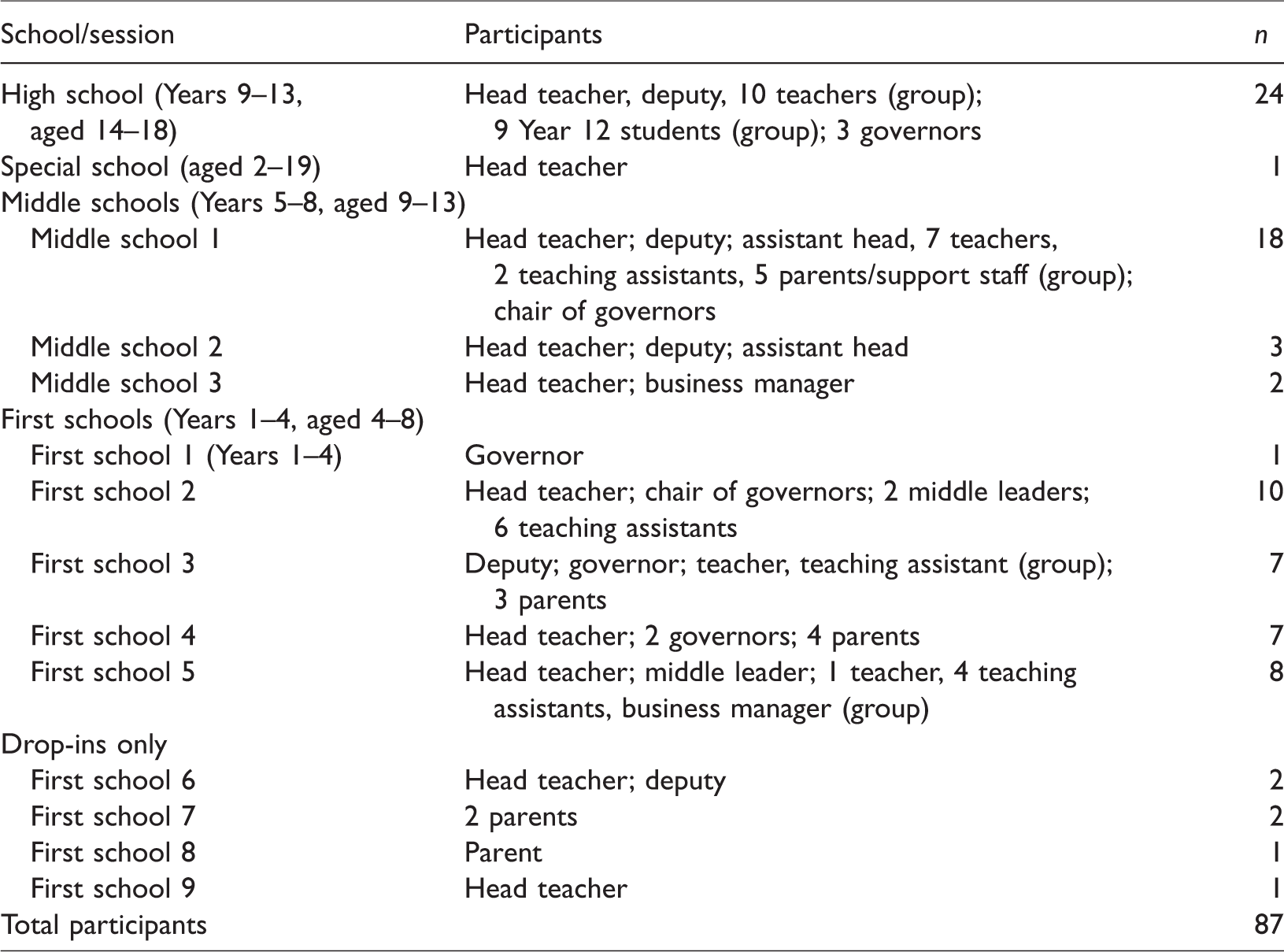
The data collection had two phases. The first explored critical issues in the partnership retrospectively and beginning to map participants’ perceptions on to a range of potential directions for its constituent schools. Seventy-four participants were involved in the individual and group interviews from five first schools, three middle schools, the special school and the academy. They were selected to ensure that a mixture of leaders, staff, governors and parents was involved from schools in each system tier (although these groups were not mutually exclusive) and from a range of locations, contexts and school sizes. Most of the data collection took the form of semi-structured, one-to-one or group interviews, supplemented by telephone interviews in some cases. The interviews followed a common structure, focusing on participants’ views on questions such as the perceived strengths of the partnership, areas for development, how the partnership functioned, and how to improve it, but were open enough to allow free discussion. They were audio-recorded with the participants’ informed consent and then partially transcribed by the researchers.
The second phase was more open and took the form of four focus-group-type drop-in events held by the research team in different public spaces in the locality during June and July 2016. The drop-in events were publicised in the local press and in local community centres, as well as through the partnership schools. Although open to anyone from the local community, the events only attracted six parents, four teachers, one head teacher and one governor. Half of these participants were from four first schools not previously involved in the data collection (for details of the schools and individuals involved in the research, see Table 1). A supplementary online survey, publicised alongside the events, was also made available to capture the perspectives of stakeholders who were unable to attend the events. Twenty-two respondents completed the survey. Eighteen of them were parents and the others were teachers (with some overlap), but it is impossible to give a response rate, as the survey was promoted to all interested parties through all the schools in the partnership. The events and survey were relatively open and followed the interviews in focusing on what the participants thought were the strengths and weaknesses of the partnership and its schools.
Research participants.
Ethical approval was given by the researchers’ university and all of the participants gave their informed consent to be included in the research. The data collected were analysed by the research team using an iterative process of thematic analysis (Boyatzis, 1998) to identify recurrent themes and issues at the end of the first phase of the research and informed the second phase. The data from this phase was then added to the analysis and reanalysed with reference to both the existing evidence base relating to school partnership and NSM research to produce the findings outlined in this article. It draws predominantly on the data collected from the participants involved in the primary phase (first and middle schools), but also includes data from academy staff where they addressed issues which affected the other schools in the partnership.
Findings
As already indicated, the findings are presented using Klandermans’ (2004) framework for participation in NSMs.
Instrumentality
As social movement and NSM research has repeatedly demonstrated, the impetus for change and coming together in a movement is often described as dissatisfaction with the existing state of affairs (Klandermans, 2004) or the recognition of a ‘structural strain’ in a system (Smelser, 1962; Crossley, 2002). Applied to the partnership under examination, this dissatisfaction emerged out of a feeling that the local school system was not functioning effectively and that the partnership was unable to address this. One of the most striking ways in which this dissatisfaction was expressed reflected neoliberal policy in lamenting parents’ lack of choice of schools after middle school. The response of one parent captured how neoliberalism’s marketising rhetoric becomes absorbed into common discourse: ‘Ideally there would be a realistic second option within the catchment, giving people choice and generating a competitive edge’. NSM research suggests the importance of establishing a movement goal around which to mobilise participation and develop what Smelser (1962) termed ‘structural conduciveness’ to help influence change. Similarly, Tilly (1978) distinguished between the repressive and facilitative effects of political systems, and it seems clear that many of the tenets of neoliberalism have a repressive effect on the ability of schools to mobilise effective partnership working, not least in a context like that explored in this research. Here the interdependent negative effects of disadvantage and isolation increased the pressures on schools without allowing them to be viewed as contributory factors. neoliberalism allows school choice to be broader for some parents than others. The academy’s perceived shortcomings encouraged some parents with the necessary wealth or ambition to send their children to the nearby independent school or into the neighbouring school system, which some participants described as a ‘brain drain’ that increased the challenges facing the partnership schools. Opting out of the partnership in this way was starting to have an effect on its feeder middle schools, as one head teacher emphasised: The problem is that this school and [the area] as a whole is losing children to [another town] and possibly, though not yet, to the independent school. Parents don’t want to send their children to the academy and that’s impacting on this school.
Varying attitudes towards accountability pressures were also evident in the different types of school. Staff in three of the first schools involved in the research highlighted their caring and nurturing approach, founded on being inclusive and knowing their children well, as a particular strength. They were also positive about their work on adapting to curriculum changes and broadening the curriculum. Similarly, staff in the three middle schools interviewed rated their links with parents highly, as well as their own nurturing approach. When they referred to accountability, it was almost always in relation to the academy’s failures in this regard. In contrast, some participants from the academy felt that the emphasis on nurturing in first and middle schools made it difficult to prepare young people for the pressure of Key Stage 4 examinations in three years at the academy, highlighting the challenge of trying to make students responsible for their learning in such a short period of time. Academy staff also thought that the fact that the three-tier system did not align with the neoliberal accountability points of Key Stages 1, 2 and 4 (outlined above) allowed middle and particularly first schools to sidestep accountability demands to some extent, which in turn placed further pressure on both the academy and the partnership.
Klandermans (2004) identifies the importance of access to information about others in building participation. The interviewees repeatedly expressed frustration about the partnership’s ineffectiveness, its opacity and its slowness to act. Several teachers were not clear about the purpose of the partnership, and some head teachers thought it had become too inward-facing, as one identified, again using the language of neoliberalism: ‘There’s a lot of partnership working in [the area] but not great deal of partnership impact. … There is also a lack of strategic leadership and accountability from the partnership’. The dysfunctional nature of the partnership at the time of the research – one governor described it as ‘as smokescreen for not doing much’ – militated against the development of the strong ties among members which Passy (2003) identified as necessary to build trust among movement, or partnership, members in defiance of neoliberal demands for accountability. While one first-school head teacher described the partnership as the ‘tip of the iceberg’ beneath which lay useful information-sharing and informal collaboration, another was more typical in contrasting the sense of collective responsibility among first schools with what they regarded as the ‘disconnect’ between phases in the partnership. However, there were examples of informal collaboration and cross-moderation in areas such as mathematics and modern foreign languages, which many participants wanted to extend. Lack of trust in the partnership prevented this collaboration from being used to build collective identity and horizontal connections between tiers to complement the lateral links within them. First-school head teachers in particular wanted to improve communication both within and without the partnership, having had little contact with the academy beyond partnership meetings. Conversely, reservations were expressed by even senior academy staff about the benefits of increased contact with first schools and the area’s special school, despite (or perhaps because of) their positive reputations. Such defensiveness reinforced the impression that relationships and interactions in the partnership were restricted, preventing the development of the collective identity that is essential for effective collaboration (Melucci, 1995; Kim and Bearman, 1997).
Identity
As Mische (2003) has emphasised, NSMs are networked at multiple levels, which makes translating individual identities into collective identities both complex and potentially conflictual. We can learn from the ways in which recent NSM research has focused on this. Applied to the partnership of schools, the interdependent themes of community and isolation, both existential and geographical, were dominant factors in relation to identity, operating in tension at a number of levels.
The first level of tension was between parents and schools. Participants spoke of the same minority of parents attending events and supporting schools, while those who did not engage were thought to spread negativity. As already indicated, a clear and familiar distinction was made between phases, exacerbated by the three-tier system. Thus, parental engagement was felt to be a strength among first schools, more difficult in middle schools (with some exceptions), and a significant barrier to improvement after that. The former group was exemplified by a survey respondent who stated that ‘staff are enthusiastic and keen for parental input’. Another respondent, whose children did not attend the academy, felt that ‘the academy does not seem to listen to the concerns of parents’. One governor felt that parental engagement was the biggest barrier to improvement across all schools; another thought that developing and achieving buy-in to an integrated system of education across the area would be beneficial. Furthermore, some middle-school participants thought that the academy was having an unspecified toxic influence on parents, which discouraged them from maintaining the involvement they had with the first schools and prevented many from engaging with the partnership.
The second level of tension was between schools and the partnership as a whole. This was often manifested as hostility to the academy, which was regarded as driving the partnership, particularly by the smaller schools. The interviewees at the academy felt that the pastoral element of learning (which they felt was also one of their strengths) was overplayed in middle schools and expressed concerns about standards of behaviour and the curriculum offer in Years 7 and 8 at middle school. This reflects long-standing concerns about lack of subject specialisms in middle schools (Hargreaves, 1987) and underachievement at Key Stage 3 (Ofsted, 2015) in English schools in general. The middle-school head teachers felt that their approach to Key Stage 3 was more effective because their children took on responsibilities that would not be available in secondary schools at that age, as one middle-school head teacher emphasised: ‘Our children in Year 7 and 8 get opportunities for leadership, they get opportunities to be independent, they are encouraged to be mature. They are given a gradual drop into the secondary process’. However, emphasis on Key Stage 2 and 4 outcomes for accountability made this difficult to evidence. One survey respondent highlighted this in classic neoliberal terms, while attempting also to reconcile the two- and three-tier systems: ‘I would like to see the middle schools particularly 7 & 8 be more accountable and led by academy so the GCSE courses start at Year 7 not necessarily at a two-tier level’. The middle-school head teachers were also keen to extend the work they had already been involved in on transition and moderation, which one of them felt would enable the partnership to operate effectively. Views were split as to whether the three-tier system simplifies or complicates transition, and fear of transition directly from primary to secondary was a significant factor in parents’ support for middle schools.
Head teachers in particular used their professional networks and connections beyond the partnership to support their schools in ways which sometimes inhibited the development of the partnership and its collective identity. This was clear in relationship to professional learning, where leaders drew on a range of support from and contact with schools in other parts of the local authority, other parts of the region and even beyond, making decisions at individual school level. Reflecting a key theme of recent research into coastal schools (Centre for Social Justice, 2013), recruitment was regarded as a key concern in all but two of the participant schools. Most stated that this was a long-standing and enduring issue for all schools in the area. Some felt that recruitment had been a problem for the academy in particular, although this had started to be addressed and needed to be publicised more widely. This obscures the fact that the pervasive but limited information made available about schools under neoliberalism makes it difficult for them to improve their reputation in ways that support the construction of collective identity. The other side of the recruitment issue was that staff retention was not an issue in most schools. While this has obvious benefits in ensuring schools have staff with good knowledge of the local context, there was a danger that they were unable to benefit from the fresh ideas and input that come from access to external expertise and recruiting new teachers with different experiences (Cordingley et al., 2003).
The third level of tension, and perhaps the most important, was between the partnership and the wider world. This applied to both the school system and society in general. Several participants highlighted the long-standing disconnect and distance from national and regional education policies and policymakers. It was felt that national policymakers did not understand, or recognise, the challenges their schools faced, as one first-school teacher underlined: ‘You’re forgotten by central government, you’re forgotten by local government and so … any sort of communal strength, it’s hard to believe in that’. Conversely, a head teacher felt that the isolation and self-sufficiency of the area and the strength of its collective identity as a community made it more difficult for people to recognise its shortcomings: ‘Ingrained views and perspectives of the school or education in general sustain over time in a community like this because they’re very self-referential. They’re very rarely challenged by any external benchmarking and therefore they can sustain’. Again, this recalls Brown’s (1993) notion of ‘wounded attachments’, where politicised identities become attached to their own sense of exclusion. Countless participants pointed to the closeness of the local community, where everyone knew everyone and negativity crowded out solution-focused approaches. It was clear from many participants that a sense of pride in the local community coexisted with the culture of blame and distrust already identified, which had deep roots and operated at multiple levels. This led to a sense of disempowerment which made it difficult to develop a vision for the area and the partnership. This reflects evidence from previous studies of small and rural schools that assumptions about such schools’ closeness to their communities can be misplaced (Hargreaves, 2009). The head teacher quoted above was convinced that ‘something is fundamentally not working in the partnership due to the massive bleed of young people [to schools outside the area]’. A sense of frustration was evident in the survey response of one first-school parent: ‘the way forward is not to pull the system down and criticise, but for the community to unite in support of all our schools and young people’. It appeared that the cultural strains and limitations that prompted the need for change – some associated with neoliberalism and others with the emotional sense of belonging to your community – made it difficult for schools to develop the collective identity necessary to overcome them.
Ideology
Castells (2015: 13) echoes Klandersmans in underlining the fact that emotional responses are part of how individuals make sense of and express the dissatisfaction that prompts collective action: ‘at an individual level, social movements are emotional movements. Insurgency does not start with a program or political strategy’. The emotional responses of school staff, when they were called on to make sense of their situation, often related to the low aspirations they associated with both parents and the community as a whole. Key contextual factors in this were low levels of participation in higher education and limited employment opportunities in the area, both of which were linked by participants to perceived low aspirations, along with the isolation of the community. These are common features of rural and coastal areas (Centre for Social Justice, 2013). They were exacerbated in this context by two factors already identified: the ‘brain drain’, in which more agentic parents with supposed higher aspirations were choosing to take their children out of the partnership’s third tier, and the sense of ‘wounded attachment’ (Brown, 1993) and hopelessness identified in more disenfranchised and disaffected families. Furthermore, increasing competition for places in these schools was felt by some to have resulted in parents starting to move their children out of middle schools from Year 7 or earlier in some cases. All of this was creating a vicious cycle, which was felt to be countering improvements being made in the academy. One survey respondent felt that parents had a crucial role to play in increasing aspiration: ‘It is too easy for everyone to blame school but beyond first school parental engagement wanes and more needs to be done to get parents to accept responsibility as part of education process’. What was less often recognised was that this was another example of teachers and parents absorbing neoliberal rhetoric, promoting accepted notions of ‘high aspirations’ without allowing the possibility of parents and young people developing different aspirations. Thus, while first and middle schools emphasised the importance of areas such as building children’s confidence and expectations and developing their sense of independence as learners, some parents, particularly those from rural areas, were concerned that their children should develop skills, including vocational skills, that would prepare them for life in the local area. However, this had not developed into an ideology with sufficient support to mobilise collective action for vocational education, possibly due to parents’ subordinate position in the partnership. In fact, it appeared that considerable work needed to be done across the partnership to develop, with parents and local employers, schools’ understanding of what knowledge and skills young people needed and wanted for the future. One of the middle-school head teachers emphasised the importance of extending the relationships being developed between schools in the context of transition to the partnership as a whole to make it more effective, reflecting Kim and Bearman’s (1997) assertion that interaction was crucial to build collective responsibility and action. She also spoke about trying to increase resilience and independence in children and young people in schools across the partnership. It seemed clear that these were characteristics that the partnership itself needed to develop.
As we have seen, where a sense of collective responsibility was felt – notably among some of the first-school head teachers interviewed – it was related to informal collaborations rather than the partnership as a whole. Other senior leaders called for a more consistent approach across the area and the region as a whole: ‘We must continue to look outwards. We need to take a holistic view, strengthen individual schools but also strengthen the partnership’. However, it appeared that hierarchy in schools and the partnership and school allegiance also made it difficult for the partnership to develop a collective identity. Shared values relating to partnership-working were not evident, as participants’ frequent references to lack of trust among schools revealed. As part of improving the communication that has already been shown to have been inadequate, one survey respondent emphasised the importance of pupil voice as ‘a key strategy for providing information from a young person’s point of view’. Although there were pockets of good practice in relation to this, it appeared to be an undeveloped area and could have been leveraged to improve student confidence and allow them to express their own sense of belonging in the partnership.
Conclusion
In conclusion, it is important to try to both determine the implications of this research for primary-focused partnership in a neoliberal policy context and assess the value and validity of applying insights from NSMs to school partnerships. The research was designed to work with local members and stakeholders to establish the effectiveness of the partnership and how to develop it further, prompted by the partnership’s perceived dysfunction, which the research quickly confirmed. The repressive effects (Tilly, 1978) of neoliberal policy exacerbated the disadvantages of context in which the partnership was located, where the effects of isolation from support structures were amplified by the ability of some ambitious parents to opt out of the local system and thereby further damage its reputation. The ‘complementary and contradictory’ double movement (Whitty and Power, 2002) identified in neoliberalism by Bernstein (2000) inhibited the partnership from reviving. On the one hand, neoliberalism’s marketising impulse was evident in the partnership’s inability to meet the expectations of those parents who were unwilling or unable to opt out of the local system, some of whom used the rhetoric of school choice to express their dissatisfaction. The competition highlighted in school league tables and inspection ratings also affected parents’ engagement in the partnership schools and increased the recruitment issues already associated with their geographical isolation. At the same time, neoliberalism’s traditionalist neoconservative impulse, exemplified by the changes to curriculum and the assessment systems by which secondary schools in particular are held accountable, devalued the vocational qualifications the academy offered to many students and thus further damaged its reputation. This became a vicious spiral and an extreme case, in which increasing numbers of parents opted out of the local school system, thereby undermining the partnership and its primary-phase schools, which felt powerless to influence these outcomes.
It is also the contention of this article that applying NSM theory to partnerships in education, particularly when they are dysfunctional, offers new insights. By focusing on the dissatisfaction with which collective action begins, Klandermans (2004) leads us to identify both the effects of the perceived unfairness of the school system on its members and the shortcomings of the partnership itself. These shortcomings made it difficult for them to use their emotional responses to these issues to mobilise into action or even to build a cohesive sense of collective partnership identity. Snow et al. (1986: 474) identified the importance of achieving a ‘shift in attributional orientation’, in which the dissatisfaction that Brown (1993) describes as ‘wounded attachments’ is externalised to recognise the contributing contextual and structural factors. The problem highlighted by this research is that neoliberalism’s focus on holding individual schools to account through mechanisms such as testing and inspection reinternalises the dissatisfaction, making it difficult for schools under pressure to develop partnerships. neoliberalism may purport to promote partnership through notions such as ‘school-to-school support’, as it promotes choice, but its emphasis on competition, accountability and progress militates against developing such collaboration.
Bringing these insights from NSM to bear on a partnership struggling with contextual and geographical disadvantages reveals the negative impact of neoliberal policy, which refuses to take such situational factors into account. It also reveals the enduring effect of hierarchy, both in the schools, where teachers, teaching assistants and parents were disempowered and effectively disconnected from the partnership, and in the partnership itself, where the three-tier system seemed to increase the perceived influence of the academy without it explicitly attempting, or being able, to exercise this power. This prevented the primary-phase schools from developing their lateral connections into collective collaborative action through developing the new, flatter forms of hierarchy Torres (2011) associated with NSMs, and restricted the partnership’s capacity to develop the trust, equality and reciprocity that Powell and Glendinning (2002) view as crucial to effective partnership. Crossley (2002) speaks of the importance of loosening the mechanisms of control to build resistant cultures. This research suggests that, through the effects of the paradoxical combined impetus of marketisation and neoconservatism identified throughout this article, neoliberalism magnifies, rather than ameliorates, these control mechanisms and the contextual conditions which inhibit effective partnership-building in schools, particularly in the primary phase.
Footnotes
Declaration of Conflicting Interests
The author declared no potential conflicts of interest with respect to the research, authorship, and/or publication of this article.
Funding
The author disclosed receipt of the following financial support for the research, authorship, and/or publication of this article: This research was supported by fundingfrom the partnership on which it focuses, but the funder played no role in the research.