




Abstract
Arizona’s “Wild West,” free-market education approach via school-choice policies reflects the expansion of neo-liberal reforms, which emphasize private provision and governance of public services once markets are established. Indeed, charter schools, tax credit programs for public (state) and private schools, inter-district open enrolment, and neovouchers are changing Arizona’s traditional public school systems and the communities where they are situated. It is known that new, incentivist market-based systems can result in decreased democratic school accountability and the thinning of collective democratic political actions. Further, the rapid entry and growth of not-for-profit and profit-making charter schools and education management organizations in the USA raises questions about equitable student access. It is not fully understood, however, how mature school-choice systems affect local communities “on the ground”—that is, how are school policies understood and acted out? This study employed ethnographic methods to analyze the perceptions and actions of community stakeholders in Arizona, including school leaders, teachers, parents, students, and institution and community organizers, at one district public school and in its surrounding community, including its charter schools. The author examines issues of power, since all community actors are not equally able to engage in school-choice practices.
Keywords
The ideology of neoliberalism is advanced by appealing to the freedom to choose and the logic of greed. (English and Bolton, 2016: 110)
We know that new, incentivist market-based systems can result in decreased democratic school accountability and the thinning of collective democratic political actions (Apple, 2012; DiMartino and Scott, 2013; Lubienski et al., 2011; Noguera, 1994). Further, the rapid entry and growth of not-for-profit and profit-making charter schools and education management organizations (EMOs) in the USA raises questions about equitable student access (Miron and Gulosino, 2013; Ravitch, 2010; Robertson, 2015; Saltman, 2014). For example, it is well known that those with more social capital tend to fare better than those with less social capital in a school-choice environment (see Ball, 2003; Ball et al., 1996). These school-choice systems also problematize how educators and leaders in district public schools make sense of competition and families’ choices to attend their schools (Potterton, 2019). We do not fully understand, however, how mature school-choice systems affect local communities “on the ground”—that is, how are school policies understood and acted out?
Similarly, how are stakeholders in a mature market-based public school system making sense of and engaging with school-choice policies and programs? This study focuses on a specific set of data collected during a larger research project that I conducted for nearly two years (2014–2016) in Arizona. The purpose of that larger project was to understand how stakeholders in a long-standing school-choice market perceived and engaged with a district public school and its surrounding community, including its charter schools; how they understood policy; and what influenced families’ choices (Potterton, 2017, 2018, 2019). In that research project, I analyzed the perceptions and actions of community stakeholders, including school leaders, teachers, parents, students, and institution and community organizers, at the Southwest Learning Site (SLS) in the district that runs the school, the Desert Public School System, and the school’s surrounding community. 1
This article focuses on a set of specific stakeholders who were exploring issues of power, influence, and politics. I conceptually examine issues of power since all community actors are not equally able to engage in school-choice practices (Datnow et al., 2002). For example, school leaders at the public and charter schools responded differently to unique enrolment challenges and competition (Potterton, 2019). An organizing group, the Arizona Interfaith Group (AIG), was examined closely in this analysis because the group was instrumental in its work as an activist organization. Involved members focused on examining power and policy in arenas including, but not limited to, education, health care, and prison reform by organizing meetings and actions in the community. These events and actions will be presented throughout the article. Members of the AIG disrupted commonly held narratives about education structures and policies by protesting, refusing to engage in charter school choice, and acting out counternarratives about market-based theory effects on public education. In the wider community, some parents took action as agents by leaving traditional district or charter schools, or at least seriously contemplating these moves (consumer-based types of exit and withdrawals of voice (Hirschman, 1970)). Many of their actions were increasingly tense and pressured as parents struggled to make, and sometimes revisit, their choices, creating a fragile schooling environment.
Literature and theoretical framework
Neo-liberal school-choice policies in Arizona
The state of Arizona is home to approximately 550 charter schools, and this number is constantly changing. What has not changed is the common description of Arizona by researchers and columnists as the “Wild West” of charter school and education reform (Finn et al., 2000; Keegan, 2017; Maranto and Gresham, 1999; Strauss, 2018). Aside from its many charter schools, which in 2015–2016 made up 24.2% of Arizona’s public schools and served 16% of all public school students, the state maintains both inter-district and intra-district open enrolment options for all students, tax credit programs for both public and private schools, and scholarship programs that allow parents to opt out of public schools to use public funds for their children’s private school tuition (National Center for Education Statistics, 2017).
Arizona’s public school system includes both its district public schools and its charter schools for base-support-level funding purposes (Powers and Potterton, 2019). However, there are some key governing differences between Arizona’s district public schools and the state’s charter schools. For example, charter school organizations have the ability to form boards through appointment rather than through election, therefore potentially shifting structural and cultural power toward particular actors and away from democratic processes and public spaces. These appointments, then, can reduce public voice and encourage private interests and power. The state’s charter schools can be understood as “blurring the line between the public and private sectors,” wherein “[e]stablished by contracts between public agencies and charter school organizers, charter schools are exempt from some of the state regulations that school districts operating traditional public schools must comply with” (Powers and Potterton, 2019: 3). These charter school exemptions, amongst others, include not requiring teachers to have certification and allowing charter schools to be established by profit-making or not-for-profit corporations (Powers and Potterton, 2019). Harvey (2005)and English and Bolton (2016)define neo-liberal reforms as the expansion of private provisions of public services, and Arizona’s long-standing market-based school-choice system is no exception to these provisions. In the 1980s and 1990s, whilst the US government declared a mega-narrative (Olson and Craig, 2009) suggesting that the nation’s public schools were in crisis and in need of radical reform (see Apple, 2006; Berliner and Biddle, 1995; Mehta, 2013; Sahlberg, 2017), 2 Arizona’s school-choice programs also developed rapidly alongside a Republican-dominated state legislature. Years later, the state sits at the top of US rankings for the number of charter schools that are managed by profit-making and not-for-profit EMOs (Miron and Gulosino, 2013).
Market-based school systems and political action
DiMartino and Scott (2013)showed how, in the state of New York, private sector contracting of services to public schools challenged processes of democratic accountability. We also know that private provisions for public schooling are diminishing both the number of stakeholders and their power (DeBray and McGuinn, 2009; Lubienski et al., 2011). Even as privatization in US public schools was gaining ground in the 1990s, Noguera said: During times of crisis and national disasters, we turn to our public schools for safety and refuge. Rather than abandoning this vast infrastructure of community-based facilities or transferring responsibility for the education and socialization of our young people over to private hands, we should find ways to improve quality through increasing community control of the educational process. (Noguera, 1994: 248–249)
Thinking about policy and power
Datnow et al. (2002)provided a conceptual tool for thinking about policy change that highlights the reflexive interplay of structure, culture, and agency as an integral part of the ongoing co-construction which occurs as policies are being played out in practice. Figure 1illustrates this interplay.
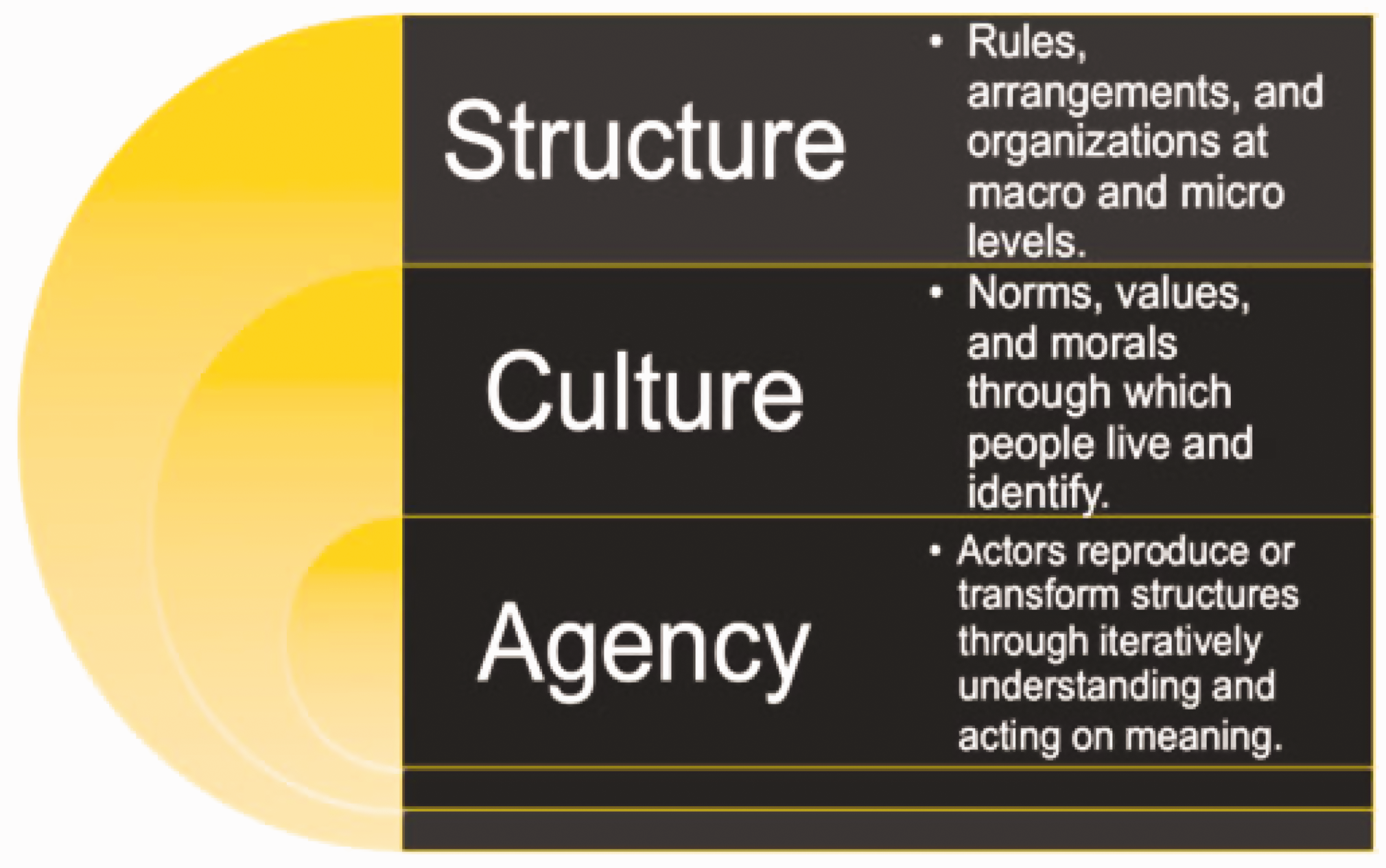
A tool for thinking about policy.
Datnow et al. (2002: 90) described this process as “building the plane while it’s flying.” They also acknowledged that, within this interplay, not everyone has equal amounts of power for engaging in politics and policy creation. Indeed, Emirbayer and Mische (1998)pinpoint agency as potentially transformative and reproductive for structures, as actors make meaning of policies and issues. Where structure, culture, and agency interact, policies are fluid, as they are continually evolving, reconstructed, and acted out in practice (Archer, 1995; Datnow et al., 2002).
Institution- and community-organizing groups
Individuals gathering to collectively organize is one way in which actors can make meaning of the policies and practices around them. Dennis Shirley (1997, 2001, 2002) and Rick Warren (for example, 2001, 2009, 2011) studied the work of specific institution- and community-organizing groups to demonstrate the ways that these collectives might represent a hopeful revitalization of US democracy. Organizing groups that were part of their studies and were connected to the Industrial Areas Foundation, a national community-organizing group that was started in 1940 by activist and writer Saul Alinsky, worked to bridge social capital by bringing together institutions and individuals across racial, religious, and socio-economic lines (Shirley, 2002).
3
The work across the Industrial Areas Foundation’s sister organizations is rooted in like principles. Shirley’s description of a group in Texas explains its working process well: Leaders … were local community residents who received guidance and training from organizers and in fact waged the political fight themselves … in the community organizing work carried out in the Valley, [the Texas organizer] questioned, agitated, and coached Valley residents, but the developing political work—which would soon expand to include voter registration, the upgrading of Texas’ indigent health care, and the equalization of school funding—was carried out by the indigenous population itself. (Shirley, 2002: 6)
Beyond the work of the Industrial Areas Foundation and its sister organizations, there have been, and continue to be, community-organizing efforts that challenge education reform policies and actions. Warren et al. (2011: 4) compiled stories of organizing movements in San Jose, Los Angeles, Denver, the Mississippi Delta, Chicago, and New York City to understand why “parents and young people have devoted their precious time and energy to working for school reform and what their aspirations and goals are for their children.” Researchers are also exploring the importance of broadening traditional notions of educational leadership by documenting how community members utilize leadership strategies to influence decision-making processes in education (Welton and Freelon, 2018).
Methodology
Site context
This study focused on the participants and activities of members within the SLS, which is a district-run public school in the Desert Public School System and its surrounding community. The SLS, which opened in 1990, serves children from kindergarten through eighth grade and was created as a school of choice (not a charter school) by the Desert Public School System to offer families an alternative model to traditional public schools. For example, classes were multi-age and instruction was understood by many in the school to be aligned with Montessori-style approaches. The SLS had a number of high-profile and high-performing EMO charter schools open around it, and these schools are seen by some in the community as competing for students in the district. Because public money follows students to the school of their choice, such competition can have a real financial impact on budgets when large numbers of transfers occur. The SLS’s community consists of parents with children attending the school, as well as others who share deep commitments to the school and its community by maintaining active affiliations even after their formal connections to the school have ended. For example, members taking part in school events included some alumni, retired teachers, and parents whose children used to attend the school but have moved to competing charter schools. Stakeholders at and around the SLS included the SLS’s school leaders, teachers, charter school administrators, and parents with children at the SLS or other schools nearby.
For a large portion (but not all) of my analysis for this study, I concentrated on associated members of the community who were affiliated with the Desert Public School System community and specifically with the SLS. The AIG is an institution- and community-organizing group that works with leaders throughout Arizona to educate, strategize, and develop the capacities of institutional members (churches, schools, and unions, including but not limited to teacher unions) to foster change related to social justice. The group is affiliated with the Industrial Areas Foundation, the previously described national community-organizing group that was started in 1940 by Saul Alinsky. The AIG is involved in promoting traditional public schools and informing members of the community about the importance of supporting public schools, public spaces, and civic society more generally.
With guidance and training support from the AIG, numerous SLS and surrounding community stakeholders in this study either are or were active in organizing and strategically building social and political relationships to influence legislators and other policymakers. In doing so, they interacted with the SLS’s neighbors, teachers’ groups, and church affiliates in the Desert Public School System to teach them about Arizona’s education reforms. More specifically, they spoke about local EMOs and their administrators’ political connections, the privatization and marketing of public services, the influence and activities of the American Legislative Exchange Council (2013; Anderson and Donchik, 2016), and the potential implications these issues and groups have for democracy and justice. One telling detail can be seen in the testimony shared by an individual in the AIG’s informational packet, which sums up an ongoing priority for the group: “to do the work of justice.”
Research design
During the two-year study, I utilized ethnographic methods including writing ongoing field notes and analytic memos when themes began to develop from my time as a participant observer at school meetings, in parents’ homes, and during many informal conversations. Primarily for this analysis, I used field notes from participant observation at AIG meetings. I attended and took part in, when and where appropriate, AIG education strategy meetings that were attended by some members of the SLS community. I met with and stayed in close correspondence with the leader of the AIG, Josh, and he kept me informed of functions, activities, and meetings on the AIG calendar where and when it was appropriate for me to participate. These AIG education strategy meetings, especially those leading up to actions in the community with legislators, sometimes occurred twice a week, and the meetings were typically about two hours long. Other times, there were not any meetings in a week. Weekend AIG leadership training sessions ran for five to six hours, and I attended these where possible, particularly when I knew that they would be attended by and relevant to some stakeholders from the SLS. I also examined documents that were collected and connected to the AIG, including information pamphlets, meeting agendas, and materials such as copies of book chapters or articles for group readings and analysis.
As part of the larger study, I conducted 37 semi-structured interviews with 35 stakeholders, including school leaders, teachers, parents, students, and institution and community organizers. These stakeholders were selected via purposive snowball sampling and with the intention to gain various views, positions, and roles within the community. As Noy (2008: 327) explains, snowball sampling, observed critically, can “generate a unique type of social knowledge—knowledge which is emergent, political and interactional” and which can lead to “a reconceptualization of the method of snowball sampling in terms of power relations, social networks and social capital.” The quotations in the findings section are from these interviews, and the analysis more generally utilized data, as described earlier, from field notes, analytic memos, documents from meetings, and these interviews.
Data coding and analysis took place throughout the entirety of my data collection, and I did not pre-develop codes. For the practical purposes of coding my data, including my transcribed interviews, memos, and field notes, I used a variety of tools including a codebook, reflexive writing in the form of jottings and memos to develop thick descriptions (Geertz, 1973; Lincoln and Guba, 1985), and first- and second-cycle coding (see, for example, Creswell, 1998; Emerson et al., 2011; Fetterman, 2010; Miles et al., 2014). Finally, I viewed the data through the previously described lens, which assumes that policy construction results from the complicated interplay between structures, cultures, and agency (Datnow et al., 2002). I used this organizing frame as an entry point through which to read and understand my data.
The findings are organized by themes. First, I explain how the AIG strategically worked to challenge notions of markets in education. Second, I describe the perspective of one EMO charter school leader, Matthew, who held strong opinions about education reform and policy. I consider this perspective alongside the understanding by some stakeholders that policies are embedded in power that influences education reform. Third, I share how two parents with children at the SLS made meaning of policy, power, and influence, which provides evidence that there are nuanced factors affecting perceptions of school-choice policies. Fourth, I examine how the choice to exit schools, alongside Arizona’s widespread set of choice policies, has created a fragile school environment for stakeholders on the ground. Fifth and finally, I explain how this fragile environment was fueled by stakeholders’ shifting notions of the democratic purposes of public schooling as they made sense of personal and family school choices versus beliefs about the common good and public education.
My role as a researcher was both as an outside observer and participant. I took part in meetings, including talking with the organizers of the AIG about any research that might be useful to the group. I also took part in canvassing for an override vote that would increase money for public schools, and attended informal gatherings with families where and when I was invited. These relationships were built over my time in the field. I did not know about the AIG or the school, the SLS, before meeting a mother and Josh, the lead organizer of the AIG, after they contacted me about a commentary that I had written about charter schools in Arizona and the demographics of students they did and did not serve. This unique positionality allowed me to be both an outside observer in the field and a woman-mother-scholar participant who was committed in the community to understand stakeholders’ perceptions of Arizona’s long-standing and deeply embedded school-choice policies and programs.
Findings
An institution- and community-organizing group’s “agitating”
Time in the field allowed me to more deeply understand the work of the AIG and its affiliation with the SLS. Shirley’s (1997, 2001, 2002) and Warren’s (2001, 2009, 2011) descriptions about community-organizing strategies were similar to those I observed and that were shared with me by Josh, the lead organizer of the local AIG. Josh is also a father with children who attended, or at one time did attend, the SLS.
Expanding on the earlier introduction of the AIG, the goal of the organization’s leaders was to train and empower leaders in local institutions, and to encourage active participation at various levels of democracy. The group’s vision was of a united people in a participatory democracy (which is, albeit, also messy), and it worked to develop groups and communities aimed at organizing to advance social justice. The group consisted of individuals and institutions from a range of religious, cultural, ethnic, and economic affiliations, employee and civic groups, and social networks.
In Arizona’s AIG, I observed Josh to be a kind, assertive, and charismatic leader, who agitated, questioned, and coached residents. The leaders were intentional in conversations with individuals, whether they occurred in a one-to-one setting or in front of a large group. The following thick description, adapted from my field notes (Geertz, 1973; Lincoln and Guba, 1985), describes one meeting which was a part of member training, where AIG leaders provided texts for individual reading and analysis, small-group reflections, and larger-group discussions before and during one training session. The meeting details how the AIG leaders engaged members of the community in unpacking contradictions associated with market-based education policies.
The AIG conducted leadership training sessions for local faith leaders, school community leaders, and engaged citizens in the area. The meetings were public and open to anyone who was interested, although members from dues-paying institutions mostly attended them. They typically lasted from two-and-a-half to three-and-a-half hours and were held on evenings midweek. Approximately 45 people attended this particular leadership training session, and the training opened, as usual, with introductions and an interfaith prayer from a local deacon. Next, Josh provided an overview and the focus of the training session, and reminded the group about the readings that he had provided in previous weeks for use during the training. The list of readings included an excerpt from a chapter of Chris Lubienski and Sarah Theule Lubienski’s (2014) book, The Public School Advantage: Why Public Schools Outperform Private Schools. Earlier, I had provided this citation as a reference for Josh when he asked me if I had suggestions about any recent readings that I felt might be important and relevant for the organization. The excerpt documented how public schools outperform private schools and advanced the claim that the concepts of choice and competition for schools may “not by themselves be the best route to effective and equitable educational opportunities for all” (Lubienski and Lubienski, 2014: xviii). Josh also reminded the attendees about other assigned readings, which were focused on the ideas and concepts of “abundance versus scarcity,” “economy failings and markets,” and “privatization” related to both charter schools and prisons.
Before breaking into groups to talk about the readings, one leader asked: “How do we ‘reframe’ the story of what is happening in Arizona? Since a narrative is being told for us, it is our job to critically evaluate political, economic, and cultural power and learn how to retell our story.” Next, Josh led a teaching session, where he explained to the group ideas about three spheres of society, including a public space (including governments and courts), a market space (teaching us to be good consumers), and a civic space (for example, schools and churches). A leader described how the public space is shrinking, the civic space is diminishing, and the markets are expanding. As a point leading to the reading groups, Josh said: You need a civic society to teach people how to function in a healthy market. With individualism at [the] forefront of school and churches, we won’t have a healthy market—not based on trust, but based on winning and losing.
Power, influence, and policy: “We’ve got to out-charter the charters”
On the other side of this particular organizing perspective, however, were administrators from EMO charter schools that were located close to the SLS and gaining some students from the SLS, as well as other district public schools in the area. Consider Matthew, a staunch proponent of Arizona’s market-based school-choice system, and an EMO administrator with ties to policymakers. Matthew’s perspective is meaningful in the study’s analysis because he was a passionate administrator who strongly believed in the potential and power of school-choice policies and programs, including charter schools, to positively change public education and those it serves. I spent time with him during my time in the field, and the following description is from an interview that I had with him, where he described how he understood and acted on school-choice policies and programs. With his close ties to policymakers, his perceptions are influential. He acknowledged that there have been documented abuses of power, and he recognized the need for improvement based on some unfortunate lessons learnt from past mistakes. However, he also felt strongly that: The tectonic shifts in education have only just begun. We have really no idea where it’s all gonna land, and if school choice remains, it will never fully stop. Right? We’ll plateau on some things but … it’s like that with any business. Longest standing. Twenty years now? Which is still not a lot of time … And you know the problem is freedom. People do good things with freedom and they do really ugly things with freedom. Some people use freedom in the education marketplace to launder money. Some of them use it to, you know, use a funding system to make sure they and their immediate family members all have jobs. You know? Um, and some get into it with really big hearts but not a whole lot of, um, skill [laughs]! And I think that, like any truly market-based system, it can be really nerve-wracking, especially when we’re talking about certain kids being caught up in the bad ones, and parents can be bamboozled, you know? But I don’t think that that’s an argument against the market. I think that is one of the things that, in this world that we live in, you know, the bureaucrat can’t save us from any, every bad mistake that we’ll make, and every bad product that will be built, and every moment that we may be bamboozled by someone selling snake oil. But over time, um, and you’re seeing this in Arizona, I mean the charter options today for moms and dads in just about every neighborhood, are better than they were twenty years ago, certainly better than they were ten years ago. … And I think over the next ten to twenty years, you’re going to see a lot of these schools not be able to compete with those that are really upping the game, the bar.
Matthew’s view on the future for Arizona’s school-choice market was different from many parents whose children were not attending charter schools and who had been a part of, or had observed, the traditional public schools in Arizona changing over time. Many stakeholders, and not only those at district public schools, were concerned with potential conflict-of-interest issues related to politicians’ and EMO administrators’ close relationships with each other, as well as the business and market-based language that drove school-choice leaders’ promotion of schooling, such as was described by Matthew. In their opinion, such ideological standpoints were largely responsible for the extraction of resources from traditional public schools and for attracting advantaged students, which thus resulted in more challenges for Arizona’s district public schools.
Contrasting Matthew’s view as an EMO leader with Josh’s view as the AIG institution- and community-organizing group leader reveals stark differences in perspectives and positions. Josh provided a strong critique of Arizona’s school-choice policies and practices, and the effects on district public schools. Below, he describes how one district public school’s building needed construction improvements and updates: And, you know, as long as the schools are deprived of the resources it needs to take care of its facilities, and they see us in a new facility [the SLS had, in the past, been completely rebuilt on a new campus] and they’re not … you’re gonna create this conflict in the district. And that’s a product of the simple scarcity. So you keep starving the schools, you’re gonna see all that. The charters love that type of thing. I mean, that’s just creating an environment for them to pop in and continue to be so predatory … This really points out the fragility of institutional life. Is this a place where people come and learn how to collectively work together, exercise citizenship, a place for children to learn this through the adults in their lives doing it, or is this just becoming a service center and a space for an educational product? Now, developing a culture of that kind of citizenship takes some time to inculcate and it can be obliterated very quickly if you bring in a strong market element. And, if you have leadership that doesn’t understand the value of that type of culture, you can decimate it. And, you know, it can be very precarious to the school environments right now because they don’t know how to make sense of the lobby pressures. I don’t think they understand how decisions are being made. So they buy into this narrative that “We’ve got to market ourselves and we’ve got to out-charter the charters.”
Perceptions of rapidly changing policies
Nevertheless, some stakeholders viewed these declarations that reassured transparency with weariness and distrust of policymakers and politicians, and as statements that masked hidden, opportunistic intentions to financially support advantaged groups of individuals through the advancement of charter school organizations over public school students. For example, some stakeholders described how they opposed Empowerment Scholarship Accounts, which would serve in a similar way to a checking account, whereby students could receive state funding that would have gone to their public school for their personal use at, for example, private schools of their choosing and online learning schools. Their concerns were related to how these Empowerment Scholarship Accounts might be used by more economically advantaged families, which would take money away from schools where funding was more seriously needed. A school superintendent pointed out that, whilst the Empowerment Scholarship Accounts that were being proposed for expansion could provide more parental choice for families, they also had the effect of lowering the enrolment of otherwise successful public schools. This, he said, “creates a burden” that falls onto the district public schools. In discussing a similar topic of Arizona’s public and private school tax credit donation programs during an interview, Joan, a mother who was considering a number of schools for her son, said: My opinion is, if you want to send your child to private school, that’s well and good, do it, if you can afford it. If you can’t really afford it, then don’t go asking other citizens of the state to help fund your child’s private education. That money should go to the state coffers to do whatever the state feels is best. And hopefully some of that money gets put into [a neighbor’s] school or other kids’ schools, and especially kids [whose parents] can’t afford to take the time to drive their kids to private school or whatever. It rubs me … it just doesn’t sit right with me.
4
No matter where stakeholders positioned themselves along the continuum of support for or against expanding school-choice policies and programs, however, individuals at the SLS or other competing schools all acknowledged how school choice could be beneficial for some people, even if they were also not entirely happy with increasing options for families to disengage with local public schools by exiting. For example, one father said: I think that charters do best when they don’t try to replace the district schools. My wife’s school [his wife teaches at a charter school] fills a niche. They don’t have a lot of students. They cap it at 300 students because that’s all they can handle, but they’re serving a population of kids that aren’t being served adequately by the district … That’s because traditional schools still have a different culture, uh, that’s geared more around the sports programs and that kind of stuff … and so her school I think really serves a niche for kids that were kind of like us in the ’80s. We were these oddballs that went to teenage nightclubs and dressed in black and dyed our hair and pierced our ears, and really were other. We didn’t fit in. We [adult siblings] were together the other night because my parents are sick and we were trying, half of them are Democrats, half of them are Republicans, and I say to my sister, “How did you end up like this?” We were having a political talk, but everybody has a different style, lifestyle, makes different choices, has different habits. And, I think what is great about now is that we can accommodate a lot of that. Not everybody has to go to the same cookie cutter place. That, to me, is really what is magnificent about schools versus charter schools versus parochial, is that there is choice.
Fragile schooling environments, agency, and the fluid option to exit
Some stakeholders at the SLS who were also affiliated with the AIG became increasingly involved with school-level tensions related to leadership decisions about curricular changes and more, which took members’ time and energy away from their larger district- and state-level foci related to markets, school funding, and privatization. The AIG members at the school adopted tactics such as meeting together with SLS stakeholders to discuss conflicts and disagreements about leadership that were occurring there, and to deal with what they saw were problems with some of the school’s policies, practices, and management.
At the same time, AIG members’ involvement at the SLS was unusual to the extent that many other schools do not have institution- and community-organizing leaders who can help stakeholders work together to be a part of strategic change. The individuals who took part in organizing with the AIG were active in helping others address the concerns of teachers and parents. A point of dissension, however, was observable, since all stakeholders did not agree about whether the leadership at the school level was working in an effective way. An observable fragile schooling environment was certainly present for some time during the school year. Numerous relationships broke down amongst parents, some of whom were involved in the school’s parent–teacher organization.
By the second half of the school year, the principal resigned, a number of families who were on different sides of the debate around the concern over school changes left the school, and many others were reconsidering whether, despite what they had always loved about the school, they would keep their children at the SLS. When I talked with various stakeholders about this fallout, most understood that it was due to many pressures coming from different angles related to the school’s academic performance, relationships amongst stakeholders, the ability to move schools through open enrolment, and concerns about the school more generally. Overall, however, some parents who had not previously considered leaving the school changed their position.
The SLS, as well as other district schools in the area, was under swelling pressure to compete for families in a way that was perhaps similar to how businesses might compete for customers. Even though schools function differently than businesses that seek profits, it must be considered in this context that Arizona’s school-choice policies encourage competition and a market-based system, which necessarily affects district public schools, too. Therefore, it is understandable that some stakeholders, especially leaders and consumers such as parents and students, might directly feel this pressure in ways that are similar to competitive pressures for businesses. Indeed, many district public schools in Arizona face competition from profit-making and not-for-profit EMOs.
Due to the large variety of options that parents had to take part in school choice, many, but not all, parents were in a position that allowed them to either remain at the school through relational conflicts or to quite easily exit. In spite of the complex and relationship-damaging fallout that some felt at the school, many stakeholders’ feelings and deep care for the SLS and the people in the school, even those with whom they disagreed, remained strong. Perhaps encouraged by the culture that had existed in the school for a long time, some stakeholders spoke emotionally in terms of the school and stakeholders moving forward in a process of “healing.” “Conflict is good” and “change is good” are two comments that I heard numerous times from people when they were speaking about these controversies. Some stakeholders who were in the very center of involvement in the conflict stayed at the school, even though the future of the SLS, in relation to its teaching and learning model, was changing quickly as the school faced pressure to maintain enrolment.
Differing democratic views on public schooling
Other stakeholders acknowledged the tensions that some faced when the demographics of students at the SLS changed and they began to receive US federal funding reserved for schools that serve a higher percentage of students living in poverty. One school stakeholder with a long history and leadership presence at the SLS explained to me how the SLS had changed over the years whilst, concurrently, more charter school options opened around the district and city. She hinted at a significant disagreement between school stakeholders: When I first started here … [an EMO charter school] was not here. We had a very, very different population, huge different population … twelve years ago … a couple things happened during that time. We were, maybe, 20% free and reduced [school lunch, an indicator of socio-economic status for the purposes of federal funding] when I first came. A lot of educated parents, a lot of professors came here, doctors, lawyers, highly educated … [the principal at the time] would talk about getting everyone to apply … for free and reduced … [then there was] a lot of marketing to [an] area [a largely Spanish-speaking neighborhood outside of the school’s neighborhood]. We became full Title I [the federal funding]. What happens when you get a lot of Title I [students]? So then, once [an EMO charter school] opened, the top 20% flew out. And during this whole time it was, “Well, we need to find out why are these people leaving?” They were leaving by the droves, and why were they leaving us? People wanted the academics … even eight years ago, nine years ago, when we were trying to re-envision, there was a huge discussion as to whether even to put the word “academics” in our vision because they [some stakeholders] just didn’t want it to be that kind of school.
Discussion
Governing differences fueled much of the activism amongst the stakeholders involved in the AIG. The individuals there disrupted commonly held narratives about education structures and policies by protesting, refusing to take part in school-choice programs, and acting out counternarratives about the effects of market-based theory in public education. However, these actions were not without tensions, apparent pressures, and even contradictions. As I discovered during my time in the field and during interviews, many parents in the community struggled to make, and sometimes revisit, their choices, creating a fragile schooling environment for their families, whilst leaders in the community and schools had strong perceptions of school choice that affected their opinions, experiences, and choices. A number of the stakeholders’ stories have been shared in this article.
Beyond market-based education rhetoric that is both influential and dominant in Arizona and increasingly throughout the USA and around the globe, parents were deeply concerned with what was happening inside of schools. In some cases, this mattered a lot more than what type of schools they were. More generally, some stakeholders were against unfettered free-market policies built on the assumption that these programs could lead to better schools for all. Most stakeholders were not duped by this proposal and, in fact, struggled quite openly with the problems that they had with some school-choice options in their area. Still, previous analyses in this community reveal how some moved their children multiple times across traditional public, charter, and private schools (see Potterton, 2017). Even Josh recognized the phenomenon of district public schools, in some ways, having their hands tied as they tried to “out-charter the charters.” For the stakeholders in my study, except for the EMO charter school leaders with whom I spent time, most agreed that there was a place for charter schools, but it was not the only place, and certainly not one that needed to be explained through theories of “winning” and “losing.”
In the context of what we know about social capital advantages in a school-choice setting (see Ball, 2003; Ball et al., 1996), Arizona’s highly marketized system, and the findings in this study, it is possible that the gaps in Arizona are extreme and exacerbated because of its long-standing policies (Potterton, 2018). In this school and surrounding community, school-choice policies and practices were not being utilized in a way that equally benefited all students, even if this was the often-spoken aim. In thinking about the interplay of structure, culture, and agency described by Datnow et al. (2002), there are great concerns and, likewise, hopes for Arizona’s public school system as policies and programs continue to develop. For example, Cookson and Berger, in Expect Miracles: Charter Schools and the Politics of Hope and Despair, wrote: From our perspective, charter schools, and the movement that supports them, are neither good nor bad. How they are used, by whom, and to what end is what concerns us. Americans tend to see education in evangelical and often moralistic terms. As a nation, we expect schools to provide a level playing field for all children, yet at the same time we have created an educational system that ruthlessly sorts and selects students in theory by merit but in reality most often by class, race, and gender. We expect miracles from our school system, and yet we often avoid the hard policy decisions and the tough political decisions that would make public education truly productive and just. Another concern we have: those who would use the charter school movement to privatize and monetize a public good. … The spirit of our times is market-oriented … we believe that social markets are quite different than commodities markets. (Cookson and Berger, 2004: 4)
Footnotes
Declaration of Conflicting Interests
The author declared no potential conflicts of interest with respect to the research, authorship, and/or publication of this article.
Funding
The author received no financial support for the research, authorship, and/or publication of this article.