




Abstract
In this article, the authors argue that a particular view of language underpins approaches to supporting students in higher education, and that this view facilitates neo-liberalism. Universities worldwide have glossaries of terms such as ‘describe’ or ‘discuss’, and centralized units to help students understand what an ‘essay’ or ‘report’ is, and to ‘critically evaluate’. This approach to support is underpinned by seeing language as a concrete abstract objectivist entity, separable from any context for analysis and teaching. Such a view is ideal for facilitating neo-liberalism and giving it persuasive power, as it underpins arguments to create support that is low-cost, applicable to all subjects and students, deliverable by almost anyone and replicable. Here, drawing on theory and data, the authors challenge this view of language and present and discuss examples to show how language is instead an individual subjectivist entity, unique to context and subject. They further show how support for students is undertaken by lecturers through dialogue in the subject context. The authors argue that current approaches to support should be changed to reflect this individual subjectivist nature of language. They therefore resist neo-liberalism by questioning the validity of the arguments used to give it persuasive power in its approach to support.
Introduction
Language, unlike speaking, is something that we can study separately … whereas speech is heterogeneous, language, as defined, is homogeneous … language is concrete. (De Saussure, 1959: 76)
If approaches to supporting students are guided by the fundamental idea that language, in this view, as an abstract objectivist (Voloshinov, 1973) entity, is concrete and can be removed from its context for analysis and teaching in a student support context, the implications are extensive. We can, for any level and any student, tell them what is expected of them when they are asked to ‘critically evaluate’ or ‘describe’, what the difference is between an ‘essay’ and a ‘report’, and also how such assessment tasks should be structured and approached. We could support students through the use of online glossaries, and also through acontextualized induction and ongoing sessions to help support students. For neo-liberalism, we argue that this view of language as being an abstract objectivist entity is highly appealing in both direct and indirect ways. In direct ways, it allows neo-liberalism to argue that the virtual forms of support (see McCarthy, 2009) which are set up present definitions of a fixed and concrete entity that supports students, provided they are responsibilized (Bonanno, 2017) individuals who access the support themselves. Such a view of language underpins arguments made by neo-liberal approaches that support exists for a whole range of students, from direct entrants to part-time students, to international students and any individual who has not been through the ‘traditional’ route to university. In addition, another direct appeal is that, as the language is fixed and similar to any context, arguments can be made that such support can be delivered by those who do not need subject mastery. Thus, it can be argued that such support can be relatively low-cost (see Olssen and Peters, 2005), in that those who deliver it do not need substantive subject expertise, do not therefore require large salaries, and can be employed on temporary contracts (University and College Union, 2013). Furthermore, materials do not need to be rewritten each time, and online glossaries, once in place, require little attention. Thus, bottom-line fiscalization is more easily achieved (see McCarthy, 2009).
Regarding the indirect appeals of this approach for neo-liberalism, the existence of such support allows arguments to be made for ‘massification’ (Thornton, 2015), without the need to provide extra specialist staff or time. This is because if lecturers and students are struggling with their workload or studies, the support exists to help them. In other words, it allows institutions to argue to lecturers that they can accommodate more students, and lecturers do not need to invest large amounts of time in helping them, as the support exists to help those students unfamiliar with assessment forms and techniques. In addition, the existence of such support can be marketed to students and, if the institution itself adheres to the view that language is concrete, it can feel reassured that it is supporting such students. Not only this but, if students do not do well or do not access such support, it can be argued that they are not being responsible or responsibilized (Bonanno, 2017) to take care that they do not fail, or they are not resilient (Hill and Larner, 2017). Thus, we argue that the persuasive power of the arguments neo-liberalism draws on are underpinned by this view of language, and we present this visually in Figure 1.
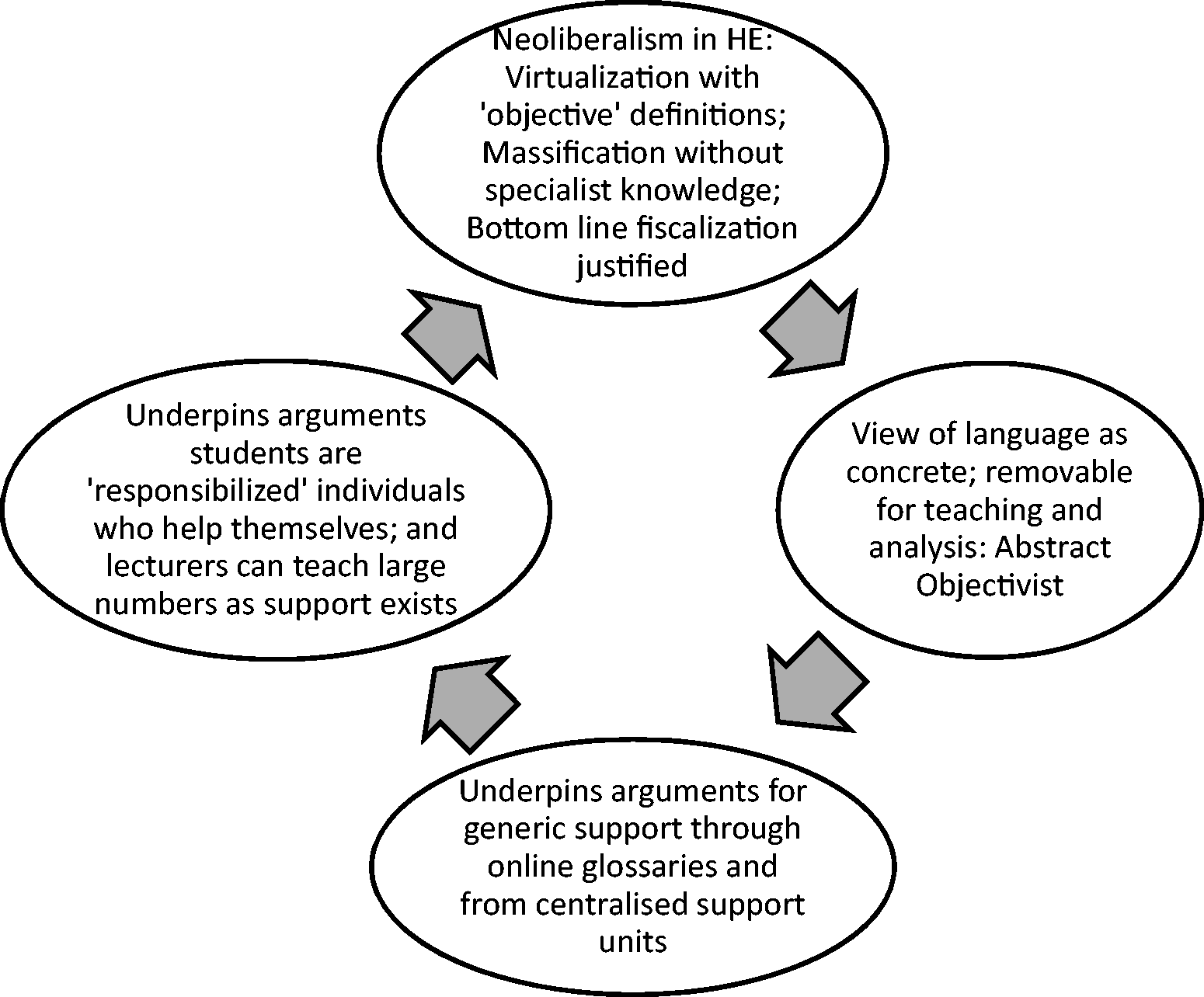
How an abstract objectivist view of language supports arguments that facilitate neo-liberalism.
However, what if this view of language were erroneous? What if, in fact, language were not concrete or homogeneous, and could not be removed, analysed and taught to everyone, by almost anyone? What if, instead, language were highly individual and subjective (Voloshinov, 1973), and very much linked to its context of use (Bakhtin, 1981), and what were ostensibly the ‘same’ words were, in actual fact, very differently used and understood in each subject area (Richards and Pilcher, 2014, 2016)? Moreover, what if those staff supporting students required a strong knowledge of the subject context to help students with such language? If this was, indeed, the case, then this would also have a number of implications for the validity of the arguments that neo-liberalism draws upon. For example, when arguing to lecturers and students that support exists in the form of online glossaries, such arguments could be refuted by noting that this support is based on a view of language that does not represent the reality of what students need to understand and that, instead, students need support through dialogue in the subject context with individuals who are experts in the subject domain.
In this article, we argue that language is not concrete and homogeneous, but is instead individual and subjective, and that dialogue in the subject context is fundamental to how it should be taught and how students should be supported. We take the language theories of Valentin Voloshinov (1973) and Mikhail Bakhtin (1981, 1986) and use them (or plug them in (Deleuze and Guattari, 1988; Jackson and Mazzei, 2013)) to read how a body of data from interviews and focus groups with lecturers reflects the individual subjective nature of language and the importance of dialogue in the subject context to supporting students. Based on these results, we question the validity of the arguments used to facilitate neo-liberalism’s persuasive power, and substantiate arguments to resist neo-liberalism that can be presented to those responsible for policies regarding student support. We stress that we are in no way against massification, and would in fact aspire to achieving 100% of the population to attend higher education. However, we argue that current approaches to help support students need to be recalibrated to reflect the individual subjective nature of language and the importance of context-specific dialogue in the subject.
The remainder of our article is structured as follows. First, we make a case for how an abstract objectivist view of language underpins the persuasive power of neo-liberalism by reviewing literature on neo-liberalism (particularly in higher education) and considering how a selection of current materials and workshops used by universities to support students are grounded in this view. Second, we present theory to make the case that language should be viewed instead as an individual and subjectivist entity, and of the fundamentally important role of dialogue in the subject context to the meaning and use of language. Then, we describe how we collected our data, where it is from and how we analysed it. Following this, we present and analyse examples of our data and, finally, we discuss how it can be used to inform arguments to divest (see Moyes et al., 2017) from current approaches to supporting students and invest in ways to support students grounded in approaches that recognize the individual subjective nature of language and the importance of the need for dialogue with specialists in the subject context. In this way, we question the validity of the arguments that are used to facilitate current neo-liberal approaches to student support, and thereby resist neo-liberalism.
Neo-liberalism in higher education and approaches and resources to support students
Although challenging to define (Davies and Bansel, 2007), neo-liberalism is argued to be all-consuming and all-encompassing of both the private and the public sectors (Olssen and Peters, 2005). It has been said that, in neo-liberalism, the ‘individual citizen becomes a homo economicus and every single area of social, cultural, and political life is reduced to the simple economic principles of cost–benefit, production, and efficiency’ (Brown, 2003: 9; see also Becker, 1990). Key to most manifestations of neo-liberalism are the concepts of ‘cost–benefit’, ‘production’ and ‘efficiency’. Such concepts are embedded in Foucault’s (1982) ideas of governmentality, including technologies of power and domination, and also technologies of the self, dating back to Ancient Greek ideas and based on the principles ‘constituted in Greek as epimelesthai sautou, “to take care of yourself”, “the concern with self”, “to be concerned, to take care of yourself”’ (Foucault, 1982). In this way, the individual becomes ‘responsibilized’ (Bonanno, 2017) and is intended to take care of themselves – a key tenet of human capital theory (Becker, 1993), which is central to much neo-liberalism. Here, behaviour is revolutionized in virtually all areas of life, including marriage, work and also education, as part of a use of ‘scarce means to competing ends’ (Becker, 1990: 4), and individuals are expected to invest in themselves through education in order to compete in the market. As Bansel writes, in this neo-liberal approach, [c]itizens, in the name of their own self-interest, are to take responsibility for their own conduct and its consequences. In this way responsibilities for education, health, welfare, security and mutual care become the responsibility of the individual rather than the state. (Bansel, 2007: 285)
In terms of the roles of the individual and the state, Friedman (1982), Hayek (1980) and Becker (1990) all promote the private sphere and the individual as taking over from the role of the state in many areas of life. They are thus symbiotically linked in that the state’s role is to shift responsibility to the individual and to create conditions for the individual to be responsibilized and able to compete in the market to contribute their human capital to the development of the market and the system. Although the state intervenes to protect ‘negative freedoms’ – for example, the right to not be prevented from developing (Plant, 2010) – in most forms of neo-liberalism, ‘social problems and their solutions are primarily the outcomes of individual choices and initiatives’ (Bonanno, 2017: 184).
In a specific education context, neo-liberalism has been said to encroach itself through virtualization, ‘or the process of managing the university as an online community and a paperless world’; vocalization, ‘or the insistence on consistently derived and derivable returns on education’; and fiscalization, ‘or bottom-line budgeting as the ruling measure of viability of all departments and units of educational institutions’ (McCarthy, 2009: 242). Education has been said to fully endorse human capital theory (Connell, 2013) so that, today, ‘schools and universities have arguably been reconfigured to produce … highly individualized, responsibilized subjects’ (Davies and Bansel, 2007: 248). Arguably, neo-liberalism has been able to assemble itself in education through the application and practice of these components. Assemblage thinking (Higgins and Larner, 2017) focuses on how processes are formed by heterogeneous actants, and helps effectively understand how entities and systems emerge. In Li’s (2007: 265) summary, the constitutive practices of assemblage for any system are to forge alignments between the aims of different groups (here, students and higher education); to render issues technical (here, the support); to authorize knowledge; to manage failures and contradictions; to be anti politics – for example, by ‘inviting citizen participation but circumscribing the agenda’; and to reassemble by ‘adding new components and altering existing elements’. Assemblage thinking also helps reveal complexities and contradictions within systems. Specifically, it can help see not only how neo-liberalism has helped deal with resistance by focusing it on the corporation and the individual (Bonanno, 2017), but also how practices such as charity and volunteering can be underpinned by social and fully ethical motivations, yet use this affect to help ‘neoliberalism to stabilize’ (Hoffman and Reidun St John, 2017: 248). The way in which neo-liberalism has assembled itself in education has arguably limited and circumvented many of the ways education should function. Such moves put serious curbs on the ability for critique (Thornton, 2015) and dialogue (Bakhtin, 1981) between students and lecturers – the latter being key to education, with learning requiring ‘authentic dialogue between learners and educators as equally knowing subjects’ (Freire, 1989: 49), which may require assumptions about certain elements (such as the nature of language) to be suspended (Bohm, 1996).
With regard to the resources universities have to support students, almost without exception universities have online glossaries of key assessment terms such as ‘describe’ and ‘evaluate’, and of exercises and explanations that help students understand what an ‘essay’ or a ‘report’ is. These cover aspects such as how to write a ‘critical literature summary’ (University of Edinburgh, 2016) or ask students to ‘figure out what the task word means (e.g. discuss, describe, argue)’ (University of Birmingham, 2017). Glossaries are provided to explain what task words mean – for example, ‘Analyse: Break an issue into its constituent parts. Look in depth at each part using supporting arguments and evidence for and against as well as how these interrelate to one another’ (University of Leicester, 2018) – or have sections describing assignments generically, such as a critical review: ‘A critical review is a type of essay which has the purpose of evaluating all, or part of, a research article, an artwork or some other type of work’ (University of Sydney, 2014 ). Workshops are given in ‘Introduction to Critical Writing’ (University of Sydney, 2014 ), ‘Essay Writing from Start to Finish’ (University of Toronto, 2018) and ‘essay writing’ (Victoria University, 2015 ). Centres can help with ‘writing assistance to all University divisions, schools, and academic and administrative programs’ (University of Chicago, 2018) and often have ‘StudyHub’-type resources (Victoria University of Wellington, 2018).
In almost every case we have studied, such resources and support are delivered from a central unit, have online materials, and contain a glossary of key terms for students. Even where we find that some institutions have specific school-based support centres and help, the main central help and glossaries still remain (for example, at the University of Cambridge (2018)). Critically, in each case, we argue that such support and resources meet all the criteria for the forms of neo-liberalism in education and higher education. Students are expected to be responsibilized individuals (see Bonanno, 2017) to access the help available; phrases such as ‘The University has lots of support to help you’ (Victoria University, 2015 ) abound, as do headings such as ‘Help Yourself’ (University of Sydney, 2015). What is more, a huge amount of the support available is online, and therefore virtualized, thus meeting the bottom-line drive to fiscalization and replicability that neo-liberalism desires (see McCarthy, 2009). Units that deliver workshops do so from the perspective that how to approach ‘essays’ or ‘critical reviewing’ can be taught through a workshop to students separate from the subject, and to all and any subject groups (see De Saussure, 1959). Such resources and approaches must, inevitably, be grounded in a view of language that sees it as being an entity which can be taken away from its context for analysis, and is homogenous and concrete. Only if language were such an abstract objectivist entity could it be taken from any subject context and defined for all to refer to.
Differing views of language: abstract objectivist and individual subjectivist
A key critique of Saussure was written in 1929 by Valentin Voloshinov of the Bakhtin school, but was not translated into English until the 1970s, and thus remained almost unknown in the West (certainly, as far as we can see, it is not referred to by post-structuralist critics such as Derrida). Voloshinov critiques the work of Saussure as being based on a view of language that sees language as being abstract objectivist, or an entity that is concrete and homogenous, and can be removed from context for the purposes of analysis and pedagogy. Instead, so Voloshinov argued, language is more appropriately viewed as creative, constantly evolving and changing – an individual subjectivist entity. As such, language is unique to the speaker and contains many underpinning or underlying psychological and ideological elements. In this view of language, the ‘text’ of the language or its words only represent ‘the inert crust, the hardened lava of language creativity’ (Voloshinov, 1973: 48). Their context of use is absolutely critical to the meaning and understanding of the language (Voloshinov, 1973; see also Bakhtin, 1981, 1986); it will be unique in psychological elements to their subjects (Pilcher and Richards, 2016) and will contain key non-textual elements that also play a fundamentally important role in their meaning in each specific subject, such as visual or emotional elements (Richards and Pilcher, 2018). Dialogue in the language’s context of use is key for the construction of meaning (Bakhtin, 1981, 1986) and to pedagogy (Freire, 1989), and language and thought are said to be inextricably linked: ‘the meaning of a word represents such a close amalgam of thought and language that it is hard to tell whether it is a phenomenon of speech or a phenomenon of thought’ (Vygotsky, 1962: 120; see also Wittgenstein, 1953).
In this view of language, support to help students understand what is required of them when asked questions using terms such as ‘critically evaluate’, or to understand what is required in a ‘report’, could not be presented acontextually online. In this view of language, universally applicable and concrete definitions would have little relevance to specific subjects, as each subject would appropriate and use individual approaches to ‘reports’, to ‘analysis’ and to ‘critical evaluation’. Instead, rather than providing support aligned with neo-liberalism which assumed that responsibilized individuals need to care for themselves and invest in their human capital, what would be required is an approach that recognized the individual subjectivist nature of language, whereby the university established and provided more subject-based expertise to support students. In practice, what would be required would be an approach which questioned the validity of the arguments that neo-liberalism draws on to support its approach to support. Instead, what would be needed would be contextualized dialogue to convey and explain concepts – something that would require those helping the students to have extensive subject knowledge and ability, in order to be able to explain to students exactly what ‘critically analyse’ entailed in their own subject (Pilcher and Richards, 2018) or what exactly a ‘report’ was.
Data collection
Our data comes from past and ongoing projects researching student support. One project involved focus groups with students and lecturers about their understandings of assessment task words (Richards and Pilcher, 2014). Another involved interviews and focus groups with lecturers where we asked questions about what ‘English’ it was felt students needed in the subjects of nursing, design, business and computing (Richards and Pilcher, 2016; Pilcher and Richards, 2017, 2018). A third project involved interviews with lecturers where we used a physical object as a focus, and asked lecturers how it would be ‘described’ and ‘critically analysed’ in their subjects of nursing, psychology, design and engineering (Pilcher and Richards, 2017, 2018). Our approach to analysis has always started with transcription (see Bird, 2005). In earlier projects, we then drew on constructivist grounded theory approaches (Charmaz, 2010) to search for emerging codes in the data. In later projects, we began to expand and develop our approaches to analysis, such as through diffractive (Mazzei, 2014) analysis, where we would read the data using our own search for emerging themes and with reference to theory.
Alongside the individual goals of each of these projects, we began to suspect that, when taken as a whole, the data could shed light on something new. This was that it may illustrate how lecturers and students saw their subject language to be individual and subjective, and also how lecturers supported students through dialogue in their own specific subject contexts. We were able to recall occasional examples of this and wanted to explore the data further. Our desire to do this led us to try to expand the diffractive approach to analysis we had been using and adopt an approach where we would ‘plug in’ (Deleuze and Guattari, 1988; Jackson and Mazzei, 2013) theory to the whole text of our data from all projects.
The process of ‘plugging in’ sees a text as an assemblage of a number of different perspectives and viewpoints, or ‘multiplicities’ (Deleuze and Guattari, 1988: 24), which can reveal many different elements. In order to reveal these elements, it asks questions of these texts from the perspective of a particular theory. As such, the text is not considered to be representative of a particular reality; rather, it can represent a multitude of realities, which can be discovered by reading the text as data through the lens of a particular theory. In this way, the process of plugging in ‘positions both data and theory as machines and reveals both their supple substance and their machinic potential to interrupt and transform other machines’ (Jackson and Mazzei, 2013: 261). For example, if Foucauldian panopticist theory (Foucault, 1979) is plugged into a data set, the question asked of the data could be something such as: ‘To what extent does the data reveal evidence of surveillance and control of individuals?’
In our case, we took the entire text of our data from previous projects, totalling over 350,000 words, and carefully combed through it. We did this and ‘plugged in’ theories to analyse it. Specifically, we plugged the theories of Voloshinov and Bakhtin into our data to reveal ‘their supple substance and their machinic potential to interrupt and transform’ the machine of neo-liberalism. Specifically, when we plugged in the individual subjectivist language theory of Voloshinov, the question we asked of the data was: ‘Does our body of data suggest that language in subjects is individual and subjective?’ Also, when we plugged in the dialogic theory of Bakhtin, the question we asked was: ‘How does our body of data reveal ways in which successful support requires subject-context-based dialogue?’ We now present and analyse the results of this process.
Results and analysis
Does our body of data suggest that language in subjects is individual and subjective?
In our data, we see many illustrations and examples of the language being seen as being individual and subjective. One way was how different groups of people interpreted language. For example, with the word ‘discuss’, for UK-based lecturers from China, there was little ambiguity; for them, there was no ‘ambiguity in this one. It should be clear’. Yet, for UK students, ‘discuss’ was anathema, with one student saying: ‘I hate this one’ and ‘I don’t know, really know what it means to “discuss” and I often failed on it’. Another UK student related a similar dislike of ‘discuss’, saying: ‘I read somewhere in one book that discuss means that you have to highlight the most important points of certain arguments and either compare or contrast them’. However, when asked if this made sense to them, this student replied with an emphatic ‘No!’ The specific context was noted by the students, with one saying that ‘discuss’ ‘all depends on the question or what it actually is you’ve been asked to do’. Similarly, UK lecturers highlighted extreme complexity with the word ‘discuss’. One lecturer commented that: ‘“discuss” must contain the elements of a think “critically appraise … analyse, review”; it’s got “synthesis”, it’s got “scholarship”, it’s got the lot in “discuss”’ . Another lecturer commented that: when you ‘discuss’ something, you’re expecting students to be able to bring in additional knowledge … talk around this subject as well as about this subject, put it into its context … the student needs to be able to place it within its subject domain. it’s a difficult one because it’s synthesizing stuff … I might ask it in a viva because then you’re expecting the student to be able to look at the body of knowledge that they have … to have gone through a process of reflection and then to be able to say, because it’s such a hard thing to do.
Related to this was the fact that ‘culture’ could also have immense implications for the way language was individual and subjective. For example, in mental health nursing, one lecturer commented how ‘Mental health is very culturally based; if you go to France … the Czech Republic … Finland or you go to Zimbabwe, mental health and mental illness is understood differently in each country’, and that ‘in terms of language issues, there are certainly some times when it’s quite clear the person isn’t picking up the subtlety of what’s taking place; they take a very kind of simplistic surface view of things’. Some lecturers also considered culture to influence student understanding and approaches to language – for example, if their educational background was from a particular environment, some ‘Master’s students find it very difficult to critically analyse because they don’t want to be critical of anybody or anything’. Importantly, ‘culture’ would not be geographically based simply in terms of countries, but also in terms of the type of institution students had been to and were coming from. As one lecturer commented: ‘a lot of our students … maybe this sounds a bit snobbish, but who come through access courses, through FE [further education] colleges, they sometimes are, quite, not as well educated as some other students’. Thus, individual backgrounds and experiences will very much affect how different people see and use language such as ‘critical analysis’, which would arguably not be something that could be conveyed in an online glossary or a generic definition without specific subject-based dialogue.
The individual nature of language was also evident in subject-specific interpretations and expectations. For example, in engineering, for ‘a “critical evaluation”, implicit in that is an assessment of whether it may be simply right or wrong … it’s a valuation, an amount, a number, a counting, a value’. Similarly, with ‘describe’, an engineering lecturer commented that: If I say ‘describe’ the soil, my lawyer sister would say, ‘Well, it’s wet and muddy and grey or brown or maybe white if it’s a China clay’, but to actually get an engineer’s ‘description’ of soil requires certain tests, requires certain calculations, and you plot that on the chart and that gives you your description … you must target your description for the right audience.
Similarly, with the term ‘illustrate’, whereas for one lecturer in film studies this would be to ‘support your argument with what somebody else has said about it’, for another lecturer in computing, they would expect diagrams and pictures, noting that they ‘would always say “illustrate” using diagrams or figures or whatever, always’. Also, with the term ‘sophisticated’, in design it would be ‘the ability to apply critical thought to context … very much about a hermeneutics of design – what does it mean, how does it mean, and explain that interpretative process’. In design, ‘critical’ would also be very much individual to the subject, as ‘the critical component is … that ability to contextualize and see shifts in time and offer interpretation’. However, in some branches of engineering, for ‘critical evaluation’, one lecturer commented that: you would hope they would be concerned with things like volume, and how much volume does it hold? Kind of measure it. Is it designed in a way that is helpful? How hot does it get? Does the handle get hot? I would expect them to take an engineering slant on it – look for a way to measure if it is fit for purpose.
With all these cases, the language and terminology were inextricably linked with the specific subject they were used in (see Pilcher and Richards, 2016). Each subject appropriated and understood each term uniquely. None of these unique appropriations could be conveyed by an online glossary or a centralized unit delivering introductory classes of the same nature to each group of students. Inevitably, such glossaries and introductory classes have to be based on the view that language can be abstracted and taught outside of its context of use. This, in turn, helps universities believe that they are delivering support that can be made generic and is replicable, and can mean that specialist knowledge is not required for any of the massification (Thornton, 2015) and that little support is needed for the virtualization, both of which enable bottom-line fiscalization (McCarthy, 2009). Yet, as the above data shows, the arguments that neo-liberalism relies on to underpin such support are invalid, given the inherently individual and subjective nature of the language here.
What is more, in our data we see many examples of assessment types also being individual and subjective. For example, a ‘report’ would differ depending on the subject being written about; for one lecturer, ‘a business report … differs from an academic report … a business report is less obsessed with in-line citations, more focused on identifying and communicating implications and next steps’. In contrast, for another lecturer, ‘a report is a collection of various aspects of the project, which is going to be put together as a formal document and sent back to somebody who is of fairly high level’, but for the students, a ‘report’ ‘just means it’s a coursework … not necessarily a report in the way I’m talking about’. Also, for another lecturer, students would be required to write a ‘technical report’, and a technical report is not an academic report; it is an industrial-based technical report. There is no literature review … [it is] very practical-based … [students] go through all different tests to evaluate the material and properties, and they have to write a report to tell me what the material is made of.
Another way in which the individual and subjective nature of the language was illustrated was in how people’s understandings of words and language had changed and developed over time (contra Saussure, 1959). For one student, the meanings of words would be very different in the workplace and academic contexts: ‘before, I worked in factories and I never really critically evaluated anything. You do account for, you do discuss and you do explain’, but, in an academic context, ‘you kind of targeted it to book work rather than [the workplace]’. Another student commented directly on how they learned many words through error and had ‘had no warning that they actually mean something completely different in an academic context than they mean in [a] normal context’. This student also noted how it was only when they read ‘other academic’ sources that they understood what to do, and not in ‘the introduction class, what’s it called … study skills … biggest waste of time in my life’. Lecturers also commented on how their own understandings of words had changed over time, with one noting that: ‘my understanding of all of these words has changed hugely since I was at university’. Here, then, language changed over time for the individuals. It was not a concrete synchronic form (contra Saussure, 1959); rather, it was individual to the extent that it would change for an individual.
How does our body of data reveal ways in which successful support requires subject-context-based dialogue?
The data contained repeated references to the importance of context (Bakhtin, 1981, 1986), with one design lecturer saying: that’s where English is horrendous, because a student will get hold of what they think the meaning of something is and then the moment you take that word and put it into a different context completely blows them out of the water.
A dictionary was also not considered to help greatly, as its definitions were removed from context (see Bakhtin, 1986). In the words of one computer science student: the dictionary will tell you what it means … but it doesn’t tell you how to put it into context; it might give you … maybe one sentence containing the word but it’ll not turn round to me and say … in user experience, I need to use ethnography in this kind of context.
One way lecturers helped support students would be to contextualize what was expected of a task word. For example, one lecturer commented: what we would like students to do is to understand what it means to do an examination and what does this verb actually mean, so we put the emphasis of the meaning on what the word expects them to carry out, rather than what the word expects them to be able to yield.
The importance of teaching the knowledge needed through dialogue in the context was also commented on. One lecturer related how ‘critical thinking’ was often taught acontextually, but that this was ineffective. Instead, they related how they taught critical thinking: with my second-year fluid mechanics students … [I] premarked their lab report submissions, went over them in a tutorial, handed them back and said, ‘Right, hand them in next week and I’ll mark the second version’ … class average [went] up by 10%. when you say ‘explain’, do they know what is meant by ‘explain’? And … often they present written work that is superficial or descriptive, and then you say to them, this is, you know, this, in feedback. They don’t understand. I’ve just realized they don’t understand what is meant by that, so then you have to explain in your feedback what is meant by that. they [the students] could go to a normal dictionary and look at the term, but then we would say to them, actually, there’s difficulties with the dictionary definition and this is what it means and there’s literature actually in evidence to support that debate.
Here, then, the ways lecturers were able to support students specifically required significant resources, but unless they were able to do this, the pass mark would not be as high, and thus to assume that students could do so as responsibilized (Bonanno, 2017) and resilient (Higgins and Larner, 2017) by going to decontextualized generic support and glossaries has to be a false assumption. Only by seeing the individual and subjective nature of the language through dialogue in its subject context would students be properly supported.
Indeed, it was often only dialogue (Bakhtin, 1981) that could help, and knowledge of the subject was a key to this dialogue. Speaking of one student who had asked about marketing after a tutorial, one lecturer commented: ‘I really had to explain it chapter and verse to her’. Similarly, another lecturer spoke about explaining the individual nuances of different jargon in leadership to students, commenting on the importance of ‘trying to explain to them how the terms have developed over time and explain to them very often these terms have been developed for, kind of, for marketing purposes as much as anything else’. This lecturer commented that: ‘it’s not so much the vocabulary they struggle with; it’s the context and how the words are used’. Another lecturer spoke about a student who had struggled, but continually asked questions after class, and as a result of engaging in dialogue in this way, successfully learned what was required: ‘she would always be there … at 5.00 … outside the office … she realized very early I’m struggling here … her dissertation blossomed from the back end of January’.
Dialogue was also key in explaining what was required to students. One design lecturer commented on how they ‘always explain the marking criteria … I often put it up on a slide … but I don’t actually know how useful that is because the terms are specialist terms … specific to the module really’. Notably, this lecturer spoke of an approach whereby a Master’s student from a particular country had been employed as a translator to help other students from that country with the subject material. This person ‘was great and we didn’t have fails when [she] was there … she had a Master’s in Design … she understood the context of the language … [she] didn’t want to leave but it was a funding issue’.
Here, then, what was essential was to ensure that dialogue occurred in the subject context in order to be able to successfully convey the individual and subjective meaning of the language that students needed. Support for students thus required dialogue (Bakhtin, 1981, 1986) to help them see the words appropriated.
Conclusion: effectively supporting students and invalidating the arguments used by neo-liberalism to justify approaches to student support
In this article, we have argued that a particular – abstract objectivist – view of language that sees language as being concrete and fixed, and as an entity that can be removed for analysis and teaching, is one that underpins and gives neo-liberalism persuasive power, to justify moves in education to massify and virtualize with little investment, and thereby to bottom line fiscalize. Such a view of language allows institutions to argue that the creation of online glossaries can illustrate to students what is meant by ‘describe’ and ‘discuss’, and that centralized units can deliver workshops on what an ‘essay’ or a ‘report’ is to students. In turn, this allows institutions to argue to lecturers that they can teach large numbers of students because the support exists to help these students. Concomitantly, it allows institutions to market themselves to students by claiming that the support exists for students if they need it, and that they should be responsibilized and resilient to access the support.
We have argued that this view is false and that, instead, language should be seen as an individual and subjective entity that is continually changing, to which its context of use is fundamental. We have illustrated this latter argument through analysing a large body of data from a number of projects by ‘plugging in’ to the data the theoretical lenses of Voloshinov’s theory of individual subjectivism and Bakhtin’s theory of the importance of dialogue. Specifically, we used these lenses to find examples and illustrations of how language is individual and subjective, and to demonstrate the key role of dialogue in context to how lecturers supported students. Of these, we find numerous examples that show how individual subjects contextualize and use language in completely unique ways, and of how these factors play a fundamentally important role in how students can best be supported by lecturers. These ways not only highlight how the arguments that students can be supported through decontextualized and generic support glossaries and classes are invalid, but also highlight exactly what we need to do to support students more effectively.
We suggest that language is individual and subjective, and subject-based dialogue with individuals who have subject specialist knowledge is essential to help support students in their subjects. Further, we suggest that such points invalidate the arguments drawn on by neo-liberalism that online ‘one size fits all’ explanations of key assessment words and tasks, such as essays or reports, are sufficient. Instead, we argue that there is a need to divest from such approaches and invest in approaches where virtualization has to be supplemented by subject-contextualized assistance. In turn, these materials and this support will need to be developed and delivered by those with subject expertise, which would mean that the individuals delivering the material would need to have background and experience in the subject, and be remunerated accordingly, thus resisting bottom-line fiscalization. Ultimately, this would then help to appropriately support the issues raised by massification, and better empower students and lecturers. We end by presenting visually in Figure 2 how we feel this can be done. We take Figure 1 and ‘invert’ and ‘reverse’ it to suggest how neo-liberalism can be resisted by seeing language as an individual and subjective entity, and emphasizing the critical role of dialogue in the subject with those knowledgeable about the subject matter. The success of neo-liberalism rests on the foundation of having validity for its arguments. In current approaches to support for students, these arguments are claimed to be valid based on an abstract objectivist view of language. We have presented and discussed data to show that such a view of language is false, and thereby the validity of the arguments that neo-liberalism uses to facilitate its success is questionable. We hope these arguments can be used to resist neo-liberalism and, ultimately, help support students more effectively.
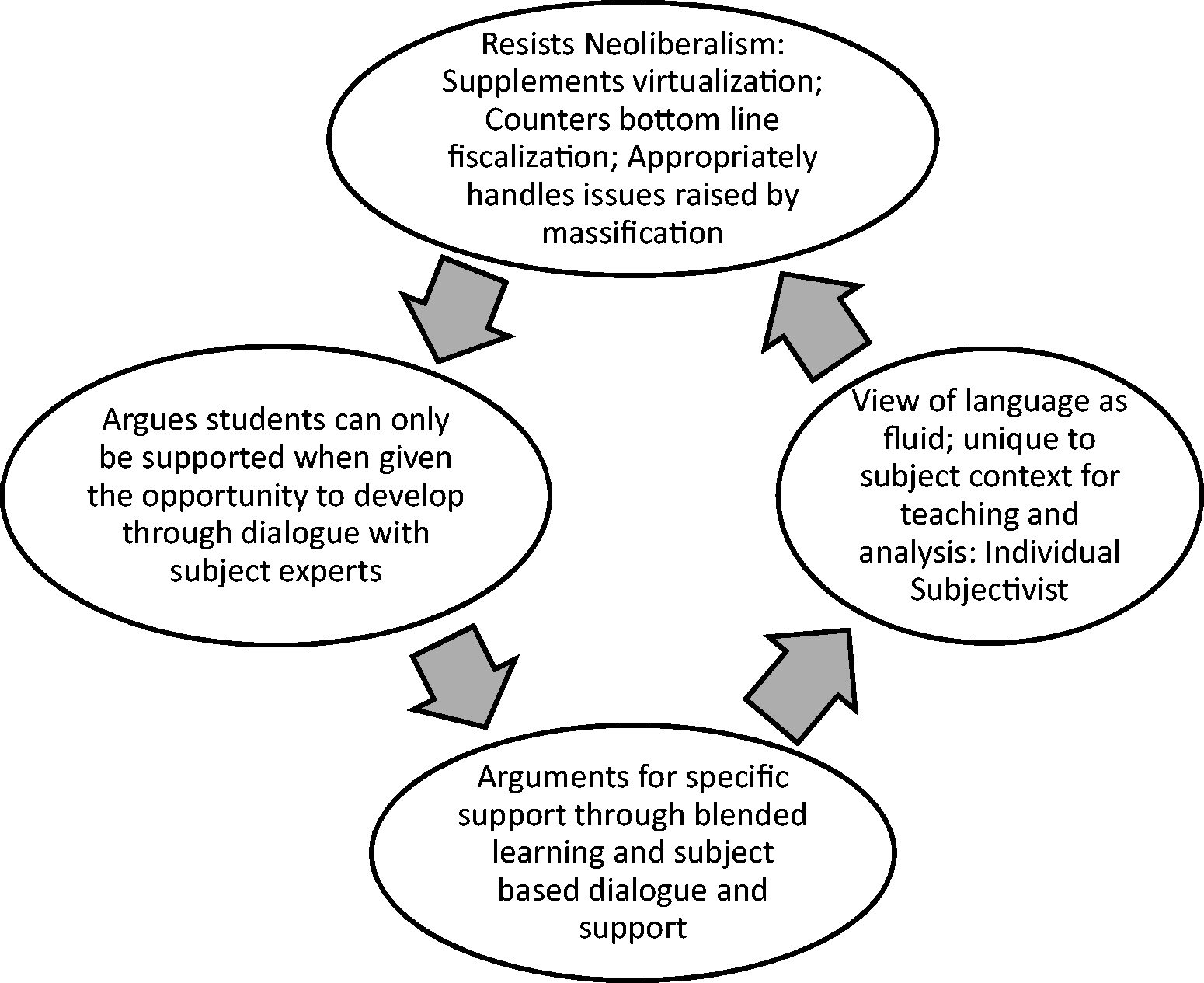
How an individual subjectivist view of language invalidates the arguments that neo-liberalism draws on to justify its approach to student support.
Footnotes
Declaration of Conflicting Interests
The authors declared no potential conflicts of interest with respect to the research, authorship, and/or publication of this article.
Funding
The authors received no financial support for the research, authorship, and/or publication of this article.