




Abstract
This study maps, characterizes, and conceptualizes the media discourse and coverage of non-governmental organization–school interactions within public education in Israel, while depicting the evolving dynamics and framing of this ever prominent phenomenon. The authors employed two complementary methodologies for the analysis: critical discourse analysis and framing theory. Specifically, this study pinpoints how neo-liberal notions are used and communicated to the public, and what role different newspapers play in framing those interactions and in helping to shape public opinion regarding the new engagements between schools and non-governmental organizations. The authors depict the ways in which school–non-governmental organization interactions are presented and framed to popular and elite audiences, and discuss the possible implications of their findings in light of the growing prominence of external entities in public schooling.
Introduction
The growing involvement of third-sector organizations 1 in the public education system is a global phenomenon (Ball, 2007; Rose, 2010). In recent decades, such organizations have become a major source of influence in developed, as well as developing countries. The increasing numbers and expanded involvement of these actors demarcates the development and expansion of neo-liberal policies in the education system (Silova, 2008). Such policies advocate for a decrease in funding and direct state involvement in the provision of public education, thus allowing for the involvement of various external actors in the system (Ball, 2007). The diffusion of economic mindsets and mechanisms reshapes the relations between the existing actors (the government, schools, parents, students, politicians, etc.) in the field, challenging their respective roles, authority, and autonomy while introducing new actors and agendas (Ball, 2016). This results in a situation where external intermediaries—including for-profit firms, third-sector organizations, charitable foundations, and voluntary organizations—deliver many services that governments are legally responsible for providing to their citizens (Kolleck, 2017).
Such privatization processes have taken on a variety of forms in different contexts and countries. Their impact is largely criticized regarding the commercialization and commodification of public education, increased competition between schools, and rising inequality within the delivery of education; moreover, the involvement of external agents in education as facilitators of these trends has been condemned (Verger et al., 2014). On the other hand, external agents’ engrossment with schools is praised as a manifestation of citizens’ agency, freedom to choose, and “voice” (Gofen, 2015), which allows citizens to shape their own relationships with the state. Media channels worldwide present, discuss, and criticize the education arena, as various stakeholders seek to influence public opinion and position their views and agendas (Robert, 2012). In education, as in other fields, policy is formed in close interrelations between policymakers, the public and mass media (Murphy, 2013). Despite the advent of electronic and social media, the traditional national press still comprises one of the major sites in which struggles over educational reforms are taking place (Yemini and Gordon, 2017; Baroutsis, 2016; Robert, 2012).
This study maps, characterizes, and conceptualizes the media discourse and coverage of non-governmental organization (NGO)–school interactions within public education in Israel so as to reveal the evolving dynamics and framing of this ever prominent phenomenon. We illustrate the ways in which school–NGO interactions are presented and framed in the Israeli context to diverse audiences (elite versus popular). Specifically, we identify how neo-liberal notions are used and communicated to the public, and highlight the role different newspapers play in framing the process and helping to shape public opinion regarding emerging engagements between schools and third-sector organizations.
Study context
NGO interactions with schools
In recent decades, neo-liberal governance has gained popularity in many countries, shaping educational policy and practice “around the principles of the marketplace” and introducing concepts such as “private property rights, free trade, consumerism, performance audits, and entrepreneurism” (Bulkley and Burch, 2011: 236). Such notions have come to be seen as “natural,” effective means of dealing with the various challenges educational systems face in developed and developing countries (Apple, 2006). Simultaneously, and perhaps, as many critics argue, as part of the same process, the public funds invested in education have been substantially reduced, alongside a rise in the regulatory role of the state (e.g., Ball, 2007). Among other changes, the neo-liberal hegemony has allowed and even promoted the entry of third-sector organizations into community management and educational practices through decentralizing, shrinking states’ responsibility, and encouraging intergovernmental cooperation (Rappleye, 2011). In sum, the proliferation of NGOs in the education landscape can be attributed to the tendency to seek private solutions to public problems (Edwards and Hulme, 1995) by producing and sustaining partnerships and associations.
Indeed, recently, NGOs have become major players in public education systems across the world (e.g. Bulkley and Burch, 2011; Kolleck, 2017). Yet definitions of what type of organization falls under the “NGO” rubric vary in the literature. Parsons and Hailes (2004) define NGOs as self-managed organizations that do not depend on the government, operate with no profit motivation, and raise at least a portion of their revenues from donations. Ichilov (2012) notes that the term represents a network of interest groups that lack formal representation, often connected with philanthropic and not-for-profit goals. Nevertheless, some of the largest business entities operate in the public sphere, including education, through NGOs; hence, the motivations underlying NGOs’ activities are not always exclusively philanthropic, but may also be shaped by financial interests (Rose, 2009). Moreover, NGOs take on various roles designed to support the delivery of educational services. Some pressure governments to fulfill their commitment to provide education for everyone. Others operate various programs to improve the quality of public education, as well as to provide educational opportunities for students who drop out of the public school system (Rose, 2009).
The claimed advantages of NGOs’ involvement in the education system lie in their assumed capacity to better understand organizational structures and work practices, as well as their abilities to identify and attract resources and generate competition in the education marketplace. In addition, some argue that NGOs may be less hierarchical and more flexible, efficient, and democratic than government service providers, as well as more aware of community needs (Patrinos et al., 2009). Generally, advocates for the involvement of private entities in public schools hope that this involvement will improve school management by assisting schools to adopt principles from the private, for-profit sectors (Eden, 2012).
Alongside such advantages, the increasing involvement in and provision of public services by NGOs has been shown to carry major drawbacks. For example, scholars have argued that this involvement leads to the uncontrolled privatization of education and, therefore, may reduce the government’s supervision of and responsibility for public education and increase educational and economic inequality between students (e.g. Patrinos et al., 2009). Haugh and Kitson (2007) claim that the provision of vital social services by third-sector actors is dangerous for the goals of social inclusion and equality of opportunity. Moreover, Berkovich and Foldes (2012) suggest that organizations which raise funds from the public can operate more easily in middle-class areas than in impoverished ones, and therefore tend to establish their base of operation in more affluent neighborhoods, thus by default fostering inequality and ultimately even acting against their own vision and mission. Rose (2010) presents the danger for social goals that arises from the exploitation of volunteers with diverse commitment and skills, especially in the neediest areas. Underlying this complicated and multidimensional debate, one fact remains indisputable: third-sector organizations are becoming more prominent than ever in many school systems worldwide (Yemini, 2017; Yemini, Cegla and Sagie, 2017).
Despite the ever growing presence of NGOs in educational spheres (Silova and Steiner-Khamsi, 2008) and notwithstanding the increasing media coverage of such interactions, the global research on media coverage of school–NGO interactions is limited. Ginsburg (2008) interprets the acronym “NGO” as, alternately, “New Great Organization” or “No Good Organization,” referring to the highly disputed image of NGOs in the public sphere and to diverse individual opinions on the subject. This dispute plays out in how the media covers and frames the involvement and interactions between NGOs and schools.
Media discourses on education
Cognitive theories of media influence—foremost among which are agenda-setting (McCombs and Shaw, 1972), priming (e.g. Valentino, 2002), and framing (e.g. Entman, 1993; Scheufele, 1999)—investigate the media’s capacity to shape people’s perceptions of the environment they live in through the provision of “information, agendas, and ‘public space’” (Katz, 1987: S28). Specifically, the framing approach investigates how the media shapes the way public issues are presented and discussed. Media frames select “some aspects of a perceived reality and make them more salient in a communicating text, in such a way as to promote a particular definition, causal interpretation, moral evaluation, and/or treatment recommendation” (Entman, 1993: 52). Framing theorists argue that influence flows from powerful media outlets allied with other powerful institutions to a less powerful audience.
Media channels may intend and claim to provide an unbiased presentation of reality, but ultimately they help shaping public policy (Levin, 2004). Research has revealed the social, cultural, and political meanings that are processed and communicated through media coverage (Fairclough, 2000). As Van Dijk (1998, 2001) notes, newspapers are ideological institutions that mobilize discursive power to shape public opinion and navigate the public discourse towards certain directions. This type of media impact on policy production is widely documented (Levin, 2004; Thomas, 2003), but the particular outcomes and extent of this impact are contested (Reimers, 2014). Thus, media discourses are complex to unpack in terms of their networks of influence and power.
The public discourse on education is increasingly characterized by messages of crisis that extend across national contexts and subjects—including teachers’ performance, salaries, and qualifications; curricular inadequacies; school organization and management; and broader socio-economic debates regarding the privatization, commercialization, and commodification of education (Cohen, 2010; Tamir & Davidson, 2011). Elements of public legitimacy are being derived from states’ performance in the global education market or, more accurately, from the press’s representation of such performance (Blackmore and Thorpe, 2003).
To date, only limited research has explored media coverage of NGOs (notably, see Hale, 2007), and no studies have specifically and systematically offered a comparative press analysis of NGOs’ involvement within education systems. Our study aims to fill this gap by investigating the media coverage of school–NGO interactions in Israel. We have chosen to focus our study on Israel as it is a country which was established with a strong social democratic vision. Yet this vision has eroded over the years as, since the 1980s, the Israeli Ministry of Education (MOE) has gradually embraced the neo-liberal ideas of decentralization and privatization (Addi-Raccah, 2012). Nowadays, NGOs are active in more than 90% of Israel's schools, having an ever growing influence on schooling and policymaking (Yemini and Sagie, 2015). Since NGOs are being investigated as prominent actors in schools in many countries (e.g. see Kolleck, 2017 for Germany), the Israeli case provides an illuminating arena for the current study.
Methods
The data for this study is based on a corpus of articles published in elite and popular daily newspapers 2 in Israel: Haaretz (elite, center-left) and Yedioth Ahronoth (popular, center-right). We used the respective digital archives of the two newspapers to search relevant news items published in 2014–2015. We selected these particular newspapers for their elite or popular affiliation, national scope, broad focus, considerable volume of articles related to education, wide readership, and availability in a searchable online database. In order to capture all possible news articles related to the search, we began the data construction by reading a broad range of news articles discussing education to avoid overlooking items that might be omitted through exclusive reliance on specific search terms. Next, we narrowed the search, scanning for references to the terms “school(s)” or “Ministry of Education” in combination with “NGO” or “third sector.” In order to ensure reliability, we met regularly to discuss the selection process of news items. All in all, the basic search yielded 150 articles from the two newspapers. After further consideration, which involved sorting the articles according to relevancy, we selected 39 items out of 80 in Haaretz and 34 out of 70 in Yedioth Ahronoth. In order to be included, the chosen articles were required to present relevancy and address issue/s related to the interactions between schools and NGOs. The rejected articles included the basic search words but did not present any relevant description or discussion related to the topic. We applied two complementary methodologies—critical discourse analysis (CDA) and framing analysis—to analyze the data, as detailed below.
Method and coding process: CDA
We chose to follow a CDA procedure developed by Fairclough (2000) and implemented in a similar (to ours) media study by Punakallio and Dervin (2015). This method corresponds particularly well with the analysis of media texts because it allows us to examine the language used in a text, constructed by the media to represent reality in a certain manner. We aim to understand “the ways discourse structures enact, confirm, legitimate, reproduce, or challenge relations of power and dominance” (Van Dijk, 2001: 353). We analyzed each of the articles separately, using line-by-line coding and interpretation with notes and comments to connect between different themes and ideas. At this stage, we read the news items multiple times and analyzed them in a comparative manner by “(a) repeated readings of the texts while making theoretical and analytical memos throughout; (b) selection, organization, and identification of discursive patterns; (c) generation of explanations linked to the overarching patterns; and (d) reflexive and transparent documentation of our claims” (Gabriel and Lester, 2003: 11).
Method and coding process: framing analysis
In addition to the qualitative analysis described above, this study uses framing theory to operationalize the role of the media in the public dialogue over the role and relationships of NGOs with the education system in Israel. Studies have found that exposure to specific frames can influence responsibility attributions (Iyengar, 1991), the type of considerations taken into account when making a political decision, the robustness of attitudes, and trust in government; occasionally, they can even directly shape attitudes themselves (e.g. Valentino et al., 2001; for a succinct overview of framing effects, see Kinder, 2003: 358–361). We will apply a quantitative framing analysis and related set of codes, as previously employed by Tamir and Davidson (2011), to the contents of the included news articles in order to identify generic frames and issues featured in the coverage. We will specifically code variables related to basic descriptive information such as the type of NGO or other educational agents mentioned in the news item, and the identity of the major educational agents featured in the item (by the relative space devoted to the agent in the item and by the number of times it is mentioned). Next, we will code the prevalence of thematic and episodic framing in each item based on the theoretical definition presented by Iyengar (1991) and elaborated by Davidson (2007). First, the prevalence of both frames is identified paragraph by paragraph and in the headline. Then, the coder makes a holistic and projective judgment regarding the dominant overall frame for each item, taking into account multiple factors such as the dominant frame in the headline and the location of the two types of frames within an item, as well as the proportion of each frame within the whole item by the number of paragraphs dedicated to it. Thus, per item, this project can report the proportion of thematic versus episodic paragraphs, as well as the overall dominant frame. Reliability was assessed for two coders who trained together and coded with full agreement the overall frame in a sample of 20 items. All of the quotations presented here have been translated from Hebrew to English and double-checked by each of the three authors.
Analysis and discussion
This section is structured as follows: first, we identify the main actors and entities featured in the news coverage. Next, we present how the two newspapers frame school–NGO interactions. We then depict the results of thorough CDA analysis focusing on how the two media outlets covered three major themes; finances and funding of NGOs' operations in schools, the problematization versus normalization discourse of NGOs' activities, and the role of NGOs in pedagogy development and implementation.
Players featured in the news coverage
Who are the major actors that are identified by the media as involved in school–NGO interactions? Answering this question provides us with an understanding of how the field is depicted in the media. The presence but also the absence of certain entities shapes the discourse and maps the actors within it. We started by recording the number of times each actor was mentioned in each of the newspapers (within the screened items). Such records serve as a rough initial indicator to help reflect on the relative prominence or weakness of some actors (see Figure 1). As can be seen, students and the MOE received most mentions (excluding the NGOs and the schools which were the basic keywords in the initial search), but other actors, such as NGO managers and employees, teachers, principals, parents, politicians, the Minister of Education, and the government, received major coverage as well. Thus, it seems that the media coverage of school–NGO interactions included most of the active and known education stakeholders in the field. We identify an interesting exception in the case of mayors and cities (i.e. local governments and local education authorities), where despite these actors’ prominent position in funding and policymaking—according to experts (Gibton, 2011)—their media coverage was low and, as a result, relatively concealed from the public eye. On the other hand, despite receiving a high number of mentions, students seem to occupy a rather passive and subordinate position in most news items.
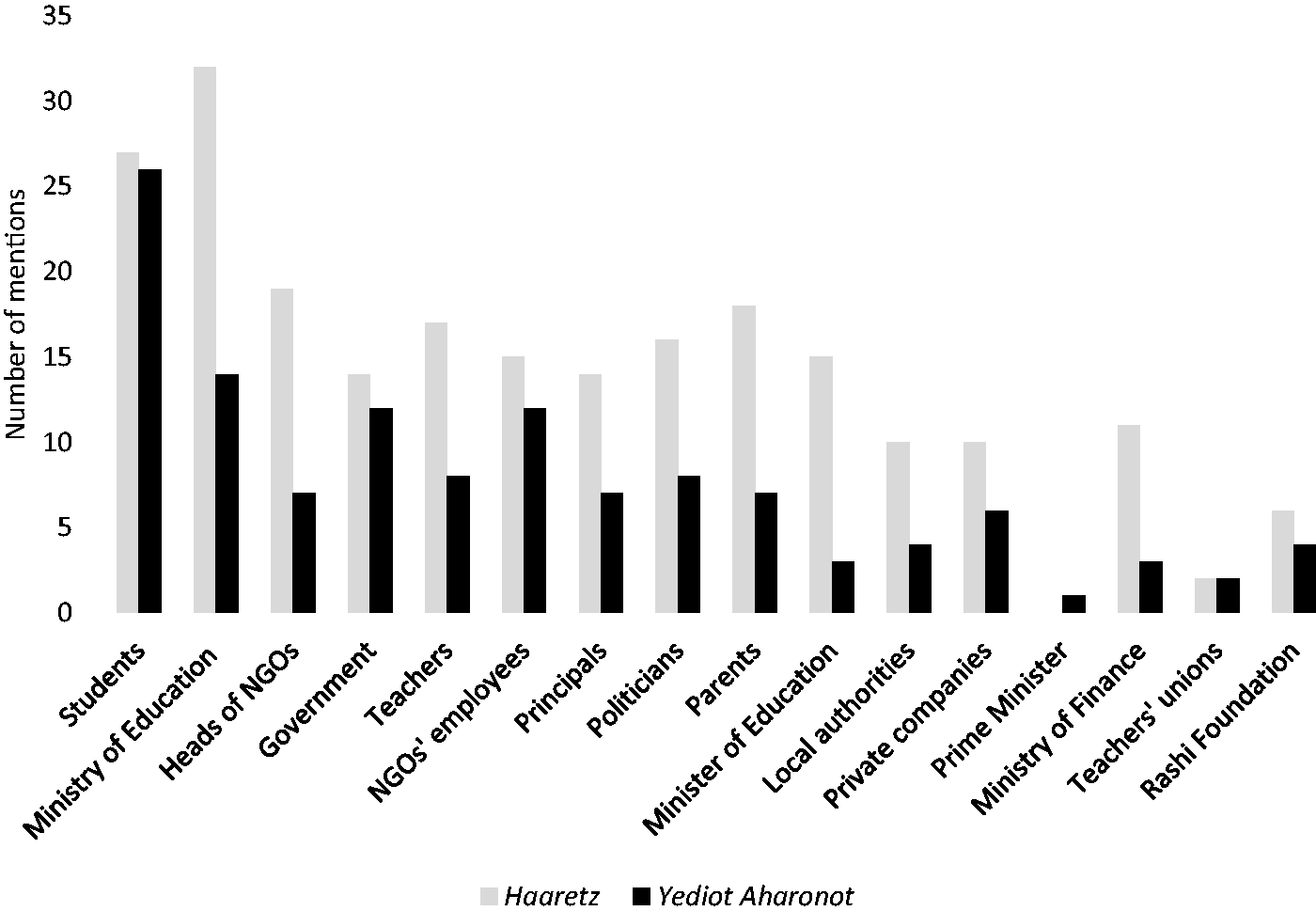
Actors’ ranking according to number of mentions (n = 401).
When comparing how the two newspapers cover the various actors, the findings suggest that the differences are relatively small. For example, students feature as the most abundant actor in both newspapers—in 76.5% of all articles in Yedioth Ahronoth and 69.2% of the articles in Haaretz.
In addition, we employed a second indicator that addresses each news item and identifies who are the first and second most prominent actors by assessing the space they receive to voice their opinions in the item. In other words, this may serve as an additional potential indicator of players’ ability to communicate and lay out their claims and arguments via the newspapers (see Figure 2). According to this measure, the NGOs and MOE are the first and second most prominent actors in Haaretz, while schools, teachers, parents, and private companies were the least prominent actors in this newspaper. In Yedioth Ahronoth, the first and second most prominent actors are the NGOs and the students, while the least prominent actors are schools, NGO employees, parents, and the Rashi Foundation.
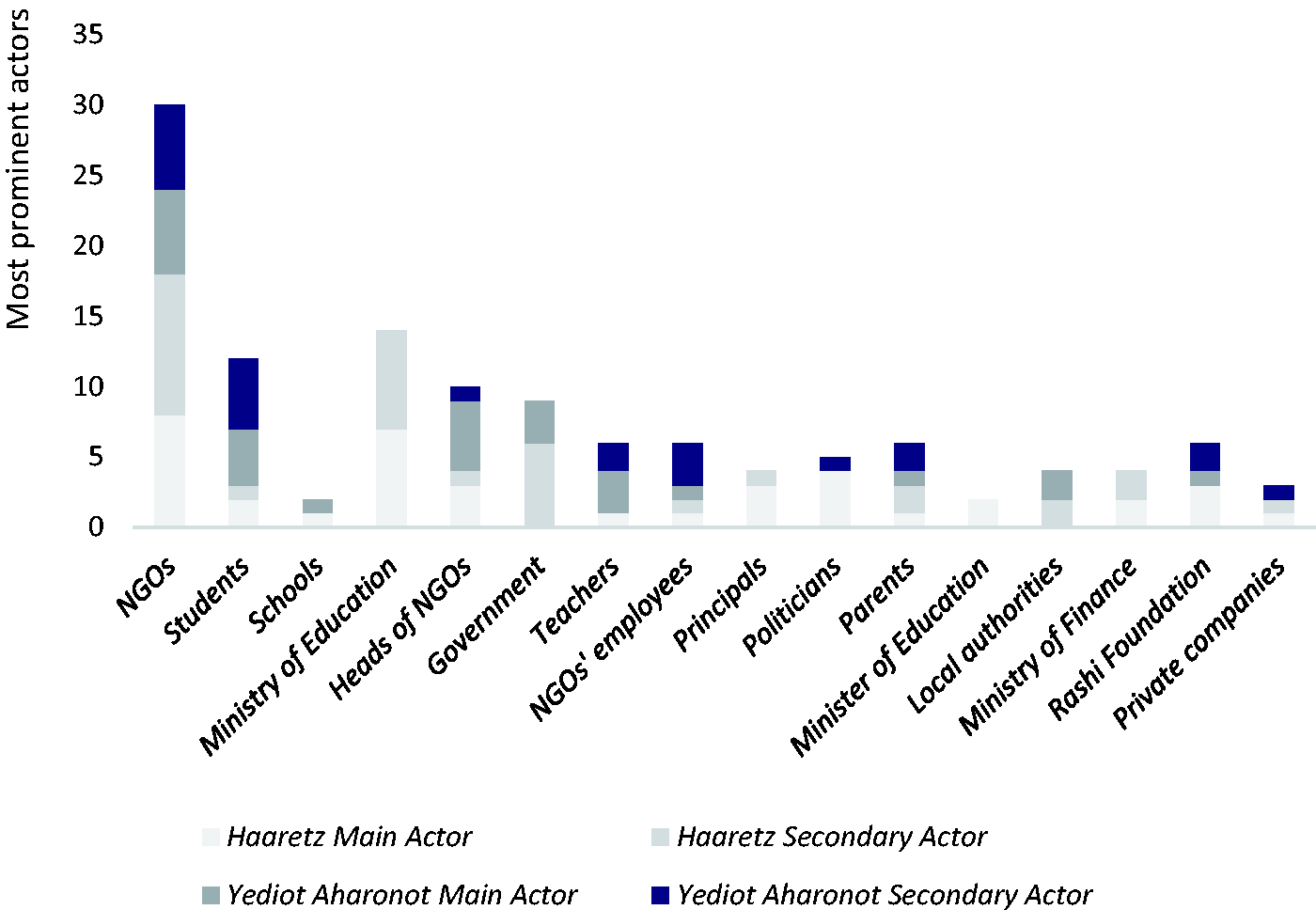
First and second most prominent actors by assessing the space they receive to voice their opinions in the item.
Putting the students and the NGOs in the spotlight reflects the narrow perspective applied by Yedioth Ahronoth’s writers and editors, who usually chose to focus their news coverage on cases of individual students and/or a particular NGO. Haaretz, on the other hand, emphasized its coverage of the MOE, principals, the Ministry of Finance (MOF), and politicians, who were completely disregarded by Yedioth Ahronoth. Haaretz’s preference to illuminate a diverse array of political actors at the national and local levels may illustrate its commitment to facilitate an informed public discourse around critical issues in educational policies and school governance. These substantial differences of focus between the two newspapers underscore what we claim are their two visions of reality: Haaretz’s elitist approach to dig deep, offer a wealth of details, and, most importantly, strive to situate the news and actors within the appropriate social, economic, historical, and cultural contexts, and Yedioth Ahronoth’s populist inclination to seek colorful stories about interesting individuals, actors, and cases without paying attention to whether these stories are important or central, or have an impact on educational policy, and, even in cases where they do, offering minimal explanation as to why. These results are consistent with the findings of the following section on framing analysis.
Framing the school–NGO interactions
Following Iyengar’s (1991) approach, we find that the news coverage in the two newspapers differed significantly in its framing of school–NGO interactions. In the popular, center-right Yedioth Ahronoth, the news framing was vastly tilted towards episodic framing, with 74.1% of the items identified as episodic and 25.9% as thematic. In quite stark difference, the news coverage in the elite, center-left Haaretz has been analyzed as mostly thematic, with 55.6% of the items identified as thematic and 44.4% as episodic. Furthermore, even in cases where the Haaretz items were identified as primarily episodic, the items contained some thematic characteristics, such as attention to detail and emphasis on context, which the Yedioth Ahronoth items, for the most part, lacked.
An example of a thematic description can be seen in the following paragraph from the Haaretz newspaper titled: “The educational wing of the Jewish Home in secular schools” (the Jewish Home is a right-wing religious nationalist party, led by the Minister of Education): About 20 years ago, the MOE adopted the Shenhar Commission report, which stated that teachers who teach Jewish subjects should have a similar background to that of the school community. This recommendation, like many others, was not implemented: about 95.5% of the NIS 18 million in the support system flowed to various organizations in the Orthodox stream. Two reform organizations received about 3%, and two pluralistic Jewish organizations (BINA and Dror Israel) received the rest—NIS 270,000. “The supervisors who determine where the money goes are not enthusiastic about a pluralistic organization,” says a senior member of one of the Jewish renewal organizations. (Kashti, 2015)
However, in Yedioth Ahronoth, where most news items were found to have an episodic framing, the articles tended to be short in length, describing a specific isolated issue and offering the reader a limited context at best. In contrast to Haaretz, where school–NGO interaction featured primarily in the financial and news supplements, in Yedioth Ahronoth the same subject (with different content) was often covered in short gossip columns (titled, “leech” and “bubbles”). In other cases, articles did not cover the subject directly and did not focus on the link between schools and NGOs, but rather on personal stories with the main subject in the background. The following example, concerning one teacher, reflects the tendency towards episodic framing in Yedioth Ahronoth’s coverage: Lavie, 38, an admired educator, a 12th-grade coordinator and a history and citizenship teacher at the Boyer School in Jerusalem, initiated a long-term collaboration with the “Good Neighbor” association, which distributes food to the needy. He explains his creed: “I want my students to always remember that there are those who are unprivileged and in great need, and that we are required to pay attention to them.” (Kaminer, 2014)
CDA thematic analysis
CDA of the news items led us to identify three major themes related to school–NGO interactions; finance and funding, problematization versus normalization, and pedagogy. Consistent with the framing analysis, CDA reveals substantial differences in the perspective, approach, and stance taken by the two news outlets when covering news concerning school–NGO relations.
Finance and funding
The analysis reveals an overwhelming emphasis on issues concerning the finances and funding of NGOs’ operations in schools, particularly in Haaretz, where the majority of articles (82.5%) dealt with the economic dimensions of school–NGO interactions. Most of these Haaretz articles appeared in The Marker, the newspaper’s economic supplement. In contrast, only 30% of the articles in Yedioth Ahronoth covered economic-related issues. Interestingly, the two newspapers also varied in their approach and emphases when covering the economics of school–NGO interactions.
The two newspapers applied a critical perspective, including asking tough questions about the distribution of resources to prominent players and following NGOs’ budgets and questionable expenditures. In particular, the question of the utilization of public funds on private means through NGOs as a channeling mechanism was covered extensively. Yet, there are considerable differences in the perspective and approach adopted by the two news outlets. Most articles in Haaretz emphasized the potential problems, waste, and breach of trust that are tied with privatization reforms and the processes implemented by the MOE. Yedioth Ahronoth’s coverage was more likely to incorporate an approach that sometimes disregards the potential challenges of privatization and, on other occasions, cites some potential risks.
An example of the different approaches taken by the two newspapers can be seen in Yedioth Ahronoth’s decision to publish an article supporting the provision of public funds to non-profit organizations, while disregarding the potential damage to the general public. On the other hand, Haaretz items emphasized questions such as: Where does the money come from? How it is spent? And who benefits from it? The privatization of education is gaining momentum—what is the connection between an insurance company and meatballs, and why does it cost NIS 900 million? The MOE’s contacts with private companies have jumped more than sevenfold in recent years and, according to the public information workshop data, the MOE acquired services from 240 private companies without a tender, as the law requires. (Datal, 2015)
Problematization versus normalization
A second theme in the coverage, which is partly related to the pervious one, concerns the type and nature of NGO–school relationships. We start by asking how these relationships are described. Are the relations between the two parties described as mutual and synergistic? Are they described as exploitative or one-sided? And, in particular, are the relationships described and perceived as having controversial aspects to them or, alternatively, viewed as normal and thus unchallenged?
The analysis suggests that, in Haaretz, relations are often presented as complex and sometimes controversial. NGOs are referred to as “external bodies” to the schools, suggesting to the reader that these relations between schools and NGOs carry complexity that should be carefully discussed and negotiated between the two sides. Haaretz’s items tend to bundle together non-profit NGOs and for-profit business corporations, which play an increasing role in offering donations and volunteers to schools in need. These relations are sometimes perceived as favorable and necessary. The coupling of the two may suggest to readers that they play a similar role as external players. Lastly, NGOs’ activities are often portrayed as manipulative and sometimes even damaging. For example, Kashti (2015) notes: “Secular and pluralistic education is under constant threat, among other things by external bodies doing what they want in schools … I hope that now secular parents will understand that the education system cannot be relied upon.” This quote demonstrates Haaretz’s tendency to perceive NGO–school relations as characterized by exploitation which is represented in the economic exploitation of NGO players who benefit from public funding and perks, as well as political/ideological exploitation. As such, the “external bodies” are perceived by Haaretz as a threat to the public at large, and particularly to secular and pluralistic education.
In Yedioth Ahronoth, the coverage of NGOs’ roles and intentions towards schools emphasizes them as being a natural and integral part of the school. A student’s description of an NGO demonstrates this point: Shortly after the beginning of the 10th grade, my science teacher informed me that a new program in Biomedical Engineering is opening. The program is initiated by the Atidim NGO, which works to reduce socio-economic gaps between the periphery and the center by offering education for excellence to selected students. (Tzirel, 2015)
Nevertheless, the coverage in Yedioth Ahronoth was not all in favor of NGOs. In some instances, the coverage in Yedioth Ahronoth was also critical, and NGO players were described as profiting from their connections to schools. In these cases, Yedioth Ahronoth described how money or favors switched hands, and also the “revolving doors” phenomenon, where senior NGO officials accepted public sector positions and vice versa. For example: Allalouf [an NGO president], the chairman of the Labor and Social Affairs Committee [of the Kneset, Israel’s legislative body], resigned from his post as director general of the Rashi Foundation in 2013 after 17 years of service and joined the Kulanu party. Allalouf previously received a grant of NIS 4.8 million from the fund to reduce gaps. (Amsterdamski, 2015)
NGOs’ involvement in curriculum and pedagogy
The third recurring theme identified by CDA is a considerable emphasis on covering issues concerning NGOs’ curricular content. While the involvement of external organizations is perceived as possible and even desirable in extracurricular or out-of-school activities, NGOs’ role in core schooling should be addressed with particular care. This theme appears in 69.2% of Haaretz items and 76.5% of Yedioth Ahronoth items. Consistent with the previous sections, Haaretz adopted a critical approach when covering NGOs’ curricula, illuminating the controversial aspects of these programs, particularly around their political, religious, and ideological underpinnings. Haaretz’s coverage tended to critically observe and carefully analyze the declared curricular contents and missions of NGOs and their actual work on the ground, mostly around attempts by religious NGOs to force their values and beliefs on secular schools and their pupils. For example, in an article entitled “Torah bodies operate in hundreds of kindergartens and schools financed by the Ministry of Education” (Scoop, 2015), the reporter raises concerns about the religious content being transmitted to secular students by religious NGOs. In support of its proposition, the article unveils the forces behind the push for religious content in secular schools and brings to the discussion the voices mostly of those who express opposition to the move. In another article, entitled “The educational wing of the Jewish Home in secular schools” (Kashti, 2015), it is argued that the religious party Jewish Home is directly engaging in a deliberate and systematic attempt to instill and coerce its religious ideology and, in doing so, is gradually undermining the democratic mission and identity of secular schools. Finally, Haaretz also sharply criticizes NGOs whose curricular contents are perceived as promoting religious nationalism. Among them is a group called Genesis, which is accused of hiding behind the term “spiritual social movement.” The organization was headed by Rabbi Moti Alon and Avi Wurzman, who was a member of the Knesset and Deputy Minister of Education on behalf of the Jewish Home. The organization’s flagship project is the “Israeli Journey” program, five days of indoctrination in the spirit of the religious right of the settlers … Had it been called a “brainwashing campaign,” or “fascist journey,” or even a “Jewish journey,” there might have been a protest. And so they call it “Israeli.” What sane Israeli can oppose Israeliness? (Misgav, 2015) It was my dream to fix cell phones, it’s something that interests me and I always wanted to develop it as a profession of life, and I’d be happy to fix people’s phones twice a week, and I’ll have important professional experience. (Moshkowitz and Peretz, 2015)
Conclusion
The prominent and rapidly growing role of external agencies, including NGOs, within the core services of public education systems worldwide has been widely documented (Omer Attali and Yemini, 2017; Ball, 2007, 2016). While scholars and policymakers are struggling to reveal the “right” way to manage education systems according to (occasionally varying) concepts of quality and equity, external agents and, in particular, NGOs actively interfere in the system and affect each of those values in different and complex ways. The media is a (if not the) major arena where the struggle over future education policymaking is being played out and, in some cases, decided (Tamir, 2008, 2010; Tamir and Davidson, 2011). The media constantly frames stories and packages them for readers—a process that ultimately shapes readers’ perception and understanding of reality in ways that are often associated with crisis creation and scandalization, as has been the case with the tarnishing of public education systems through coverage of international and local ranking, social cleavages, and conflicts (e.g. Adamson et al., 2017).
While many studies have addressed the role of the media in the coverage of education (see Baroutsis, 2016; Blackmore and Thorpe, 2003), more nuanced analysis of the education-related topics of press coverage is still scarce. In this study, we empirically show considerable disparities in media coverage of school–NGO interactions between elite and popular newspapers in a specific context of the Israeli education system. Overall, the coverage of school–NGO interactions in the popular Yedioth Ahronoth was almost entirely episodic, with reports that consistently depoliticized NGOs’ activities, motives, and ways of action. Bearing in mind that episodic framing tends to discourage political and social engagement, we believe that the type of coverage we identified offers a “free pass” to NGOs to promote their ideology and interests away from public scrutiny. In such coverage, the state is consistently shying away from assuming an authoritative role and holding NGOs accountable. Instead, it emboldens and uses various NGOs (some of which have nationalist religious ideas) as its operational arm in schools. We claim that the disappearance of the government and the tendency of popular news outlets to frame reality in strict episodic terms might ultimately lead to diminished public understanding, engagement, and civil participation, which are an essential part of liberal democracies.
The elitist newspaper Haaretz has taken a very different role in the struggle over education policymaking. Despite its relatively small readership, Haaretz’s tendency towards thematic coverage, with its critical, thought-provoking items, offers political and historical context, as well as a wealth of information. These components are all crucial to the ability of readers to assess, analyze, and develop an independent and more informed opinion about the role of NGOs in public schooling.
In summary, we show that the fierce power struggle over the sustainability of public education, and thus the attempt to minimize privatization, which is manifested in Israel by NGOs’ involvement in public schooling, is shaped and, in part, decided by mass-media coverage. This is also why investigating media–public education relations is so crucial, specifically at times when external entities increase their activities in public schools. Finally, we argue that: a) the representation of NGOs’ activities in the populist news outlet was shown to be fragmented and episodic, especially highlighting the savior role of NGOs, b) In tandem, the same NGO activities were heavily criticized in the elitist newspaper, and c) press coverage of school–NGO interactions in both newspapers is dominated by political and economic issues, marginalizing the place of core educational issues concerning pedagogy and values.
Footnotes
Declaration of Conflicting Interests
The authors declared no potential conflicts of interest with respect to the research, authorship, and/or publication of this article.
Funding
The authors received no financial support for the research, authorship, and/or publication of this article.