




Abstract
This article provides a theoretical frame to structure methodological approaches to examining religious authority in education. It does so by examining the complex, overlapping relationship between secular and religious authority and the institutional power of education evident through responses to issues of cultural expression. The political theologies research examined ongoing tensions – accommodations, conflicts and resolutions – of religious authority with secular political systems, legal frameworks and institutions of educational replication. Through the data it became clear that education – in the broadest sense, as well as in its formal institutional structures – provided a mediating role for power exchanges between religious and political authority, which was especially evident in responses of religious leaders to issues of cultural and self-expression. Through interviews with senior religious leaders and authority figures in England – technically religious ‘elites’ – the findings provide insights into a ‘double nexus’ conceptual framework for researching religious authority in education: first, the internal nexus within religious traditions and, second, the external nexus of religious communities with secular, legal and political authority. Theoretically and methodologically, this represents a critical synthesis of political theology and elites’ theory, providing as yet underexplored possibilities for researching religious authority in education.
Introduction
A nexus is a connection or a link, which may be determinate or causal, between events, ideas, institutions and/or people. This article draws serious attention to the educationally undertheorised double nexus where education (formal and informal) acts as an institutional mediator between religious authority and political power. Our empirically derived contention confirms what a vast, multidisciplinary, post-Enlightenment literature had long established: that the only major struggle for ideological power in the modern world is that of the conflicting authority structures of religious faith and modernity. It is why in the opening sentence of Black Mass, John Gray (2017: 1) writes: ‘Modern politics is a chapter in the history of religion’.
This is an essentially ideological but far from merely abstract struggle over ideas. It provides not only intellectual shape to modern-day societies but also still highly contested senses of political direction. It is played out most subtly and yet all the more powerfully in the curricular structures of educational institutions, formally where they treat issues of citizenship, human rights and religion, and informally where they treat issues of ethos, moral judgement and value (Arthur, 2013; Arthur and Lovat, 2013; Gearon, 2003).
Education as a double nexus of religious authority and political power
Post-Cold War and post-9/11 contexts have seen an apparently self-evident resurgence of debate on religion in public life and global governance (see, for example, Davis et al., 2005; Habermas, 2006; Habermas and Ratzinger, 2007; Haynes, 2008, 2009; Schüssler Fiorenza et al., 2013). In a European and global context, few countries, even those which provide for constitutional separation of religion and the state, are immune to the legislative implications of managing religious communities through political means. Apart from constitutional accommodations and separations, a primary means of inculcating sociopolitical and cultural values is through both the formal roles, professional mechanisms and institutional bureaucracies of educational systems and what may be termed ‘public education’. Davis and Miroshnikova’s (2017) little-attended-to scholarly global overview remains – for specialists and non-specialists – the most useful single volume review of international models of religion and education in legislative and historical-contemporary political contexts. Hunter-Henin (2012) is a good example of how the framing of religion in educational systems often reveals deep structural patterns of (modern-day) legislatively imposed and sustained undercurrents of political intent and societal direction through the shaping of value.
In more direct and explicit terms, political agencies worldwide have, through a diverse number of intergovernmental bodies, as a result turned to teaching and learning about religion in order to ameliorate conflicts between religious authority and political power: in the United Nations through the Special Rapporteur on Freedom of Religion or Belief (United Nations General Assembly, 2010; United Nations Human Rights Office, 2012); in UNESCO’s (2006, 2011) work on intercultural understanding; in the Council of Europe (2008) and the Organization for Security and Co-operation in Europe (2007); and across the Commonwealth. This political interest has of late sharpened to security concerns, with a wealth of counterterrorist agendas being incorporated into frameworks for religion in education, prompting heated debate over ‘the politicisation and securitisation of religion in education’ (see Gearon, 2017b).
The voice of religious authority is thus seemingly a powerful force to be contended with in legal judgements over education and the freedom of religion (Davis and Miroshnikova, 2017; Hunter-Henin, 2012). Religion in education is justified as a major contributor to social and community cohesion (Grimmitt, 2010; Jackson, 2012), and as a means to counter religiously motivated terrorism (Ghosh et al., 2016; Miller, 2013). Religion in education is seen as making a major contribution to upholding democratic values (see, for example, Jackson, 2009, 2011) – a stance that is supported by a variety of intergovernmental agencies (Organization for Security, 2007; UNESCO, 2006, 2011; United Nations Human Rights Office, 2012). Worldwide, the voice of religious authority seems to be being heard through a renaissance in religious education to mirror its apparent resurgence in public and political life (see Davis and Miroshnikova, 2017).
Willaime argues that such initiatives are subject to a ‘double constraint’: a sociological one, in that the religious and philosophical pluralisation of European societies obliges them to include ever more alternative religions and non-religious positions into their curricula, and a legal one, through the importance of the principle of non-discrimination on religious or philosophical grounds (as well as others such as gender or race) in international law, especially in the European Convention on Human Rights. (Willaime, 2007: 65; original emphasis)
Yet, in all these contexts, interrogations of those political and/or religious elites – who hold the power to determine such developments – have remained largely beyond scrutiny. Indeed, many researchers whose specialist interest is in religion in education seem more complicit in political and security agendas than maintaining a critical distance from them (Jackson, 2011; Jackson et al., 2007; see Gearon, 2017a, and related international debates about positioning on religion and secularity in education). More generic classic studies of power in and beyond education have tended here to make a range of secularist assumptions which emphasise political and economic factors rather than religious components (Ball, 2013; Bourdieu, 1986; Foucault, 1970, 1972, 1977, 2009, 2010; Wright Mills, 2000).
This article draws attention to this imbalance and specifically illustrates how the voice of religious authority can significantly nuance our understanding of this highly complex interaction between religion, politics and education (De Souza, Durka, Engebretson, and Gearon 2010). Drawing on findings from a two-year Arts and Humanities Research Council-funded project, including 50 interviews with senior religious leaders and authority figures in England, we present a necessarily schematic ‘double nexus’ conceptual framework for researching religious authority in education. Selected and illustrative empirical findings are used to demonstrate the deep structure of relations between religious authority and secular, legal and political power. Providing a conceptual framework for the double nexus within political theology and elites’ theory, we then sketch some possibilities from this for researching religious authority in education. Confident as we are of our framing, our research findings and analysis are not designed to be conclusive, but they provide some confirmatory empirical evidence for classic theoretical assumptions about the interplay of education and political power (Bourdieu, 1986; Darder et al., 2017; Foucault 1970, 1972, 1977, 2009, 2010; Freire, 2000; Illich, 1972), and here give voice to those ‘elites’ who speak with religious authority.
Researching religious authority in education: the double nexus
One way, then, to approach this complex multiplicity of religious and political determinants is by a ‘double nexus’: first, the internal nexus of religious authority within and between religious traditions and, second, the external nexus of (diverse and plural) religious authority with political power (see Figure 1). The structural model arose through 50 semi-structured interviews over a two-year period, examining how religious leaders and authority figures respond to contemporary issues of freedom of expression. This was framed as an aspect of the complex, overlapping relationship between secular and religious authority and the institutional power through responses to issues of cultural expression was shaped by two research questions: (1) How do religious leaders and authority figures in England respond to contemporary issues of freedom of expression? and (2) From these responses to issues of freedom of expression, what can be learnt about the wider relationship between religious and secular (for example, educational, legal and political) authority and institutions of power in England today? The political theologies research here examined ongoing tensions – accommodations, conflicts and resolutions – of religious authority with secular political systems, legal frameworks and institutions of educational replication through semi-structured in-depth interviews with religious leaders and authority figures (Author, Date). The interviewees were selected on the basis of their seniority within the hierarchies of world religions with a significant presence in Britain, including Buddhism, Christianity, Hinduism, Judaism, Islam and Sikhism, and with cognisance of the internal diversity of traditions within each, and included discussions with heads of umbrella organisations (n = 50). The first author, who conducted the empirical investigation, also spoke with leading figures in organisations representing secular humanist views, including the British Humanist Association. In order to verify the respondent statements in terms of factual accuracy, the first author also spoke with leading academic theologians at Oxford and Cambridge, and one ecclesiastical historian at another Russell Group university (n = 7). In addition, the first author conducted several interviews (n = 4) with senior civil servants whose work involved interactions with religious communities – notably, in the Department for Local Government and Communities.
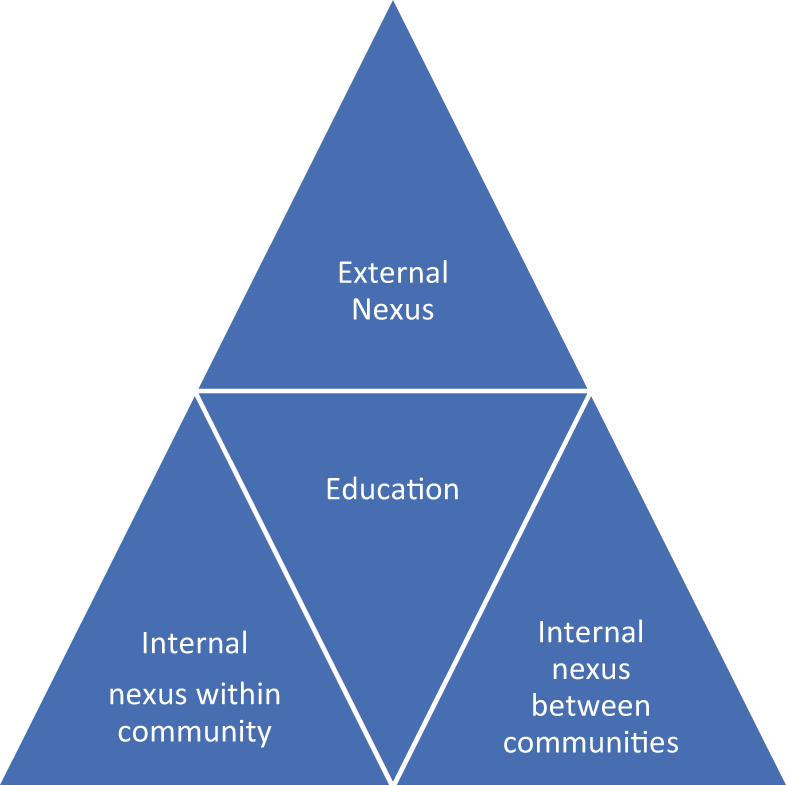
The double nexus.
In terms of the political theologies research, the research began with no predetermined definitions of religious authority in its positions to political power. The approach of the first author allowed the respondents to shape the sources of this authority when religious leaders were seeking to have their voice heard or exert influence on political debate. As outlined elsewhere (Gearon, 2013; 2015), religious leaders draw from three principal sources of authority – that is, sources from which they derive their ability to influence: (1) scriptural (where they use the texts within their traditions to greater or lesser extents to inform thinking and decision-making); (2) hierarchical (internal sources of authority maintained by structures, which are diverse within and between traditions); and (3) lay-delegated authority (those outside formal hierarchies – ‘laity’ or those delegated with authority who have devolved authority for decision-making). The internal and external nexus of religious authority is replete with examples of each of these layers of authority, with each tradition giving varying weight to one or another aspect of the sources of authority.
The educational dimension of the investigation arose from the interviewees themselves and was in many respects an incidental outcome of research predominantly focused on political theology in relation to cultural and self-expression. The persistent references to education, in large measure unprompted, seemed only however to underline the importance of educational institutions and systems as mediators of power between religious and political authority. It was such prompts from the interviewees which led us to consider the possible wider significance of the double nexus as a framework for researching religious authority in education. We outline here, our thinking behind the double nexus – the internal nexus of religious authority within and between religious traditions and the external nexus of (diverse and plural) religious authority with political power. On one level a restatement of the religious–secular divide, it is a structural means for often simplistically portrayed polarities to contain complexity, in order to recognise deep structures without getting lost in the detail.
Political theology
Often referred to as ‘public theology’, political theology is a form of intellectual discourse which, depending on your perspective, provides a theological interpretation of the political or a political interpretation of the theological. Scott and Cavanaugh (2004) demonstrate the range of applications of political theology globally (see also De Vries and Sullivan 2006). Though questions of Church–state relations reach back to antiquity, Schmitt’s (2005) Political Theology remains foundational to modern debate. Yet Political Theology, in the narrow sense of Schmitt’s work, and political theology, in the wider sense of the modern field of enquiry which Schmitt so informed, are in both senses underused in addressing these questions of religion and politics in education.
Written at a time of crisis in German and European liberal democracy, Political Theology reframed a problem of the relationship of religious and political authority from antiquity into the context of modernity. Schmitt (2005: 32) argued that: ‘All significant concepts of the modern theory of the state are secularized theological concepts’ – that is, the theological has been transposed into the political. As Schmitt argues: ‘not only because of their historic development – in which they were transferred from theology to the theory of the state, whereby, for example, the omnipotent God became the omnipotent lawgiver – but also because of their systematic structure’, ‘[t]he idea of the modern constitutional state triumphed with deism [over] a theology and metaphysics’ (32). Schmitt, above all other theorists, demonstrates the way in which modernity reframes the theological to the political – the theological, in other words, transmogrifies in open and often subtly disguised ways as and through overarching and ever more powerful political interfaces.
The prescient timeliness of Schmitt’s analysis of how this might lead to absolute power represented in the political realm (now that theology and metaphysics have been displaced) was evidenced by the totalitarianism which emerged with his work. The theme of absolute secular power as totalitarian power was taken up by mid 20th-century political theorists such as Arendt (2004), Aron (1957), Friedrich and Brzezinski (1967), Popper (2011) and Talmon (1961), and in the various writings of Eric Voegelin (1999). The literature is concisely reviewed by Isaac (2003) and Burleigh (2006, 2007). It was Vogelin (1999) who identified this as the rise of ‘political religions’ (Voegelin, 1999). This political religions framework shows how autocratic,dictatorial and totalitarian systems replaced theology with similarly all-encompassing by secular ideologies.
The potential contribution of political theology to religious authority in education seems perhaps less than obvious. Yet in uncovering at a deep level of institutional and structural power relations mediated in complex ways through responses to culture, the terms of political theology – the ‘political’ and the ‘theological’ – seem usefully to frame the large-scale complexities of the debate under consideration: researching religious authority. And yet political theology itself has left education largely untouched, just as researchers of elites have neglected researching religious authority in education. It is because the interplay of religious and political authority is so important that we need to take both sides seriously; doing so will help us to understand in more nuanced ways the interplay between them and stave off simplistic oppositions of either. One means of attaining this more nuanced understanding is through a ‘researching the powerful’ methodology, which has its origins in elites’ theory.
Elites’ theory
A preoccupation with the structures of power has been the very bedrock of political theory from antiquity to the modern theories of polity and governance (say, from Plato through Rousseau to Paine), and notable as a foundational principle in the formation of the social sciences (from Comte through Marx to Foucault). The relationship between such power in political theory and the social sciences has always confronted the issue of the alternative and, in western philosophical-political history, the theological has, again from antiquity through modernity to the present, been that alternative.
Researching the powerful as a particular method, however, has a relatively recent history and can be traced – often unacknowledged by researchers of the powerful – to elites’ theory, which emerged from fascist Italy – for example, in Pareto’s (1991) The Rise and Fall of Elites and Mosca’s (1960) The Ruling Class (Albertoni and Goodrick, 1987; Aron, 1967; Hartmann, 2007). Finding acclaim for their consciously counter-Marxist sociology, both Pareto and Mosca argued that it was a natural (and acceptable) mark of social organisation (even of the human condition) for there to be a ruling class and a class of others (the ruled) to which the latter were subject. Pareto’s (1963) The Mind and Society: A Treatise on General Sociology, along with other elites’ theory, here sees religion in reductionist terms. Religion is regarded as a remnant of a spent hierarchical force, due for replacement by new secular political elites. This notion is reflected in much of the literature around totalitarianism, where the totalising structures of new political systems (‘totalitarianism’) attempt comprehensively to replace formerly dominant theological systems (Friedrich and Brzezinski, 1967). This is why Gray (2017: 1) comments that ‘[m]odern politics is a chapter in the history of religions’. Schmitt (2005) is important because he defined the process – Political Theology was originally published in 1922 – in the wake of the Russian Revolution, a decade before his country’s own totalitarian revolution.
In differing ways, Pareto provides a timely justification for fascism just as Schmitt provided one for Nazism. Indeed, Schmitt in Germany and Pareto and Mosca in Italy found for themselves a theoretical respectability that they would lose after the Second World War. Only later in the 20th century did their thinking re-emerge with renewed respectability. It must be borne in mind, however, that the originating figures in both elites’ theory and political theology were far removed from the liberal democratic contexts and sympathies of present-day researchers: Schmitt was a member of the Nazi Party, unrepentant of his Nazi apologetics to the end, and Pareto was known as the ‘Karl Marx of fascism’ (Alexander, 1994).
From this lineage (where we might explain within it a certain antipathy to religious authority), in recent decades there has emerged renewed interest and a significant literature on researching ‘elites’ and the ‘powerful’ across the social and political sciences (Ball, 1994a, 1994b; Conti and O’Neil, 2007; Harvey, 2010; Moyser and Wagstaffe, 1987; Ozga, 2011; Ozga and Gewirtz, 1994; Walford, 1994). Almost two decades after Walford’s (1994) Researching the Powerful in Education shaped the field, for a British Educational Research Association now familiar with the approach, he outlined the distinctiveness of ‘researching the powerful in education’: ‘Such policy research is also sometimes knows as elite research, or “studying-up”, in contrast to the more common forms of research where the researcher usually has more power than the researched’ (Walford, 2011). The theological dimensions of such were explored in Walford’s foundational collection (see McHugh, 1994). Recent work in education and across the social and political sciences, however, demonstrates a surprising lacuna in theological perspectives and a certain absence of religiously plural ones in the literature on researching religious elites (Williams, 2012).
Method
This article focuses on the complex, overlapping relationship between secular and religious authority – in particular, the examination of how the voice of religious authority can influence societal understanding of the highly complex interaction between religion, politics and education. As already noted, this problem is approached through the following research questions: (1) How do religious leaders and authority figures in England respond to contemporary issues of freedom of expression? and (2) From these responses to issues of freedom of expression, what can be learnt about the wider relationship between religious and secular (for example, legal and political) authority in England today? The empirical data was gathered, again as noted, over a two-year period, examining how religious leaders and authority figures respond to contemporary issues of freedom of expression. The research approach was qualitative and the data-gathering was carried out through 50 semi-structured interviews with senior religious leaders and authority figures in England.
The interviewees were selected on the basis of their seniority within the hierarchies of world religions with significant presence in Britain, including Buddhism, Christianity, Hinduism, Judaism, Islam and Sikhism, and with cognisance of the internal diversity of traditions within each, and included discussions with heads of umbrella organisations (n = 50). The first author, who carried out the data-gathering, also spoke with leading figures in organisations representing secular humanist views, including the British Humanist Association. Furthermore, the views of academic theologians in leading British universities (Oxford, Cambridge and Bristol) on the topic were also included in the data in order to enhance further its factual accuracy from more general ‘external’ perspectives.
The participants were aged between 40 and 65 and represented both genders, though unequally (only 4 females from a sample of 50). This gender disparity itself is worthy of further examination – that is, that the predominance of male religious leaders and authority figures in the sample says much about the relationship between gender and religious authority more widely. Pseudonyms are used in the reporting of the data, and the exact ages and genders are not connected to the informant statements in order to safeguard anonymity.
In terms of the political theologies research, no predetermined definitions were employed, but the respondents were allowed to shape and express their views on the sources of this authority when religious leaders were seeking to have their voice heard or exert influence on political debate. The political theologies research examined ongoing tensions – accommodations, conflicts and resolutions – of religious authority with secular political, especially legal, frameworks through interviews with religious leaders and authority figures.
With regard to the ethical considerations related to the study at hand, amongst other ethical issues, the question of gender in researching religious authority in education is of paramount importance (Mickelson, 1994; Neal, 1995; Neal and McLaughlin, 2009; Ozga and Gewirtz, 1994). The majority (n = 50) of the interviewees were male, with only four participants being female. This disparity between the secular legal frameworks of equality in relation to gender opens further avenues for enquiry where religious authorities are responsible for educational provision.
An exploratory article of this nature can only raise, rather than answer, such questions, but in providing theoretical and methodological frameworks through the double nexus, it provides a fresh working framework to examine the internal and external workings of religious authority in education. We began, as mentioned above, in a field that is some formal distance from education – political theology – but uncovered a deep structure which could usefully apply the terms of political theology and elites’ theory methods to researching religious authority in education. A closer examination of the role of religious authority in education through this tentative ‘double nexus’ provides a simple structure to frame many complexities, from which new insights are likely to arise.
Researching religious authority in education
The lacuna of religious perspectives in the literature on researching the powerful and elites is surprising given the prevalence of religion in national public and political life, in global governance, and not least in national and intergovernmental efforts to incorporate religion into education, even where previously the separation of religion and the state has proscribed it (see Davis and Miroshnikova, 2017).
Substantively, then, the key justification for researching religious authority in education is that religious authorities are engaged with political power, including in educational contexts – the sorts of milieux which preoccupy researchers of elites in education. In addition to the obviously distinctive religious focus in researching religious authority in education, we found that there are, however, methodological similarities and differences worthy of reflection. Walford (2011) highlights four issues of method for those interested in researching the powerful: ‘access’, ‘interviewing’, the ‘interpretation of interviews’ and ‘ethical issues’. In each respect, researching religious authority in education raises its own distinctive issues.
Access to religious leaders and authority figures requires the same generic adept use of contacts which Walford suggests. The most senior religious leaders had gatekeepers, in similar ways that political leaders might. But access to religious communities, especially their leaders, arguably requires specific sensitivity. We found that some communities were not so much hostile as testing of the assumptions behind the research. In a world where the media does not often present religions favourably, but often presents them indeed as the source of much of the world’s conflict, intolerance and violence, trust needs to be carefully nurtured. In gaining access, however, there remain issues. In one interview, permission was not granted for recording. In another, the interview had begun but the interviewee asked for the recording to be stopped.
The first author, who conducted the empirical research, found that access to his own (Roman Catholic) tradition facilitated far easier access to the highest levels of religious authority, although, as Ostrander (1993) has pointed out, too close a rapport can have its difficulties. This does not mean that one needs a religious affiliation to gain access, but, as in political contexts, it helps. Interviews are more likely to be granted to those with political or religious sympathies. In terms of access, then, researching religious authority does present distinctive problems as well as opportunities. Being open about your means of gaining access can be a source of fruitful analysis in itself in researching religious authority, and can tell us much about the interplays of power that interest researchers of elites – so too can thinking through why access was denied or, if gained, was difficult.
In Walford’s (2011) sketch of the issues around ‘interviewing’ and the ‘interpretation of interviews’, there is much generic congruence between researching religious authority and researching political elites: being prepared, being on time and being informed are critical to success. These are minor matters compared to the breath of theological language required in political-theological inquiry. Interviews with imams, rabbis, swamis, a Zen Buddhist master and a Tibetan lama reflect a very wide range of religious discourses. For this reason, we supplemented the latter interviews with academic authorities. The latter could inform us about specialist religious matters, and thus also assist in establishing the accuracy and veracity of the technical detail. In researching religious authority, as in researching any such authorities, verifying that respondents are telling the ‘truth’; is critical – and, if there is dissembling, unconscious bias, or other forms of distortion, using authorities outside the sample can help in cross-checking accuracy and establishing some degree of balance in interpretation.
In researching religious authority, there are, as with researching the powerful (see, for example, Harvey, 2010; Hertz and Imber, 1995; Williams, 2012), considerable ethical issues. In highlighting these, Walford (2011) selects a religious exemplar from his personal experience in interviewing ‘a right-wing fundamentalist Christian minister’. This was an interview where he ‘felt it necessary to partly challenge what had been said, but allowed the interviewee to misinterpret his beliefs in order to maintain rapport in the interview. While such techniques may lead to “good” data, they raise severe ethical issues’. For us, this raises issues about (religiously sceptical) presuppositions amongst elites’ theory researchers themselves – here Walford addresses the British Educational Research Association with the cosy assumption that readers will share his own assumptions.
Results
The empirical findings presented below are used to demonstrate the deep structure of relations between religious authority and secular, legal and political power. Utilising the above-framed conceptual framework for the double nexus within political theology and elites’ theory, we will then conclude by sketching some possibilities from this for researching religious authority in education.
The internal nexus
Not unlike political parties, religious traditions themselves demonstrate internally diverse and plural structures of contested authority. We can here but give the briefest indication of the variations of internal struggles for authority within and between traditions, here with regards to critical power structures of religious authority in relation to the cultural questions at the heart of the research, the first author has already presented substantial theoretical, methodological and empirical considerations on the relations between religious authority and the arts (Gearon, 2015).
Some sense, however, of the wealth of potential data can be presented here. And the obvious tradition with which to begin is the Church of England, whose religious authority has been integrally interconnected with political power since the English Reformation – that is, for the not inconsiderable period of half a millennium. Even here, the religious authority internal to the Church of England is fraught with tensions, compromises and accommodations. A senior member of the Archbishops’ Council, which advises the Archbishops of Canterbury and York, commented: ‘I think people constantly misunderstand the Church of England if they think of it in corporate terms. It’s a coalition: it’s always been a coalition of interests … we’ve got three parties’. This respondent continued by explaining how these three parties differ in their aims: ‘One of these parties wishes to complete the work of the Reformation, one party wants to complete the work of the Counter-Reformation, and one party wants to complete the work of the Enlightenment’. When it comes to the task of the Archbishops’ Council, this participant said that it is ‘to find the maximum consensus possible within that coalition’ and ‘of course like all coalitions, the power within it is in flux’. The Church of England’s aptly named National Society here provides a role in maintaining educational provision, in both primary and secondary schools and also in critical curricular areas such as ethos and religious education (National Society, 2017). Conversations with the people in authority revealed not only more doctrinal diversity, but also wide variations in relation to the institutional arrangements and purposes of both political power and ecclesiastical authority. Here, the often discrete and subtle fusing of religious and political authority can pose pragmatic difficulties for educators (teachers, policy-makers, managers) in trying to establish unified aims and purposes. The recognition of patterns of entanglement between religious and secular political power structures becomes too a critical task for the researcher of religious authority. We are aware, of course, that this may seem self-evident to those familiar with the Church of England. For educational researchers, a lack of knowledge of such historical, philosophical and theological nuances can only lead to partial insights into the educational programmes of what remains one of England’s largest providers of education.
All other religious traditions in England have less institutional rootedness in British society, and have different models of authority. These are not a result of any political positionings, but are critical to the internal workings of diverse traditions. Hinduism in England provides a good example. Amongst all such traditions, Hinduism, with its emphasis on a plurality of faiths as expressions of one divine reality, has an authoritative structure equally as accommodating as its philosophical orientation. A senior member of the Hindu Forum commented: Within Hinduism, there isn’t one authority, and not even one leader. Within Britain, there are certain traditions which are … led by gurus. And that would be the authority the layperson would follow. And mandirs [Hindu temples] and the community organisations that belong to that tradition would follow. they embrace me and they let me do talks to their congregation, allow me to conduct classes for the students … they can relate to what I say because I’m not compromising their own particular vision of worship, religion, or spirituality.
In Buddhism in England, even less emphasis is placed on hierarchical authority. As a senior figure from the Buddhist Society (Britain’s longest established Buddhist organisation) put it: ‘There isn’t a hierarchy: it’s flat, actually’. This hierarchical model is applied even to Buddhist monastic communities: ‘The Abbot of that monastery is his own master and he teaches and does what he wants to out of the guidance from his own heart … It doesn’t come from some sort of hierarchical structure’. If we are to extrapolate this attitude to education, such power positions could be applied to the roles of ‘teacher’ and ‘learner’. For Buddhism there seems to be here something more pragmatic. In this tradition, the individual quest for Enlightenment is pragmatic, drawing on what is needed for that single purpose, even if it involves subverting accepted hierarchies. The Buddhist saying which encapsulates this is the legendary and seemingly contradictory statement: If you meet the Buddha on the road, kill him (Kopp, 1976). This disregard for hierarchical authority was confirmed by the founder-president of the Oxford Centre for Buddhist Studies: ‘Now one thing is really clear, and that is that the meditation master … has the highest prestige of any monk in the monastery, the monk who is in charge of meditation’, and Political engagement is not a priority. If laypeople spending time in a monastery find themselves unsuited to the rigours of an all-out assault on Enlightenment … you have a choice of direction … One is that you can just stay there as long as you like: nobody is ever going to throw you out unless you do something grotesque. Secondly, you can ask to join the education department, if you are any good at that sort of stuff.
These are merely three samples from an extensive data set of religious authority voices. Suffice to say, we are convinced that future researching of religious authority in education should be cognisant of the internal variants and nuances of religious authority within traditions. In turn, this will involve some considerable re-evaluation of assumptions about what elites’ theory takes as a will to power. There are other significant and, at present, unexplored issues worthy of further investigation, then, concerning hierarchy, power, influence, and the educational implications and significance of such, and, critically here, the variant and difficult-to-measure differences of access to or influence on political power of religious authority voices whose communities are minorities in the UK, as in this research project, and elsewhere, if this analysis were extended to comparative and international contexts. For researchers of elites and the powerful in education, this is arguably where the external nexus holds particular interest. It will also raise, we hypothesise, significant questions about whether religious leaders and authority figures can, beyond their own communities, be defined today as elites at all – notably, when the terms of religious authority’s engagement with political power are determined by the latter’s invariably secular agendas (Lewin, 2017).
The external nexus
Even with its different theological-ecclesiological standpoints (reformed, Catholic, liberal), the Church of England provides a publicly prominent model of the double nexus from an establishment status. A Church of England Bishop here represents the Church of England spokesperson for education in the House of Lords. The role of the Church of England bishop often that is necessitates an interface between religious authority and public life.
In the Roman Catholic tradition, one of the most senior churchmen in the Catholic hierarchy in England here reflects on the late Cardinal Hume and the historical relationship between the Catholic Church, the Church of England and the state: One of Cardinal Hume’s great ambitions in the very best sense of the word was to try and ensure that the Catholic Church in England and in London in particular made progress in its positioning within the public sphere. So, for him, a very great moment was when the Queen came to Vespers here in Westminster Cathedral – the first time a reigning monarch had done so since the Reformation. Yes, yes. We have the lead on faith, as it were, across departments. Of course, a number of departments have their own consultative mechanisms and structures. Particularly obviously, the Department for Education has its ways of consulting faith communities on religious education.
We note, then, major differences in attitude between religious authority and political power in the institutional relations with the state of faiths relatively new to Britain, and also in some of these (Buddhism, in particular) a studied indifference to political power. Education is one of the key focal points of this meeting of religious authority and political power. In structural-institutional terms, the Church of England and Roman Catholic Church both have significant educational directorates, as well as a substantial number of schools. In other ‘minority’ religious traditions, such educational commitment is more limited in scale, but not in commitment. The Board of Deputies of British Jews is an organisation which is extremely focused on educational matters, and indeed its history in England dates back 250 years. Other religious traditions have established networks that are often staffed by laypeople – the Muslim Council of Britain, the Hindu Forum, the Hindu Council UK, the Sikh Council, and so forth – both to present a coherent voice to their own communities (the internal nexus) and to engage with concerns with (local and national) political authorities (the external nexus). The growing interest in each of these communities (with the exception of Buddhism) in founding their own schools is only today enhanced by the English system of academies, which encourages the religious foundations for schools.
Here, one of the most contested issues is the issue of legitimacy. The political theologies research showed that, in religious communities that are newer to Britain, contested questions of authority were especially acute in terms of political voice. For instance, when the government is seeking representative voices from a ‘minority’ religious tradition (which, in population terms, may be numerically significant), whose ‘voice’ does it select? This is what an Archbishops’ Council interviewee wryly described as ‘the Kissinger question’: The Church of England has an extremely diffuse authority: some people imagine that the Archbishop of Canterbury sits at Lambeth with a big lever he can pull and make things happen, but there is almost no one more unable to make things happen in some ways. We’ve actually had discussions with government ministers sometimes, who have said ‘It’s the Kissinger question’. When you want Europe, Kissinger said: ‘Who do I ring?’ When they want the Church of England, who do they ring?
Tensions in the double nexus
Increasingly, the direct interface of religious authority and political power is framed in terms of law. It is here where tensions in the double nexus seemed most evident. The trend towards a secular legal framing of debate across political domains was defined by one interviewee, a Professor of Ecclesiastical Law, as an emergent sensitivity to the growing juridification of society … the way in which people will have recourse to law or at least claim or threaten to have the recourse to law, and so, you know, you only need to get a situation in which somebody feels threatened – ‘Have you disrespected me?’ – you know, and then waving a piece of legislation around. ‘Juridification’ is a term that some sociologists of law use to talk about the way in which legal, and legalistic, modes of thought come to colonise certain areas of social life, where hitherto they might have been absent.
When asked whether the law was moving faster now, the interviewee responded: Yes, absolutely, very much so. I was going to say, one of the things that we wanted to mention was perhaps the issue of legal structure and real religious structure, and the interplay between what the law says about the structure in organised religion and then what religions say … I think, sociologically, we’re very, very complex now, because, on the one hand, we have a residual cultural Christianity, a loose form, the sort of thing that produces your 70% response rate in a sense, or something like that. You’ve got your new religious minorities, some of which are now substantial – Islam – but then also you’ve got the rise of professed non-belief. So, in statistics, people would say: ‘I do not believe in a God’. Well, in that sense, ‘Are you an atheist?’ Well, maybe not using the label ‘atheism’, but certainly saying ‘I do not believe’ … there it is. It’s a powerful social force in legitimising a certain sort of hostility to religion. Well, on [the influence of the] humanist, that’s the most [laughter] difficult question to answer actually … because who can say what those 10 or 17 or whatever, however many million people it is who roughly are humanists, think of what we’re doing? Our own members are one thing, of course. We play an important role in informing and educating our members, and also in distilling their own views into our policies. But that’s just, you know, 10,000 full members, I suppose, and 20,000 members and supporters in total, plus I suppose people in local groups. So, that’s not humanists as in all the humanists in Britain. [We’ve] worked with religious groups on issues to do with education … the Religious Education Council, of course, and then religious groups that share our views on faith schools or bishops in the Lords. Some Christian groups we work with against bishops in the Lords – for example, non-conformance groups and so on. There’s a fundamental fault line in that the Equality Act of 2006 talked about religion or belief, and so, officially, the Commission started off by forming an advisory group on religion or belief. But because of ‘belief’, the secular humanists came on board, and so, over these years, the Advisory Group to the Commission has comprised of a wide variety of religious groups – Church of England, Catholic, and so on, myself, but also representatives from the British Humanist Association and the National Secular Society who saw … I mean, these groups represent virtually nobody in comparison. They’ve got a few thousand members. That’s about it. I mean, we represent, the Evangelical Alliance reckons it would represent, say, in the region of at least two million Evangelical Christians. That’s just the Evangelical Alliance. secular societies and organisations saw a great opportunity to get themselves a level of recognition that they would never have got in any other kind of format whilst all under the pretext of complaining that religious groups were getting privileged by the government meeting with them. And so they pushed the government very hard to demand a veto almost over every meeting between government and religious groups. The secular humanists … say, publicly, ‘We represent the non-religious’, and I will say, ‘No, you don’t. You represent the few thousand members of the British Humanist Association. There’s loads of non-religious people who have never heard of you and don’t want to be represented by you’.
Thus, when responding to the prompt ‘It was or is the same in education?’, the answer given was clear, and resonated with a sense of a powerful institution pushing agendas laden with values which impacted on schools and their curricula: Yeah. But what they’ve done is, the government have listened to them, and so, with the Equality of Human Rights Commission, they were on the consultative group, and so every time we met, of course, there was complete contradiction, total contradiction. They would be all for silencing and marginalising religion and we’d be all wanting a voice and representation. There were battles and so on. I mean, I’m good friends with the humanists. I’ll meet and have lunch with them, but in terms of our agenda, they’re completely opposite. Very early on, I and others said to … ‘This is no good. You can’t have a group meeting like this. They’ll never agree on anything. You’ve got to sort them out’. I saw ... just the other day and he says they’re trying to take this on board now because the group has collapsed. In the end, the Roman Catholics and the Church of England walked out of it and said, ‘This is a total waste of time. We can’t afford to waste our time with a group like this. This is just going to go nowhere’.
The senior Catholic cleric made here a distinction between legally vouchsafed secular voice and perceived secularising influence of voices antagonistic not only to religious authority but even religion itself. On Pope Benedict XVI’s theology, this cleric commented: What he [Pope Benedict XVI] would not expect and what he would argue against is that a secular state or the institutions of a secular state would be secularist. In other words, they would, as it were, be dogmatically driven by their secularism and therefore have a negative role and attitude and relationship with religious faith. He would say that what is perfectly clear is that the religious dimension of human experience and enterprise is a vitally important part of the richness of a society which quite properly sees its public space and its institutions in particular as not aligned to any of those religious faiths.
In the sphere of competing tensions between religious authority and political power, the research found government departments acting to mediate such complexity. Such moves were in large part directed towards, as the interviewees perceived it, the instigation of conformity to legal – particularly human rights – frameworks. This political mediation of religion is shown to create tensions. These are apparent when perceived as a manipulation of religious authority not only by the direct exercise of political – especially legal – power, but also by more subtle and difficult-to-delineate influences, most commonly identified as ‘secular’.
However, in terms of the latter, those religious authorities who are confident of their own influence on political authority are to varying degrees more comfortable with confronting and challenging such perceived secularity. Indeed, it was precisely those (largely Christian) religious authorities with established relations with political authority who mentioned secularity, secularism and related matters at all, or who questioned human rights and equalities legislation as impinging on their authority. Minority traditions, if we can make this inference, may value such legislation as it provides them precisely with a legal guarantee of voice and influence in relation to political authority where they might have none.
Education is here but one if an important locus of complex interactions between religious authority and political power. It was through the interviewees’ references to education that we reflected on the potential applications of the double nexus to researching religious authority within a field beyond the scope of the original enquiry, and to exploring the possibilities of the synthesis of political theology and elites’ theory for researching religious authority in education.
Theorising the double nexus: political theology, elites’ theory and researching religious authority in education
The findings from the study showed that political authority operates to mediate such religiously plural complexity across the range of religious authorities. This basic premise is unarguable, unsurprising even; it is the commonplace of political liberalism (Rawls, 2005a, b). Within this context, of course, there are more debates with regard to the practicalities and instrumental guidance – the legislatively defined and politically directed roles of religion in public life (Audi, 2005; Audi and Wolterstorff, 1997; Habermas, 2006, 2008b; Habermas and Ratzinger, 2007; Trigg, 2008). Stepan (2000) frames the debate as one of ‘twin tolerations’ – that is, balancing the acceptable limit of freedom from political or religious perspectives. Habermas (2006: 6) suggests that: ‘Arguments for a more generously dimensioned political role for religion that are incompatible with the secular nature of the state should not be confused with justifiable objections to a secularist understanding of democracy and the rule of law’. At the core of the resolution of conflict is that the principle of separation of church and state demands that the institution of the state operate with strict impartiality vis-à-vis religious communities; parliaments, courts, and the administration must not violate the prescription not to privilege one side at the cost of another. Irrespective of how the interests are weighted in the relationship between the state and religious organizations, a state cannot encumber its citizens, whom it guarantees freedom of religious expression, with duties that are incompatible with pursuing a devout life – it cannot expect something impossible of them. (Habermas, 2006: 7; see also Calhoun et al., 2013; Habermas, 2008a)
Conclusion
An exploratory article of this nature raises, rather than answers, such questions, but in providing the tentative beginnings of a theoretical framework, it provides a fresh working framework for examining the internal and external workings of religious authority in education. As we have made clear, the research undertaken for the Arts and Humanities Research Council was largely cultural, examining questions of religious authority’s response to freedom of expression. Its framing was in a field that is some formal distance from education – political theology. Yet, what was uncovered was a deep ‘double nexus’ structure which could usefully apply the terms of political theology and elites’ theory methods to researching religious authority in education. A closer examination of the role of religious authority in education through this tentative ‘double nexus’ provides a simple structure to frame many complexities, from which new insights are likely to arise. It is perhaps for others to provide more directed examination of the questions asked by this article for further empirical testing and theoretical examination.
The dearth of a religious dimension in researching elites’ literature more generally is understandable here, given the importance of secular political power in mediating religious authority: there may be a perception that real power lies with the political. The political theologies research, indeed, in part supports such a view. The double nexus shows that, after all, religious authority in many respects is subject to political power. Some religious authorities, particularly in ‘minority’ traditions, differ greatly (in England) in their access to the politically powerful, and have limited educational influence. This raises important questions about the extent to which religious authorities are elites or powerful (for ethnographic studies and studies of ‘local elites’, see Hunter, 1993). In part, this goes some way to explaining the neglect of religious authority by researchers of the powerful in education. Yet religious authority, in its diversity, plurality and complexity, still remains a potent counterpoint to political power, even if the ‘power’ of religious authority ‘elites’ varies considerably between religious traditions.
The application of political theology to one of its most politically critical contexts – education – has, we can say, been underexamined, just as researchers of the powerful in education have tended to neglect religious authority. In addition to the ‘double nexus’ analytical framework – simple in outline but capable of containing complexity – we have attempted in this article to highlight the theoretical and methodological possibilities in the synthesis of political theology and elites’ theory for researching religious authority in education.
Footnotes
Declaration of Conflicting Interests
The authors declared no potential conflicts of interest with respect to the research, authorship, and/ or publication of this article.
Funding
The authors disclosed receipt of the following financial support for the research, authorship, and/or publication of this article: The first author gratefully acknowledges the Arts and Humanities Research Council for funding research grant AH/H008543/1 and AH/H008543/2 Political Theologies:Responses of Religious Leaders and Authority Figures In England to Contemporary Issues of Freedom of Expression. The second author acknowledge funding from the Adacemy of Finland through research grant 298052.