




Abstract
This study comprehends the power of Ethiopian secondary school principals and learns valuable theories and models towards the quality of education. The study was delimited distinctly in government secondary schools of Ethiopia especially in South Nations, Nationalities Peoples Regional State. Qualitative research method was utilized. Six secondary schools from the three zones (Gedeo, Sidama, and Hadiya) were chosen for the study. The participants were six principals, 3 heads of province/Zone Education Department, 6 heads of Kebele Education and Training Board, and 3 retired principals. The primary sources to gather information were interview, focus group discussion, and document analysis. The study revealed that a portion of the principals realizes their power yet neglect to appropriately exercise because of negative obstructions from local authorities. This could affect academic achievement of the students.
Literature review
The law gives leaders explicit power (Maak, 2007). Since they are relied upon to utilize this power to guarantee quality training in a reasonable way, they can be considered responsible for so doing. They additionally should have the option to impact their followers. Tjosvold et al. (2003) argue that the techniques used by leaders to influence their followers have long been thought to be a fundamental aspect of power and authority. They likewise note that since pioneers can impact followers dangers, guarantees, ideas, rewards, and the methodologies they utilize could have either negative or positive effects.
Goswick (2007) attempts to distinguish and indicate how power and authority have been understood for a long time. As a result, whereas authority is defined as the right to command or issue orders, power is defined as the amount to which an individual can exert influence over others and compel them to obey his or her commands or requests. According to Arendt (1969), authority stems from the quality of a person’s organization in relation to relevant evidence and knowledge. She maintains that followers achieve their strength as leaders in decision-making and persuasive ability.
French et al. (1959) perceived that legitimate, expert, reward, referent, and coercive as different types of powers. These sources of power can be apportioned into two categories: organizational power which incorporates genuine, reward, and coercive and individual power which incorporate expert and referent. Legitimate power emerges from society’s way of life and appointed legitimately to other by the specialists of the greater foundation (Kitzmiller, 2013). It enables pioneers to control assets and to compensate and rebuff followers. All supervisors have legitimate control over their followers. Due to his/her position, the leader has a specific level of power. He/she has the option to expect that errands they provide for his staff ought to be executed.
Expert power comes from a pioneer’s specific learning and ensuing information on and admittance to data about complex circumstances (Gong, 2006). This kind of power is subject to the experience and abilities of the head of the school. Then again, coercive power suggests the inclination to limit the commitment of visionary leaders by rejecting followers or compromising them. Pioneers who practice coercive power are supposed to be described by a few elements. Among others, they regularly compromise representative’s employer stability, make changes to the worker’s plans for getting work done, and could even go similar to the utilization of actual power (Kitzmiller, 2013). The leader may in certain occurrences power the staff to achieve assignments in some particular ways. Inability to meet specific particulars may prompt discipline through doing horrendous things. This power accordingly utilizes dread as an inspiration.
Reward power alludes to the limit of people to control and manage things esteemed by others. This could include offering prizes like certified affirmation, merit-based honors, and compensations to great exhibitions just as suggestions for advancement of fantastic work. Referent power is likewise founded on the outstanding qualities of the head (Hains and Smith, 2012; Cerit, 2013). This may bring about teachers needing to help the activities and administrative style of the head.
The legitimate power that the administrators practice is the power that is recommended by a country’s schooling laws and arrangements. Approaches allude to the obligations and elements of a leader; however, he/she is responsible for what occurs in the school. The Ethiopian Ministry of Education (MOE, 2002; MOE, 2012) has arranged and given a rule expressing the capacities and obligations of school administrators.
The report delegated authority to government school administrators to run those schools competently. The central’s obligations might incorporate authoritative, administrative, and optional administrative errands. The job of the leader is to give administration, heading, and coordination of exercises inside the school. The MOE rule portrays the leader’s center obligations' to be: authoritative, staff, instructing and learning, and co-curricular just as connection with partners and correspondence. Optional administrative exercises will often move from a specific location, whereas official administrative exercises are prescribed by-laws, rules, and recommendations, referred to as legal sources (Marchington et al., 2016; MOE, 2002).
In addition to administering their own schools, Ethiopian school directors serve as retired members of the school administration body (MOE, 2002; Tekleselassie, 2002). Edamo (2018) contends that leaders actually assume a predominant part in gatherings held and choices made on scopes of issues. This is credited to their situation of legitimate power inside the school, level of training as opposed to individuals, the way that they have first admittance to data giving from the instruction specialists, and on the grounds that they execute the choice taken.
History of school leaders in Ethiopia
In Ethiopia, the first modern school started during the reign of Emporer Minilik II in his palace in the year 1905 (Wagaw 1979). Nonetheless, this education was systematically inaugurated with the opening of Minilik II School in the capital in 1908 (Negash 1996; Teffera, 2005). It was led by Coptic teacher Hanna Saleb (Pankhurst, 1998). Till 1935, the tasks of leading the schools were mostly delegated to Coptic/Egypt and French principals who were heading the Ethiopian schools (Bishaw and Lasser, 2012).
Over half of Ethiopia’s educators were slain, and many more were banished from 1936–1941, during the Italian occupation (Wagaw, 1979). Prior to the occupation being “successfully” stopped, an endeavor was made to build the human resource. As a result, the nation’s education was once again relying on expatriate staff (Kebede, 2006). As a result, many of the principalship positions were filled by foreigners. Despite the fact that, the school principals were British; Indians were largely recruited to staff provincial/Aweraja schools. Principals were selected on every criterion except ability and qualification at the time (Wagaw, 1979).
Ethiopian substitution for expatriate principals was a step advance in the correct direction from the second half of the 1940s onwards; many situations also required national principal preparedness. The fast-growing number of schools and enrolment, the ever-increasing expectations from schools, and the requirement for efficient and effective leadership in schools were all factors that necessitated their formal education in Ethiopia (Tekleselassie, 2002).
School principals were effectively brought to Ethiopian school leaders' training after 1950 (Wagaw, 1979). Ethiopian school principals were immediately assigned in primary schools without competition among candidates at the time. After that, one of the program’s standards was to continue to recruit experienced educators into the program (Wagaw, 1979).
During the Derg 1 /military regime (1974–1991), educational decentralization was attempted for the first time. As a result, the educational framework penetrates down to the lower level, with local control vested in the school management committees (Gumbel et al., 1983). This was sparked by the issuing of two independent proclamations, both of which had a significant impact on the nation’s educational development. With the exception of community and mission schools, all private schools were taken over by the government through Proclamation No.54/1975. The declaration effectively ended private investment in education and placed educational services firmly in the hands of the government (Shibeshi, 2008).
During the Derg regime (1974–1991), the role of the principal was explicitly centers around administration and the job of the head in working on the nature of instructing and learning. As such, there was basically no political obstruction in the organization and issues of schools. Maybe they were exceptionally regarded and surprisingly dreaded by political bodies (Bishaw and Lasser, 2012). Once assigned, they could practice their power with no outer strain from political bodies. Interestingly, the idea of heads’ task and the power they delighted during the Derg period was somewhat unique. It ought to be referenced here that the Derg system was the first party framework political undertaking in the nation’s set of experiences (Tareke, 2009). Party participation was not a prerequisite to relegate an individual as a school head. As such, one was not rigorously expected to be an individual from the party (for example, Ethiopia Workers Party) to fill in as a school head. Yet, school directors were ordered to openly practice their powers in their schools. There were no concerns about political affiliation, implying that she/he was solely responsible for the teaching–learning process, with no interference from political bodies in the school.
In 1991, when the Ethiopian People Republic Democratic Front took power, the country’s educational management was more decentralized than ever before. In its education and training policy document, it declared that “educational management will be … professional” (MOE, 1994). This policy orientation was addressed in the Education Sector Development Programme I (ESDP I) from 1997/98–2001/02 (MoE, 1998). Principals will be trained in school management, resulting in better school administration...principals and officials at all levels would be trained in educational leadership and management (MOE, 1994). While these were promising directions for the preparation and development of school leaders, what was executed beginning in 2001/02 did not follow these recommendations (MOE, 2002).
Principalship positions were made to be grabbed through elections at the time. Any teacher, regardless of whether or not s/he had been trained in educational administration areas, might be chosen principal if he s/he earned the support of his or her colleagues. The staff’s job was to nominate three people in order of rank, often against their choice. The district/woreda education office made the final decision on who would be appointed as a school principal without taking into account the order of rank in which they were chosen by the teachers. This arrangement was dubbed “de-professionalization of school principalship” (Tekleselassie, 2002).
This arrangement had a lot of negative consequences. To begin with, it removed trained principals from their positions, resulting in a waste of resources spent on their preparation as well as the loss of their experience (Tekleselassie, 2002). Second, it resulted in the appointment of unqualified personnel to the position, necessitating further significant investment in their preparation. Putting inexperienced principals in charge also meant leaving school effectiveness to chance and putting kids' achievement in the hands of an uncontrollable accident. How was the anticipated educational management and administration supposed to function effectively and efficiently in the first place? (Teffera, 2005).
Tekleselassie (2002) suggested that “elected school principals are either great in their teaching assignments, or popular among colleagues and superiors,” and that they “stay loyal to the staff and their superiors rather than to their professional tasks and commitments.” As a result, Teffera (2005) inquired as to “why those without the essential training were placed in those positions when there were others with the relevant training and qualification for the job.”
The ministry’s specific motivation for this decision remained unclear, albeit there were various suspicions from outside sources. Given that the country was undergoing democratization, the goal of such an arrangement, according to some educators, could be to aid in the implementation of democracy. It could also be an attempt to put into practice a policy directive that states that “educational leadership will be democratic” (MOE, 1994). Whatever the intention, there was little doubt that the policy statement had been mistranslated into action.
After some years of its peak promotion, a de-professionalization arrangement was neither rigorously empowered nor officially dropped. Principals were elected in some schools. Principalship vacancies in other schools were filled by moving teachers from other schools or assigning principals among teachers. As a result, it was unclear whether guidelines were followed. This suggested that the arrangement had failed to achieve the hypothetical goal of “followers must elect their leaders.” It is commonly discovered that educational policies are not articulated in operational terms; it is in fact often difficult to discern which policies are in power at a certain point in time. Kiros (1990) and Negash (1996) stated in relation to the previous state of the education system. The circumstance at the time appeared to be one of the best examples of this.
The MOE produced the 2007 programme for the professionalized principalship after de-professionalization of the principalship was met with harsh criticism from various educational stakeholders. Educational management is a distinct and expansive profession in and of itself. It contains its own set of scientific theories as well as rules for application. As a result, professionals charged with educational leadership will receive training in this field (MoE, 2007). Principals at primary and secondary schools were required to have a bachelor’s degree in different subjects, and to have completed specialized school leadership training in master’s program (MoE, 2012).
In general, the Ethiopian principalship history has been passing with many ups and downs. Therefore, this article examined the following points critically. How the school principal’s designation is carried out in Ethiopia at present time? Does the existing political system fetter the exercise of power by principals in their school administration? Is there any pressure negatively exerted on the exercise of the power of such principals in their school administration? Or is the power of school principals in the mind of either political bodies or others?
Objectives
The specific objectives of the study are the following:
1. Examine constitutes of secondary school principals’ power in the South Nations, Nationalities Peoples Regional State (SNNPR).
2. Investigate secondary school principals’ awareness of their power to improve quality education in the SNNPR secondary schools.
3. Understand secondary school principals’ power influence on the school community to bring about quality education in SNNPR.
4. Examine whether secondary school principals’ can exercise their power freely in the study area.
Research design and methodology
Participants profile and school information.
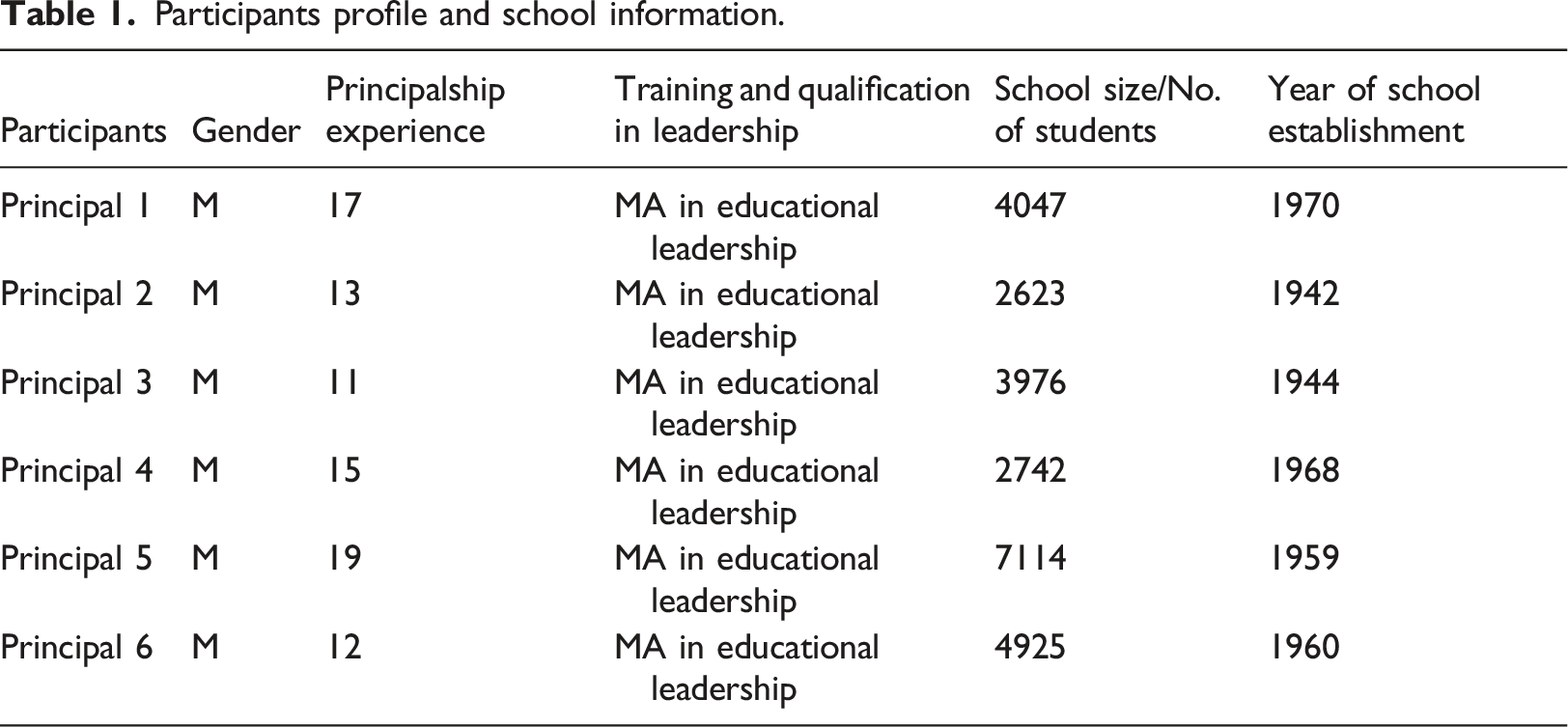
The study constitutes secondary schools that are found in SNNPR of Ethiopia especially in three province/zones (Gedeo, Sidama, and Hadiya). The schools were located in the province/zone town. Two schools were selected from each province/zone town, based on their long years of experience. The schools have been serving over 50 years, making them somewhat old school in the SNNPR even at the country level. The totally number of schools which were included in the study were six.
Participants bio-data.
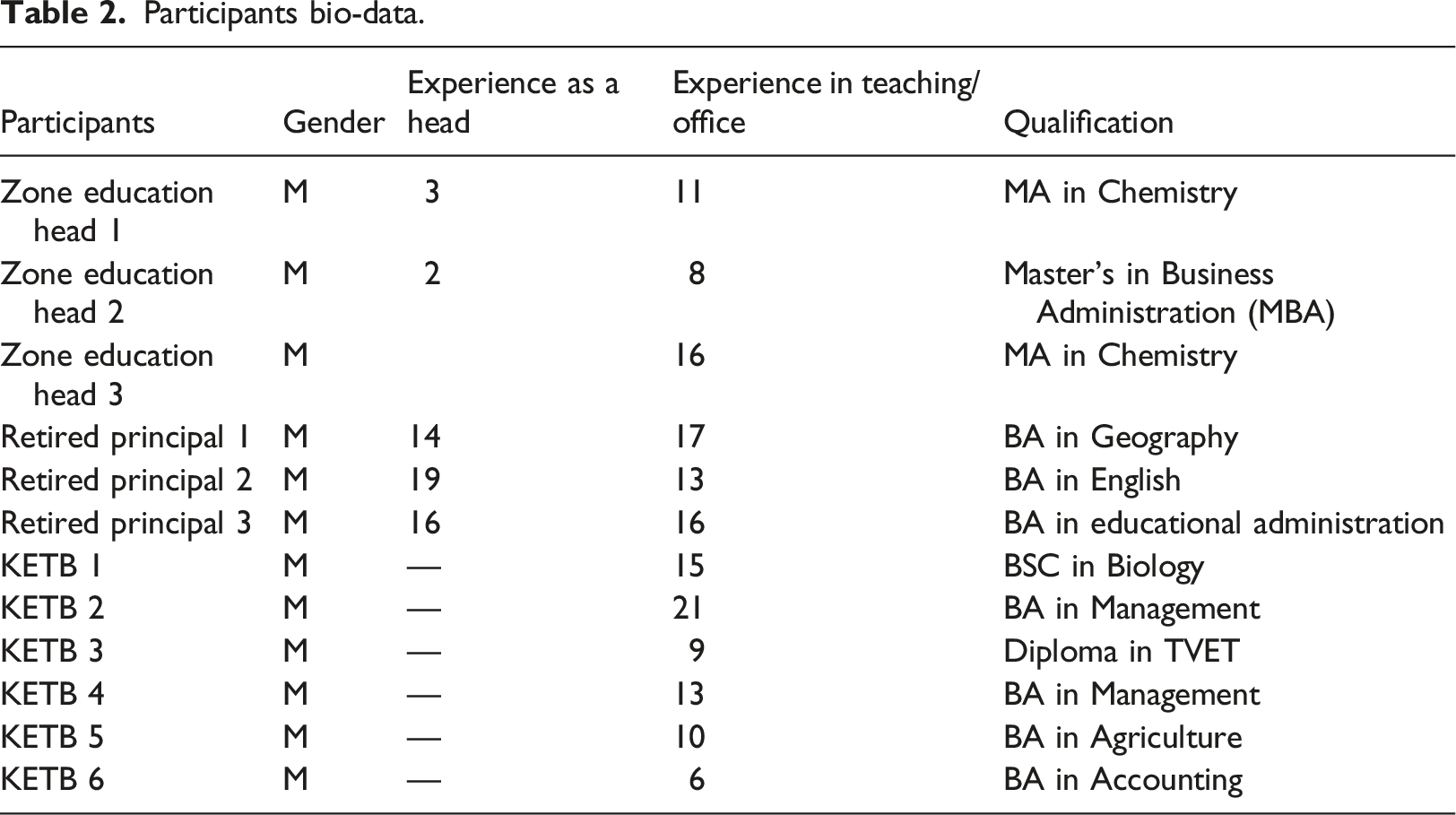
Secondary schools in SNNPR, especially in the three provinces/zones (Gedeo, Sidama, and Hadiya), were chosen for this research using a simple random sampling technique. The participants were six secondary school principals; three heads of the province/zone Education Department; six heads of the local/kebele education and training board; and three well experienced retired principals (one from each zone to learn from their experience of the time). Principals, heads of province/zone education department, heads of local/kebele education and training board were chosen by availability sampling, and principals of the Derg time were chosen by using a snowball sampling technique.
There are several ways of evaluating the authenticity and trustworthiness of qualitative research data. The focus of this study is on three procedures that are widely used to validate qualitative studies. Triangulation, participant observation, and auditing are the three methods (Creswell, 2012). Triangulation is the process of combining evidence from several sources and data collection methods, such as interviews, focus group discussions, and document analysis (Patton, 2002). As a result, the researcher used different sources of information to strengthen the study’s accuracy and reliability.
Interviews were based on the value of human contact for knowledge development and stressed the social context of research data, and they were a conversation between two or more people about a shared interest (Creswell, 2007). Using interview, I was able to learn more about how principals in the selected schools used their power. I utilized a semi-structured interview, which is one of the most used styles of interviews. Interviews were conducted with secondary school principals and retired principals.
Focus group discussion (FDG) was utilized to gather common perspective from a few people just as to get opinions from explicit individuals (Creswell, 2012; Parson et al., 2016). I have conducted FDG with provincial/zone education department heads and local/kebele education and training board chairperson in order to collect information.
Document analysis is frequently used as an additional mode of data collection in qualitative research to add rigor to a study through multi-method triangulation. When documentary evidence is both relevant and possible, investigations using qualitative methods like interview within a constructive epistemology are likely to incorporate it an additional source of data (Cardno, 2018). Documents such as different MOE policies, rules and directives were used in this study.
The researcher’s primary focus during the research process was ethical considerations. Because the researcher’s goal was to use a qualitative method to investigate principals' influence in delivering quality education, the motivation and interest of participants in providing true and self-believed information was crucial. As a result, the researcher built a trusting relationship with all participants in order to collect accurate data. Furthermore, the researcher willingly chose the interview and FGD participants, their names were not revealed in the text, and the recorded data was only used for research purposes. Participants also asserted that they declined to answer any of the questions and that they were ready to withdraw the interview and FDG at any time.
Results and discussions
This section presents the results and discussions on the data. These are presented in themes in line with the research objectives: principals’ power constituency, awareness of their power, their freedom to exercise their power, and the influence of their power on the school community.
Regarding principals’ power constituency (objective 1), principal 1 indicated as he mostly exercised positional power. He contended the sources of power as “I don’t practice personal power for the explanation that I don’t have a couple.” He accepted the arrangement of reward power; however, he had no decent appreciation of the impression of power. He also claimed as he used positional power by excellence of his position.
During the FDG, one of the head of province/zone education department elaborated: The principal’s use of expert power has an impact on teachers’ professional growth. Principals who help replacements learn, support inventive and broadened teacher endeavours, and encourage teachers to try new ways may be valued more highly than others. Coercive power, referent power, and expert power are significant focuses for interaction and personal traits.
Similarly, one of the retired principals expressed his feelings with regard to coercion power as: Intimidation based conduct in schools have answered to bringing about disappointment and hostility between the principals and teachers. Expert power brings satisfaction while coercive power has contrarily impacted disappointment. It is additionally a case for the wellbeing and teaching-learning settings that intimidation couldn't be valued emphatically.
These two quotes implicitly indicated as the principal used positional power. As it can be understood, unlike positional power, expert power can empower and work with explicit conduct abilities and qualities of skillful and knowledgeable teachers. These are fundamental for capacity building for the teaching staff. Moreover, referent power works with the preparation of teachers to be skillful and knowledgeable.
Further to these, in the FGD, the chairperson of the kebele education and training board (KETB) member reflected as the principal used the blend of positional and personal power, yet the transcendently depended on positional power. According to him, most of the time, the principal relied on reward power and used rewards as means of building self-assurance. He gave credit where it was important and merited and focused on certain curricular and extracurricular activities for teachers.
In general, as it can be understood from the data, Principal 1 used positional power to a higher degree and personal power to a lower degree. This is finding is in contrast with the view that top-down regulatory associations could cause teacher to feel less incredible in light of the fact that power for the most part relies upon leaders (Pierro et al., 2013).
Principal 2 used expert power on account of his insight into and ability in the diverse learning milieu. He noted “I’m well-fully informed regarding the curriculum and know what the assumptions in each learning milieu are, share idea and persuade his teachers to do what they should do.” The other one he used was legitimate power since he got things done by the guideline of the MOE of 2002.
During the FDG, the head of province/zone education department head confirmed as principal 2 worked each and every activity on a legitimate manner. The head added that the principal aspired to bring quality education by implementing the guideline that was formulated by MOE in 2002. To guarantee quality education, the principal used disciplinary activities and demanded teachers to do what they should do.
In addition, the chairperson of KETB expressed the principal’s power as: The traditional power utilization of principals overwhelmed his organizational power. While he might have utilized it for great, he rather tried to disregard his proper obligation, simultaneously preventing the legal right from getting educators. The principal apparently acted outside the arrangements of the MOE report by depending on scholastic qualities legitimatizing the conduct of the principal as a ‘master’, ‘boss’ and one who knows best, while teachers are diminished to modestly regarding and tolerating the judgment of their principal.
Similarly, one of the retired principal described the principal’s nature of power use as: Ethiopian secondary school principals’ power conspires interesting is that teachers’ pleasantness and regard for principals are over-underscored; along these lines wrongly convincing teachers to be saved, underestimate everything educated, not challenge principal, and rather profess to satisfy them. Such a pointlessly wide hole in this way denies the important coaching and sharing of involvement accessible to teachers. Ethiopian secondary school principal stage connection has been exceptionally severe and tyrant while in Europe, the cooperation takes a more liberal and impartial.
Form the data, though there were indications as he used expert power, it can be said that positional power was dominantly used.
As regards to principal 3, he primarily utilized positional power. He gave direct requests to teachers to execute specific duties to enforce them to do things, authorizes disciplinary activities and awards consent to truants. The different sources of power that the principal frequently utilized incorporated coercive power. For example, if a teacher entrusted with something did not react as needs be, approvals might follow. The school leader got immediate request to advance that information.
He was aware of reward power. He was clear in giving teachers' time-off when they needed it. Concerning this, he noted, “I give permission to teachers to be exempted from school activities earlier after receiving such a demand.” Although he did not make reference to it, he appeared to utilize legitimate power. For example, if teachers did not follow school-related guidelines, they might be accounted for in whichever way is fitting. Furthermore, he appeared to utilize expert power and information power depending on his information, aptitude, and character.
Related to the principal 3, one of the retired principals clarified nomination of KETB as follows: Principals often with politically-motivated assignments can explain such trends. This becomes evident if one takes a look at the composition of School Boards, who are the highest governing body of a school. The kebele education and training board (KETB) has seven members out of which four, including the chairperson, are directly appointed by the local/woreda/town administration. The remaining three are also confirmed by the district/ woreda top officials.
Form the data, it can be said that principal 3 used legitimate power, and to some extent, expert power.
Regarding principal 4, he is not in good turn of power although he acknowledged that the power he used was the power that he acquired from the MOE (organizational power). He indicated, “I am not in good turn of power. The only power I own from MOE. This helps me to motivate teachers, students and parents to promote the teaching learning process.” The principal used a combination of positional and personal power. He acknowledged the exercise of all types of power to ensure quality education. In addition, he wanted to “lead by example.” Moreover, he inspired both teachers and students what is expected from them.
Similarly, one of the retired principal explained principal 4 as: He sees himself as the school’s father figure, and he acts as a father figure to its teachers. Furthermore, the principal exercised a referent authority based on their charismatic leadership and via example. The use of principals’ power in Ethiopian secondary schools has been well documented, with a strong emphasis on personal power. As a result, their followers are motivated to go above and beyond for their vocation. Power is lawfully used by a principal who is regarded as having extraordinary and heroic qualities by the dedicated teachers.
From the data, it can be said that Principal 4 adopted both personal and positional power but with more tendency of using personal one.
Principal 5 regularly used legitimate and expert power. He used legitimate power to ensure teachers’ awareness of their duties and responsibilities. He exercised expert power to share his information about instructional leadership. This practice could guide teachers to attain quality education. He appealed that he acquired his power from his position.
Although he did not directly refer to principal 5, the head of KETB expressed his experience regarding the unethical practice of power by the principals as follow: Disgraceful use of power may aid a principle in achieving a short-term benefit, but in the long run, the principal will become a problem for the school, forcing it to turn against him. Some of them take advantage of their positions of authority. For example, at one school, the principal shredded records in order to impress district/wereda officials at a higher level.
Principal 6 understood power as the authority to give duties and responsibilities to the subordinates. He pointed out, “I have power as a result of my appointment and that I must rigorously adhere to the MOE’s guidelines,” indicating that his power originated from the position he held. He also described how power was used to ensure that great education was provided. Therefore, principle 6 seemed to have a view on various sources of power with well-versed in right application.
Principal 6 appeared to make regular use of both legitimate and coercive powers. Most of the time, he used legitimate power to ensure teachers’ awareness of their roles and responsibilities. This type of formal power is based on a hierarchical authority. Principals with legitimate power occasionally take a nosedive to realize they have it, and then they may begin to recall others working around them to achieve their goals. It operates on the basis of reputation and includes the possession of referent power. He also rarely used coercion. However, in schools, this type of power exercise can lead to frustration and aggression; and hence, it should not be used in educational settings (Yılmaz and Altınkurt, 2012).
As far as the nature of principals’ power is concerned, one of the retired principal expressed that personal power was relatively dominant in the past but currently, the practice of positional power is becoming dominant. Likewise, another indicated that as current principals are appointed on the basis of their political orientation. He said: Expert power has little value. What matters most is your loyalty to the system. So, often principals are not capable of leading the teaching-learning process. This way of assigning principals eroded the healthy relationship among teachers. It also demoralizes those teachers with better experiences and qualifications. Politics have more importance than students’ learning.
The idea here is that principals are more concerned about implementing the interest of authorities than academic issues. This shows that MOE and it lower echelon exercise rigorous and extended controlling over educational organizations, implying that the Ethiopian schools are becoming highly bureaucratized.
Overall, as regards to the nature of principals’ power (Objective 1), the findings showed that almost all exercised organizational/positional power, to a larger extent. The findings also indicated as they exercised expert/personal power but to a lesser extent. By implication, this indicated as they were not in a position to exercise power freely in light of theories and actual situations. It can be said that they had no the freedom to exercise it (Objective 4).
When it comes to principals’ awareness of power (Objective 2), as far as the interview data were concerned, there were indications for lack of understanding about the sources and concept of power among school principals. In particular, principals 1, 4, and 5 were found be unclear about power in terms of theories and models. For example, principal 1 believed that power is not a serious concern for him though his lack of comprehension has no bearing on his capacity to direct the school, by using positional power. He said, “In the MOE document, the power I wield is revered.” He viewed power as the authority to govern and ensure the fulfilment of responsibilities. Of course, he went against himself [contradictory views] on the question of power, indicating lack of understanding about the concept of power. Likewise, principal 4 was found to have a poor understanding of the different sources of power. Like the two principals, principal 5 lacked understanding about the different sources of power. He said, “Credit should be given where it is due to the teaching staff, but that you should also reprimand if necessary.”
However, principals 2, 3, and 6 were found to have better understanding power. In this regard, principal 2 had a decent understanding about power and used it to accomplish quality education. He understood and used it to guide somebody to carry out his/her duties and responsibilities. Similarly, principal 3 knew about the various sources of power and attempted to use it to work on the nature of education at his school. Still, principal 6 was found to have good knowhow about the various theories and models of power
During FDG, the chairperson of KETB reflected as: Principals do not have a consistent stand with regard to power utilization. However, some of them knew about the scope of their power and degree of utilization, yet they did not conceptualize on the various theories and models of power.
Overall, as far as understanding of power is concerned, principals had different levels of understanding where part of them had good understanding whereas others had no.
When it comes to the influence of principals’ power on school community to improve education quality (Objective 3), the data indicated as the type of power exercised by a principal has a direct bearing on the school community and education quality. For example, principals 2, 3, 5, and 6 confirmed that school leaders’ power can ensure quality education. In this regard, principal 2 said, “Power must be used according to the existing situation. If you want to reprimand your teachers, you can coercive power. However, you can use reward power for recognizing if the work is properly.” Likewise, principal 3 indicated as he preferred to achieve his goals by dialogue and consensus rather than through the use of force. This demonstrates how he employs personal power, specifically expert power. He showed that he can transfer his personal power (skills, competence, and knowledge) without sacrificing his energy. Further to these, principals 2 and 6 suggested that educational leaders need to exhibit trust on their teachers when they exercise organizational power.
During the FDG, one of the head of province/zone education department stated: The principal’s use of expert power has an impact on teachers’ professional growth. Principals who help replacements learn, support inventive and broadened teacher endeavours, and encourage teachers to try new ways may be valued more highly than others.
Similarly, one of the retired principals expressed his feelings with regard to coercion power as: Intimidation based conduct in schools have answered to bringing about disappointment and hostility between the principals and teachers. Expert power brings satisfaction while coercive power has contrarily impacted disappointment. It is additionally a case for the wellbeing and teaching-learning settings that intimidation couldn't be valued emphatically.
This is in line with the view that highly punitive cultures might succeed in establishing a bit of order and performance through coercion and intensive monitoring of behavior, but in the end, they tend to generate anger, resistance, and negative sub-cultures (Sorenson, 2007). In this regard, as far as the researcher’s own experience is concerned, the pattern of social interaction in Ethiopia hence sustains a strictly hierarchical stratification of society, where one is constrained, by a largely invisible but rigid system of collective sanctions to obey the “orders from above.” This applies whether the orders are fatherly to assist in the chores of the household, or an instruction from the kebele to join in a political meeting. Ethiopia has a tradition that promotes respect authoritative people. This foundation has conferred Ethiopian schools and their teachers with integrity, honor, and pride; however, this has been incessantly eroded. In this respect, in Ethiopian schools, organizational power is mostly exercised, whereby the power keeps an eye on a legitimately established institutional structure. Moreover, talented principals (expert power holders) often become charismatic leaders, the examples of whom are keenly followed by many teachers.
Furthermore, a former principal elaborated: In the past, principals were chosen by the head of province/Awraja education based on their exceptional leadership abilities. Thus, principals encouraged teachers’ to boost their performance through their visionary messages, symbolic values and deed. However, during this time the scenario seems totally different. Principals are not much-loved by teachers for their inhumane treatment and their preference to more value students than teachers. Consequently, they face resistance from their teachers for they are thought to have compromised the old tradition of keeping the crucial power distance
2
between teachers and students. There looks a drift of decline of power compared to the earlier time.
The ideas in the three quotes indicate as the nature of power exercised by a principal has impact on teachers’ motivation and professional practice, teaching–learning process, and indirectly education quality in the form of student academic achievement. One can also understand that expert power is more influential than positional power in bringing about quality education. Still, there is an implication that the nature of principal–teacher interaction effect on the quality of education.
This finding is in line with the view that principals who provide teachers with expert power can encourage and facilitate specific behavioral skills and traits of knowledge that is crucial for skill and knowledge gaining (Sharp, 2009). Related to this, MOE (1994, 2002) seeks principal to be highly respected by the school community and its stakeholders for positive outcomes.
In general, this study is hoped to make some contributions. It could contribute to the improvement of knowledge in the field of education by shedding light on the theories and models of power in the context of Ethiopian education system. This could develop the discussion of cultural, psychological, and legal setting of Ethiopian educational leadership development process.
Conclusions
Based on the findings, the following conclusions were drawn. 1. It was found that principals exercised organizational/positional power. There was also a tendency of exercising expert/personal power but in a lower degree. 2. There was variation about understanding of power among school principals. They were found to have different levels of understanding about the sources and concept of power. Part of them had good understanding whereas others had no. 3. The type of power that school principals assume was found to have impact on teachers’ and their professional practice, teaching–learning, and quality of education in the form of student achievement. 4. Principals were not in a position to exercise power freely. They lacked the freedom to exercise it in accordance with actual situations.
Recommendations
Based on the findings, the following recommendations were suggested: 1. The application of power in a school setting can be a challenging practice. It demands principals to exercise a type of power that fosters respect, trust, and positive interaction among the school community. Thus, there is a need for them to exercise personal power instead of positional power that is rendered from above. 2. Principal must be intelligent, knowledgeable, and willing to apply and embrace change leadership. However, as it can be seen from the findings, most principals lacked good understanding about the concept of power. From this perspective, there is a need to develop their understanding about the concept of power in order to be effective in their leadership. 3. There is a need for principals have good understanding about power and exercise it properly to bring about quality education. 4. Having understanding about power by itself is not sufficient to be effective in their leadership, they should also have the freedom to exercise it in accordance with actual situations in schools. They should not be imposed by authoritative power from outside in the form of dos and don’ts.
Footnotes
Declaration of Conflicting Interests
The author(s) declared no potential conflicts of interest with respect to the research, authorship, and/or publication of this article.
Funding
The author(s) disclosed receipt of the following financial support for the research, authorship, and/or publication of this article: This work was supported by the Dilla University (0013/2019).
Availability of the data
I would like to inform the journal managers that a set of field data is available and it will be shared whenever requested.
