




Abstract
Most of the projects aimed at making migrants more successful in the context of higher education in Germany focus on programmes that introduce the rules and expectations of the university to students and try to change their habitus. This article discusses a multilingualism project conducted in a German university that strives to go beyond this perspective and influence not only the habitus of students, but also that of the university and its symbolic order. The sociology of Pierre Bourdieu provides valuable and powerful concepts, such as habitus, field, symbolic violence and cultural capital, for the analysis of the outcomes of the project. The article suggests that in order to reduce inequality in higher education and to improve outcomes for migrant students, the habitus of the university environment and its symbolic order of language must be changed along with the habitus of students.
Introduction
Germany has a relatively complex education system. After elementary school (Grundschule), which lasts four years, students are streamed into one of five different types of school: the Gymnasium, Realschule, Hauptschule, Gesamtschule and Förderschule. Those students who are classified as the most gifted are usually sent to the Gymnasium for preparation for higher education. The Realschule is designed for intermediate pupils who can go to a normal or higher vocational school. The duration of the Hauptschule is shorter than other types of school, and it has an explicit focus on vocational training. The Gesamtschule was initiated in the 1970s to end the three-class model in Germany. However, because of resistance from conservative parties and groups, this type of school has failed to change the traditional system and has remained a complementary part to it. The Förderschule is intended not only for those with physical disabilities, but also for those labelled as ‘learning disabled’ (lernbehindert). Similarly to the Hauptschule, the proportion of migrants at this type of school is disproportionally higher than that of non-immigrant students, and because of the deficit-oriented approach to bilingualism, the specific language skills of these children are seen as a sign of their cognitive disability (Nieswandt, 2013: 39). In theory, students with learning disabilities are supposed to be supported at these special schools. Scientific studies show, however, that this type of school does not always support children, but rather reduces their opportunities in the education and labour markets (Bos et al., 2010; Essen, 2013).
It is relatively well documented that the German education system promotes inequality. 1 In this unfair education system, migrants, who are mainly working-class children, have increasingly become the major victims of this inequality. Whereas the situation of women, Catholics and villagers has improved, the new losers in the system are now young migrant men living in big cities. 2 The children of parents who have graduated from a university have more than three times the chance of enrolling at a university compared with children of working-class origin (Middendorff et al., 2013: 12). The proportion of university students with a Turkish migrant background is also lower than that of native German students. In 2015 and 2016, whereas 16% of Turkish migrants attended a Gymnasium – typically a school which enables access to university – almost 44% of Germans attended such schools (Autorengruppe Bildungsberichterstattung, 2016: 173; Statistisches Bundesamt, 2017: 181). 3 Twenty-nine percent of migrant students without German citizenship attending university have a Turkish background. Other students in this category have mostly Croatian (6%), Italian (6%), Greek (5%) or Ukrainian (5%) nationality. In the category of migrant students with German citizenship, Turkish students represent the highest proportion (26%), followed by Russian (18%), Polish (13%) and Kazakh (12%) students (Middendorff et al., 2013: 526). The relatively high dropout rate for these students (11% versus 8%) shows that even if a ‘migrant’ achieves university level (Middendorff et al., 2013: 535), the reproduction of inequality continues for such students.
In the literature, it is widely agreed that early differentiation in the organized hierarchy of schools, coupled with parents’ high expectations, is the main reason for inequality in the German education system (Geißler and Weber-Menges, 2010: 558; Nieswandt, 2013: 47; Quenzel and Hurrelmann, 2010: 26). If parents do not hold a university degree, teachers tend to encourage their children to go to schools that do not provide university access. In order to legitimize this tendency, teachers often employ the argument that such children, with parents who are presumed not to be able to support them, cannot cope with the huge challenges associated with attending difficult types of school such as the Gymnasium (Gomolla and Radtke, 2009: 169).
The strong emphasis on ‘parent participation’ (Elternbeteiligung) in the German education system leads to advantages for children from the upper and middle classes with substantial cultural capital (Fürstenau and Gomolla, 2009: 15). Due to a lack of time and their unfamiliarity with the education system, working-class parents have more constraints to negotiate and contend with in the school system, which results in a considerable disadvantage for their children. Moreover, the different forms of habitus transmitted in middle-class and working-class families provide children from the middle class with an invisible – but very effective – edge at school. As Lareau (2011: 7) shows in the US context, the children of the middle class develop a sense of entitlement through the concerted cultivation approach of their parents: ‘Middle-class children … learned to make demands on professionals, and when they succeeded in making the rules work in their favor they augmented their “cultural capital” … for the future’. Contrary to these children, the children of working-class families develop a ‘sense of constraint in their interactions in institutional settings’ (6).
An important reason for the relatively low success of migrant students at universities is the divergence between the habitus of this group and the habitus of universities (Fürtjes and Arslan, 2016; Lange-Vester and Teiwes-Kügler, 2006). Most of the projects aimed at improving the success of migrants at universities focus on programmes that introduce the rules and expectations of universities. 4 In other words, they try to change the habitus of students by way of language courses, individual coaching, financial support, mentoring programmes or career planning. The multilingualism project at the University of Bielefeld between 2010 and 2012 tried to change the habitus of students, but had several additional components that questioned the prevailing habitus of the university by challenging the symbolic order in that field. 5 This article focuses on the specific position of the field of education as both the manifestation and production of the symbolic order in a given society. Through the experience of the project, I address the question concerning the possibilities and boundaries of the educational field for changing the symbolic order in the German context.
This article revolves around the meaning of language in the context of education inequality in the experience of migrant students. Although mainstream debates over the integration and equality of migrants in the education system attribute a central role to language, they are strongly framed by a monolingual understanding of education (Gogolin, 1994). In this mainstream thinking, the positioning of the German language as the only language for education is assumed, and so the perceived deficiency of German in migrant students is identified as the main problem (Becker, 2016; Splitt, 2016). This article discusses the language issue from a multilingual point of view. The main question is not the deficit of migrant students in their ability to use German, but rather the recognition and support of the family language of migrant students in the education system. This article suggests that in order to improve outcomes for multilingual migrant students, the habitus of the system and university environment must be changed along with the habitus of the students.
In the following, I explore the meaning of the concepts of habitus and symbolic order in the reproduction of social inequality, employing Bourdieu’s sociological approach. I then discuss the monolingual habitus of the German education system and the role of language in the symbolic order of the system. I continue by discussing the relevance and significance of these concepts (habitus and symbolic order) for understanding the process of the above-mentioned project, following a reflection on my position within the project. In the conclusion, I stress the value of academic courses in migrant languages for creating spaces that challenge the habitus and symbolic order in the educational field.
Manifestation and production of symbolic order in the field of education
In almost all industrial countries, the phenomenon of educational expansion after the Second World War encouraged most to believe that there would be more educational justice and equality for the lower classes of society (Schubert and Engelage, 2006: 93). The long-term data, however, shows that such formulaic expectations for educational equality through educational expansion are largely illusory, because of privileged, class-based channelling in this process (Vester, 2004, 2008). Moreover, sociological studies by Bourdieu and Passeron since the 1960s (see especially Bourdieu and Passeron, 1964, 1970) have shown the reproductive character of educational inequality according to class positions in so-called post-industrial society. Contrary to its objectivist or structuralist echo, 6 in his explanation of this reproduction, Bourdieu tried to work out the hidden or indirect mechanisms of power and associated relationships in the educational system. Paradoxically, the most important mechanism of the reproduction of educational inequality is the formal equal evaluation of children, as if they come to school under the same conditions and with the same social origins (Bourdieu, 2003). The school, as an institution, and teachers, as individuals, tend to forget about their own social origins and see their own norms of perception, judgment and behaviour as the norm or sign of culture per se (Bourdieu, 2005: 33–39). Culture is, for Bourdieu, not a transcendental and universal good, but a contested capital, which is used as a weapon for the benefit of distinguishing (Bourdieu, 2005: 26–27). In order to explain the hidden mechanisms of social inequality, especially in the education system, Bourdieu employs the old philosophical term ‘habitus’, known since Aristotle, in the sociological sense (Wacquant, 2004: 315). In his first text on habitus, Bourdieu (1974: 125) defines it as the interplay between structure and praxis. In other words, habitus is structured by the prevailing social structure, which, in turn, structures ways of perceiving, judging and behaving, influencing a person in his or her everyday life. Since the habitus of a person is mostly formed through socialization in the family and the school during childhood, it reproduces itself unconsciously (Bourdieu, 2001: 186). Therefore, it is difficult to change and/or even reflect on.
Another important mechanism that hides the reproduction of inequality is constructing a relationship of domination with the consent of the discriminated group. In order to explain this relationship, Bourdieu uses concepts such as symbolic capital, symbolic violence, symbolic power and symbolic order. Symbolic capital is an invisible kind of capital that is recognized by both the dominant and dominated components of a relationship (Bourdieu, 2001: 218). Although symbolic capital grows mainly from other kinds of capital (economic, social or cultural), its influence goes deeper because the reason for (symbolic) superiority has the appearance of being natural and is hence invisible to the dominated people (Bourdieu, 1974: 60–63). If a kind of capital remains without symbolic effect, its historical and social character remains visible. Symbolic power is based on the forming and reforming of thought structures in a given social relationship (Bourdieu, 1990: 53). If certain hierarchical symbols (skin colour or a certain style of clothing) dominate the thought structures, by transmitting certain messages without reflection, there emerges a process of symbolic order that produces unequal relationships. 7 In this process, the dominant and dominated parts of the order recognize the values of symbols without talking about them.
Bourdieu (1991: 165) goes beyond this subjectivist perception of the concept of ‘symbol’ by taking two further steps of synthesis. First, he conceives symbolic instruments not only as structuring structures for knowing the subjective world, but also as structured structures for knowing the objective world. Second, he combines this synthesis with symbols as instruments of domination. Bourdieu’s (1991: 165) approach is not simply about refusing the subjectivist position of symbolic interactionism, but about transcending it by combining it with the perspectives of Hegel and Saussure (objective structures) and Marx and Weber (political and social domination). His distinction between the areas of the manifestation and production of the symbolic order is a good example of differentiating the subjective, objective and domination aspects of symbolic instruments without isolating them (Bourdieu, 2005: 21).
Bourdieu (2005: 21) considers education as one of the most important fields for the production of the symbolic order of masculine domination. 8 Through textbooks, curricula and certificates, the educational field produces ‘legitimate knowledge’ about the differences between males and females, or ethnicities and races. The educational field is, in my view, the site not only of the production but also of the manifestation of the constructed symbolic order producing masculine domination or ethnic hierarchies. Schools and other educational institutions are in the arena of the process of discrimination against certain groups of outsiders, as a result of the unequal social system and its symbolic order. Whereas teachers and administrations play predominantly important roles in the production of the symbolic order, migrant students are mostly in the place of the manifestation of the symbolic order. It is important to stress that the educational field is not the most powerful producer of the symbolic order in most industrial societies. Although several actors in the educational field belong to the dominant class, the fields of economy and politics have more influence over the production of social and symbolic hierarchies. As experience with the multilingualism project shows, actors in the educational field cannot reproduce or challenge the symbolic order without the support of other fields of society.
Language and symbolic order in the German education system
In Germany, it has been a tradition for more than 40 years to present the language issue as the main problem in explaining the failure of migrants in the education system (Roth, 2013: 13). Since the 2000s, one of the most popular mottos in debates on integration in Germany has been ‘Language is the key to integration’. 9 In mainstream discourse, the debate centres on the economy (Tekin, 2009: 9) and the family languages of migrants, but only German is seen as relevant for success in the education system and labour market (Becker, 2016; Roth, 2013; Splitt, 2016), and migrants who grew up with two languages are often considered from a deficit-oriented perspective (Allemann-Ghionda, 2006). 10 As Gogolin (1994) puts it, the ‘monolingual habitus’ of German education reproduces social inequality within the system. A monolingual habitus in the education system is not a natural fact, but rather a result of political and cultural transformation processes in history. Using the theoretical terrain of Bourdieu, Fürstenau and Niedrig (2011: 82) define school as a language market, where a struggle for legitimacy occurs in terms of language habitus and where student success depends first of all on being familiar with a certain language register.
Whereas some students come to school with a ‘legitimate’ knowledge, lexicon and language, others come with an ‘illegitimate’ knowledge, lexicon and language, stigmatized as slang, foreign or ‘uneducated’ (bildungsfern). The process is effective only if those having illegitimate knowledge believe and reproduce this illegitimacy. The experience of a teacher teaching Turkish at a secondary school is a good example of the process of symbolic violence: Turkish classes have a general reputation problem at schools because of the indifference of parents and the fear and prejudices of school administrators. Unfortunately, school administrations and teachers have a fear of being labelled as Türkenschule [a school of Turks]. We, as Turkish teachers, however, complain mostly about the parents. There are many Turkish parents saying, ‘We speak Turkish already at home. Our kids do not need Turkish at school’. (Kolbaşı, 2013: 11)
The bearers of educational knowledge (teachers, principals or policymakers) habitually ignore the historical character of nationalist and monolingual approaches to education. They regard the familiarity or unfamiliarity of students in terms of legitimate language and elaborated codes not in the context of social class relations and political decision-making processes, but rather as the natural talent of students (Bourdieu, 2003: 85). 11 Therefore, schools seldom see themselves as being responsible for overt language education for all students, but label certain groups of students as talented and others as less talented. Such explicit teaching of rules and expectations is lacking, especially at the university level, where it is often expected that students will bring particular knowledge (regarded as legitimate) to the table. Projects aimed at overcoming inequality in the education system focus on changing the habitus of students by transmitting the rules and expectations of the system. Individual coaching, information about the structure of the education system, mentoring and language classes are examples of such programmes. In the short run, such programmes help improve opportunities for disadvantaged groups. However, while such direct and explicit intervention of language education is important recognition of migrant family languages and their culture represent important steps on the way to establishing a more egalitarian education system (Fürstenau and Niedrig, 2011). The relatively small-scale multilingualism project, on which this article is based, aims to change not only the habitus of students, but also that of the university. In the following, the data, conception, concrete steps and experiences of this project are introduced and further elaborated on.
Reflections on the multilingualism project
The main argument of this article – that changing the habitus of the university is as important as changing the habitus of the student – has been developed based on my experiences and research during a multilingualism project. In my view, this observation is important both for reducing social inequality in the education system and for revealing and activating the covert potential of migrant students within and for society. The presentation of the data will be achieved in four key steps. First, I explore general aspects of the research methodology and analysis, such as the form and limitations, sampling strategy, ethical considerations, and my position as a researcher and educator in the project. Second, I present the concrete processes of the project, including its aims, components and (partially unexpected) developments. The following two sections of the presentation aim to analyse the data utilizing the theoretical constructs of Bourdieu. Whereas the third section employs the concept of habitus, the fourth part revolves around the concept of symbolic order, which is used to explain the positions and dispositions of the actors and institutions involved in the project.
Ethnographic approach and critical analysis
Since these reflections rely on personal experience with students and other social actors in the university during the project, the methodological approach can be defined as broadly ethnographic. The analysis of the data is shaped by a critical sociolinguistic and ethnographic approach (Byrd Clark, 2009: 59). The term ‘critical’ implies two factors of the analytical process: (1) going beyond a description of a given social phenomenon and trying to expose ‘the rules of the game’ (Bourdieu, 1991) and ‘the potential for transformation and emancipation’ (Byrd Clark, 2009: 60), and (2) being aware of one’s own circumscribed position and ‘existential determination’ or Seinsverbundenheit (Mannheim, 2015: 229). As a researcher cannot impose a position on or over the relationships he or she is observing, a reflexive attitude in the analysis is essential for gaining accurate knowledge in the field (Byrd Clark, 2009: 62; Karp and Kendall, 2001: 30; Pole and Morrison, 2003: 103). Thus, managing my own assumptions, positionality and personal experience was vital, since I was not just an external observer but crucially active in the observed field.
Because of my background as a political scientist and sociologist, I was also interested in collecting data on social origins, ideological mechanisms and power relations in the university space. From the beginning of the project, I aimed to initiate research about the meaning of the project for Turkish students in the university. At the beginning, my interest was more in the world views, political ideologies and transnational life of the students. During and after the project, however, I noticed the power of sociological concepts like habitus, cultural capital and symbolic violence as a means to explain the behaviour, expressions and feelings of the students – as well as my own. During the project, I prepared seminars about social inequality in the education system, applying the sociological concepts of Bourdieu. The data analysis and methodology presented in this article are strongly influenced by the sociology of Bourdieu, stressing the socio-analysis and reflection of one’s own position in the social field. Indeed, two of the most extensive and large-scale research projects by Bourdieu applied totally different methods: ethnographic research was used in The Weight of the World (Bourdieu, 1999) and multiple correspondence analyses in Distinction (Bourdieu, 2010). The data in this article depends on ethnographic research, first, because of my position as a team member of the project. From the beginning to the end and thereafter, I was an active designer of the process, which gave me an opportunity to observe the participants. However, the reflexive sociology of Bourdieu goes beyond just being a participant observer and involves ‘participant objectification’ in the sense of ‘the objectifying of the objectifying subject’: Social scientists are called on to apply the same methods of analysis to themselves as to their object of research. What this means, in effect, is to see their own research field in terms of habitus, field and capital, and to objectify their own position within it. (Grenfell, 2014: 31)
Sampling strategy
In the context of the multilingualism project, the project members – including myself – collected data for the evaluation of the project. I conducted several additional interviews with students and the project director during and after the project in order to supplement the sociological analysis. The analysis and presentation of the data aims to show the variation of actors within the selected sample from the point of view of the chosen theoretical conception (Schittenhelm, 2012: 408). Table 1 illustrates the approach to data collection.
Data Collection
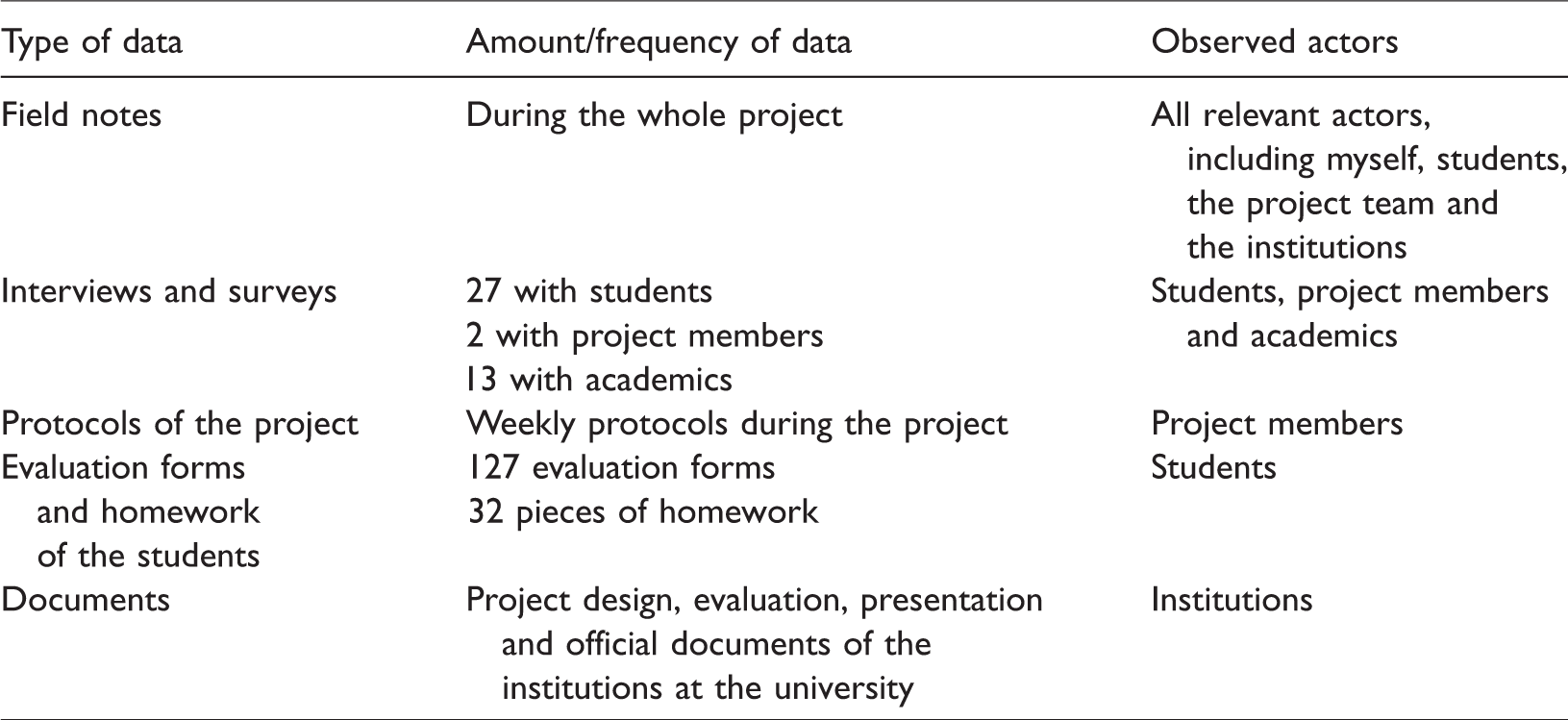
The data presented in this article comprises field notes based on participant observation, documents and interviews from four main actors involved in the project in the university field – namely, students, the project team, academic members of the departments and administrators (heads of department, deans, directors of institutes and members of the directorate). Based on my field notes on my own classes (32 hours per term) and workshops (between 16 and 32 hours per term), we conducted surveys and interviews with the students. The students’ evaluation forms and videos are also relevant. In the classes, there were 15 to 20 students on average. Over the course of the project, we reached almost 300 students; most of them attended more than one of the project’s workshops. The majority of the students were aged between 20 and 25, with a disproportionately high number of females (more than 70%). The students were mainly from three departments: Linguistics and Literature, Educational Sciences and Sociology. There were also several students from the Departments of History, Law, Natural Sciences and even Sport.
Another source of data stemmed from the project team, which mainly consisted of the protocols of the project, field notes and interviews. The core project team comprised three persons: the project director, a colleague for the German field and myself for the Turkish field. Advising the students (on their university life, on their plans for going abroad as exchange students or on their profile-building for their future career paths), conducting surveys of the needs and expectations of members of the university (students, academics and administrators), and disseminating the output of the project (participating in and organizing conferences, networking and publishing) were other parts of our work on the project. We held weekly meetings with the project director, who had initiated and conceptualized the project.
During the project, we conducted surveys with several academics from different departments (mainly Linguistics and Literature, Educational Sciences, Sociology and History), so that they could state their expectations and needs concerning their relationships with migrant students. Moreover, we had intensive verbal and written communication with them on matters of student mobility or credit points for our classes. The information from the university administrators was based mainly on my own field notes and documents.
Reflection of my position and ethical considerations
Denscombe categorizes ethnographic educational research into the following three possibilities: Total participation, where the researcher’s role is kept secret … Participation in the normal setting, where the researcher’s role may be known to certain ‘gatekeepers’, but may be hidden from most of those in the setting … [and] Participation as observer, where the researcher’s identity as a researcher is openly recognized. (Denscombe, 2010: 207)
Project aims and development
The explicit rationale of the project can be expressed thus: the fact that just 55% of migrant students graduate from the university means that we should recognize the special situation of this student group and develop suitable supporting instruments. Our aim is both to support them with their study requirements and to identify and promote the potential of multilingual students – for example, international students from Turkey, Russia and Germany had the opportunity to participate in some classes. So, whereas migrant students in standard classes at school or university may be perceived in terms of their imputed language and cultural deficits, in our classes they were regarded as ‘experts’ who translated or explained German texts for other international students or, in a different example, Turkish texts or systems for German students.
Before the project began, there were already language classes in Turkish and Russian for beginners at the university, although it was impossible to employ these for academic purposes. In particular, some migrant students speaking their family language in common parlance had no opportunity to improve their skills academically. Thus, language classes such as ‘Turkish as an Academic Language’ provided migrant students with an opportunity to improve their skills and use them for academic purposes. Both language classes and scientific seminars in Turkish were evaluated as being helpful and productive, and the students attending sociological seminars in Turkish were particularly committed.
The most important aspect of the project – a novelty, in fact – was the academic classes in Turkish hosted in various departments of the university as a means to provide space for the authentic use of Turkish in the academic context. The Departments of Sociology, History, Educational Sciences and Linguistics and Literature were ready to integrate such classes into different modules, thereby increasing the academic status and symbolic value of Turkish in the university space. In this sense, multilingualism was experienced as a meaningful instrument for multiperspective analysis – one essential for scientific knowledge. The evaluation of the ‘German as an Academic Language’ class provides evidence for the positive impact of explicit teaching on the use of language rules for migrant students. In their feedback, several students described their experiences of exchanges with other students in an open space as ‘emancipating’. In these classes, they were able to tackle difficulties with the German language without fear of being stigmatized or otherwise labelled as ‘untalented’ or ‘incapable’. Through professional support and interaction with other students, they became more self-confident in school. Our feedback showed that both German and Turkish courses created valuable new spaces for students, leading to a transformation of their habitus, and it is to this that I now turn my attention.
Habitus clivé of the migrant students in the university habitat
Several sociological studies on the experience of Turkish youth in Germany have identified the emergence of a gap between their spheres of life (Bohnsack, 2003; El-Mafaalini, 2012; Nohl, 2001; Rosen, 2013). The school or workplace constitutes the public sphere, while family and friends remain in the private sphere. The constant awareness of this difference between the spheres forms the specific characteristics of their lives. In his comparison of the social mobility of students from German and Turkish backgrounds, El-Mafaalini (2012: 151–154) identified similar typologies of habitus transformation, with the development of either a critical reflexive or practical synthetic pattern of change. In the process of vertical social mobility, students stay in a split habitus because of the substantial differences between the habitual disposition of their family and of the people in their present life – in other words, between their own past and present life. Bourdieu (2002) uses the term ‘split’ or ‘cleft’ habitus (‘habitus clivé’) for self-analysis to explain the situation of internal divisions as a result of living in a social context which radically differs from the context of primary socialization. In the case of a Turkish ‘climber’ (vis-à-vis social mobility), it is the difference not only between ‘lower’ and ‘upper’ classes, but also between ‘inner’ and ‘outer’ spheres that plays a role in the emergence of the divided habitus.
While there is a connection between the university habitus and that of students whose parents have an academic background, students from non-traditional families experience a conflict between their habitus and university structures (Schmitt, 2008). This situation of a habitus–structure conflict can also be defined as a divided habitus for such individuals (Friedman, 2016; Thiersch, 2014). Compared to German students, Turkish university students tend to come from working-class families without an academic educational background (Fürtjes and Arslan, 2016: 180; Middendorff et al., 2013: 537). In this important respect, it is possible to argue that they live more often with a divided habitus within the university space. The difference between the inner, familiar Turkish and the outer, public German spheres extends their divided habitus at the university as well. An empirical study which shows that many more migrant students perceive the university as ‘too cold’ in comparison to German students also supports the thesis of migrant students dealing with a more divided habitus at university (Fürtjes and Arslan, 2016: 184).
The following section exemplifies the meaning of the project in relation to the divided habitus of migrant students. The first student, Sevgi, may be viewed as a prototypical student of our target group. She appeared to be provided with limited cultural capital through her family because her language skills in both German and Turkish were insufficient for her to study successfully at a university. She was, for us, a ‘dream’ student, not only because she required support, but also because she was very eager to use the programmes within the project. While she was in Turkey for an Erasmus semester, she saw our programmes on the Internet and contacted us. She actively participated in almost all of the project’s programmes. She made intensive use of individual coaching programmes for supporting academic writing in German and she attended almost all of the courses on German and Turkish as academic languages, as well as social science courses in Turkish. In an interview for the presentation of the project, she presented her ideas as follows: If you want to achieve more, but you have difficulties, if you have languages, but you cannot apply them, if you are in a dilemma situation at the university, you can speak to the persons in this project. They really help you to find a way out of this dilemma.
Another student, Emine, while only partially meeting the requirements of the typical target group, nevertheless had relatively high cultural capital through the influence of her educated older sisters and relatives. She possessed quite sophisticated language skills in German, though not in Turkish. Indeed, Emine started attending a seminar I conducted, along with a German friend, without knowing that the seminar language was Turkish. Unfortunately, her friend had to drop the course because she was not able to speak and read Turkish. Emine had a self-confident way of speaking and interacting. For example, once she explained to me that she was having an argument with the Department of Sociology because they rejected her application for the Master of Arts programme. Instead of accepting the outcome, she complained to the head of department, and her persistence resulted in the application being accepted. She later reflected: I grew up with three languages: first I learned Arabic, then Turkish, and then German in kindergarten. In everyday life I spoke Turkish with my family and friends. At school I attended a Turkish course where we learned some grammar. But the course in this project was an entirely different experience. It was a great challenge. We learned new concepts, new expressions in Turkish. It was not only about vocabulary. I had to think intensely about these concepts when we translated them into Turkish. Many of us had no confidence before attending the course. Here we are free to use both languages. One is always told not to mix the languages. At the beginning, I was worried that others would speak much better than me. I have seen that we all have different levels of Turkish, but it plays no role in the discussion, because we all have the same target of understanding the text and completing our studies. We have a tradition that the students come to the class earlier, talk about the text of the day by combining our own experiences. And after the seminar, we have a meal together. It is not a normal seminar for us.
I knew a third student, Selim, from my earlier work in the Department of Sociology. He had good German-language skills but seldom participated in discussions during lectures. At the beginning, I had not noticed that he had a Turkish name, but later when I did, I got the impression that he had no contact with his native language or community. Surprisingly, he attended almost all of the Turkish courses linked to the project. I was also surprised by his knowledge and interest in Turkish social science literature since he had never mentioned this previously. In Sociology seminars conducted in Turkish, he was very engaged and more comfortable during discussions, and so it proved a great opportunity to have such a student who was able to introduce new sources with high intellectual quality to lessons with a discernible passion. A year later, he attended an English-speaking Turkish university in Istanbul as an Erasmus student. Later, I learned from another student that Selim had decided to pursue an academic career and was now writing his PhD thesis at another German university.
Such significant differences in Selim’s level of commitment and participation in German academic courses compared with Turkish ones provides compelling evidence of his divided habitus at the university. In German courses, he was almost invisible, often sitting at the back of the class and seldom commenting on the subject, while in Turkish courses, he was often at the front of the class and participated very actively in discussions. This might suggest that his non-participation in German courses was not due to a lack of interest in the subject per se. Rather, it seems that in the Turkish courses he was less burdened by the ‘translation costs’ between his inner Turkish and outer German spheres.
Manifestation of symbolic order and symbolic violence
The above-mentioned examples show the positive effect of Turkish academic courses in creating a space for bridging the inner and outer spheres of the migrant students. However, a key limitation relates to the manifestation of the symbolic order in a given society, where within the German education system, for example, Turkish is seldom seen as a branch of scientific communication. Several students mentioned that they had tried to hide their native culture at school for fear of being categorized as ‘uneducated’ (bildungsfern). In their view, teachers would typically interpret examples of Turkish knowledge as an overt sign of German-language deficiency. This process of discrimination can be elucidated through the concept of ‘symbolic violence’, whereby oppressed people can sometimes take the perspective of the powerful group and thereby reproduce the conditions of their oppression and reinforce the discrimination process. Bourdieu describes symbolic violence as ‘the violence exercised upon a social agent with his or her complicity’ (Bourdieu and Wacquant, 2002: 167). Similarly, several Turkish students did not want to participate in academic courses in Turkish because they perceived it as somehow negatively affecting their integration within the German education system. Some experiences during the project showed that negative perceptions of migrant students towards the native language of their own parents could develop and be sustained through intense interaction with the norms of methodological nationalism (Wimmer and Glick-Schiller, 2002) within society. Furthermore, people and actors who are against political nationalism reproduce these norms and perceptions, reminding migrants that their mother tongue is a deviation from the usual and normal societal standards. In the following section, examples are provided from the interactions of the participants with Turkish-focused academic courses.
One such example is Tuna, who came to Germany from Turkey as an Erasmus student for one year. Like many Erasmus students from Turkey, his English was better than his German, but because the number of seminars hosted in English was fewer than those in German, and because his knowledge of German was relatively limited, he was required to attend several German seminars. Tuna was reserved but otherwise a friendly and engaged student in the Turkish academic seminars. As we suspected, his high level of Turkish knowledge and friendly attitude were very helpful for the migrant students in Germany. As I read his protocols for each lesson, I noticed that the course was, for him also, an important source of support: Today it is sixth months since I came to Germany and for the first time I have participated in a seminar in Turkish. I am very excited, because I came here with my English language skills, and German as the seminar language was very difficult for me. For the first time I am in a seminar in my language. At the beginning of the course I had a feeling that all students would speak German again. And then we began to introduce ourselves. I was very relieved because I could understand everything I heard, not just a piece of what was said. But the most important and joyful thing in the lesson was that a fellow student asked me a Turkish word and I could explain it in German. Until now, I always had to ask something to my fellow students, and today they ask me something. I am very happy that I can answer them.
In a different example, I bumped into one of my students, Sinan, at the university. He was very attentive and engaged, with very good Turkish as well as German language skills. He was also politically active in movements against racism and stood up for the rights of asylum-seekers with a group composed mainly of German students. I wanted to watch the German national team in a football match, and he said that he was going to meet with his German friends in that group to watch it. I went with him and, as he introduced me as his Turkish lecturer, one of his German friends was astonished and asked him why he wanted to live in Turkey. When he responded that he had no plans to live in Turkey, she retorted with a laugh: ‘Then why are you learning Turkish?’ Sinan elected not to answer her question and just responded with a laugh, but I felt somewhat uncomfortable and, for that reason, could not communicate with them during the game. Apparently, her question was not intended as a real question but was a stance, because she was not irritated by not receiving an answer. Politically, she was an anti-nationalist (she was a member of the anti-racist group and also supported the team that was playing against Germany), but her way of perceiving the Turkish language serves as a good example of methodological nationalism: Turkish is meaningful only within Turkish national boundaries and makes little sense in the German national sphere. Intuitively, I understood this unspoken and unconscious message. In my view, the term ‘symbolic violence’ can help explain my strange feeling, for I was also aware of the symbolic order of languages in Germany. Like Sinan, I did not perceive her question as a real question but as a ‘non-reflected reflection’ of the dominant symbolic order. This invisible reflection reminded me of the lower value and status of my work compared with, say, those working with so-called legitimate languages – ones with more symbolic capital in the German national sphere.
Within the parameters of the project, courses conducted in Turkish attempted to change the symbolic order and dominant habitus of the university space. In the long run, it did not work and the project was not extended. In support of this decision, the university administrators emphasized that internationalization rather diversity should be the proper orientation and strategic focus of the university. Such discourse and negativity on the part of the administration illustrates the difference (some might say tension) between the concept of multilingualism and the prevailing orthodoxy of the university administration. Although multilingualism and internationalism are important mottos within the university, prestigious languages like English and French tend to be seen as superior. Before the project began, the administrators were positive because of their positive perception of the concept of ‘multilingualism’. When confronted with the real consequences of the project, many became more sceptical. Academic language courses in Turkish, Russian and Polish were an important step towards the recognition of migrant languages. This new recognition, however, led to the symbolic order being called into question, where almost only German and English were regarded as scientific languages.
Conclusion
Two important tendencies came to light over the course of the project. Firstly, once again, the project suggests the importance of recognizing the cultural capital of migrants as a form of legitimate knowledge in the university sphere for transformation of their habitus. The project motivated Turkish-speaking students and they felt, with the help of such support, a greater sense of belonging at the university. The project thus served as a bridge for migrant students, binding the habitus of their family with that of the university. Secondly, the project, through questioning the symbolic order at a German university, manifested moments of symbolic violence, for as long as Turkish remained a foreign language in the university programme, it did not challenge the symbolic order of the education system. The critique and expression of the project began with the use of Turkish within scientific courses at the university. Academic seminars conducted in Turkish within the Departments of Sociology, History and/or Educational Sciences changed the status of the language into one that was regarded as more of a natural mode of scientific communication, and it was also enthusiastically supported by several academics across the departments. At the same time, the unspoken and unconscious perception of Turkish as a non-scientific language was, in the minds of several actors, also exposed and challenged. This small-scale project had a profound effect not only on the situation of Turkish students at the university, but also on debates within the university community. Through this project, the Turkish language achieved the status of a legitimate ‘scientific’ language for the students and also the academics. On a small scale, it has shifted the field of legitimate knowledge. The project tried to change not only the habitus of Turkish students (among other migrant students), but also that of the university.
Throughout this article, I have endeavoured to show that the sociology of Pierre Bourdieu has significant utility and explanatory power as a means to elucidate the project. Within the constraints of an article, of course, it is never quite possible to achieve a comprehensive analysis, but it is still feasible to provide a meaningful one: that transformation of the habitus of migrant students must also focus on the possibility of changing the habitus of public institutions – in this case, the German university. My contention is that the project did just this by achieving a transformation of sorts with regard to the migrant student experience. By accepting the students’ native language as a key component of cultural capital, these students became more confident and experienced a greater feeling of familiarity. For those engaged, it was also a radical experience, bringing together two otherwise completely separate spheres: the German public sphere and the Turkish private sphere. Seminars conducted in Turkish served to open up a public space in which students recognized the language of the private family sphere.
In broader conceptual terms, the project challenged, if somewhat modestly, the monolingual habitus of the German education system. The deliberate embedding of Turkish in scientific seminars enhanced the value of the language as well as its cultural capital and, as a consequence, began to change the symbolic order of the educational field. Over time, moves towards a more systematic and comprehensive application of Turkish in the university context could further influence the status of the language and of migrants in other fields of society. A key strength was the way in which the project used a positive discourse on multilingualism and internationalization. However, while German universities see similar benefits in promoting multilingualism and internationalization, such optimism is often limited to prestige languages like English and French – what might be defined as elite multilingualism. In this respect, the project began to unsettle, if not completely disturb, the status quo.
Projecting forward, meaningful comparisons with similar projects in other countries may provide a timely impetus, offering both theoretical and practical insights into the complex dynamics of power at the interface of intercultural education. Accordingly, two sets of questions seem especially fruitful for further theoretical and practical consideration. First, how are the psychology and emotions of students impacted through intercultural engagement in a multilingual project, and how and in what ways does participation both enable and constrain students in their everyday social life space? And second, how and to what degree do such projects help transform the balance of power between the established and outsider figuration – in the sense of Elias and Scotson (1994) – in Germany? Answers to these questions might prove helpful in forging a better understanding of the relationship of migrants to contexts of future professional and educational endeavour.
Footnotes
Declaration of Conflicting Interests
The author declared no potential conflicts of interest with respect to the research, authorship, and/or publication of this article.
Funding
The author received no financial support for the research, authorship, and/or publication of this article.