




Abstract
Public education systems in Europe were created in the course of the foundation of the ‘classical’ nation state in the 18th and 19th centuries. Historical analyses show that it was part of their destiny to contribute to the consolidation of the respective states’ national self-design. In the 19th century, the myth developed that a nation state is monolingual not by its creation but ‘by mere nature’, and that monolingualism in the national language is the ‘natural’ result of being born and growing up in a nation state. Many of today’s public education systems are still based on this notion of linguistic ‘normality’ with respect to the composition of their clientele as well as their image of an individual ‘normal’ child(hood). However, the populations of nation states are in fact multilingual. Linguistic diversity increased as a result of migration and factors such as technical means for virtually ‘borderless’ communication. My contribution presents the European traditions of nation building since the late 1700s and asks for the functionality of monolingual habitual practice in education systems today. First results from an empirical study are presented which illustrate individual language abilities of multilingual children and the potential of linguistic diversity as a resource.
Introduction
The establishment of public education systems in Europe was an epiphenomenon of the foundation of the ‘classical’ (i.e. European) nation state in the 18th and 19th centuries (Hobsbawm, 1990). Historical analyses show that it was an integral part of the determination of public education systems to contribute to the emergence and consolidation of the respective states’ national self-conception. Visions of the features of a ‘normal’ and ‘well-functioning’ nation state were created and debated. One of these was the idea that a monolingual public sphere is appropriate and necessary for social cohesion in the nation state. Consequently, the creation of a common language which is understood and used by all members of the nation state was a core political endeavour, and the dissemination of this language as well as its standardization was a primary responsibility of the emerging public education systems. In the course of the 19th century, the visions transferred into myths. The legitimacy of the national language was reinforced by the narrative that it had always belonged to the common heritage of the people. It belongs to the most persistent myths to date, that a nation state is monolingual not by its creation, but ‘by mere nature’, and that individual monolingualism in the national language is the ‘natural’ result of being born and growing up in the respective state (Gogolin, 2006). Many of today’s public education systems are still based on this concept of linguistic ‘normality’ with respect to the composition of their clientele as well as their image of an individual ‘normal’ child(hood).
Historical analysis shows that the impression that multilingualism is a ‘new’ problem to public education – a problem which derives from current phenomena such as worldwide migration – is a myth as well. In fact, the populations of the majority of nation states were in their history, and today still are multilingual. After World War II, however, linguistic diversity as a result of migration increased considerably in Europe. Germany is a good example for constellations that can be found in many regions of the continent. In German cities and urban areas, roughly every second child is born into a migrant family. Due to historical reasons, census data about the number of languages actually spoken in the country are not available. It is most likely however, that the linguistic constellation in German urban areas does not differ much from the constellation in London, where more than 280 languages are represented by school children (King and Carson, 2016). According to a survey carried out at the University of Hamburg, its students communicate in about 280 languages (Gogolin et al., 2017). Such data illustrate that European societies, and consequently their public school systems, can be described as compositions of linguistic diversity. As yet, this reality is primarily perceived as a threat to approved traditions of teaching and learning. In my contribution I will take a different perspective by showing that indeed a monolingual concept of normality limits children’s opportunities to develop intellectually and linguistically. My contribution is based on a presentation of European traditions of nation building since the late 1700s, focused on the role of language, and on the traces these traditions left in the concepts of public education today. Against this backdrop, I give insight in an exemplar empirical study which is still ongoing. The research project ‘Multilingual language development in a longitudinal perspective’ (MEZ) illustrates the individual language abilities of multilingual children which could serve as a resource for the development of multiple language competences – if the monolingual traditions of education systems were replaced by openness for the multilingual reality in societies (Brandt et al., 2017).
Nations and ‘monolingual habitus’, Germany as an example
The tremendous success of the monolingual self-conception of individuals, and of the states they live in, is rooted in the radical transformations of economies, technologies and concepts of society since the Age of Enlightenment. In those days, the notion of ‘nation’ was designed and negotiated out of the deep conviction that the creation of societies will be possible in which inequality, the domination and egoism of the nobility will be overcome, the selfish ‘Kleinstaaterei’ (scattered regionalism of the sovereigns) will be conquered and a peaceful coexistence of the new states, new systems of government will be conceived. From the outset, the development of the ‘classical’ concept of nation has been associated with access to education for all members of the population, rather than addressing only clergy and the progeny of nobles. In the German tradition, the conversion of the school system into a public system, a subsystem of the civic society, started at the turn of the 18th to the 19th century – the ‘Neo-humanistic Reform’, which is closely associated with personalities such as Wilhelm von Humboldt (Blankertz, 1982; Menze, 1975).
This was a radical change. It was a matter of redefining learning and teaching in general and, with respect to both, the subject matter and the ideas about best ways of presenting and communicating what children and adolescents were expected to learn. The idea of ‘Bildung’ – the non-translatable German term which embraces learning and development of literacy as well as education and formation – was developed. In the course of this, the role and function of the German language in the education process was also negotiated. The concept of education sensu ‘Bildung’ was previously associated with the idea that it could not happen in a language of everyday life. Languages of education were classical Greek, Latin or, in some contexts, French. It was alien to contemporaries at the time that an educational value could be linked to the language that is used in everyday life.
Thus, the role and function of what was later called the ‘mother tongue’ had to be re-defined. Albeit grossly abbreviated, the related discourse and process of implementation of learning and teaching German, as both a subject matter and as a medium of instruction in general, can be divided into two different periods.
In the first of these, broadly classified as Pre-March era (‘Vormärz’), 1 the function of German was conceptualized as a gateway to general education (‘Allgemeine Bildung’) in the sense of both: education for every member of the society and making the pupils acquainted with the basic knowledge and skills of the time. The educational engagement with the language that people use every day was now conceived as a path to the intellectual development of the individual, regardless of which language is involved. The aim of language education (‘Sprachbildung’) in this sense was conceptualized as contribution to the development of the spoken word as well as script. The national language was perceived as diverse in itself, not as a stable, inflexible entity.
It is only in the individual that language acquires its final determination, and only this completes the concept. A nation does, of course, have the same language as a whole, but not all individuals in it, [. . .], quite the same, and if one goes further into the finest, then really every human being possesses his own language. (Von Humboldt, 2016: chapter 2, par. 65).
2
In this understanding, language is a means for the development of a person’s individuality and intellect, and at the same time every individual has power over the development of the language. Language education from this point of view strives for supporting the individual’s understanding of both language internal diversity and their ability to make deliberate choices between possible ways of expression in orality as well as script.
This perspective of the function and role of German in education was by no means hostile to the study of foreign languages. On the contrary: foreign languages were considered an indispensable element of general education. Their role was seen as twofold: comparisons between languages should function as an eye-opener for the comprehension of construction principles of languages as such and ‘one’s own language’ in particular, and learning a new language should serve as a tool for better understanding the world: ‘The learning of a foreign language should therefore be the acquisition of a new point of view in the previous world view, since each contains the whole fabric of the concepts and the way of imagining of a part of mankind’ (Von Humboldt 2016, chapter 2, par. 61). 3
In the first half of the 19th century, German and foreign language teaching and learning were perceived as the basis for participation in the public sphere and a tool for the acquisition of knowledge. In the second half of the century, this concept was gradually replaced by a different understanding of nation and the nation’s language. More and more, the participatory connotations were replaced by nationalistic associations.
4
Finally, after the foundation of the Empire in 1871, the use of the national language was associated with a commitment to emperor, people and ‘national culture’. This understanding resonates that there are superior and inferior nations and peoples, and consequently cultures and languages. The idea of language development got a naturalistic touch – it was assumed that the acquisition of the nation’s language is virtually a natural effect of birth on the nation’s soil:
Since every little German brings his language to school in the form of a self-grown planting, which is planted into him in and out of life and is therefore growing, the teacher has the task of the gardener, who has to create order in the wild growing planting, then usability and where possible beauty’ (Hildebrand, 1890: 141).
5
In this understanding, language education is related to instinct and emotion rather than knowledge and cognition. A pupil’s language
. . .can be formed neither by grammar and orthography, nor by speaking and reading skills, but only by the content of the language. . . . Thus in school every discipline becomes a German lesson; everything that I teach as a German in the German language infallibly bears the imprint of Germanism, is impregnated with German thinking, comprehension, intuition, feeling and striving, down to the last sound of the words. (Linde, 1897)
6
In this perspective, the educational process is no longer seen as associated with the foundation of linguistic ability, since this is already provided by mere nature. Teaching and learning of foreign languages was still regarded as part of education, but its function was reduced to utilitarian purposes – connected, for example, with the aim of performing tasks in the military or in trade.
This very rough overview can hopefully illustrate that what had been an effort at reform since the end of the 18th century had changed severely over the next 100 years – and at the same time was highly successful. The implementation of a national language, also called mother tongue, as a core element of an education system, has succeeded and became a general model of many systems worldwide. 7 The extent to which this implementation process was successful can be demonstrated by the fact that the knowledge of this history as history has largely disappeared from memory (apart from the memory of specialists). It belongs to the lost memory, that many aspects of what counts as self-evident today constitute the reified, de-historicized version of propositions of a not-too-distant past. One example is the assumption that development and perfection of the national language belongs to the ‘natural’ prerequisites of the pupils which they bring to school. Consequently, the teaching process can rely on this ‘natural’ resource of learners. Other examples are the suppositions that all learning (except of learning a foreign language) should at best take place in the medium of the national language; and that the optimal organization of a public education system is inevitably linked with the central position of the national language. This is what I called a ‘monolingual habitus’ (Gogolin, 2006): the forgetting of history, or in other words, the transfer of a man-made concept into the idea that it represents the nature of the things.
In fact, none of these assumptions (which are still present in the gestalt of contemporary education systems, e.g. the German) is based on evidence. The assumptions are based on ideas about best solutions that developed in the specific geopolitical, cultural and social context of the second half of the 19th century. ‘Losers’ in this development were the intellectuals of the late 18th to early 19th century, whose ideas were not transferred and implemented in their initial form, but in extensively modified versions. For a reflexion about the appropriateness of today’s education systems, it could be wise to reconsider if suppositions as the ones mentioned find their correspondence in the reality of today’s educational systems. One way to deal with this problem is to study the current linguistic texture of (German) society.
Migration – Germany as an example
The linguistic reality of today’s German society is substantially influenced by migration. Germany, in its varying cultural and political shapes, has been an area of immigration as well as emigration throughout its history (for a more detailed version of the following see Gogolin et al., 2019). After World War II, however, the country faced a new dynamic of immigration. The first significant phase of immigration consisted of returnees or refugees from former Eastern European war zones until the 1960s. In the second phase, an intense recruitment of labour took place (from early 1950s to the early 1970s as part of the German ‘economic miracle’ (Wirtschaftswunder). During this recruitment period, the proportion of ‘foreigners’ in Germany grew from 1.2% in 1960 to 4.9% in the 1970s. In 1973, Germany ceased recruitment on account of the oil crisis. Family unification then remained the only legal possibility for these groups of migrants to enter the country. Between 1973 and 1988 the number of foreign citizens increased from 4 million to 4.8 million (Beauftragte der Bundesregierung für Ausländerfragen, 1999). In 1990, around 5,342,500 ‘foreigners’ were registered in population statistics, amounting to 8.4% of Germany’s total population. In reality, the number of immigrants was significantly higher; the criterion for entry in migration statistics was ‘foreign citizenship’, meaning all immigrants with German passports – naturalized citizens, those with dual nationality, children from binational couples – were therefore invisible.
Researchers of migration bemoaned the highly insufficient data collection on migration to Germany since the 1970s, but it took more than three decades to convince the statistical offices of the importance of more detailed data. Since 2005, representative data is collected via the ‘Mikrozensus’ (micro census). Here, ‘migration background’ is defined according to place of birth of a person or at least one parent (first- and second-generation migrants), main family language, and citizenship. According to these data, about 15.7 million residents with a migration background in this sense lived in Germany in 2010. Of these, 35% were below the age of 6 years, 32% were between 6 and 15 years old, and 26% of the 15 to 20 year old age group had a ‘migration background’ (Statistisches Bundesamt, 2010).
Since about 2010, Germany has been affected, as have many other countries, by the new dynamics of migration which are forced by conflicts and crises. The number of international migrants worldwide has increased rapidly, reaching 244 million in 2015, a 41% increase when compared with 2000 (International Organization for Migration, 2017). Sources of migration vary considerably: While conflicts and crises are causes of forced migration (refugees), global mobility enables voluntary migrants to work or study in other countries. Today, people from about 190 countries contribute to the economic, social, linguistic and cultural diversification of Germany’s population.
The effects of migration are seen mainly in urban areas. In major cities, especially in Western Germany (e.g. Hamburg, Frankfurt), more than 50% of births now come from a migrant family. Although hardly any reliable data are available on the question of language diversity in the country (differently from other areas in the world, in Germany, no information on other languages than German spoken at home is collected in census data), it is plausible that a large proportion of these children are used to having more than one language at home. Moreover, language diversity is also driven by other factors. All children learn at least one foreign language at school; for the majority this is English. For about half of the student population – namely all who attend academic track schools – a second foreign language is obligatory in secondary education. It is everyday life for children and youth in Germany to communicate with multilingual peers and friends, encounter different languages and dialects when travelling and using (social) media in more than one language (Brandt, 2018; Brandt and Gogolin, 2016)).
Despite this situation, Germany long refused, in official politics, to accept its reality as a country of immigration and language diversity. The very first official governmental statement that indicated full political responsibility for the integration of migrants in social, economic, cultural and educational spheres was adopted in 2006 (Bundesregierung, 2007). With respect to language diversity in education, a number of official documents from the ministries of education and cultural affairs state that immigrant children’s heritage languages should be recognized and valued. Nevertheless, only a small minority of those children who speak a language other than German in their family enjoy access to education in their heritage languages within the framework of the public school system (Mediendienst Integration, 2019). The official commitment to recognition and appreciation of linguistic diversity in the student population is a political lip service rather than an indicator of readiness to respond to the actual linguistic conditions in the country.
This data illustrates that a multilingual composition of their population is actual reality in the majority of schools in Germany (for further details see Ylimaki and Wilmers in this volume). Nevertheless, the traces of a monolingual habitus are present in many parts of the education system. The monolingual principle is still the general norm, apart from a few exceptions such as bilingual schools – which, by the way, turn out to be quite successful for children who live in monolingual families as well as for their fellows from multilingual migrant families (Möller et al., 2017). In many subjects, the principles of Didaktik, teaching and learning still rely on the assumption that the learners are ‘normally’ equipped with the language competence that is necessary for understanding the matter (see for example Prediger, doi.org/1007/s10857-019-09434-3/2019/ in print). Last but not least, educational research contributes to the vitality of a monolingual habitus, for example by the interpretation of data about migrant children’s disadvantages in German schools as a consequence of being bi- or multilingual. Speaking a language other than German at home was, and often still is, presented as the most important risk factor for educational success (e.g. in the context of international large-scale studies such as OECD’s Programme for International Student Assessment, PISA, or the Progress in International Reading Literacy Study, PIRLS, although in depth studies show that evidence for causality of this conjecture is missing (Schnoor, 2019). Educational research can contribute to further clarification of the question how public education can (or should) react to the challenge of linguistic diversity, especially with respect to school systems that work in a monolingual tradition.
Linguistic diversity – a threat or an opportunity for public education systems in the 21st century?
In the following section an ongoing German study is presented. This project strives to contribute to further clarification of the questions of why language diversity is relevant for public education in the 21st century and how public education systems can deal with this constellation in a constructive manner. The background to these questions derives from both a normative basic principle and a functional perspective. The normative principle indicates that languages are valuable in themselves and that it is up to the individual to determine his or her linguistic identity and practice. Basic thoughts from the philosophy of the Pre-March period (‘Vormärz’) are taken up here, according to which public education supports the person to his or her self-determined use of language as well as the power to contribute to the evolution of language. This is connected with the ability to choose between the many variants that are always available for the adequate expression of a communicative intention. In a normative perspective, dealing with linguistic diversity is inherent in the mission that public education for the common good contributes to social justice in the society (Piller, 2016).
From a functional perspective, the capacity to communicate in more than one language is nearly self-evident in an increasingly internationalised and globalised world. Bi- or multilingual proficiency expands the scope and space for self-determined cultural, social, political and economic participation. For example, it is indispensable for a placement and a career in the labour market to have access to more than one language. Surveys show that multiple language competence is a not only relevant for highly specialized professions or senior staff, but for the whole range of occupations and hierarchical levels. They also show that it is anything but sufficient to have a command of English, the (current) lingua franca (Grin, 2001, 2012). In non-English-speaking countries – at least in Europe – the command of English has become a common prerequisite for access to a wide range of employments, even in the lower occupational sectors (Hall, 2015). Distinction is no longer gained by knowing English in addition to the regional or national language, but by having command of more than these two languages. Moreover, analysis shows that an exclusive reliance on English as a sole lingua franca is likely to result in considerable rates of disenfranchisement in the population of diverse societies, and hence in a politically and ethically undesirable side-effect on social cohesion (Ginsburgh and Weber, 2011).
The question however, how to deal with multilingualism in public education systems – if it is a threat or rather a resource in light of contemporary challenges for general education in relation to the historical foundations of public education – opens up the demand for more precise empirically based knowledge about linguistic reality in the societies and their schools. The research project I present in the following is dedicated to contributing to such knowledge.
The research project ‘Multilingual development – a longitudinal perspective’ (MEZ) is an interdisciplinary study under my supervision, funded by the Federal Ministry of Education and Research, Germany from 2014 to 2019 (Brandt et al., 2021; Gogolin et al., 2017). 8 The project is located at the University of Hamburg, with a team of principal investigators that includes educational researchers and linguists from different German universities. The general aim of the study is to identify starting points for the development of strategies that raise awareness about multilingualism as a ‘normal’ condition of teaching and learning in today’s German public school system. This is based on the premise that the implementation of a ‘multilingual habitus’ in the concept of general education (‘Allgemeine Bildung’) will be supportive for language development of all learners in an era of increasing international individual mobility and globalisation. Moreover, we assume that strengthening the language skills and potential of migrant students – including their multilingual language competences – can contribute significantly to reducing their educational disadvantage.
The relevance of these assumptions is linked to the condition that a significant multilingual potential is actually present in the student body. Given the circumstance, that the German public school system is not very attentive to migrants’ heritage languages, it was an open question as to what extent migrant students maintain these, and furthermore get access to literacy in them. The MEZ study aims to contribute to the deeper understanding of processes and effects of multilingual development by examining the following research questions:
Which linguistic, personal and contextual factors facilitate or inhibit multilingual development?
How do these factors interact and change over the course of secondary education?
How is the development of multilingual skills related to other dimensions of educational attainment (e.g. motivation; educational aspirations)?
In order to explore these questions, we have measured students’ language skills in German (the general language of instruction in school), the first foreign language (English), heritage languages of students with a Turkish and Russian family background, and second foreign languages (French or Russian). This constellation mirrors features of the school system as well as the actual constellation of migration to Germany:
With respect to the school system, it is a general norm in Germany today that all children are taught a foreign language in primary school already – in some Federal States from grade 1 (age 6 to 7), in others from grade 3 (age 8 to 9). In the vast majority of schools, the first foreign language is English. In order to achieve the school leaving certificate which gives access to university studies (the Abitur), at least a second foreign language has to be studied. This concerns roughly 50% of the student population. As a consequence of Germany’s migration history, Turkish and Russian should represent the languages with the largest number of speakers after German in Germany. Speakers of these two heritage languages usually belong to second or further-generation migrants, meaning they experience their entire school career in a German school. Despite the increase of new migrants that Germany has faced in recent years (International Organization for Migration, 2017), second or further-generation students still represent the majority of migrants in German schools.
The MEZ-sample includes students from monolingual (German) families and migrant families. We identify differences in the language performance of the students and explain variations in their language skills and development by controlling for contextual (e.g. socio-economic), linguistic (features of the included languages) and personal factors (e.g. cognitive skills). Drawing on sociological rational-choice theories, we assume that the development of language performance is influenced by attitudes and students’ linguistic self-concept, their career aspirations and expectations, and on investment choices that have been made in the course of their educational career.
MEZ is a longitudinal two-cohort study. Data collection started in spring 2016 with two parallel cohorts (students in grade 7, i.e. around age 13, and grade 9, age 15) and was carried out in four waves (see Figure 1) over three years (until grade 9 and grade 11, respectively); the last wave of data collection took place in autumn 2018. 9
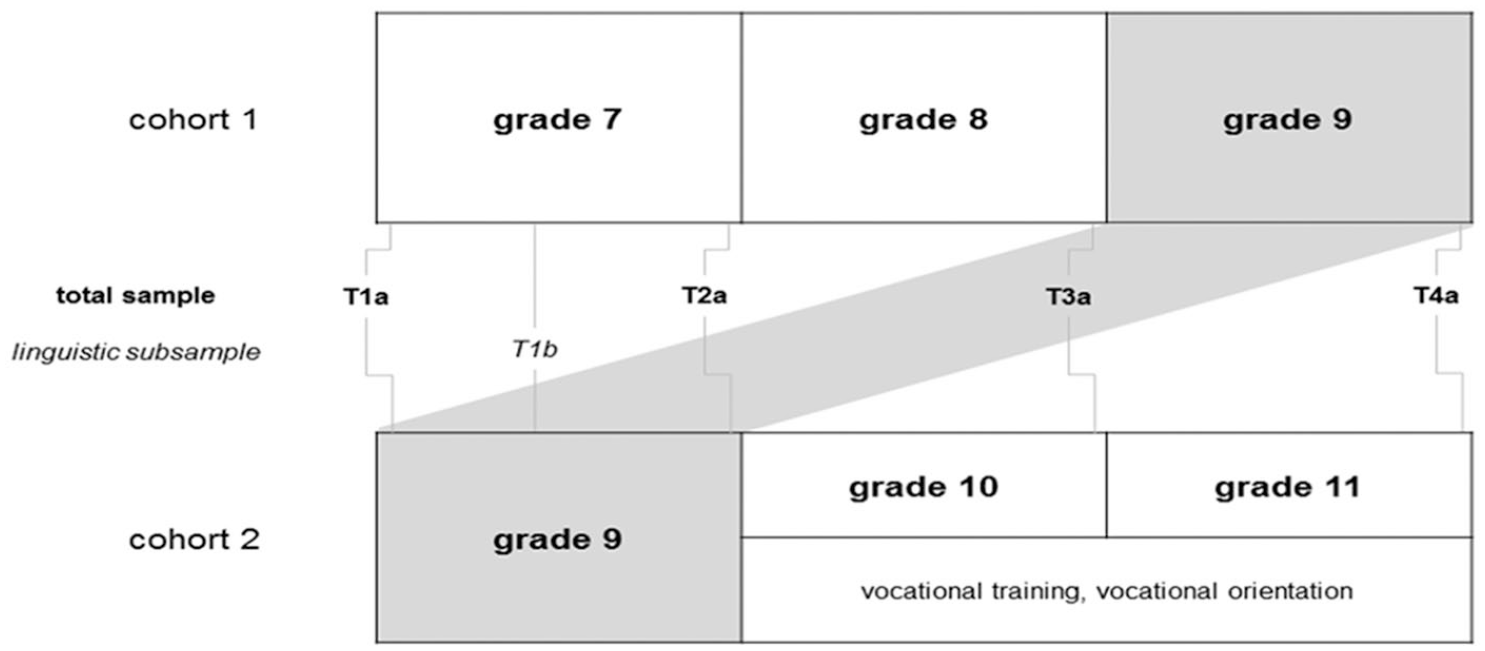
Design of the MEZ study.
The MEZ sample consists of roughly 2000 students in waves 1 to 3, and 1400 in wave 4. The decline is mainly due to the fact that a proportion of the student body leaves the school system after grade 9 or 10. About 1000 students in waves 1 to 3 (750 in wave four), are monolingual German; 350 (wave 4, 260) have Russian and 600 (wave 4, 375) have Turkish as a heritage language. Figure 2 provides an overview over the instruments we used:
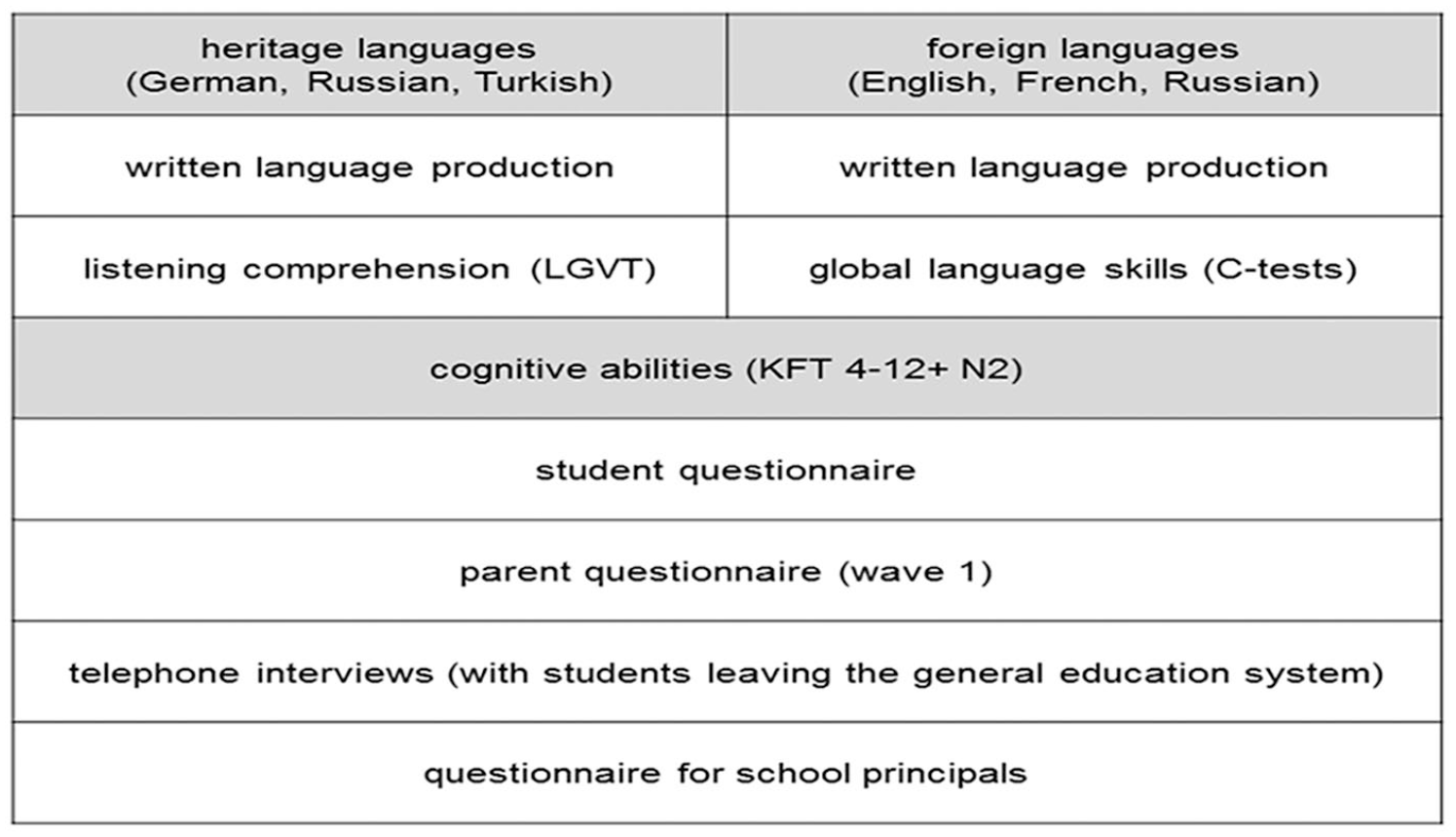
Instruments used in the MEZ study.
We measure different dimensions of students’ language proficiency: by cloze tests (Trace et al., 2017) and assessed global language competencies in the foreign languages: English, French and Russian. Receptive language skills in German, Russian and Turkish were assessed by means of a standardized reading speed and comprehension test (LGVT 6-12) (Schneider et al., 2007). As these tests were only available for German, we developed parallel versions for Russian and Turkish, together with the original authors. Differing from other large-scale studies, which usually restrict their data to receptive language skills (reading), we tested also students’ productive (writing) skills in English, French and Russian (as foreign languages) and in German, Turkish and Russian (as heritage languages). For this purpose, we developed statistically valid and reliable language assessment tools on the basis of a model that was tested in an earlier study (Reich et al., 2009; Lengyel et al., 2009). The instruments are based on visual stimuli and corresponding tasks, eliciting written text production (genre: unerring description with narrative elements). The analysis of the texts is based on lexical, morpho-syntactic and pragmatic indicators (task accomplishment, academic language, vocabulary, aspects of syntax, word count), representing school related, but not curriculum-based writing skills. In order to compare language abilities in the different tested languages, the indicators for analysis were developed according to the same theoretical model, applying functional equivalence of expressions in each language.
As already mentioned, the last wave of data collection in the MEZ project took place in late 2018. Consequently, data analysis is not yet fully completed (for further results see Brandt et al., 2021). The following aspects are intended to give an impression of the results we have obtained so far.
In our sample, German as the language of instruction turns out to be the dominant language among all students (Klinger et al., 2019). From a theoretical point of view, this was to be expected, given that German is the lingua franca in German society as well as the language of schooling. Thus, the learners receive by far more input in German than in any other language they may use or learn. Nevertheless, our data show that a considerable proportion of the sample with Turkish or Russian as heritage language prove to have multilingual writing skills, including not only German (the language of schooling) and English (the first foreign language taught at school), but also skills in their heritage language. The latter result is remarkable because only 40% of the German-Turkish sample and 15% of the German-Russian sample reported having visited the heritage country or having taken heritage language tuition at school (Usanova and Schnoor, 2021).
On the one hand, this result reflects a basic principle of the German education system’s reaction to migration: heritage language education for migrant children is provided only in a small number of languages and still today is a mirror of migration history. The provision of heritage language teaching was originally based on European political strategies concerning the ‘integration’ of migrant workers (guest workers/Gastarbeiter) in the 1970s, assuming that their residence in the receiving country is of limited duration. Considering this principle, teaching the ‘language of origin’ should be provided to their children in order to prepare them for returning to the country of origin (Boos-Nünning et al., 1986). In this tradition, heritage language teaching in Germany was – if at all – established for the largest groups of migrants at that time. Until now, Turkish is the second largest language in Germany, after German. The major part of migrants from Russian speaking areas, on the other hand, came to Germany on the basis of provisions for ‘ethnic Germans’. They were considered to be descendants of German migrants to Russia from the 18th century, at first recruited as ‘guest workers’ by Czarina Catherine the Great. Due to this perception, German was considered to be their ‘real’ heritage language, therefore no provision was made for the teaching of Russian as a ‘language of origin’. 10 Our study shows, that despite of very low (Russian) or low (Turkish) access to heritage language education in the official education system, a large proportion of migrant students who acquire the languages in their families develop not only oral, but also writing skills. This indicates that the migrant families and (or) their children place value on the acquisition of biliteracy and invest in the development of this competence, even if the official education system is not supportive in this respect.
An open question, however, would be if it is a threat or rather an advantage for migrant children to dispose of literacy not only in the officially respected languages – as in the example of our study: German and English – but also in their heritage languages. In research as well as in the practical or political field, the comprehension that the development of skills in the heritage language is likely to impair the acquisition of the educationally relevant language, i.e. the language of schooling and the language(s) taught as foreign language. This apprehension is substantiated by the time on task hypothesis, assuming that the time that a person invests in the development of the heritage language reduces the opportunities to invest, particularly in the language of schooling (Esser, 2006). This assumption, however, is not confirmed by our data. In our study, the German-Turkish- and German-Russian-speaking students who perform high at writing in their heritage language also consistently achieve high results in our tests. This can be shown for both, German and the first foreign language English. Usanova and Schnoor (2021) identify three ‘multiliteracy profiles’ in the MEZ data: All students appear to be ‘unbalanced’ multiliterate learners, because they achieved higher scores in German than in the two other tested languages. However, the same pattern of writing skills was identified in all three profiles: the students write best in German, followed by the respective heritage language, and English is on the third rank. Furthermore, no significant differences were found between the multiliteracy profiles when results were controlled for students’ migration background, the order of language learning, and the use of German language within the family.
For the interpretation of this finding it has to be noted that all students in our sample passed through their educational career in the regular German school system. For that reason, this result cannot be an effect of a particular school model, e.g. bilingual education. 11
Linguistic diversity as an asset in a globalized world
The MEZ project shows in the first results of data analysis that a considerable potential for the development of multiple language skills is present among the students – at least in the investigated groups. It is noteworthy that this potential can be found in an educational system which does not treat heritage language skills with particular care. With respect to language education, the system still works according to the monolingual tradition that was developed and ‘naturalized’ in the course of the 19th century, as was presented in the first part of this article. The actual linguistic diversity that students bring to school still is largely ignored; only a minor proportion of the students in our sample benefitted from heritage language education. One of our next tasks of data analysis will be to identify the resources that the learners (or their families) have managed to use for the acquisition of literacy skills in their heritage languages; obviously, they are able and willing to invest in this outcome of education.
From a broader perspective, our study demonstrates that a constructive perspective on linguistic diversity in (not only) European education systems would not endanger the relevance of the ‘majority language’ as a common means of teaching and learning. A ‘take away message’ from our results is that the development of reading and writing skills in the heritage languages is not at the expense of skills in the majority language.
Our study calls for future research that takes a more differentiated look at the relationship between the languages in which a person lives and learns. The empirical observation of actual language practice and competence can serve as a basis for the development and evaluation of constructive ideas for dealing with diversity in ‘normal’, i.e. linguistically diverse contemporary classrooms. Some pilot studies have already been carried out which illustrate the potential of linguistic diversity as a resource (Duarte and Gogolin, 2013; Duarte and Günther-Van der Mej, 2018; Gogolin and Duarte, 2017). The transformation of a monolingual to a multilingual habitus seems adequate for and possible in public education for a globalizing world, but still requires a lot of investment – not least from the educational research community.
Footnotes
Declaration of conflicting interests
The author declared no potential conflicts of interest with respect to the research, authorship, and/or publication of this article.
Funding
The author disclosed receipt of the following financial support for the research, authorship, and/or publication of this article: This work was supported by the Bundesministerium für Bildung und Forschung (BMBF) 01JM1406
