




Abstract
This article reports the findings of a longitudinal study exploring the process of learning to teach modern languages in the changing landscape of teacher education. It employs a postmodern critical ethnographic methodology to examine the experiences of a group of student teachers over the course of a one-year postgraduate teacher education programme in England. The focus is on how experiences in university and in school encourage or discourage the development of creativity. The schools inspectorate, Ofsted, is critical of lifeless teaching which fails to inspire young people to learn languages. However, the pressures of ‘performative’ requirements act as a discouragement to creativity. The data indicates that whilst student teachers express a desire to be more creative, they find it difficult to implement their ideas in school. A post-structuralist analysis of Marx’s theory of alienation is employed to argue that the early formation of professional identity is a process of acquiescence to oppressive external structures over which individuals have no control. The study concludes that it is possible to create spaces where the temporary suspension of alienation can allow individuals to put life back into language learning.
Introduction
Student teachers, as they begin their professional education, often express their motivation to teach languages as a ‘passion’. They have spent time immersed in other cultures and languages, and are enthusiastic with regard to sharing this knowledge and experience with their students (Barnes, 2005). However, evidence presented by the inspectorate, the Office for Standards in Education, Children’s Services and Skills (Ofsted, 2011: 5), based on observations of language lessons in 90 secondary schools in England, suggests that this ‘passion’ is not always translated into classroom practice: ‘too often, the teaching was too uninspiring and did not bring the language to life for students’. The consequences of this are evident in the fact that only half of young people choose to study a foreign language beyond the age of 14 (Board and Tinsley, 2016). This has prompted calls for government intervention to prevent a critical skills deficit which may be detrimental to economic growth (Burns, 2016). ‘Lifeless’ teaching, it is argued in this article, may also be a factor influencing the high number of modern languages teachers choosing to leave the profession (Sellgren, 2017). This study investigates the process of learning to teach languages, exploring what happens between the moment a student begins the Postgraduate Certificate in Education (PGCE) programme and the moment they emerge as a qualified teacher. Specifically, it asks: how do people with a declared ‘passion’ for languages end up teaching dull and uninspiring lessons? In this article, I propose that the early formation of professional identity is framed by neo-liberal agendas, which have brought about the curtailment of individual freedoms, thereby limiting creativity in the classroom. The evidence presented from my work as a PGCE modern languages tutor suggests that the prevalence of performative requirements over ethical professional judgement has acted to extinguish individual creativity, resulting in a deadening of the experience of language learning for both teachers and students.
The environment within which student teachers develop a sense of a professional self is being transformed by the rise of neo-liberal ideology. Education has become a commodity which, like any other, can be traded in the marketplace for money or status (Olssen et al., 2004: 181). Within the ‘new knowledge economy’, what is accepted as ‘knowledge’ becomes more narrowly defined, giving rise to tensions in practice (Dale and Robertson, 2009). The idea that the study of other languages and cultures offers young people a broader world view and a means of connecting with people from other places becomes marginalized, and language skills for business are prioritized. Ozga and Jones (2006: 8) assert that the ‘failure of policy-makers to acknowledge the ambivalent and unstable nature of the Knowledge Economy contributes to a limited view of knowledge and loses sight of its capacity to create meaning and value beyond the marketplace’. Individuals, they point out, may indeed wish to engage in a ‘wider approach to and engagement with knowledge’ (8). However, in a climate where education has become the servant of neo-liberal agendas (Enever, 2009), the capacity for student teachers to exercise their own creativity is very limited. This, in turn, has impacted on the learning experiences of young people and seems likely to be a contributing factor to their rejection of language learning.
Policy context
Defined by Olssen et al. (2004: 172) as the ‘new authoritarian discourse of state management and control’, neo-liberalism extends the reach of the market into all aspects of human interaction, putting a value on and measuring the costs of all forms of human activity. Ball has argued that it is the advance of neo-liberal ideology which has given rise to a managerial and technocratic culture in schools, replacing the professional autonomy and ethical judgements of the individual teacher with standardized ‘norms’ for the purpose of measuring performance. Drawing on Lyotard’s (1984) notion of ‘performativity’, he explains how control is exercised through a system of ‘terror’ – a ‘regime of accountability that employs judgements, comparisons and displays as means of control, attrition and change’ (Ball, 2008: 49). This gives rise to a fear of being seen as inadequate, of not measuring up to someone else’s idea of what it is to be a ‘good teacher’. This constraining culture of performativity in schools has been highlighted as having a negative effect on creativity and professional autonomy (Adnett and Hammersley-Fletcher, 2009; Robinson, 2011). However, these critiques do not fully acknowledge the extent to which this is the inevitable outcome of a neo-liberal ideology which seeks to impose an identity on individuals.
Althusser’s (2001) theory of the ‘ideological state apparatus’ offers a way of exploring the mechanisms whereby neo-liberal ideology functions to deliberately extinguish creativity in order to exercise control and ensure social reproduction. Althusser makes the distinction between the ‘repressive state apparatus’, which operates through violence (such as the judiciary and the military), and the ‘ideological state apparatus’, which operates through ideology (such as the school and the Church) (97). The means by which the individual is recruited to an ideological state apparatus is via the mechanism of what Althusser calls the ‘interpellation of the subject’. He draws on Lacan’s post-Freudian theories to propose that individuals ‘act out’ the rituals of ideologies, thereby enabling the construction of an illusory sense of identity. Althusser’s post-structural interpretation of Marx’s theory of alienation allows for the existence of oppressive structures, which is non-foundational. Ideological state apparatuses are not ‘ready-made’ but come into being as material practices (112). The ideas and representations on which they are based do not have a ‘spiritual’ existence, but are wholly material. They are constantly made and remade by those participating in them. As participants in Initial Teacher Education, my students and I find ourselves subscribing to the ‘material practices’ which constitute the ideological state apparatus of teacher education. Althusser notes that all ideological state apparatuses use suitable methods to discipline their members (98), and so, in fear of being ‘cast out’, of losing our jobs or failing to meet the requirements for qualified teacher status, we continue grading, measuring and assessing, thereby upholding the very structures which oppress and alienate us. Althusser’s rereading of Marx centres on the idea that the worker is always dominated by powers and structures external to the self; we are shaped by the structures within which we live. Althusser singles out the school as the dominant ideological state apparatus, which functions to reproduce the ‘relations of production’ and exploitation (104). ‘Good teachers’, he says, are forced to work in a system which is bigger than they are and which crushes them. They ‘put all their heart and ingenuity’ into performing their job, and are unaware that it is their own ‘devotion’ which contributes to the ‘maintenance and nourishment of this ideological representation of the School’ (106). Thus, the individual teacher is complicit, albeit unwittingly, in the maintenance of oppressive structures, of which ‘performativity’ is one specific manifestation. Ball’s (2008: 58) Foucauldian analysis of the work of teachers suggests that they are ‘entrapped’ into taking responsibility for their own ‘disciplining’, and are urged to believe that their commitment to such processes will make them more professional.
One of the consequences of this is the diminishment of subject pedagogy. Lingard refers to several studies which demonstrate how the quality of education is being reduced by a narrow, technicized view of education. He argues that this has effected a ‘thinning out’ of pedagogy and challenged the potential for more ‘authentic’ pedagogies (Lingard, 2009: 81). Pedagogy, he points out, remains an individual and local concern, in opposition to the universalizing standardization of policy (Lingard, 2009: 82). It rests on the professional and ethical judgements of the individual teacher as opposed to the implementation of generalized teaching strategies . Modern languages pedagogy draws on a robust body of research which emphasizes the key importance of spontaneous language use (Mitchell, 2003). However, the demise of subject-specific pedagogy and its replacement with a generalized ‘science’ of learning (Hardcastle and Lambert, 2007, in Pachler et al., 2007: x), in order to facilitate the measurement of teacher effectiveness, has marginalized the key principles of second-language acquisition. It has been noted, for example, that there is very little verbal spontaneity in language lessons, and written role plays pass for ‘speaking activities’ (Ofsted, 2011: 24). Ofsted (2008 ) has berated students’ inability to ‘speak creatively or beyond the topic they were studying by making up their own sentences in an unrehearsed situation’. The diminished use of the target language by teachers and their students has been a focus of concern in recent years. Chambers’ (2013) study of a group of PGCE student teachers found that whilst they agreed with the principles of using the target language and had the linguistic competence to use it, they were unable to sustain it in practice. This was due to the priority accorded to generic pedagogies which emphasize short-term goals and militate against a view of language learning as a long-term project, which is a precondition for sustained use of the target language (Pachler et al., 2007: 31).
The student teachers in this study participated in a series of university seminars that were designed to promote the creative use of the target language within authentic cultural contexts. These included drama, songs, games, poetry, music, art, drawing, film, storytelling, magic tricks, dance and culture. Following the seminars, the students and I collated a list of suggestions for developing creativity in modern languages lessons, which was intended to support experimentation with creative, multi-sensory pedagogical approaches that allow for responses which are not limited to the linguistic (Pachler et al., 2009: 153). Such approaches are not the ‘norm’ in the modern languages classroom and are likely to bring student teachers into conflict with what they observe in school. Student teachers, however, are reluctant to challenge the way things are done in school (Raffo and Hall, 2006), leading to the replication of ineffective practices. The influence of the university in promoting broader forms of professional learning which foster criticality and creativity (British Educational Research Association, 2014) has been undermined by recent policies which have sought to reposition initial teacher education (ITE) as an apprenticeship model under the direction of schools (Brighouse, 2013). The conceptualization of teaching as a craft or technical skill neglects the centrality of the capacity for critical reflection, which is the ‘insight that comes from interrogating one’s own practice’ (British Educational Research Association, 2014: 20). The standards for qualified teacher status, arguably, exacerbate this by encouraging a superficial engagement with subject pedagogy (Calderhead and Shorrock, 1997, in Pachler et al., 2007: 43). The effect of this has been to diminish individual agency, narrowing the possibilities open to student teachers to make language learning a meaningful and creative experience for themselves and their pupils.
Creativity as an expression of liberty: theoretical perspectives
Marx’s theory of the commodity offers a way of understanding how student teachers experience their work in an environment where ‘language learning’ and ‘teacher education’ have become objectified and removed from the human beings participating in them. Capitalism, in replacing ‘use value’ with ‘exchange value’, separates the worker from their labour, bringing about a state of alienation (Marx, 1992: 330). Marx draws on Hegel’s idea of Gattungswesen (‘species being’) from Phenomenology of the Spirit (1807) as a way of conceptualizing human creativity. According to Marx, we are creative beings and in separating our creative activity from our Gattungswesen, we bring about our own alienation (Petrovic, 1963: 421). In his critique of the commodity, Marx drew on the philosophy of aesthetics to demonstrate how ‘[t]he object as exchange value is abstracted from its sensuous particularity in order to make it exchangeable for any other commodity’ (Bowie, 2003: 61). According to Bowie, this has given rise to a ‘crisis of meaning’, where the relationship between the ‘unique’ individual and the ‘external’ world is uncertain. We experience this as a ‘loss of particularity’ to an imagined external reality which can be explained by generalizable laws. Art presents a challenge to scientific rationality because it ‘lives from its particularity, which is not reducible to conceptual generalisation’ (Bowie, 2003: 5). Art implies an individual human subject, and the human capacity to create and appreciate art presents a challenge to the view that we can understand ourselves and the world around us only through scientific rationality. It draws on the imagination to produce images of what the world could look like if we were to ‘realise our freedom and thus establish a more appropriate relationship to the rest of nature’ (5). I propose that what is termed ‘creative practice’ in modern languages is quite simply an attempt by student teachers and me, as their tutor, to reconnect the Gattungswesen to the work we do – an attempt to insist on enjoyment in the (po-)face of killjoy policies which sap human creativity and deny us our connections with each other.
Research aims
Research on the professional development of language teachers has tended to be focused on ‘cognition’ – on how knowledge and beliefs about specific aspects of language teaching, such as grammar, influence decision-making (Borg, 2003: 98). Borg (2003) suggests that this has led to a neglect of the political, social and cultural contexts which influence teachers’ decision-making. Kanno and Stuart (2011) draw attention to the lack of studies addressing novice modern languages teachers’ long-term development – a gap which this study aims to address. The study is framed by the following questions: how do student teachers view creativity in the context of language teaching? What do they think it is? Are they motivated to experiment with creative approaches? What opportunities do they have to develop creative practice in schools? And how do they view the tensions between creativity and performative requirements, and their effect on their emerging professional identities?
Research methodology and ethics
The study follows one cohort of 11 student teachers through their PGCE year, gathering data through observation, individual semi-structured interviews and naturally occurring data, including assignments and reflections. An open-text questionnaire was completed at the end of the programme, which asked the following questions: how important is creativity in language lessons? Did the ‘creativity list’ encourage you to be more creative? Were you encouraged to be creative by your mentors in school? And did you feel your own creativity was restricted in any way? The research design evolved over the course of the year and was divided into four phases (see Table 1). The data gathered from each phase was used to inform the design of the next (Hammersly and Atkinson, 2007).
Data collection phases
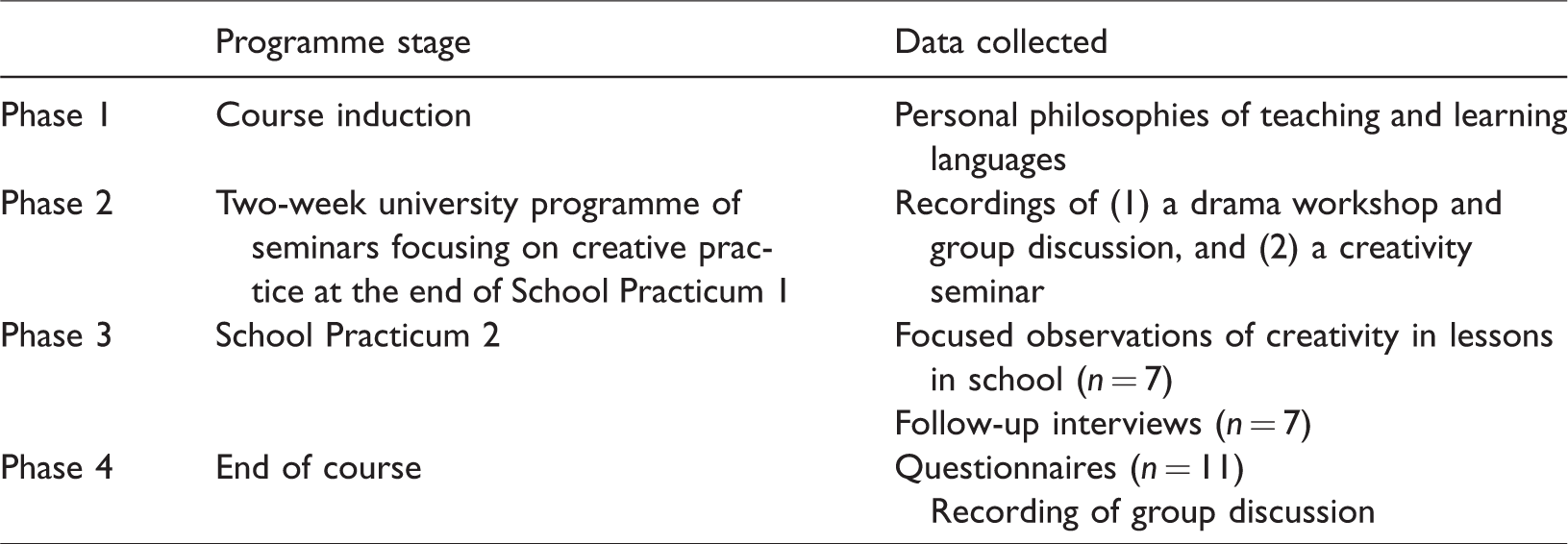
Observations took place during the normal course of my school visits, and seven were selected as a representative sample. I did not inform the students that, in addition to the normal observation, I would be focusing on creative aspects of the lesson, as this may have put additional pressure on them to perform and would not have captured their authentic experiences. Following the observation, I emailed the students my reflective analysis of the lesson, focusing on creativity and inviting them to discuss this with me. Reflexivity (Pillow, 2010) is a key feature of the methodology of this study, and the critical narrative arises out of my reflections on my own experiences and those of my students. It is an explicitly personal interpretation, where validity is conceived not as a ‘regime of truth’ but as an ‘incitement to discourse’ (Lather, 1993 : 674). All names are pseudonyms.
Presentation and analysis of the data
One of the most notable findings is that creativity is seen by the student teachers as being disconnected from ‘normal’ modern languages practice but connected to ‘real life’ or embodied experiences. Creativity is viewed as a desirable ‘added extra’, a luxury rather than an integral part of modern languages practice. In commodifying their own creativity, the student teachers have brought about their own self-alienation through the separation of their work from their Gattungswesen, or sense of being human. The data reveals how the student teachers’ sense of their own agency diminished as they progressed through the programme. They gradually became more pragmatic (or cynical) with regard to the parameters of creativity in language teaching, accepting the limitations imposed by external influences. The following reflections from Gemma illustrate this change in attitude between the start and end of the programme, respectively: My aim is to make exciting, active, enjoyable and fun lessons which challenge all students. I want to inspire students and help them understand that languages will give them powers and open doors in the future. (Personal philosophy) The important thing is to create a love for learning, but on the flipside there is also the requirement to make progress. (Group discussion)
The student teachers conceptualized creativity as being linked to ‘real life’ or embodied experiences, which have been removed from language learning through the process of alienation. ‘Creativity’ symbolizes that which is absent from ‘normal’ lessons and can be understood in terms of ‘sensuous particularity’, or the individual imaginative articulation of the object (Bowie, 2003: 61 ). The idea of sensuous particularity unifies the themes which emerge from the data: creativity is seen as being aesthetic, physical, spontaneous, an expression of individual freedom, imaginative, enjoyable, and connected to real life and to culture. All of these aspects of experience require a particularized subject which cannot be quantified, predetermined or standardized. Gemma, for example, suggests that allowing students to use hand gestures was constitutive of creative practice because it allowed students to make connections with real-life experience, thereby making modern languages more accessible: they have got this myth that languages are tricky. But if you put a creative slant on it, they can … French people express themselves so creatively, you know; they use hand gestures. If you give them the freedom to do that, it’s really important. (Interview) What is the point of saying a whole load of random sentences somebody wants you to say? Surely the point of it is to be able to express yourself in some way … they have got to be able to say what they are feeling. (Interview)
The absence and presence of enjoyment is a theme running through the data. All of the students expressed a desire to make language learning an enjoyable experience and saw creativity as a solution to pupil boredom and disaffection. Joe comments that much of the content of modern languages lessons is a joyless preparation for examinations. Boredom, he acknowledges, is what turns young people away from language learning: Quite often they are writing sentences that are boring to read and so must be boring to write. … It’s probably going to be good for their exams, but there is no kind of joy there. You can see it in their faces when they are not enjoying the lesson. Also, it makes the country you are trying to tell them about seem really one-dimensional and boring, somewhere they would not really want to go to. (Interview) Really brings the language to life and makes it more memorable, meaningful and fun for the learners. (Nina) Creative lessons encourage the students to think around the language, to participate more. It engages students and helps them to enjoy language learning more. (Kris) The more you make it seem creative and fun and not such a hard subject, the more you break down those ideas that ‘this is hard and we can’t do this’. So bringing in different elements, creative elements … helps the children. (Nina, interview) The video clip about ‘untranslatable words’ was delivered in a lively style by a young German native speaker accompanied by music. It was well chosen to arouse the pupils’ curiosity about the German language and immediately caught the attention of this group of 12 pupils of lower ability. The class have presented Diana with some challenges regarding motivation and engagement, and the purpose of the video clip was to begin the lesson on a positive note and to tune the pupils into German again. However, it was rather hurried and the opportunity to explore the idea that some words cannot be translated was missed. The clip was shown with a very brief discussion, after which the lesson objectives were presented and copied down. There was no time available for any expansion or discussion about what they had seen in the video clip, which she had chosen, I imagine, with a view to broadening their understanding of what language is. It would have been nice to … extend it a little. … There are pressures to get things done by certain points, particularly for a trainee because I am told ‘this is what you need to cover, this has to be done’, so I feel I have to do what [the teachers] are telling me to do rather than something I would maybe like to do. (Interview)
The students demonstrated a keen awareness of the tensions between creativity and the performative requirements of both the school and the university. They focused on particular aspects of performativity as being barriers to creativity, including evidencing pupil progress, assessment, time and managing pupil behaviour. The idea that what is important is not what you actually do but what you are seen to be doing was understood to be a part of the job: ‘It’s the pressure of Ofsted because they have to see what you do. So, what’s more important for them is what is in their exercise books’ (Kris, group discussion). I interpret this as evidence of the ‘terror of performativity’ (Ball, 2003), where individual performances serve as measures of productivity. The result is that teachers feel coerced into behaving in ways which they believe to be unethical through fear of losing their job or of letting colleagues down. Some students had been told by their schools that they needed to show ‘progress’ in every lesson: ‘Ofsted come in and you have to show progress within twenty minutes, and schools are so obsessed with showing progress within twenty minutes so that if Ofsted walked in they could appraise you’ (Sian, group discussion). Sian acknowledges that this ‘performance’ of progress has no value beyond demonstrating the teacher’s capacity to produce observable, measurable outcomes for the purpose of appraisal. It is an example of a momentary ‘display of quality’ (Ball, 2003: 216), which has no connection with human interaction. Her disapproval is evident in her use of the word ‘obsessed’, which is, ironically, a term describing irrational behaviour. The students understood that the kind of demonstrable ‘progress’ required for the purposes of measuring teacher effectiveness is not always in the interests of pupils: I certainly feel as a trainee that I am rushing. I can’t spend the amount of time I would like to on things. You feel like you are racing through. I do wonder actually how much the pupils take in … if they are flying through everything rather than really taking the time to learn something. (Linda, interview)
Time constraints were viewed as a barrier to creativity, both in terms of the actual lesson time available, which was seen as inadequate, and the amount of time it took to prepare creative activities. Joe comments on how much he had enjoyed writing a poem to teach the conditional tense, despite the amount of time it took: Joe: I spent nearly three hours writing that poem, not because I had to but because I wanted it to rhyme. That was a silly idea, but … BHr: Did you enjoy doing it? Joe: To be honest, yes, sad though it is. I kind of forgot it was part of the lesson. (Interview)
The lack of lesson time was frequently mentioned as a barrier: I also find that I sometimes get the comment if I do something creative, obviously it might take a bit longer, and then they’ll say: ‘Well, you could have done that a lot quicker if you had just given them the list’. (Linda, group discussion)
The students expressed a great deal of frustration with the narrow parameters of the curriculum: The schemes of work … can be too prescriptive in that you NEED to cover all of these things. You feel as though if you don’t get through, you are going to be disadvantaging those pupils somehow. Whereas, I wonder how much getting through those things, how much of it they actually retain? (Linda, group discussion)
Evidence from my observations suggests that student teachers’ efforts to engage students through creative practice have a positive impact on pupil behaviour: As they enter the room, it is clear that some pupils in this small group of Year 10 pupils have the potential to misbehave. Nina quickly engages them with an innovative activity using iPads. They are intrigued and, as soon as they have logged on, are posting items of French vocabulary on the topic of ‘Places in Town’ which appeared on a ‘Wordle’ on the screen at the front of the classroom. There is an air of curiosity and creative energy as pupils contribute to the growing image on the screen. They are proud of the words they have remembered and Nina’s strategy has paid off; they are ready to learn and she has won them over. They work hard for the remainder of the lesson. (Observation of Nina)
However, the students identified poor behaviour as one of the main reasons teachers give for not being more creative. This applied mainly to pupils in the lower sets. Althusser’s (2001) claim that schools function to ensure that the rules of the established order are obeyed is evident in the unequal distribution of creativity in the classroom. It is reserved for pupils who behave: ‘The teachers said that in the bottom sets there tends to be more behaviour issues, so I am not going to try something nice and creative and fun, we’ll only give it to the ones that behave’ (Diana, group discussion).
Kris’s school is in a socially deprived area, and many pupils have emotional and behavioural difficulties. Some of the other students, who have not experienced such circumstances themselves, were shocked to hear that the pupils in Kris’s school are not allowed to have scissors: Kris: In my school, I was told that I have to be more creative than the kids. For example, with some groups I wasn’t allowed to give them scissors because their behaviour was quite … [several voices make exclamations of protest] um … challenging. Steve: Yes, but you have got to trust them to give it a go. Kris: [quietly] It was quite a challenging school. Quiet voice: Oh God! Kris: But I think that they needed … they really were … they had a hunger to express themselves, you know. Steve: I was basically told, ‘Don’t get them all up and moving at the same time because it will just cause chaos the classroom’. In school S, they have got a lot of behaviour issues, so their focus is on making sure that the kids are able to be quiet and with the teacher leading the … They worry that if you leave them on their own for five minutes, then they won’t do anything, which in some cases that is true. If the teacher isn’t there telling them exactly what to do, then they won’t do a single thing and then the whole class will turn to chaos. Sian: But is that because they are so used to being told what to do that they can’t actually do it by themselves? [voices of agreement] Steve: I think that’s a lot of it. So, if you sit in front of the teacher answering questions, they are used to doing that, but if you ask them to do more … Gemma: I think it should be about kids doing things for themselves. There is too much … Amy: Spoon-feeding!
Concluding discussion
The research findings corroborate those of Ofsted with regard to the failure of teachers to ‘bring the language to life’. However, I conclude from my analysis that this cannot be attributed to the student teachers themselves. The evidence shows that whilst the student teachers were acutely aware of the lack of ‘life’ in their lessons, they made attempts to restore it, which were thwarted by performative requirements beyond their control. These attempts allowed them to experience moments of connection with their Gattungswesen and to glimpse a different way of being. The students said that using music, art, drama, film and other forms of sensuous or aesthetic experience enabled them to make language learning ‘more real’ to their pupils. In other words, art (semblance) feels more real than school. This is because art allows us to imagine ourselves as autonomous, particular subjects, if only for a moment. Art is not ‘real lived experience’ but an expression of it. For the student teachers, creative practice represents an attempt to reconnect with the self (body, imagination) and with others (culture) to reinstate the ‘life’ which has been extracted from language learning through the process of exchange value. However, this enjoyable sense of connection with self and with others is a momentary experience – a temporary suspension of alienation where life and work are one. The elusiveness of these moments of connection is accepted increasingly by the students as they are inducted into the working practices of their school and, through this process, are interpellated into the ideological state apparatus. Efforts to make it better, to subvert the authoritarian, oppressive ideological state apparatus, also act to uphold an unjust system. Althusser (2001: 124) argues that the maintenance of the status quo – that is, the reproduction of the relations of production – is dependent on the ‘attitudes of the individual-subjects occupying the posts which the socio-technical division of labour assigns to them in production, exploitation, repression’. The ‘ideological representation’ of education within which we work has distorted our human relationships, coercing us into prioritizing that which is measurable above that which is human.
I conclude from my findings that neo-liberalism has wrought changes both to the practice of language teaching and to the identities of practitioners. The student teachers relinquished significant aspects of their own identities in order to adopt the image of a teacher which has been decided for them – that is, someone who is competitive and compliant. Language teaching, as it is currently configured within the discourses of global economic competitiveness, does not inspire young people to undertake the lifelong project of learning to communicate in another language. The imperative to learn other languages and to understand other cultures comes not from economic competitiveness but from a shared need for cooperation. For change to occur, there needs to be a shift in those discourses which might allow for the development of a curriculum that is centred on human interaction as opposed to economic imperatives, which are beginning to look dangerously outdated.
Footnotes
Declaration of Conflicting Interests
The author declared no potential conflicts of interest with respect to the research, authorship, and/or publication of this article.
Funding
The author received no financial support for the research, authorship, and/or publication of this article.