




Abstract
This study analyses the role that the gender difference of school constituents plays in rating the performance of high-performing principals in 125 schools across Jamaica. A Principal Components Analysis (PCA) generated four dimensions which conceptualized leadership performance in effective principals, and a confirmatory factor analysis (CFA) was used to assess the fit between the resulting data and the hypothesis of gender difference in the performance of high-performing principals. The analysis from the independent-samples t-test showed that there was a significant difference between the rating of male and female school constituents on the dimensions of leadership and management, and community support and relationships. For the dimensions of personal philosophy and abilities, and student support systems there was no significant difference between male and female constituents. The similarities and differences in the rating of the dimensions of performance of high-performing principals by male and female school constituents may be influenced by factors related to the gender of the principals, the nature of the dimensions being rated, and the gender of the school constituents themselves.
Introduction
The rating of high-performing principals based on the gender of the respondents brings a different perspective to looking at leadership and specifically high-performing principals in the Jamaican school system. In fact, a perusal of the literature shows no study specifically targeting male and female respondents to determine their rating of the performance of effective leaders, and more specifically school leaders such as principals. Indeed, the literature provides a mixed report on which gender is viewed as the more effective leader (Bass and Bass, 2008; Kent et al., 2010; Wilen-Daugenti et al., 2013; Yukl, 2013). These findings range from no difference in effectiveness, to males being seen as more effective than females, or females as more effective than males. Those studies which assert that female leaders are more effective than males identify their areas of strength to include interpersonal and relational skills (Yukl, 2013), while males are portrayed as command oriented (Grove and Montgomery, 2011). From the standpoint of the respondents, one would expect that there would be similarities based on gender. But there seem to be three issues which need to be addressed: male and female school constituents’ rating of the effectiveness of high-performing principals, school constituents’ rating of male and female high-performing principals, and male and female constituents’ rating of the performance of male and female high-performing principals.
In addition to the specific factors responsible for gender differences, the findings of the study may be influenced by the gender composition of the respondents. The gender divide of respondents was represented by 76.5 per cent female as compared with 23.5 per cent male (Hutton, 2013). Further, for the high-performing principals who were the object of the study, the data showed that 37 per cent were males and 63 per cent females (Hutton, 2013). With such a large percentage of females (both as respondents and high-performing principals), bias in favour of the rating of females should be contemplated.
The level of penetration of female professionals was also evident at the senior level of the education ministry. For example, there were three female and three male regional directors in Jamaica, and the minister of education was female. The education officers who provided supervisory support for the schools comprised 79 per cent female to 21 per cent male. So the transition from males to females in the leadership of schools in Jamaica seems to be taking place on a broad scale in the education system. While a similar trend is also observed in the public schools in the United States of America, the transition is not as pronounced (Gates et al., 2003). Guthrie and Schuermann (2010) acknowledged that males continue to dominate the various spheres of leadership that are available in the United States, but also agreed that there is only a slightly higher number of male principals than female ones, and the trend is moving in favour of females as they rapidly assume principal positions across the nation.
The basis for female ascendency in leadership
The dominance that females are now exerting in the education system is a recent phenomenon. Historically, in most societies, men have played the leading role in providing leadership and being the main power brokers. But over the past 40 years there has been a reordering of the roles, and females have become the majority in a number of professions that were once dominated by men, including teaching. Providing an explanation for this change, Miller (1995) pointed out that the rise of females in the public space was as a result of: … the drive, momentum, and energy that characterize women’s effort. The opportunities to break away from the historical marginalization have stimulated and motivated women to participate with enthusiasm, energy, determination and purpose in advancing their chances through education, training and employment (p.241). The attribution of headship to the male may well be symbolic, a conforming to religious and societal norms, since the actual household decision-making is carried out by women. Male authority is usually dependent on the man's economic contribution to the household and the extent to which the family depends on this contribution. (p.9)
Selecting high-performing principals
High-performing principals are school leaders who have made a significant difference in the overall performance and effectiveness of the schools for which they have leadership responsibility. These principals are so recognized by the school community, their superiors, peers and teachers. The selection of high-performing principals was done by regional directors along with senior education officers and territorial officers who have supervisory responsibility for schools and the principals assigned to these schools. The regional directors were asked to work with the senior education officers and territorial officers to select the high-performing principals in order to minimize personal biases and preference in the selection process. The criteria for selecting high-performing principals were based on what Reynolds (2003) referred to as “a body of agreed-upon insights into what constitutes the excellent leadership qualities and methods shown by effective or exemplary principals or head teachers” (p.1). The directors were also encouraged to apply additional factors which they deemed important in determining the principals’ performance. Among the factors identified by Reynolds were: (a) demonstrating a sense of mission with a focus on effective leadership, (b) focusing on instructional leadership, (c) building strong relationships with community and parents, (d) including school community – staff, parents and key constituents – in a participative approach to the operation of the school, (e) implementing monitoring and evaluation systems to manage performance, (f) encouraging staff to demonstrate high expectations for students, and (g) improving academic performance.
The regional directors along with the senior education officers and territorial officers from each region made up the panels which selected the high-performing principals. In addition, the regional directors were also required to rank principals based on their judgement of the principals’ performance against the criteria established. This exercise produced a list of 125 high-performing principals who were employed in three types of schools: (a) traditional secondary schools, (b) newly upgraded secondary schools, and (c) primary, all-age, and primary and junior secondary schools, which are placed in one category because of the similarity of their functions in a number of respects.
Twenty (20) principals who were ranked 1, 2 or 3 in each type of school for each region were interviewed. Each principal was visited at his or her school and the interview conducted. Each interview lasted between 40 and 60 minutes. Based on the information provided by the principals, nine categories were identified which represented the general areas of performance: (a) articulated a philosophy of self and school, (b) emphasized the importance of personal characteristics, abilities and qualities, (c) practised situational and transformational leadership behaviour, (d) provided a supportive platform for student growth and development, (e) focused on students’ academic performance and achievement, (f) emphasized the need for strong staff involvement and support, (g) recognized the psychological benefits of a well-managed school plant, (h) engendered broad-based community relationships, and (i) enjoyed a cordial, if sometimes fractious, relationship with the Ministry of Education. These were further placed in three broad categories: personal competencies and leadership, students’ performance, and relationship management (Hutton, 2011). It is these factors that were used to developed the High-Performing Principal Survey Instrument (HPSI) which school constituents used to rate the performance of the principals who were identified as high performing.
Review of the literature
While the original focus of the study was to examine the effectiveness of high-performing principals, there was also a need to explore the nature of those who were doing the rating. Notwithstanding the role of gender or other personal differences which may influence the perceived effectiveness of leaders, Rosser (2003) said that “individual perceptions of effectiveness are based on what leaders say and do; that is, perceptions are grounded in the individual’s experience with the leader’s behaviour, either directly or indirectly” (p.71). This seems to be an unbiased approach to assessing the effectiveness of leaders. Sikdar and Mitra (2008) expressed a similar concern when they pointed out that “though leadership is a widely researched topic in organizational literature, surprisingly there is lack of research to suggest whether perception of leadership from the gender angle influences leadership roles in organizations” (p.2). The rating of high-performing principals by school constituents should be based on the performance demonstrated in relationship to established performance indicators. But in the practical world, school constituents who are asked to provide their perceptions of leadership will inevitably be influenced by a variety of factors which serve as the lens through which they make their decision. These factors include their own socialization, biases, belief systems, cultural orientation and genetic disposition. Rosser (2003) contended that most studies about leadership were self-reported by leaders themselves, and advanced the position that “although superiors’ and subordinates’ evaluations are perceptual and may well be subject to bias, learning the perceptions of those who work with and for leaders is vital to understanding their effectiveness” (p.71).
The explanation for the difference in the judgement of a leader’s performance may be influenced by a gender bias existing in both male and female constituents. Sikdar and Mitra (2008) noted that the socialization of males and females may encourage them to see males performing some types of jobs and females performing other types. Thus, the nature of the rating of female-based as opposed to male-based leadership or leadership in general may be influenced by the strength of the social orientation of the gender of the person making the rating. Paustian-Underdahl et al. (2014) explained that “based on these social roles, women are typically described and expected to be more communal, relations-oriented, and nurturing than men, whereas men are believed and expected to be more agentic, assertive, and independent than women” (p.1130). These qualities which are gender oriented cannot reside in only those who are principals. In many cases, respondents are themselves leaders but at a lower level or in a different capacity (Hutton, 2016).
Examining leadership from a participative or distributed standpoint it is expected that “everybody has the potential to lead at some time” (Duif et al., 2013: 12). Harris (2005) was even more specific by pronouncing distributed leadership as “suggesting multiple leaders at multiple levels” (p.10). Since leadership resides in both the respondents and the leaders themselves, much can be gleaned from all levels of the organization. The stereotyping of roles is addressed by a survey carried out by Eagly et al. (1995), who found that females were usually assigned roles related to people involvement and the need to demonstrate concern. On the other hand, males were assigned roles that required authority figures who were in charge and prepared to direct the actions of others. Morrison et al. (2011) pointed out that societal traditions tend to have an impact on whether men or women demonstrate this creative ability based on beliefs surrounding the influence of genes. They also emphasized that males and females perceive elements of adeptness differently as it relates to leadership skills. These elements include ability to organize and a passion for change as measurements of the personal qualities of a leader.
In addition, it is expected that male respondents, whatever their level in the school, will tend to rate their male school leaders higher than females. The converse is true for females. The literature speaks to the tendency of females, based on their same sexual disposition, to support females rather than males (Sikdar and Mitra, 2008). For the study on high-performing principals, it should be expected that because the majority of the schools’ constituents are females, bias in favour of female principals would be a real possibility. Thus, the rating of the performance of leaders by female respondents is expected to differ from the rating of male respondents. Ijaiya (1998) documented that leadership opportunities within the education sector in Nigeria have improved over the years for women, with more becoming principals, but they are under consistent pressure to perform. Examining leadership behaviours in schools, Ijaiya found that female and male teachers rated principals differently on specified behaviours. Female principals were rated as demonstrating a more autocratic leadership style, as well as having better control of staff members. On the other hand, Ijaiya (1998) noted that male principals were rated higher on democratic leadership style and they were “more relationship-oriented and less task-oriented” (p.11). Thus, the difference in the performance between male and female principals seemed to be largely determined by whether the respondents were male or female. Brailsford (2001) noted that male teachers rated the male principal’s work behaviour as more important than their female counterparts. This demonstrates that even though female leadership is increasing, the preference for male leaders remains significant both organizationally and culturally (Costellow, 2011).
The other factor which may figure in how male and female school constituents rated the performance of school leaders is influenced by the fact that the male brain differs from the female brain in a number of ways (Faust, 2014). In fact, just as male and female leaders demonstrate different leadership qualities and abilities based on biological or genetic factors, those who rate the performance of leaders, school or otherwise will also be influenced by these same factors. Research on the human brain has revealed that females have 11% more neurons than men in the area of the brain responsible for language and hearing. This enables women generally to be “better at expressing emotions and remembering details of emotional events and communicating them (and) they use language to talk about feelings and develop consensus more efficiently than men do” (O’Brien, 2008: 4). O’Brien also pointed out that, on the other hand, the brains of males do not have the same number of connections and this allows them to focus without being easily distracted. Fisher, discussing the difference between males and females based on the results of brain research, said that the male brain is more compartmentalized, so sections operate more independently. However, females, who have more connectors between both hemispheres of the brain, are better able to: Integrate more details faster and arrange these bits of data into more complex patterns. As they make decisions, women tend to weigh more variables, more options, and see a wider array of possible solutions to a problem. Women tend to generalize, to synthesize, to take a broader, more holistic, more contextual perspective of any issue (Fisher, 2005: 133).
Research question
Does the gender of school constituents provide any significant differences in the rating of the four dimensions of effective performance of high-performing principals?
Methodology
Participants
For this study, 2384 respondents were selected from a quota sample of 125 schools across the Island of Jamaica. There was a 64 per cent return of survey accounting for 1523 school constituents, excluding the five surveys completed by the principals. The sample of school constituents comprised 76.5% female to 23.5% male respondents. Most of the respondents were employed at primary and related schools (39.3 per cent), while the rest of the sample was represented by upgraded high schools (35.3 per cent) and traditional high schools (25.5 per cent). A little over half of the respondents were classified as classroom teachers (51.9 per cent), 19.2 per cent as senior teachers, 8.7 per cent as heads of department and 8.5 per cent as grade coordinators. The remaining constituents who responded were vice principals (6.1 per cent), board chairmen (2.7 per cent), PTA presidents (2.7 per cent) and education officers (0.3 per cent).
Measures
The HPSI was developed and used to elicit information on the principals’ leadership performance. This is a two-tiered questionnaire which measures both the rating of the performance strengths of principals and the importance of principals’ performances. The first section targets demographic information, which includes sex, age, position, education level, and number of years working with the principal and the school. The other portion of the instrument consists of a 69-item Likert scale that comprises nine categories or sub-scales of leadership performance. Items are ranked on a scale of 1–5, with 1 representing ‘Strongly agree’, 2 being ‘Agree’, 3 ‘Undecided’ or ‘Neutral’, 4 ‘Disagree’ and 5 ‘Strongly disagree’.
Reliability results
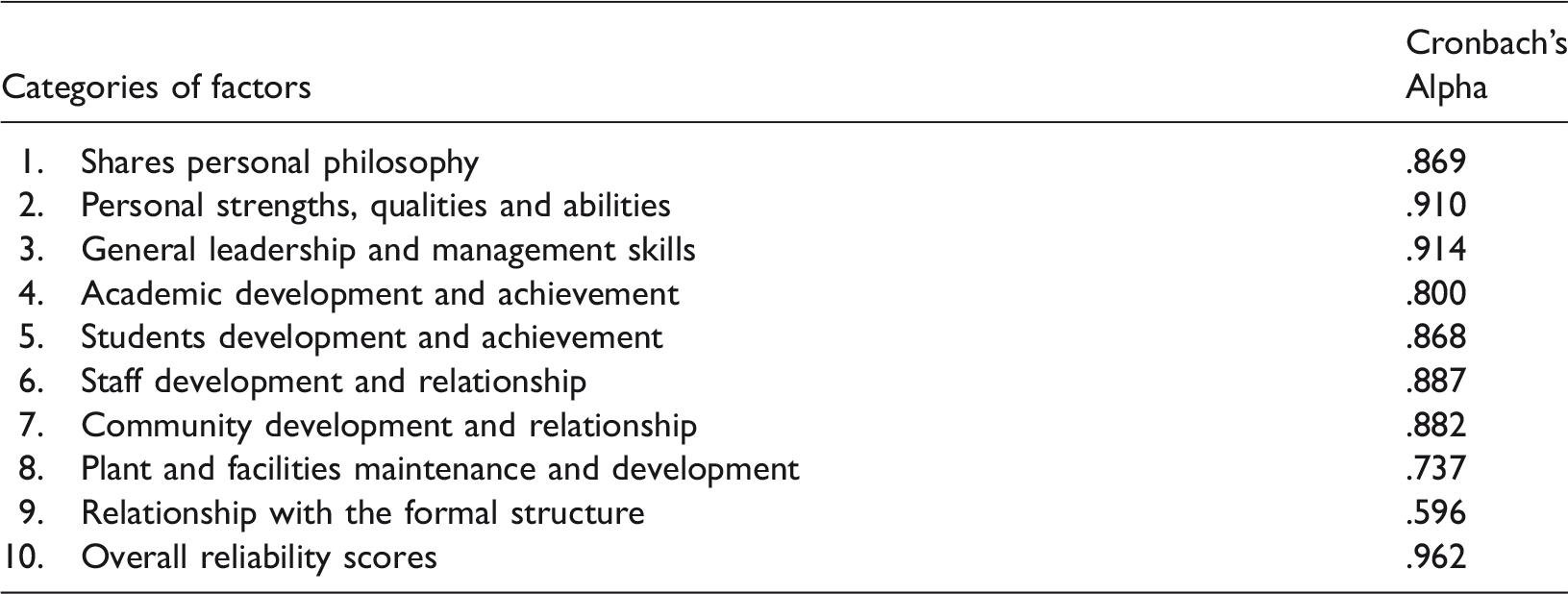
Test of reliability of the categories of factors representing the performance of high-performing principals.
Procedure
The questionnaires were either mailed or delivered personally by the researcher to all 125 schools identified with high-performing principals over a six-week period. The questionnaires were administered to the respondents by a designated teacher within each school who also collected and returned the instruments upon completion. Respondents were allowed to keep the instruments for a maximum of three weeks. In those cases where the administration of the questionnaire was delayed, the researcher made phone calls to the respective principals and/or designated teachers with the aim of advancing the completion of the data collection process. The completed instruments were returned via mail by the designated teacher or collected from the school by the researcher.
Data collection and analysis
The data were checked for errors and inconsistencies and then analysed using the Statistical Package for the Social Sciences (version 17). Within the context of this study, PCA
1
was used to test the theoretical premise that leadership performance could be explained by a number of factors. Prior testing using exploratory factor analysis (EFA)
2
generated four components which explained principals’ leadership performance among this sample. Examples of the elements identified under each of the dimensions are as follows.
Personal philosophy and abilities
‘Promotes the belief that formal schooling provides the majority of students the opportunity to achieve a rounded and broad-based education’ ‘Demonstrates a personal commitment to the school and the education of the students’ Leadership and management
‘Demonstrates strong interpersonal skills when dealing with teachers, students and other members of the school community’ ‘Involves the staff and other stakeholders in making important decisions regarding the direction and operation of the school’ Student support
‘Prescribes standards for students’ general conduct and insists that they are enforced and maintained at all times’ ‘Promotes values and attitudes to guide students’ behaviour both inside and outside of the school’ Community support and relationship
‘Maintains active personal involvement in the life of the immediate school community’ ‘Provides academic and/or skills training programmes to benefit community and parents’
Subsequently, a confirmatory factor analysis (CFA) was used to assess whether the performance factors relating to high-performing principals were related to the researcher’s understanding of the construct. Based on a hypothesis of the initial constructed model, a subsequent model of the factors was created and assessed through path analysis using Amos version 21. Once the factors were assessed using the CFA, an independent-samples t-test was performed to assess whether there were significant differences between male and female constituents’ rating on the factors obtained.
Results
Fit indices for the model on rating of the performance of high-performing principals.
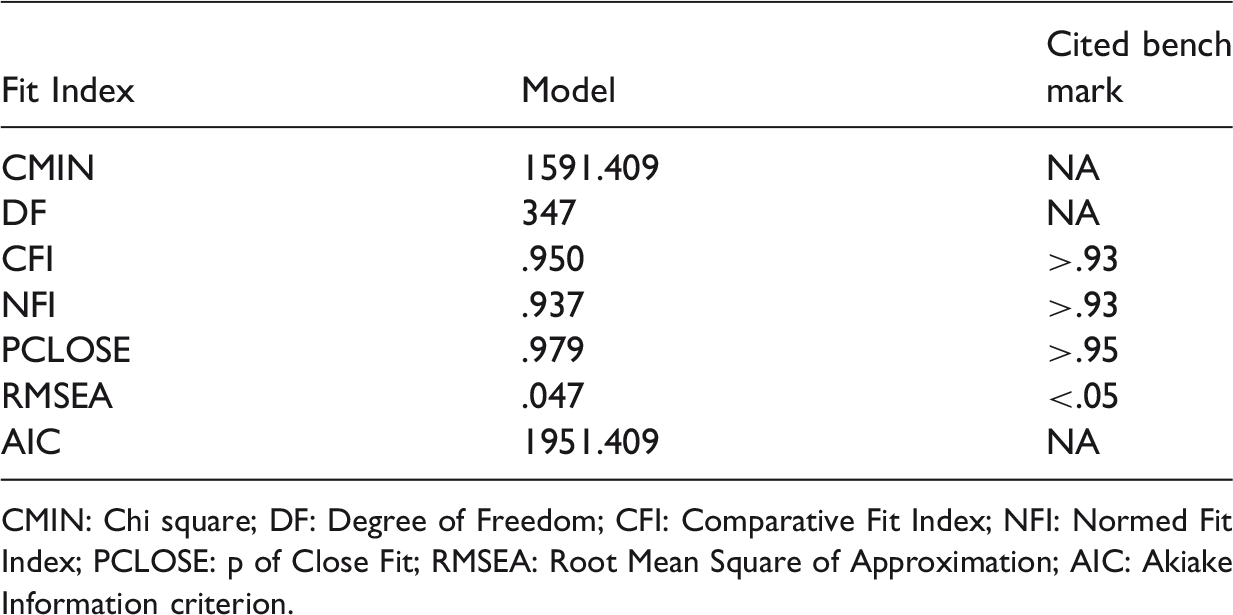
CMIN: Chi square; DF: Degree of Freedom; CFI: Comparative Fit Index; NFI: Normed Fit Index; PCLOSE: p of Close Fit; RMSEA: Root Mean Square of Approximation; AIC: Akiake Information criterion.
A one-way between-group of analysis of variance for critical performance factors related to gender.
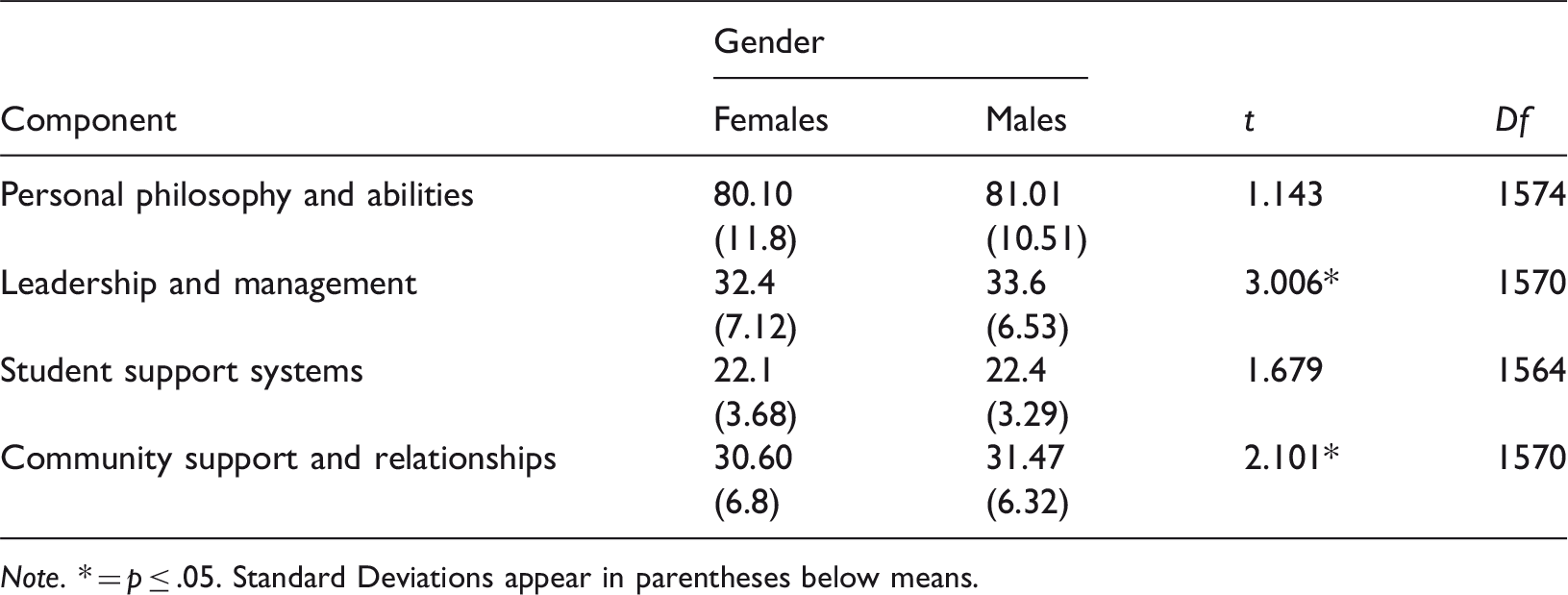
Note. * = p ≤ .05. Standard Deviations appear in parentheses below means.
Discussion
The study showed that there was no difference in how male and female respondents rated high-performing principals regarding the dimensions of personal philosophy and abilities, and student support systems. However, there was a significant difference in how they rated the performance of high-performing principals in relation to the dimensions of leadership and management, and community support and relationships. This was confirmed in both the t-test and the analysis of variance. The findings were also consistent with the mixed findings reported by Bass and Bass (2008), Wilen-Daugenti et al. (2013) and Yukl (2013). In discussing the findings, the question posed was:
Does the gender of school constituents provide any significant differences in the rating of the four dimensions of effective performance of high-performing principals?
Leadership and management, and community support and relationships
The difference in the rating of the effectiveness of high-performing principals on the dimension of leadership and management is instructive. Even though the mean score showed that male respondents rated high-performing principals slightly higher than female respondents, there was a significant difference in the rating. Similarly, the dimension of community support and relationships also indicated a significant difference in how it was rated by males and females.
The fact that male and female respondents rated high-performing principals differently suggests that one or a number of the factors identified as differences in the performance of leaders could be at play. First, respondents themselves are just as likely to be impacted by the factors responsible for the perceived differences in the school leaders. The fact is that respondents are leaders in the capacity in which they serve. They are therefore likely to rate high-performing principals from their perspective, based on their own background, preferences, attitudes and beliefs. These perspectives include societal influences as expressed by Morrison et al. (2011) or beliefs that both male and female socialization lead to job stereotyping (Sikdar and Mitra, 2008). Brailsford (2001) indicated that male respondents rated males’ work behaviour as more important than females’, and Bass and Bass (2008) identified studies in which respondents rated males higher than females or females higher than males, while others indicated no difference.
Second, the special skills attributed to females could indeed be one factor responsible for the difference in the rating for male and female respondents. As Paustian-Underdahl et al. (2014) pointed out, social skills, including building relationships, along with a communal and nurturing spirit may be a contributing factor to the difference in rating. Third, as the study reported by Hutton (2011) indicated, the schools which are doing well are those that recognize the community as being critical to their existence, especially in a situation where the central ministry is unable to satisfy a number of their basic needs such as those related to resources. Indeed, for this study, both the majority of respondents and high-performing principals who participated in this study were females. It follows, therefore, that the female advantage together with gender bias could be a relevant factor in explaining the difference.
Philosophy and abilities and student support systems
The study revealed that there were no differences in the rating of high-performing principals by male and female constituents on the dimensions of philosophy and personal abilities, and student support systems, even though the mean scores were slightly in favour of males. This aspect of the findings does not support the view that skewing of the data in favour of females would provide a significant difference in favour of the rating of female high-performing principals (Ijaiya, 1998). However, this finding is in keeping with the position expressed and those reported by Kent et al. (2010) and Bass and Bass (2008), who indicated that there was no difference in the rating of the effectiveness of the performance of organizational leaders based on the gender of the respondents. Second, the rating of male and female respondents of the philosophy and personal abilities of high-performing principals may be similar because they are leaders in their own right (Duif et al., 2013; Harris, 2005) and active participants in the process of building student support systems in the schools. Personal abilities, which include passion, commitment and enthusiasm among others, are integral to the dimension of philosophy and personal qualities. It would be reasonable, therefore, to expect that the rating of male and female respondents would be based on the same factors which are advanced by the dimension of philosophy and personal qualities.
Third, despite reports that factors related to genetic influence, social orientation and bias should result in differences in performance based on gender, the findings of the study showed that there was no difference in the rating of the effectiveness of the performance of high-performing principals in relation to the implementation of student support systems. This is similar to the rating of the performance of high-performing principals in the area of philosophy and personal abilities. The student support systems or services include: (a) setting and maintaining standards for proper deportment and conduct, (b) providing support for students’ educational development, and (c) providing skills for functioning as useful citizens. In addition, there is the promotion of values and attitudes to encourage students to display behaviours that are required by the education system. The fact that there is no difference in the rating of male and female respondents on the dimension of student support systems reflects the importance of this factor and suggests that it is undisputed, at least as far as the factor of gender is concerned. Again, this view would be consistent with those findings which see no difference in how male and female respondents perceived the effectiveness of leaders (Pew Research Centre, 2008).
Conclusion
The rating of the leadership performance by respondents has provided mixed results, with some studies showing that there was no difference in effectiveness, others indicating a difference in effectiveness in favour of females and some showing effectiveness is favour of males. The findings of this study, based on the gender of respondents, have shown differences related to two performance dimensions and similarities related to the other two dimensions, in keeping with the findings of the studies which show mixed results in leadership performance based on gender. The question arising from this result is: why the similarities and differences in the rating of the performance factors based on gender differences? The fact is that respondents who are classroom teachers, senior teachers, or vice principals are themselves leaders in their own right. So the leadership role of respondents would be one lens through which their decisions would be made. In addition, based on the gender emphasis of this study, gender bias may also play a role in how male and female respondents evaluate the performance of principals. It would be prudent, therefore, to allow school leaders themselves to make judgements of their own performance. In other words, in order to have a more balanced assessment, self-reporting should be one of the assessment strategies. But even then, the reliance on constituents’ assessment of leaders’ performance coupled with leaders’ own self-reporting may just compound the biases and lack of reliability of the evaluation. In order to increase the reliability of the rating of leadership performance, the tried and proven means of engaging a panel of trained assessors, facilitated by the framework of an assessment centre to determine the effectiveness of principals’ performance, should be employed. Combining the results of an assessment team along with the principals’ self-assessment and the respondents’ assessment should improve the reliability of the assessment outcome. The limitation of this involved approach would be the cost and time to implement the process effectively and efficiently. What is evident, however, is that policymakers and educators alike must be cautious regarding how the findings of this study are interpreted and used to make decisions about the performance of principals.