




Abstract
Research often highlights concerns about the underachievement of Black students in education and, later, within the labour market. However, shortcomings are identifiable with such research. Firstly, achievement levels of all Black students are often homogenised. For example, findings on the achievements of African-Caribbean students are often applied to other Black groups, creating a misleading impression of their different academic outcomes. Secondly, studies seeking to explain low attainment levels of Black students frequently present a pathological picture of Black families in Britain, by assuming that most parents use authoritarian approaches to socialising their children, which hinders educational outcomes. This research aims to challenge these ideas. It analyses the role of parenting in the academic and professional success of 24 high-achieving British-Ghanaians. In doing so, it suggests that not all Black/Ghanaian parents use authoritarian socialisation methods. However, when parents did adopt this approach, it was not necessarily detrimental to children’s educational/professional outcomes.
Keywords
Introduction
Criticism has been levelled by policymakers, educationalists and researchers at Black parents for their approach to socialising their children. It is often assumed that Black parents have a predisposition towards strict and authoritarian socialisation methods, which supposedly hinders the child’s socio-emotional development and academic outcomes. The current study, however, seeks to challenge these views. It analyses the role of parenting in the academic and professional success of 24 high-achieving British-Ghanaians. In doing so, it suggests that not all British-Ghanaian parents adopt authoritarian socialisation methods and that, when parents did adopt this approach, the outcomes were not necessarily as detrimental to children as is often implied.
In addition, the research seeks to address gaps in knowledge about the life experiences of children born and raised in Britain to West African migrants. These gaps have existed since the 1960s, when researchers focused on British-born children of migrants from the West Indies and Asia, attempting to understand differential academic achievements between these ethnic groups and Whites. During this period, the African population in Britain was much smaller than that of other migrant groups, which may explain the lack of research about their educational attainment levels (Demie and McLean, 2007). Moreover, since African-Caribbean immigrants were the largest Black population in Britain, African groups were often subsumed within a broad Black category covering all those disparate groupings. This was further compounded by the lack of a separate category for Black Africans until the 1991 census. Yet, although the African population has grown considerably, and in some areas Africans outnumber other Black groups, the experiences of African and African-Caribbean groups are still often conflated. Thus, this study begins to address this issue by examining some of the experiences of a group of British-Ghanaians.
Recurring concerns about Black academic achievement
It has been noted by various British governments over the years (e.g. Committee of Inquiry, 1981, 1985) and in numerous studies (e.g. Coard, 1971; Gilborn, 2008) that, compared to other ethnic groups, Black African and African-Caribbean students have consistently underachieved academically. Recent statistical evidence continues to suggest that ‘Black heritage students lag far behind the average achievement of the majority of their peers’ (Demie and McLean, 2007: 419). General Certificate of Secondary Education (GCSE) results for 2011, for example, indicate that 54% of Black Africans and 46% of Black African-Caribbean students obtained five or more A–C grade GCSEs, compared to 61.6% for Indian students and 70.2% of students from Chinese backgrounds (Department for Education, 2012).
In relation to further and higher education, research shows that participation rates of most minority groups, including Africans, Indians, Chinese and Bangladeshis, surpass the national average (Higher Education Statistics Agency, 2008; Singh, 2011). At university, Black and minority ethnic students have capitalised on widening participation policies, aimed at promoting inclusion of those from ‘disadvantaged’ backgrounds, as the number of these students taking up university degrees continues to increase (Singh, 2011; Vignoles, 2008). Statistics from the Higher Education Statistics Agency (2008) also indicate that students of African parentage are three times more likely to be in higher education than expected from their numbers in the overall British population.
Nevertheless, the issue of low achievement for ethnic minority students persists within higher education, since their results are still below those of other groups (Connor et al., 2004). Longitudinal research undertaken by the Higher Education Funding Council for England based on a group of students who commenced their degrees in 2002, for example, showed significant differences between the outcomes for Black, White and Asian students. The number of White students achieving first or upper-second degree classifications was 25% higher than for Black students, and 20% higher than students of Pakistani and Bangladeshi parentage. Black Africans, therefore, appeared to be the lowest-achieving group (Higher Education Funding Council, 2010).
Employment outcomes for Black and minority ethnic graduates
Inequality in the labour market for ethnic minorities is also a long-standing problem, which worsens during recessions. The Labour Force Survey, for example, revealed that the unemployment rate for Black British people is currently 18.2% (Office of National Statistics, 2012). Diane Abbott (2012), the Labour Member of Parliament for Hackney North and Stoke Newington, North London, expressed concerns about this issue, describing it as an ‘inequality time bomb’. Black and ethnic minority students are very aware of these issues, which is why they seek to enhance their opportunities and skills through further and higher education. However, this appears to do little to improve their employment opportunities. Africans also appear to face the greatest disadvantages in this respect. Dustman and Theodoropolous’s (2006) research, for instance, shows that second-generation Africans have, on average, a 5.4% lower employment level than Whites, and African-born males have some of the lowest employment rates, despite the fact that many have qualifications above undergraduate level.
The post-study employment situation of young Blacks is not helped by the fact that they are more likely to study at post-1992 universities than at traditional institutions (Connor et al., 2004; Singh, 2011). This places them at a disadvantage, as companies prefer to employ highly qualified graduates from traditional universities (Connor et al., 2004). For those in employment, concerns remain about opportunities for advancement within certain fields. Despite anti-discrimination acts spanning over 30 years, too few ethnic minority students (and women) are found in senior management positions (Bhopal, 2010). Carter et al. (2000) note that, within academia, for example, minorities are more likely to face a ‘glass ceiling’, as their opportunities for progression beyond the level of senior lecturer are limited.
Black and minority ethnic achievement: an alternative picture
While the research on academic participation and attainment and on employment suggests a bleak picture for Black and minority ethnic groups, and media reports continually reinforce these concerns, problems exist with research in this area. Many researchers do not distinguish between variations in attainment levels of different Black groups, and the focus remains primarily on African-Caribbean students (Demie and McLean, 2007). It is also often the case that the achievement levels of students from different African backgrounds are homogenised, thus affecting perceptions of their academic outcomes. If, however, results are considered according to the individual African nations from which students’ families originate, the picture would be significantly different. Statistics from the Department for Education and Skills reflecting GCSE results, for example, show that, of all African groups, Nigerian students are the highest achievers, with 56% obtaining five or more A–C grades, which is 1% above the national average for all cultural backgrounds. This sharply contrasts with the figure for Somalian students, which is 29% (Department for Education and Skills, 2006).
Recognition of positive achievement amongst Black students is also limited. As Mirza (1992: 193) points out: ‘acknowledging Black [positive] achievement seems problematic, especially to those wishing to assert simplistic models of race, culture and achievement’. Academic studies should therefore begin to recognise positive achievement amongst Black students and the reasons for it, and by so doing will present a more accurate and balanced picture. Demie and McLean (2007) begin to address this issue through their study of British-African students based in Lambeth, a borough with one of the largest African populations in London. Their findings show that 79% of their research sample obtained five or more A–C grade GCSEs and went on to further and higher education. Several reasons were identified for these attainment levels, including familial and community emphasis on academic and professional achievement, and the fact that children shared parental aspirations about success.
Heath and Cheung (2006) present a different picture of Africans’ progress within the labour market. They recognise that, despite their increasing levels of educational achievement, minority ethnic groups still face a greater likelihood of unemployment than Whites, which they suggest is a result of ethnic penalties. Nevertheless, their findings suggest that the gaps in occupational attainment between all minorities and Whites are narrowing, which may be attributable to the increase in minority ethnic participation in non-manual, professional and managerial work. Africans appear to be doing particularly well in this respect because, since 1992, the number of second-generation Africans in managerial and professional positions has increased by 7%. Furthermore, although Africans are still behind Whites in this area, the difference is just 2.3%.
The role of parenting and educational achievement
Positive achievement by Black children partly results from the high educational and professional expectations of their parents (Bagguley and Hussain, 2007; Demie and McLean, 2007). Parents who migrated from other, often less developed, countries often experienced socio-economic difficulties that hindered their own academic and professional success. These parents are particularly insistent that their children use the opportunities that the parents were denied in order to enhance their academic and socio-economic outcomes.
While migrants and their children are sensitive to the limitations for minority ethnic groups in the labour market, they are also aware that opportunities in education and training have expanded in recent decades. Moreover, the second generation have received their education in British schools, and have had access to learning resources, including books, computers, and so on. Pastoral support and careers guidance are also readily available to assist students in making their vocational choices. These factors increase the aspirations and expectations that migrant generations have for their children.
In order to ensure that their children utilise these opportunities and fulfil their aspirations, parents may adopt behaviours which they believe will enhance their children’s educational chances (Falconer and Hays, 2006). Examples may include strict and/or authoritarian socialisation practices, whereby educational achievement is prioritised. The following summarises the research that has been undertaken on parenting styles.
Authoritarian parenting
Authoritarian parenting emphasises discipline and punishment. Power assertion based on the belief that children should obey their parents without question is a key characteristic (Baumrind, 1966). These parents are ‘demanding’ and expect much from their children in terms of their behaviour and achievements, and there is less focus on emotional warmth.
Authoritarian parenting has been associated with high levels of conformity, but also emotional and cognitive disturbance in children, which includes hostile withdrawal, personality problems, nervousness, and long-term emotional and psychological problems (Baumrind, 1966, 1991). It has also been associated with poor academic achievement. Cramer’s (2002) analysis of the relationship between parental practices and behaviours and children’s academic success lends support to this argument. She finds that authoritarian or overcontrolling parenting styles often underlie a child’s disinterest in education, leading to adverse consequences for their achievements.
Much of the existing research seems to be preoccupied with the problems of this approach, especially the impacts on children’s academic achievement. Weaknesses are highlighted particularly in research pertaining to Black families. Stewart and Cheatham’s (1990: 336) research concludes, for example, that ‘it is reasonable’ to assume that educational problems faced by Black children result from the strict and ‘authoritarian’ socialisation they receive. This notion is reaffirmed in Roopnarine et al.’s (2006) research, which analyses the interrelationships between parenting styles, parent–child academic interaction, early academic skills and social behaviours in children of African-Caribbean immigrants to the USA. Their findings suggest that, although the parents see it as their role to maintain discipline within the family, the use of authoritarian controlling strategies limits opportunities for verbal and emotional engagement, which ultimately becomes psychologically and emotionally damaging for the child. This ‘damage’ may, in turn, extend to the child’s academic achievements.
Claims such as these, arguably, reinforce pathological notions about Black families and imply that Black parents inhibit their children’s education. There is a common and damaging failure to acknowledge that there are cultural variations which may dictate what constitutes discipline and good parenting. Within numerous cultural contexts, authoritarian parenting is indicative of positive parental involvement (see Ellis’s (1978) study of West African families in Britain and Chao’s (1994) study of Chinese families).
Authoritative parenting
As with authoritarian parenting, discipline and demandingness are also key features of authoritative parents. However, authoritative parents are regarded as being more nurturing and responsive to their children’s socio-emotional needs. They are supportive of a child’s autonomy and individuality, but make clear their expectations of their children’s behaviour.
Evidence suggests a correlation between far-reaching positive emotional outcomes for children and the parental warmth, acceptance and non-punitive measures that characterise authoritative parenting styles. Mandara (2006), for example, observes that African American children who had experienced (cohesive) authoritative parenting styles were more likely to engage in more positive behaviour at school and within the community. In earlier work, Mandara and Murray (2002) sought to explain why these parenting styles were perceived as more beneficial to the child than authoritarian approaches. They note that authoritative parents appear to pay specific attention to the child’s emotional well-being and are less likely to be overbearing about, or critical of, their achievements. If anything, authoritative parents are likely to appreciate their children’s values and individual attributes, which enhances their self-esteem and contributes to greater levels of behavioural and psychological adjustment.
Research based on Baumrind’s work reinforces the notion that authoritative parenting may be linked to higher levels of educational attainment than authoritarian or permissive approaches. For example, Pittman and Chase-Lansdale (2002) discuss research which emphasises the benefits of authoritative parenting styles for academic achievement amongst African American children aged between 5 and 18. They observe that African American parents develop an alternative style of authoritative parenting, which includes greater emphasis on demandingness and seems to be conducive to children’s academic achievements and general emotional well-being. Park and Palardy (2003) also identify links between authoritative parenting styles and higher levels of academic achievement. Their findings associate parental authoritativeness with fewer behavioural problems at school for African American, Hispanic and Euro-American teenagers.
Permissive parenting
Permissive parents adopt a non-interfering, indulgent approach, with less emphasis on discipline (Baumrind, 1966). As none of the respondents in the current research experienced this approach, less attention is given to it in the study.
Aims and objectives of the current research
The current research examines 24 British-Ghanaian respondents who have achieved highly in their academic and professional pursuits. It also considers their socialisation experiences and the influence of parental aspirations and expectations on their academic and professional choices and outcomes. In doing so, it addresses the following research questions: What were some of the educational and professional aspirations and expectations that Ghanaian migrants had of their children? How did the children respond to them? To what extent did the aspirations and expectations of the migrant parents have a bearing on subsequent academic and professional choices and achievements of the second generation?
Research methodology
Life histories were used so respondents could reflect on their personal development and ‘define their socialisation experiences and… focus upon critical and fateful moments’ (Marshall and Rossman, 2006: 116). Participants were recruited through British-Ghanaian professional and community organisations, snowballing and personal contacts. They were drawn from two locations: London, where I currently live, and a city in the Midlands, where I have strong connections. The locations from which the samples were drawn differ in size – that is, London contains a larger overall Ghanaian population, which is divided into subcommunities according to boroughs and neighbourhoods, whereas the regional city has one single Ghanaian community. Including respondents from two different locations ensured a broad range of participants from across the British-Ghanaian community; regardless of where they came from, their experiences were very similar.
The selection criteria for the participants were based on their academic outcomes (i.e. five or more GCSEs) and their work occupations (i.e. that they worked in management/senior management positions or as entrepreneurs). The participants reflected on their socialisation experiences and the extent to which educational achievement and professional achievement were prioritised. Moreover, they were asked about the academic and professional expectations that their parents had of them, the role of their parents’ Ghanaian upbringing in shaping these ideas, and their own responses to the expectations.
The data has been analysed according to key themes identified as affecting the academic and professional choices of the British-Ghanaian participants. The themes include ‘parent–child relationships’ and ‘academic and professional choices and achievements’. Analysing the individuals’ life stories involved gaining an understanding of how the participants perceived their relationships with their parents during their formative years. Baumrind’s (1966) ‘typologies of parenting’ were used to categorise broadly the participants’ descriptions of their parent–child relationships and how these parenting styles influenced the transmission of the value of educational achievement. This was because the participants’ accounts of their parent–child relationships tended to conform to Baumrind’s ‘authoritarian’ and ‘authoritative’ parenting styles. However, ascribing the respondents to these categories was by no means an easy process, especially because approaches to parenting will vary according to contexts and circumstances.
It is acknowledged that there are other problems associated with the use of typologies within social science research, including a risk of reductionism, whereby complex issues (e.g. experience and behaviour) are attributed to one or a few simplistic factors. In relation to this, a criticism levelled at Baumrind’s research is that it implies that adopting certain approaches to parenting will lead to specific academic, behavioural and socio-emotional outcomes for the child. This, however, negates the impact of other factors, such as individual temperament, which may also have a bearing on how children respond to the parenting that they have received.
Another issue is that particular approaches (e.g. authoritative) are regarded as producing the ‘best’ outcomes for the child’s overall well-being. In contrast, ‘authoritarian’ and ‘permissive’ approaches are regarded as unconducive in this respect. It must be acknowledged, however, that there are no ‘universally best’ approaches to parenting, and that it varies according to the family’s situation and context.
Baumrind’s parenting styles have, nevertheless, been referred to within the media and academic discourses to analyse relationships between the family and educational attainment. As noted previously, when applied to Black families, it has often been in an unfavourable light. The research therefore assess the veracity of these views and responds to some of the assertions made about Black families and their attitudes to education.
Although this article includes reference to a substantial amount of research data from Baumrind, and others from the USA, arguably the broad social, cultural and economic similarities between the contexts mean that the populations are comparable, and that research outcomes may be transferable. Significantly, other academics have also drawn on Baumrind’s data in British-based research focusing on relationships between parenting and children’s outcomes (e.g. Chan and Koo, 2011), and have found that it can be applied within this context.
As a theme, ‘academic and professional choices and achievements’ has also been divided into subsections, reflecting participants’ responses to the academic and professional expectations and aspirations that their parents had for them. The subcategories include compromise (balancing individual and parental expectations and aspirations) and rebellion and resistance (rejection of parental expectations and aspirations).
Characteristics of respondents from Authoritarian families
Demographic, educational and professional characteristics of respondents from Authoritarian families.
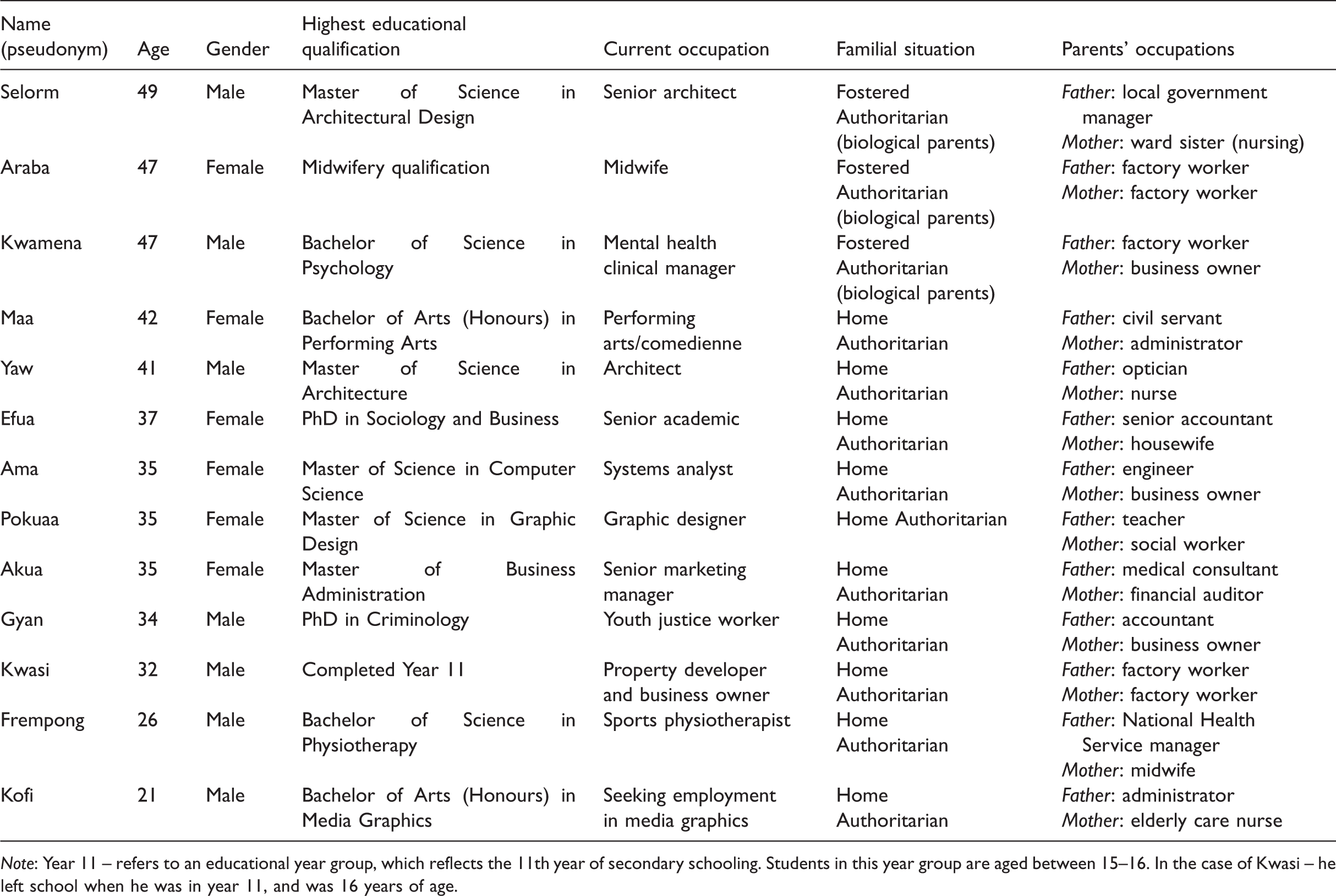
Note: Year 11 – refers to an educational year group, which reflects the 11th year of secondary schooling. Students in this year group are aged between 15–16. In the case of Kwasi – he left school when he was in year 11, and was 16 years of age.
Thirteen of the respondents described the relationships with their parents in ways which corresponded with Baumrind’s description of authoritarian parenting. They indicated that key features of their parent–child relationships included emotional distance between themselves and their parents, an overemphasis on discipline, negative reinforcement, occasional physical punishment and much importance attached to a strong work ethic.
The respondents in this category also described how their parents were specific about what constituted academic and professional success. There was particular emphasis on subjects leading to careers such as medicine or law, as Kwasi explained: My parents, especially my mum, was a bit wary about what I said I wanted to do. Simple fact was that they were always telling me to go for the usuals, you know, be a doctor, a lawyer … My dad always said that if you worked hard, then you could do it. What he didn’t really see was that sometimes no matter how hard you worked, if it isn’t you, then you couldn’t force yourself.
The respondents understood that their parents emphasised the lucrative nature of legal, medical and engineering careers because of their own experiences of childhood poverty in Ghana, and latterly of poverty in England, resulting from poor educational outcomes that limited their employment opportunities. Kwasi and Araba spoke of their fathers’ intentions to train in accountancy and chemical engineering, respectively. However, due to limited access to good-quality education, both worked in factories, earning low wages. Although Araba and Kofi, and some of the other respondents, experienced poverty as children, they had achieved upward economic mobility. They also feared returning to situations of poverty, which reinforced their drive and determination for academic and professional success and economic stability.
Overall, the respondents agreed that they had fared better academically and professionally than their parents. They also realised that educational and employment situations are more complex than their parents acknowledged, especially because minorities are still vulnerable to racial discrimination, which limits opportunities. Some also remarked that first-generation family members failed to recognise costs in terms of time and money for the education and training required for certain careers.
Despite understanding that their parents sought the best for them, some of the respondents felt that, by urging them towards careers that they were not interested in and/or felt ill equipped or unqualified for, they were attempting to live vicariously through their children. Direction or coercion of children towards prescribed academic and career trajectories may also be considered indicative of authoritarian approaches to parenting, due to the expectation that children ‘honour parental expectations of narrowly defined acceptable academic and career achievements’ (Dundes et al., 2009: 143). Ultimately, however, this approach had less impact on the respondents’ academic and career outcomes than their parents intended. This is discussed later in the article.
Saving face: the pressure to achieve and attitudes of the Ghanaian community
Family and the wider community can be a valuable support mechanism in terms of academic and professional attainment. At times, however, there may also be considerable pressure to succeed, especially if emotional and financial support has been provided, and where there is an expectation to maintain the family’s name and status within their communities (Bhopal, 2010). Academic failure could, therefore, result in difficult repercussions, as Gyan described: What and, of course, how you did was not just about you, it reflected on your parents and, coming from where I come from, the Ghanaian community, too. It was small, but people always talked. You really felt the pressure to do well. Though this type of pressure was not always a good thing, because when the ‘jungle drums’ started talking about how ‘so so so so and so’, as the old folks say, failed their exams, it became a nightmare which you had to do your best to ignore. Yet inside, you were praying that you didn’t end up in that situation, cos you didn’t want to hear people talking about you or your family like that. Sometimes, the things that certain people would say … people didn’t always look at the real situation, whatever that was. No, at times, it was a case of people making unfair judgments.
Parental support for academic and professional pursuits
The respondents in the ‘authoritarian’ category described the limited emotional engagement between themselves and their parents, which was supplemented by an emphasis on negative reinforcement rather than encouragement. Araba expressed it as follows: ‘Oh yeah, there were all these high expectations, but there was a real gap between these and the type of help and support you got in trying to achieve them. You didn’t really get any help at all’.
Research highlights the importance of positive emotional encouragement and practical support from parents to enhance academic and professional success (see Bhopal, 2010; Reay, 2000). Practical support may include financial assistance, guidance about course selection and the monitoring of children’s academic progress. All of the participants reported that their progress was monitored through school reports and visits to their schools on parents’ evenings. Throughout the rest of the year, however, some of the respondents from authoritarian families indicated that they were, in Efua’s words, ‘left to get on with it’.
The limited amount of academic and professional support that many of the respondents received from their parents can be partly understood in relation to the migrants’ educational experiences. The respondents acknowledged that, since their parents had received the majority of their education outside Britain, they could not always understand the nature of the British system and some of the milestones children were expected to achieve. For migrants who had received some education in Britain, but had struggled, confidence in their abilities to provide academic and careers guidance for their children was often undermined by this experience. Consequently, they placed absolute trust in the education system and passed the responsibility of educating onto teachers.
Academic and professional outcomes for respondents in authoritarian families
Most of the respondents within the ‘authoritarian’ category did not pursue the exact academic and career trajectories anticipated by their parents. Instead, the majority (ten) of the respondents compromised by balancing personal and parental academic and career aspirations, and three rebelled or resisted, opting to follow their own academic and/or career paths.
Compromise
The respondents who compromised did so in different ways. One option was to undertake a mixture of arts and science courses, and then move into careers that combined the two. Five respondents had adopted this approach. At the time of the interviews, Kofi had completed his degree in Media Graphics and was seeking employment in this area. Yaw and Selorm were architects, and Pokuaa was working as a graphic designer. Ama, who enjoyed science and technology, was working as a systems analyst.
Others, including Araba and Kwamena, had a broad interest in the medical field, although they did not wish to become doctors. Araba decided against following a career in medicine because she felt that her Ordinary-level (subject based qualifications) grades were inadequate. Moreover, she was not prepared to spend seven years in medical training – thus, she decided on midwifery. Kwamena, who was working as a mental health nurse and had recently been promoted to clinical manager, traced his career choice to his interest in psychology.
Efua and Gyan compromised by undertaking academic careers. Efua had just defended her PhD in Sociology and Business at the time of our meeting. She was working in a university and developing her area of research. Gyan initially considered embarking on a career in law. After taking Sociology and Law at Advanced level (British standardised examinations in particular academic subjects) and finding that he enjoyed both, he combined the two areas by studying Criminology at undergraduate and Master’s level. He was working with young people within the criminal justice system. Gyan had also recently defended his PhD and planned on becoming an academic in this area.
Rebellion and resistance
Kwasi, Akua and Maa pursued their own interests in different ways. Kwasi felt that he did not have the aptitude or interest to obtain qualifications for careers which required a strong academic background. However, his strong business acumen led him to become a successful entrepreneur – but he remembered how his choices were met with resistance: They, or she, my mum, couldn’t appreciate me going into business, because they didn’t know anyone else who was doing it. I mean, the main objective when our parents came to Britain seemed to be for them to work for others, but me, well mine was to work for myself. It’s their conditioning. They grew up around people who had a set opinion. Once, as well, my dad told me that I was only fit to work in a factory and brought me a form from the place that he worked at. And you know what, Louise? That was the best piece of advice he ever gave me, because I could just show that I was better than that. It’s all about turning a negative into a positive.
Akua, who had undertaken a degree in Marketing and a Master of Business Adminstration degree, and was working in a senior management position, also explained how her subject choice was vetoed by her parents, partly because they did not understand what this career entailed. Maa also resisted family and community pressures to undertake law, medicine or engineering, and became a stand-up comedienne.
Choosing freely but wisely: authoritative parenting
Demographic, educational and professional characteristics of respondents from Authoritative families.
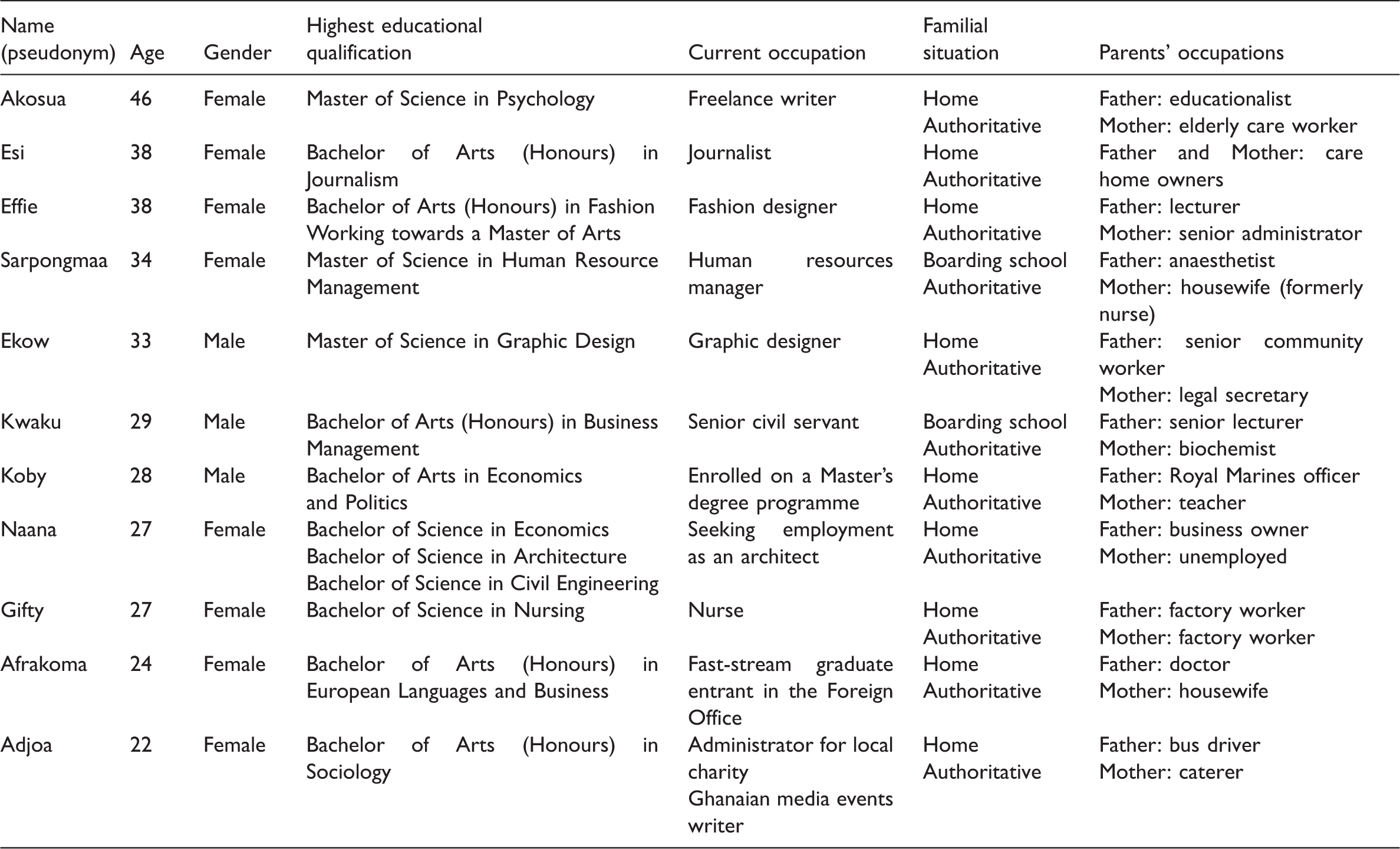
The respondents from authoritative families were more likely to pursue academic subjects and careers reflecting their preferences. Their parents encouraged this on the grounds that they applied themselves fully in their chosen fields.
The career choices made by these respondents varied widely. Ekow, for example, described his flair for technical drawing, and had undertaken an Advanced-level examination and degree in this area. He subsequently found employment in graphic design. At the time of the interviews, Afrakoma had undertaken a combined degree in European Languages and Business, in preparation for work in the civil service, hoping eventually to be an ambassador. On completion of her degree, she had secured a position on a fast-track graduate training scheme in the Foreign Office. Naana completed two undergraduate degrees in Economics and Civil Engineering respectively, but later became interested in Architecture and commenced a degree in this area.
Support and guidance in academic and professional achievement
As a way of facilitating educational and professional achievement, the respondents described how their parents adopted an interventionist approach (Bhachu 1985, cited in Singh-Ghuman (1994: 104)), which entailed offering significant levels of educational/professional support and guidance. Support fell into two broad categories: material support (through resources and private education) and practical support (guidance in terms of academic work and career support). In relation to career decision-making, support came in the form of parental advice and the use of social capital through family contacts.
Material support
The respondents from more affluent families had greater access to higher levels of material support. Sarpongmaa, Afrakoma and Kwaku, for example, had attended schools at the top of the national league tables, and they explained that this, in conjunction with emotional and practical parental support, had contributed to their current positions. Their experiences echo observations made by a number of sociologists in this area (see Bhachu 1985, cited in Singh-Ghuman 1994: 104; Devine, 2004), who note that the socio-economic position of more affluent families ensures that members are provided with the material support (e.g. books, technology and access to good schools) that enhances their chances of academic and professional achievement.
Although some of the respondents from authoritative families came from less affluent backgrounds, and had less access to the type of material resources that others enjoyed, this did not detract from the level of academic support provided by their parents. These respondents received a great deal of practical guidance. Adjoa and others, including Ekow and Effie, remembered how their parents offered support through regular discussions about their academic progress and, later, career options. This might be considered as an example of what Evans (2006) describes as intensive parenting, entailing warm and caring relationships between parents and children (which the respondents reported they had experienced), and emphasising educational skills which facilitate the child’s progress at school and beyond.
‘Who you know counts’: social capital, family contacts and career support
Calling on friends, family and other contacts for assistance in order to facilitate the respondents’ career opportunities was an approach adopted by some parents. Gifty explained how advice from family contacts helped when she was applying for her course. It enabled her to identify the best hospitals for training and to know how to prepare for interviews. Similarly, Kwaku remembered how his father contacted friends who were civil servants to help him acquire the necessary skills and training in order to enhance his opportunities for promotion.
Using contacts to enhance career prospects is not uncommon. Members of minority ethnic groups, who are in a less advantageous position in terms of employment opportunities, are more likely to utilise the available social capital and informal networks to ensure that their employment reflects their qualifications (Heath and Cheung, 1992). This challenges suggestions (see Modood, 2004; Papardemetriou et al., 2009) that minority ethnic groups are unable to enhance their job opportunities due to a lack of networks. It also suggests that generalisations cannot be made about minority ethnic communities and their networks, since these will vary according to the ethnic group. Moreover, the functions, meanings and impacts of the networks are often very different (see Holland, 2008; Li, 2010).
Conclusion: great expectations! The role of parental aspirations and academic achievement for Black students
Although research often suggests that authoritarian parenting is a defining feature of Black families, clearly, not all of the respondents’ parents adopted this style. While some reported that they experienced less academic support and careers guidance, this was not attributable to a lack of parental interest. Rather, it was due to a limited understanding of the education system and a lack of confidence in their ability to help their children, resulting from their own difficult experiences.
While many of the respondents also highlighted the (over)emphasis on discipline, negative reinforcement and high standards, which are a key feature of authoritarian parenting, this did not necessarily lead to negative ramifications for the respondents’ achievements. If anything, some of the benefits were recognised. Interestingly, although the academic and professional outcomes for both groups were relatively similar, it appears that those who had experienced ‘authoritarian’ parenting were the highest achievers overall.
While ‘authoritarian’ parenting is frequently condemned by researchers, this is, as noted previously, often considered by Black and minority ethnic families as a form of care. Furthermore, it is regarded as a way of encouraging their children to strive academically and professionally in societies where racial discrimination presents a barrier to progress (Fenton et al., 2000). It is worth noting that, in contrast, some White students experience indifferent, lackadaisical parenting, which has negative ramifications for their education and general well-being. Pathological accounts emphasising the ‘problems’ of the ‘authoritarian’ approaches adopted by some Black/African parents may therefore be considered highly inappropriate.
All of the respondents were second-generation Britons living between the cultures of their parents’ countries and British culture (Song, 2003). They had therefore experienced two distinct value systems: one from the society that they had been educated and worked in, and another relating to their families’ original culture, which was instilled within the home. Cultural values and expectations in relation to academic and professional choices and outcomes were, however, more significant amongst the authoritarian respondents. Yet, these often contrasted with the respondents’ personal aspirations. While research suggests that children who have experienced authoritarian parenting are more likely to conform to parental expectation without question, this did not apply in relation to the respondents. Most either found a compromise between their own preferences and parental and cultural expectations, or pursued their own choices. Authoritative parents, on the other hand, were more flexible about their children’s academic and career outcomes, and allowed the respondents to pursue areas that best reflected their skills and abilities. Moreover, in all cases, parents provided ‘practical’ and/or material support for the respondents.
It is important not to underplay the ongoing and serious concerns about the achievement levels of Black (African and African-Caribbean) students in Britain. Yet, high achievers and factors contributing to their success must be acknowledged by teachers, researchers and policymakers far more than is currently the case. Doing so may open up useful avenues and opportunities for enhancing Black achievement and informing policy in this area (Bagley et al., 1979 cited in Robinson 1995: 120).