




Abstract
The moving particle semi-implicit method is a meshless particle method for incompressible fluid and has proven useful in a wide variety of engineering applications of free-surface flows. Despite its wide applicability, the moving particle semi-implicit method has the defects of spurious unphysical pressure oscillation. Three various divergence approximation formulas, including basic divergence approximation formula, difference divergence approximation formula, and symmetric divergence approximation formula are proposed in this paper. The proposed three divergence approximation formulas are then applied for discretization of source term in pressure Poisson equation. Two numerical tests, including hydrostatic pressure problem and dam-breaking problem, are carried out to assess the performance of different formulas in enhancing and stabilizing the pressure calculation. The results demonstrate that the pressure calculated by basic divergence approximation formula and difference divergence approximation formula fluctuates severely. However, application of symmetric divergence approximation formula can result in a more accurate and stabilized pressure.
Keywords
Introduction
The moving particle semi-implicit (MPS) method is a Lagrangian gridless method originally proposed by Koshizuka 1 for incompressible free-surface flows. The MPS method is applied in a wide variety of engineering fields such as nuclear engineering,2–7 ocean engineering,8–10 bioengineering, 11 etc. Despite the wide application in various engineering fields, the MPS method suffers the drawbacks that may significantly affect the stability and accuracy of pressure calculation. Many attempts have been made to resolve this problem. Sueyoshi12,13 studied the nonlinear phenomena in naval architecture and ocean engineering and proposed the time average method to control the pressure oscillations. Hibi and Yabushita 14 investigated the unphysical pressure fluctuations and proposed the modified MPS method with postprocessing for incompressible fluid flow. Khayyer and Gotoh 15 proposed a modified MPS method and improved the performance of the prediction of wave impact pressure. Khayyer and Gotoh 16 further improved the error-compensating parts in the multiterm source, and a corrective matrix for pressure gradient is proposed. The proposed improvements are shown to stabilize and enhance the performance of MPS method. Kondo and Koshizuka 17 proposed a new formulation for the source term of pressure Poisson equation which consisted of three parts, one main part and two error-compensating parts. Lee et al. 18 illustrated that there are several defects including nonoptimal source term, gradient and collision models, and detection of free-surface particle, which caused the unphysical pressure fluctuations. These defects are remedied by step-by-step improvements. Taimai and Koshizuka 19 introduced a new methodology including arbitrary high-order accurate mesh-free spatial discretization schemes, and this new methodology showed drastic improvement of accuracy and stability. Daneshvar et al. 20 proposed two modified pressure gradient models for discrete pressure gradients and improved the pressure calculation.
In this paper, three various divergence approximation formulas, including basic divergence approximation formula (BDAF), difference divergence approximation formula (DDAF), and symmetric divergence approximation formula (SDAF) are proposed and used to discretize the source term in pressure Poisson equation. We applied these formulas to two problems: hydrostatic pressure problem and dam-breaking problem. Performance in pressure calculation by different divergence approximation formulas is discussed.
MPS method
Governing equations
MPS method is an approximation method for particle systems; the mass and momentum conservation equations of incompressible flows in MPS method are as follows


Particle interaction models
The governing equations written with partial differential operators are transformed to the equation of particle interactions. The particle interactions in the MPS are based on the weight function. In the traditional MPS method, the following weight function is employed

The distance between two particles is

The particle number density represents its fluid density. It should be constant for incompressible flows:
Gradient model
The gradient operator in the governing equations is transformed to equivalent particle interactions. If

Laplacian model
In the traditional MPS method, the Laplacian operator model is derived from the physical concept of diffusion. The Laplacian operator in the governing equations is transformed to equivalent particle interactions. If


Parameter
However, this formulation of discretization scheme in the traditional MPS method has some disadvantages, including no foundation of exact mathematical derivation, only one order of precision, and unphysical pressure fluctuation effects. In this paper, a brand new second derivative for pressure Poisson equation is proposed which is based on the idea of smoothed particle hydrodynamics (SPH). SPH is a particle method which is similar to MPS method. SPH was proposed by Lucy
21
and Gingold
22
independently for astrophysical problems. We first briefly introduce the basis of interpolation integral in the SPH method. In the SPH method, a quantity, which is a function of the spatial coordinates, is based on the integral interpolant


For an arbitrary scalar


The approximation of the second-derivative integral interpolant can be expressed as follows
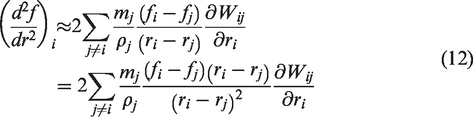
To keep the stability of simulation, a formula can be written as follows


Kernel function
In the traditional MPS method, the kernel function represents the weight of physical quantities. At the same time, it does not require for the derivatives of kernel function. The following weight function is employed in the traditional MPS method

The distance between two particles is

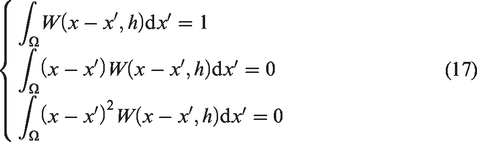
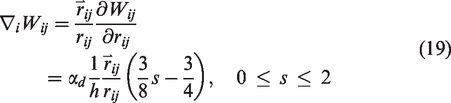
The quadratic smoothing function has advantages in compressive stability and computational efficiency. The quadratic smoothing function and the derivative is as follows

Pressure Poisson equation
The divergence free velocity field is employed as the source of pressure Poisson equation which is found on the Helmholtz–Hodge decomposition of an intermediate velocity field. According to the Helmholtz–Hodge decomposition, any vector field,

For the N–S equation, it can be written as follows

And the left side of the equation (17) can be written as

In the tradition MPS method, the equation can be decomposed to equations as follows


Equation (24) can be written as follows

Take the divergence on both sides of equation (25)

The divergence of velocity field at

On the right side of equation (27), the source term of the pressure Poisson equation is the divergence-free velocity.
Choosing the divergence approximation formula of source term
In the SPH frame, the derivative of a function can be obtained by using the formula of equation (9). The following formula is the divergence of the velocity field obtained in this way

In the present paper, the formula in equation (28) is called the BDAF. Equation (28) is based on the basic approximation idea of SPH method and has a simple discretization scheme.
Apart from the BDAF, the divergence value for the velocity can be calculated by other ways. The second formula is derived by utilizing the derivative of a product. The process of derivation is as follows, first we have


This leads to the following expression

Thus, the divergence of the velocity can be approximated as

We called equation (32) the DDAF in this paper.
In order to satisfy Newton’s second law with two particles, some researchers adopt the derivative of a quotient function to discrete the divergence. The derivative of a quotient of functions is expressed by

The above equation can be written as follows

Thus, the following formula can be obtained

Thus, the divergence of the velocity can be approximated as

We called equation (36) the SDAF in this paper.
Hydrostatic pressure problem
The hydrostatic pressure problem is chosen to verify pressure calculation as the first problem. In order to understand the differences in the divergence approximation of BDAF, DDAF, and SDAF, the hydrostatic pressure problem is simulated to compare the different divergence formula for simulating stable fluid flows. Figure 1 shows the simulation domain. The height of the water is 0.48 m and the width of the water is 0.36 m. The fluid mass density is

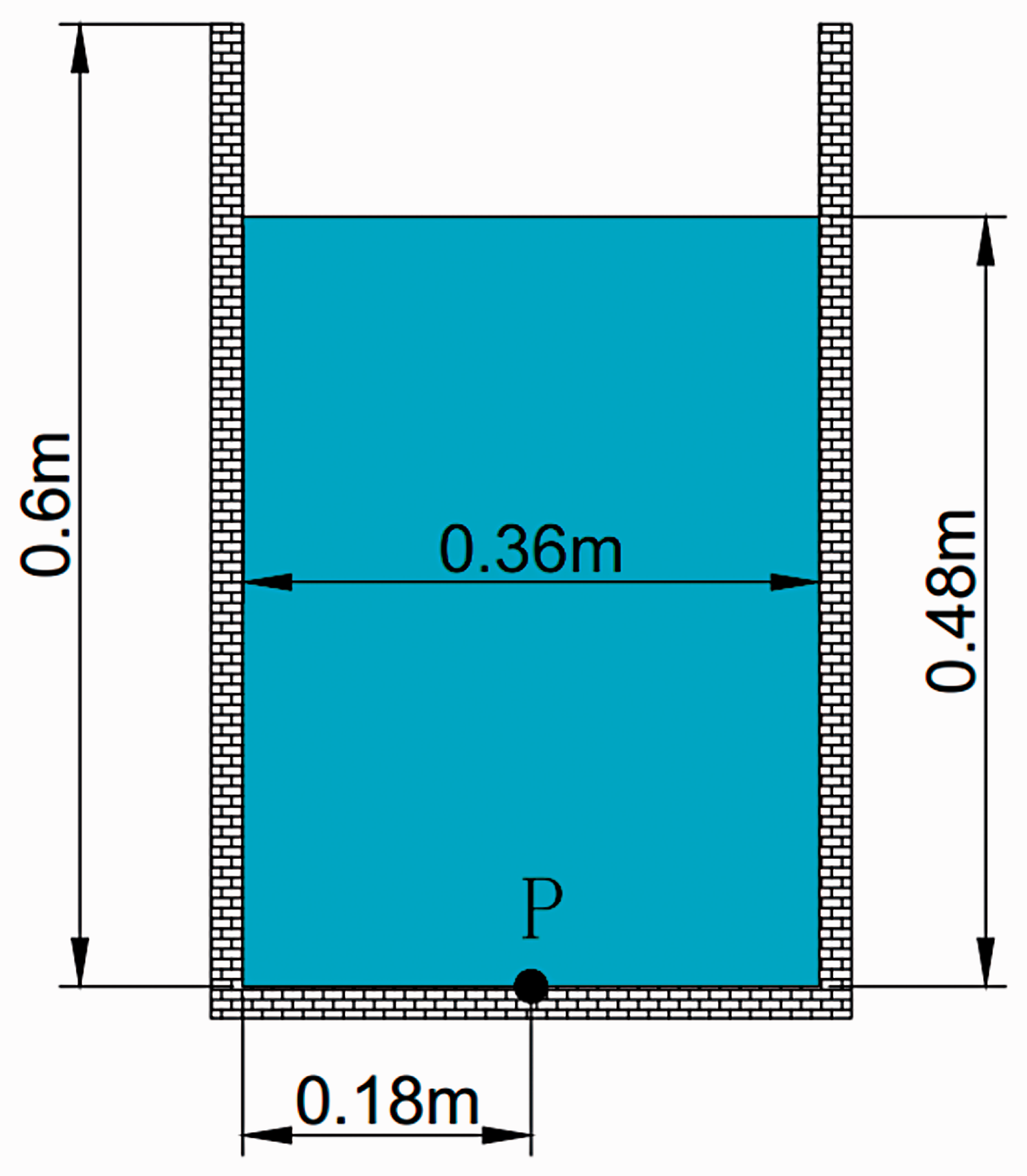
Schematic view of hydrostatic pressure problem.
Accuracy of divergence formula
In this section, three different divergence formulas are explicitly evaluated by the hydrostatic pressure problem. Figure 2 shows the divergence approximation results of point P by BDAF, DDAF, and SDAF at different time. In our simulations, however, the three different forms of divergence approximation behave differently, as presented in Figure 2. SDAF acquired the least error result and yielded a more accurate solution. While the other two formulas had much greater errors and are not as accurate as the SDAF performs. We also observe that BDAF had a larger error than DDAF.
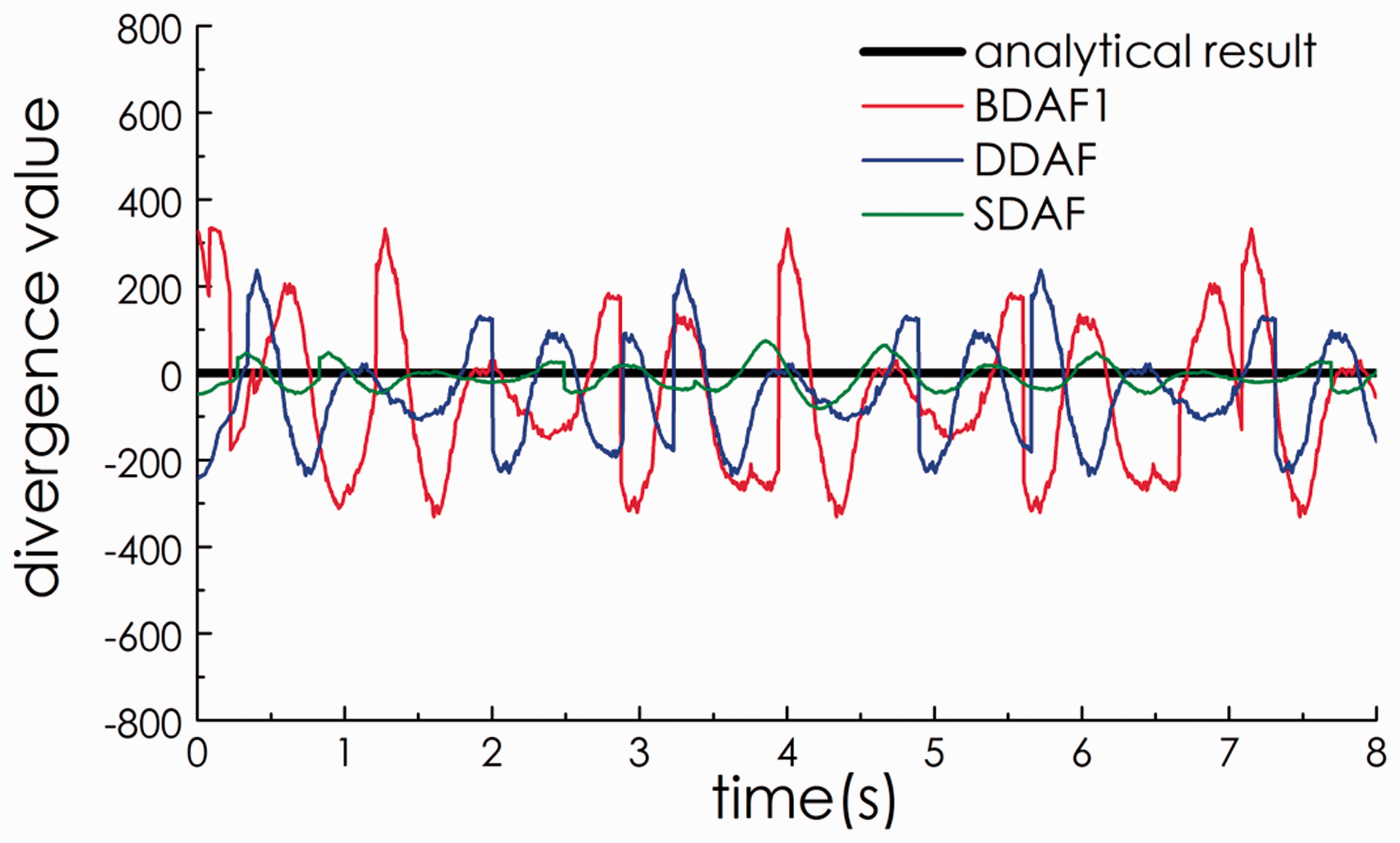
Divergence value of hydrostatic pressure problem by different formulas. BDAF: basic divergence approximation formula; DDAF: difference divergence approximation formula; SDAF: symmetric divergence approximation formula.
Comparison of pressure field
The time histories of pressure at measuring point P are shown in Figure 3. From this figure, the BDAF has resulted in largest amplitude of pressure similar to the amplitude of divergence seen in Figure 3. The amplitude of pressure of DDAF is second largest among the three divergence formulas. Because solving the pressure Poisson equation equals to solving the large sparse matrix

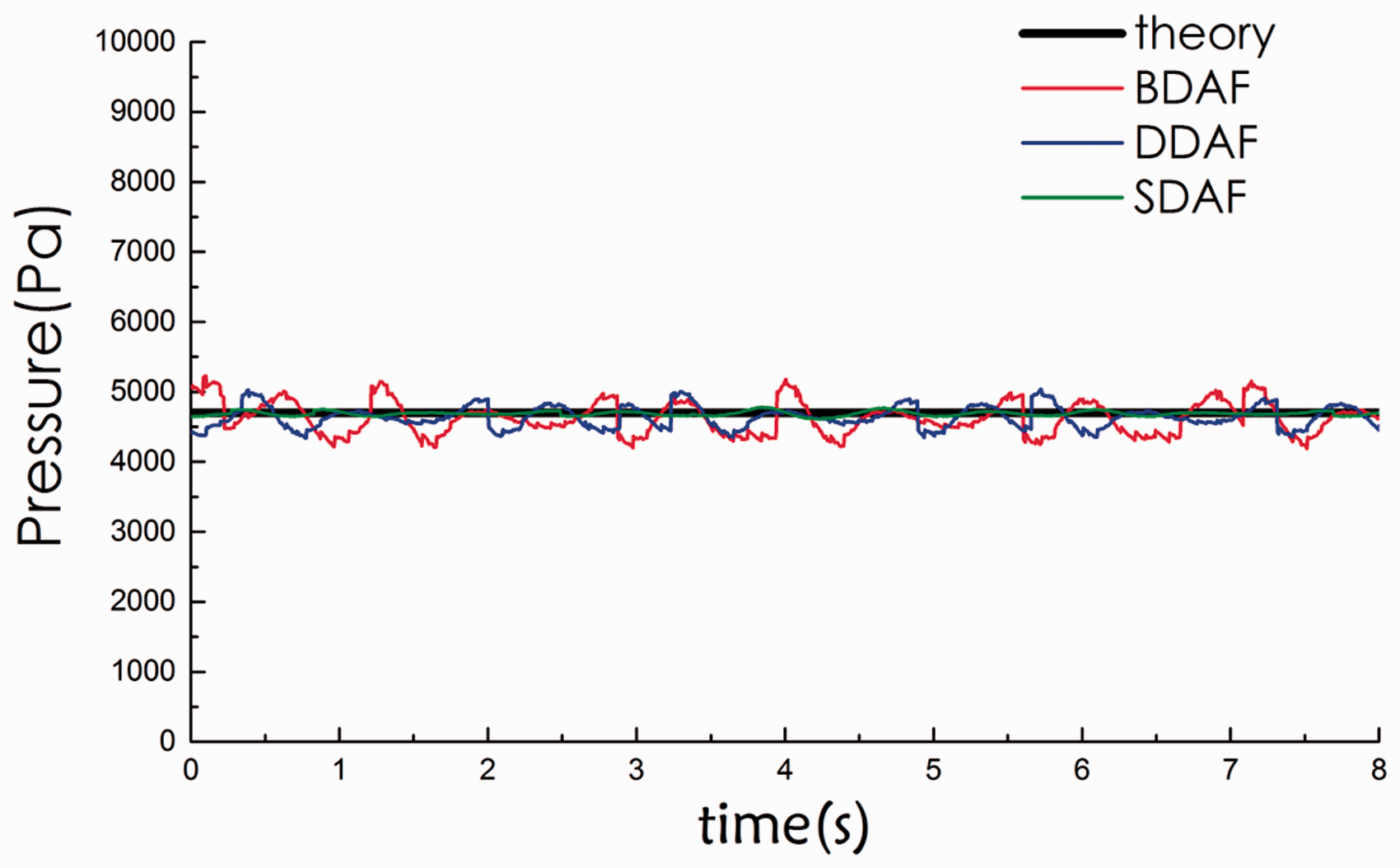
Comparison of pressure field of different divergence formulas. BDAF: basic divergence approximation formula; DDAF: difference divergence approximation formula; SDAF: symmetric divergence approximation formula.
The system of equations actually solved is as follows

If the ||
Figure 4 presents the pressure field of hydrostatic pressure problem by different divergence approximation formulas. Not surprisingly, the pressure field calculated by BDAF is characterized by large particle movement on the fluid boundary, which is deduced by the larger particle distance on the free surface by BDAF. As a result, the height of the free surface by this formula is higher than other approximation formulas. For the unstable phenomenon on the free surface, the pressure is unphysical and unstable on the free surface. Accordingly, the pressure calculation at point P is affected from the pressure oscillation on the free surface and unphysical pressure fluctuation occurs at point P. The particle vibration on the free surface by DDAF is also obvious and the height of the free surface is shorter than the result of BDAF. It means the pressure calculation on the free surface by DDAF is smoother than BDAF. Accordingly, the unphysical pressure fluctuation at point P by DDAF is smoother than BDAF. Compared to BDAF and DDAF, the particle distance is almost the same between any particles (including the particle on the free surface) by SDAF, which means the pressure calculation on the free surface is accurate and stable; as a result, it leads to smoother pressure field and less pressure fluctuation at point P.
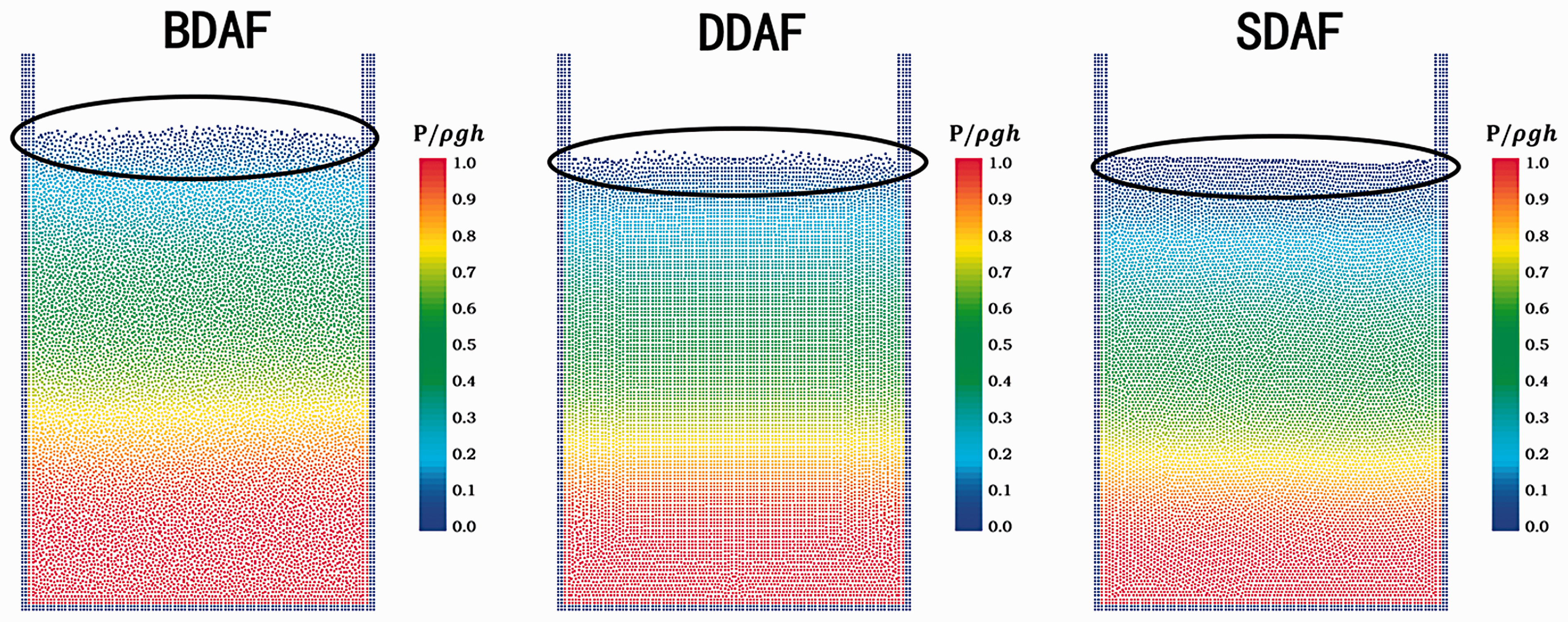
Comparison of pressure field of different divergence formulas. BDAF: basic divergence approximation formula; DDAF: difference divergence approximation formula; SDAF: symmetric divergence approximation formula.
Effect of spatial resolution
In general, the stability of the pressure calculation in MPS method is related to the sensitivity to oscillation of divergence approximation formula of pressure Poisson equation. Another critical issue which may affect the stability of the pressure calculation of MPS method is the randomness of particle distribution. The spatial resolution of simulation will affect the randomness of particle distribution during the simulation. Figure 5 portrays the effect of spatial resolution (the same problem with different particle number) on the performance of different divergence approximation formulas. From the presented figure, refinement of spatial resolution from 1000 to 8000 particle numbers has considerably decreased the pressure error of hydrodynamic pressure problem. Further refinement of spatial resolution from 8000 to 16,000 particle numbers only slightly decreases the pressure error. This would signify the existence of an optimum particle size considering the desired level of computational efficiency and pressure oscillation.
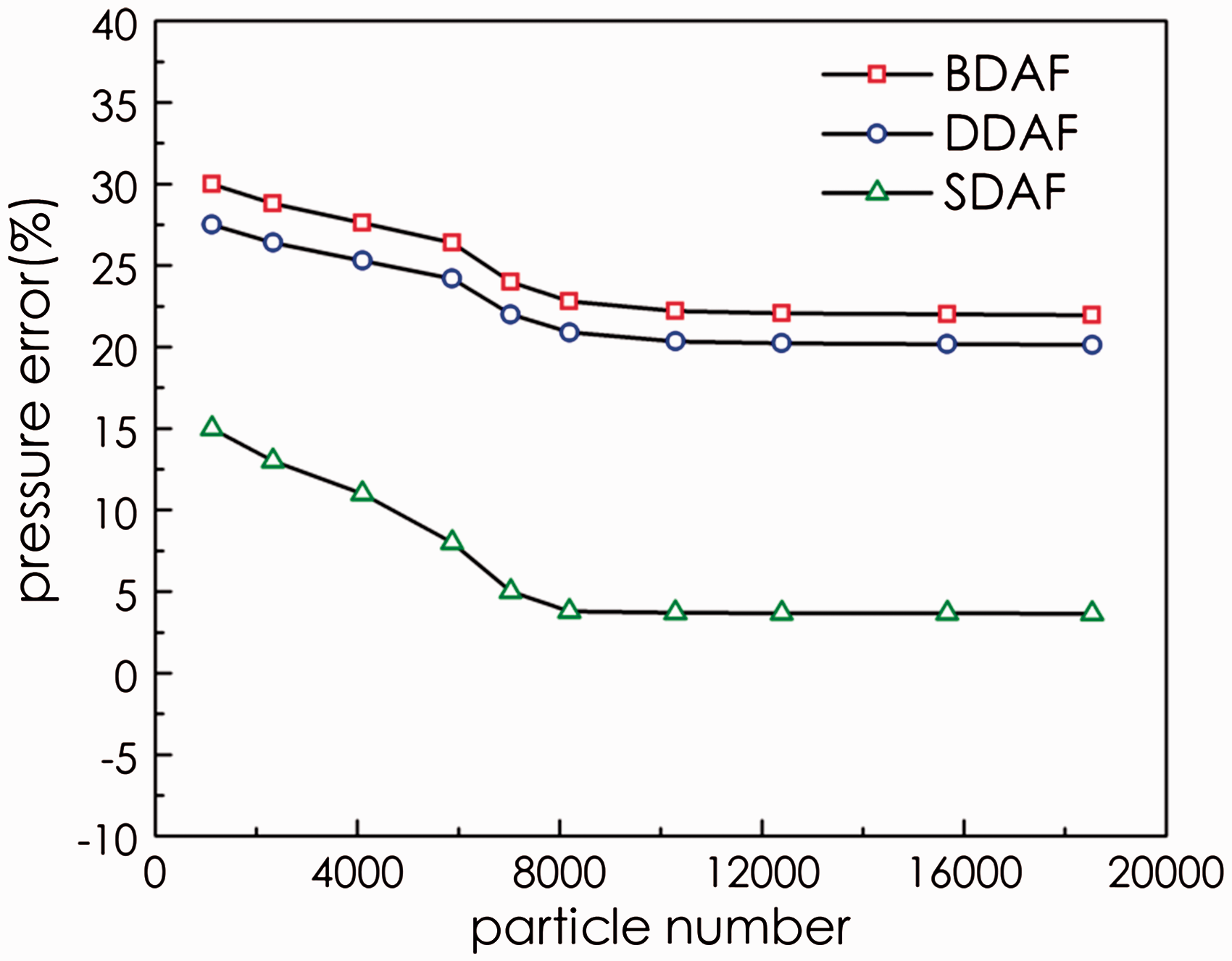
Average pressure error of different particle number by different divergence formulas. BDAF: basic divergence approximation formula; DDAF: difference divergence approximation formula; SDAF: symmetric divergence approximation formula.
Figure 6 shows the improvement of pressure error corresponding to resolution refinement by various divergence formulas, qualitatively. From this figure, refinement of spatial resolution has resulted in enhanced pressure fields characterized by more uniform particle distribution for all the three approximation formulas, especially the particles on the free surface. Not surprisingly, the particle distribution by the SDAG is much uniform than others with the same spatial resolution, which is consistent with the previous conclusion. For all the pressure fields by BDAF with different particle number, the particles on the surface are in severe vibration. However, the pressure by different spatial resolution is different. Because when the particle number equals to 1132, the distance between particles is bigger than the condition with larger particle numbers, such as particle number equals to 5872. When the particle moves the same proportion of initial particle distance, the divergence variation caused by low spatial resolution is larger than the high spatial resolution. As a result, the pressure error by the low resolution is larger than the high spatial resolution. When the particle number is bigger than 8000, the refinement of spatial resolution could not decrease the pressure error. It can be seen that the particle vibration on the surface still exists by BDAF and DDAF when the particle number equals to 12,392 and it could not be eliminated by the refinement of spatial resolution. The particle vibration on the surface by SDAF is also not eliminated when the particle number is larger than 8000, although it is not obvious in the last picture in Figure 6.
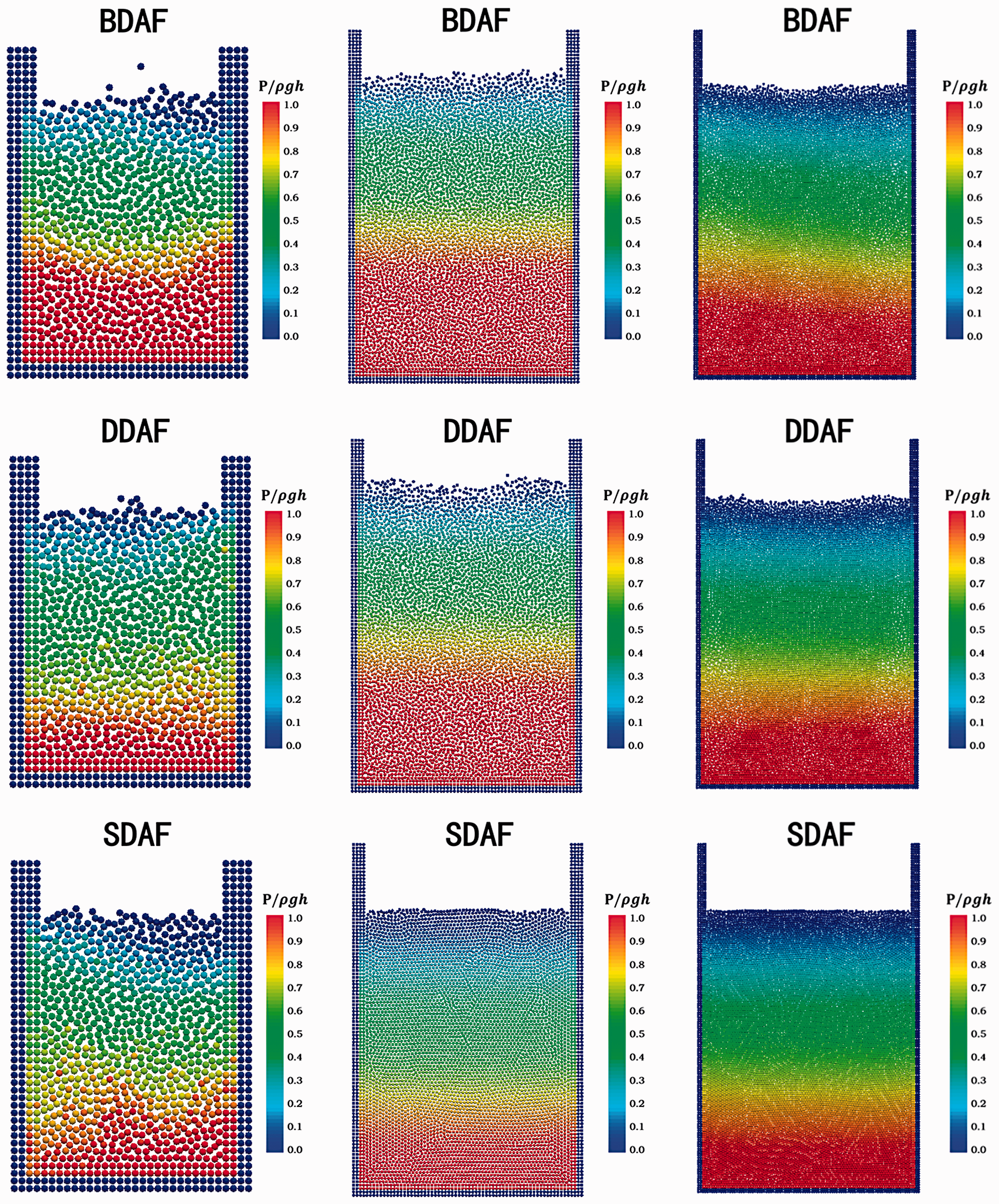
Pressure field by refinement spatial resolution by different divergence formulas (particle numbers are 1132, 5872, and 12,392, respectively). BDAF: basic divergence approximation formula; DDAF: difference divergence approximation formula; SDAF: symmetric divergence approximation formula.
Verification by dam-breaking problem
Dam-breaking problem
Simulation of dam breaks has been studied by many researchers20,25,26 in most particle method as a complicated bench problem. In order to understand the differences in the divergence approximation of BDAF, DDAF, and SDAF in violent flows, the dam-breaking problem is simulated to compare the different divergence formula for simulating violent fluid flows. Shibata et al.
26
and Hu and Kashiwagi
27
conducted an experimental dam-breaking problem to study the free-surface flow. In order to compare with Hu’s experimental results, the same dam-breaking model is employed in this research. As is shown in Figure 7, the height of the vertical wall is 0.22 m, the width of the tank is 1.18 m, the height and width of the water column are 0.12 and 0.68 m, respectively. In the initial condition, the water column is stable in the left side of the tank. The density of the water is
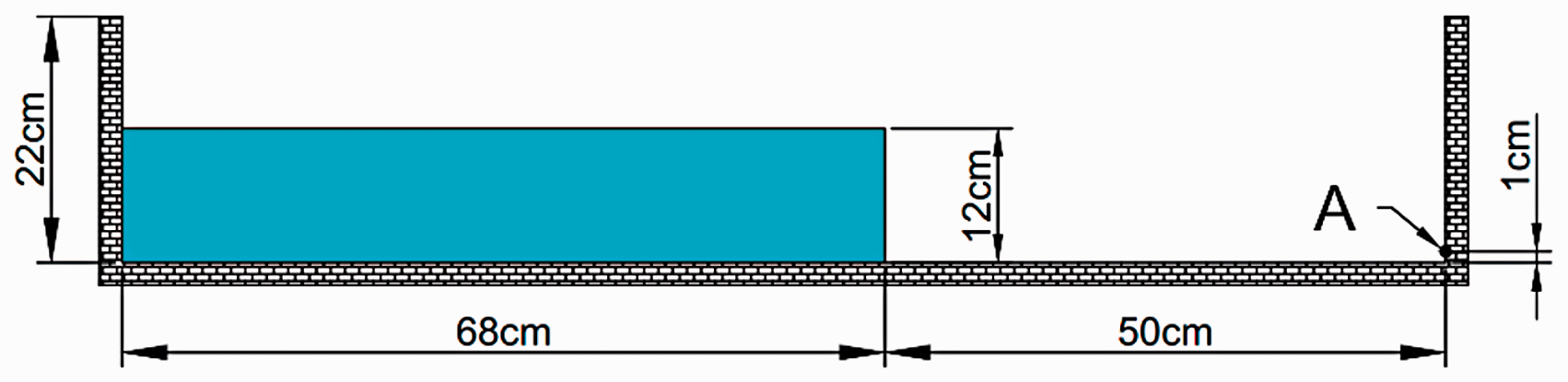
Schematic view of the dam-breaking experiment.
Result and discussion
Figure 8 shows time histories of the calculated pressure at point A by different approximation formulas comparing with the experimental result by Hu. It could be seen that all the simulated results are roughly consistent with the experimental result of Hu. For the BDAF, the calculated pressure at point A fluctuates severely at some instants, including the instants of
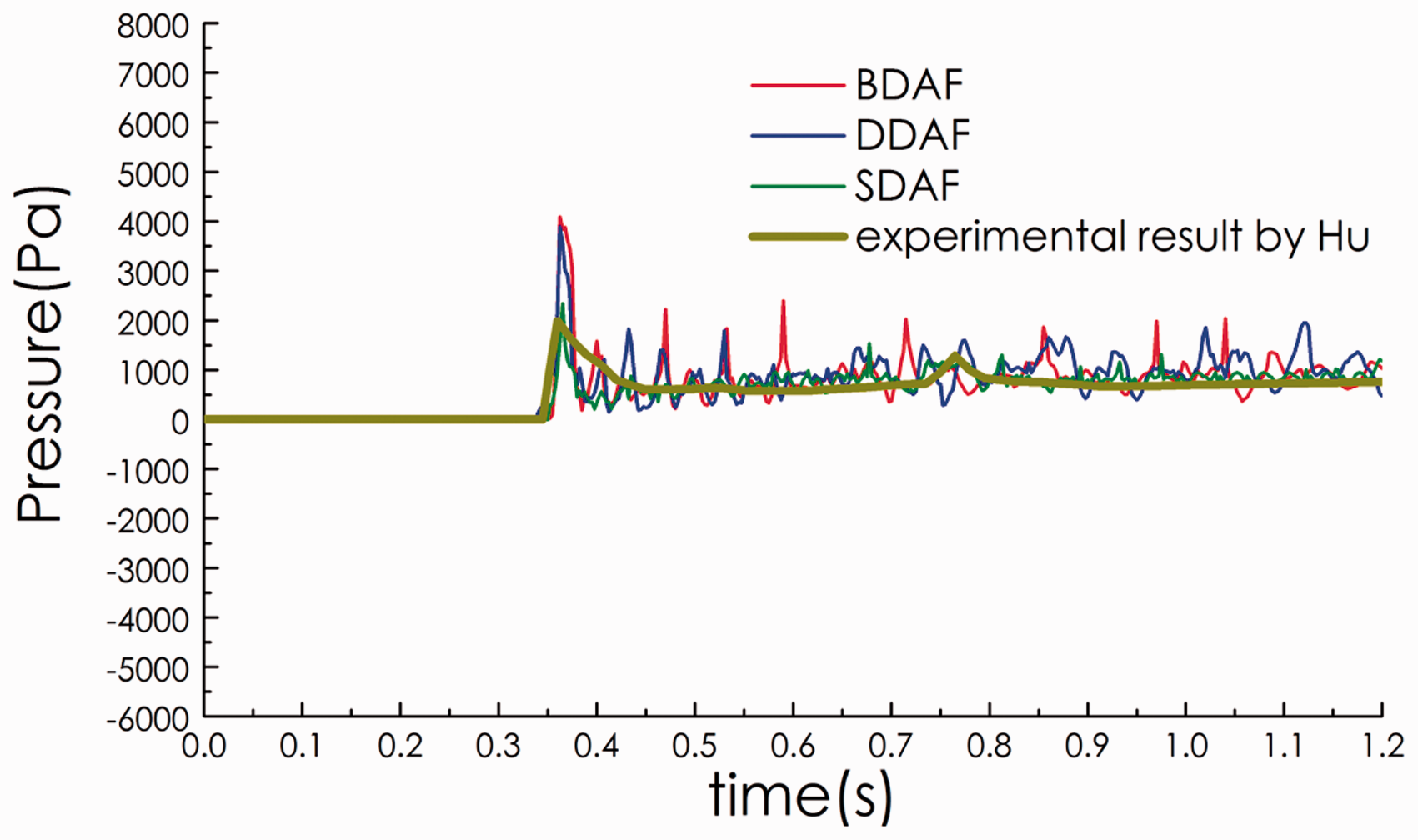
Comparison of time history of pressure of dam breaking at point A by different divergence formulas. BDAF: basic divergence approximation formula; DDAF: difference divergence approximation formula; SDAF: symmetric divergence approximation formula.
Figure 9 shows time histories of source term value by dam-breaking problem at point A by different approximation formulas. Similar to the time history of pressure in Figure 8, the fluctuations in source term value by different approximation formulas are different. The fluctuations in source term value by BDAF and DDAF are large; however, the fluctuations in source term value by SDAF are smallest. During the process of simulation, the fluid at point A has undergone through severe and unphysical expansions and compressions, which causes the variation of source term value. The SDAF tends to have a more stabilizing effect than the other two formulas, at least for this specific test. Among the applied three formulas, the most stable result belongs to SDAF. As previously stated, pressure is a direct function of time variation of source term value. Therefore, the less fluctuation in source term value, the less oscillation in pressure calculation. It can be seen in Figures 7 and 8, when the source term has a peak value at
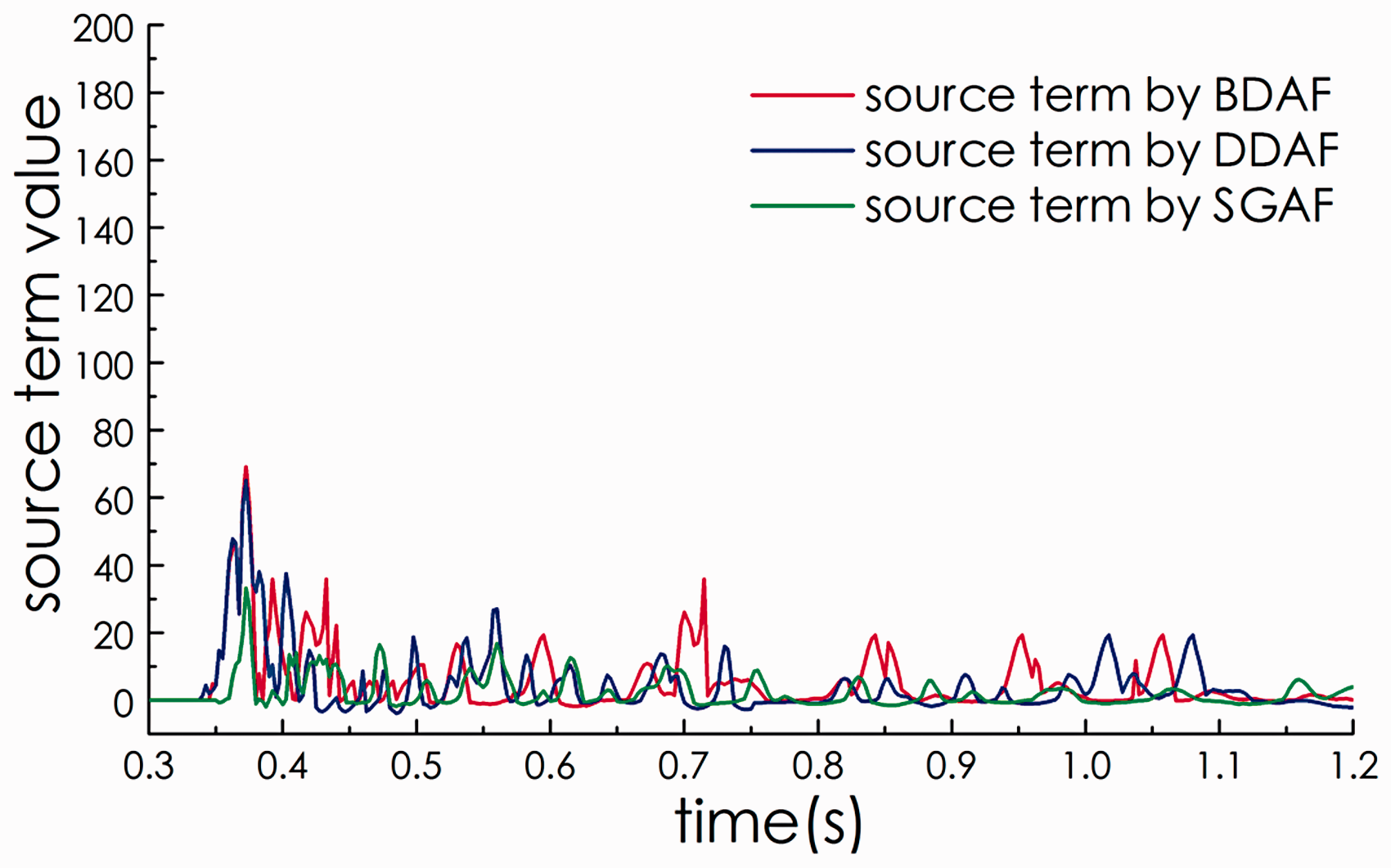
Comparison of time history of source term value of dam breaking at point A by different divergence formulas. BDAF: basic divergence approximation formula; DDAF: difference divergence approximation formula; SDAF: symmetric divergence approximation formula.
Figure 10 shows the distributions of fluid particles and pressure fields at different instants for BDAF, DDAF, and SDAF. The snapshot by three different formulas is characterized by significant discrepancies in pressure field. For the BDAF, severe pressure oscillation in spatial distribution occurs at different times. It is due to the fact that the DDAF has the shortcoming of unphysical pressure fluctuations. A similar spatial distribution of pressure is proposed by DDAF. On the other hand, the smoother pressure spatial distribution is provided by SDAF. In particular, the SDAF has provided a more reliable spatial distribution of pressure at
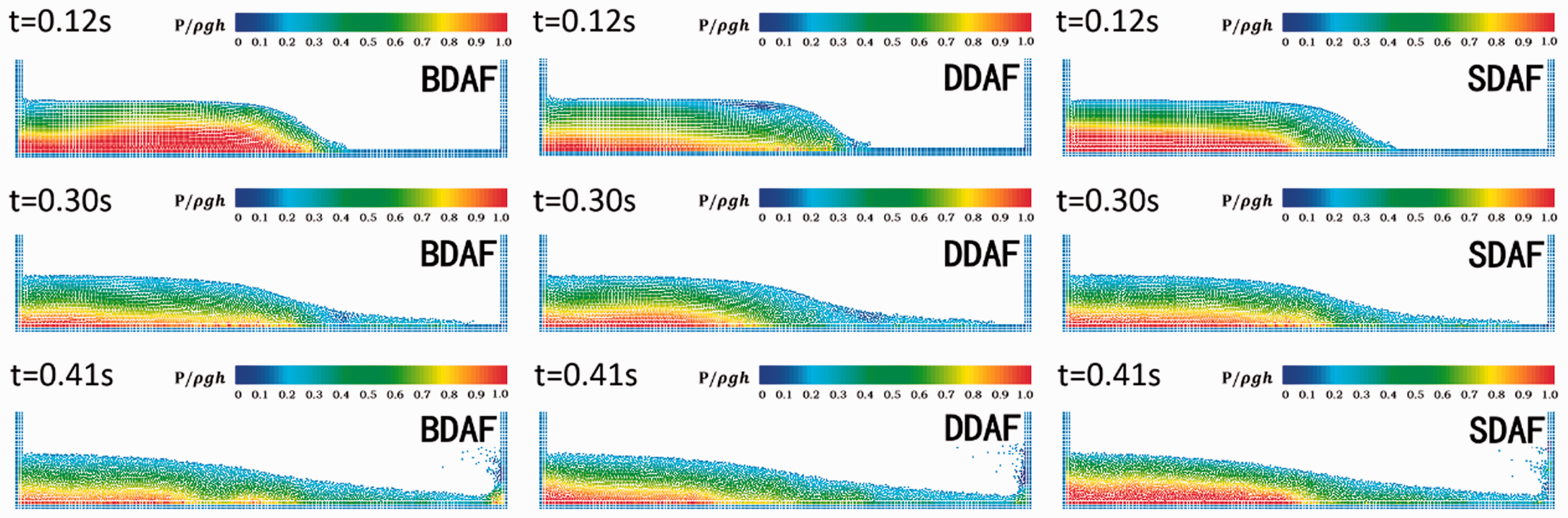
Comparison of pressure field of different MPS methods. BDAF: basic divergence approximation formula; DDAF: difference divergence approximation formula; SDAF: symmetric divergence approximation formula.
Table 1 presents the comparison of CPU time for 10 steps by different divergence formulas of various particle numbers. The workstation utilized in this study is equipped with the CPU: Intel Xeon Processor E5-2680 v2*2 and the main memory: 128 GB. A single core is used without parallel computing. From Table 1, it is found that the CPU time increases with the refinement of spatial resolution. It is the result of that the calculated particle numbers increase. The CPU time of BDAF is smaller than the other two formulas for its simple discrete scheme. The CPU time of SDAF is largest because the mathematical formula of SDAF is little complicated than the other two formulas. However, the discrepancy between three approximation formulas is not significant.
Comparison of CPU time by different formulas.
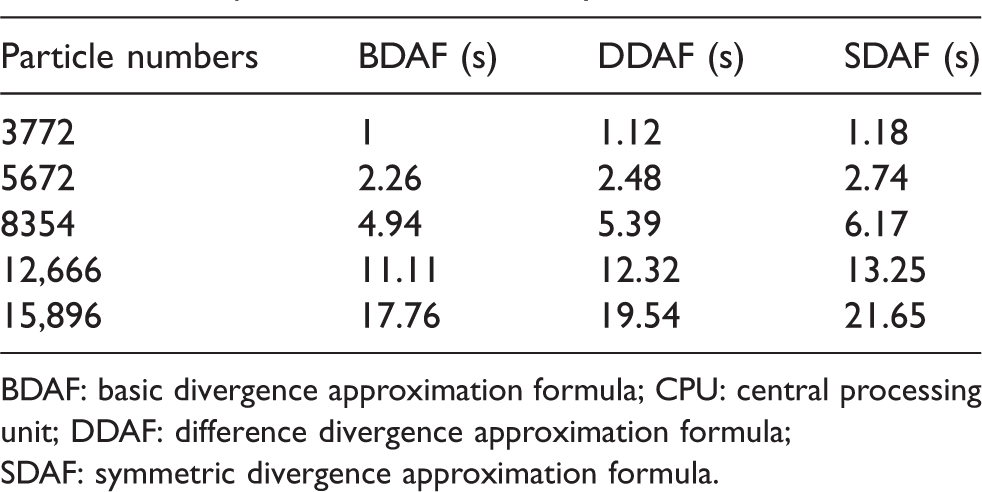
BDAF: basic divergence approximation formula; CPU: central processing unit; DDAF: difference divergence approximation formula; SDAF: symmetric divergence approximation formula.
Conclusion
The MPS method is a mesh-free particle method which is popular for its flexibility. It has the shortcoming of pressure fluctuation; however, it is resolved by various improvements. In this study, three different divergence approximation formulas for source term in pressure Poisson equation are investigated. The hydrostatic pressure problem is simulated as the first case; the results show that the SDAF has a better performance than the other two formulas in suppressing pressure oscillation and obtaining a smoother pressure field. It is due to the accuracy calculation of movements on free surface particles. The dam-breaking problem is selected as the second benchmark; not surprisingly, the SDAF stabilizes the pressure calculation in dam-breaking problem and an enhanced and accurate pressure field is achieved.
Footnotes
Declaration of conflicting interests
The author(s) declared no potential conflicts of interest with respect to the research, authorship, and/or publication of this article.
Funding
The author(s) disclosed receipt of the following financial support for the research, authorship, and/or publication of this article: The authors would like to acknowledge the supports from the National Natural Science Foundation of China (Grant No. 51779126,11472155) and the National High Technology Research and Development Program of China (863) (2014AA052701).