




Abstract
Multiple interactions may occur when a poly-disperse spray is exposed to an acoustic field. In the context of spray combustion instabilities, acoustic agglomeration, the formation of a droplet number density wave and the modulation of the droplet size distribution are interesting effects. A droplet number density wave, i.e. preferential concentration of droplets in space, may result from size-dependent, one-way momentum coupling between the acoustic field and the spray. The modulation of the droplet size distribution, which has been evidenced in the experimental work of Gurubaran and Sujith (AIAA 2008-1046), is thus a consequence of the droplet number density wave formation. In the present work, the mechanisms that produce these effects are simulated and analyzed in depth by means of computational fluid dynamics. The spray is modeled with both Lagrangian (particles mass-point approach) and Eulerian (continuous phase approach) descriptions. The particular Eulerian method used is a variant of the presumed density function method of moments, which allows to account for the effects of poly-dispersity, in particular the size-dependence of particle velocity. Both the Lagrangian and Eulerian models are validated against experimental data for spray dynamics and spray response to an acoustic field.
Keywords
Introduction
In industrial systems that make use of sprays, there are important efforts to understand and characterize the spray dynamics and the spray response to oscillatory conditions of the carrier fluid. This is a critical aspect as the spray dynamics determines several features of the process or products. In sprays flames, for example, a steady droplet concentration is normally desired. Time-varying concentration of droplets lead to unsteady feed of fuel and, potentially, to a unstable combustion process. Periodic fluctuations of the fluid field, i.e. oscillating fields or acoustic waves, excite the spray periodically, producing an unsteady droplet concentration. This mechanism is clearly prejudicial and needs to be avoided. In other applications, interactions between a spray and periodic fluctuations of the fluid field may be beneficial. Acoustic agglomeration (AA), the mechanism that promotes particle collision and coalescence due to the presence of velocity nodes (or attractors) in the acoustic field, is a good example. Recently, the use of acoustic standing waves to promote agglomeration of particulate material to ease filtration in exhaust systems (such as diesel engines) is being extensively investigated analytically, numerically and experimentally. 1
The particular spray dynamics that results from the interaction with a pulsating or oscillating carrier flow is what we call here spray response. Although different scenarios of sprays interacting with unsteady flows have been studied experimentally,2–5 by means of computational fluid dynamics (CFD),6,7 and analytically,8,9 there is to the best of our knowledge no proper and comprehensive classification of different types of spray responses in the literature. The problem of making a rigorous classification lies in the fact that, depending on the scenario under investigation, various mechanisms are more or less dominant.
It should thus not come as a surprise that different studies draw very varied conclusions. Gajan et al. 4 present evidence that the fundamental spray response is the appearance of a number density (ND) wave. It is argued in that study that the origin of the ND wave is related to two factors: the atomization process itself and the fluctuating transport of small droplets. Gurubaran and Sujith have also performed experimental investigations in non-evaporating 2 and evaporating sprays 5 submitted to an axial acoustic field. They found that the spray velocity oscillates with the same frequency as the excitation signal, but out of phase. Droplets clustering and a maximum variation of 25% in droplet mean diameter were observed. The particle size distribution (PSD) was measured locally and averaged conditioned on the phase angle of the acoustic oscillation. A strong influence of the acoustic pressure amplitude on the modulation of the PSD was observed.
Guiliani et al. 7 performed experiments where both the liquid and the air in a liquid-fuel atomizer were pulsating. They concluded that, although relevant for technical combustion control, pulsations on the liquid phase do not affect considerably the PSD. However, the air pulsation produces a dense droplet front close to the injector exit. Such droplet concentration is formed and ejected periodically during the high-acceleration phase of the air velocity. A simplified Lagrangian CFD simulation for a set of poly-disperse particles was also performed in their work to illustrate the concept. It was concluded that the smaller droplets dominate the droplet ND wave formation, due to their low Stokes number. Chisty et al. 6 carried out a Lagrangian-drop/Eulerian-flow simulation study of a non-reacting spray in an acoustic field. A dense pocket of droplets appearing at an interval equal to the acoustic wavelength was found. Katoshevski et al.8,9 attempted to study the droplet grouping phenomena analytically. They have proposed conditions under which droplet grouping may or may not occur, based on the solution of the equation of motion of a droplet excited by an acoustic wave with mean flow (only drag force was accounted for). This condition is related to how the droplets are attracted to a distance equal to the acoustic wavelength. Unfortunately, this analysis was performed for a combination of acoustic frequency and wavelength that is not realistic.
The remarkable variety of conclusions of the above-mentioned studies, the mixture of scenarios and the lack of knowledge of the role of the various parameters in the spray response have motivated the present investigation. We strive to clarify the role of each parameter by selecting simplified configurations of the spray (test cases) and use CFD methods to draw general conclusions, when possible. It is proposed that the spray response can be classified in terms of two effects: (1) AA and (2) generation of a droplet ND wave. Test cases corresponding to these effects are constructed and analyzed. A cross-validation that employs two approaches for sprays simulation, i.e. the Euler–Lagrange (EL) and the Euler–Euler (EE), is carried out for each case. We investigate the capabilities and limitations of the particular EE approach, the presumed density function Method of Moments (PMoM), to capture the aforementioned spray responses. Validation of the EL and EE models is also performed against the experimental results obtained by Gurubaran and Sujith 2 for a spray submitted to an axial acoustic field.
Mathematical model and considerations
Generally speaking, spray dynamics can be modeled by means of two descriptions, the EE and EL, where the carrier flow dynamics is expressed in Eulerian form in both. It is well known that each approach provides advantages and disadvantages in terms of mathematical modeling and computational cost. Despite the need of elaborate more mathematical models to account for poly-dispersity and poli-celerity for the EE case, this approach can be a cost-effective alternative.
Continuous phase equations
The Eulerian equations for the continuous phase are common for both approaches. In an incompressible flow, the continuity equation reads


For the one-dimensional test cases, the continuous phase velocity is imposed (one-way momentum coupling). The general form of the excitation (varied according to the corresponding test case) is

Since no thermal effects are contemplated, there is no energy equation and the continuous phase is assumed to be incompressible. The use of this incompressible approach is discussed in the validation section, as long as the validation problem can be approximated as acoustically compact.
Disperse phase equations
Lagrangian mass-point approach
In the Lagrangian framework, the spray model is comparatively simple. The equation of motion of a droplet with diameter D can be read as
10
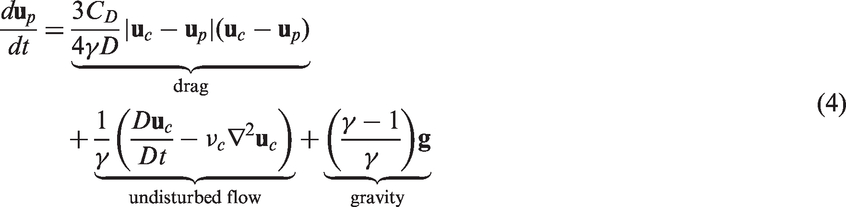

Although the undisturbed flow force is composed by the pressure gradient the shear stress around the “absent” droplet,
10
with the help of the Navier–Stokes equations for an incompressible fluid, this force can be conveniently expressed only in terms of the fluid velocity field, as occurs in equation (4). For a gas-particle flow with large droplet and fluid density ratio
In the Lagrangian context, the momentum transfer from/to the continuous phase can be calculated as the local sum of the particles momentum variation along the Eulerian time step
a

Eulerian approach
The so-called PMoM is just one (among several) EE moment model for the description of a poly-disperse spray. A systematic derivation of the mathematical model of the PMoM is given in the work of Carneiro11,12 or Dems.13,14 Without detailing mathematical and statistical formalities of the method, the main idea is to resolve transport equations for the k moments


The NDF is defined as

The moments

A set of moments needs to be selected to perform the reconstruction. For the gamma function, three consecutive moments are required, then



km is chosen depending on which quantity one wants to ensure conservation. Making km = 0 or km = 1 ensures the conservation of number of particles per unit volume
Nevertheless, there is still an issue regarding the transport velocities for the moments


This expression is obtained after integrating the drag force indicated in equation (4) on the size spectrum. It contains both the linear (Stokes) and non-linear (Schiller and Naumann) law for drag (see “Lagrangian mass-point approach” section). The corresponding momentum transfer term in equation (2) becomes
For the rest of the transport velocities

Although, this approach results very efficient computationally, important assumptions have been made. Our task is to identify if they are restrictive or not for sprays in oscillating flows.
The set of equations (1), (2), (6) and (13) are resolved using a customized OpenFOAM® code, which is based on a finite volume discretization. A first-order integration schema has been used to resolve equation (4), based also in an existing OpenFOAM library.
Problem description of the test cases
The test cases set-up is represented in Figure 1. In which, for “Acoustic agglomeration” section, all droplets are placed at initial time (no injection), while for the “ND wave formation” and “Modulation of the DSD” sections, a continuous injection of droplets is implemented.
Illustration of the test case. Initial ND profile for the AA case.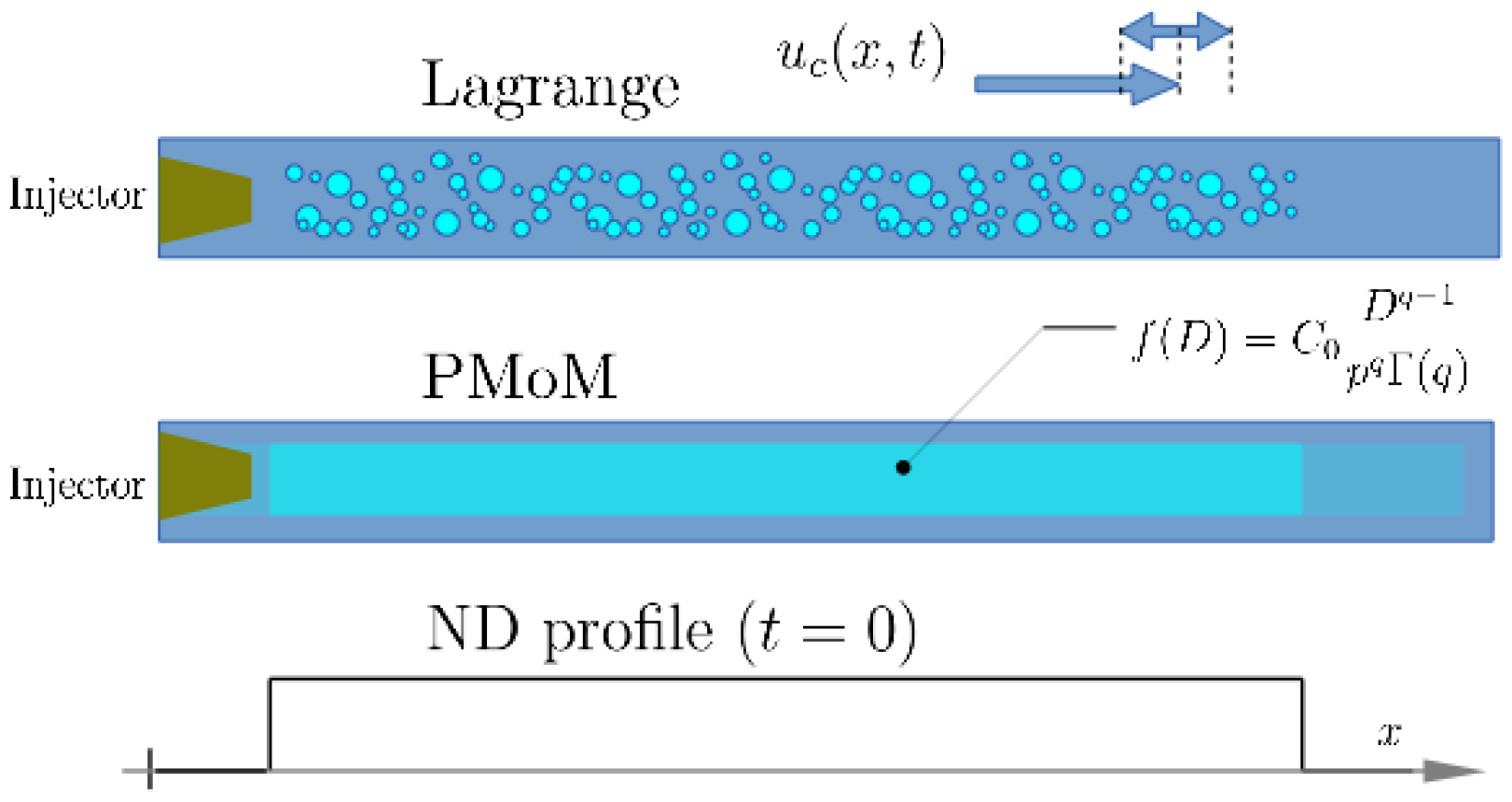
Acoustic agglomeration
Consider a population of droplets that is positioned in a section of a one-dimensional channel, as represented in Figure 1.
For the Lagrangian representation 12,000 particles
c
are placed uniformly in space, which produces a constant initial ND profile. The droplets diameter follow a Gamma density distribution with parameters
The corresponding Eulerian model can be constructed based on the adopted density function. The zero-moment
An acoustic standing wave may be described a velocity field for the continuum
This mechanism of AA is clearly recovered by both CFD model formulations (see Figure 2): a droplet ND profile composed by a series of U-shape intervals is established in the x domain. This profile becomes more prominent as the time advances and the accumulation rate, which could be measured as the rate at which these peaks grow, augments if the amplitude of the excitation ( Normalized ND profile obtained with Lagrange mass-point approach (– – –) and PMoM approach (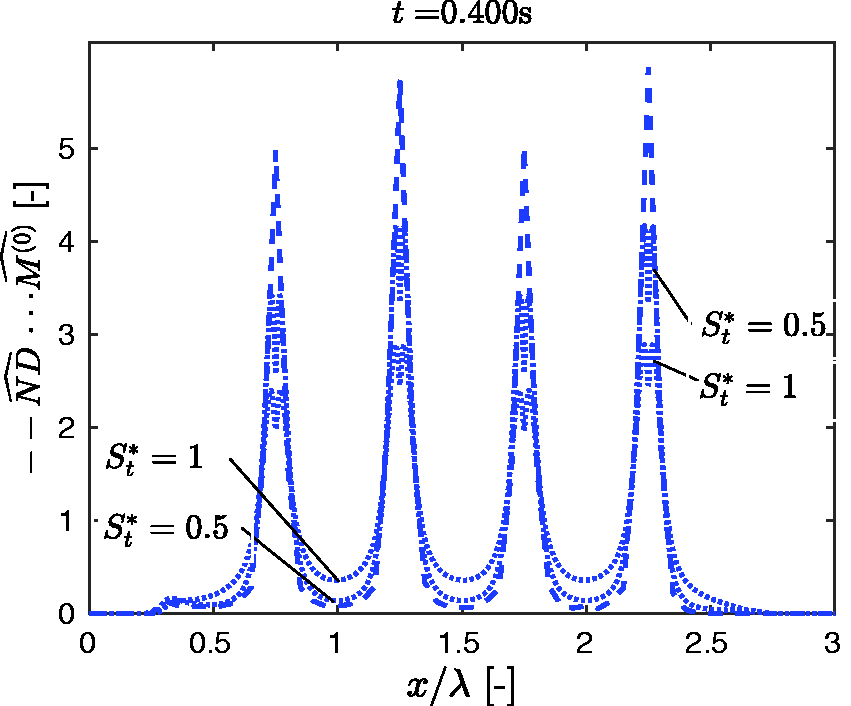
The corresponding PMoM simulation of the equivalent problem captures qualitatively the evolution of the ND profile (dotted lines in Figure 2). However, the development of the ND profile is slower than in the Lagrangian reference case (dashed lines of Figure 2). This suggests that the way in which the transport velocity of the zero moment
In order to analyze to what extent the predictions obtained by the relaxation approach are accurate, the transport velocities Time signals of uc (——–), 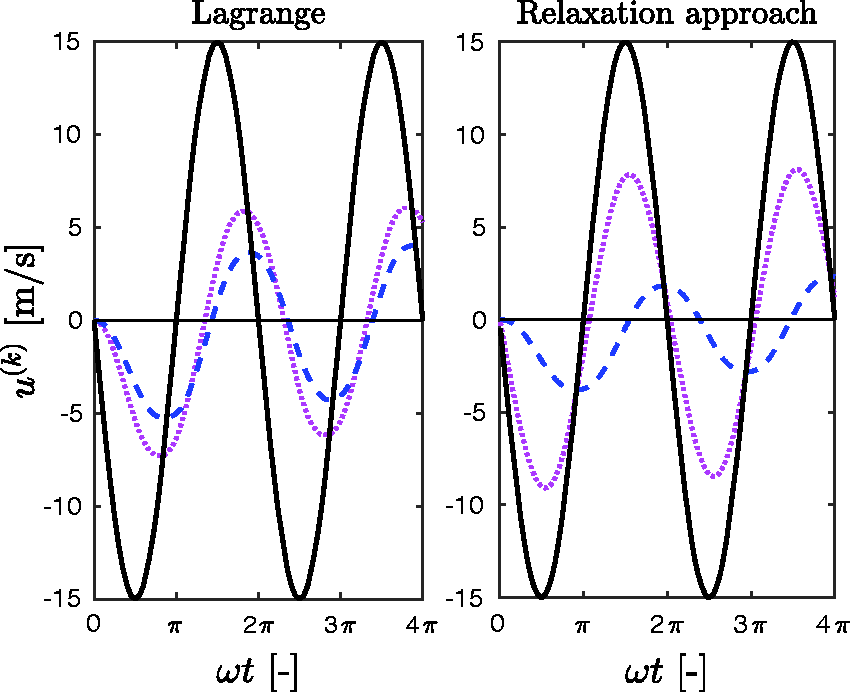
Relaxation approach with limited inertia
One of the fundamental premises of the Eulerian equilibrium method (which derives the relaxation approach) is that it is suitable only for small particle relaxation times (τp). This is due to the particle velocity Size–velocity correlation at the velocity anti-node (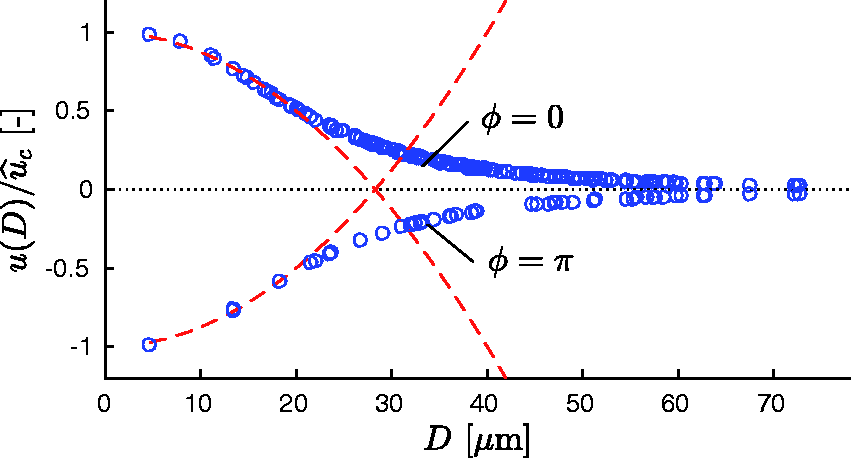
So, there is a conflict between the unbounded (quadratic) nature of the implicit size–velocity correlation of the relaxation approach for large sizes and the bounded particle response expected for large St (large D). Two potential alternatives may resolve this conflict: (1) a higher order expansion in τp or (2) bounding the quadratic function of the size–velocity correlation in the “standard” relaxation approach. The latter alternative is employed here as the extension of high-order terms requires a complex mathematical treatment involving total derivatives and gradients of the velocity field

A piecewise size–velocity correlation (bounded) can be adopted saying that

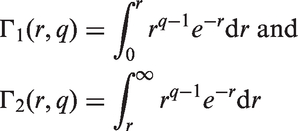
Combined with the definitions of the incomplete gamma functions


Employing the limited inertia schema decreases this phase angle, as it can be seen in Figure 5. This improves significantly the agreement of the droplet ND profile formation of the PMoM approach with respect to the Lagrangian one, as the delay of the former is reduced. This can be appreciated in Figure 2 for two critical Stokes numbers Time signals of uc (——-), 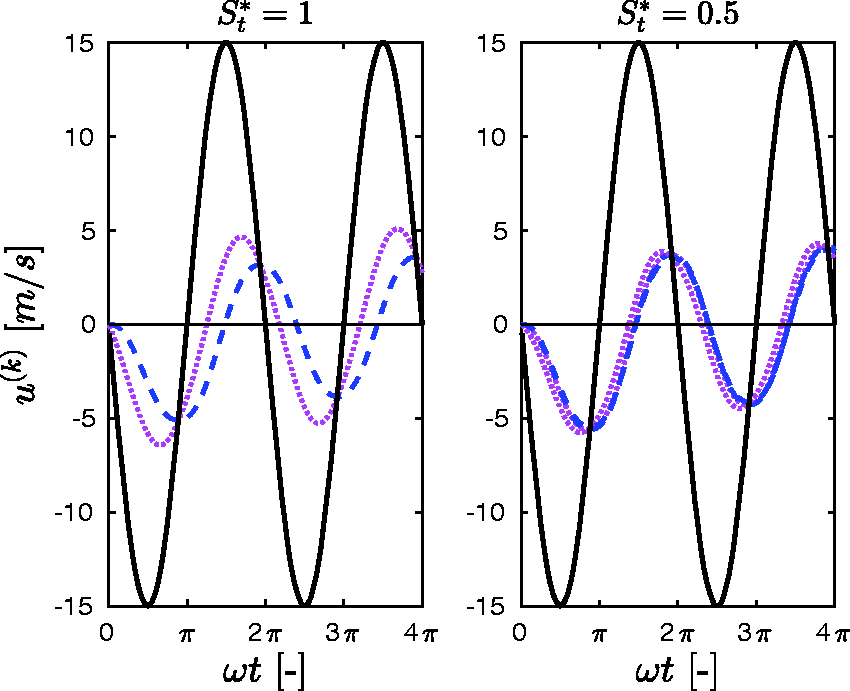
A closer look for the size–velocity correlation (u(D)) at the velocity anti-node (see Figure 4) supports properly the need of using the correction for large particle sizes in oscillating excitations. Although droplets continuously leave the plot as the time lapses, the shape of the evolving size–velocity correlation is maintained. Clearly, this function can be properly approximated by a quadratic function only for small droplets sizes (see dotted lines in Figure 4), but may cause over- or under-predictions up to some critical sizes
The wavelength λ is a key parameter for AA. Note that, in principle, if
ND wave formation
The continuous injection of droplets (mono-disperse spray with
The continuous injection of droplets in an oscillating population generates a ND wave at the injection area which is transported downstream by the mean flow
In Figure 6, both the droplet ND and ND wave formation for a mono-disperse spray (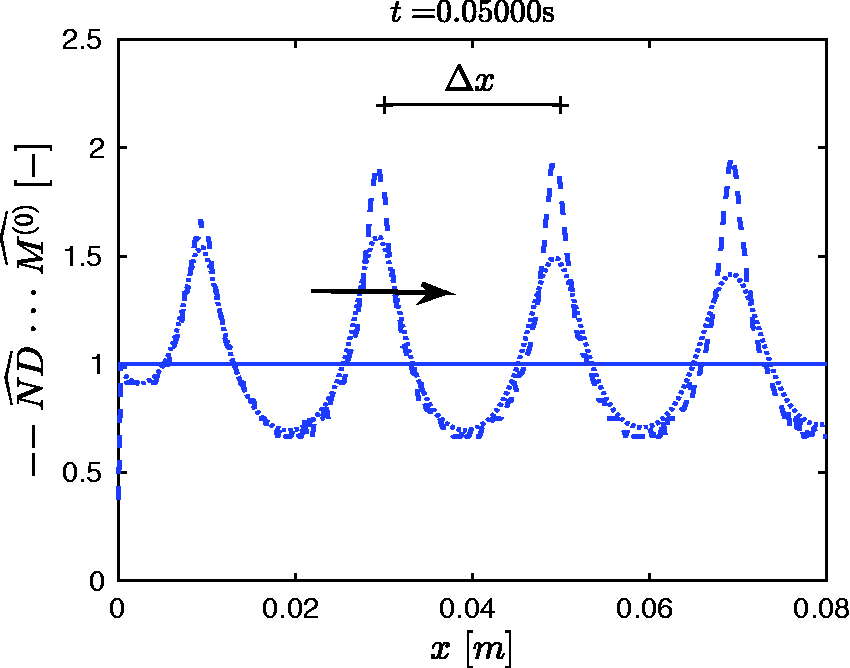
Modulation of the DSD
The ND wave formation in a poly-disperse injection of droplets is reflected as a local modulation of the DSD in time, as can be appreciated in Figure 7 (top). Any given point sees an undulating droplet ND profile traveling at a velocity Left: modulation of the DSD at x = 0.03 m. Right: reconstructed function of the PMoM simulation.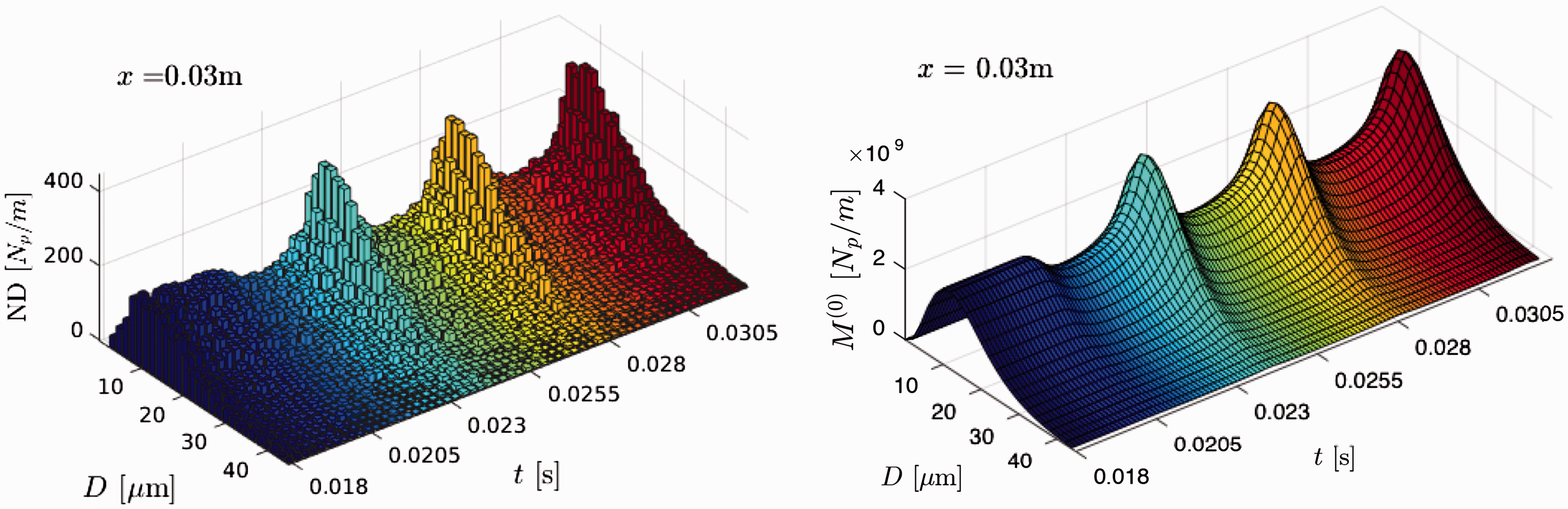
The droplet ND wave for the Lagrangian model and the PMoM approach for two values of the critical Stokes number ( Poly-disperse spray response obtained with Lagrange mass-point approach (- - -) and PMoM (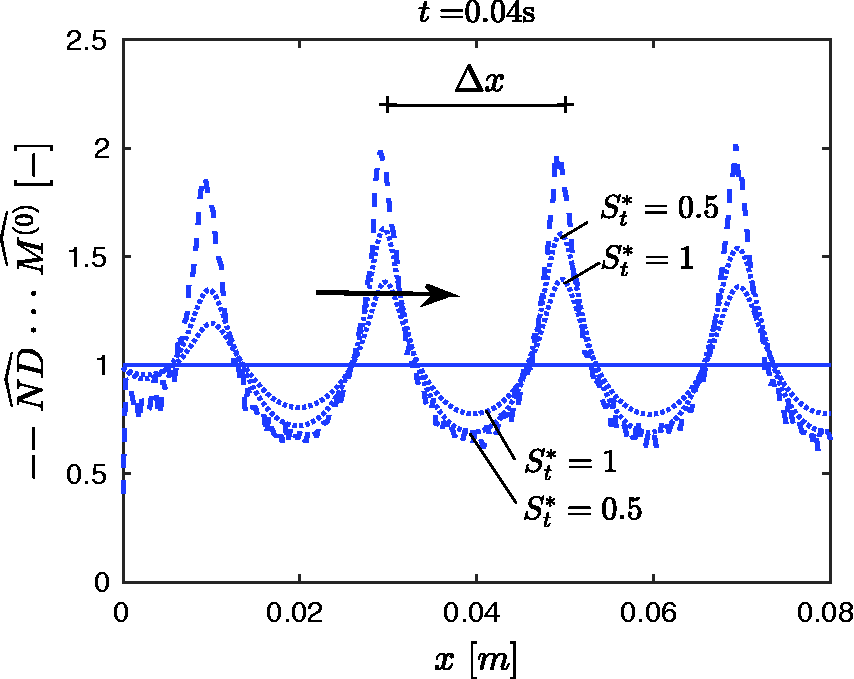
Phase lag of the modulated DSD
Due to the size-dependent relaxation that each droplet experiments, a phase lag in the modulated DSD is expected for large diameters. This situation is more evident if a relative velocity in the droplets injection is introduced in the previous test case ( ND wave formation of the poly-disperse spray with relaxation, obtained with Lagrange (- - -) and PMoM (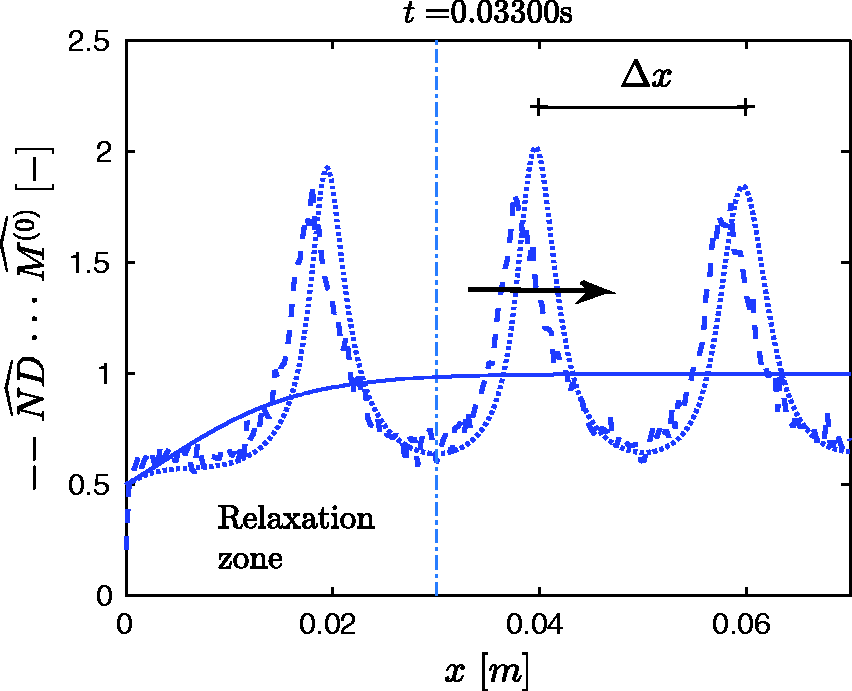
If an oscillation in the gas field is imposed ( Local modulation of the DSD and phase lag (arrows) due to the droplets relaxation. Lagrange (left) and PMoM for 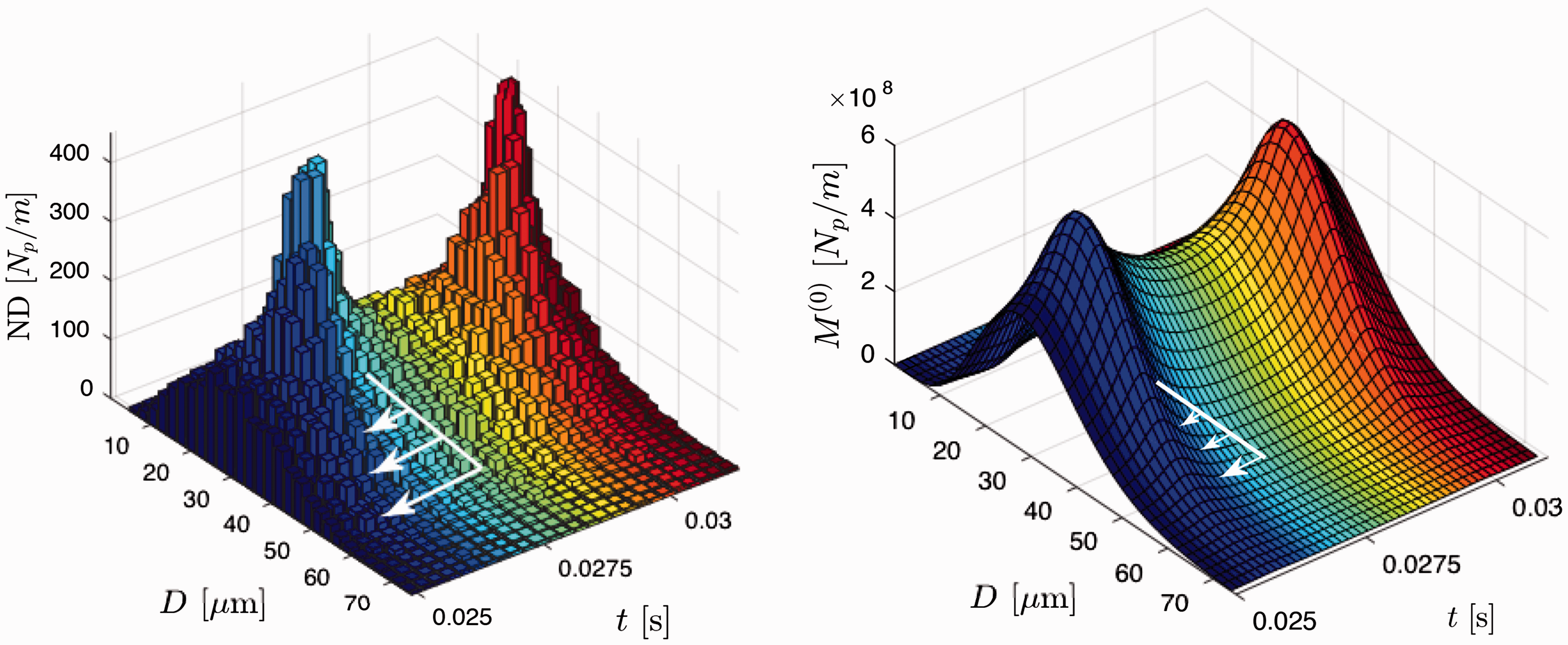
Comparison with experiment
As a validation case, the experimental setup of Gurubaran and Sujith
2
has been taken, which is represented in Figure 11. It consists of an injector fed by a liquid and a gas line, placed inside of an acoustic chamber. Four acoustic drivers, placed on the top of the channel, are synchronized to produce an acoustic standing wave, which interacts with the spray. The location of the injector is adjusted in such a way that the solid cone spray reaches one of the standing wave pressure nodes. In that position, the largest acoustic velocity amplitude is produced.
Schema of the experimental setup.
2
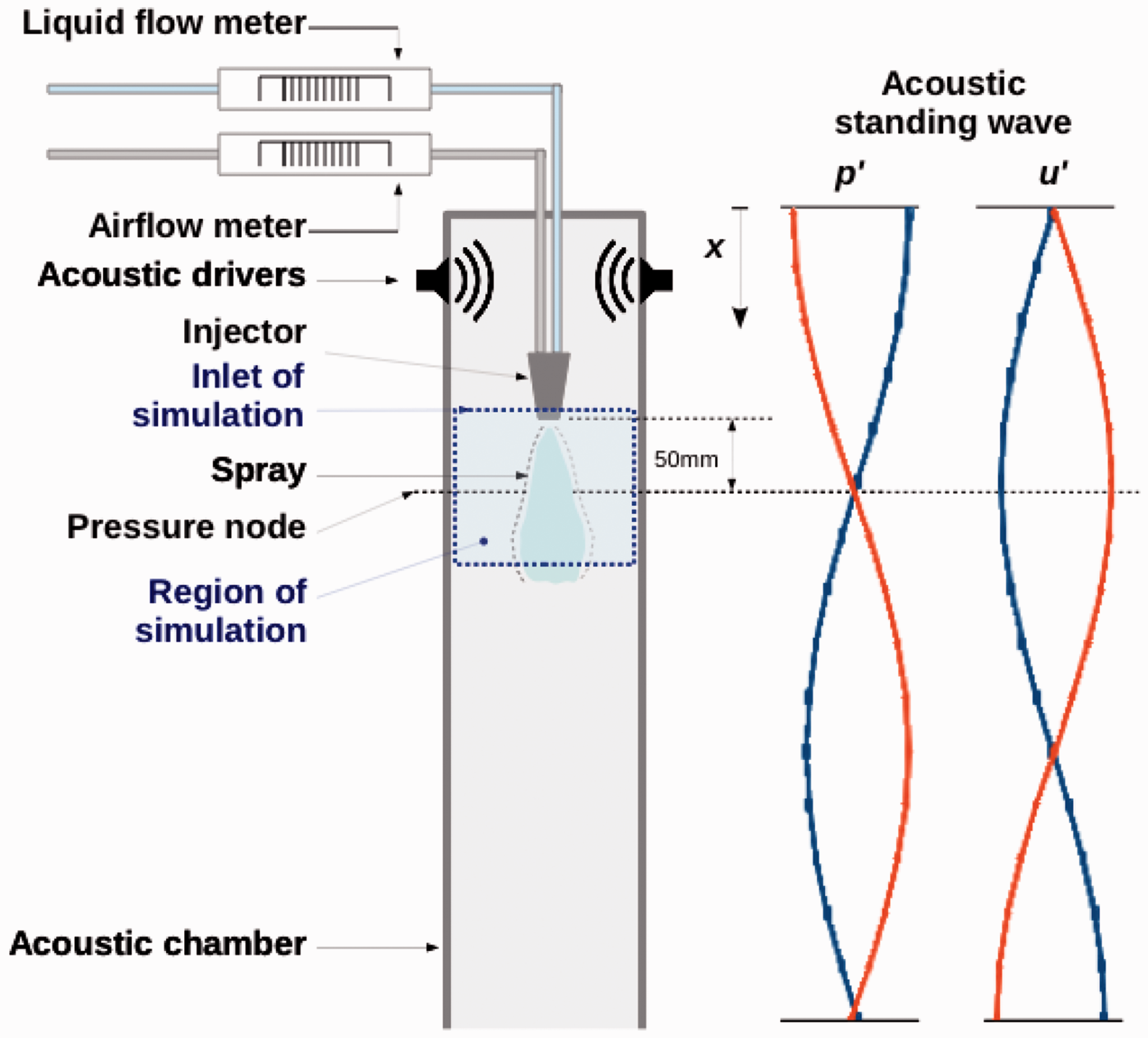
Our CFD model comprises the reduced section where the spray develops. We assume this section to be acoustically compact, as its length is small compared to the acoustic wavelength, and therefore, the gas is presumed to be incompressible. This is advantageous in terms of both solver formulation and boundary conditions treatment for acoustic waves. 19 By doing so, we automatically discard AA (as described in “Acoustic agglomeration” section) as a dominant mechanism. This is reasonable because the flow velocity in the spray axis is large, the acoustic velocity amplitude is relative small and only few acoustic cycles pass between the transport of particles from the injector to the pressure node. Therefore, the intensity of droplets clustering due to AA is small in this case. Thus, we want to prove that the DSD modulation evidenced in the experiment can be explained by the mechanism of droplet ND wave formation.
Boundary conditions of the CFD model are approximated in the following manner: for the Lagrangian case, an injection of droplets was implemented in the code. It consists in a series of points of injection on the atomizer exit, where droplets are appended at a given velocity emulating the spray velocity profile measured experimentally. The diameter of each injected particle follows the discrete DSD measured at the pressure node. The rate of injected particles and the air entrance at the injector exit were estimated to satisfy the global liquid phase load (
For the aforementioned volume fraction, two-way momentum coupling is expected and the system of equations [(1), (2), (4)] and [(1), (2), (6), (13)] are resolved for the Lagrangian mass-point and PMoM approach, respectively.
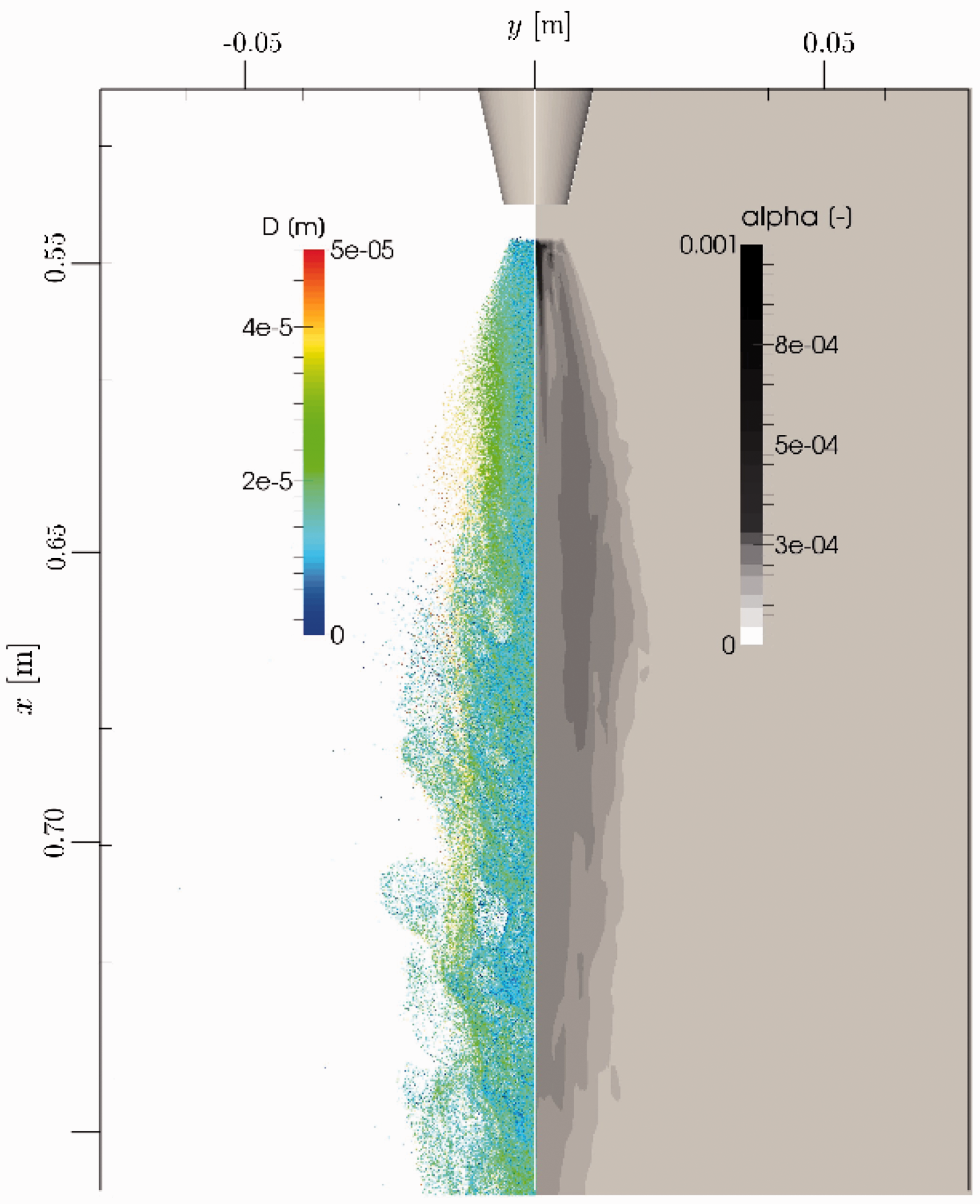
First, the spray without an imposed acoustic wave is simulated. The x-component of the spray velocity up at axial planes x = 0.56, 0.6, 0.625 and 0.65 m, respectively, is presented in Figure 12. Adaptation of the profiles of volume fraction and air velocity on the injection patch resulted in a good match between experiment and computation, in particular at the most downstream location. This level of agreement allows meaningful comparison of DSD modulation in the presence of oscillations, see below. Note that for the Lagrangian simulation, individual particle velocities are plotted ( Spray axial velocity immediately downstream of the atomizer exit, which is located at x = 0.55 m. Experimental value (——–), Lagrangian velocity of droplets crossing a thin layer at the corresponding section (instantaneous, not post-processed) ( Droplet size (left) and volume fraction (right) of the spray without excitation. EL model. Sauter mean diameter (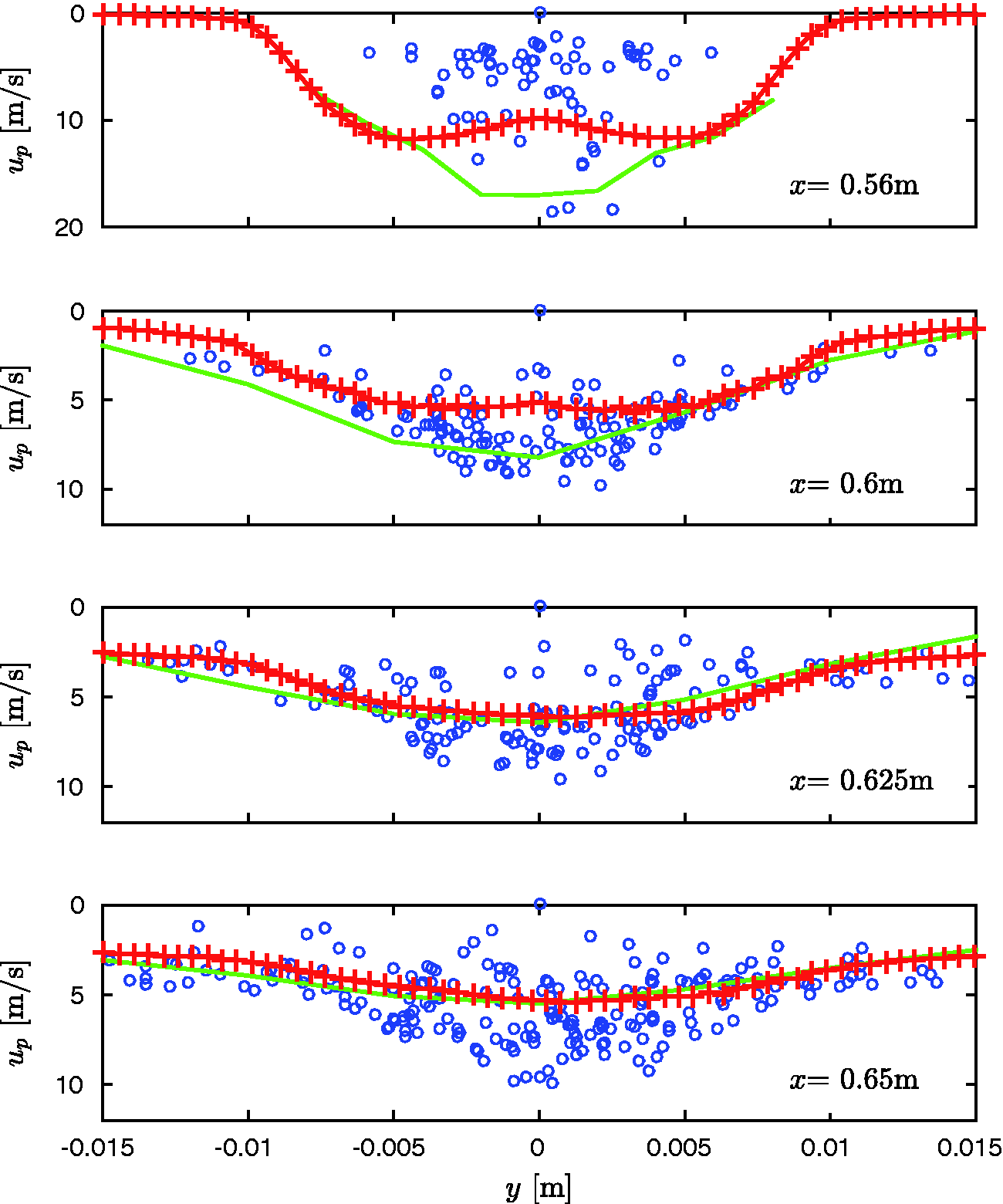
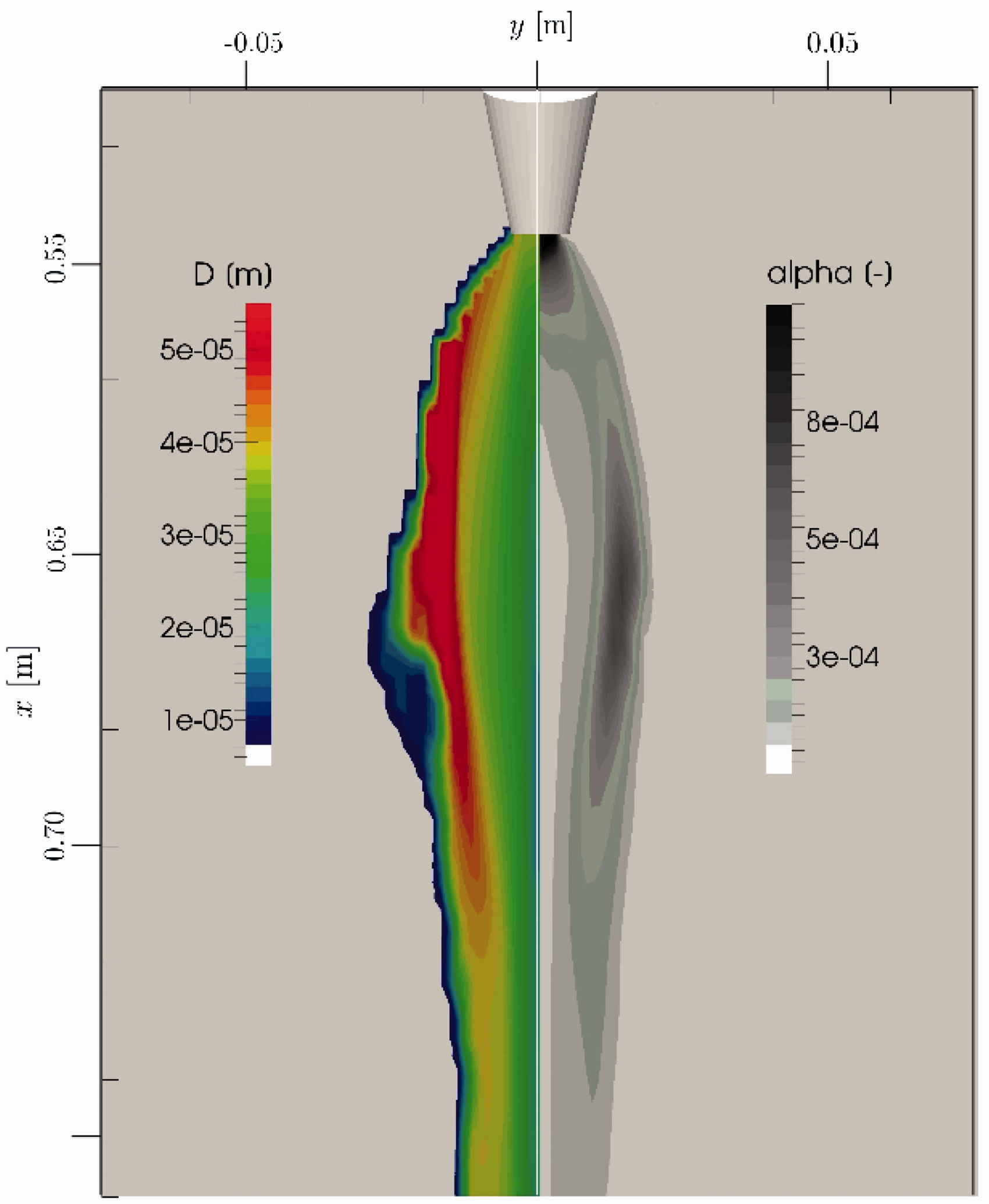
The excitation is applied as a uniform air velocity fluctuation (which is equivalent to excite the pressure) around the cone of injection. A small mean flow velocity was also imposed (0.1 m/s), in accordance to the experiment characterization. The structure that the spray develops when the acoustic excitation is applied ( Droplet size (left) and volume fraction (right) in a thin cross-sectional area of the spray with excitation. 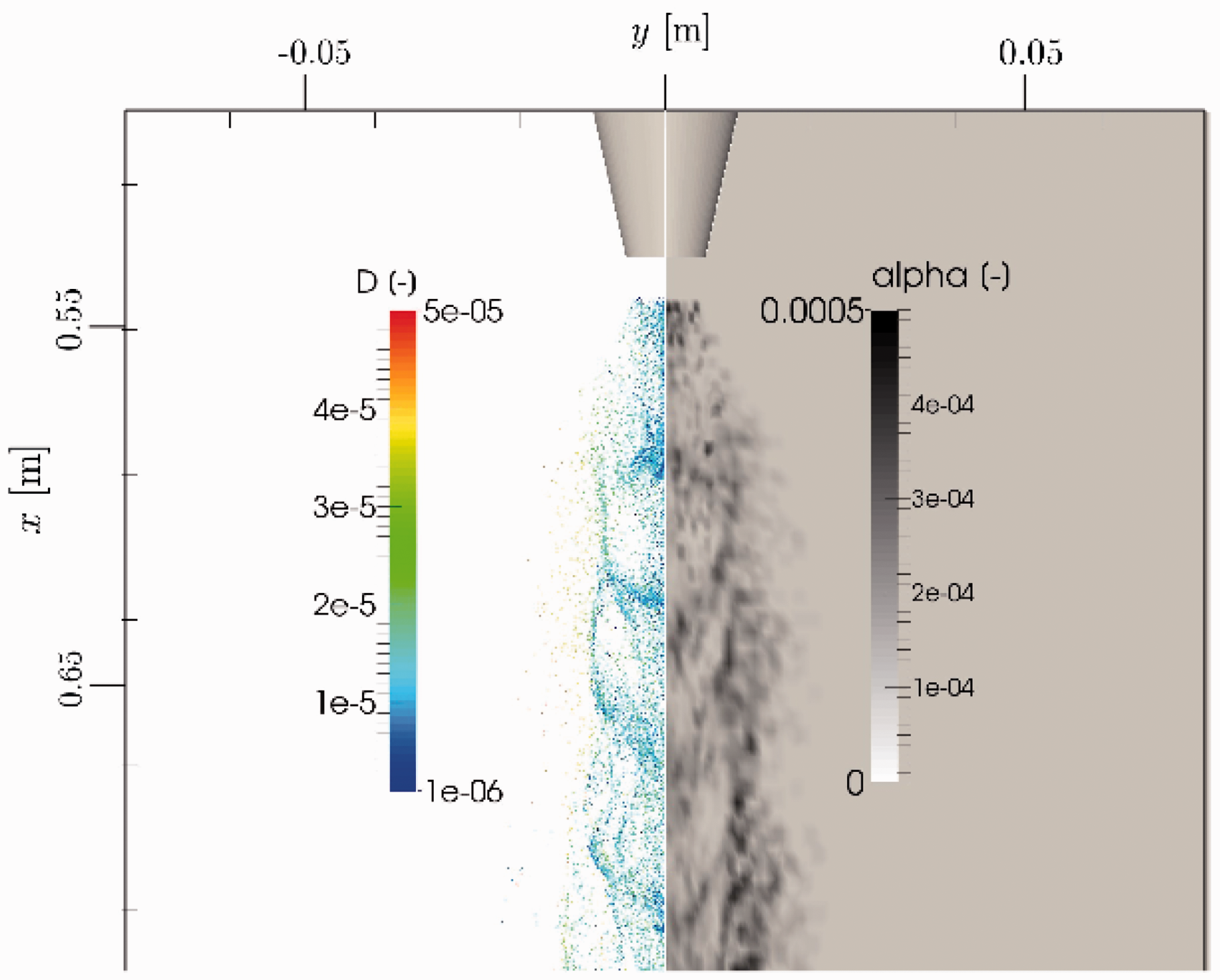
It can be appreciated that dense droplet clusters are formed at the injection zone and transported downstream with the local fluid velocity. The cluster extinguishes progressively downstream, as the air flow velocity decreases.
The DSD was measured experimentally at several positions along the spray axis using phase Doppler particle size analyzer (PDPA)/laser Doppler velocimetry (LDV), but we focus on measurements performed at the pressure standing wave node in particular. In this technique, two lasers intersect forming a small probe window at the measurement location. A droplet crossing this window produces an interference pattern that can be used to determine its size and velocity. Each droplet crossing the probe window contributes to the respective bin of the histogram, according to the phase angle in the acoustic cycle. Thus, after a large amount of acoustic cycles (around 500), the histogram forms a pattern of a modulated DSD. Since accounting for a large amount of acoustic cycles (to emulate the PDPA/LDV measurement) in the CFD simulation is prohibitively expensive, our approach consisted in taking a small computational probe volume to construct the droplet size histograms in time, from the droplets (with their corresponding sizes) contained in such probe volume. The time series of histograms were phase averaged over four cycles.
Predictions of DSD modulation due to spray/acoustic interactions obtained by both EL and PMoM agree qualitatively with experimental observations, see Figure 16: With increasing amplitude of acoustic pressure oscillation, particle numbers at phase Phase-locked DSDs of droplets at the pressure node (x = 0.05 m from the atomizer exit) for different amplitudes of excitation (from left to right 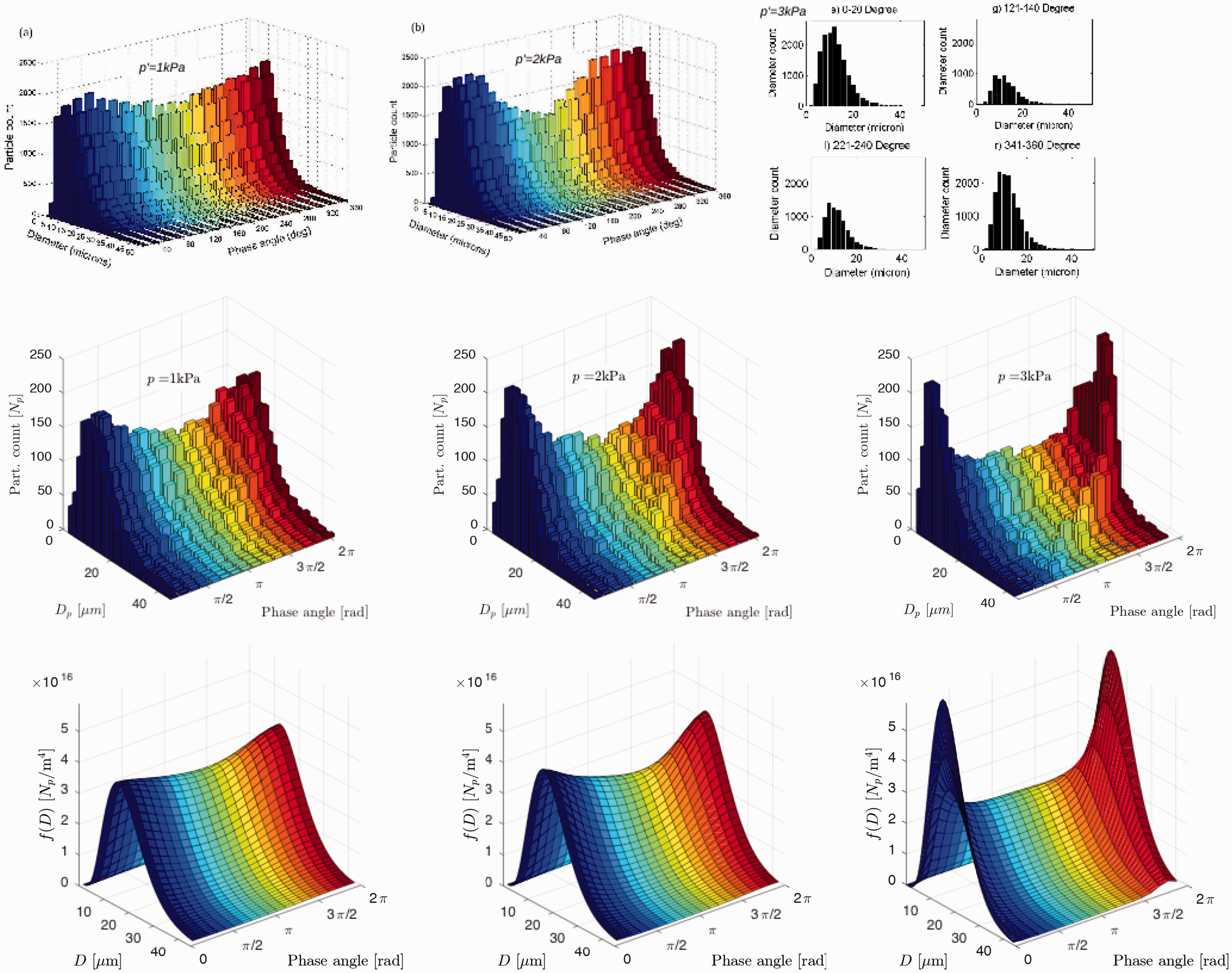
Conclusions
CFD methods have been employed in this work to describe the spray response to an acoustic field. Two important kinds of spray response, AA and ND wave formation, have been identified and characterized. The acoustic displacement (
The hypothesis that the effect of ND wave formation is the dominant mechanism in the experimental configuration of Gurubaran and Sujith 2 has been validated successfully. Potential aspects to be investigated in the future include the assessment of more sophisticated methods to estimate the size–velocity correlation in the EE context, for oscillating flows in particular.
Footnotes
Acknowledgements
We want to specially thank Dr Kumara Gurubaran for providing detailed experimental data for validation.
Declaration of conflicting interests
The author(s) declared no potential conflicts of interest with respect to the research, authorship, and/or publication of this article.
Funding
The author(s) disclosed receipt of the following financial support for the research, authorship, and/or publication of this article: This work has been financially supported by a grant of the Colombian Administrative Department of Science, Technology and Innovation (Colciencias).