




Abstract
In this study, the finite volume method is employed to simulate the coalescence collision between water drops immersed in a continuous phase (n-heptane). It chooses a range of values for the velocity of collisions for the finite volume calculations yielding different possible outcomes of the collision process (permanent coalescence, formation of satellite drops, etc.). The streamlines are calculated for the process of coalescence and fragmentation of drops. These streamlines allow the understanding of the dynamics of the droplets immersed in the n-heptane phase. The effect of the interfacial tension is shown in the oscillations that the droplets exhibit, which after some time tends to the spherical form. It can be seen that when the velocity of collision is 0.2 m/s the droplets do not form an interfacial film just before the onset of coalescence. On the other hand, when the inertial forces are more important with a velocity of collision of 3.5 m/s the system shows an interfacial film of circular section, and when the velocity of collision is increased to a value of 16.0 m/s the system of drops forms a multiple satellite droplets but at the beginning of the dynamics where the circular interfacial film appears.
Introduction
Gokhale et al. 1 studied the coalescence of two condensing drops and shape evolution of the coalesced drops. Also, the image analyzing interferometry has been used to study the coalescence of two drops of 2-propanol and the shape evolution after the coalescence is found to be driven by the capillary forces inside the drop. Ashgriz and Poo 2 conducted an experimental study of the binary collision of water droplets for a wide range of Weber numbers and impact parameters. These authors identified two types of collisions leading to the drops separation, which can be reflexive separation and stretching separation. It is found that the reflexive separation occurs for head-on collisions, while stretching separation occurs for high values of the impact parameter. These authors studied the experiments of the border between two types of separation, and also collisions leading to coalescence.
Menchaca-Rocha et al. 3 conducted a study on the coalescence and fragmentation of mercury drops of equal and unequal sizes. These authors found out the limits for the coalescence measured in terms of the relative velocity and impact parameter. Gates et al. 4 conducted an experimental study on the effect of viscosity on the collision of drops. Various organic substances are used as liquid phase corresponding to a range of viscosities from 0.9 to 48 MPa s. The collision Weber numbers ranged from 10 to 420, and binary collisions of liquid drops were reported using a modified stroboscopic technique, varying the impact parameter.
Mohamed-Kassim and Longmire 5 conducted particle image velocimetry (PIV) experiments to study the coalescence of single drops through planar liquid–liquid interfaces. Sequences of velocity vector fields were obtained with a high-speed video camera and through subsequent PIV analysis. Two ambient liquids with different viscosities but similar densities were examined. After rupture, the free edge of the thin film receded rapidly, allowing the drop fluid to sink into the bulk liquid below. Vorticity generated in the collapsing fluid developed into a vortex ring straddling the upper drop surface. The inertia of the collapse deflected the interface downward before it rebounded upward. During this time, the vortex core split in such a way that part of its initial vortices moved inside the drop fluid while the other part remained in the ambient fluid above it. The velocity of the receding free edge was smaller for higher ambient viscosity and the pinching of the upper drop surface caused by the shrinking capillary ring wave and was stronger when the ambient viscosity was lower. This resulted in a higher maximum collapse speed and higher vorticity values in the dominant vortex ring.
Aarts et al. 6 proposed a study of droplet coalescence in a molecular system with a variable viscosity and a colloid–polymer mixture with an ultra low surface tension. When either the viscosity is large or the surface tension is small enough, it is observed that the opening of the liquid bridge initially proceeds at a constant speed set by the capillary velocity. In the first case studied, one finds that the inertial effects become dominant at a Reynolds number of about 1.5 and the neck then grows as the square root of time. In the second case, one finds that decreasing the surface tension by a factor of 105 opens the way to a more complete understanding of the hydrodynamics involved. Xing et al. 7 put forward a lattice Boltzmann method-based single-phase free surface model to study the interfacial dynamics of coalescence, droplet formation, and detachment phenomena related to surface tension and wetting effects. A perturbation similar to step one in Gunstensen’s color model is added to the distribution functions of the interface cells in order to incorporate the surface tension into the single-phase model. Implementations of the model are verified simulating the processes of droplet coalescence, droplet formation and detachment from the ceiling, and from nozzles with different shapes and different wall wetting properties.
Cristini et al. 8 proposed an algorithm for the adaptive restructuring of meshes on the evolving surfaces. The resulting discretization depended on the instantaneous configuration of the surface. As an application of the adaptive discretization algorithm, some simulations of the drop breakup and coalescence were presented. The results show that the algorithm can accurately resolve detailed features of the deformed fluid interfaces and the slender filaments of the drop breakup as well as dimpled regions with drop coalescence. Baldessari and Leal 9 reported a comparison of the experimental results for flow-induced drop coalescence with the existing theories. For head-on collisions, the experiments showed a plateau with the dependence of drainage time versus the capillary number that cannot be explained by either the existing scaling analysis or the existing thin film theory of the film drainage process. 10 These results indicated that the existing theories were incomplete in providing a framework for a comprehensive explanation of the experimental results. In this study, the authors find that a quasi-static model in which deformation is localized within the thin film is, in general, not sufficient to describe the asymptotic approximation of the flow-induced collision to the coalescence of two slightly deformable drops at low capillary number.
Qian and Law 11 proposed an experimental investigation of binary collisions of drops with emphasis on the transition between different regimes, which may be obtained as an outcome of the collision between droplets. In this study, the authors analyzed the results using photographic images, which showed the evolution of the dynamics exhibited for different values of the Weber number. As a result of the experiment reported by Qian and Law 11 five different regimes governing the collision between droplets were proposed: (i) coalescence after a small deformation, (ii) bouncing, (iii) coalescence after substantial deformation, (iv) coalescence followed by separation for head-on collisions, and (v) coalescence followed by separation for off-center collisions. Jia et al. 12 proposed a lattice Boltzmann simulation for collisions between two liquid drops in an immiscible liquid in linear Stokes flow. The results reported in this reference were compared with the experimental results and the asymptotic solutions. The mixing of a contaminant that was initially contained in one of the drops, was discussed and compared to the results of particle tracking simulations. Jia et al. 12 verified that the Oxford approach of the lattice Boltzmann method can be used to perform useful simulations of drop coalescence in which the mixing of a chemical contaminant occurs that is initially confined to one of the drops. The lattice Boltzmann method solutions were compared with the analytical results. The most significant finding was that after coalescence of a pure drop with a contaminated drop, the contaminant was initially confined to half of the product drop. The results for mixing subsequent to coalescence were in good agreement with the results obtained from the tracking marker particles in the exact flow field for a spherical drop in a shear flow. The simulations with marker particles suggested that mixing occurred more rapidly in drops with much smaller viscosities than the suspending medium and that diffusion is the dominant mechanism of mixing for Schmidt numbers smaller than about 50. For larger values, the dimensionless mixing time was relatively insensitive to the Schmidt number.
Zhang et al. 13 conducted a study on the coalescence of unequal-size drops. In this work, the coalescence of a drop with a flat liquid surface pinches off a satellite droplet from its top, whereas the coalescence of two equally sized drops does not appear to produce, in this case, a satellite drop. These authors found that the critical ratio grows monotonically with the Ohnesorge number and the experimental coalescence of two unequal-size droplets were reported. Wu et al. 14 reported the experimental results on the coalescence of two liquid drops driven by surface tension. Using a high-speed imaging system, these authors studied the early-time evolution of the liquid bridge that was formed upon the initial contact of two liquid drops in the air. It was found that the liquid bridge radius followed the scaling law in the inertial regime. Further experiments showed that such scaling law was robust when fluids of different viscosities and surface tensions were used. The dimensionless pre-factor was measured to be in the range of 1.03–1.29, which was lower than the pre-factor 1.62 predicted by the numerical simulation of Duchemin et al. 15 for inviscid drop coalescence.
Roisman 16 performed a theoretical study on the collision of equal-size drops considering the radial expansion of the droplets, the deformation, and stretching of the surface. He concluded that the deformation of drops in the radial direction was governed by the motion of a ring, while the axial deformation of the drops was governed by the motion of two globules formed at the end of a stretching liquid jet. Yoon et al. 17 carried out a study about the coalescence of two equal-sized deformable drops in an axisymmetric flow using a boundary-integral method. The thin film dynamics are simulated up to a film thickness of the order of 10–4 times the nondeformed drop radius. These authors studied two different regimes for head-on collisions. At lower capillary numbers, the interfaces of the film between the drops remain in a circular flat form up to the film rupture. At higher capillary numbers, the film becomes dimpled at an early stage of the collision process as well as the rate of the film drainage slows down after the dimple formation.
Eggers et al. 18 conducted a study about the dimensions of the bridge that arises when two droplets collide to form a bigger drop. It was concluded that the analyzed problem was asymptotically equivalent to the two-dimensional problem. In addition, these authors studied analytically and numerically the case of coalescence of drops in the presence of an external viscous fluid, finding a toroidal structure.
Rekvig and Frenkel 19 reported a molecular simulation study of the mechanism by which droplets covered with a surfactant monolayer coalesce. These authors proposed a model such that the rate-limiting step in coalescence is the rupture of the surfactant film. For this numerical study, one made use of the dissipative particle dynamics method using a coarse-grained description of the oil, water, and surfactant molecules. It was found that the rupture rate was higher when the surfactant had a negative natural curvature, lower when it had zero natural curvature, and lying in between when it had a positive natural curvature. Narsimhan 20 proposed a model for drop coalescence in a turbulent flow field as a two-step process consisting of the formation of a doublet due to drop collisions followed by the coalescence of the individual droplets occurring after the drainage of the intervening film by the action of van der Waals, electrostatic, and random turbulent forces. The turbulent flow field was assumed to be locally isotropic. A first-passage-time analysis was employed for the random process in the intervening continuous-phase film between the two drops. The first two moments of the coalescence-time distribution of the doublet were evaluated. The average drop coalescence time of the doublet was dependent on the barrier due to the net repulsive force. The predicted average drop coalescence time was found to decrease whenever the ratio of the average turbulent force to repulsive force barrier became larger. The calculated coalescence-time distribution was broader with a higher standard deviation at lower energy dissipation rates, higher surface potentials, smaller drop sizes, and smaller size ratios of unequal drop pairs.
Podgorska 21 reported experimental studies on the coalescence of toluene as well as silicone oil drops of different viscosities and the results of model predictions. The coalescence model was based on the assumption of partially mobile drop interfaces and has been applied for toluene as well as for silicone oil. Three different models for immobilized drop interfaces were proposed for silicone oil of high viscosity. Drop size distributions were predicted by solving the population balance equation with the assumption of partial mobility. This approach yields good results for toluene and quite good results for silicone oil of low viscosity. For silicone oil of high viscosity, drop size distribution cannot be precisely predicted by simple models because drops of different sizes behave in completely different ways. However, the proposed models allow discussion of the experimental observations.
Sun et al. 22 conducted a study of deformation and mass transfer for binary droplet collisions with the moving particle semi-implicit method. A surface tension model was implemented in numerical simulations to study large deformation processes and a mechanism map was reported to distinguish different collisions regimes. Brenn and Kolobaric 23 conducted a study on satellite droplet formation in unstable drop collisions. Based on the data from experiments on the formation and breakup of ligaments, the process of satellite droplet formation was modeled by Brenn and Kolobaric 23 and the experiments were carried out using streams of various liquids. On the other hand, it was observed that for a high-energy collision Weber number, permanent coalescence occurred and the biggest drop was deformed producing some satellite drops.
Governing equations
The governing equations can be given by the continuity equation (1) and the momentum equation (2)

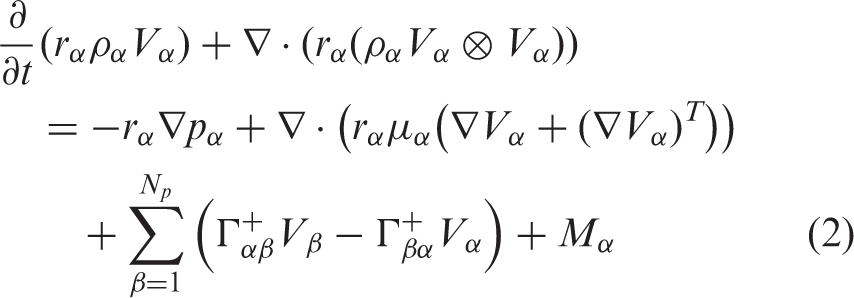
CFX® (ANSYS® 15.0, ANSYS®, Inc. Southpointe 2600 ANSYS Drive Canonsburg, PA, USA), a flow solver based on the finite volume method, was used to solve equations (1) and (2). A rectangular mesh was used for this calculation with 360,000 elements. Inside the CFX module was defined the following constants: ρ(n-heptane) = 683.8 kg/m3, ρ(water) = 1000.0 kg/m3, µ(n-heptane) = 0.000408 × 10⁻³ kg/m.s, µ(water) = 1.12 × 10⁻³ Pa.s, rdrop = 15.0 × 10⁻⁶ m, σ(water/n-heptane) = 49.1 × 10⁻³ N/m. Here rdrop is the droplet radius, σ(water/n-heptane) is the interfacial tension of the system water–heptane.
The surface tension model
The surface tension contributes a surface pressure that is the normal force per unit interfacial area “A” at points

If two fluids are considered, fluid 1 and fluid 2, separated by an interface at time t, the two fluids then are distinguished by some characteristic function, c(x)
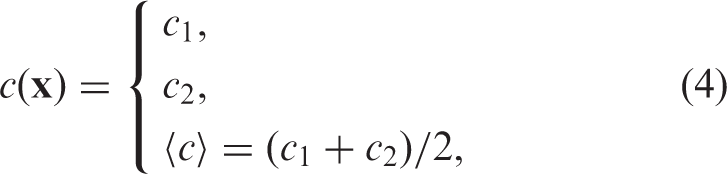

Consider replacing the discontinuous characteristic function by a smooth variation of fluid color c′(
The interface where the fluid changes from 1 to 2 discontinuously is changed by a continuous transition. Consider a volume force,


If

The smoothed function c′(

The function c′(

The Gauss theorem can be used here to convert the volume integral to an integral over the interface A

From the integral in equation (11), a weighted mean of the surface normal can be computed. Since
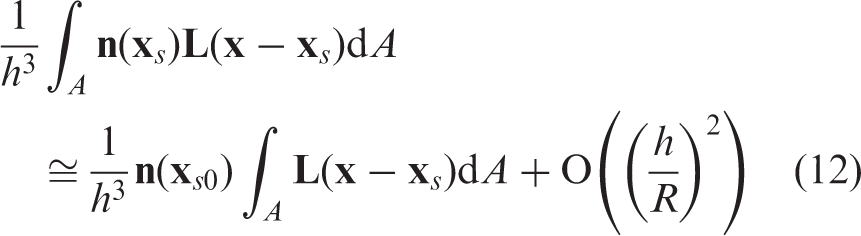

As h → 0,

Then the limit h → 0 of

This delta function can be used to rewrite
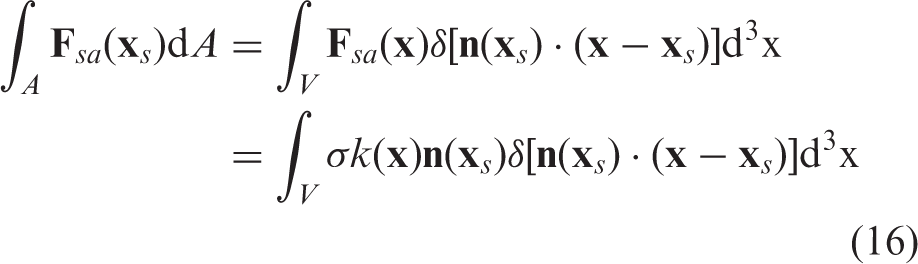
The delta function converts the integral of

If equation (17) is compared with equation (6) the volume force

Coalescence and fragmentation of liquid drops
In order to model the collision of liquid drops, some calculations were carried out using the volume finite method. Velocity of collision with values of 0.2 m/s, 3.5 m/s, and 16.0 m/s were chosen, which correspond to coalescence and fragmentation of water drops immersed in n-heptane continuous phase.
In Figures 1 and 2 is shown a sequence of snapshots for the collision between two water drops (blue color) immersed on a hydrocarbon continuous phase (white color). It can be seen that for a velocity of collision of 0.2 m/s the coalescence of drops is carried out, without the formation of the circular interfacial film that is reported in the literature. This behavior occurs because the liquid that drains out between the droplets has the time enough to drain and no fluid is trapped at the interface of the drops.
Sequence of times showing the evolution of the collision between two drops with Vcol = 0.2 m/s. The time scale is given in seconds. Sequence of times showing the evolution of the collision between two drops with Vcol = 0.2 m/s. The time scale is given in seconds.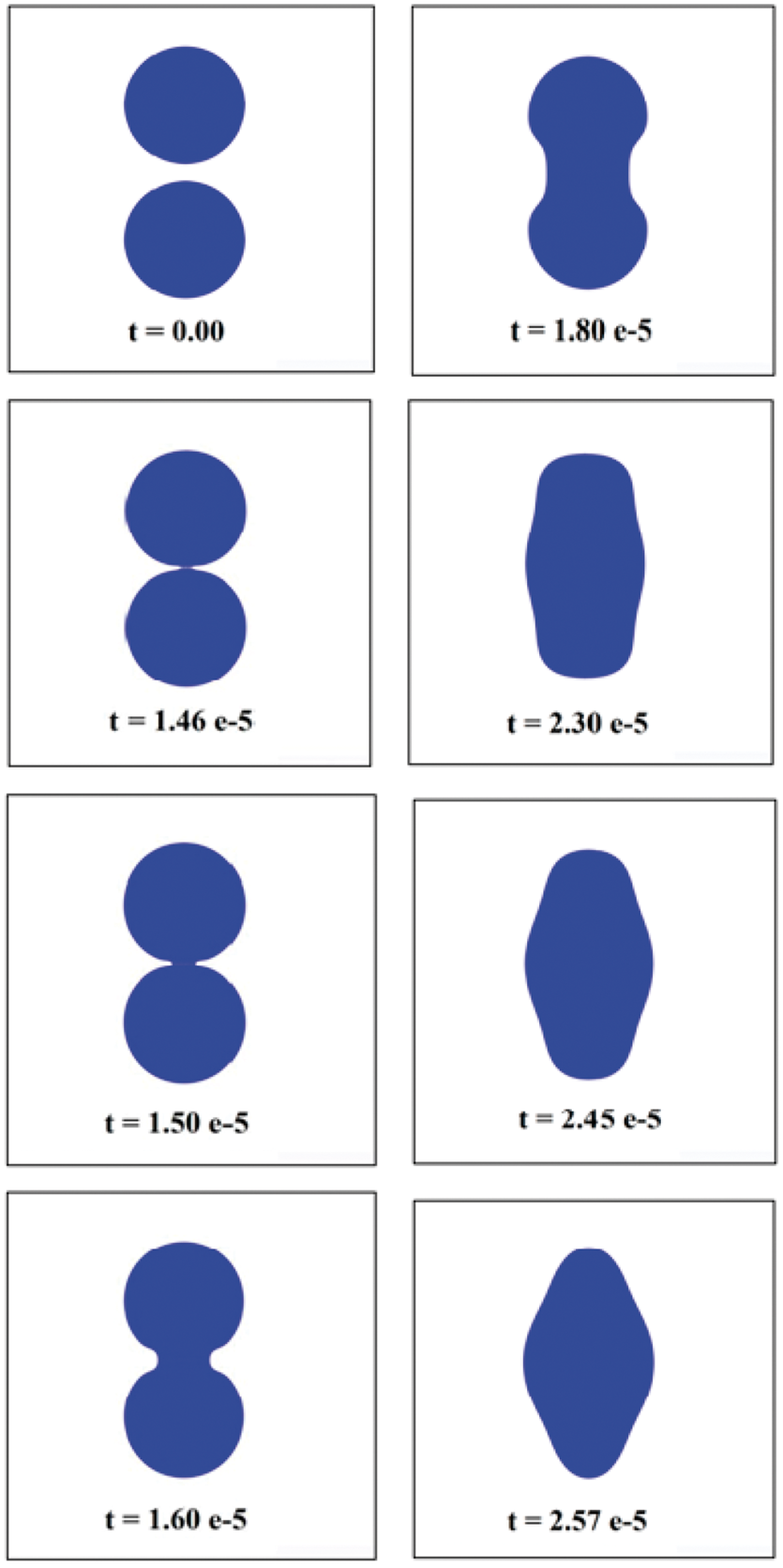
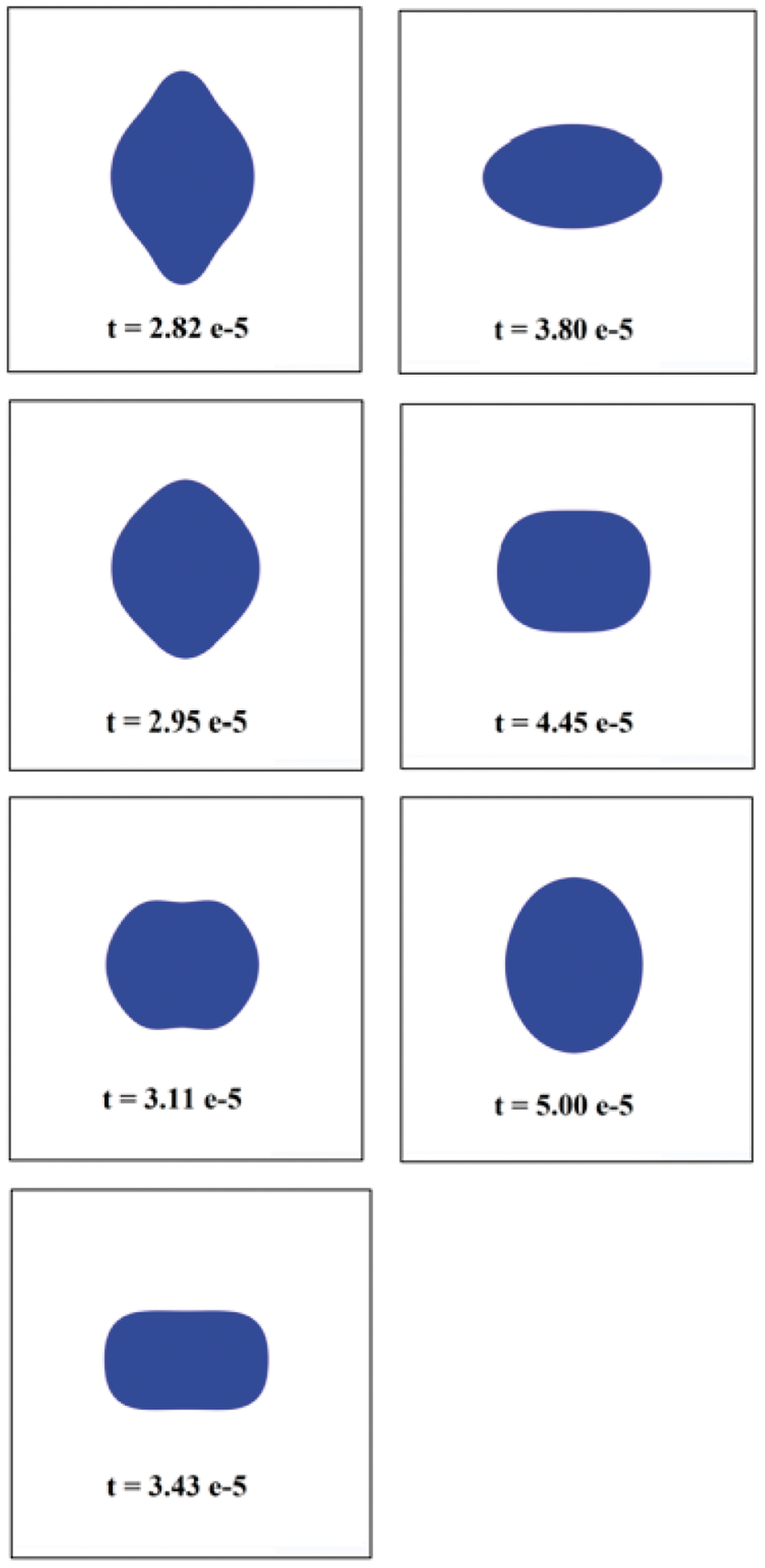
In fact, for this case the surface tension forces prevailing over inertial forces and the dynamics of the system water–heptane show multiple oscillations at the surface of the bigger droplet that is a result of the coalescence process. At t = 1.46 × 10⁻⁵ s, a little point of contact is seen between the two drops that form a bridge structure with the dispersed phase. After this period of time, the evolution of the system shows the increment of the radius of this bridge and the whole system exhibits a combination of the vibrational modes of a circular membrane. At t = 5.0 × 10⁻⁵, it is shown that the system recovers its circular form.
In Figure 3 it can be seen the internal streamlines for the system of drops are at t = 1.5 × 10⁻⁵ s and t = 1.6 × 10⁻⁵ s. Once the surfaces of the drops touch between them, the internal flux of the droplets changes its direction only at the point of contact between the drops. In fact, at the bridge of circular section the stream lines are in the direction of the flux that drains out at the zone of interaction between them.
Streamlines for the system water–heptane with Vcol = 0.2 m/s. The time scale is given in seconds.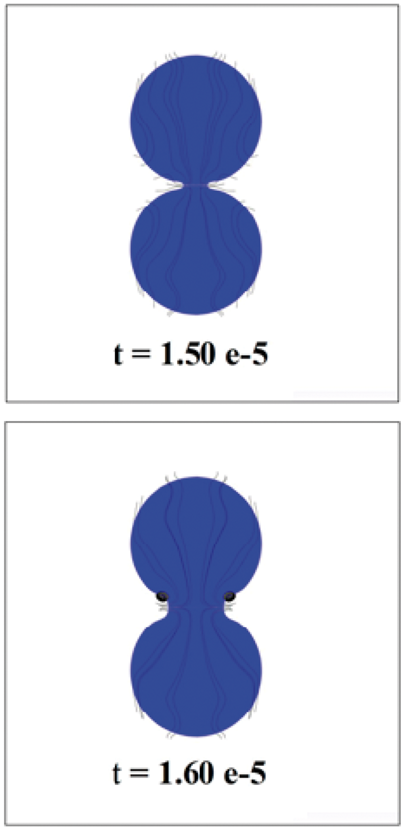
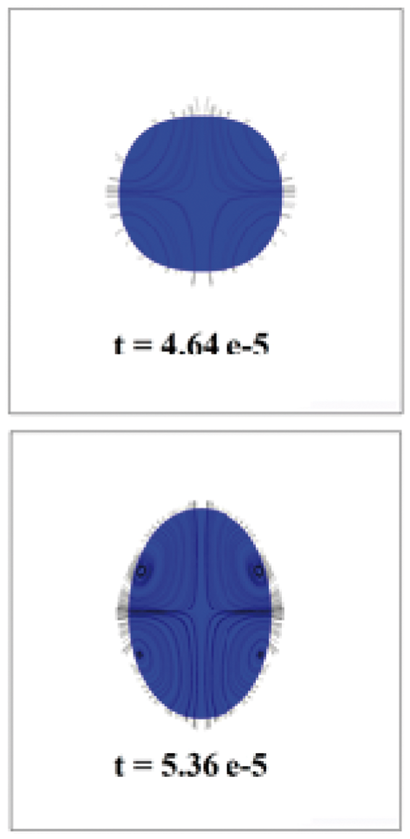
In Figures 4 and 5 are shown the streamlines for the biggest drop once the coalescence process occurs. At this stage of the dynamics, the drop exhibits a local circular patron of flux inside the water drop that is divided into four regions. Depending on the oscillations over the surface of the drops the streamlines modify its form. At t = 5.36 × 10⁻⁵ s are shown the streamlines for the drop at the end of the dynamics with its approximately circular form. In this snapshot, four circular regions of fluxes inside the bigger drop can be observed clearly.
Streamlines for the system water–heptane with Vcol = 0.2 m/s. The time scale is given in seconds. Streamlines for the system water–heptane with Vcol = 0.2 m/s. The time scale is given in seconds.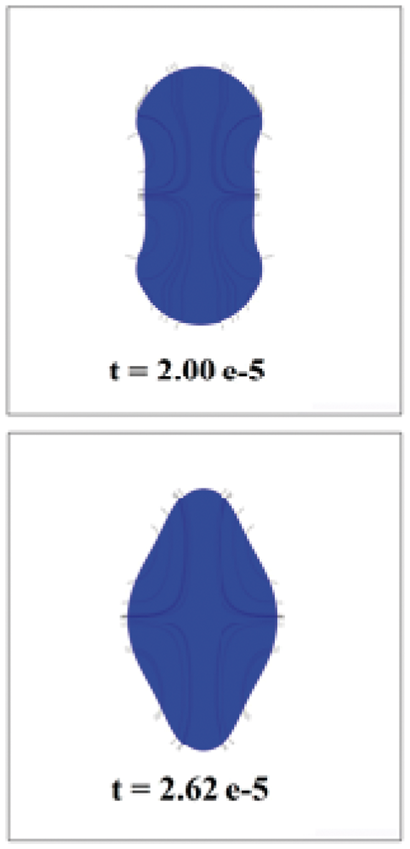
In order to model the coalescence phenomenon and the formation of the interfacial film between the drops, a collision velocity of 3.5 m/s was chosen for the water droplets immersed in the hydrocarbon phase (n-heptane). In Figures 6 to 8 is shown a sequence of times for the collision between the water drops. It can be seen that for a velocity of collision of 3.5 m/s at t = 2.0 × 10⁻⁶ s the deformation of the droplet surface has begun. In the next snapshot, the formation of the interfacial film can be seen and is completely formed at t = 4.5 × 10⁻⁶ s.
Sequence of times showing the evolution of the collision between two drops with Vcol = 3.5 m/s. The time scale is given in seconds. Sequence of times showing the evolution of the collision between two drops with Vcol = 3.5 m/s. The time scale is given in seconds. Sequence of times showing the evolution of the collision between two drops with Vcol = 3.5 m/s. The time scale is given in seconds.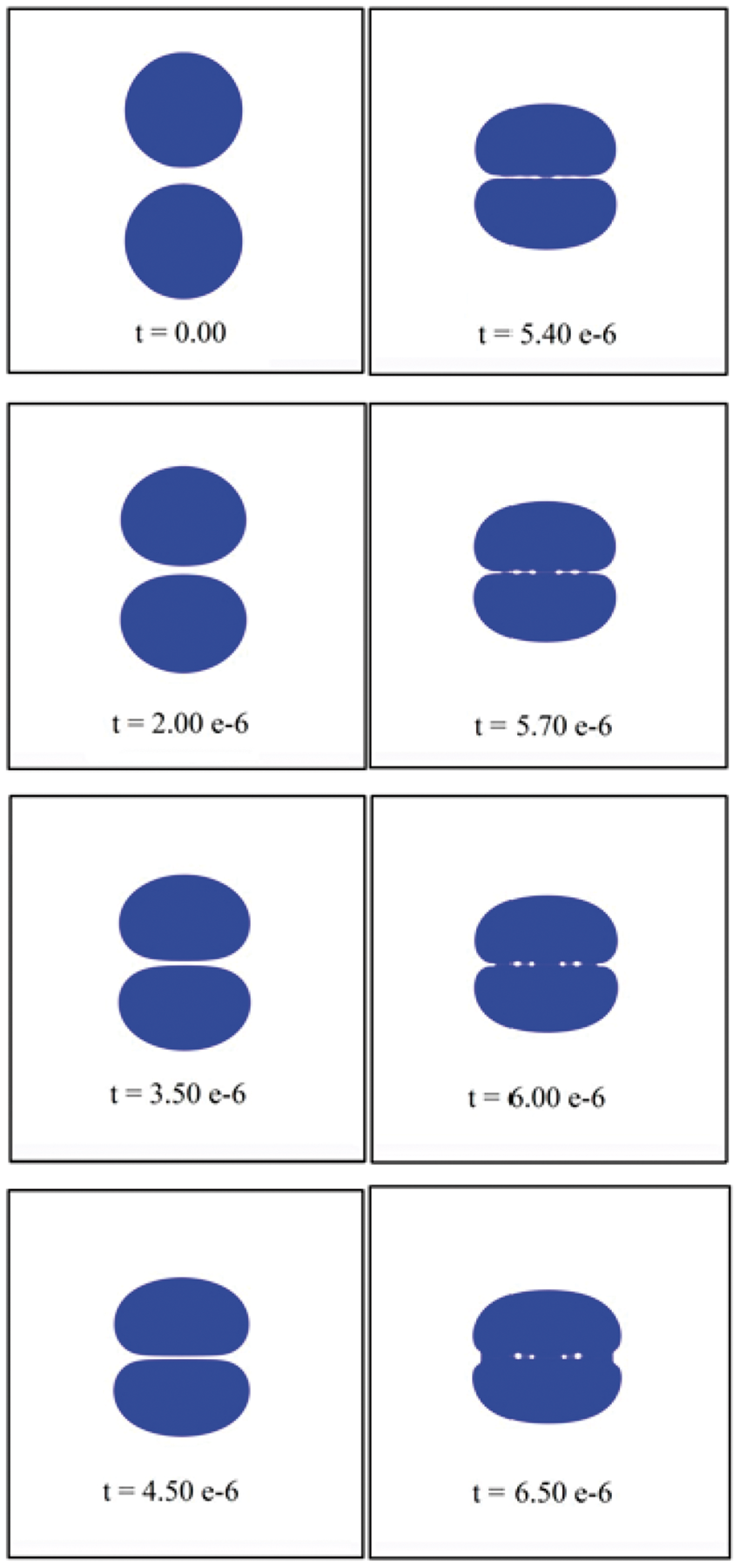
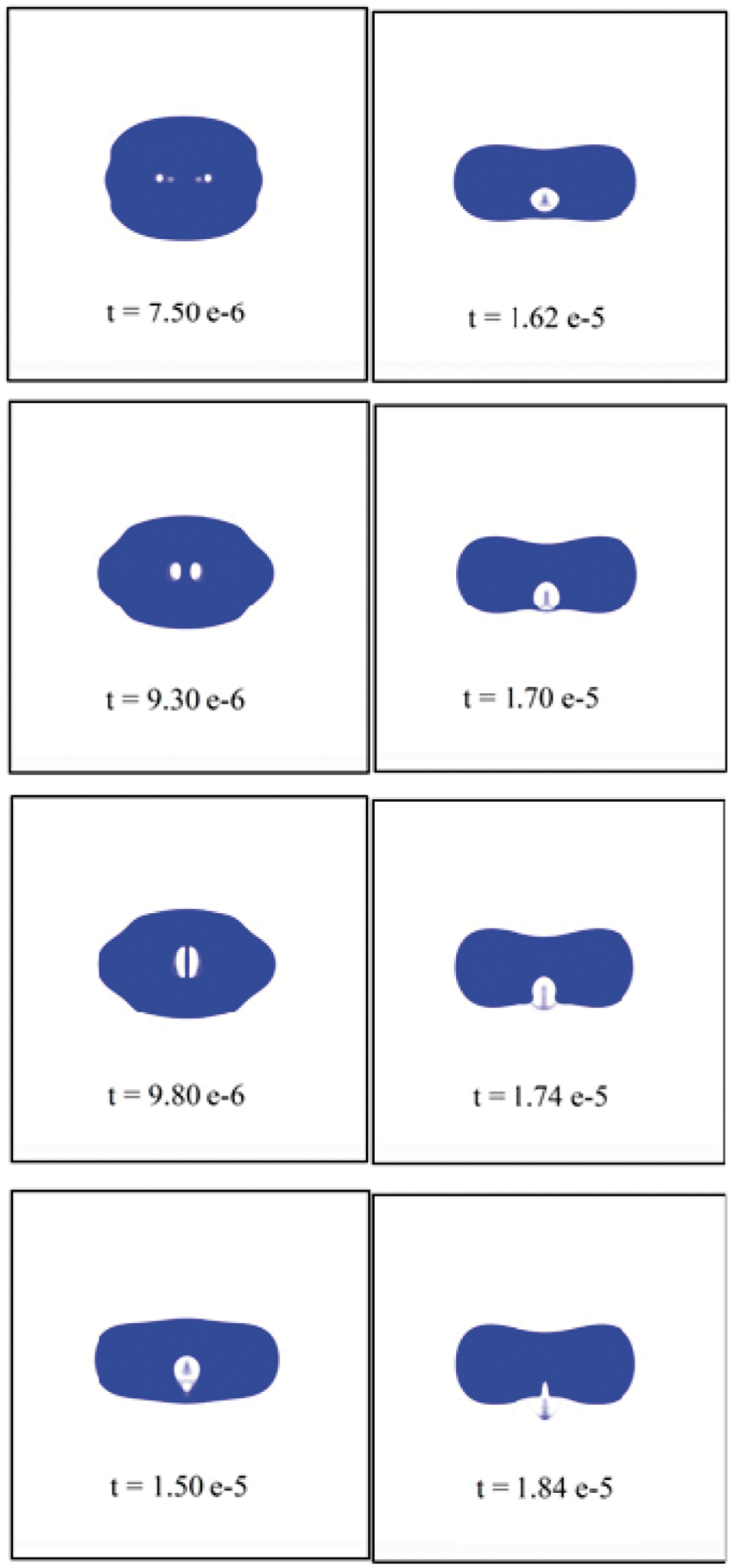
At t = 5.4 × 10⁻⁶ s, a wavefront begins to move on the surface of the drops inside the interfacial film. This wavefront with the evolution of the dynamics caused a collapse of the interfacial film, in fact at t = 5.7 × 10⁻⁶ s the coalescence phenomenon begins at the center of the film. After this, at t = 6.0 × 10⁻⁶ s there are multiple points of coalescence and a little fraction of n-heptane is trapped in the interfacial film. This amount of hydrocarbon forms a little drop inside the water drop, in fact the coalescence of the n-heptane little drops can be seen from t = 7.5 × 10⁻⁶ s to t = 9.0 × 10⁻⁶ s.
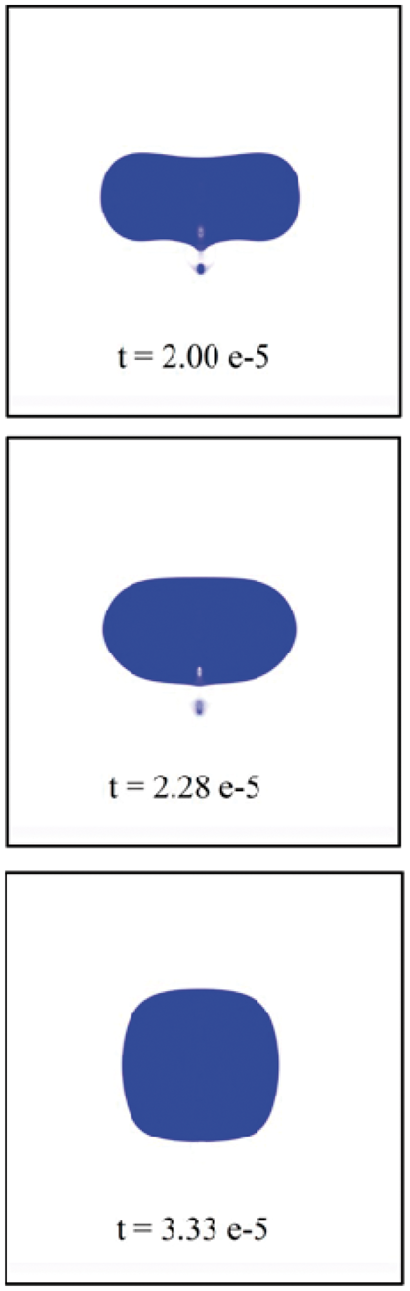
At the subsequent snapshot, the hydrocarbon droplet starts to move out of the bigger water drop and is expelled completely at t = 2.3 × 10⁻⁵ s. The biggest drop approximately reaches its circular form at t = 3.3 × 10⁻⁵ s. For the initial value of the velocity of collision (Vcol = 3.5 m/s), it can be seen that the bigger drop that arises from the collision process exhibits very interesting oscillations of its surface due to the surface tension forces that transform the deformed mass of water into a very well-defined circular drop.
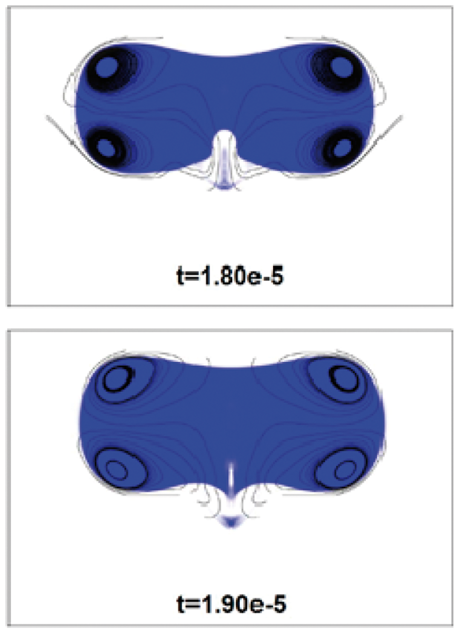
In Figures 9 and 10 are shown the streamlines that explains why the hydrocarbon droplet is expelled out of the bigger water drop. At t = 1.6 × 10⁻⁵ s, the internal flux inside the water drop start to expel the hydrocarbon droplet out of this zone of the fluid. Analogue to the first case a circular patron of four fluxes in the water drop can be seen. This patron of internal fluxes makes that the drop tends to a circular form with the aid of the surface tension forces.
Streamlines for the system water–heptane with Vcol = 3.5 m/s. The time scale is given in seconds. Streamlines for the system water–heptane with Vcol = 3.5 m/s. The time scale is given in seconds.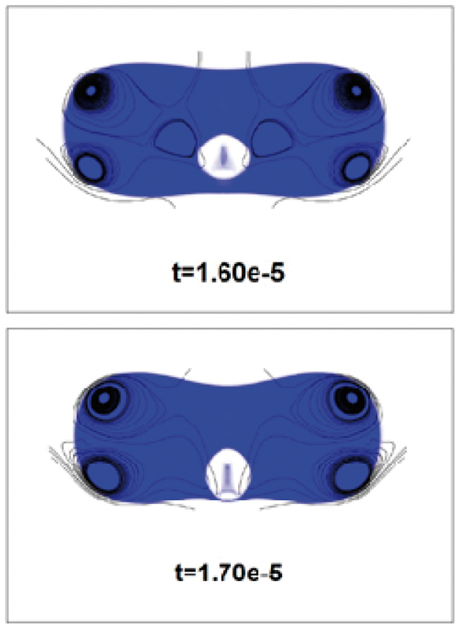
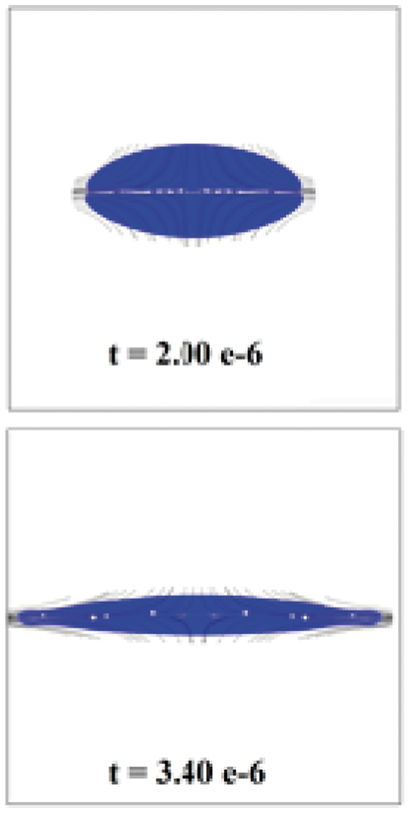
In order to simulate the fragmentation phenomenon using the finite volume method, two drops of water were chosen with a collision velocity of 16.0 m/s. These water drops were immersed in a continuous phase composed of a hydrocarbon (n-heptane). In Figure 11, a sequence of several snapshots for the dynamics of deformation and fragmentation of drops is shown. At t = 6.0 × 10⁻⁷ s it can be seen certain stretch of the surface of the drops due to the drainage of the interfacial film between them. This interfacial film diminishes its thickness until the film collapses and the drops coalesce. At t = 3.0 × 10⁻⁶ s, the coalescence process began and certain portions of hydrocarbon was trapped inside the mass of water. With the evolution of the dynamics it can be seen that the mass of water diminishes its thickness and forms a ligament. This ligament is broken and form many little ligaments (see Figure 11 at t = 7.1 × 10⁻⁶ s). After that, by means of the surface tension forces these ligaments tend to recover its circular form and give rise to many satellite droplets (see Figure 11 at t = 8.4 × 10⁻⁶ s).
Sequence of times showing the evolution of the collision between two drops with Vcol = 16.0 m/s. The time scale is given in seconds.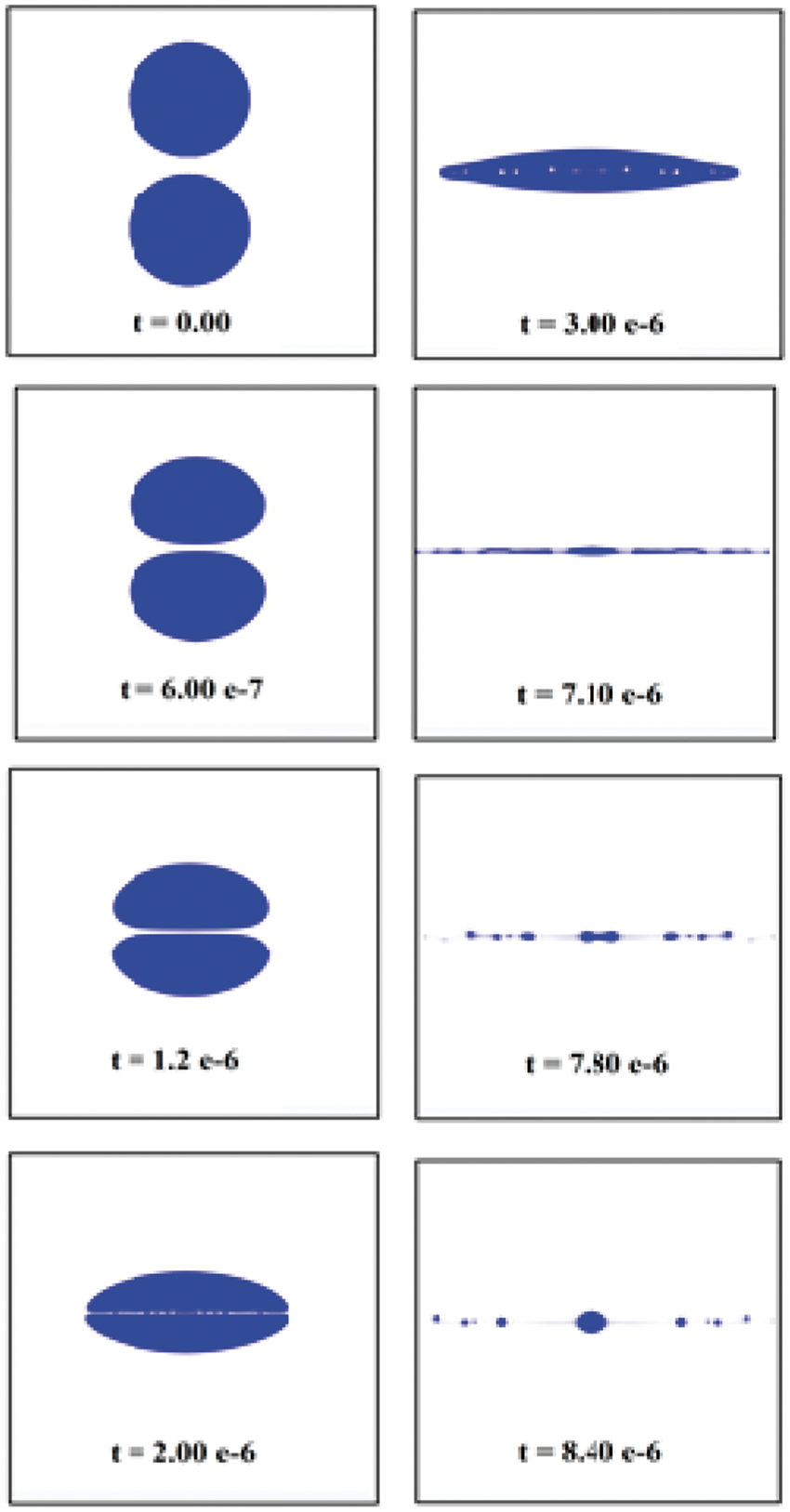
In Figures 12 and 13 are shown the streamlines for the flux inside the drops and outside of them. These streamlines establish the direction of the flux and allow the understanding of why the drops tend to form a ligament with the initial velocity of collision of 16.0 m/s. At t = 1.3 × 10⁻⁶ can be seen the direction of the flux of the interfacial film that diminishes its thickness with time.
Streamlines for the system water–heptane with Vcol = 16.0 m/s. The time scale is given in seconds. Streamlines for the system water–heptane with Vcol = 16.0 m/s. The time scale is given in seconds.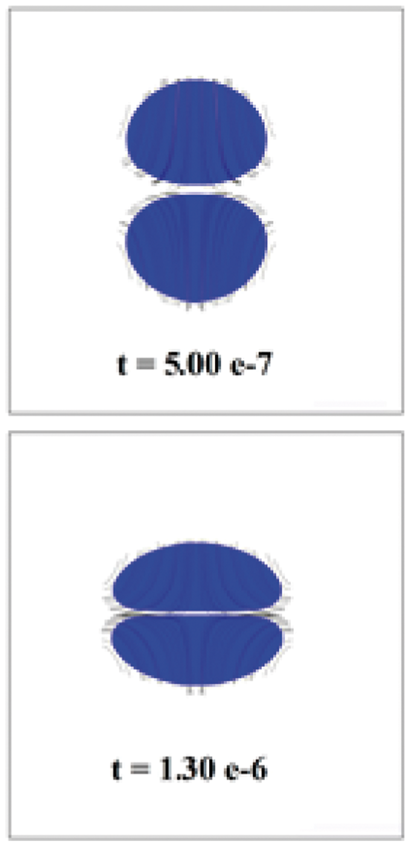
Conclusions
In this paper, an adequate methodology for the study of droplet collisions was presented. The equations of fluid mechanics were resolved using the volume finite method for a system composed of water and one hydrocarbon (n-heptane) that represents a continuous phase. Depending on the velocity of collision, three different outcomes were shown such as: coalescence without formation of interfacial film, coalescence with the formation of the interfacial film and fragmentation, and formation of satellite droplets. When the velocity of collision was 0.2 m/s the water drops coalesce instantly and there was no formation of the interfacial film, in this case the surface of the drops retained its circular form without any deformation prior to the coalescence. The streamlines are shown for the flux of water inside the biggest drop and it can be seen that this flux can be divided into four regions where the flux is circular when the coalescence is completed. On the other hand, when the velocity of collision was 3.5 m/s, the drops stretch its surface and the formation of the interfacial film arises after this step in the dynamics of the system. The corrugations that appear in the interfacial film form several little drops of hydrocarbon inside the mass of water and these drops in the dynamics of the system coalesce. The streamlines allow the understanding of why a little hydrocarbon drop is expelled out the mass of water and follow that direction. When the velocity of collision was 16.0 m/s, the system exhibits the formation of the interfacial film too, but this time the inertial forces prevailing over the surface tension forces and the mass of water form a ligament. This ligament forms many little ligaments that allow the formation of many satellite drops. This is due to the surface tension forces acting over these ligaments of water. Finally, the streamlines show the internal trajectories of the fluid inside the drops showing the direction of the flow of mass that allow the formation of these ligaments.
Footnotes
Declaration of conflicting interests
The author(s) declared no potential conflicts of interest with respect to the research, authorship, and/or publication of this article.
Funding
The author(s) received no financial support for the research, authorship, and/or publication of this article.