




Abstract
In this study, numerical calculations of the collision process between water drops immersed in a continuous phase composed of a hydrocarbon (n-heptane) is reported. For the resolution of the hydrodynamic equations, i.e., the continuity and momentum equations, the finite volume method was used. A range of values for the velocity of collision between the drops was chosen. These values for the velocity of collision give two different outcomes. For these off-center collisions, it is shown that the system of drops rotates around its mass center acquiring certain angular momentum. When the velocity of collision is 0.2 m/s, the system of drops coalesces without the deformation of the surface of the drops and the prevailing surface tension forces. These surface tension forces with the evolution of the dynamics transform the bigger mass of water as a very well-defined circular drop. For a velocity of collision of 3.5 m/s, the system shows coalescence with a rotation of a bigger mass of water with certain angular momentum. In this case, there is a stretch of the surface of the drops, but due to the value of the velocity of collision, the prevailing inertial forces and the bigger mass of water are deformed spinning around its mass center.
Introduction
Experimental studies of the binary collision of alkane droplets were carried out by Ashgriz and Givi.1,2 These authors found that when the Weber number is increased, the collision takes the form of a high-energy one and different types of results arise. In these references, the results show that the collision of the droplets can be bouncing, grazing, and generating satellite drops. A similar experimental study about the binary collision of equal-size alcohol droplets has been carried out by Brenn and Frohn, 3 showing different stages of the collision process. The collisional dynamics of equal-sized liquid drops was also studied by Jiang et al. 4 In this work, it is reported that the experimental results of the collision of water and normal-alkane droplets in the radius are in the range of 150 µm. These results show that for the range of Weber numbers studied, the behavior of hydrocarbon droplets is more complex than that of water droplets. For head-on collisions, the permanent coalescence always results for water droplets.
Eow and Ghadiri 5 report a study on the effects of the direction of the applied electric field as well as the geometry of the electrodes. In this study, the angle between the electric field and the center line of two drops (θ) should be zero for the electrically induced force to attain its maximum attractive value. The maximum induced force is chosen to be large enough to deform the adjacent surfaces of the drop prior to coalescence. It has been shown experimentally and theoretically that the drop–drop attraction can occur also when θ is less than 54.7° or more than 125.3°. Roisman et al. 6 studied the collisions of liquid drops dominated by inertial forces. These authors compare the experimental data with numerical simulations for the shape of the lamella that is generated by the droplets impact. The results show that for Reynolds number and Weber number high enough, the evolution of the lamella thickness is independent of the viscosity and surface tension. Wang et al. 7 studied the effect of glycerol on the coalescence of water drops in stagnant oil phase. In this reference, the authors consider the binary coalescence of water drops formed through the capillaries at low inlet flow rates in an immiscible stagnant oil phase. The evolution of the coalescence process is shown in this case.
Gotaas et al. 8 propose a method for determining the boundaries between the different outcomes that can be achieved in the collision of liquid drops setting the Weber number and varying the impact parameter. Menchaca-Rocha et al. 9 investigate the collision of two mercury drops at very low kinetic energy using fast digital and analog imaging techniques. In this paper, these authors studied the time evolution of the surface shape as well as an amplified view of the contact region. Thoroddsen et al. 10 conducted an experimental study of surface profiles and propagation of Marangoni waves along the drop surface. One finds that the capillary-Marangoni waves along the water drop show self-similar character when measured in terms of the arc length of the original surface.
Eow and Ghadiri 11 propose a study about the behavior of a liquid–liquid interface and drop-interface coalescence under the influence of an electric field. In this work, the authors report experiments that show the measured electric current through water-sunflower oil and water-n-heptane systems, induced by an applied potential difference that increases linearly until a particular value, beyond which the measured current changes very rapidly. For various thicknesses of the water layer and the organic phase layer, the electric current corresponding to the turning points in the voltage–current characteristic curves is between 3.7 and 18 nA. It is observed that the turning point of the voltage–current characteristic curve for a liquid–liquid system is caused by the formation of a cone at the interface. Above this turning point, the intensification of the local electric field above the tip of the cone is believed to be responsible for the very fast increase in the measured electric current. The measurement of the electric current can be used to monitor and control the behavior of a liquid–liquid interface, thus providing an optimum condition for instantaneous and single-staged drop-interface coalescence.
Li 12 and Chen 13 studied the coalescence of two small bubbles or drops using a model for the dynamics of the thinning film in which both London-van der Waals and electrostatic double layer forces are taken into account. Li 12 proposes a general expression for the coalescence time in the absence of the electrostatic double layer forces. The model proposed by Chen 13 describes the film profile evolution and predicts the film stability, time scale, and film thickness, depending on the radius of the drops and the physical properties of the fluids and surfaces. Foote 14 proposes a method to study the dynamics of liquid drops by a numerical integration of the Navier–Stokes equations. This author examines the motion of droplets with application to the raindrop problem. The study was restricted to the collision of equal-sized drops along their line of centers. Numerical solutions are developed to study the rebound of water droplets in the air. It is found that, except for a small viscous effect, the Weber number of the drops determines the dynamics of the collision and the bounce time.
Leal 15 conducted a study about the coalescence of drops in a viscous fluid in the absence of inertial effects. This study is based on visual observations of drops with diameters between 20 and 100 μmthinsp; μmmicro;m that collide in a linear flow. The effect of adding a copolymer to the interface is studied. It is found that the conditions for coalescence are indicative of a complicated sequence of film configurations during the thinning process. Nobari et al. 16 propose a numerical study to simulate head-on collisions of equal-sized drops. These authors solve the Navier–Stokes equations using a finite difference method. In the model proposed by Nobari et al., 16 the drops approach to each other until the force between them is removed before the collision occurs. When the collision occurs, the fluid between the drops drains out. This leads to the formation of a thin layer that interacts with the surfaces of the drops. Then this layer is artificially removed to model the surface rupture.
Decent et al. 17 studied the formation of a liquid bridge during the coalescence of droplets. These authors consider a model in which the pressure singularity is removed at the instant of the impact for the coalescence of two viscous liquid volumes in an inviscid gas or in a vacuum environment. The formation of the liquid bridge is examined in two cases: (a) two infinitely long liquid cylinders, and (b) two coalescing spheres. In both cases, the numerical solutions are calculated for the velocity and pressure fields and the removal of the pressure singularity is confirmed. Azizi and Al Taweel 18 propose a new methodology for solving the discretized population balance equation (PBE) by minimizing the finite domain errors that often arise when discretizing the drop size domain to study drop breakup and coalescence. Use is made of the size distribution sampling approach combined with a moving grid technique. In addition, an enhanced solution stability algorithm was proposed which relies on monitoring the onset of errors in the various birth and death terms encountered in PBE. This allows for corrective action to be undertaken before the errors propagate in an uncontrollable way. This approach was found to improve the stability and robustness of the solution method even under very high shear rate conditions.
Mashayek et al. 19 study the coalescence collision of two liquid drops using a Galerkin finite element method in conjunction with the spine-flux method for the free surface tracking. The effects of some parameters like Reynolds number, impact velocity, drop size ratio, and internal circulation in the coalescence process are investigated. The long-time oscillations of the coalesced drops and the collision of unequal-size liquid drops are studied to illustrate the liquid mixing during the collision. The coalescence for different liquids is also studied, finding that the coalescence velocity of a water drop with a more viscous liquid is nearly independent of the viscosity difference strength.
Acevedo-Malavé et al. 20 consider the problem of the film drainage between two drops and vortex formation in thin liquid films. These authors also develop a simple model to describe dimple dynamics. 20 Pan and Suga 21 study the process of collision between two drops solving the Navier–Stokes equation coupled with the convection equation in order to model the interface between the drops and a gas phase. The simulations cover four regimes of binary collisions, which are: bouncing, coalescence, reflexive separation, and stretching separation. The numerical results reported by Pan and Suga 21 suggest that the collisions that lead to rebound between the drops are governed by the macroscopic dynamics. The authors also studied the mechanism of formation of satellite drops, confirming that the principal cause of the formation of satellite drops is the “end pinching,” while the capillary wave instabilities are the dominant feature in cases where a large value of the impact parameter is employed.
In this paper, the continuity and momentum equations are resolved using the finite volume method. Off-center collisions (see Figure 1) are studied for droplets of water immersed in a continuous phase composed by one hydrocarbon (n-heptane). The streamlines are shown for a determined situation; this allows the understanding of the dynamics that follow the drops with the evolution of time.
Definition of the problem: off-center coalescence collision of two drops of equal-size approaching with a velocity of collision Vcol and radius R immersed in a continuous phase (n-heptane). X is the projection of the separation distance between the centers of the colliding drops normal to the relative velocity vector and gives a measure of the degree to which the collision is off-center (it is choose X = R).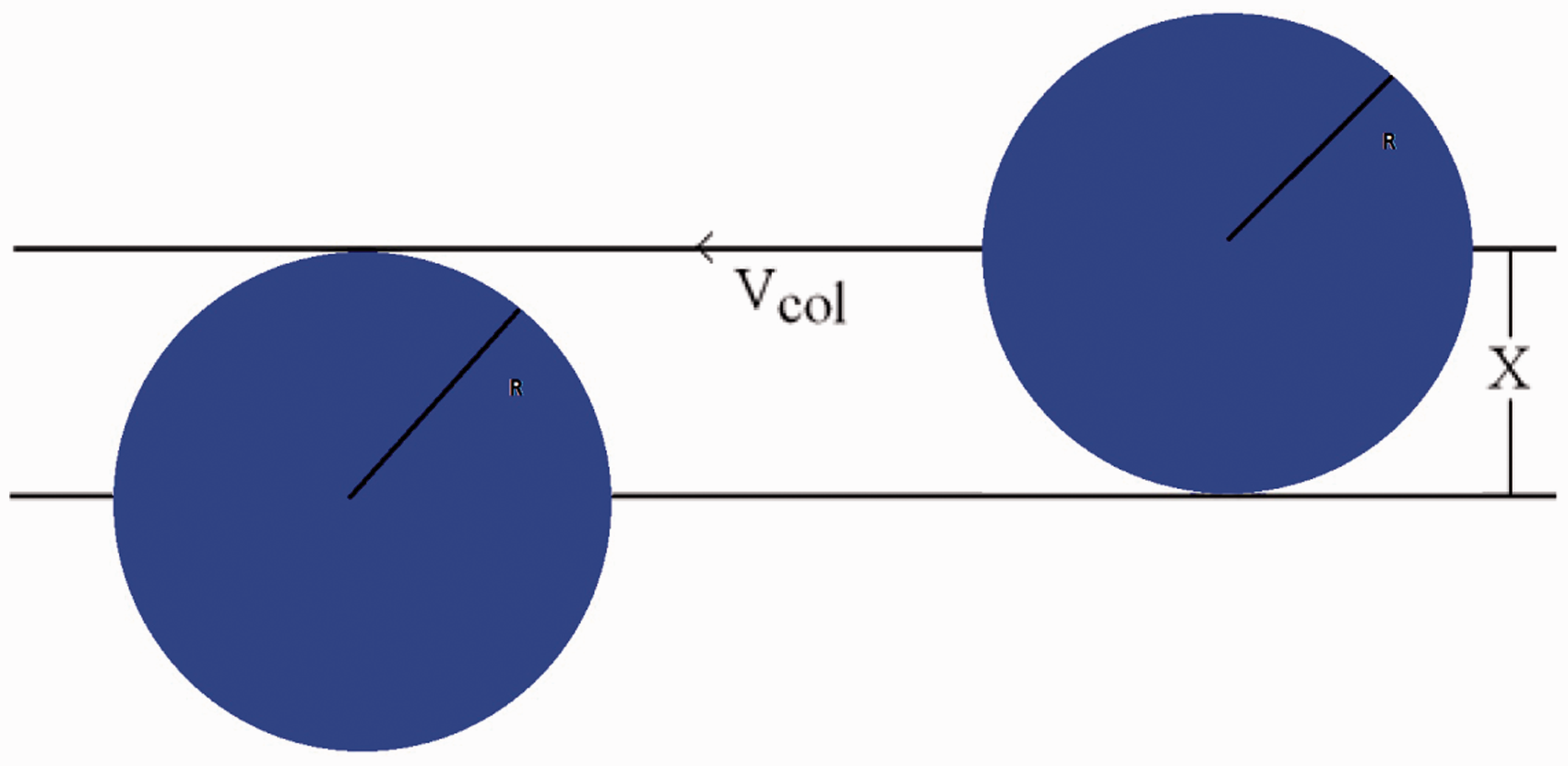
Governing equations
The governing equations can be given by the continuity equation (1) and the momentum equation (2)

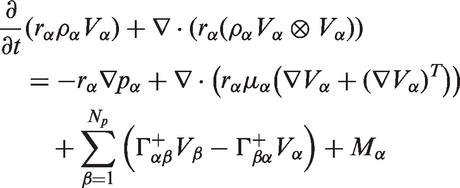
CFX® (ANSYS® 15.0, ANSYS®, Inc. Southpointe 2600 ANSYS Drive Canonsburg, PA 15317, USA), a flow solver based on the finite volume method, was used to solve equations (1) and (2). A rectangular mesh was used for this calculation with 360,000 elements. Inside the CFX module was defined the following constants: ρ(n-heptane) = 683.8 kg/m3, ρ(water) = 1000.0 kg/m3, μ(n-heptane) = 886.0 × 10⁻⁶ Pa.s, μ(water) = 1120.0 × 10−6 Pa.s, R = 15.0 × 10⁻⁶ m, σ(water/n-heptane) = 49.1 × 10⁻³ N/m. Here R is the droplet radius, σ(water/n-heptane) is the interfacial tension of the system water-heptane.
The surface tension model
Surface tension is the force that holds the interface together and this effect is included here according to the method that is described in Acevedo. 22 The surface tension formalism is based on a continuum surface force model. 22 This models the surface tension force as a volume force concentrated at the interface, rather than a surface force. The two terms summed on the right hand side of the equation of the continuum force defined in Acevedo 22 reflect the normal and tangential components of the surface tension force, respectively. The normal component arises from the interface curvature and the tangential component from variations in the surface tension coefficient (the Marangoni effect). Other term is often called the interface delta function; it is zero away from the interface, thereby ensuring that the surface tension force is active only near to the interface. When the interface between the two fluids intersects a wall, it is possible to account for wall adhesion by specifying the contact angle, which the interface makes with the wall through the primary fluid. The interface normal vector used for the calculations of both curvature and the surface tension force must satisfy the wall contact angle.
Coalescence of liquid drops
In order to model the off-center coalescence collision of liquid drops, several calculations were carried out with a collision velocity of 0.2 m/s. In this case, two droplets of water immersed in a continuous phase (n-heptane) approach each other and a liquid between them drains out without any formation of the interfacial film between the drops. This fact is due to the very low inertial forces in the system. In this case, surface tension forces prevailing and the evolution of surface waves on the surface of the droplets travels until the bigger drop recover its circular form.
At t = 3.72e−5 s, it can be seen that the droplets coalesce in only one point of contact and the drops do not stretch its surface. This point of coalescence takes the form of a bridge and with the evolution of the dynamics the radius of this bridge grows. After this, in the subsequent snap shots, the dynamics of the system are so rich in surface tension effects. For example, at t = 4.14e−5 s, it is shown in Figure 2 that the system starts to change the orientation of its principal oscillation. This mass of water starts to spin around its mass center with certain angular momentum. Its rotational movement is stopped with the evolution of the dynamics, because of the viscosity of the continuous phase. It can be seen at t = 4.94e−5 s that the bigger drop has begun to increment its central diameter and at t = 6.63e−5 s, the mass of water takes the form of an oval (see Figure 3). With the evolution of the dynamics to larger times, the system recovers its circular form and a very well-defined bigger drop is obtained.
Sequence of times showing the evolution of the collision between two drops with Vcol = 0.2 m/s. The time scale is given in seconds. Sequence of times showing the evolution of the collision between two drops with Vcol = 0.2 m/s. The time scale is given in seconds.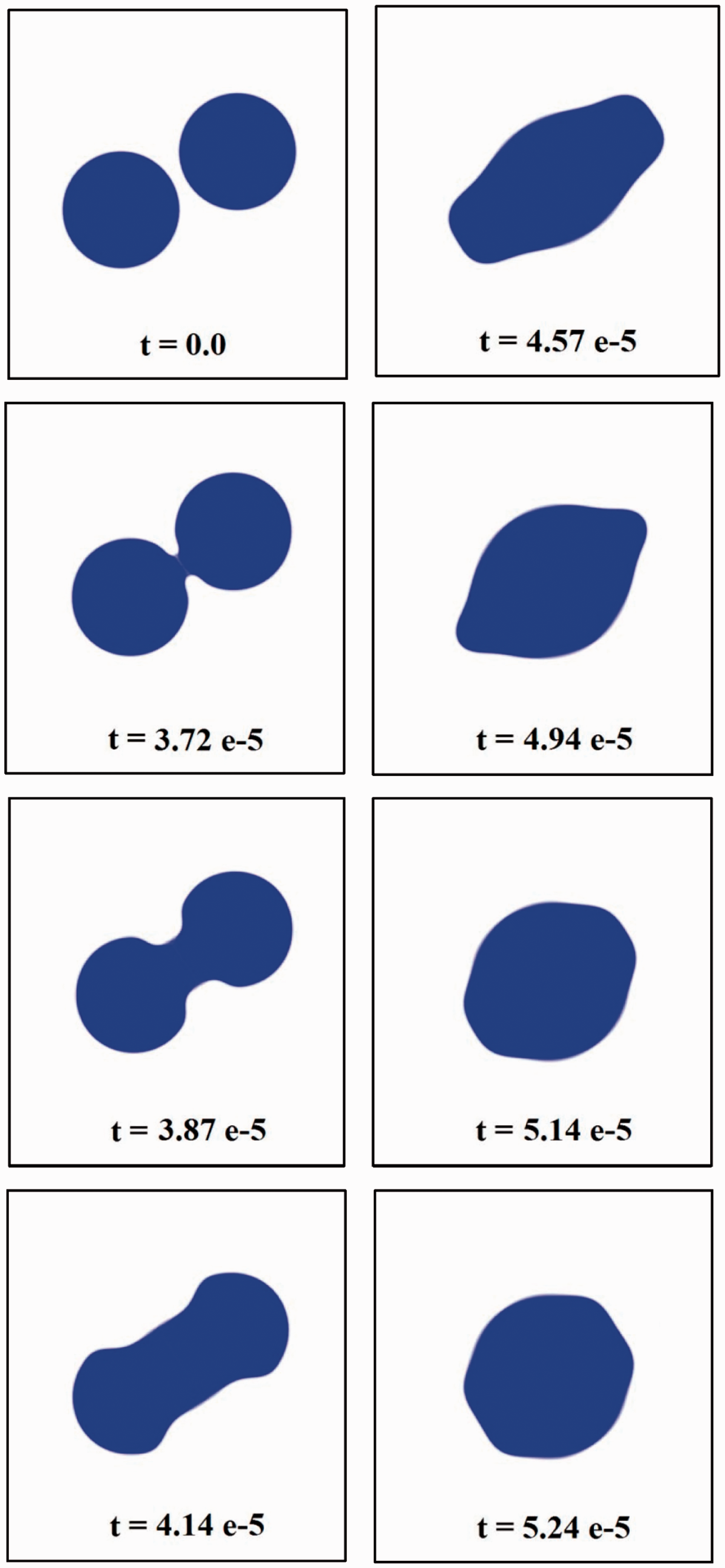
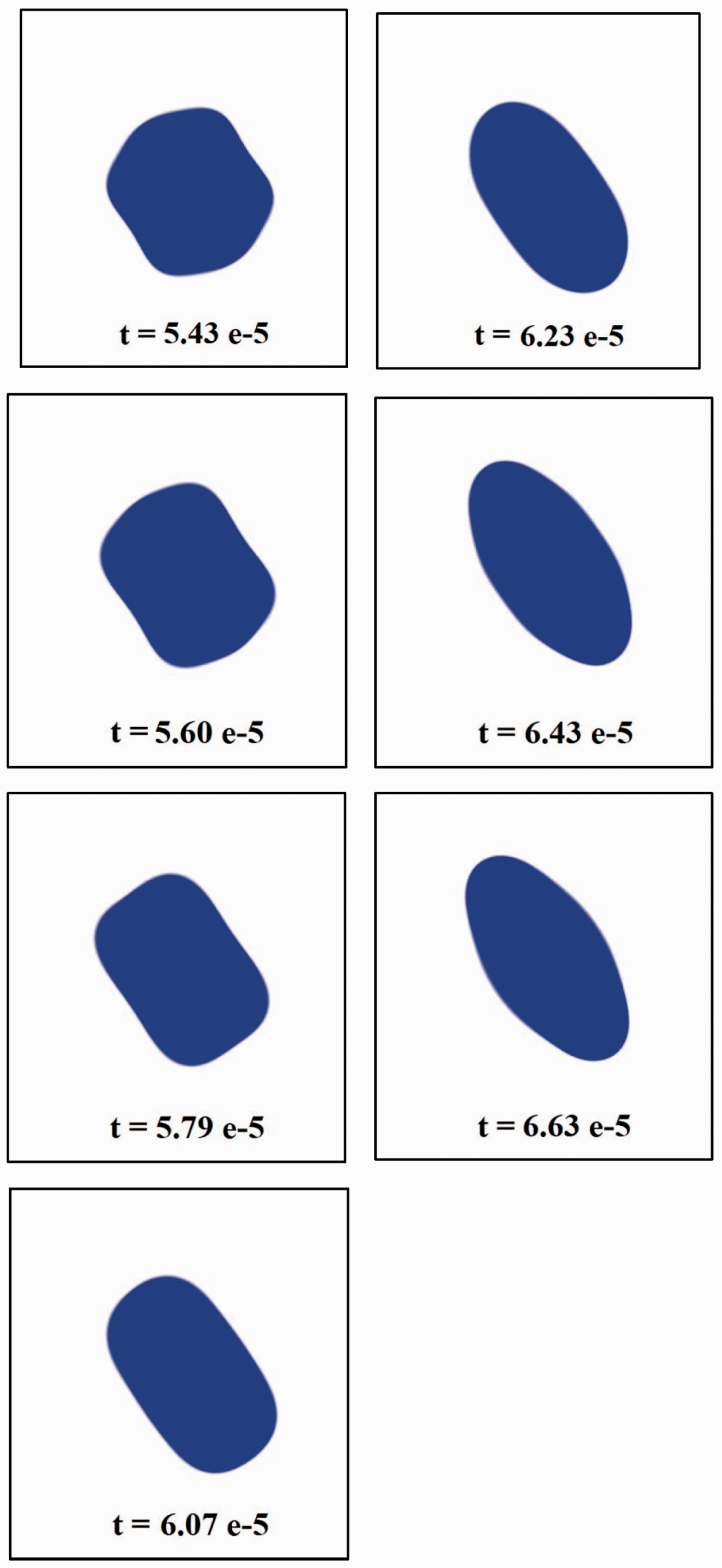
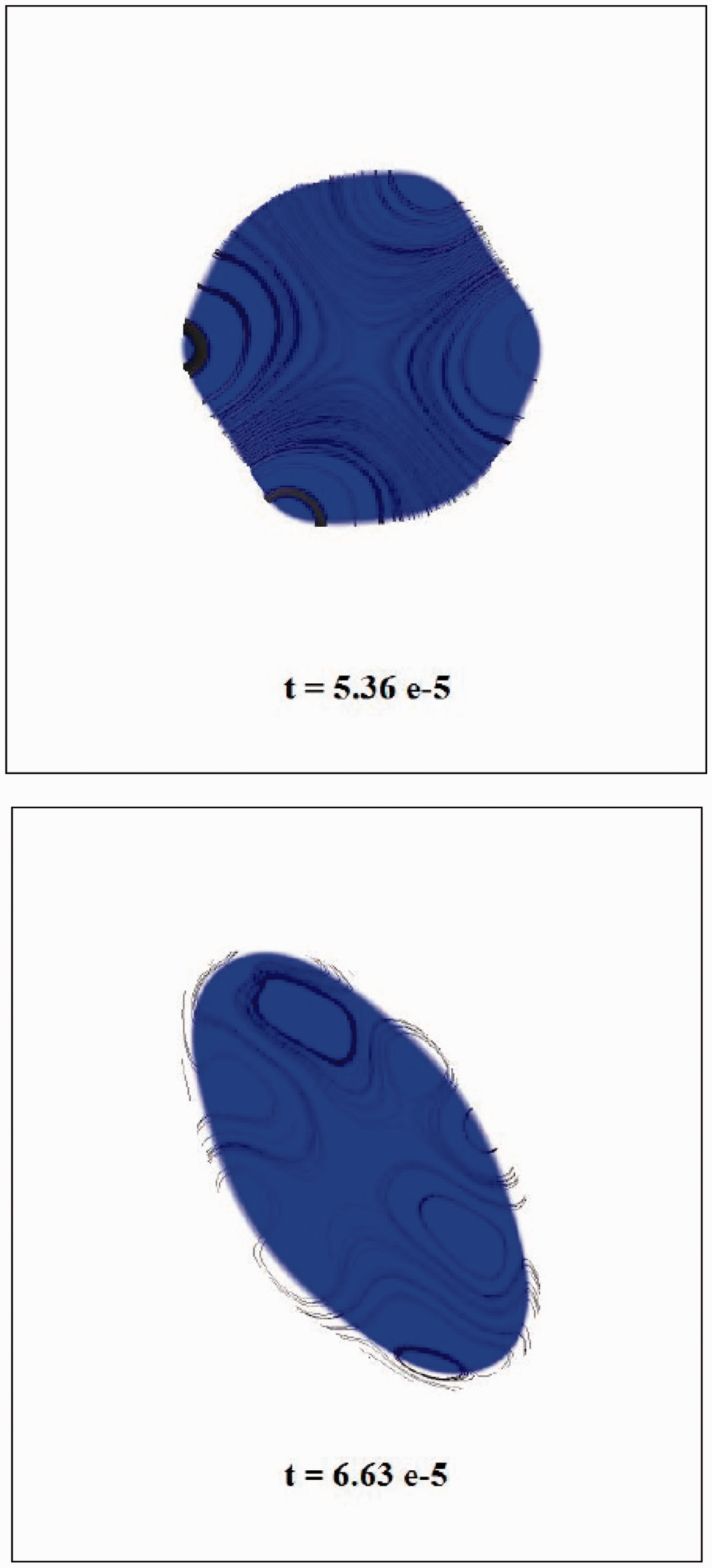
In Figures 4 and 5, the streamlines of the system of drops are shown. At t = 3.72e−5 s, the streamlines of the drops at the instant where the coalescence has begun can be seen. In this snapshot, one can see a circular structure in the flux inside the bigger mass of water in the zone of contact between the drops. This flux progressively enables the growth of the radius of the bridge structure and as a consequence of this fact, the mass of water acquires the form that is shown in Figure 4 at t = 4.57e−5 s. At this stage of the dynamics, the flux inside the mass of water has four circular sections that transform the bigger drop into the structure reported here at t = 5.36e−5 s. After this, the drops acquire the form of an oval of the snapshot at t = 6.63e−5 s. In the subsequent snapshots, the system oscillates until reaching a very well-defined circular form of a drop. These oscillations decrease with time because of the effect of the viscosity of the continuous phase.
Streamlines for the system water-heptane with Vcol = 0.2 m/s. The time scale is given in seconds. Streamlines for the system water-heptane with Vcol = 0.2 m/s. The time scale is given in seconds.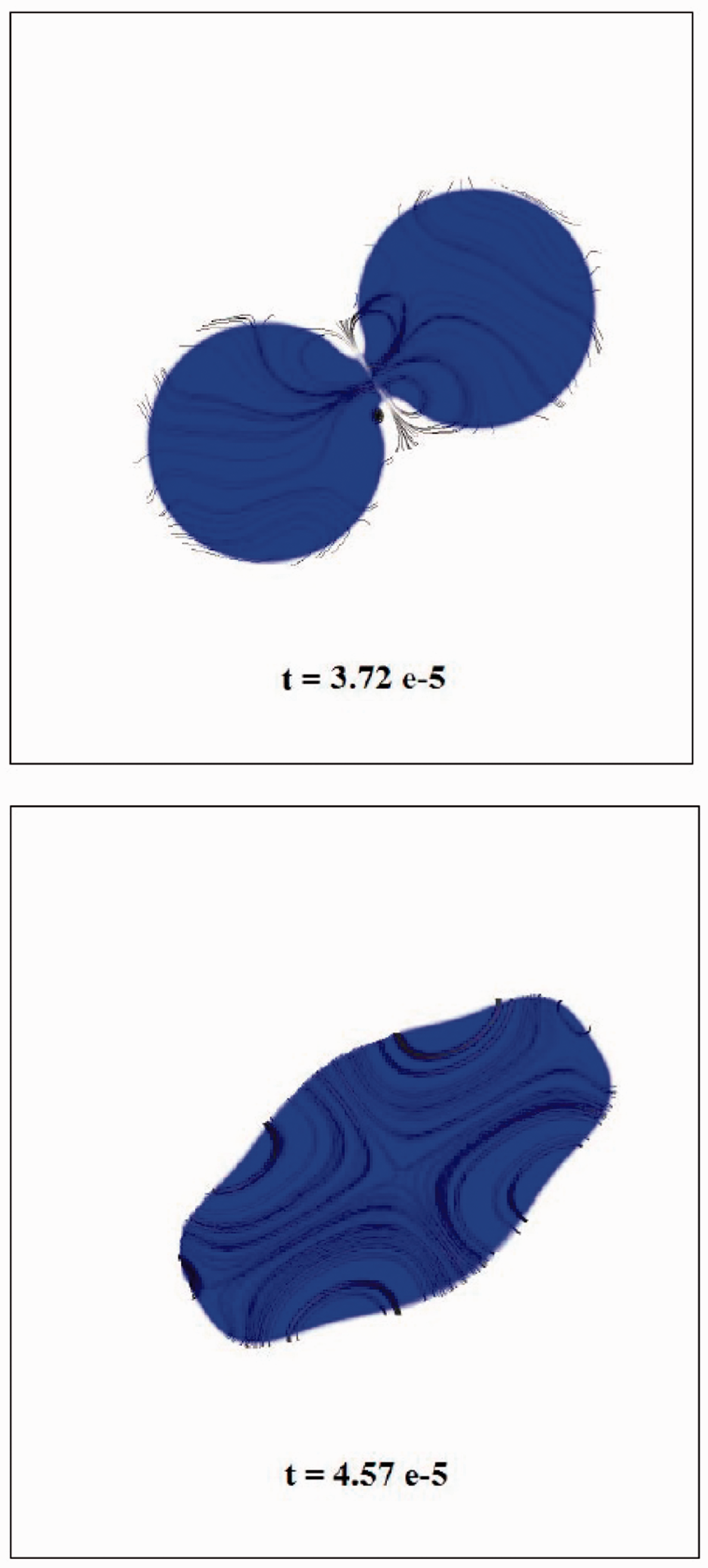
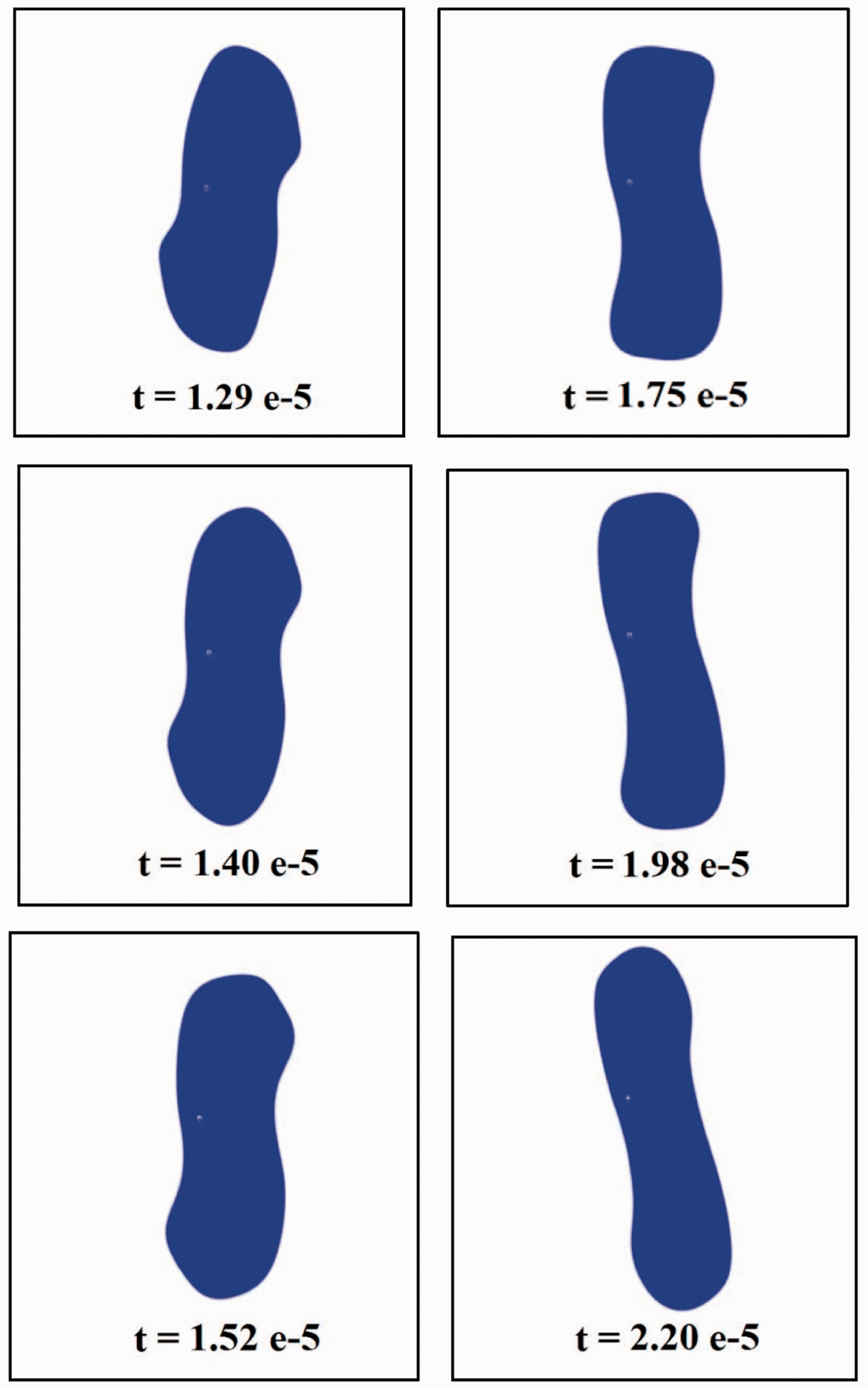
In order to model off-center collisions of equal-size drops, several calculations were carried out with a velocity of collisions of 3.5 m/s. In this model, the continuity and momentum equations are resolved by means of the finite volume method. For this value of the velocity, the inertial forces prevailing and the surface tension forces are not enough to restore the bigger mass of water to its circular form. In consequence, a deformed mass rotates around its mass center with certain angular momentum without any oscillations like the first case with a velocity of collision of 0.2 m/s. At the first stage of the dynamics, it can be seen at t = 4.11e−6 s that a little interfacial film is formed and the drops tend to deform their surfaces due to the inertial forces acting in the dynamics. This stretching of the surfaces is more evident at t = 8.15e−6 s where the interfacial film drains out of the zone of contact between the droplets. At t = 9.04e−6 s, a bridge structure can be seen that connects both drops; this bridge of water grows until certain radius and after that the bigger mass of water maintains its deformed structure that rotates around its mass center with certain angular momentum.
Sequence of times showing the evolution of the collision between two drops with Vcol = 3.5 m/s. The time scale is given in seconds. Sequence of times showing the evolution of the collision between two drops with Vcol = 3.5 m/s. The time scale is given in seconds.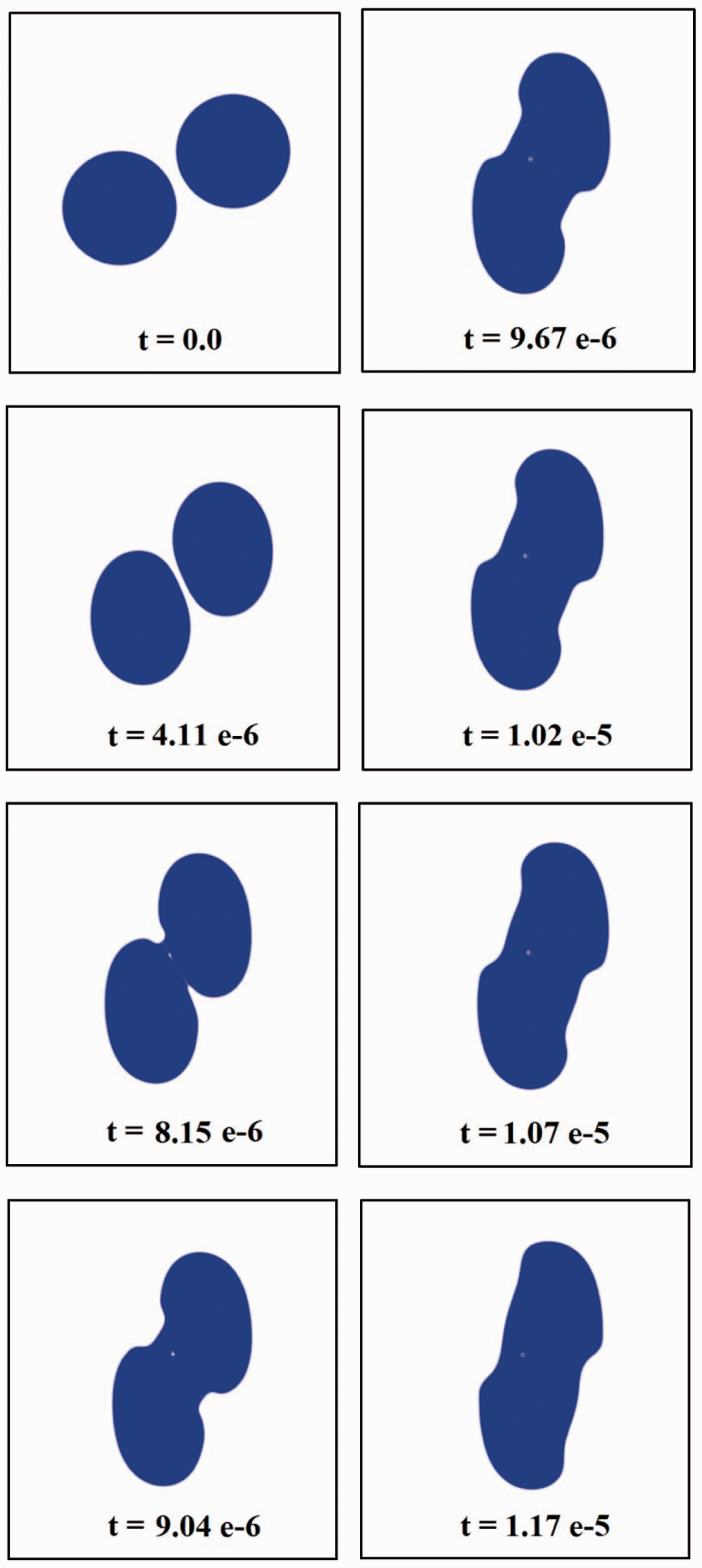
Conclusions
In this paper, an adequate methodology for the study of off-center collisions of droplets was presented. The equations of fluid mechanics were resolved using the volume finite method for a system composed of water and one hydrocarbon (n-heptane) that represent a continuous phase. Depending on the velocity of collision, two different regimes were reported that conduce to the coalescence phenomenon. In the first regime with a velocity of collision of 0.2 m/s, the system coalesces without any deformation of the surface of the drops and no interfacial film is formed. The portion of hydrocarbon located around the zone of contact of the drops drains out with the enough time and only surface tension effects can be seen during this calculation. In this case, there is a circular flux inside the bridge structure that is obtained during the first stages of the dynamics; this flux enables the growth of the radius of this zone and the system acquires the form of the oval that is oscillating during the dynamics, until the viscosity of the continuous phase dissipates the mechanical energy involved in this movement and this oval is converted into a very well-defined circular drop. During the oscillations of the oval, it spins around its mass center and the structure of its internal flux has four zones of circular flux given by means of the streamlines of the system. In the second regime, the drops stretch their surface and the droplets are deformed in comparison with their initial form at t = 0.0 s. In this regime, an interfacial film is formed and this film drains out with the evolution of the dynamics. At the zone of contact between the drops is formed a bridge structure that maintains the bigger mass of water deformed like a ligament with the evolution of time. This ligament rotates around its mass center and with the evolution of the dynamics, the system does not recover its circular form.
Footnotes
Declaration of conflicting interests
The author(s) declared no potential conflicts of interest with respect to the research, authorship, and/or publication of this article.
Funding
The author(s) received no financial support for the research, authorship, and/or publication of this article.