




Abstract
This paper presents user needs and preferences gathered prior to the development of an indoor remotely piloted air system. A literature review was carried out to analyse previous studies about the involvement of users in the design of indoor unmanned aerial vehicles. Subsequently, the results of these user needs obtained from three focus groups held in European countries (Belgium, Spain and United Kingdom) are presented here. Through a content analysis of the information obtained in the focus groups, 40 codes and 4 variables were defined and used to examine the differences between types of users and their previous experience with drones. The literature review gave support to the results obtained through users’ involvement in the features to be included in a new unmanned aerial vehicle. Non-parametric tests and qualitative comparative analysis were used to analyse the information gathered in the focus groups. The results revealed few differences between artists working in creative industries and drone operators working for the creative industries. These differences affected features such as detecting and avoiding obstacles, which requires the inclusion of sensors. In addition, previous experience with drones was found to be a sufficient condition to explain greater concerns over safety, ethical and security issues in indoor environments.
Introduction
User involvement means sharing their needs and preferences with a firm. 1 To pinpoint these needs, firms have to answer questions such as why users should be involved, when they should be involved and what type of users should be involved. These questions have been answered by the literature on new product development (NPD). In terms of the first question, previous works have stated the advantages of involving users in all phases of NPD, as including new ideas provided by users results in better products and superior financial performance.1–3 In relation to when firms should involve users, some studies indicate that companies obtain better performance when they involve users in early product development stages. 4 Regarding the third question, studies tend to indicate that involving lead users and users with experience provides better performance. 4
Firms obtain information about what users’ unmanned aerial vehicle (UAV) needs are through user involvement. Literature in the UAV field has focused on presenting technological developments. However, despite the widespread use of drones by consumers and firms, there are few studies on which drone features are valuable to users, the type of users involved when firms and engineers develop a new UAV and the stage at which these users were involved. In addition, literature on the subject of new indoor UAV development is scarce. This is especially noticeable in the fields of management and business, which could obtain knowledge from other areas in which user involvement has a long tradition, such as human–computer interaction (HCI). This information is important both in the design of new UAVs and in marketing them. This article presents the needs obtained when developing an indoor drone for the creative industries (CI) and supports results with the features revealed in previous studies on UAVs.
To obtain drone users’ needs, we used focus groups, involving different customer segments. The information from focus groups was analysed through content analysis, and the data obtained was examined using non-parametric tests and qualitative comparative analysis (QCA). This analysis established differences between artists, some of whom had had previous experience with drones and drone operators (DO).
The paper is organised as follows. After this introduction, ‘Literature review: user involvement in New Product Development’ section summarises the literature review about involving users in NPD and new UAVs. ‘Method’ section explains the methodology used to obtain and analyse data, while ‘Results’ section presents the results from the analyses. The conclusions are presented in the final section.
Literature review: User involvement in NPD
This section presents the literature review first for user involvement in NPD in general and then for the development of new UAVs.
User involvement in NPD
Through a literature review, this section explains what user involvement means, the benefits for companies of involving users in NPD and how to involve them.
User involvement and user participation
Literature has differentiated between user involvement and user participation. For example, Hartwick and Barki 5 stated that user involvement in a company generated information about the importance and personal relevance of a product, while user participation in the development of a product led to them performing activities in the development process.
When users are involved in NPD, they share their needs and preferences, 1 becoming a source of information. 6 When they provide solutions to cater for their needs by creating ideas for new product design and selecting the product designs to be produced, they become co-developers (co-creation) in conjunction with the firm. 4 However, there is no common view about what is the best decision for firms, as some authors say that for some products, it is better to only involve users to obtain information rather than to generate solutions. 6
Benefits of user involvement
Understanding user needs has proved to be essential for new product performance 7 whilst not understanding their needs has the opposite effect. Previous works found that when companies do not focus on customers and do not identify their requirements, their new products obtain poorer results.8,9
Literature has identified the main advantages of involving users in NPD. We have organised these advantages according to whether they were obtained before, during or after NPD.
Before product development, user involvement enables companies to obtain timely and reliable information about user needs, preferences and requirements 10 from different customer perspectives. 1 Firms can obtain important ideas which are different from current solutions and offerings.11,12 Some of these ideas are associated with shifts in technology.9,13
During product development, companies can respond quickly to changing customer needs,9,14 anticipating customer needs early in NPD 12 and accelerating the time to market1,3 As a result, firms can reduce the risk of new product failure by increasing the product-market fit,1,3,4,15 create products which are more difficult to imitate 7 and develop a larger number of products than without users’ knowledge. 11
Once products have been developed and tested in the market, companies realise that they can offer a superior value proposition3,12 because they have developed products and services that are more closely in tune with users’ needs.2,10,12 Consequently, they can also obtain superior financial performance from these new products. 1 Thus, companies recognise that they have improved their image because they are perceived as firms which promote customer empowerment in NPD, and as a result, users prefer them to companies which do not involve users. 15 This makes customers feel more important and thus enhances their loyalty. 12 Additionally, lead users involved in NPD recommend new products to other users, therefore increasing sales. 11
Involving users
When companies decide to involve users, they need to select the methods and tools to involve them based on formalised and structured processes.16,17 These processes include decisions about the type of user to be involved and the product development phases in which users will be engaged. The design-thinking method defines the different stages of NPD in which involving users is an important premise.18–20
Literature states that the types of users who give the most valuable information are previous product users. 10 Other studies believe that firms need to work with lead users, i.e. those who ‘are ahead of market trends’. 4 Involving lead users can increase the success of a new product as it anticipates users’ needs. 21 In medical devices, for example, professionals are considered as lead users. 11 However, authors such as Cui and Wu 6 found that the type of involvement depends on the degree of experimentation associated with the new product. They considered that only involving customers as a source of information is more beneficial when there is a high level of experimentation in the new product. However, when the level of experimentation is low, firms can involve customers to obtain solutions that cater for their needs. Chand and Taylor 1 also found that the high complexity of high-tech industries makes it difficult for companies to involve customers who can transfer complex knowledge. Cooper and Sommer 14 defined six phases of NPD when developing a new product: ideation, concept, business case, development, test and launch. Other authors, however, add a stage before ideation, i.e. the phase in which new ideas for a product are identified to incorporate users’ needs. 22 For example, works applying the design-thinking methodology call this previous phase need-finding, 23 inspiration 18 or empathize. 19
Some authors say that design thinking is an early phase of innovation activities, 23 although there are three stages that describe how it is applied. These stages are the explanatory phase or customer discovery, the idea generation phase and the prototyping and testing phase. 24 In the explanatory phase, observation and empathy with users lead to an understanding of their needs and problems and the definition of opportunities.25,26 This phase is also called observation, and the information obtained is analysed to make sense of the data collected about the users’ needs. 25 In the idea generation phase, ideas are generated and developed. 18 Prototyping is the phase in which ideas are developed through models that are tested by users. 26
Although previous works have stated that users can be involved in different phases of NPD, 17 some authors have pointed out that involvement results in better product performance when it occurs at specific stages. Under the first perspective, Cooper and Sommer 14 presented a model that combines Stage-Gate and Agile development, indicating that customer feedback is relevant from the ideation phase through to the product launch. Dahan et al. 13 suggested the preference market method, as it can be used in all phases of NPD from idea generation through to testing and product launch. However, these studies do not indicate whether these methods resulted in higher product performance depending on the stage.
Conversely, other works have concluded that product performance is higher when involvement takes place in the early phases of NPD, such as the ideation and launch stages, while it is lower when it occurs during the development phase.1,4,12 Companies obtain better performance when users are involved in the ideation phase because it enables firms to access important information before developing a product. 3
In the early stages of NPD, firms use qualitative methods to pinpoint users’ needs because they enable rich descriptions to be acquired about what consumers want. 27 Roberts and Darler 4 favoured the adoption of face-to-face methods as they facilitate rich discussions, although they are more expensive to implement. Ge and Maisch 28 pointed out that big companies use these methods because they have been proven to be successful. Focus groups are a method used to ‘identify needs, wants, problems, points of pain and new product suggestions’. 29 People are organised together in a group and asked about their needs. 30 The number of people involved in a focus group varies according to authors, ranging from 4 to 12 people.31,32 Some authors believe that focus groups are more useful in NPD to test concepts rather than to generate ideas. 29
User involvement in new UAV development
A specific UAV literature review was performed to find works that considered: (a) user involvement in the development of a UAV and different user segments, (b) stages of NPD in relation to UAVs, (c) use of UAVs in indoor environments and (d) features included in the UAVs analysed.
The search for literature was performed using the Web of Science database including the keywords in Table 1, without publishing year restrictions. The searches combined terms for UAV and terms for user involvement.
Searches in the web of science.

aScience Citation Index Expanded and Social Science Citation Index.
Then, a content analysis was undertaken with the NVivo 12 software with the 161 results obtained in searches two to five, using codes to answer the four questions. The following paragraphs show the results of this content analysis.
First of all, we found that, in spite of the keywords indicating users’ needs, there were very few studies that presented user involvement in new unmanned vehicle development and that these were even more limited in the case of aerial vehicles. For example, Simmons and Mehmet 33 described the preferences of beach and ocean end-users in shark management strategies, while Weidinger et al. 34 described the needs of firefighters related to the potential use of drones and indoor positioning sensors. We also found a few studies that considered different user segments. For example, Liu et al. 35 described three user segments: pilots, air traffic controllers and non-pilot-non-air traffic controllers in their analysis. Neace et al. 36 listed six stakeholders in their development of an unmanned aerial system for disaster response, including a pilot, a mission specialist and a safety observer. Hence, these works took into account both DO and those who did not have a licence.
Some authors specified that they involved users, and they also explained how user preferences were obtained. For example, de-Miguel-Molina et al. 37 used focus groups to explore concerns put forward by DO in relation to safety and security before designing a new RPAS. They highlighted the importance of involving operators in drone design in order to improve safety and security. Papautsky et al. 20 used design thinking, combined with cognitive task analysis, to explain the design of a ground-control station interface for an autonomous helicopter. They interviewed experts to understand the needs and requirements of a mission. Weidinger et al. 34 conducted semi-structured face-to-face interviews with experts in the field of emergency response. The main advantage experts cited about using drones was the information they offered (visual, presence of contaminants and location of the fire). They also valued compatibility with other drones and technologies but saw disadvantages in the complex requirement of having to have a pilot controlling the drone from the ground. The use of indoor positioning systems is not connected to drones, but these offer advantages related to information and the location of injured firefighters.
Moving on, few works have referred to the stages of new UAV development. Likewise, even when authors stated that the involvement of users was central in every phase of NPD, 20 the stage which received the most attention in studies was user testing of a prototype or system to validate it38,39 and testing the pilot experience while operating the system. 35
More recently, literature in the UAV field has been enriched through the application of the HCI approach to the drone-interaction experience, i.e. human–drone interaction (HDI). Although papers in this area are also scarce,40 they present results from experiments in which users are central to improvements in UAVs. For example, Zhu et al. 41 used experiments to test a video stabilization solution with users. Kumar et al. 42 analysed the usability of a system proposed for 3D mapping with five participants in a water treatment plant. These works have focused on the testing stage, in which users have participated in testing systems that have already been designed. These studies offer experience in usability applied to UAV systems, obtaining user knowledge at the test stage of specific elements of an UAV system. Introducing HDI in methods such as design thinking when a new RPAS system is being developed might help to ensure that the system covers users’ needs.
Third, very few studies have considered indoor use of UAVs, which indicates that this is still an unexplored market despite its potential. Studies have analysed developments in CI 37 and industrial inspection in confined environments. 43
Literature about UAVs is mainly focused on the features they have, including the elements in the camera. Works centring on technological developments in specific components are highly useful as these could be incorporated in the technical phases of new RPAS development. However, few studies have considered issues related to safety and security issues and other services which are important to users. We found the work conducted by Albayram et al., 44 who analysed hypothetical scenarios with different risk levels related to safety. They found that drone and system operators were more concerned about scenarios in which decisions might impact on people. According to Tezza and Andujar,40 safety is set to be a trend in future works about HDI.
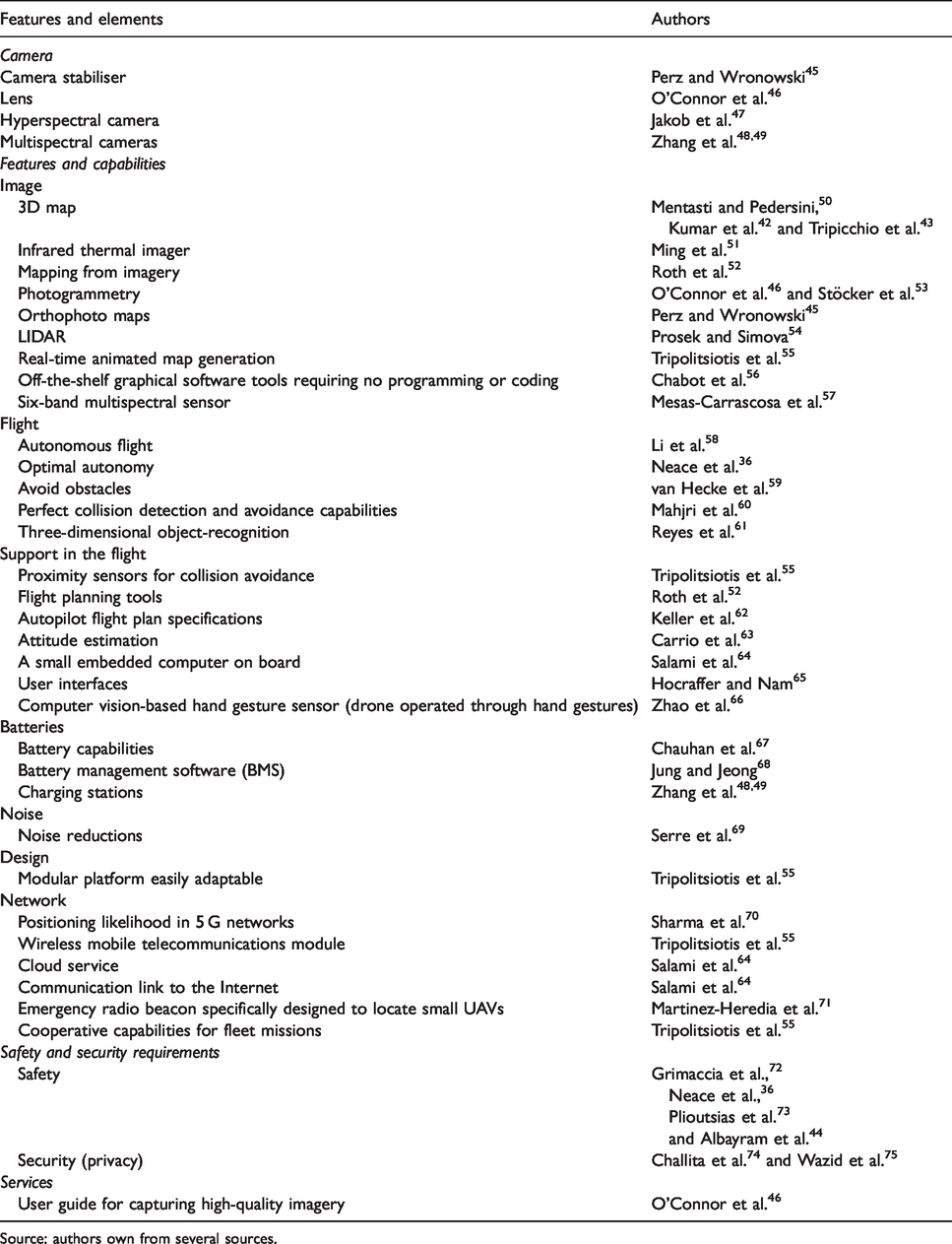
Through the content analysis with NVivo software, different features of UAVs and elements of the camera were coded. Then, the codes were organised in Table 2, which also shows works that incorporate all these features.
UAV features and camera elements cited by previous studies.
Source: authors own from several sources.
The groups of codes for features and elements found through the literature review were used to analyse the information obtained in the case studied in this paper, which was the development of an indoor UAV for the CI. Our analysis in the next section also shows the codes in Table 1 that users considered important in an indoor UAV.
Method
Data and variables
In this section, we present the method used to obtain information from users, who detailed the importance and personal relevance for them of different features in an indoor drone. The development of the drone was a joint project carried out by three small-sized firms and a university, located in three European countries. The focus group method was selected to obtain information from users. Following Krueger and Casey,
32
the three focus groups were designed as follows:
The aim was to involve users before the drone was developed. The focus groups intended to explore participants’ ideas about which features should be included in an indoor RPAS. The three focus groups were organised in Belgium, Spain and the United Kingdom, the countries the project partners were located in. Planning was based on budget and timeline. Users involved in the focus groups were selected based on their relationship to the CI. The main potential customer segments were identified as ‘artists working in CI and DO working for creative industries, all of whom needed high quality filming and photography in aerial indoor environments’. Each focus group had six or seven members and a total of 20 people participated. Some of them had had previous experience with drones (16 out of 20). Moreover, nine out of the 20 participants were DO while the others did not a have a licence. The interview guide consisted of 21 questions, some of which were introductory questions about previous experience with drones to obtain first impressions about an indoor RPAS. Then, questions related to the drone and camera elements and to safety and security issues were posed. The remaining questions aimed to identify additional services expected by users to improve their overall product experience. Qualitative content analysis was used to classify information about what was important and relevant for users. Eriksson and Kovalainen
76
defined two types of qualitative content analysis: categorization and interpretation. In our study, we used categorization. According to these authors, categorization is more objective than interpretation, although it requires systematic coding to give factual descriptions about the information. Krippendorff
77
indicated that this reduced the volume of information enabling users to work with something manageable. However, he offered advice about counting words and ensuring that the frequencies obtained made sense of the defined research questions. In the analysis we conducted, coding helped us to obtain the elements that were important to potential users of drones in indoor environments. It also enabled us to compare the importance to users depending on their jobs and needs.
It is important to point out that the involvement of users was constant throughout the project. This included usability tests for different elements in the system to ensure a drone–human interaction approach in the RPAS development. The analysis presented in this paper refers to the two first stages in design thinking, which cover obtaining users’ needs and their synthesis. The results were then discussed in the stages of ideation before the prototyping phase.
To facilitate content analysis, the conversations recorded in the three focus groups were transcribed. Content analysis was used to structure information and define variables and was carried out using the QDA Miner software, defining the codes while reading the transcriptions line by line. The main lines in the interviews and the defined codes were grouped into four variables, as shown in Table 2 in the literature review section. These variables were features (elements required for success), camera (elements and movements), SES (safety, ethical and security issues) and service (additional services). Table 3 shows the codes included in each variable and the percentage of participants who spoke about these codes.
Codes for features defined through the content analysis.

Note. Features (codes F1 to F14), Camera (codes C1 to C8), SES (codes S1 to S11), Service (codes SV1 to SV7).Bold words and data are for the terms which indicate groups of codes.Source: authors’ own, after content analysis of focus groups with QDA Miner.
Data analysis
Once the data from the content analysis had been organised into codes and variables, two analyses were performed. The first analysis included tests to determine the existence of statistically significant differences in the following cases:
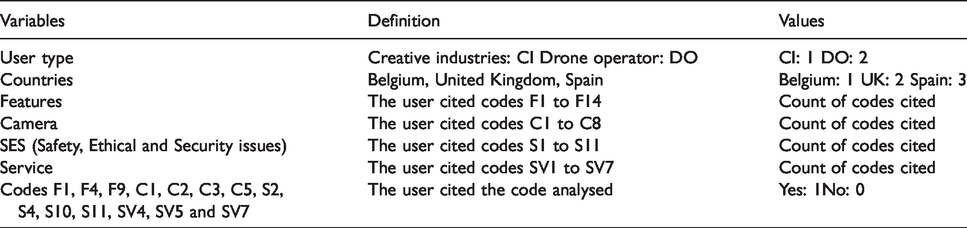
Between the four variables (features, camera, SES and service) in relation to the type of user (DO or CI), in order to analyse whether there were differences in the importance that CI and DO users gave to the four variables. The Wilcoxon–Mann–Whitney test was used for this analysis Between the four variables (features, camera, SES and service) in relation to the three countries (Belgium, Spain and the United Kingdom). The aim was to analyse whether there were differences in the importance that countries gave to the four variables. The Kruskal–Wallis test was used for this analysis. Between some specific codes in Table 3 (F1, F4, F9, C1, C2, C3, C5, S2, S4, S10, S11, SV4, SV5 and SV7) in relation to the type of user (DO or CI). The aim was to analyse whether there were differences in the importance that CI and DO users gave to each code. The Pearson’s χ2 test was used in this analysis.
Stata 16 software was used to test the hypotheses. The variables and values are explained in Table 4.
Variables used in the tests.
The second analysis focused on explaining how important the SES variable was for users in relation to their previous experience with drones and to the other three variables (features, camera and service). This analysis was undertaken using QCA with fsQCA software, which included combinations of conditions to explain the SES concerns expressed by users. A Crisp-set analysis was used for the study (values 1 and 0 for conditions and output), involving the conditions shown in Table 5 and the model defined as follows:
Conditions used in QCA.

Model: SES (output) = f (Experience, Features, Camera, Service)
Results
This section presents the results obtained. Table 3 shows the descriptive analysis and a comparison with Table 2. Then, the association tests are shown followed by the qualitative content analysis.
Descriptive analysis
Figure 1 shows the percentage of users who cited each code when both types of users were considered (DO and CI). The figure indicates that more than 40% of users cited six codes, which were F1 (3D Mapping and photogrammetry), F9 (Noise reduction), C1 (All camera movements, incl. 360°), C5 (Image: 4 K, quality, components such as lenses), S11 (Sensors) and SV5 (Support for users). 3D mapping and photogrammetry using drones is a key activity in the architecture sector and in heritage sites. Drones have enabled cultural heritage monuments to be filmed that were previously difficult to access as is the case in indoor environments. The use of drones in the film industry explains the importance of offering high quality images and the fact that creative users want the camera to move in all directions (360°). At the same time, difficulties arise when filming objects in movement when the drone is also in movement. This explains why DO considered the need to include ideas such as ensuring calibration while artists demanded smooth camera motion. This difference in what each group demands indicates disparities in the use of technologies between users.
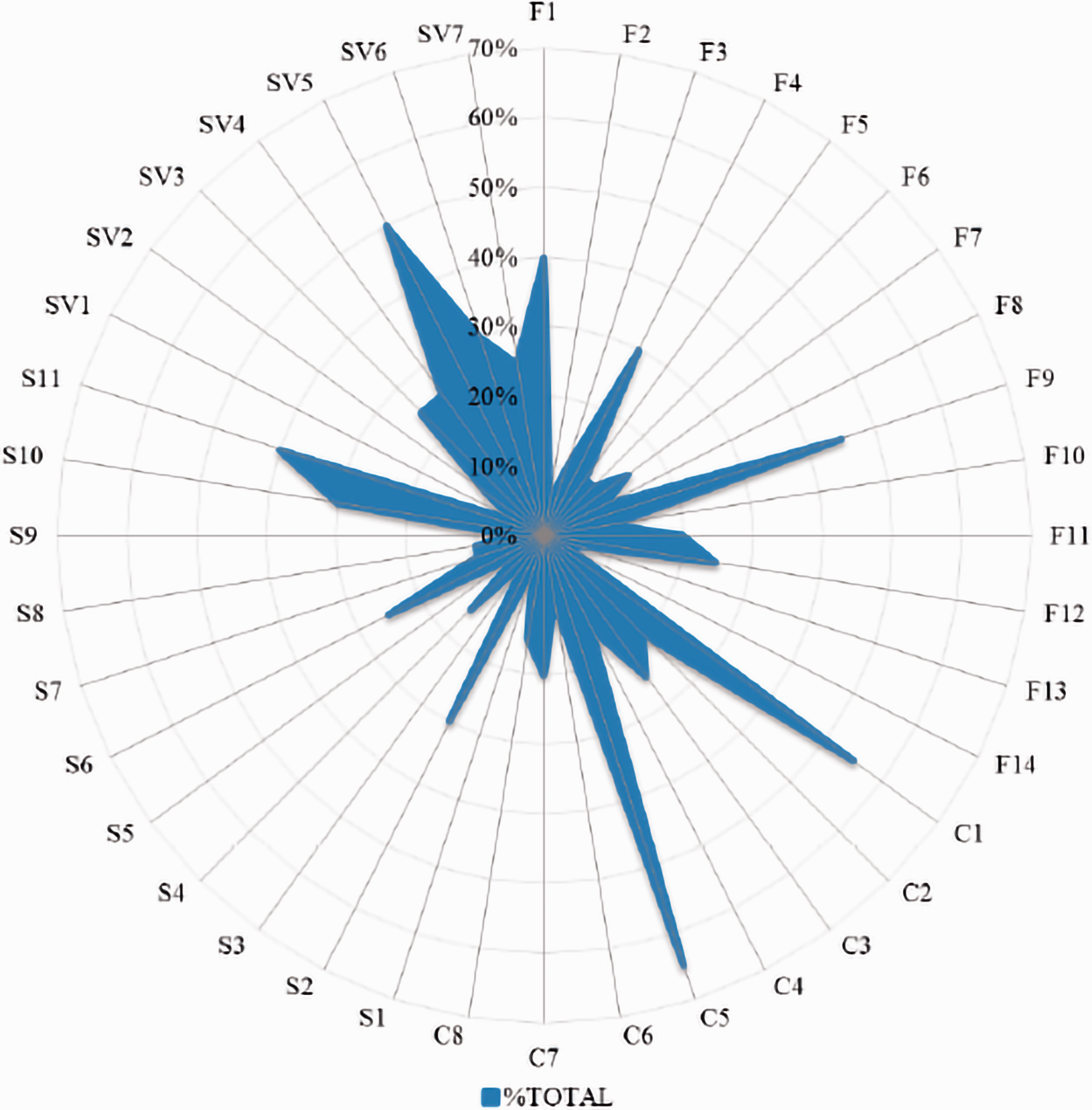
Percentage of users (total) who cited each code.
In general, there were few differences between the responses from the two types of users, except for noise reduction and sensors, which were more important to DO. They considered noise to be an issue when filming in indoor environments, especially in the CI, because it created a trade-off between capturing images and voices in sectors such as film and journalism. DO also stated that the use of sensors was a necessary safety feature in indoor environments. In the case of Table 3, the greatest differences between the two types of users were in the codes F9 (noise reduction) and S2 (detecting and avoiding obstacles). The greater importance for DO might be explained by the fact that many works in creative and cultural industries are outsourced to DO, who have experience in using drones in other sectors. Their work for cultural institutions in heritage conservation might also explain their greater concerns about the risks when detecting and avoiding obstacles.
Although literature about NPD has stated the importance of involving users, when Tables 2 and 3 are compared, we find similarities but also differences. It can be observed that Table 2 provides technological information about what areas could be considered before working with users, which features and capabilities users might not contemplate (such as estimating altitude) and expressing user needs based on a more technological approach. Conversely, Table 3 provides information about features that did not come up in the literature review, such as the codes F11 (replicate a flight), C8 (wind generated by the drone), S8 (propeller guard) and SV6 (training). For example, participants indicated that wind generated by drones is a problem when filming as it moves the actors’ hair. Moreover, as the aim of the new RPAS was to attract artists by offering them an easy system, they indicated the need to obtain training as an additional service. Therefore, we can conclude that firms should consider both sources of information, i.e. literature and user knowledge, when they select the features to be included in the design of a new UAV.
Results for association tests
Three different analyses were undertaken to illustrate whether user type and country influenced how important the variables and codes were for users who participated in the focus groups. The results for the tests in Table 6 indicate that: (a) the type of user (drone operator) explained the importance of codes related to the SES variable in indoor environments, (b) the country did not explain the importance of the four variables to users and (c) the type of user (drone operator) explained the importance of noise and capacity for detecting and avoiding obstacles in indoor environments.
Test results.

Source: own source using Stata 16.
Concern about SES codes was also found in previous works.36,71–74 The issue about noise and the need to reduce it also appeared in work by Serre et al. 68 A drone’s ability to detect and avoid obstacles was also indicated in previous works.54,58–60 However, none of these studies referred to any differences based on the type of user.
Results for QCA
The defined model related the presence of SES codes to previous experience with drones and the presence of codes to features, camera and service. The analysis of the necessary conditions (see Table 7) indicated that the camera was a necessary condition for the presence of the output (SES codes), as consistency was higher than 0.9. However, the presence of the service was a necessary condition for the absence of the output (SES codes). Hence, the model used in the sufficient analysis was the following:
Analysis of necessary conditions.

Source: authors’ own using fsQCA software after content analysis.
Model: SES = f (Experience, Features, Camera)
The sufficient condition results (Table 8) indicate that the combination of factors in the following solution was a sufficient condition. This implied that when participants spoke about SES, they had had previous experience with drones and spoke about the camera. The consistency of this solution was higher than 0.85, and coverage was over 0.80. Consistency refers to the strength between the solution and the outcome, while coverage indicates how much of the output is explained by the solution. 77 This solution indicates the importance of the camera-related codes for both types of users (DO and CI). It also revealed that users that had had previous experience with drones were concerned about safety and security issues related to operating drones in an indoor environment.
Sufficient conditions.

Source: authors’ own using fsQCA software after content analysis.
Solution: Experience * Camera → SES
Conclusions
This paper has presented the steps performed to obtain information from literature and users about which features should be included in the development of a new indoor UAV for the CI.
The literature review was the basis to understand what involving users in the development of the RPAS implies, considering the advantages stated in previous works on NPD. Through the literature review, it has been ascertained that there are promising opportunities for new products if users are involved and their needs are considered before developing an RPAS. 9 Moreover, it has been established that if users are involved, both information and solutions can be obtained from them. 3 The literature review also helps to identify types of users that could be involved, which could include those with previous experience of the product to be developed.4,10 The literature review also brings together ideas from different fields such as business, management and drone–human interaction which, when combined, facilitate an interdisciplinary approach in the design of a new RPAS.
Our research has revealed that there are few studies explaining users’ needs in products such as RPAS, and, therefore, this paper covers this gap, detailing user needs for an indoor RPAS. The literature review enabled us to obtain the technological features and components that give support to the results obtained after analysing users’ needs through qualitative methods such as focus groups. Our analysis has shown that the literature review also revealed features which were not expressed by users in the focus groups. In the same way, users put forward ideas that were not found in the literature review. Our results present examples for both cases.
In this work, we have presented the information obtained from focus groups carried out in three European countries, involving artists working in CI and DO working for creative industries. The information obtained from the content analysis was used to apply nonparametric tests and QCA. Two conclusions were obtained from these analyses. The first was that there are few differences in what is important to the two types of users featured in the study. Moreover, there were no differences between countries. When differences did exist between the two types of users, these centred on noise reduction and on detecting and avoiding obstacles (SES). Therefore, considering both customer segments was important when drawing up the composition of the focus groups. This was in line with the literature review which revealed that the few studies, which had involved users in new UAV development, also considered different stakeholders.35–37
The second conclusion, obtained from the QCA analysis, was that when participants were concerned about safety and security, talking about the camera was a necessary condition. It was also a sufficient condition in combination with having had previous experience in working with drones. This result coincides with previous studies on other product developments and confirms that firms should work with users who have had previous experience with the product.4,10
The results presented in this paper may be of interest to firms and entrepreneurs involved in the drone market as they might give them ideas about how to obtain information from users and how to analyse results. Future research could extend the qualitative analyses to include more users and thus obtain additional information which could help to better understand how they use drones.
Footnotes
Acknowledgements
The authors would like to thank the two reviewers of this paper for their time taken to review our work and for all the ideas they have put forward to help us improve the paper.
Declaration of conflicting interests
The author(s) declared no potential conflicts of interest with respect to the research, authorship, and/or publication of this article.
Funding
The author(s) declared the following potential conflicts of interest with respect to the research, authorship, and/or publication of this article: This work was supported by the European Commission (H2020, grant number 732433).
