The effects of fuel Lewis number on the minimum ignition energy (MIE) requirements for ensuring successful thermal runaway, and self-sustained flame propagation have been analysed for forced ignition of homogeneous fuel–air mixtures under decaying turbulence for a wide range of initial turbulence intensities using three-dimensional direct numerical simulations. The minimum energy demand for ensuring self-sustained flame propagation has been found to be greater than that for ensuring only thermal runaway irrespective of its outcome for large turbulence intensities, and the minimum ignition energy increases with increasing rms turbulent velocity irrespective of the fuel Lewis number. The MIE values have been found to increase more sharply with increasing turbulence intensity beyond a critical value for all fuel Lewis numbers considered here. The variations of the normalised MIE (MIE normalised by its laminar value) with increasing turbulence intensity beyond the critical point follow a power-law and the power-law exponent has been found to increase with an increase in fuel Lewis number. This behaviour has been explained using a scaling analysis. The stochasticity associated with forced ignition has been demonstrated by using different realisations of statistically similar turbulent flow fields for the energy inputs corresponding to the MIE and successful outcomes are obtained in most instances, justifying the evaluation of the MIE values in this analysis.
Localised forced ignition (e.g. spark or laser ignition) initiates the process of burning and has a significant influence on the resultant combustion process, and this is one of the most important aspects of combustion research. Localised forced ignition is yet to be fully understood to enable the efficient utilisation of the fuel in Spark Ignition engines and industrial gas turbines. Ignition characteristics in quiescent homogeneous gaseous mixtures originating from a point ignition source have been investigated by Espi and Linan,1,2 whilst Champion and Deshaies3 developed analytical tools to predict flame initiation in homogeneous mixtures. Despite the fact these analytical studies1–3 were carried out for laminar conditions, they provided key physical insights into the ignition phenomenon for both laminar and turbulent conditions. Localised forced ignition has also been extensively studied using experimental diagnostics. A wide range of fuels such as propane-air, iso-octane, diesel oil and heavy fuel oil has been investigated by Lefebvre and co-workers.4–7 It was shown that the critical radius, that the kernel needs to reach for successful self-sustained flame propagation, increases with increasing turbulence intensity. Moreover, Lefebvre and co-workers4–7 reported that the critical radius also increases with either an increase or a decrease in equivalence ratio with respect to the stoichiometric (i.e. ) mixture. This indicates that more energy is required to ignite fuel-lean or fuel-rich mixtures than the energy that is needed for stoichiometric mixtures, and this behaviour becomes more prevalent with an increase in turbulence intensity.
The minimum ignition energy (MIE) for homogeneous methane–air mixtures under homogeneous isotropic forced turbulence was analysed by Huang et al.8 and Shy et al.9 for different values of equivalence ratios and turbulence intensities (where is the root-mean-square (rms) value of the turbulent velocity, and is the unstrained laminar burning velocity of the homogeneous mixture in question). A qualitatively similar variation of MIE with and was observed, in line with the previous findings by Lefebvre and co-workers.4–7 In addition to corroborating the previous findings,4–7 a transition in the increase of the MIE with increasing turbulence intensity was observed beyond a critical value of turbulence intensity . For , the MIE requirement increases gradually with an increase in turbulence intensity, but it remains significantly smaller than the MIE for . The MIE requirement increases rapidly with increasing for . The MIE variation for lean methane-air mixtures under isotropic homogeneous decaying turbulence has also been experimentally investigated by Cardin et al.,10,11 using a laser ignition system. A transition of the MIE with increasing turbulence intensity was also observed by Cardin et al.10,11, similar to the findings of Shy et al.12–16 despite the difference in ignition systems used. Thus, it can be inferred that the transition of the MIE is independent of the ignition system. It has been observed that the transition in MIE requirement occurred at ,8–16 where is the Karlovitz number. However, different critical turbulence intensities were reported by Shy and co-workers8,9,12–16 and Cardin et al.10,11 This has been attributed to the different ignition apparatus, experimental setup and the integral length scale of the turbulence used in the respective analyses.
Wu et al.17 reported a novel and unexpected experimental result, which is known as turbulent facilitated ignition (TFI). In TFI, the turbulence was found to facilitate ignition through differential diffusion when the effective Lewis number of a mixture is sufficiently larger than unity and when a small electrode gap () was used in near-isotropic turbulence generated by a fan-stirred burner. This suggested that the required MIE in intense turbulence can be smaller than that in the quiescent mixture for mixtures with . Further research by Shy et al.18 investigated the MIE for both laminar and turbulent conditions of the same hydrogen/air mixtures as those previously investigated by Wu et al.17 and Shy et al.,14 over a wider range of electrode spark gaps () and . Continuing from the previous work, Shy et al.19 investigated laminar and turbulent MIE of a lean () primary reference automobile fuel (PRF95; 95% iso-octane/5% n-heptane) with a large Lewis number (), and the effects that are induced by the distance between the electrodes. They reported that TFI only occurs at sufficiently small electrode gaps and sufficiently high fuel Lewis numbers, irrespective of the fuel.19 The MIE transition is also observed to occur for these fuels when the electrode gap is large enough (),19 whilst a large gap was found to be more beneficial for obtaining successful ignition after the MIE transition had occurred. Jiang et al.14 investigated the MIE of prevaporised iso-octane/air mixtures at an equivalence ratio of at with over a wide range of . They reported a qualitatively similar MIE transition to that observed for methane–air mixtures by previous studies.4–13
Patel and Chakraborty20 used three-dimensional simple chemistry DNS to investigate the influence of turbulence intensity and fuel Lewis number on the ignitability and subsequent self-sustained combustion for localised forced ignition of homogeneous mixtures. They reported that the extent of burning has been found to increase with decreasing values of for a given set of values of energy deposition, spark duration, energy deposited and turbulence intensity. An increase in also leads to a decrease in the extent of burning for all values of in homogeneous mixtures20 and the same behaviour was also observed for turbulent stratified mixtures.21 They also reported that the critical at which misfire takes place decreases with increasing . Patel and Chakraborty20,22 also investigated the effects of spark parameters such as the characteristic width of the energy deposition, spark duration, energy deposited and turbulence intensity for homogeneous mixtures for different equivalence ratios, and their findings were in good-qualitative agreement with the experimental results by Ballal et al.4–7 Chen23 investigated spherical flame initiation as a result of localised ignition both theoretically and numerically using different fuel/oxygen/helium/argon mixtures (fuel: hydrogen, methane and propane) and reported that the critical flame radius and the minimum ignition energy increase significantly with increasing Lewis number.
The Lewis number has also been found to influence autoignition24 and it has been found that the burning rate and propensity to self-sustained combustion following localised forced ignition of turbulent mixing layers increase with decreasing fuel Lewis number.25 The effects of of the fuel on the density-weighted displacement speed statistics of the edge flame arising from localised forced ignition of turbulent mixing layers under decaying turbulence were analysed by Hesse et al.,26 which revealed that the extent of edge flame propagation decreases with increasing fuel Lewis number. The probability of finding negative density-weighted displacement speed decreases with decreasing of the fuel, whilst the mean value increases with a decrease of the fuel Lewis number, indicating that the Lewis number can have a significant influence on flame propagation following successful ignition. An in-depth review on localised forced ignition for both homogeneous and inhomogeneous mixtures was provided by Mastorakos,27,28 and interested readers are directed there for further information. The above discussion implies that the Lewis number will have a significant effect on the MIE and its variation.
Of particular interest to this study is the transition of MIE from low to high turbulence intensities observed across a wide range of fuels, which was reported by Shy and co-workers8,9,12–16 and Cardin et al.10–11 The MIE transition phenomenon was replicated numerically by the present authors for stoichiometric methane–air mixtures under homogeneous isotropic decaying turbulence.29 Subsequently, these authors30 demonstrated that the MIE transition with increasing turbulence intensity remains qualitatively similar for homogeneous stoichiometric biogas–air mixtures, with varying amounts of the diluent. The power-law exponent for the variation of the MIE with turbulence intensity remains mostly independent of the mixture composition but the critical turbulence intensity for the MIE transition changes with the mixture composition.30 The MIE transition obtained numerically29,30 was in good qualitative and quantitative agreement with the findings reported by experiments.10,11 These computational studies have also been shown to capture the stochasticity of the localised forced ignition phenomenon, which has been explained in terms of energy budget.29 These analyses29,30 also utilised scaling analysis and flame wrinkling statistics to explain the occurrence of the MIE transition.
Both experimental8–16 and computational29,30 results indicate that MIE transition occurs irrespective of the fuel being used. The MIE transition phenomenon is relevant to the development of gasoline engines operating at high turbulence intensities.31 The effects of fuel Lewis number on the MIE behaviour and its transition are becoming increasingly important, as next generation high hydrogen content fuels will have sub-unity Lewis number. Moreover, high molecular weight hydrocarbons (e.g. iso-octane) have a Lewis number much greater than unity. Thus, it is necessary to analyse the effects of fuel Lewis number on the MIE variation with turbulence intensity for forced ignition of homogeneous mixtures, to understand the effects of fuel Lewis number in the context of MIE and its variation with turbulence intensity.
To the best of the authors’ knowledge, despite the influence of the Lewis number on the ignition phenomenon having been highlighted, the effects of of the fuel on the MIE and its transition with increasing turbulence intensity have not yet been investigated. The present study aims to address this gap in the existing literature by utilising three-dimensional compressible DNS to investigate the effects of fuel Lewis number (for , 1.0 and 1.25) on the variation of the MIE with turbulence intensity and the related statistics (critical turbulence intensity, slope of transition) under decaying turbulence, as considered experimentally by Cardin et al.10,11 It is worth noting that the analysis of the TFI is kept beyond the scope of the current analysis because the Lewis number of the fuel needs to be significantly >1.25 and the ignitor radius may need to be altered to observe the TFI, and such an analysis requires a separate parametric analysis in its own merit. In the present analysis, the MIE has been evaluated for only a successful thermal runaway, and for a successful thermal runaway followed by self-sustained combustion once the ignitor has been switched off, following previous analyses.29,30 A one-step chemical mechanism, which adequately captures the MIE transition phenomena as shown in a previous analysis,29 is used for an extensive parametric analysis. Thus, the objective of the present study is to understand the effects of the fuel Lewis number:
on the variation of the MIE requirements for successful ignition and subsequent flame propagation under different initial intensities of homogeneous isotropic decaying turbulence;
on the transition of the MIE based on the physical insights gained from DNS data.
The above information extracted from DNS data has been utilised to express the normalised MIE (i.e. MIE for turbulent conditions normalised by the corresponding value for quiescent laminar condition) based on a power-law in terms of turbulence intensity, guided by a scaling analysis.
The rest of the article will be organised as follows. The mathematical background and numerical implementations pertaining to the current analysis are presented in the next two sections. The results are presented and subsequently discussed in the following section. Finally, the main findings are summarised, and conclusions are drawn.
Mathematical background
The wide range of initial turbulence intensities required to quantify the MIE transition in conjunction with the variation of the fuel Lewis number, whilst investigating the stochastic effects of the ignition phenomenon (requiring multiple turbulent realisations), leads to many simulations. It should be noted that the analysis conducted here involved 300 different DNS cases amounting to altogether CPU hours involving variations in , and their statistically independent variations. It becomes impractical to carry out such a parametric analysis based on detailed chemistry because the computational cost becomes exorbitant.32 Typically, a detailed chemistry simulation for a skeletal methane–air combustion mechanism involving 16 species and 25 reactions33 is roughly 20 times more expensive than one of the simulations conducted for this analysis. Thus, it is impossible to carry out the analysis conducted here using even a skeletal chemical mechanism. Therefore, the chemistry aspect in this analysis is simplified here by a single-step mechanism. It is worth noting that pioneering analytical studies1–3,34,35 on ignition have been conducted for single-step irreversible Arrhenius-type chemistry. The single-step chemical mechanism used here has been benchmarked for flame propagation and the relevant details are provided elsewhere.36,37 In the case of forced ignition, the temperature attained during the external energy deposition duration is high enough to result in a very small value of ignition delay time. Therefore, the ignition delay prediction does not significantly affect the results presented in this article because the subsequent flame kernel development is principally determined by flame propagation. It is worth noting that the seminal DNS analysis on autoignition by Mastorakos et al.38 was conducted in the context of single-step Arrhenius-type chemistry, and the findings of that analysis were subsequently confirmed in detailed chemistry DNS studies.39 Moreover, the outcomes of multi-step chemistry results for the MIE transition by Papapostolou et al.30 are found to be both qualitatively and quantitatively similar to the corresponding single-step chemistry results by Turquand d’Auzay et al.29 and experimental findings by Cardin et al.,10,11 which suggests that the MIE transition is not highly sensitive to the choice of the chemical mechanism. The likelihood of obtaining thermal runaway and the occurrence of self-sustained flame propagation are dependent on the competition between the heat release rate due to chemical reactions and the heat transfer from the hot gas kernel, and these mechanisms can be qualitatively captured by single-step chemistry. However, the magnitudes of the heat release rate and heat transfer rate are expected to be dependent on the choice of chemical mechanism. Therefore, the actual magnitude of the MIE is sensitive to the choice of the chemical mechanism but the trend of the MIE of turbulent mixtures normalised by the corresponding laminar value with turbulence intensity can at least be qualitatively captured with the help of single-step chemistry. The MIE value for the successful self-sustained flame propagation is dependent on flame structure and flame propagation.25,26,40,41 The flame structure resulting from localised forced ignition of turbulent mixing layer using single-step Arrhenius type chemistry25,26,40,41 is found to be qualitatively similar to those obtained from detailed chemistry simulations.42,43 Furthermore, it has been found that the statistical behaviours of the flame propagation obtained from simple single-step chemistry DNS data25,26,40,41,44,45 have been found to be qualitatively consistent with detailed chemistry DNS46–48 and experimental49–51 findings.
The single-step chemical mechanism utilised for this study takes the following form:
where s indicates the mass of oxygen consumed per unit mass of fuel consumption under stoichiometric conditions. The fuel reaction rate is given by an Arrhenius-type expression20–22,29:
where is the gas density and and the fuel and oxidiser mass fractions, respectively. The dimensionless temperature is defined as where , and are the dimensional instantaneous, reactant and stoichiometric adiabatic flame temperatures, respectively. The Zel’dovich number is defined as , where is the activation temperature, a heat release parameter and the normalised pre-exponential factor. The extent of the completion of the chemical reaction can be quantified by a reaction progress variable c which rises monotonically from 0 in the reactants to 1.0 in the products and is defined as20–22,29:
where and are the mass fractions of fuel in the reactants and products, respectively.
For the present analysis, all species in the gaseous phase are considered to be perfect gases, and standard values were taken for the ratio of specific heats (, where and are the gaseous specific heats at constant pressure and volume, respectively) and Prandtl number (, where is the dynamic viscosity and the thermal conductivity of the mixture in the gaseous phase). The Lewis number of all the species apart from the fuel is taken to be unity and three different Lewis numbers (i.e. and 1.25) have been considered for the fuel. The fuel Lewis number of 1.0 is representative of the stoichiometric methane–air mixture, whereas fuel Lewis numbers of 0.75 and 1.25 are representatives of stoichiometric mixtures of 13% H2 and 87% CH4 and 65% C2H6 and 35% CH4 by volume, respectively. The effective fuel Lewis number is estimated based on the methodology proposed by Dinkelacker et al.52 All of these mixtures provide a stoichiometric oxygen-to-fuel ratio by mass . The species diffusion velocity is accounted for by using Fick's law of diffusion.
An additional source term, 1,2 with r being the distance from the ignitor centre and representing the characteristic radius of energy deposition) is added to the energy conservation equation to account for the effects of the localised forced ignition in the following manner20–22,25,26,29,30:
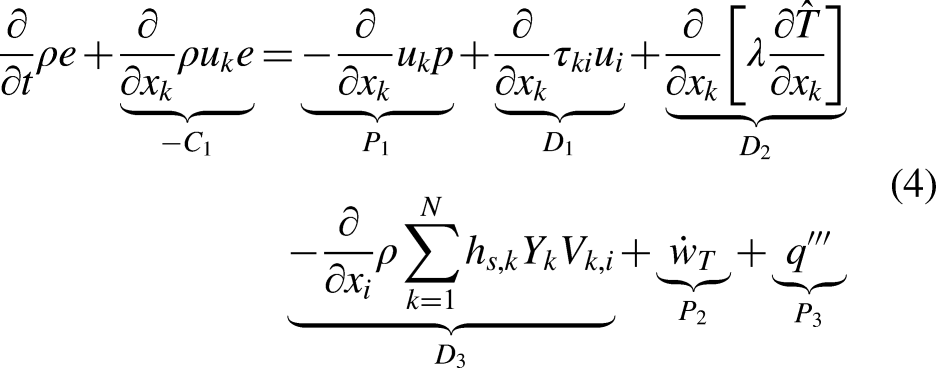
where is the specific enthalpy of the species, the pressure, the viscous shear stress, the source term originating from heat release (due to combustion henceforth referred to the heat release rate) with H being the heating value of the fuel,53 and the specific stagnation internal energy. For the current analysis the term disappears as the specific heats at constant pressure and volume are taken to be identical for all the species for the sake of simplicity. For the present analysis, the heat release parameter for the stoichiometric mixture, is taken to be 3.0, which corresponds to an unburned gas temperature in excess of 590K. For low temperatures (e.g. ), the difference in heat capacity between and is as high as 40%. For higher temperatures (), the difference of the heat capacity between the two species is at most 6%. As the gaseous mixture is predominantly composed of the heat capacity of the gaseous mixture would be very close to that of . For the present analysis, the specific heat at constant specific heat , dynamic viscosity , thermal conductivity and the density-weighted mass diffusivity are considered to be constant for the sake of simplicity following previous analyses,29,30,40,41,54 ensuring that the Lewis number does not change within the flame. It was demonstrated previously by Poinsot et al.,55 Louch and Bray56 and Aspden57 that temperature dependence of these transport properties does not modify the qualitative nature of the flame–turbulence/flame–vortex interaction in the context of both simple and detailed chemical mechanisms. Moreover, the pioneering ignition studies by Champion and Deshaies,3 Sibulkin and Sinskind,34 He35 and Espi and Linan1,2 made assumptions similar to the present analysis regarding thermophysical properties.
The constant in the source term is determined by a volume integration which leads to the total ignition power in the following manner20–22,25,26,29,30:
where is a parameter determining the total energy deposited by the ignitor, the Zel'dovich flame thickness of the stoichiometric mixture (, where is the unburned mass diffusivity of the reactants and the unstrained laminar burning velocity of the stoichiometric mixture) and and the Heaviside functions, which ensure that the ignitor is only active during . The energy deposition duration is expressed as , where is a characteristic timescale and the energy deposition parameter is given a value of in the present study, which falls within its optimal range ().32 For a shorter duration, strong shock waves that dissipate energy can be formed, and for a longer one, the temperature is wastefully dissipated outside of the energy deposition region.58 The details of the spark formation (momentum modification contribution, plasma and shock wave formation) are not considered in this analysis for simplicity and computational economy. In the present study, and and all other spark parameters are kept unaltered (i.e. , )29,30 whilst only is varied until the minimum energy levels leading to either of the two following is found:
Thermal runaway: A successful thermal runaway in this article refers to a situation where the maximum temperature either attains or surpasses the adiabatic flame temperature during or after the energy deposition period regardless of subsequent flame behaviour. If the maximum temperature does not reach the adiabatic flame temperature, it is referred to as a misfire in the following discussion. This phase was referred to as the kernel establishment phase by Mastorakos.28 It is worth noting that under low Mach number, unity Lewis number and globally adiabatic condition, the maximum temperature will be the adiabatic flame temperature , which leads to a non-dimensional temperature . However, under non-unity fuel Lewis number conditions, it is possible to obtain locally super-adiabatic temperatures (i.e. ) even under globally adiabatic condition depending on local curvature and tangential strain rate. However, forced ignition is not an adiabatic case due to external heat addition and thus the maximum temperature is determined by the magnitude of the ignition energy addition.
Self-sustained propagation: A successful self-sustained propagation is obtained when the flame kernel burns without the aid of any external energy deposition after a successful thermal runaway. It is determined by evaluating the temporal evolution of the burned gas volume (i.e. characterised by the volume of the gas with ), that is, if the temporal derivative is positive at the end of the simulation time (i.e. ) or when the kernel leaves the computational domain, a successful self-sustained propagation is obtained, otherwise, it is considered failed or quenched.
It must be mentioned that a successful thermal runaway does not necessarily give rise to a successful self-sustained combustion. It has been demonstrated earlier29,30 (and will also be demonstrated later) that the energy required to obtain just the thermal runaway differs from the energy required to obtain self-sustained combustion at large turbulence intensities. Thus, it was deemed necessary to investigate both events.
For the purpose of evaluating the MIE for turbulent conditions, small steps of have been taken to find out the outcomes given by (i) and (ii) for a precision of about 1.0% of the corresponding laminar value of . The laminar value of is also obtained by changing its value gradually to ensure a precision of smaller than 1% (i.e. 1% smaller value of leads to misfire). This suggests that several simulations have been carried out to evaluate the MIE values and thus numerous simulations, whose results are not reported in this article, were required.
The localised forced ignition is a stochastic event, and it was demonstrated previously29,30 that the computational methodology adopted here, although not equivalent to the experimental procedure for the quantification of the MIE (i.e. based on 50% ignitability), is adequate to capture the probabilistic nature of the ignition phenomenon. It is important to note that DNS allows for the turbulent realisation being investigated to be kept the same, whilst only the input energy is varied until a successful event is obtained. In an experimental scenario, a successful thermal runway is always obtained at the spark location, but this is not guaranteed with a computational approach as a misfire can happen without any thermal runaway when the energy input is insufficient.20,29,30 The terminology ‘ignitability’ and ‘successful ignition’ in the context of experimental analyses9–11 translate to ‘successful ignition with subsequent self-sustained flame propagation’ for the current DNS analysis. Additional simulations have been carried out under different realisations of statistically identical conditions of the initial turbulent flow field (i.e. and ). Thus, the amount of energy required to achieve both (i) and (ii) for the first turbulent realisation (henceforth referred to as S01) is tested on the two other turbulent realisations (referred to as S02 and S03, respectively) to analyse the stochasticity of the ignition phenomenon. The MIE requirements are evaluated based on only one turbulent realisation (i.e. realisation S01) due to the computational cost arising from needing multiple simulations to ascertain the MIE for a certain case. This inherently implies that successful thermal runaway and self-sustained flame propagation are always obtained for one of the turbulent realisations (realisation S01) for the stochasticity analysis associated with the MIE values. The above methodology precludes the estimation of the ignition probability for the reported MIE values, as the reported values are based on only three statistically independent realisations. The minimum number of realisations and energy levels required for each turbulence intensity would be like that required in an experimental analysis to ascertain 50% ignitability, and thus this approach is impossible to adopt using DNS because of its enormous computational cost. Additionally, the ignition probability has been found to vary linearly with the deposited energy,10 whilst the qualitative trends of normalised MIE are not expected to vary significantly regardless of the value of ignition probability associated with the reported MIE values. For further details regarding the validity of the computational approach followed to capture the stochastic aspect, interested readers are directed to the previous work by the present authors.29,30
Lastly, only the thermal aspect of the spark is considered in this analysis, as outlined previously (see equations (4) and (5)) following several previous analyses.20–22,25,26,29,30 This method neglects the initial shock wave produced by the breakdown phase, which may lead to an underprediction of the flame kernel surface and in turn to an underprediction of its MIE. Plasma physics which introduce radicals to the flame and might have some influence on the MIE value are also neglected in the present study for simplicity and computational economy. However, these simplifications will not modify the qualitative variations of the normalised MIE with the variation of turbulence intensity.
Numerical implementation
The present study aims to investigate the variation of the fuel Lewis number at three distinct values (i.e. and 1.25), in conjunction with multiple separate turbulence intensities. The simulations in the present study ( and 1.25 cases for different values of turbulence intensity) have been carried out using a three-dimensional compressible DNS code SENGA+.59 The conservation equations of mass, momentum, energy and species are solved in non-dimensional form where all the velocity and length scales are normalised in the code by and , respectively. Thus, the simulation parameters, such as , and the domain size, have been chosen in the non-dimensional form. Interested readers are referred to Dopazo et al.60 for more information regarding the non-dimensionalisation of governing equations in SENGA+.
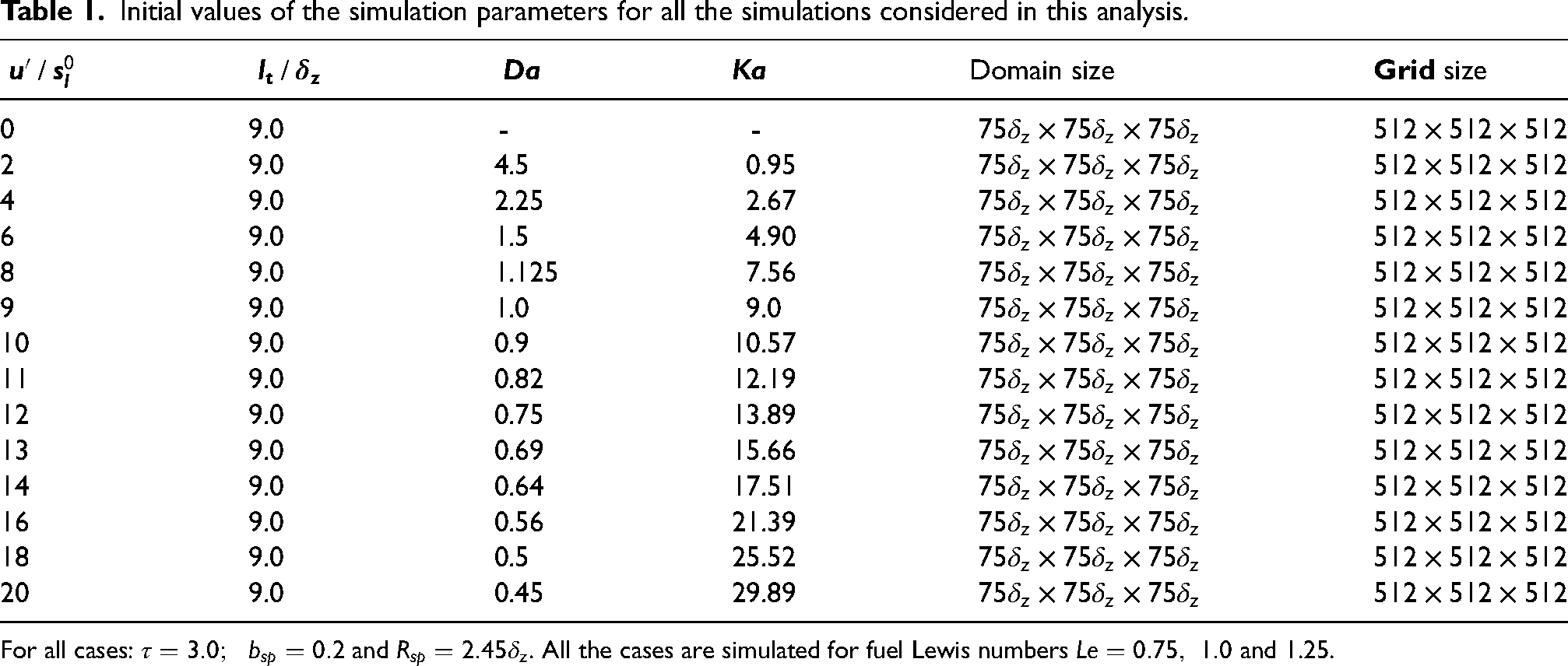
The simulation parameters such as initial values of , , Damköhler number and Karlovitz number considered for the current analysis are summarised in Table 1 along with domain and grid sizes. A cubic domain with a size of , equivalent to ( is the initial integral length scale) was used for the simulations. The domain is discretised with a cartesian grid of cells of uniform grid spacing . The grid spacing used for the simulations ensures 10 grid points across the thermal flame thickness , whilst also ensuring (i.e. is at the least 1.5 times of the grid spacing), where is the Kolmogorov length scale. This ensures both flame and the smallest structure of turbulence are adequately resolved, which are requirements for combustion DNS.53 Coarsening of the grid spacing by a factor of two gives rise to <1% differences in and . However, in order to ensure high fidelity, the finer grid spacing is used for the simulations. The boundaries of the domain are considered to be partially non-reflecting and are specified using the Navier–Stokes Characteristic Boundary Conditions (NSCBC) technique.61 The code SENGA+ employs a 10th-order central difference scheme for the internal points that gradually decreases to a one-sided second-order scheme at the non-periodic boundaries for spatial differentiation. The time advancement is carried out using a third-order low-storage Runge–Kutta scheme.62
Initial values of the simulation parameters for all the simulations considered in this analysis.
Domain size
size
0
9.0
-
-
2
9.0
4.5
0.95
4
9.0
2.25
2.67
6
9.0
1.5
4.90
8
9.0
1.125
7.56
9
9.0
1.0
9.0
10
9.0
0.9
10.57
11
9.0
0.82
12.19
12
9.0
0.75
13.89
13
9.0
0.69
15.66
14
9.0
0.64
17.51
16
9.0
0.56
21.39
18
9.0
0.5
25.52
20
9.0
0.45
29.89
For all cases: . All the cases are simulated for fuel Lewis numbers and 1.25.
The flame–turbulence interaction takes place under decaying isotropic homogeneous turbulence. A well-known pseudo-spectral method63 is used to initialise the turbulent velocity fluctuations by an incompressible, homogeneous isotropic field with prescribed values of rms values and integral length scale adhering to the Batchelor–Townsend spectrum.64 The initial integral length scale is kept constant throughout the study at (), which is comparable with previous computational studies of localised ignition,22,29,30,65 but smaller than the experimental studies by Cardin et al.10,11 with and by Shy et al.9 with .
For the purpose of numerical experimentation, only the fuel Lewis number is modified in isolation similar to previous analyses34,35,66–68 and the Lewis number of other species is considered to be unity and the mixture is taken to be stoichiometric with . The heat release parameter and the Zel’dovich number are taken to be 3.0 and 6.0, respectively, following the previous analysis.29 To evaluate the MIE required for a solely successful thermal runaway to occur, the simulations have been conducted at least for , whilst the simulations for estimating the MIE for successful self-sustained propagation lasted till either or the kernel exited the domain. The MIE for each case investigated is determined by solely modifying the value of the ignition energy parameter (see equation (5)), until the energy deposited is large enough to obtain a successful event. The MIE is estimated to have a precision of about 1.0% of the corresponding laminar MIE value. A total of around 300 DNS simulations have been conducted for this analysis which amounts to a computational cost of approximately CPU hours. The present study investigates a range of different initial turbulence intensities for each fuel Lewis number and 1.25 cases. All simulation parameters for the current analysis have been kept the same as those in Turquand d’Auzay et al.’s study,29 and interested readers are directed there for further information.
Results and discussion
Global effects of fuel Lewis number on localised forced ignition
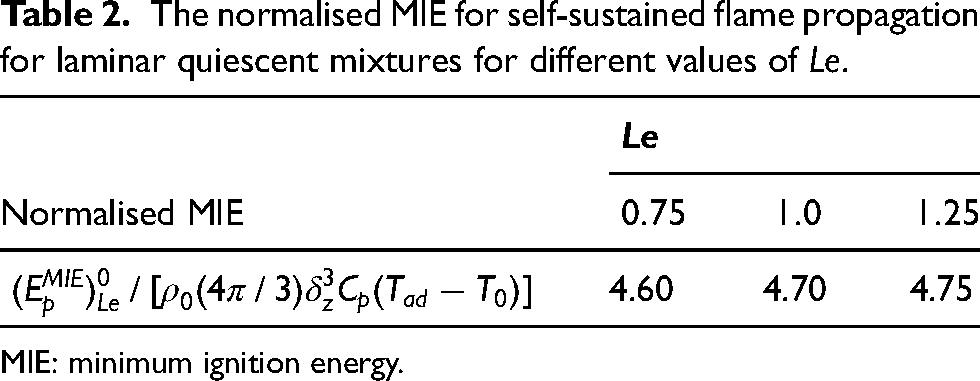
For the purpose of a direct comparison between cases with different fuel Lewis number , the MIE is normalised by the MIE obtained for = 1.0 under quiescent laminar conditions and is calculated as where is the MIE and the subscripts i and p indicate values sufficient for just thermal runaway and self-sustained flame propagation following thermal runaway, respectively and the MIE for a quiescent laminar condition for the fuel Lewis number of , which is indicated by the subscript. The values of for different values of are listed in Table 2.
The normalised MIE for self-sustained flame propagation for laminar quiescent mixtures for different values of .
Normalised MIE
4.60
4.70
4.75
MIE: minimum ignition energy.
It can be seen from Table 2 that the energy required for successful thermal runaway and subsequent flame propagation without the aid of external energy addition under quiescent laminar conditions increases with increasing for the range of fuel Lewis number considered in this analysis. The explanations for this behaviour can be provided as follows.
For the quiescent laminar conditions, the flame is initiated as a spherical kernel as a result of external energy deposition by the ignitor. Thus, the resulting flame surface is convex towards the reactants and in these zones, the focussing of fuel into the reaction zone takes place at a higher rate than the defocussing of thermal diffusion rate for the fuel Lewis number of . This gives rise to the simultaneous presence of high fuel concentration and high temperature, which acts to increase the fuel consumption and heat release rates in comparison to the corresponding unstretched laminar flame values in the case. By contrast, the defocussing of thermal diffusive flux out of the reaction zone is stronger than focussing of fuel from the unburned gas side in the regions, where the flame is convex towards the reactants, in the case of fuel Lewis number of . This leads to a combination of low temperature and low fuel concentration in the reaction zone for the case with which acts to decrease the fuel consumption and heat release rates in comparison to the corresponding unstretched laminar flame values. In the case of fuel Lewis number of unity (i.e. ) species and thermal diffusion rates occur at the same rates and thus the fuel consumption and heat release rates do not change in comparison to the corresponding unstretched laminar flame due to flame curvature under the thermochemistry considered in this analysis.
The heat release rate due to chemical reaction needs to overcome the heat transfer rate from the hot gas kernel in order to have a successful ignition event. From the foregoing discussion, it can be appreciated that the case with fuel Lewis number of due to higher heat release rate needs a smaller amount of external energy input by the ignitor in order to have a successful ignition than in the unity fuel Lewis number case. By the same token, the case with fuel Lewis number of due to its smaller heat release rate needs a higher amount of external energy input by the ignitor to have a successful ignition than in the unity fuel Lewis number case.
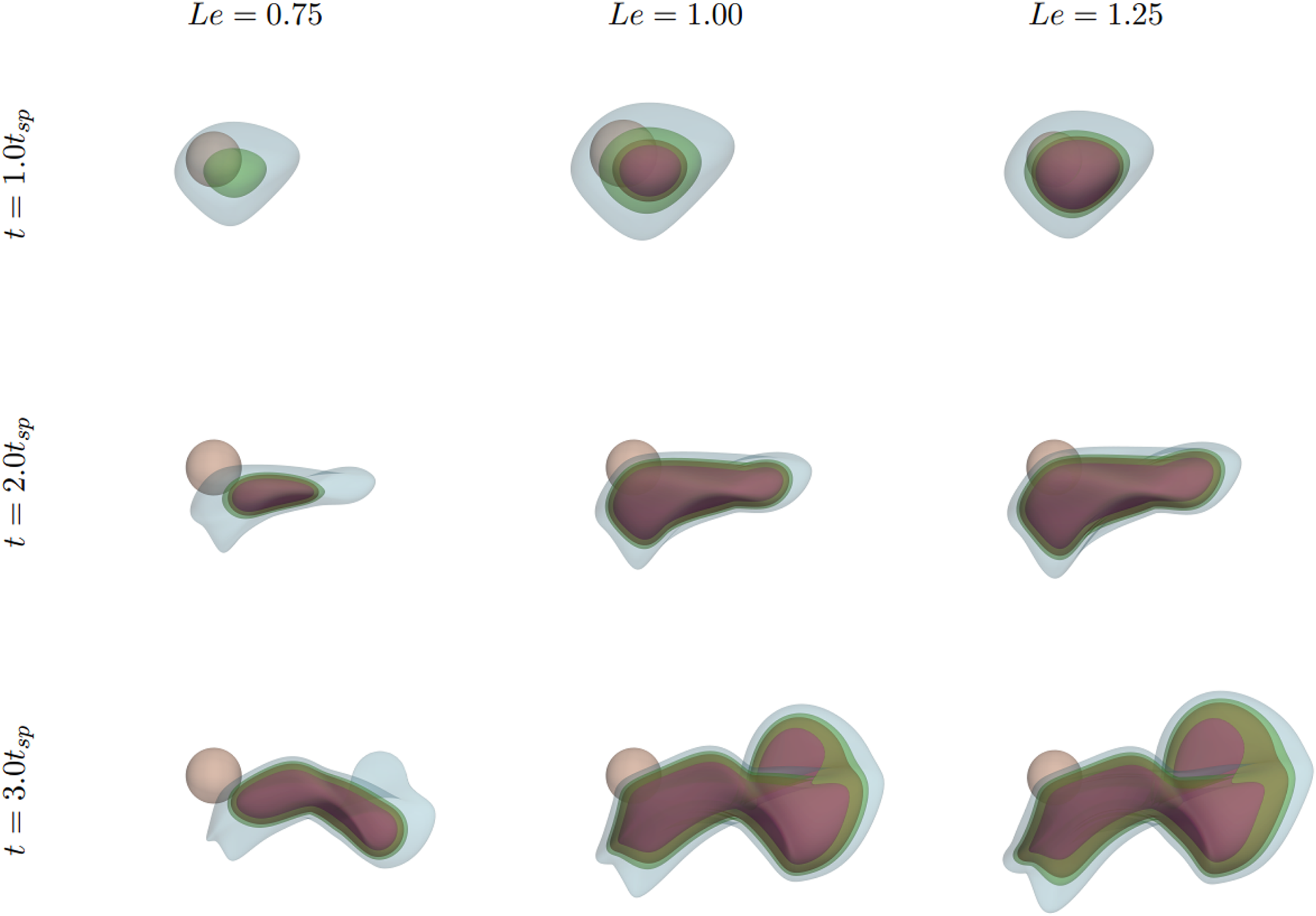
It is important to demonstrate the flame kernel development following localised forced ignition before discussing the MIE variation with turbulence intensity for different fuel Lewis numbers. The effects of fuel Lewis number on ignition in conjunction with initial turbulence intensity, isosurfaces of different values of non-dimensional temperature at and 3.0 are presented in Figure 1 for the MIE value for self-sustained flame propagation in , 1.0 and 1.25 cases at initial turbulence intensity of . The temporal evolution of the T isosurfaces shown in Figure 1 indicates that the ignition kernels become significantly wrinkled and eventually move away from the volume where the energy was deposited for the MIE value of . The observations from Figure 1 indicate that the flow conditions away from the ignitor location can also affect the fate of the hot gas kernel and this effect is likely to be less prevalent during the early stages of flame evolution.
Isosurfaces of T = 0.1 (blue), 0.3 (green), 0.5 (orange) and 0.99 (red) with the energy deposition region indicated by the translucent beige sphere obtained for the respective MIE values for successful self-sustained flame development for initial = 14 at and 3.0 (top to bottom). MIE: minimum ignition energy.
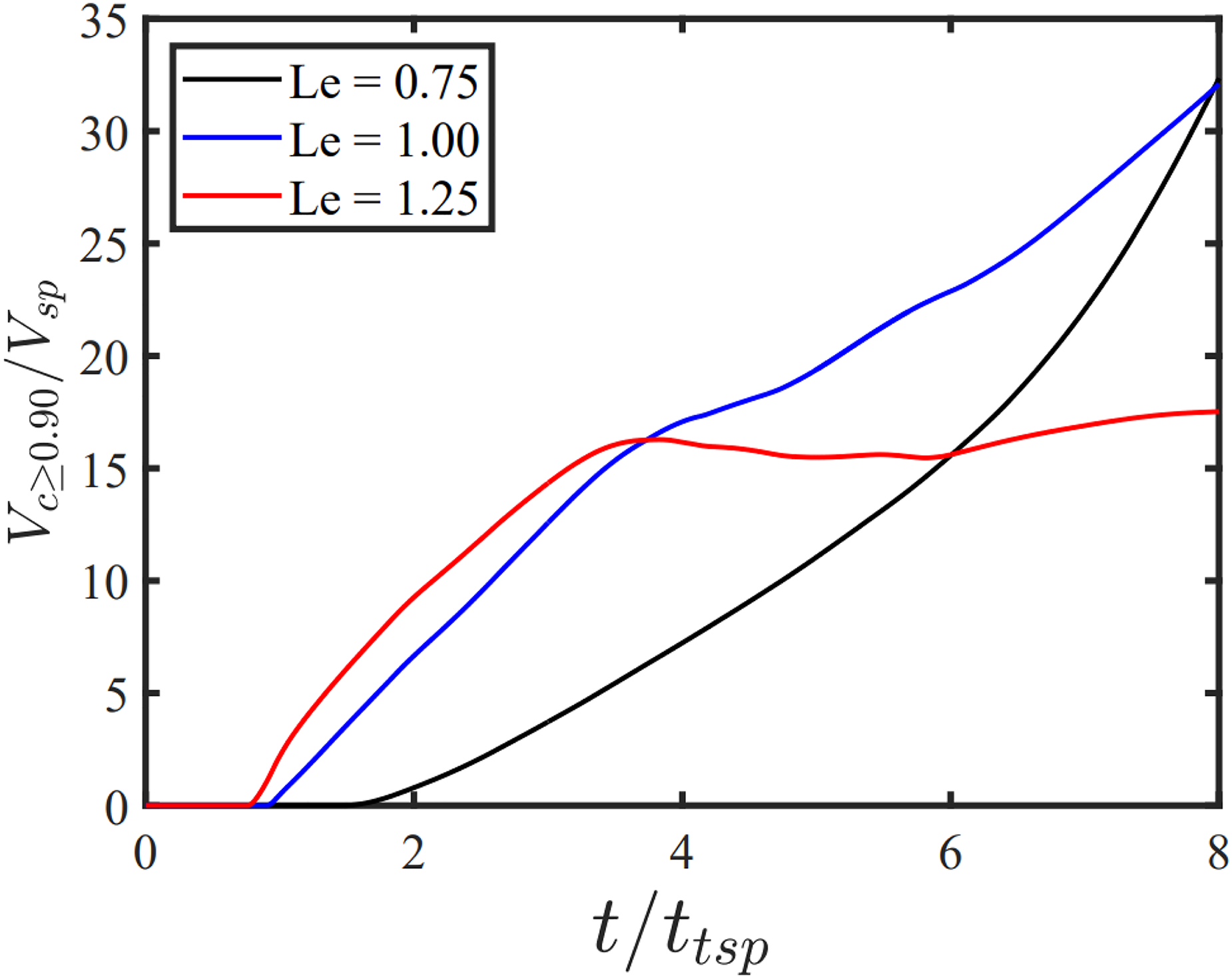
It can also be discerned from Figure 2 that the burned gas volume (characterised by the volume of the gas with ) corresponding to the MIE exhibits an increasing trend with an increase in during early times (i.e. ). In order to understand this behaviour, it is important to note that the MIE value for initial in the case is 19% higher than the case, whereas the MIE value for this initial turbulence intensity in the case is 17% smaller than the case. The higher MIE requirement with an increase of drives the above behaviour of the burned gas volume at early times (i.e. ). However once the flame kernel is established and the self-sustained propagation is occurring, and the effects of the energy deposition have passed, the rate of burning for the kernels increases as decreases, which is consistent with previous findings by Patel and Chakraborty.20,21 This can be substantiated by Figure 2 where the temporal evolutions of for the cases in Figure 1 are shown where is the characteristic energy deposition volume.
Temporal evolutions of the normalised volumes of the reaction progress variable range given by for the respective MIE values for successful self-sustained flame development of different fuel Lewis number cases for initial = 14. MIE: minimum ignition energy.
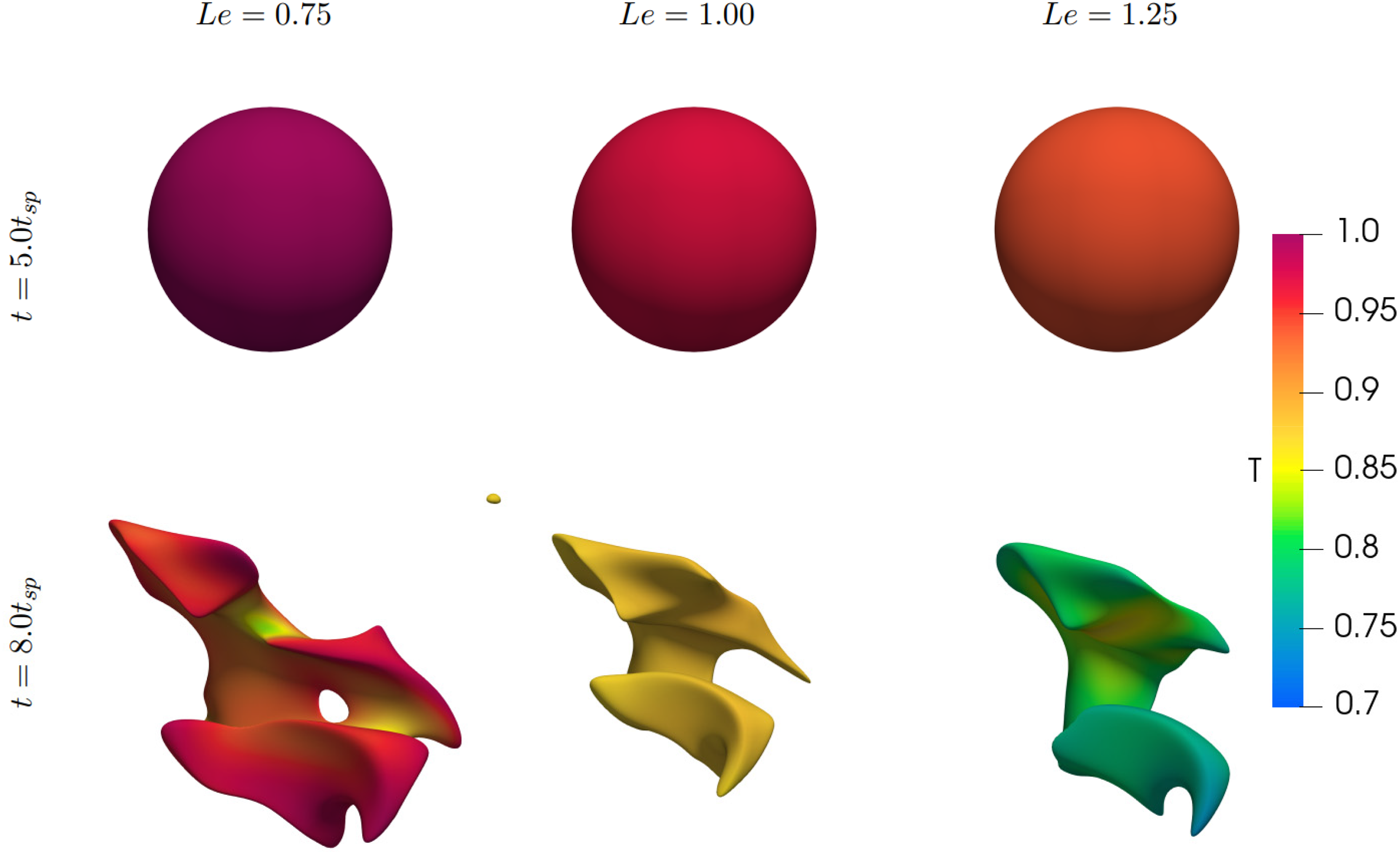
For the purpose of further explanations, the reaction progress variable isosurfaces coloured by local values of T for the , 1.0 and 1.25 for the ignition energy input corresponding to the MIE for quiescent laminar and turbulent conditions with an initial turbulence intensity of are shown in Figure 3 for different time instants. It can be seen from Figure 3 that the high-temperature values in the case are associated with zones with flame wrinkles which are convexly curved towards the reactants, whereas low-temperature values are observed in the regions concavely curved towards the unburned gas. The opposite behaviour is observed in the case with fuel Lewis number of 1.25 (i.e. ). The temperature remains uniform in the reaction progress variable isosurfaces in the case of fuel Lewis number of unity (i.e. ). The curvature dependence of temperature on the reaction progress variable isosurfaces for non-unity Lewis number cases is a result of thermo-diffusive effects arising from and this behaviour is consistent with previous findings in the context of premixed flame propagation.66–68 The distributions of fuel consumption and heat release rates are qualitatively similar to the temperature distribution and thus are not explicitly shown here. For the laminar flames, the flame surface remains convex towards the reactants at all times and for turbulent cases, the flame remains mostly convex despite local concavely curved surfaces.
Instantaneous views of the reaction progress variable isosurfaces coloured by local values of T for the , 1.0 and 1.25 (1st−3rd columns) for the ignition energy input corresponding to the MIE for quiescent laminar condition at (top row) and turbulent condition with initial turbulence intensity of at (bottom row). MIE: minimum ignition energy.
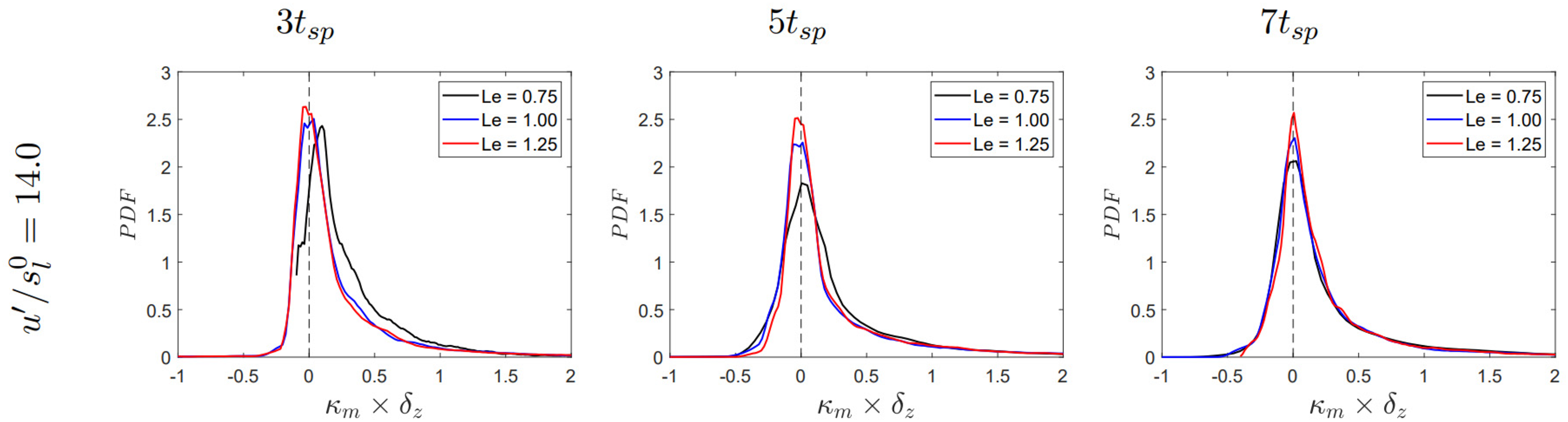
This can exemplarily be seen from Figure 4 where the probability density functions of normalised curvature for isosurface at and are shown for the turbulent cases with initial for their respective MIE values. A positive (negative) value of corresponds to a surface which is convex (concave) towards the reactants. Figure 4 shows that there are probabilities of finding negative but the probability of finding positive overwhelms that finding negative at all stages of flame evolution in turbulent cases irrespective of . As the flame surface remains predominantly positively curved (i.e. ) and the high reaction and heat release rates are associated with in the case, the heat release rate within the hot gas kernel in this case more readily overcomes the heat transfer rate to the surrounding cold gas than the unity Lewis number case. Therefore, the case needs less energy for successful thermal runaway and the subsequent self-sustained flame propagation than in the case. By contrast, in the case, the low reaction and heat release rates are associated with predominantly positively curved (i.e. ) flame surface elements. This indicates that a smaller surface-to-volume ratio (i.e. larger mean flame radius) is needed in the case so that the heat release rate within the hot gas kernel overcomes the heat transfer rate to the surrounding cold gas to have successful self-sustained flame propagation unassisted by external energy addition subsequent to thermal runaway. This warrants a greater energy input for producing larger burned gas volume to ensure successful ignition in the case than in the unity Lewis number case.
PDFs of normalised curvature for isosurface at and (1st−3rd column) are shown for the turbulent cases with initial for the respective MIE values for successful self-sustained flame development of different fuel Lewis number case for initial . MIE: minimum ignition energy; PDF: Probability density function.
Effects of fuel Lewis number on the normalised MIE values
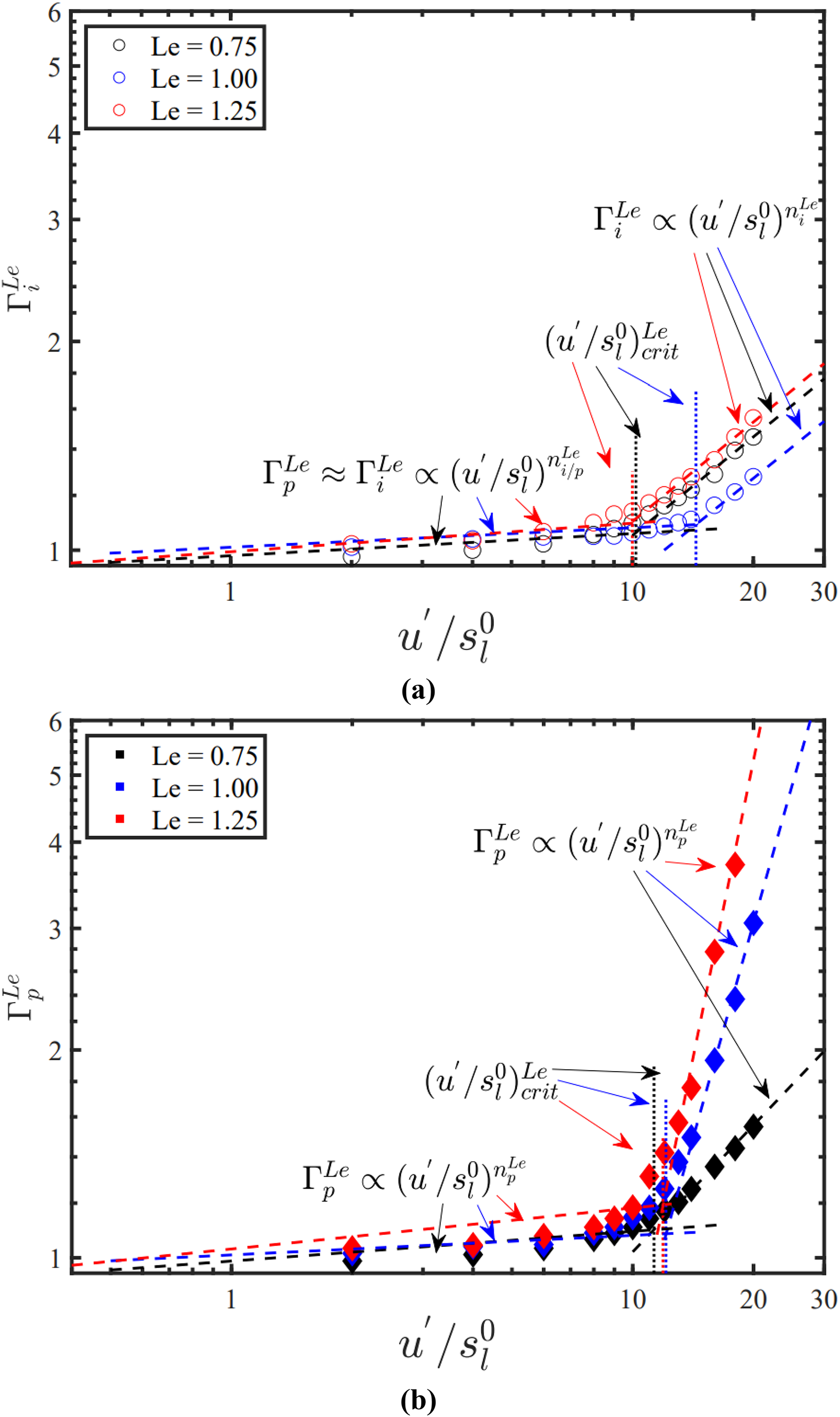
The variations of the normalised MIE values for ensuring just thermal runaway and also for successful self-sustained flame propagation following the thermal runaway are shown as functions of in Figure 5(a) and (b), respectively. It can be seen from Figure 5(a) and (b) that both and increase with increasing fuel Lewis number. The trend holds for all turbulence intensities, and is obtained for large values of , which can be quantified as: , where is the critical turbulence intensity after which a sharp increase of the MIE requirement is observed for each value of fuel Lewis number , as the energy requirement for just ensuring thermal runaway is significantly smaller than that needed for ensuring self-sustained flame propagation. The energy demand for both successful thermal runaway and self-sustained flame propagation increases with increasing turbulence intensity. The turbulent diffusivity scales as: and thus the heat transfer rate from the hot gas kernel increases with increasing turbulence intensity. Thus, the external energy supply needs to increase for increased values of turbulence intensity in order to overcome the augmented heat transfer rate and thus the MIE increases with increasing turbulence intensity for the cases considered here and this behaviour is consistent with several previous studies.8–13,15,16,29,30
Variation of the normalised MIEs (a) and (b) with for different fuel Lewis numbers . The critical turbulence intensity (shown by vertical lines) is estimated by the intersection point between the fits of and . MIE: minimum ignition energy.
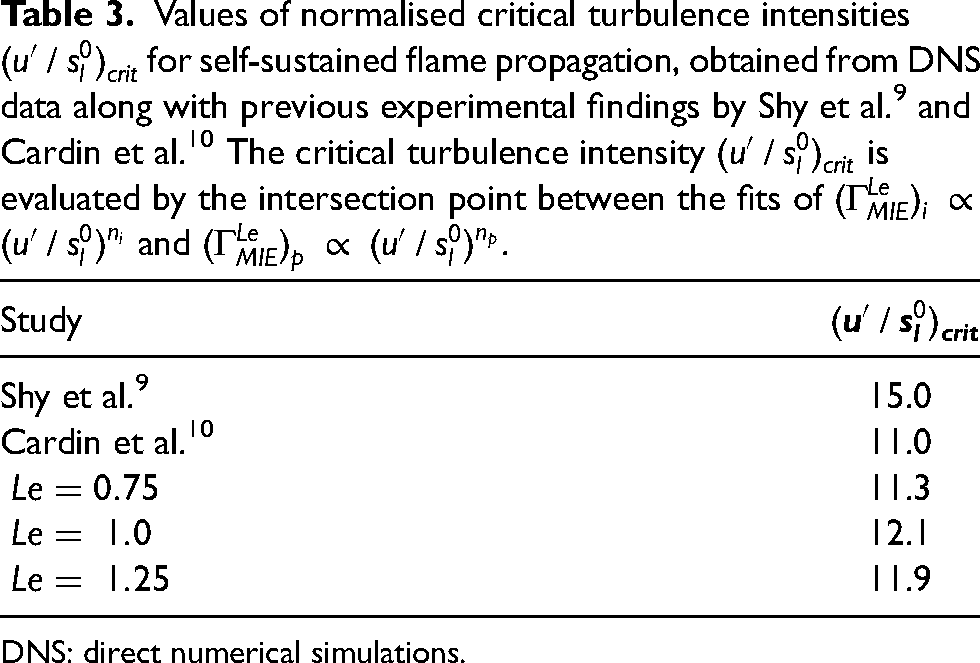
Moreover, the sharp increase in the demand of with increasing for is consistent with previous experimental8–13,15,16 and computational29,30 findings. It can be seen from Figure 5 that decreases with increasing fuel Lewis number . The values of are compared with previous experimental findings by Shy et al.,9 Cardin et al.10,11 in Table 3. The critical turbulence intensities for the different cases considered here fall in the same range as the value that was reported by Cardin et al.10,11 for lean methane–air mixtures (i.e. ). The critical turbulence intensities for the cases considered here give rise to a range of Karlovitz number () given by 9.0–13.85 (13.0–20.0), which is also consistent with previous experimental findings.10,11
Values of normalised critical turbulence intensities for self-sustained flame propagation, obtained from DNS data along with previous experimental findings by Shy et al.9 and Cardin et al.10 The critical turbulence intensity is evaluated by the intersection point between the fits of and .
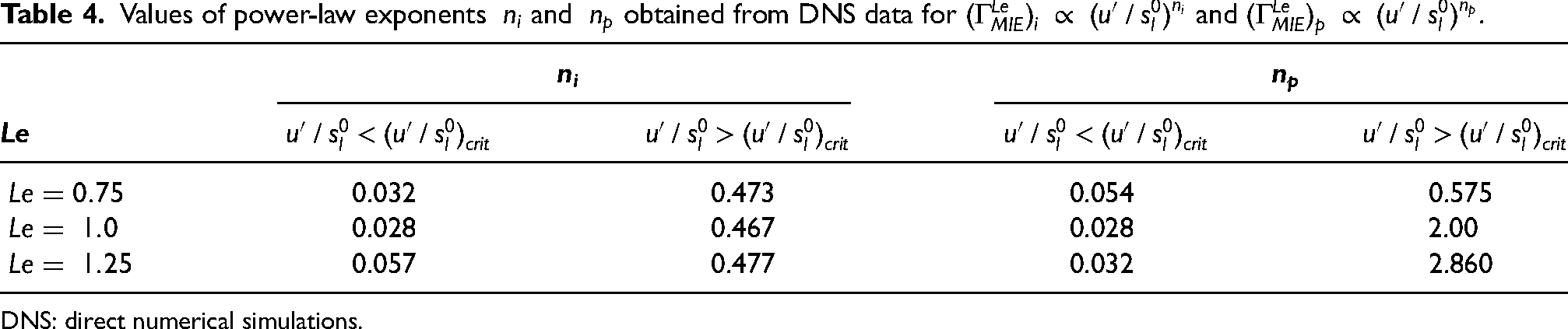
It can be seen from the log–log plot in Figure 5(a) and (b) that the normalised MIE for a given fuel Lewis number can be approximated by a power-law of the form and , which are shown by the dashed lines in Figure 5(a) and (b), respectively. The values of the power-law exponents and for different values of are listed in Table 4. Figure 5(a) and (b) show that both and decrease with decreasing . It can be seen from Table 4, and values are of the same small order of magnitude () and are quite similar (i.e. ) for . The small discrepancies that arise, are due to the different number of data points that are used for obtaining and because the MIE transition just for thermal runaway takes place at a different turbulence intensity from that for self-sustained flame propagation (i.e. .) The similarity between and for ) can also be seen from Figure 5(a) and (b), which suggest that the energy requirements are nearly identical for just thermal runaway and propagation in these cases, thus implying that the corresponding slopes should exhibit similar behaviour as outlined earlier. The localised ignition process for ensuring just the thermal runaway is principally driven by the autoignition process,29,30 whereas the competition between the volume-integrated heat release rate (which is governed by flame wrinkling and flame propagation statistics) and heat transfer rate from the hot gas kernel determines the fate of the ignited hot gas kernel without the assistance of the external energy deposited by the ignitor. As the flame wrinkling and propagation statistics are stronger functions of than the autoignition delay, is found to be less sensitive to Le than (see Table 4). The caveats regarding the power-law exponents also hold for ) because the value of can depend both on the number, and choice of data points used to obtain it but the trendlines are in excellent agreement with a sufficient number of data points. This provides confidence in the values of reported in this analysis. It can be seen from Table 4 that shows an increasing trend with increasing , which is consistent with the physical explanations provided in the context of Figures 2 to 4. This further suggests that the MIE transition with increasing is more severe for higher values of fuel Lewis number .
Values of power-law exponents and obtained from DNS data for and .
0.032
0.473
0.054
0.575
0.028
0.467
0.028
2.00
0.057
0.477
0.032
2.860
DNS: direct numerical simulations.
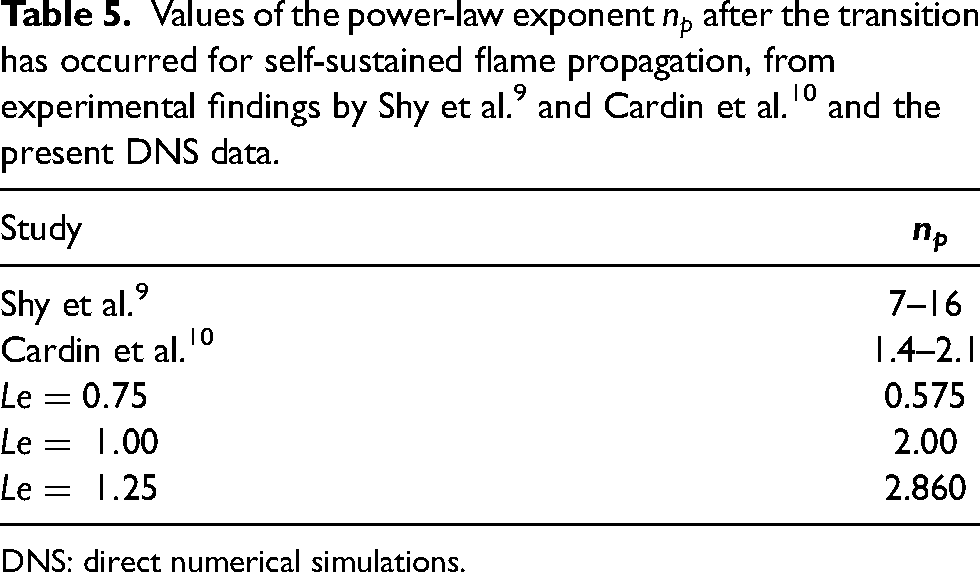
The values of the power-law exponent after the MIE transition has occurred for self-sustained flame propagation from the present DNS data are compared to the experimental findings by Shy et al.9 and Cardin et al.10 in Table 5. The value of for reported in this article shows a good agreement with the experimental findings by Cardin et al.10,11 and previous numerical results,29,30 which considered mixtures with fuel with a Lewis number of 1.0. However, it is worth noting that Shy and co-workers8,9,12,13,15,16 reported a much larger value of . The quantitative disagreements that arise between the experimental studies by Shy and co-workers8,9,12,15,16 and current DNS findings (and also previous DNS analysis by Turquand d’Auzay et al.29) possibly arise due to differences in the (i) quantification of the MIE evaluation, (ii) integral length scales between the experimental and DNS studies and (iii) the use of forced turbulence by Shy and co-workers8,9,12,15,16 as opposed to decaying turbulence used in the DNS, and experimental analysis by Cardin et al.10,11 It is worth noting that the exact amount of energy deposited to the gaseous mixture in the case of spark ignition is not easy to measure as precisely as it is in the DNS (no heat losses, plasma formation and shock wave in the numerical results).29,30 Moreover, the uncertainty regarding the energy input in laser ignition in Cardin et al.10,11 is likely to be smaller than in spark ignition in the experiments by Shy and co-workers.8,9,12,15,16
Values of the power-law exponent after the transition has occurred for self-sustained flame propagation, from experimental findings by Shy et al.9 and Cardin et al.10 and the present DNS data.
It has already been mentioned that the competition between the chemical heat release rate and heat transfer rate from the hot gas kernel determines the fate of the ignited hot gas kernel without the assistance of the external energy deposited by the ignitor. The heat transfer from the hot gas kernel adversely affects the likelihood of both ignition and subsequent self-sustained propagation, and it increases with increasing , which scales as . For the experiments by Shy and co-workers,8,9,12,15,16 under forced turbulence does not decay with time and thus the heat transfer rate from the hot gas kernel does not decrease with the progress with time. However, under decaying turbulence, the heat transfer rate from the hot gas kernel decreases with the decay in with time. This implies that the MIE demand under forced turbulence has to be greater than that for decaying turbulence, as the higher heat transfer from the hot gas kernel would result in a misfire or flame quenching if the MIE for decaying turbulence were used for forced turbulence. Therefore, it is perhaps not surprising that the current DNS results exhibit a better agreement with the decaying turbulence experimental analysis by Cardin et al.10,11
For the experimental MIE evaluation8–12,15,16 it is often useful to estimate the amount of energy needed to obtain 0% successful ignition (successful ignition will never occur), and also the energy required to achieve 100% ignition (successful ignition will always occur). This necessitates a large number of experimental realisations, and the energy demand which corresponds to 50% ignition probability is taken to be the measure of the MIE once the limits associated with 0% and 100% ignitability have been ascertained. In experiments8–12,15,16 several runs are carried out to determine the final MIE value for a given value of turbulence intensity, but this method cannot be adopted in DNS due to the exorbitantly expensive computational cost associated with such a task. Thus, the differences between the evaluations of the MIE between the experimental and the current DNS analysis may also contribute to the differences between values obtained from DNS and the experimental results by Shy and co-workers.8,9,12,15,16
Physical explanations for the effects of fuel Lewis number on the MIE transition
As has been estimated based on a finite number of data points, there is a small degree of uncertainty in the values presented in Table 5 but the increase in with increasing can be explained in the following manner. One gets the following relation under the critical condition in the absence of any mean advection based on the equilibrium of the heat release and heat transfer rates from the hot gas kernel29,30,69:
where the heat release rate can be taken to scale with 52 with being the flame surface area to volume ratio.69 In equation (6), is the actual flamelet area and the projected flame surface, and the effective diffusive thermal flux which can be taken to scale as29,30:
Henceforth, it will be considered that because turbulent diffusion is expected to be much stronger than the molecular diffusion rate. In equation (6), represents the critical radius of the hot gas kernel such that one needs for self-sustained propagation without the assistance of external energy addition.69 Using , and with in equation (7) gives rise to29,30,70,71:
Based on ), the normalised MIE, can be taken to scale as:
The values of and do not change significantly in comparison to their initial values in the timescale of ignition so the initial values can be considered in the context of equation (9). Several analyses on turbulent premixed combustion72–79 reported that varies linearly (i.e. ) with for small turbulence intensities, whereas becomes less sensitive to the changes for large turbulence intensities leading to . A value of is consistent with small values of for small turbulence intensities (see Table 5). A value of yields for large values of . Several previous studies69–78 reported , which also suggests according to equation (9). However, increases with decreasing for a given turbulence intensity66–68,70,71 due to thermo-diffusive effects, which have been explained in detail elsewhere66–68,70,71 and thus are not repeated here. Therefore, is expected to decrease with decreasing , which is consistent with the results presented in Figure 5(b) and also with values reported in Table 5.
Stochasticity in localised forced ignition
Finally, the stochasticity of the ignition phenomenon cannot be overlooked and this aspect in the current analysis has been addressed in the following manner. The MIE evaluation in this computational analysis considers a given turbulent flow realisation (referred to as S01) and two additional simulations have been carried out to analyse the effects of stochasticity for the same ignition energy input for two different realisations of statistically identical flow conditions in terms of and (referred to as S02 and S03, respectively). This methodology is adopted for the sake of computational economy in terms of time and storage. It is worth noting that the MIE requirements are evaluated based on realisation S01, which inherently means that successful ignition is always obtained for this turbulent realisation.
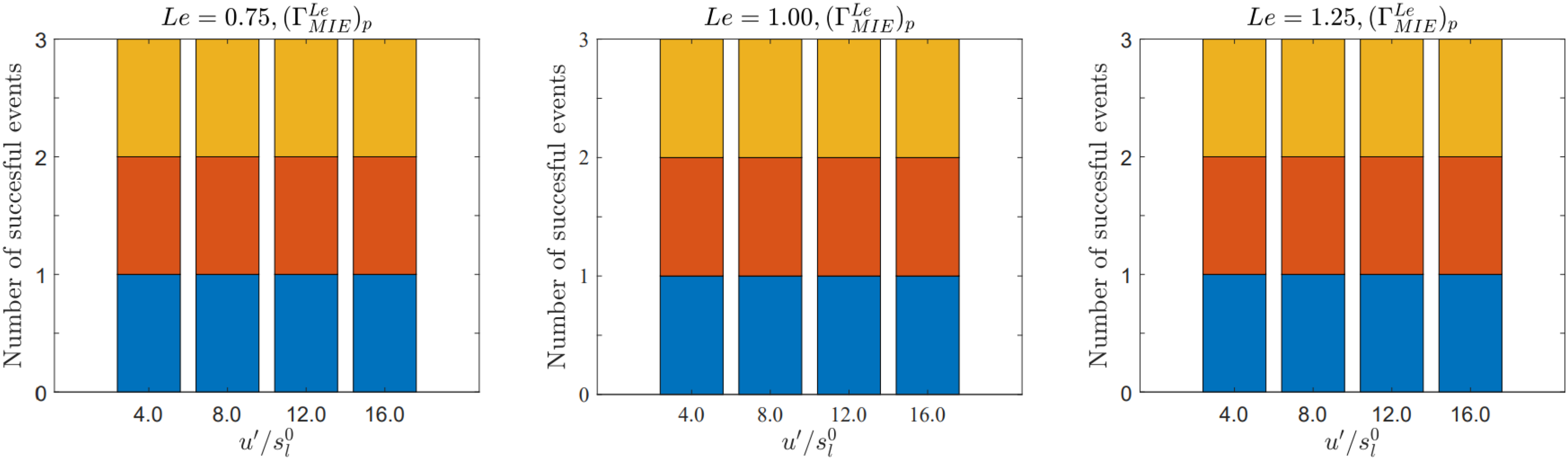
The stochasticity analysis for the MIE required for self-sustained flame propagation is conducted only for a limited number of turbulence intensities because of the high computational cost associated with it. The outcomes of the stochasticity analysis for self-sustained flame propagation for four initial turbulence intensities ( and ) are exemplarily shown in Figure 6. Figure 6 shows that successful self-sustained flame propagation is obtained for all the realisations (i.e. for S01, S02 and S03 realisations) for the ignition energy input corresponding to for all the initial turbulence intensities considered for this analysis. This suggests that values are reasonably accurately evaluated. The qualitative nature of the stochastic behaviour of the MIE only for thermal runaway is similar to that shown in Figure 6, which was demonstrated in a study by the same authors29,30 and thus is not shown here for the sake of brevity.
Number of successful events out of three different turbulent realisations (S01 (blue), S02 (orange) and S03 (yellow)) across selected turbulent cases for fuel Lewis number of and 1.25 for the input ignition energy corresponding to .
It is admitted that three realisations are not enough to analyse statistically independent events, but more realisations cannot be afforded in order to keep the computational cost within reasonable bounds, but the results from Figure 6 give some confidence that values are reasonably accurately evaluated using the methodology considered here. However, it should be appreciated that a different outcome can be obtained for different turbulent flow realisations. For example, different outcomes were reported for the cases in Turquand d’Auzay et al.’s study29 for some of the turbulence intensities analysed here. In this analysis, the simulations for the cases have been freshly carried out to ensure that the same turbulent flow realisations are used for all the different values of , which provided almost identical values of (within the uncertainty of 1%) for the case obtained in Turquand d’Auzay et al.’s study,29 but the outcomes for the turbulent flow realisations used here are different from that in Turquand d’Auzay et al.’s study29 where some unsuccessful outcomes were obtained for some realisations. It is important to note that Figure 6 shows only three realisations where successful propagation happened to be obtained for all values of , but this does not guarantee that successful propagation will be obtained for all turbulent flow realisations.
The budget of the terms in the energy conservation equation (5) was reported elsewhere29 by the present authors and the same qualitative behaviour has been observed here. Therefore, the energy budget plots for the cases considered here are not explicitly shown here but the main findings are summarised here. After the energy deposition period, the heat release rate, , and thermal diffusion rate, , act as the leading order terms in the energy conservation equation.29 To ensure successful flame propagation without the aid of external energy addition, the combined contribution of the heat release rate and thermal diffusion rate (i.e. ) needs to be positive in a mean sense29 for the growth of the hot gas kernels. By contrast, the negative mean values of suggest that the hot gas kernel shrinks with time and eventually extinguishes.29 It has already been explained that the surface-to-volume ratio of the hot gas kernel at the end of energy deposition for the MIE decreases with increasing . The ratio of the magnitudes of heat transfer rate to heat release rate decreases with the decreasing surface-to-volume ratio. Therefore, smaller surface-to-volume ratio values for higher values of may compensate for the weaker heat release rates for large values of .
Conclusions
The effects of fuel Lewis number on the MIE of homogeneous mixtures have been numerically analysed for isotropic decaying turbulence for a wide range of initial turbulence intensities. It has been found that the MIE increases with increasing turbulence intensity with a transition so that the energy demand increases sharply above a critical value of turbulence intensity for both successful ignition and self-sustained flame propagation for all fuel Lewis numbers considered here (i.e. and 1.25). This behaviour has been found to be qualitatively similar to previous numerical29,30 and experimental8–13,15,16 results. It has been found that the MIE for self-sustained propagation can be considerably higher than the MIE for only successful thermal runaway for large turbulence intensities. This trend strengthens further with increasing fuel Lewis number and the MIE value for a given turbulence intensity increases with increasing . It has been shown that the MIE for self-sustained flame propagation following thermal runaway under turbulent conditions normalised by its value under the quiescent laminar condition (i.e. ) follows a power-law in terms of turbulence intensity for with the power-law exponent exhibiting an increasing trend with an increase in fuel Lewis number . A scaling analysis and flame wrinkling statistics have been used to explain the MIE transition and the increase of the normalised MIE for self-sustained flame propagation with increasing turbulence intensity and . It has been demonstrated that successful ignition events have been obtained for all the different turbulent flow realisations in this analysis for the MIE inputs for both ignition and self-sustained flame indicating reasonable accuracy of the MIE values reported here. Although it has been demonstrated earlier30 that the qualitative nature of the MIE transition process is unlikely to be influenced by the choice of chemical mechanism, further analyses in the presence of detailed chemistry will be necessary in the future. Moreover, TFI for large values of fuel Lewis number needs further analysis, which will form the basis of future investigations.
Footnotes
Acknowledgements
The computational support of Rocket, Cirrus and ARCHER2 are gratefully acknowledged.
Declaration of conflicting interests
The authors declared no potential conflicts of interest with respect to the research, authorship, and/or publication of this article.
Funding
The authors disclosed receipt of the following financial support for the research, authorship, and/or publication of this article: This work was supported by the Engineering and Physical Sciences Research Council (grant number EP/R029369/1).
ORCID iD
Nilanjan Chakraborty
References
1.
Vázquez-EspíCLiñánA. Fast, non-diffusive ignition of a gaseous reacting mixture subject to a point energy source. Combust Theory Model2001; 5: 485–498.
2.
Vázquez-EspíCLiñánA. Thermal-diffusive ignition and flame initiation by a local energy source. Combust Theory Model2002; 6: 297–315.
3.
ChampionMDeshaiesB. Spherical flame ignition: theory versus experiment for lean propane-air mixtures. Combust Flame1986; 65: 319–337.
4.
BallalDRLefebvreAH. The influence of flow parameters on minimum ignition energy and quenching distance. Symp Combust1975; 15: 1473–1481.
5.
BallalDRLefebvreAH. Ignition and flame quenching of flowing heterogeneous fuel-air mixtures. Combust Flame1979; 35: 155–168.
6.
BallalDRLefebvreAH. A general model of spark ignition for gaseous and liquid fuel-air mixtures. Symp Combust1981; 18: 1737–1746.
7.
LefebvreAHBallalDR. Gas Turbine Combustion: Alternative Fuels and Emissions, 3. Boca Raton, USA: CRC Press, 2010.
8.
HuangCShySSLiuCC,et al.A transition on minimum ignition energy for lean turbulent methane combustion in flamelet and distributed regimes. Proc Combust Inst2007; 31: 1401–1409.
CardinCRenouBCabotG,et al.Experimental analysis of laserinduced spark ignition of lean turbulent premixed flames: new insight into ignition transition. Combust Flame2013; 160: 1414–1427.
11.
CardinCRenouBCabotG,et al.Experimental analysis of laser induced spark ignition of lean turbulent premixed flames. Comptes Rendus Mécanique2013; 341: 191–200.
12.
PengMWShySSShiuYW,et al.High pressure ignition kernel development and minimum ignition energy measurements in different regimes of premixed turbulent combustion. Combust Flame2013; 160: 1755–1766.
13.
MullaIAChakravarthySRSwaminathanN,et al.Evolution of flame-kernel in laser-induced spark ignited mixtures: a parametric study. Combust Flame2016; 164: 303–318.
14.
ShySSNguyenMTHuangS-Y,et al.Is turbulent facilitated ignition through differential diffusion independent of spark gap?Combust Flame2017; 185: 1–3.
15.
ShySSShiuYWJiangLJ, et al.Measurement and scaling of minimum ignition energy transition for spark ignition in intense isotropic turbulence from 1 to 5 atm. Proc Combust Inst2017; 36: 1785–1791.
16.
JiangLJShySSNguyenMT, et al.Spark ignition probability and minimum ignition energy transition of the lean iso-octane/air mixture in premixed turbulent combustion. Combust Flame2018; 187: 87–95.
17.
WuFSahaAChaudhuriS,et al.Facilitated ignition in turbulence through differential diffusion. Phys Rev Lett2014; 113: 024503.
18.
ShySSNguyenMTHuangSY. Effects of electrode spark gap, differential diffusion, and turbulent dissipation on two distinct phenomena: turbulent facilitated ignition versus minimum ignition energy transition. Combust Flame2019; 205: 371–377.
19.
ShySSLiaoYCChenYR,et al.Two ignition transition modes at small and large distances between electrodes of a lean primary reference automobile fuel/air mixture at 373 K with Lewis number >> 1. Combust Flame2021; 225: 340–348.
20.
PatelDChakrabortyN. Effects of fuel Lewis number and the energy deposition characteristics on localized forced ignition of homogeneous mixture: a numerical investigation. Int J Spray Combust Dyn2016; 8: 183–196.
21.
PatelDChakrabortyN. Effects of fuel Lewis number on localised forced ignition of globally stoichiometric stratified mixtures: a numerical investigation. Flow Turb Combust2016; 96: 1083–1105.
22.
PatelDChakrabortyN. Effects of energy deposition characteristics on localised forced ignition of homogeneous mixtures. Int J Spray Combust Dyn2015; 7: 151–174.
23.
ChenZBurkeMPJuY. On the critical flame radius and minimum ignition energy for spherical flame initiation. Proc Combust Inst2011; 33: 1219–1226.
24.
CaoSEchekkiT. Autoignition in nonhomogeneous mixtures: conditional statistics and implications for modelling. Combust Flame2007; 151: 120–141.
25.
ChakrabortyNHesseHMastorakosE. Effects on fuel Lewis number on localised forced ignition of turbulent mixing layers. Flow Turb Combust2010; 84: 125–166.
26.
HesseHChakrabortyNMastorakosE. The effects of the Lewis number of the fuel on the displacement speed of edge flames in igniting turbulent mixing layers. Proc Combust Inst2009; 32: 1399–1407.
27.
MastorakosE. Ignition of turbulent non-premixed fames. Prog Energy Combust Sci2009; 35: 57–97.
Turquand d’AuzayCPapapostolouVAhmedSF,et al.On the minimum ignition energy and its transition in the localised forced ignition of turbulent homogeneous mixtures. Combust Flame2019; 201: 104–117.
30.
PapapostolouVTurquand d’AuzayCChakrabortyN. A numerical investigation of the effects of fuel composition on the minimum ignition energy for homogeneous biogas-air mixtures. Flow Turb Combust2021. 10.1007/s10494-020-00229-8
31.
MarutaKNakamuraH. Super lean-burn in SI engine and fundamental combustion studies. J Combust Soc Jpn2016; 58: 9–19.
32.
ChenJHChoudharyADe SupinskiD, et al.Terascale direct numerical simulations of turbulent combustion using S3D. Comput Sci Discovery2009; 2: 015001.
33.
SmookeMDGiovangigliV. Premixed and nonpremixed test flame results. In: Reduced Kinetic Mechanisms and Asymptotic Approximations for Methane-Air Flames. Berlin: Springer, 1991, pp.29–47.
34.
SibulkinMSiskindKS. Numerical study of initiation of a combustion wave by an ignition kernel. Combust Flame1987; 69: 49–57.
35.
HeL. Critical conditions for spherical flame initiation in mixtures with high Lewis numbers. Combust Theory Model.2000; 4: 159–172.
36.
TarrazoESanchezALiñánA,et al.A simple one-step chemistry model for partially premixed hydrocarbon combustion. Combust Flame2006; 147: 32–38.
37.
MalkesonSChakrabortyN. Statistical analysis of displacement speed in turbulent stratified flames: a direct numerical simulation study. Combust Sci Technol2010; 182: 1841–1883.
38.
MastorakosEBaritaudTAPoinsotTJ. Numerical simulations of autoignition in turbulent mixing flows. Combust Flame1997; 109: 198–223.
39.
ImHGChenJHLawCK. Ignition of hydrogen/air mixing layer in turbulent flows. Proc Combust Inst1998; 28: 1047–1056.
40.
ChakrabortyNCantRSMastorakosE. Effects of turbulence on spark ignition in inhomogeneous mixtures: a direct numerical simulation (DNS) study. Combust Sci Technol2007; 179: 293–317.
41.
HesseHChakrabortyNMastorakosE. The effects of the Lewis number of the fuel on the displacement speed of edge flames in igniting turbulent mixing layers. Proc Combust Inst2009; 32: 1399–1407.
42.
RayJNajmHNMcCoyRB. Ignition front structure in a methane air jet. Presented at the 2nd Joint Meeting of the U.S. Section of the Combustion Institute, Oakland, California, paper no. 150 (2001).
43.
NeophytouAMastorakosECantRS. DNS Of spark ignition and edge flame propagation in turbulent droplet-laden mixing layers. Combust Flame2010; 157: 1071–1086.
44.
KaramiSHawkesERTaleiM,et al.Mechanisms of flame stabilisation at low lifted height in a turbulent lifted slot-jet flame. J Fluid Mech2015; 777: 633–689.
45.
KaramiSHawkesERTaleiM,et al.Edge flame structure in a turbulent lifted flame: a direct numerical simulation study. Combust Flame2016; 169: 110–128.
46.
EchekkiTChenJH. Structure and propagation of methanol-air triple flames. Combust Flame1998; 114: 23–245.
47.
ImHGChenJH. Structure and propagation of triple flames in partially premixed hydrogen-air mixtures. Combust Flame1999; 119: 436–454.
48.
ImHGChenJH. Effects of flow strain on triple flame propagation. Combust Flame2001; 126: 1384–1392.
49.
KoYSChungSH. Propagation of unsteady tribrachial flames in laminar non-premixed jets. Combust Flame1999; 118: 151–163.
50.
ChungSH. Stabilization, propagation and instability of tribrachial triple flames. Proc Combust Inst2007; 31: 877–892.
51.
HeegerCBohmBAhmedSF, et al.Statistics of relative and absolute velocities of turbulent non-premixed edge flames following spark ignition. Proc Combust Inst2009; 32: 2957–2964.
52.
DinkelackerFManickamBMuppalaSPR. Modelling and simulation of lean premixed turbulent methane/hydrogen/air flames with an effective Lewis number approach. Combustion Flame2011; 158: 1742–1749.
WandelA. Influence on scalar dissipation on flame success in turbulent sprays with spark ignition. Combust Flame2014; 161: 2579–2600.
55.
PoinsotTEchekkiTMungalM. A study of the laminar flame tip and implications for turbulent premixed combustion. Combust Sci Techbol1992; 81: 45–73.
56.
LouchDSBrayKNC. Vorticity in unsteady premixed flames: vortex pair-premixed flame interactions under imposed body forces and various degrees of heat release and laminar flame thickness. Combust Flame2001; 125: 1279–1309.
57.
AspdenAJ. A numerical study of diffusive effects in turbulent lean premixed hydrogen flames. Proc Combust Inst2017; 36: 1997–2004.
58.
BallalDRLefebvreA. Sprak ignition of turbulent flowing gases, 15th Aero. Sci. Meeting, AIAA Los Angeles, paper no. 77-185 (1977).
59.
JenkinsKCantR. Direct numerical simulation of turbulent flame kernels. In: KnightDSakellL (eds) Recent Advances in DNS and LES: Proceedings of the Second AFOSR Conference, Rutgers. New Brunswick, Kluwer, Dordrecht: The State University of New Jersey, 1999, pp.191–202.
60.
DopazoCCifuentesLChakrabortyN. Vorticity budgets in premixed combusting turbulent flows at different Lewis numbers. Phys Fluids2017; 29: 045106.
WrayA. Minimal Storage Time Advancement Schemes for Spectral Methods. California, USA: NASA Ames Research Center, 1990.
63.
RogalloRS. Numerical experiments in homogeneous turbulence, Technical Report, 1981.
64.
BatchelorGKTownsendAA. The nature of turbulent motion at large wavenumbers. Proc R Soc A Math Phys Eng Sci1949; 199: 238–255.
65.
PeraCChevillardSReveillonJ. Effects of residual burnt gas heterogeneity on early flame propagation and on cyclic variability in spark-ignited engines. Combust Flame2013; 160: 1020–1032.
66.
RutlandCTrouvéA. Direct simulations of premixed turbulent flames with nonunity Lewis numbers. Combust Flame1993; 94: 41–57.
67.
ChakrabortyNCantRS. Influence of Lewis number on curvature effects in turbulent premixed flame propagation in the thin reaction zones regime. Phys Fluids2005; 17: 105105.
68.
Ozel-ErolGKleinMChakrabortyN. Lewis number effects on flame speed statistics in spherical turbulent premixed flames. Flow, Turb Combust2021; 106: 1043–1063.
69.
KleinMChakrabortyNCantRS. Effects of turbulence on self-sustained combustion in premixed flame kernels: a direct numerical simulation (DNS) study. Flow Turb Combust2008; 81: 583–607.
70.
MuppalaSRAluriNKDinkelackerF,et al.Development of an algebraic reaction rate approach for the numerical calculation of turbulent premixed methane ethylene and propane/air flames at pressures up to 1.0 MPa. Combust Flame2005; 140: 257–266.
71.
KobayashiHKawazoeH. Flame instability effects on the smallest wrinkling scale and burning velocity of high-pressure turbulent premixed flames. Proc Combust Inst2000; 28: 375–382.
72.
Abdel-GayedRGBradleyD. Dependence of turbulent burning velocity on turbulent Reynolds number and ratio of laminar burning velocity to r.m.s. turbulent velocity. Proc Combust Inst1977; 16: 1725–1735.
73.
Abdel-GayedRGAl-KhishaliKJBradleyD. Turbulent burning velocities and flame straining in explosions. Proc R Soc London A1984; 391: 391–414.
74.
BradleyD. How fast can we burn?Proc Combust Inst1992; 24: 247–262.
75.
BradleyD. Problems of predicting turbulent burning rates. Combust Theory Model2002; 6: 361–382.
76.
BrayKNC. Studies of turbulent burning velocity. Proc R Soc Lond A1990; 431: 315–335.
77.
NivartiGVCantRS. Direct numerical simulation of the bending effect in turbulent premixed flames. Proc Combust Inst2017; 36: 1903–1910.
78.
AhmedUChakrabortyNKleinM. Insights into the bending effect in premixed turbulent combustion using the Flame Surface Density transport. Combust Sci Technol2019; 191: 898–920.
79.
VarmaARAhmedUKleinM,et al.Effects of turbulent length scale on the bending effect of turbulent burning velocity in premixed turbulent combustion. Combust Flame2021; 233: 111569.