




Abstract
The Spanish Working Group on Crohn’s Disease and Ulcerative Colitis (GETECCU) was founded in 1990 to improve the clinical care and scientific knowledge of inflammatory bowel disease (IBD) in Spain. From its origins as a clinician-driven collaborative network, GETECCU has developed into a nationally and internationally recognised platform, supporting multicentre research, quality assurance and medical education in IBD. A key achievement has been the development of ENEIDA (Estudio Nacional en Enfermedad Inflamatoria Intestinal sobre Determinantes Genéticos y Ambientales), a nationwide prospective registry that now includes data from over 100 centres and more than 85,000 patients. ENEIDA has supported a wide range of observational studies and translational projects and has become a cornerstone of Spanish IBD research. Complementing this scientific foundation, the Certification of Units of Excellence programme for certifying IBD units – launched in 2017 – has promoted equity, quality and benchmarking of care. More than 80 units across the country are currently accredited under this system. GETECCU has also prioritised generational renewal through the GETECCU Young Group, which fosters early-career leadership in research and education. In parallel, the society has expanded its international presence, participating in ECCO and Pan-American Crohn’s and Colitis Organisation, and co-leading the Five Nations initiative together with peer groups in France, Italy, Israel and Portugal. This article presents an overview of GETECCU’s structure, current status and strategic directions. Looking ahead, GETECCU aims to promote research of excellence, continuous education through the translation of scientific knowledge into clinical practice, equitable access to specialised care across regions and the advancement of integrated multidisciplinary care models. GETECCU represents a well-established example of how a national academic group can evolve into a driver of innovation and quality in IBD.
Plain language summary
Crohn’s disease and ulcerative colitis are long-lasting illnesses that affect the digestive system. People living with these conditions often need specialist care and ongoing support. In Spain, physicians and researchers created a group called GETECCU to help improve treatment, share knowledge, and support patients and professionals. GETECCU brings together experts from hospitals across the country so they can learn from each other, agree on the best ways to care for patients, and carry out important research. One of GETECCU’s biggest achievements is a national project called ENEIDA. ENEIDA collects anonymous medical information from more than 85,000 people with inflammatory bowel disease (IBD) and over 100 hospitals. By studying this information, physicians can better understand how IBD affects people in everyday life and which treatments work best. This helps improve care for current and future patients. Another key accomplishment is a programme that reviews and recognises hospitals that provide high-quality IBD care. More than 80 hospitals in Spain have already been certified. This means that patients, no matter where they live, can receive expert treatment and support. GETECCU also encourages young physicians and researchers to take part in IBD care and research, helping to train future leaders in the field. In addition, GETECCU works with IBD organisations from other countries to share experience and learn from each other. This article explains how GETECCU is organised, what it has achieved, and what it hopes to do in the future. Its goals include making sure all patients in Spain receive high-quality care, turning new scientific discoveries into everyday medical practice, and supporting close teamwork between different healthcare professionals. GETECCU shows how working together across the country can lead to better care and better lives for people living with Crohn’s disease and ulcerative colitis.
Introduction
Since its foundation in 1990, the Grupo Español de Trabajo en Enfermedad de Crohn y Colitis Ulcerosa (GETECCU, Spanish Working Group on Crohn’s Disease and Ulcerative Colitis) has played a pivotal role in shaping the clinical and scientific landscape of inflammatory bowel disease (IBD) in Spain, operating as an entirely independent organisation, separate from other national gastroenterology societies. At that time, the management of IBD was heterogeneous, access to innovative therapies was limited and coordinated national research initiatives were virtually non-existent. Guided by a strong academic spirit, GETECCU was created as a collaborative network bringing together professionals to harmonise clinical practise, foster multicentre research and guarantee equitable care for people living with IBD.
Gradually, GETECCU adopted a unique multidimensional structure – integrating clinical excellence, research, education and advocacy to ensure equitable, evidence-based and patient-centred IBD care across Spain. Over the past 35 years, GETECCU has evolved into the main academic and clinical reference group for IBD in Spain. Its members are actively involved in national healthcare policy, postgraduate training and international research consortia.
This paper presents an overview of GETECCU’s evolution, strategic structure, current priorities and future directions. In addition to recounting its origins and landmark projects – such as the ENEIDA (Estudio Nacional en Enfermedad Inflamatoria Intestinal sobre Determinantes Genéticos y Ambientales)) registry or the Spanish national programme for the certification of IBD units (Certification of Units of Excellence, CUE) – we reflect on the internal and external factors that have shaped its track.
GETECCU’s journey combines progressive institutional development with a strong sense of community. It demonstrates how an academic network, built on collaboration and shaped by the needs of both patients and professionals, can make a real difference in both advancing science and shaping healthcare delivery. The lessons learned from GETECCU’s experience have been a reference for other national IBD groups in Europe and beyond.
Structure of GETECCU: Strategic vision and operational organisation
GETECCU’s organisational structure reflects its dual mission: to advance scientific knowledge to improve the quality and equity of care for patients with IBD across Spain. Founded on a collaborative academic principles, the group operates within a robust institutional framework and a dynamic strategic plan that directs its work across clinical, scientific, educational and advocacy domains.
Governance and committees
The governance of GETECCU is led by an elected Executive Board composed of a President, Vice-President (President-elect), Secretary and Treasurer, with each mandate lasting 2 years. The Board is supported by several key committees that shape the operational and strategic direction of the organisation. These include the Scientific Committee (that promotes and coordinates research in IBD, supports multicentre studies and ensures scientific excellence and rigour within GETECCU and ENEIDA’s projects), the Education Committee (that develops and delivers educational programmes for healthcare professionals, supports continuous learning and encourages the exchange in IBD care), the Social Committee (that strengthens relationships with patients and different scientific groups, promotes awareness and advocacy initiatives and incorporates the patient’s voice into GETECCU’s activities) and the Communication Committee (that ensures coherent internal and external communication, increases the visibility of GETECCU’s work and disseminates scientific and institutional achievements). Additionally, the GETECCU Young Group plays a crucial role in mentoring early-career clinicians and researchers, fostering renewal and continuity within the organisation.
Each committee operates with autonomy and well-defined mandate, ensuring that GETECCU’s scientific work, clinical guidelines and educational activities lead the way in IBD care. The committees meet regularly and present their work at the annual assembly that gather members from all affiliated centres.
Gastroenterología y Hepatología (Elsevier) serves as the official publication platform of GETECCU. Through this journal, the society disseminates its positioning documents, which address issues of direct relevance to clinical practice in Spain. These documents provide guidance on locally specific matters – such as tuberculosis screening 1 and vaccination strategies 2 – as well as on clinically important grey areas not fully covered by international guidance, including the management of psychological problems 3 or sexual health in patients with IBD. 4 They therefore do not compete with ECCO guidelines; rather, they complement them by offering pragmatic, context-adapted recommendations that shape national clinical practice.
Strategic plan 2023–2026
The current strategic plan (2023–2026) outlines several central axes: (1) excellence and equity in clinical care in Spain through the consolidation and expansion of the CUE programme 5 ; (2) promotion of translational and clinical research, with an emphasis on expanding the scope and utility of the ENEIDA registry 6 ; (3) support for young professionals, with increased training, mobility and leadership opportunities within GETECCU; (4) internationalisation, fostering strategic collaborations with worldwide partners; (5) enhancing and systematising internal and external communication; (6) strengthening GETECCU’s political and institutional presence with new synergies in order to increase IBD awareness in the general public and the political bodies in Spain and (7) optimising and innovating the quality and scope of our educations programmes.
This roadmap provides a structure for prioritising projects, allocating funds and engaging in policy development. It also defines GETECCU’s role as the link between clinical practice, academic research and health policy.
GETECCU’s structure integrates clinical professionals across disciplines, however most of the professionals are gastroenterologist, although a great deal of paediatricians, surgeons, radiologists and especially basic scientists, have gradually incorporated to GETECCU along these years. This group of experts has promoted knowledge exchange, supporting a translational approach across both research and clinical care.
Collaboration with patient associations ensures that the lived experiences of patients inform priorities and decision-making. It has also a close relationship with the IBD nurses’ organisation (GETEII). Beyond its internal ecosystem, GETECCU maintains active relationships with national and international scientific societies, regulatory agencies and academic institutions. This allows for the alignment of research and care objectives with broader healthcare policies and innovations.
The history of GETECCU
The interest in IBD started early in Spain, case reports and patients’ series were often reported, and in 1935, an excellent book on ulcerative colitis was published and then summarised in an international paper. 7 Along the 70s and 80s of the last century, well methodologically structured epidemiologic studies were published by several groups from different areas of Spain, including Galicia, Asturias, Madrid, Mallorca, Catalonia, Andalucía and Aragón. IBD was the subject of discussions at the Congresses of the Spanish Society of Gastroenterology, and in the early 80s, several groups reviewed and published their casuistic and brought the attention to the increasing number of patients with IBD. However, the efforts for improvement were scarce and the concepts heterogeneous and confuse. At that time, the new generation of gastroenterologists and those in-training faced new cases without clear ideas about diagnostic procedures and therapeutic management of these patients. No cooperative studies or clinical-therapeutic algorithms to follow existed.
In 1988, a small number of gastroenterologists and surgeons interested in this area met in Valencia, in the first monographic meeting on IBD to our knowledge. In 1990, a new monographic scientific meeting took place in Zaragoza where it was decided to establish a stable working group of physicians, surgeons and paediatricians interested in IBD. Few months later, after a meeting of 25 physicians interested, mainly gastroenterologists, GETECCU was founded. In the name of the group the use of terms such as ‘Scientific Society’ was avoided to emphasise the concept ‘Working Group’ highlighting that the objective of the group was to achieve a better care of the patients through a continuous and coordinated effort, based on the acquisition and promotion of the scientific knowledge to be applied in the clinical practice. It is fair mentioning the initial unifying and co-ordinating role of some authors of this paper (M.A.G., J.H.d.V., F.G.) together with Antoni Obrador, a great professional and specially a great person we still very much miss.
From the very beginning, working groups were formed and individual responsibilities were allocated across initiatives, with the ultimate objective of harmonising the diagnosis and treatment of IBD. Independent scientific meetings were annually organised to discuss the progress of the working groups, together with educational sessions addressed to gastroenterologists and surgeons to homogenise diagnostic and therapeutic concepts. An internationally collaborative textbook was published, which has been updated two times, and a pocketbook, as working tool with recommendations for IBD management, based on physio-pathological concepts and containing the updated evidence found in the medical literature; since then, this booklet has been regularly reviewed and published eight times. In parallel, cooperative studies were initiated, and a clinical trial was finalised and published in the American Journal of Gastroenterology. 8
Since its early days, an intense and fluid relationship was established with the Patient’s Association (ACCU España, www.accu.es) resulting in an important development impulse in both sides.
On the other hand, a constructive partnership was developed with the pharmaceutical industry, under a firm principle of non-interference. Preserving this framework has required continued vigilance over the years.
In 2000, an intensive 2-day course, for a limited number (25) Medical Residents in Gastroenterology in their 3rd or 4th year of training was organised. The course, which used an interactive methodology, began with the participants answering a multiple-choice test on IBD clinical questions; the same test was repeated at the end of the course (as quality control of the trainer’s efficiency), together with a satisfaction survey. This course has been a great success so that it must behold four editions a year and so far, more than 60 have been done. The course was offered free of charge to medical residents and soon became a reference model for other societies. Its content and structure served as the basis for ECCO’s first educational activities during its initial 3 years, and it has also inspired similar resident programmes in Latin America, including those of GECCOL in Colombia, which we initially mentored by GETECCU.
Other scientific activities of GETECCU include yearly meetings (deliberately not referred to as ‘Congresses’), where the working groups present their progress and results, alongside keynote lectures, pro-and-con debates and the development of consensus documents and clinical guidelines. It is worth mentioning that one of the first, if not the first, guidelines in the world on the use of infliximab was elaborated and published by GETECCU in 2001. 9 A new internationally participated textbook on IBD was published and three reviewed editions have been released, the last available as a webapp for GETECCU members.
In 2006, 16 years after its foundation, GETECCU started a Patient’s Registry: ‘ENEIDA Registry’, 6 which is described in another section of this article. This activity has been determinant in the development and evolution of the Scientific production of our ‘Working Group’. Similarly, the creation of ‘Young GETECCU Group’ in 2007, including young basic scientists, gastroenterologist, paediatricians and surgeons, has had great transcendence by stimulating basic and clinical research in IBD, resulting in a good deal of publications in international journals. Those initiating members of this group are nowadays members of the Governing Board of GETECCU, two of them leading the group as Presidents (M.B.A. and Y.Z.).
The ENEIDA registry
The ENEIDA Registry (acronym for Estudio Nacional en Enfermedad Inflamatoria Intestinal sobre Determinantes Genéticos y Ambientales) was developed in 2005 by a group of gastroenterologists from GETECCU and received approval from a central ethics committee in 2006.
Its overarching aim was to establish the infrastructure and operational procedures necessary to conduct large, multicentre collaborative studies on various aspects of IBD. From its inception, the principles governing participation and data usage have been clearly defined and consistently upheld. First, participation and data entry are voluntary and non-remunerated; therefore, the completeness of recorded variables depends on the commitment and motivation of the investigators at each site, given the absence of any obligation to report data. Second, the registry was designed to fulfil three primary functions: (1) to serve as a healthcare tool enabling rapid access to clinical information, (2) to act as a local registry and (3) to support multicentre scientific research, all under the regulation of GETECCU.
Initially launched as a local application requiring periodic data uploads, the registry was transitioned to a fully online platform in 2012. Since then, both technological upgrades and dataset modifications have been implemented. A comprehensive chronological overview of the registry’s development and monitoring procedures was published in 2020. 6
Participation requires that all centres sign an agreement with GETECCU, and all patients must provide informed consent before inclusion. Each participating site designates a principal investigator and may assign an unlimited number of ENEIDA investigators (i.e., researchers with access to the centre’s local data). Investigators can only access data from their own site. As of June 2025, 100 Spanish centres have contributed patients to the registry, with approximately 360 participating investigators, 85,000 IBD patients enrolled and over 8000 DNA samples stored in two biobanks.
Investigators are permitted to use their local ENEIDA data for research purposes without additional approval. The use of centralised data must comply with a specific Standard Operating Procedure (SOP). Only GETECCU members from ENEIDA-participating sites can propose studies using ENEIDA data. Once a study is approved by GETECCU, anonymised data for the selected variables are provided to the investigator for analysis and publication. Requests involving genetic analyses are governed by a separate SOP and require the provision of DNA samples from included patients, along with relevant clinical data.
The registry adheres to a well-defined authorship policy. All ENEIDA investigators who contribute patient data for a given study are eligible for authorship. Final authorship lists and manuscripts must be approved by the GETECCU Research Board, the ENEIDA coordinator and the principal investigators of the participating centres.
As with other large clinical registries, ENEIDA is based on data from expert IBD centres rather than a population-based sample, and data completeness depends on voluntary participation. Given that participation and data entry are voluntary, sustained efforts have been made to improve data quality for collaborative studies. A specific dataset defining ‘complete patients’ (i.e., those with a minimum set of critical variables completed) was established early on. As of 2025, 91% of patients meet this ‘complete’ status, and 76% of centres are considered ‘high-performing’, with at least 90% of their patients classified as complete.
The ENEIDA registry is widely regarded as a success. First, it has become the cornerstone for multicentre research in IBD in Spain. The collaborative spirit fostered through data sharing has built a culture of trust, altruism and generosity among centres, facilitating subsequent prospective GETECCU studies beyond ENEIDA. Second, ENEIDA is the leading source of high-quality scientific output in IBD in Spain, covering epidemiological, genetic, pharmacological and surgical research. It has also become a benchmark platform for real-world evidence, enabling extensive experience with newly approved therapies and generating robust data across large patient cohorts. To date, over 70 peer-reviewed articles derived from the registry have been published, the majority in top-quartile journals. Furthermore, ENEIDA has provided a valuable platform for early-career researchers, with more than 50 different first authors among the published studies, contributing to the development of promising academic careers.
Multicentre research in GETECCU (excluding ENEIDA)
GETECCU has conducted numerous multicentre studies throughout its long-standing history, among which several randomised clinical trials stand out for having led to changes in the clinical management of patients with IBD (Table 1).8,10–17 The collaborative philosophy and the success of GETECCU’s multicentre studies are based on a series of recommendations for conducting this type of research: (1) effective project leadership; (2) clearly defining feasible and relevant objectives; (3) designing a clear and detailed protocol; (4) carefully selecting participating centres and investigators; (5) meticulously designing the data collection form; (6) managing the project efficiently; (7) maintaining fluid communication with investigators and (8) establishing a clear authorship policy and ensuring appropriate publication of study results.
Randomised clinical trials conducted by GETECCU.
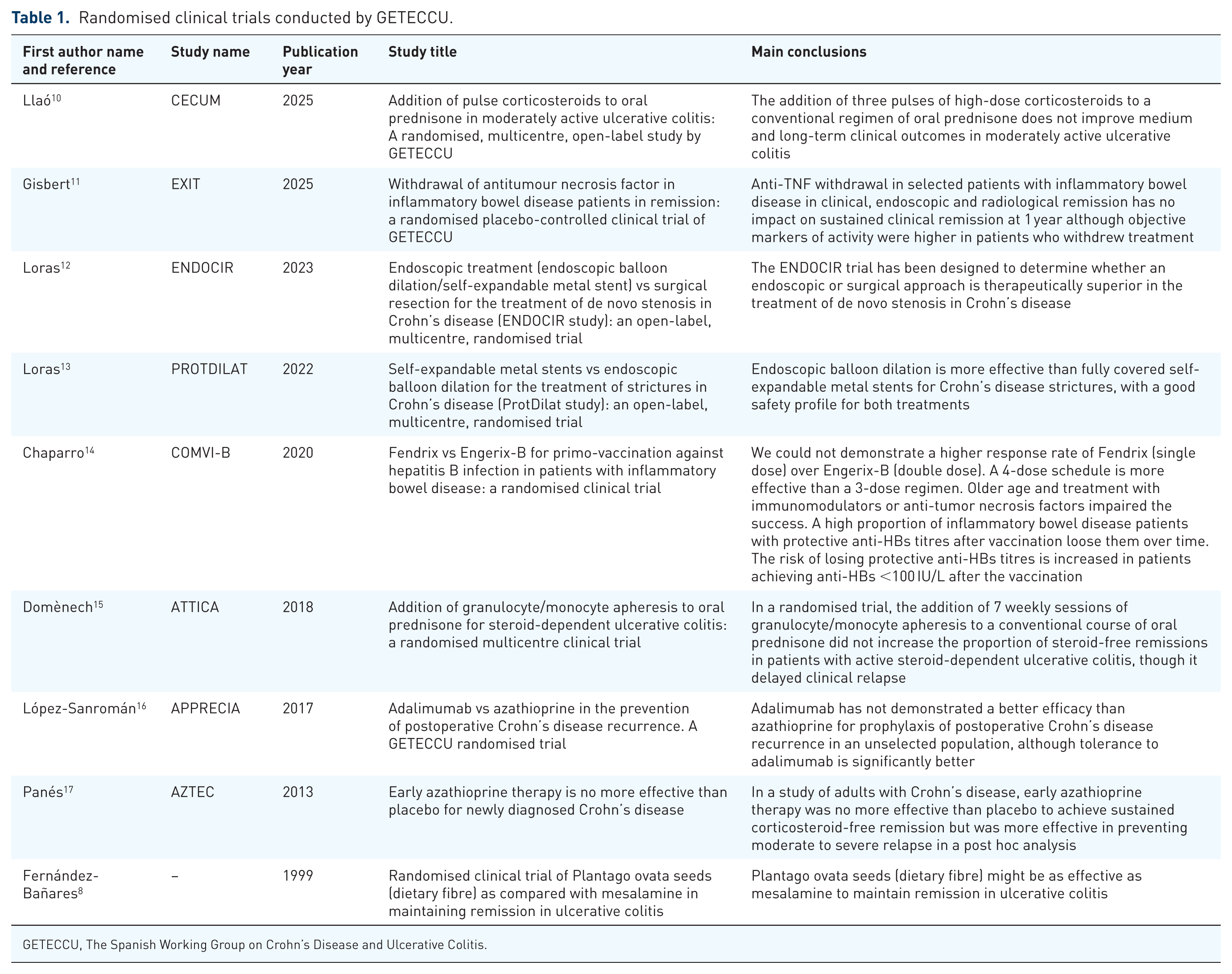
GETECCU, The Spanish Working Group on Crohn’s Disease and Ulcerative Colitis.
In addition, GETECCU provides structured support for both funding and methodological aspects of clinical research. Multicentre studies are typically supported through a combination of competitive public grants and industry-supported investigator-initiated studies (GETECCU-sponsored grants), and resources promoted directly by the society (GETECCU grants). To ensure methodological rigour, GETECCU facilitates access to dedicated statistical expertise, supporting investigators in protocol development, sample size estimation, data management strategies and statistical analysis, particularly in complex multicentre projects.
One of the most relevant aspects of any multicentre study is the selection of centres and investigators, as recruitment milestones, quality standards and ultimately the validity and robustness of conclusions depend on it. Therefore, the proper selection of investigators is one of the most important factors for a project’s successful development and, above all, its completion. In this sense, GETECCU’s philosophy has always been to carry out a broad and generous (yet sensible) selection of collaborating centres. That is, to ‘think big’ without allowing fear of expanding the study’s scope to limit its chances of success.
There is no doubt that the key factor for the success of GETECCU’s (and any other organisation’s) multicentre studies is the commitment of the investigators. Generally, what matters more than the centre itself is the enthusiasm and passion of the individual researcher. One of the main barriers to proper participation in a multicentre study is the investigator’s lack of availability or dedication. For this reason, GETECCU has always considered the academic or professional hierarchy of potential investigators to be of limited relevance. Highly reputed scientists (who could undoubtedly add prestige to a study) do not always succeed in collaborative enterprises such as these. Meanwhile, relatively less specialised professionals working in regional hospitals may be highly motivated to participate and prove to be very effective collaborators.
Another relevant factor in any multicentre study is effective and fluid communication with investigators, an aspect that GETECCU strives to prioritise in all its studies. Fluid communication among investigators plays a fundamental role in the success of collaborative research, particularly when, as is often the case, centres are geographically dispersed. Regular interaction fosters collaboration, commitment and motivation among investigators, who feel valued and aligned with the project’s objectives. In this way, communication among investigators becomes the ‘glue’ that effectively binds together the different components of a successful multicentre study.
An essential element of GETECCU’s communication strategy is the dissemination of the results of its multicentre studies. Sharing findings with investigators in a multicentre study is of utmost importance, as it enhances transparency, promotes collaboration and maximises research impact. For all these reasons, GETECCU devotes significant effort to designing an effective communication plan aimed at disseminating study results both within the scientific community and to the general public.
Regarding dissemination of results at scientific forums, GETECCU is highly proactive in preparing abstracts and presenting them at conferences, where it has maintained a strong presence for years. This allows early dissemination of study results, well before the full manuscript is finalised and published in a scientific journal, especially in the case of preliminary results or interim analyses. For collaborating investigators, this provides clear evidence that the study is progressing well or has even reached completion.
Multicentre studies increase the complexity of determining authorship for the resulting publications, which may present unique practical and ethical challenges. For this reason, GETECCU carefully plans authorship matters in multicentre studies, as it was explained previously. Authorship and publication rules are clearly defined a priori to ensure transparency, fairness and credibility in the dissemination of results. GETECCU’s philosophy is to aim for the highest possible level of representation, being generous – yet fair – with investigators who, in any case, are fully deserving.
In summary, multicentre studies generate high-quality, generalisable medical data that can influence clinical practice and are therefore considered the backbone of evidence-based medicine. These studies are undoubtedly associated with multiple benefits, but their successful implementation requires strong leadership, detailed planning, continuous and precise coordination, multidisciplinary collaboration and an effective communication strategy; above all, they require strong commitment from the entire research team. GETECCU’s collaborative philosophy greatly facilitates the generation and execution of such successful multicentre studies, ultimately improving the quality of research and its application to clinical practice. In fact, one key lesson from GETECCU’s experience is that the proactive support and collaboration of independent institutions, along with the networks established within them, represent the most cost-effective strategies not only to increase the volume of research, but more importantly, to enhance its quality.
Overall, GETECCU-led initiatives, including ENEIDA and other multicentre studies, have resulted in more than 180 peer-reviewed publications to date.
The CUE programme: A story of excellence in IBD care
Improving the quality of care has become a central goal of modern medicine. GETECCU launched a pioneering project to support all stakeholders involved in IBD management: the CUE. Its objective was clear: to guarantee all IBD patients, regardless of where they live, comprehensive, homogeneous and top-quality care.
The first major milestone was reached in 2014, when quality indicators for Comprehensive IBD Care Units were published. 18 These included 53 standards structured into indicators of structure, process and outcomes. This framework, with legal deposit BI-1125-2016, became the foundation of the CUE programme. The initiative was very well received among members. 5
Progress in clinical practice and the need to incorporate the patient’s perspective led to a comprehensive update of the programme: CUE 2.0. Its development employed a Multicriteria Decision Analysis methodology, which made it possible to weigh the relative importance of each standard with the participation of a multidisciplinary panel that included gastroenterologists, colorectal surgeons, nurses, patients and quality experts. The result was the definition of 67 standards, incorporating both clinical experience and patient-reported outcomes. 19 The programme remains active today, with a focus on continuous improvement.
To ensure transparency and rigour, GETECCU relies on an external entity: Bureau Veritas (https://www.bureauveritas.es), an independent certification body responsible for conducting audits. These audits include reviewing protocols, care pathways, multidisciplinary meetings, clinical records and verification of patient outcomes. The system includes two levels of certification: advanced certification (⩾80% and <90% compliance with indicators) and excellence certification (⩾90% compliance), with periodic audits for recertification every 3–4 years depending on the level achieved. Currently, the entire programme is detailed on the official website 20 and presented at annual meetings and in corporate communications. Eighty units, under either CUE 1 or CUE 2.0, have been accredited, making Spain an international benchmark in quality unit certification.
CUE 2.0 represents a qualitative leap forward from its initial version. In addition to strengthening the requirement for specific resources (specialised nursing clinics, colorectal surgery and digestive radiology), the programme has placed emphasis on structured follow-up, access to emergency care, vaccination, infection control and therapeutic drug monitoring. Outcome indicators have been expanded to measure not only clinical effectiveness but also safety and patient-perceived quality of life.
The impact of the programme today is undeniable. It has improved the consistency of care, fostered a collaborative network, highlighted the role of nursing and consolidated patient participation in defining quality standards. What began as an expert consensus has evolved into a robust system of external certification, recognised for its independence, transparency and capacity for continuous improvement. Its evolution into CUE 2.0 reflects the maturity of the project and GETECCU’s commitment to excellence, equity and innovation, positioning Spain at the forefront of IBD quality models worldwide. 21
The GETECCU young group
The Young Group of GETECCU was established in 2007, following an exploratory meeting that received full support from the GETECCU Board. From the outset, the aim was to provide a platform for young IBD specialists – defined as those under 40 years of age – to conduct research projects that were typically not eligible for inclusion in GETECCU’s main studies. These projects often featured retrospective designs, were independent of the ENEIDA database and lacked pharmaceutical sponsorship. Nevertheless, they presented a unique opportunity to foster collaborative networks and empower emerging leaders in the Spanish IBD community.
To our knowledge, this was the first national young IBD initiative in Europe, preceding the formation of the Young-ECCO Group. After several meetings to discuss study protocols, the first two original publications from the Young Group appeared in 2011. These included a multicentre study evaluating the use of methotrexate in ulcerative colitis 22 and a study assessing the efficacy of infliximab in chronic refractory pouchitis. 23
Since then, the group has continued its trajectory of scientific productivity, now with over 30 indexed publications. Recent examples include a multicentre retrospective study on rectal tacrolimus in refractory ulcerative colitis 24 and an epidemiological study on Leishmaniasis in IBD patients. 25 These studies exemplify the group’s continued commitment to collaborative, practice-oriented research. Importantly, the scale of these efforts has grown substantially, with over 500 GETECCU members now affiliated with the Young Group (nearly 40% of all GETECCU members).
The Young Group is coordinated by four rotating members, one of whom has served on the GETECCU Board since 2011, allowing strategic alignment with the senior leadership. This structure has enhanced visibility and integration within the society. Notably, two former Young Group coordinators have subsequently been elected as presidents of GETECCU, highlighting the group’s role in cultivating future leaders.
Currently, the group organises two major annual activities. One is held during the GETECCU National Meeting and is dedicated to presenting new study proposals and discussing preliminary and final results. The second activity focuses on training and mentoring, with sessions led by senior experts on protocol development, scientific writing, tips for publishing, keys to present at a congress as well as training in statistics.
In 2023, the Young Group gained a dedicated section in Gastroenterología y Hepatología. Every three issues, a member of the group authors an editorial on a current IBD topic. 26
GETECCU remains committed to supporting this initiative as interest in IBD among young gastroenterologists continues to grow. The Young Group has also played a key role in the formation of the PANCCO (Pan-American Crohn’s and Colitis Organisation) Young Group and is expected to contribute future leaders to the Young-ECCO community at the European level.
GETECCU–ECCO relationship
The relationship between GETECCU and ECCO, the European Crohn’s and Colitis Organisation, comes from the early days of this scientific society. As a matter of fact, the first fully independent educational initiative of ECCO drew directly on the GETECCU model. The structure, core content, teaching materials and assessment tools used in its initial editions were adapted from the long-established GETECCU Course on IBD for medical residents. This framework guided ECCO’s early resident programmes and has continued to inspire their evolution, with appropriate adjustments over time. Also, the first Editor-in-Chief and Assistant Editor of the Journal of Crohn’s Colitis were members of GETECCU. Since then, the collaboration of both organisations has been characterised by close and active collaboration. One of the founders, Presidents of ECCO (M.A.G.), was in fact a member of GETECCU, fostering a unified effort to advance research, education and clinical practice in IBD across Europe and beyond. A key aspect of this relationship is the participation of members of GETECCU as National Representatives (President and Vice President of GETECCU), ensuring that Spanish perspectives are represented in ECCO’s decision-making and initiatives.
Furthermore, several members of GETECCU are actively involved in ECCO committees such as ClinCom (Clinical Research Committee), EduCom (Educational Committee), EpiCom (Epidemiological Committee) and GuiCom (Guidelines Committee). These committees are integral to developing comprehensive clinical guidelines, educational programmes and research initiatives that benefit the entire IBD community. Additionally, members of GETECCU participate regularly in ECCO’s guidelines development processes, contributing their expertise and ensuring that regional insights are incorporated into broader European directives,27–32 as well as in scientific workshops.
Another important aspect of this collaboration is the participation of GETECCU members in the United Registries for Clinical Assessment and Research (UR-CARE) project. The UR-CARE platform is an online international registry capturing IBD patients’ records in an easy and comprehensive way, inspired by the ENEIDA registry. Spain is currently the ECCO country member that has contributed with the highest number of patients to the UR-CARE registry and the current President of GETECCU is part of UR-CARE Board.
GETECCU–PANCCO interaction
PANCCO was established on 2014 due to the particular interest of gastroenterologists from various Latin American countries such as Mexico, Argentina, Brazil, Colombia, Peru, Chile, Ecuador, Uruguay, Venezuela and Caribbean Islands to join efforts for the academic and scientific consolidation of the area of IBD in Latin American countries. The collaboration between GETECCU and PANCCO highlights a critical juncture in addressing IBD across the world. One of the key pillars of this collaboration is the common language, which not only facilitates seamless communication but also strengthens mutual understanding and cooperative efforts.
This cooperation has led to differentiating initiatives such as the Latin American Consensus on Quality Indicators for Comprehensive Care Clinics for Patients with IBD: PANCCO-GETECCU, which has led to the creation of monographic clinics for IBD in several Latin American countries, using the CUE from GETECCU (described before), as a basis and adapting it to the Latin American situation. 21 Currently, there are 19 IBD accredited units distributed across Colombia (6), Chile (5), Mexico (2), Uruguay (2), Argentina (1), the Dominican Republic (1), Peru (1) and Brazil (1). On the other hand, GETECCU has also collaborated through official participation in the PANCCO biannual meeting for several years, as well as in the annual congresses of various national societies dedicated to IBD societies (Argentine Group for Crohn’s Disease and Ulcerative Colitis: GADECCU; Colombian Crohn’s and Colitis Study Group: GECCOL; Chilean IBD Group: ACTECCU; Mexican IBD Group: GAICCUM and the Peruvian Bowel Group: ASPEIN). Meanwhile, members of PANCCO have also participated in some of GETECCU’s annual meetings. On the other hand, PANCCO members can apply for a specific quota of spots in the Master’s programme in Advanced Vision and Comprehensive Management of IBD, sponsored by GETECCU, with the aim of continuing to provide specialised quality training in IBD and facilitating access to it for PANCCO members. Another example of collaboration between GETECCU and GADECCU has been the creation of the GADECCU 2022 Guideline for the treatment of UC, which is an adaptation and update of the GETECCU 2020 Guideline and has been recently published. 33 Beyond scientific contributions, GETECCU has played an active advisory role in the development of these organisations, including supporting the drafting of their statutes and the design of their training programmes, as previously mentioned.
The Five Nations Initiative
As part of GETECCU’s international engagement strategy, since 2015, it has actively participated in an annual educational initiative originally known as the Trinational Meeting. This project was initiated by GETAID (France) and IG-IBD (Italy) to promote knowledge exchange and networking among young gastroenterologists with a focus on IBD. With Spain’s inclusion, and subsequent participation by Portugal (GEDII) and Israel (I-IBDS), the initiative evolved into what is now called the Five Nations Meeting.
Held annually and hosted on a rotating basis by the participating countries, this course is specifically designed for residents and young gastroenterologists with a keen interest in IBD. In 2026, GETECCU will host the meeting for the third time. The programme includes a combination of high-level scientific lectures delivered by renowned experts from each country and interactive clinical case discussions. These cases are reviewed in small groups under the moderation of young IBD specialists, and then collectively discussed in plenary sessions.
This educational format offers a distinctive setting in which participants can openly explore controversial or challenging aspects of IBD management. Conducted in English among non-native speakers, the atmosphere encourages informal but insightful dialogue. Networking is another critical benefit of the initiative. In some instances, collaborative discussions during the course have led to scientific publications. A notable example is a recent study that examined inter-rater discrepancies in applying the Montreal Classification for Crohn’s disease across different countries, based on clinical case evaluations conducted during the meeting. 34
Present and future perspectives of GETECCU
Beyond education and research, GETECCU has consolidated its position as a trusted interlocutor for health authorities, patient associations and industry partners. It also acts as a scientific advisor for national and regional health authorities on the planning and evaluation of IBD care pathways.
Overall, GETECCU’s present status reflects a robust and forward-looking organisation with a strong scientific identity, institutional credibility and national reach. It continues to evolve in response to clinical needs, scientific developments and systemic challenges, with an unwavering commitment to improving the lives of people with IBD.
As IBD continues to grow in prevalence and complexity, GETECCU faces new challenges and opportunities that will shape its trajectory in the years to come. With a strong foundation built over the past three decades, the group is now well-positioned to lead the transformation of IBD care and research in Spain, and to contribute meaningfully to the global agenda.
Despite significant progress in standardising IBD care, disparities in access to specialised services remain a major concern across Spain’s diverse healthcare landscape. GETECCU aims to play a leading role in addressing these inequities by promoting universal adoption of quality standards, expanding its outreach to underserved regions and supporting the development of IBD networks in areas lacking dedicated units. Building on the experience gained through the CUE programme, the society advocates for the inclusion of certified IBD units in regional healthcare planning, to ensure that all patients – wherever they live – have access to timely, coordinated and evidence-based care.
A key direction for the future of IBD research lies in understanding disease heterogeneity. GETECCU plans to strengthen its efforts in precision medicine by promoting studies that focus on clinically relevant subgroups – such as early-stage IBD (early-onset disease) or elderly-fragile patients. These initiatives will be supported by prospective cohorts, biobanking and the incorporation of genomic, transcriptomic and microbiome data.
To remain relevant and impactful, GETECCU must continue to evolve as a learning organisation. This means investing in training future leaders, fostering interdisciplinary collaboration and embracing diversity within its membership. The continued empowerment of early-career professionals through the GETECCU Young Group, and the inclusion of patients in governance and research design, will be central to this vision.
In conclusion, GETECCU’s future lies in its ability to anticipate change, adapt to new scientific and societal contexts and lead through innovation. By promoting equity and deepening its commitment to translational and patient-centred research, the group is poised to shape the next chapter in IBD care – both in Spain and beyond.
Footnotes
Acknowledgements
This article is dedicated to every member of GETECCU who, through their generosity, effort and shared purpose, has contributed to building the society we are proud of today. This publication is, above all, a tribute to their work and vision.
Declarations
ORCID iDs

Use of artificial intelligence
The authors used a generative artificial intelligence tool (ChatGPT, OpenAI) to assist with language editing, including rephrasing and translation, to improve clarity and readability of the manuscript. The AI tool was not used to generate original scientific content, data, analyses or conclusions. All content was reviewed, edited and approved by the authors, who take full responsibility for the accuracy and integrity of the manuscript.