




Abstract
Background:
Crohn’s disease (CD) is a chronic inflammatory bowel disease. Monitoring the disease activity and providing appropriate treatment are essential for improving long-term prognosis. Endoscopy remains the gold standard for assessing disease activity; however, it is invasive and costly. Recently, we identified gelsolin as a promising serum biomarker for endoscopic disease activity in ulcerative colitis.
Objective:
To investigate serum gelsolin levels as a potential biomarker for mucosal activity in the small bowel and colon of patients with CD. Furthermore, we aimed to compare the performance of gelsolin with that of C-reactive protein (CRP) in detecting mucosal activity.
Design:
A retrospective observational study at a single tertiary care center.
Methods:
Serum gelsolin and CRP were measured in 82 patients with CD and 16 healthy controls. Endoscopic disease activity was assessed using the Applied Simple Endoscopic Score for CD (aSES-CD). We conducted receiver operating characteristic curves and correlation analyses. In addition, subgroup analyses were performed to evaluate differences in the biomarker performance between ileal and ileocolonic types of CD.
Results:
Serum gelsolin levels were significantly lower in patients with CD than in healthy controls (p < 0.001). Gelsolin levels were negatively correlated with aSES-CD, particularly in patients with the ileocolonic-type CD, and showed a stronger correlation with endoscopic activity than CRP. The area under the curve for gelsolin was 0.8377, with a cutoff of 13 µg/mL, yielding 75% and 83% sensitivity and specificity, respectively.
Conclusion:
Serum gelsolin is a prospective noninvasive biomarker that outperforms CRP in detecting endoscopic disease activity in patients with ileocolonic-type CD.
Plain language summary
Keywords
Introduction
Crohn’s disease (CD) is a chronic inflammatory disorder characterized by recurrent relapses and remissions, often leading to progressive bowel damage and disability. 1 With advances in treatment, including biologics and small molecules, 2 a treat-to-target (T2T) strategy has emerged as a key approach in managing CD.3,4 The updated Selecting Therapeutic Targets in Inflammatory Bowel Disease (STRIDE-II) position statement highlights endoscopic healing as the long-term treatment goal, as it is associated with reduced rates of relapse, hospitalization, steroid use, surgery, and neoplasia risk. 5 In addition, initiating early and effective treatment based on disease activity assessment aids in improving long-term prognosis and preventing disease-related disabilities. 6
Endoscopy remains the gold standard for assessing mucosal activity in patients with CD. Approximately 70%–80% of patients with CD have the disease manifestation in the small bowel,7,8 where active lesions may likely cause complications compared with colonic lesions and are associated with poor prognoses. 9 Therefore, evaluating small bowel and colonic disease activity is essential for optimal disease management. However, frequent endoscopic assessments are limited by their cost, invasiveness, and patient burden, necessitating the identification of reliable and noninvasive biomarkers.
Recently, we identified gelsolin as a promising biomarker of endoscopic disease activity in ulcerative colitis. 10 Gelsolin is an actin-binding protein that is ubiquitously expressed in the small bowel and colon. 11 In addition, reduced blood gelsolin levels have been observed in psoriatic and rheumatoid arthritis, and autoimmune diseases, where they correlate with disease activity, treatment response, and prognosis. 12 Previous studies on patients with CD have shown that gelsolin expression is decreased in ileal biopsy specimens, compared with that in healthy controls, 13 and its expression changes depending on disease activity in stool samples. 14 However, its presence and significance in the serum have not been explored.
In this study, we aimed to determine the correlation between serum gelsolin levels and mucosal disease activity in CD and to evaluate whether gelsolin’s performance varies by disease location. Furthermore, we aimed to compare gelsolin’s ability to that of C-reactive protein (CRP), a commonly used serum biomarker for assessing disease activity in patients with CD.
Methods
Study population and sample collection
Eighty-two patients with CD who underwent endoscopy within 14 days before or after a blood test were enrolled in this study, alongside 16 healthy individuals without a history of inflammatory bowel disease (IBD) who were recruited from the Department of Gastroenterology and Hepatology at Nagoya University Hospital between July 2020 and March 2021. Patients were diagnosed with CD using clinical, endoscopic, and histological criteria and received medical therapy. Clinical activity was determined by the physician responsible for the patient’s care, whereas endoscopic activity was assessed by endoscopists. Clinical and endoscopic activity scores were reviewed from medical records.
Disease activity evaluation
Clinical activity was assessed using the Crohn’s Disease Activity Index (CDAI), with a score of ⩽150 indicating remission. The endoscopic activity was evaluated using the Applied Simple Endoscopic Score for CD (aSES-CD), 15 which includes small bowel lesions. Briefly, the aSES-CD is a modified version of the Simple Endoscopic Score for CD (SES-CD), 16 which evaluates four parameters (ulcer size, ulcer area, lesion area, and stenosis/0–3 each) in seven segments. The scores for the three small bowel segments (terminal ileum, proximal ileum, and jejunum) are added to those of the four colon segments (right, transverse, left colon, sigmoid, and rectum) in the SES-CD to calculate the total score 15 (Supplemental Table 1). The proximal ileum was defined as the region extending 10–300 cm proximal to the ileocecal valve. Balloon-assisted endoscopy was performed using both anterograde and retrograde approaches, and the aSES-CD was calculated. Endoscopic remission and mild, moderate, and severe CD were defined by aSES-CD of 0–2, 3–6, 7–15, and ⩾16, respectively.17 –19 Endoscopic remission was defined as a score ⩽2. Clinical and endoscopic disease activities were assessed within 14 days before or after blood collection.
Measurement of serum gelsolin and CRP levels
Serum gelsolin levels were determined using an enzyme-linked immunosorbent assay (ELISA) kit (Abcam, Cambridge, UK), following the manufacturer’s instructions. Each sample’s absorbance was measured at 450/570 nm wavelength using a PowerScan4 microplate reader (DS Pharma Medical Co., Osaka city, Japan). Gelsolin concentration was calculated using a standard curve. CRP levels were measured by latex-enhanced immunoturbidimetry.
Statistical analysis
All analyses were performed using Prism software (GraphPad Software, San Diego, CA, USA). Differences between the groups were tested using the Mann–Whitney U test, whereas differences among more than three groups were analyzed using the Kruskal–Wallis test. Receiver operating characteristic (ROC) curve analysis was used to determine the optimal cutoff value for gelsolin concentration. Furthermore, the sensitivity and specificity for endoscopic remission (aSES-CD, 0–2) were calculated. The area under the ROC curve (AUC) was calculated by plotting sensitivity on the y-axis against 100-specificity on the x-axis for each value. Statistical significance was defined as p < 0.05.
Ethical considerations
This study was approved by the Ethics Committee of Nagoya University Hospital, Japan (2017-0244) and conducted according to the principles of the Declaration of Helsinki and its later amendments. Written informed consent was obtained from all the participants.
Reporting guidelines
This study conforms to the Strengthening the Reporting of Observational Studies in Epidemiology (STROBE) statement (Supplemental Table 2).
Results
Downregulation of serum gelsolin levels in patients with CD
In this study, we enrolled 115 patients with CD who underwent endoscopy within 14 days before or after a blood test at Nagoya University Hospital between July 2020 and March 2021. All patients were diagnosed with CD using endoscopic, histological, and clinical criteria. Of the 115 patients, 33 who underwent only colonoscopy were excluded from the analysis (Figure 1).
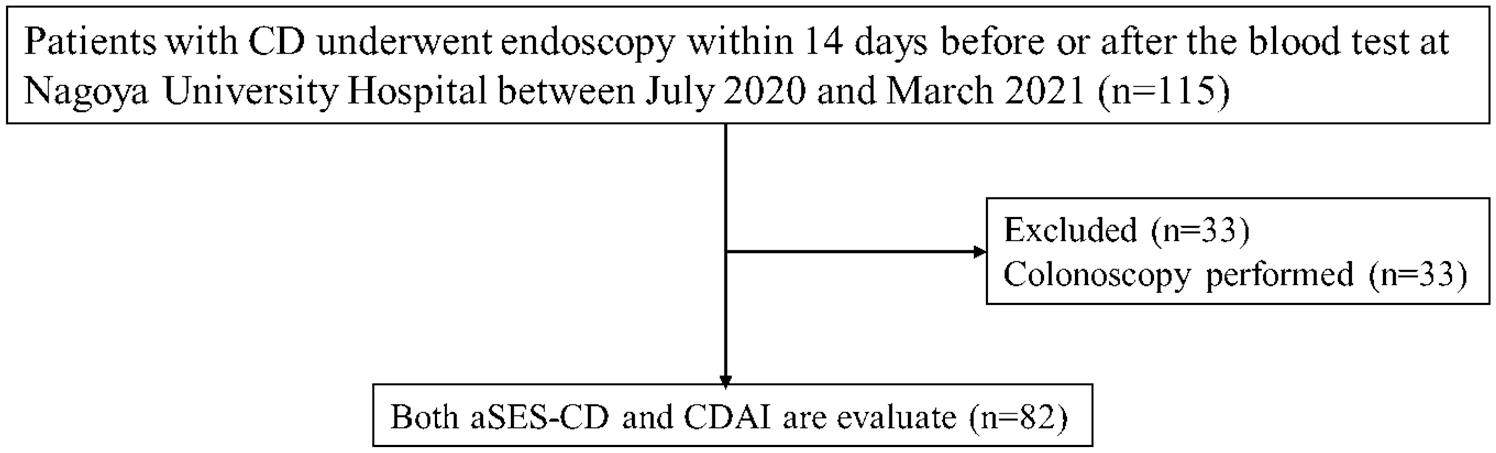
Patient inclusion flowchart. Of the 115 CD patients who underwent endoscopy within 14 days before or after the blood test, 82 were eligible for aSES-CD evaluation after excluding 14 patients who underwent only colonoscopy. All 82 patients were evaluated using both aSES-CD and CDAI.
Serum gelsolin levels were analyzed in patients with CD (n = 82) and in healthy controls with no history of IBD (n = 16). Serum samples were obtained from 82 patients (68 males and 14 females) with a median age of 46 years. Of the patients with CD, 41% and 59% had the ileal and ileocolonic type, respectively. Clinical activity was assessed using the CDAI, with ⩽150 indicating remission. Patient characteristics are shown in Table 1. Serum gelsolin levels were significantly lower in patients with ileal-type (n = 34) and ileocolonic-type (n = 48) CD compared to healthy controls (p < 0.001; Figure 2(a)–(c)). In contrast, serum CRP levels were significantly elevated only in patients with ileocolonic-type CD compared to healthy controls (Figure 2(d)–(f)).
Patient characteristics and clinical information.

CD, Crohn’s disease; CRP, C-reactive protein; n.s., not significant.

Serum gelsolin levels were decreased in clinically active patients with CD. (a) Serum gelsolin levels in 82 patients with CD and 16 healthy individuals without a history of IBD (control group). (b) Serum gelsolin levels in 34 patients with ileal-type CD and in the control group. (c) Serum gelsolin levels in 48 patients with ileocolonic-type CD and in the control group. (d) Serum CRP levels in 82 patients with CD and in the control group. (e) Serum CRP levels in 34 patients with ileal-type CD and in the control group. (f) Serum CRP levels in 48 patients with ileocolonic-type CD and in the control group. (g) Serum gelsolin levels in 50 patients with CD in clinical remission (CDAI <150) and 32 clinically active patients with CD (CDAI ⩾150). (h) Serum gelsolin levels in 22 patients with CD in clinical remission and 12 clinically active patients with ileal-type CD. (i) Serum gelsolin levels in 28 patients with CD in clinical remission and 20 clinically active patients with ileal-type CD. (j) Serum CRP levels in 50 patients with CD in clinical remission and 32 clinically active patients with CD. (k) Serum CRP levels in 22 patients with CD in clinical remission and 12 clinically active patients with ileal-type CD. (l) Serum CRP levels in 28 patients with CD in clinical remission and 20 clinically active patients with ileal-type CD.
Furthermore, serum gelsolin levels were significantly lower in patients with clinically active CD than in those in remission (CD remission (n = 50), CD active (n = 32), p < 0.001, Figure 2(g)–(i)), in both the ileal and ileocolonic-type CD. In contrast, serum CRP levels were elevated in the clinically active phase compared with the remission phase only in patients with ileocolonic-type CD (Figure 2(j)–(l)).
Correlation of serum gelsolin levels with endoscopic disease activity in patients with CD
Patients were classified based on endoscopic disease activity: remission (SES-CD ⩽ 2), mild (3 ⩽ SES-CD ⩽ 6), moderate (7 ⩽ SES-CD ⩽ 16), and severe (SES-CD > 16). Serum gelsolin levels were highest in the endoscopic remission group and were significantly lower in the moderate and severe groups (Figure 3(a)). Serum CRP levels were lowest in the endoscopic remission group and were significantly higher in the severe groups (Figure 3(b)).

Serum gelsolin levels correlated with endoscopic disease activity in patients with CD. (a) Serum gelsolin levels were determined in patients with CD according to aSES-CD during BAE. Remission (aSES-CD ⩽2, n = 6), mild (3 < aSES-CD ⩽ 6, n = 20), moderate (7 < aSES-CD ⩽ 16, n = 47), severe (SES-CD > 16, n = 9). (b) Serum CRP levels were determined in patients with CD according to aSES-CD during BAE. Differences between the groups were tested using Kruskal–Wallis test.
Serum gelsolin levels correlated with aSES-CD in patients with CD (p < 0.001, r = −0.5072; Figure 4(a)). Moreover, serum gelsolin levels correlated with aSES-CD in both the ileal (p < 0.05, r = −0.3656; Figure 4(b)) and ileocolonic-type groups (p < 0.001, r = −0.6447; Figure 4(c)). The correlation coefficient between gelsolin levels and aSES-CD was higher than that between CRP levels and aSES-CD, indicating a stronger association (total, p < 0.001, r = 0.3674, ileal-type, p = n.s., r = 0.2775, ileocolonic-type, p < 0.05, r = 0.4581; Figure 4(d)–(f)).

Correlation between serum gelsolin levels and aSES-CD scores in patients with CD. (a) Scatter plot showing the correlation of aSES-CD with serum gelsolin levels in patients with CD. The Spearman rank correlation coefficient r is 0.5072 (p < 0.001, n = 82). (b) Scatter plot showing the correlation of aSES-CD with serum gelsolin levels in patients with CD with ileal type. The Spearman rank correlation coefficient r is 0.3656 (p < 0.05, n = 35). (c) The scatter plot shows the correlation of aSES-CD with serum gelsolin levels in patients with CD with the ileocolonic type. The Spearman rank correlation coefficient r is 0.6447 (p < 0.001, n = 47). (d) Correlation between aSES-CD and CRP levels in all patients with CD. The Spearman rank correlation coefficient r is 0.3674 (p < 0.001, n = 82). (e) Correlation between aSES-CD and CRP levels in patients with ileal-type CD. The Spearman rank correlation coefficient r is 0.2775 (p = n.s., n = 34). (f) Correlation between aSES-CD and CRP levels in patients with ileocolonic-type CD. The Spearman rank correlation coefficient r is 0.4581 (p < 0.05, n = 48).
Gelsolin levels in detecting endoscopic remission in patients with CD
The univariate analysis was performed to evaluate factors associated with endoscopic remission in CD. Univariate analysis revealed that gelsolin (odds ratio (OR), 1.72; 95% confidence interval (CI), 1.23–2.45; p = 0.003) was significantly related to endoscopic remission. Next, a multivariate analysis was performed using significant parameters.
This analysis revealed that gelsolin was independently associated with endoscopic remission (OR: 1.51; 95% CI: 1.63–2.89; p = 0.005; Supplemental Table 2). The AUC for gelsolin levels in detecting endoscopic remission in patients with CD was 0.8377. In the ROC analysis, the gelsolin level cutoff value of 13 µg/mL had a sensitivity and specificity of 75% and 83%, respectively, for detecting endoscopic remission (Figure 5(a)). Using this cutoff value, gelsolin showed a higher sensitivity and positive predictive value than CRP or CDAI (Figure 5(b) and (c)).

Serum gelsolin levels detect endoscopic remission. (a) ROC curve analysis in patients with CD shows that a gelsolin cutoff value of 13 µg/mL has a sensitivity of 75%, specificity of 83%, and AUC of 0.8377 (n = 82) for detecting endoscopic remission. (b) ROC curve for CRP in detecting endoscopic remission. CRP cutoff value of 0.14 mg/dL has a sensitivity of 42%, specificity of 86%, and AUC of 0.6447 (n = 82) for detecting endoscopic remission. (c) ROC curve for CDAI in detecting endoscopic remission. CDAI cutoff value of 179 has a sensitivity of 67%, specificity of 60%, and AUC of 0.561 (n = 82) for detecting endoscopic remission.
Discussion
In this study, we discovered that serum gelsolin levels were significantly lower in patients with CD than in healthy controls, and they correlated with endoscopic disease activity. Furthermore, gelsolin levels were reduced in mild CD cases compared with those in healthy controls, suggesting that mild inflammation can be detected before the onset of symptoms. Notably, we assessed endoscopic activity in patients for whom both the entire small bowel and colon were observable, allowing for a more comprehensive evaluation of mucosal inflammation.
Gelsolin performed better than CRP in detecting mucosal activity in both ileal- and ileocolonic-type CD, suggesting that it is a more reliable biomarker. Notably, gelsolin’s performance as a biomarker was not affected by medication history. Furthermore, in detecting endoscopic remission, our analysis showed that gelsolin had a high AUC, indicating strong diagnostic accuracy for evaluating mucosal healing in patients with CD. However, the correlation was relatively weaker in the ileal-type CD, which was consistent with previous proteomic studies showing that serum gelsolin levels were selectively decreased in patients with colonic-type CD but not in those with ileal-type disease. These findings suggested that the diagnostic utility of gelsolin may be particularly pronounced in colonic involvement and highlighted the importance of the location of disease when interpreting biomarker performance. 20
Gelsolin is a multifunctional protein that regulates actin function via cleavage, capping, and nucleation. 13 Furthermore, it is important in biological processes such as cytoskeletal remodeling, cell survival, and inflammatory responses. 21 Recent research has shown that gelsolin regulates intestinal stem cell regeneration and T-helper 17 cell function. 22 Double-knockout mice lacking gelsolin and villin-1 have been reported to develop colitis resembling CD due to actin dysregulation, 13 further supporting their potential role in CD pathophysiology.
Gelsolin’s sources in blood include various cell types such as skeletal muscle, epithelial, and immune cells (e.g., neutrophils and macrophages) under certain physiological or pathological conditions.11,12 A recent study by Vitali et al. 14 identified gelsolin as one of three novel fecal biomarkers significantly elevated in the stools of patients with active CD. Their proteomic and ELISA-based analyses demonstrated that fecal gelsolin levels strongly correlated with endoscopic disease severity. This indicated increased intestinal shedding or local production during active inflammation. In contrast, this study showed that serum gelsolin levels were significantly decreased in patients with active CD, particularly in those with colonic involvement. This inverse pattern involving elevated fecal levels and reduced serum levels may reflect the disease-associated redistribution of gelsolin from the circulation to the intestinal lumen. This may be due to increased mucosal damage and leakage or altered expression in inflamed tissue. These complementary findings highlight the potential value of assessing gelsolin in both compartments. Furthermore, they underscore the importance of understanding the tissue origin and trafficking of this protein during intestinal inflammation.
Our study has some limitations. First, this was a retrospective, single-center study with a relatively small sample size and no validation in an independent cohort. Second, there was a time discrepancy between clinical and endoscopic assessments and blood sample collection. Third, we did not evaluate the correlation between Fecal Calprotectin (FCP) and gelsolin levels. FCP is a well-established biomarker of endoscopic activity in CD; however, its role as a surrogate marker for ileal-type CD remains unclear. Fourth, this study does not include patients with colonic CD, making it impossible to assess the performance of gelsolin in colonic involvement. Therefore, gelsolin’s utility according to the disease location remains unclear.
Therefore, future studies should include a prospective cohort to validate whether gelsolin accurately reflects mucosal activity in patients with CD. Our findings suggest that serum gelsolin measurement may help reduce the need for frequent endoscopic procedures, ultimately contributing to improved disease monitoring and management in patients with CD.
Conclusion
Serum gelsolin is a promising, noninvasive biomarker that outperforms CRP in detecting endoscopic disease activity in patients with CD. Further research is necessary to validate its clinical utility prospectively and explore its potential integration with other established biomarkers to improve diagnostic accuracy.
Supplemental Material
sj-docx-1-tag-10.1177_17562848251362570 – Supplemental material for Performance of serum gelsolin as a biomarker for mucosal activity in Crohn’s disease: a comparison with C-reactive protein
Supplemental material, sj-docx-1-tag-10.1177_17562848251362570 for Performance of serum gelsolin as a biomarker for mucosal activity in Crohn’s disease: a comparison with C-reactive protein by Keiko Maeda, Takeshi Yamamura, Masanao Nakamura, Tsunaki Sawada, Eri Ishikawa, Kentaro Murate, Tatsuya Kawamura, Takashi Hirose, Kazuhiro Furukawa and Hiroki Kawashima in Therapeutic Advances in Gastroenterology
Supplemental Material
sj-docx-2-tag-10.1177_17562848251362570 – Supplemental material for Performance of serum gelsolin as a biomarker for mucosal activity in Crohn’s disease: a comparison with C-reactive protein
Supplemental material, sj-docx-2-tag-10.1177_17562848251362570 for Performance of serum gelsolin as a biomarker for mucosal activity in Crohn’s disease: a comparison with C-reactive protein by Keiko Maeda, Takeshi Yamamura, Masanao Nakamura, Tsunaki Sawada, Eri Ishikawa, Kentaro Murate, Tatsuya Kawamura, Takashi Hirose, Kazuhiro Furukawa and Hiroki Kawashima in Therapeutic Advances in Gastroenterology
Supplemental Material
sj-docx-3-tag-10.1177_17562848251362570 – Supplemental material for Performance of serum gelsolin as a biomarker for mucosal activity in Crohn’s disease: a comparison with C-reactive protein
Supplemental material, sj-docx-3-tag-10.1177_17562848251362570 for Performance of serum gelsolin as a biomarker for mucosal activity in Crohn’s disease: a comparison with C-reactive protein by Keiko Maeda, Takeshi Yamamura, Masanao Nakamura, Tsunaki Sawada, Eri Ishikawa, Kentaro Murate, Tatsuya Kawamura, Takashi Hirose, Kazuhiro Furukawa and Hiroki Kawashima in Therapeutic Advances in Gastroenterology
Supplemental Material
sj-docx-4-tag-10.1177_17562848251362570 – Supplemental material for Performance of serum gelsolin as a biomarker for mucosal activity in Crohn’s disease: a comparison with C-reactive protein
Supplemental material, sj-docx-4-tag-10.1177_17562848251362570 for Performance of serum gelsolin as a biomarker for mucosal activity in Crohn’s disease: a comparison with C-reactive protein by Keiko Maeda, Takeshi Yamamura, Masanao Nakamura, Tsunaki Sawada, Eri Ishikawa, Kentaro Murate, Tatsuya Kawamura, Takashi Hirose, Kazuhiro Furukawa and Hiroki Kawashima in Therapeutic Advances in Gastroenterology
Footnotes
Acknowledgements
We appreciate the careful reading of the manuscript and helpful discussions with members of the Department of Gastroenterology, Nagoya University Graduate School of Medicine.
Declarations

Supplemental material
Supplemental material for this article is available online.
References
Supplementary Material
Please find the following supplemental material available below.
For Open Access articles published under a Creative Commons License, all supplemental material carries the same license as the article it is associated with.
For non-Open Access articles published, all supplemental material carries a non-exclusive license, and permission requests for re-use of supplemental material or any part of supplemental material shall be sent directly to the copyright owner as specified in the copyright notice associated with the article.
