



Abstract
Background:
The diagnostic accuracy of colon capsule endoscopy (CCE) depends on a well-cleansed bowel. Evaluating the cleansing quality can be difficult with a substantial interobserver variation.
Objectives:
Our primary aim was to establish a standard of agreement for bowel cleansing in CCE based on evaluations by expert readers. Then, we aimed to investigate the interobserver agreement on bowel cleansing.
Design:
We conducted an interobserver agreement study on bowel cleansing quality.
Methods:
Readers with different experience levels in CCE and colonoscopy evaluated bowel cleansing quality on the Leighton–Rex scale and Colon Capsule CLEansing Assessment and Report (CC-CLEAR), respectively. All evaluations were reported on an image level. A total of 24 readers rated 500 images on each scale.
Results:
An expert opinion-based agreement standard could be set for poor and excellent cleansing but not for the spectrum in between, as the experts agreed on only a limited number of images representing fair and good cleansing. The overall interobserver agreement on the Leighton–Rex full scale was good (intraclass correlation coefficient (ICC) 0.84, 95% CI (0.82–0.85)) and remained good when stratified by experience level. On the full CC-CLEAR scale, the overall agreement was moderate (ICC 0.62, 95% CI (0.59–0.65)) and remained so when stratified by experience level.
Conclusion:
The interobserver agreement was good for the Leighton–Rex scale and moderate for CC-CLEAR, irrespective of the reader’s experience level. It was not possible to establish an expert-opinion standard of agreement for cleansing quality in CCE images. Dedicated training in using the scales may improve agreement and enable future algorithm calibration for artificial intelligence supported cleansing evaluation.
Trial registration:
All included images were derived from the CAREforCOLON 2015 trial (Registered with The Regional Health Research Ethics Committee (Registration number: S-20190100), the Danish data protection agency (Ref. 19/29858), and ClinicalTrials.gov (registration number: NCT04049357)).
Keywords
Introduction
Colon capsule endoscopy’s (CCE) diagnostic accuracy depends on the quality of bowel preparation. The evaluation of cleansing quality is instrumental in patient management, and a conservative grading strategy will lead to a high reinvestigation rate. In contrast, a lenient strategy can lead to missed pathology. The reference standard for cleansing quality evaluations is nonexistent, and readers are only supported in their decisions by different cleansing scales created for the purpose. Two such scales are the Leighton–Rex scale 1 and the Colon Capsule CLEansing Assessment and Report (CC-CLEAR). 2 The Leighton–Rex is a qualitative scale, whereas the CC-CLEAR is a quantitative scale based on the reader-estimated percentage of visualized mucosa. The interobserver agreement on the two scales has been investigated only in studies that have included a few readers.1–3 Bowel cleansing is a topic discussed extensively; however, the optimal bowel preparation protocol has yet to be established. To carry out reliable comparisons of bowel cleansing regimens, we need to minimize the impact of reader variation on the evaluation of bowel cleansing. This requires a reference standard that we have not yet been able to set. Artificial intelligence (AI) algorithms have been presented as a possible solution to the inconsistency problem in bowel cleansing evaluations.4,5
This study aimed to create an agreement standard for bowel cleansing quality in CCE based on an assessment by a group of expert readers. This standard could serve as a baseline for calibrating an AI algorithm for automatic cleansing quality assessment. To ensure the quality of the agreement standard, we aimed to investigate the interobserver agreement on bowel cleansing quality in CCE readings and compare the level of agreement between the Leighton–Rex scale and CC-CLEAR.
Materials and methods
We conducted an interobserver agreement study on bowel cleansing quality evaluated on the Leighton–Rex scale and CC-CLEAR. The manuscript is prepared according to the STROBE guidelines. 6
All included images were derived from the CAREforCOLON 2015 trial (Registered with The Regional Health Research Ethics Committee (Registration number: S-20190100, registration date: approval date: February 7, 2020), the Danish data protection agency (Ref. 19/29858), and ClinicalTrials.gov (registration number: NCT04049357, registration date: August 7, 2019, enrollment period: August 3, 2020 to December 16, 2022)). 7
Bowel cleansing scales
The Leighton–Rex scale is a qualitative scoring system based on two parameters: a four-point cleansing level scale and a two-point bubbles effect scale. 1 Often, the bubbles effect grade is incorporated into the cleansing level to ease the practical use of the scale. We asked the readers to report on the overall cleansing combining the cleansing level and bubbles effect scale. We gave the readers the description of the four grades provided by Leighton and Rex. For grading of entire CCE investigations on this scale, the large bowel is divided into five segments (cecum, right colon, transverse colon, left colon, and rectum) and scored individually and overall. This segmentation was unnecessary as we based our study on images rather than videos.
CC-CLEAR is a quantitative scale. 2 The large bowel is divided into three segments (right colon, transverse colon, and left colon) and scored individually from 0 to 3 points depending on the percentage of visualized mucosa (<50% = 0 points, 50%–75% = 1 point, >75% = 2 points, >90% = 3 points). The sum of the scores for the individual segments determines the overall score. To use this scale, readers must be able to report the percentage of visualized mucosa, at least within the preset intervals. We, therefore, asked the readers to report a percentage within a single image from the large bowel.
CCE readers
We invited endoscopists from several countries (Denmark, France, Israel, Italy, Malta, the Netherlands, Portugal, Scotland, Spain, and Sweden) with different levels of colonoscopy and CCE experience to participate in a CCE reader panel. We asked all invitees to place themselves in one of the following groups based on their level of experience:
- Group A: Readers extensively experienced in both colonoscopy (>5000 investigations) and CCE (>500 investigations).
- Group B: Readers extensively experienced in colonoscopy (>5000 investigations) but without CCE experience.
- Group C: Readers slightly experienced in colonoscopy (250–1000 investigations) and CCE (10–50 investigations).
- Group D: Readers slightly experienced in colonoscopy (250–1000 investigations) but without CCE experience.
If readers did not fit into any group, we did not include them in the study. We included seven readers in groups A, B, and D, respectively. As it was difficult to find readers fitting the criteria for group C, only six were included in this group. All readers received a study protocol, including an introduction to both bowel cleansing scales.
CCE images and surveys
Through a review of a sample of CCE investigations carried out with the PillCam™ COLON2 capsules (Medtronic, Minneapolis, Minnesota, USA), we selected 500 CCE images and extracted them using the online platform PillCam Cloud Reader Software (Medtronic). We chose the images to represent the entire spectrum of bowel cleansing quality, so a randomized image selection could not be conducted. The endoscopist selecting the images was not part of the panel. The images were de-identified and presented in an online survey on a secure platform (SurveyXact; Rambøll, Aarhus, Denmark). We created two surveys, one for grading the cleansing quality on the Leighton–Rex scale and one for CC-CLEAR (percentage of visualized mucosa). The same 500 images were included in both surveys, meaning that the readers were presented with the same images twice. On the Leighton–Rex scale, readers were asked to report on a full scale marking one of four grades (poor, fair, good, excellent), and for the CC-CLEAR, a percentage of visualized mucosa (0%–100%) was selected using a sliding tool. A short instruction on the relevant grading scale was given within the survey and was always visible to the reader (Leighton–Rex: Table 1, CC-CLEAR: Figure 1). Half of the readers received a link to the Leighton–Rex and half to the CC-CLEAR survey. Readers were given 4 weeks to complete the task. We did a crossover 4 weeks after this deadline and distributed the second survey (Figure 2).
Instructions for capsule readers on the Leighton–Rex scale visible within the survey.


Instructions for capsule readers on CC-CLEAR visible within the survey.

Project setup and flow.
Agreement requirements
To create the standard of agreement for the calibration of the AI algorithm, we used evaluations by the experts in CCE and colonoscopy (group A) on the Leighton–Rex scale. For an image to be eligible for inclusion in the data material for the calibration, at least six out of seven experts should agree on the cleansing quality grade.
Sample size and statistical analysis
The sample size was based on the estimated number of images needed to calibrate the AI algorithm. We aimed for a minimum of 60 images per category (Leighton–Rex: poor, fair, good, excellent) with agreement between the desired number of experts. We included 500 images, more than double the necessary images for AI calibration to leave room for the likely variation.
We evaluated the interobserver agreement using the intraclass correlation coefficient (ICC). An ICC below 0.50 was interpreted as a poor agreement, 0.50–0.75 as a moderate agreement, 0.75–0.90 as a good agreement, and above 0.90 as an excellent agreement. Readers who did not complete both surveys were excluded from the analysis. A technical error occurred during the first session of the CC-CLEAR survey. This error was resolved, and readers were asked to redo the survey from the beginning if they encountered the problem. No issues occurred with the Leighton–Rex survey or in the second session of the CC-CLEAR survey. As the results for group B deviated substantially from the other groups, we performed subgroup analyses on subsets of images and readers in this group. First, one reader at a time was excluded from the analysis. Afterwards, we created subsets of images, analyzing them in groups as follows: 1–500, 101–500, 201–500, 301–500, and 401–500, to identify readers who had not restarted their CC-CLEAR evaluation following the survey error.
Results
Twenty-four readers completed both surveys (one incomplete in group C and two incompletes in group D).
Standard of agreement
We observed 80 images where 6 or 7 expert readers (group A) agreed on the Leighton–Rex grade poor, 21 for the grade fair, 27 for the grade good, and 122 for the grade excellent. A standard of agreement for AI algorithm calibration was therefore not achieved (i.e. ⩾60 images with agreement) for grades fair, and good. If the number of desired readers in agreement was reduced to 5, the results were 103 images for poor, 51 for fair, 61 for good, and 139 for excellent.
Leighton–Rex, interobserver agreement
The overall agreement on the Leighton–Rex full scale (poor, fair, good, excellent) was good (ICC 0.84, 95% CI (0.82–0.85)). We observed the same level of agreement when stratifying by group/level of experience (Table 2). When considering the evaluations on a simplified scale (inadequate/adequate) where the grades poor/fair were deemed inadequate and good/excellent were considered adequate, the agreement declined to moderate both for the overall comparison and by group (Table 2). Examples of images with good agreement are depicted in Figure 3.
ICC for agreement between colon capsule endoscopy readers on the LR scale.
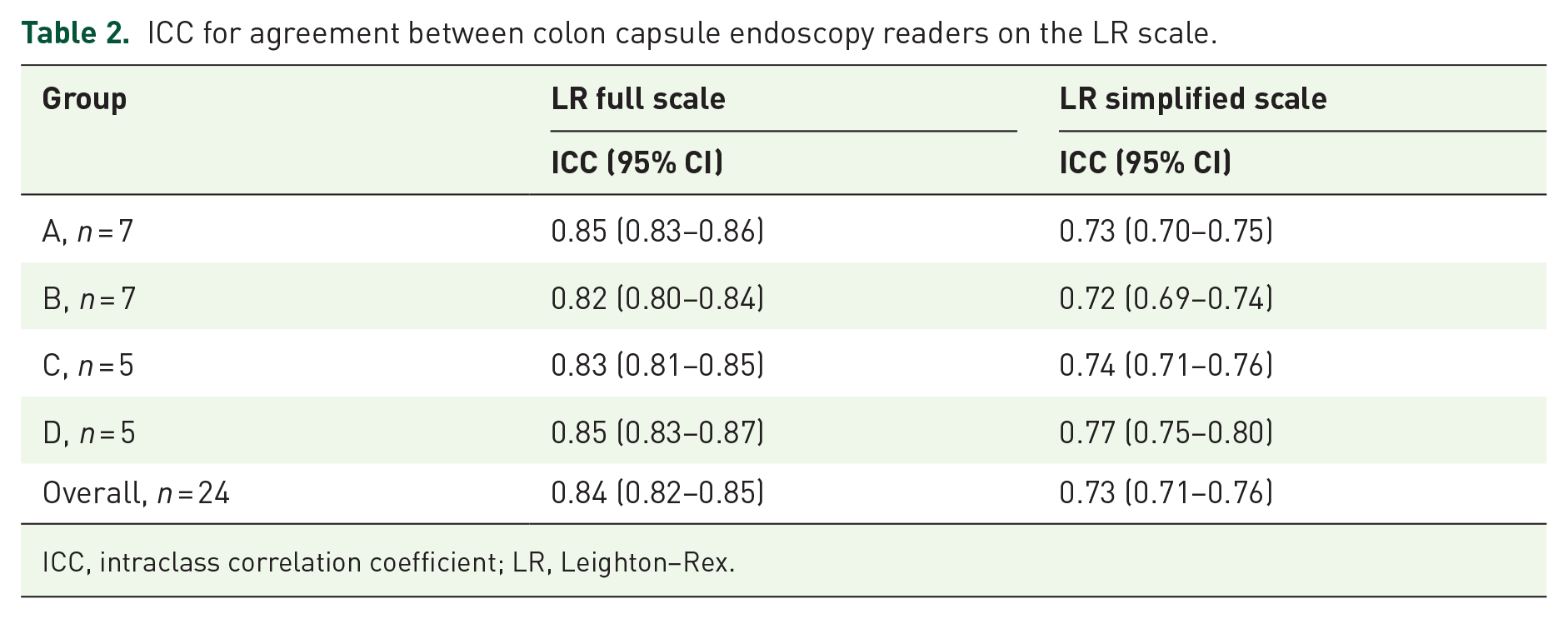
ICC, intraclass correlation coefficient; LR, Leighton–Rex.

Examples of images with good agreement between readers on the Leighton–Rex scale. (a) Poor (24 readers in agreement). (b) Fair (21 readers in agreement). (c) Good (22 readers in agreement). (d) Excellent (24 readers in agreement).
CC-CLEAR, interobserver agreement
When evaluating the reported percentages of visualized mucosa on a full scale (<50% = 0 points, 50%–75% = 1 point, >75% = 2 points, >90% = 3 points), the overall agreement was moderate (ICC 0.62, 95% CI (0.59–0.65)). Stratified by group, we also observed moderate agreement on the full scale (Table 3). When converting this to a simplified scale (inadequate/adequate) where a percentage of visualized mucosa below 75% was considered inadequate and above 75% was considered adequate, the overall agreement and the agreement for groups A, C, and D remained moderate. In contrast, the agreement for group B declined to poor. Finally, we looked at the percentage of visualized mucosa on a continuous scale from 0% to 100%. The overall agreement was poor (ICC 0.07, 95% CI (0.06–0.08)). This was mainly due to an inferior interobserver agreement in group B (ICC 0.02, 95% CI (−0.003, 0.04)), whereas the agreement in the other groups was moderate. We performed subgroup analyses to find a possible explanation for this low agreement within one group. First, on subsets of images, to test whether the poor agreement was caused by individuals not redoing the questionnaire after the error in survey distribution, as this could lead to better agreement in the subsets of images rated after the error was resolved. On subsets of images, we found poor agreement in group B when including images 1–300 (Table 4). We observed good interobserver agreement when only including images 301–500. We then made subgroup analyses on all images, excluding one reader at a time, to test whether a single reader caused the error. When doing so, the interobserver agreement improved from poor to moderate when excluding reader 13 (Table 5). Excluding reader 13 from the overall analysis only affected the results significantly for CC-CLEAR as a continuous scale, where the interobserver agreement improved from poor to moderate (Table 3).
ICC for agreement between colon capsule endoscopy readers on the CC-CLEAR scale.
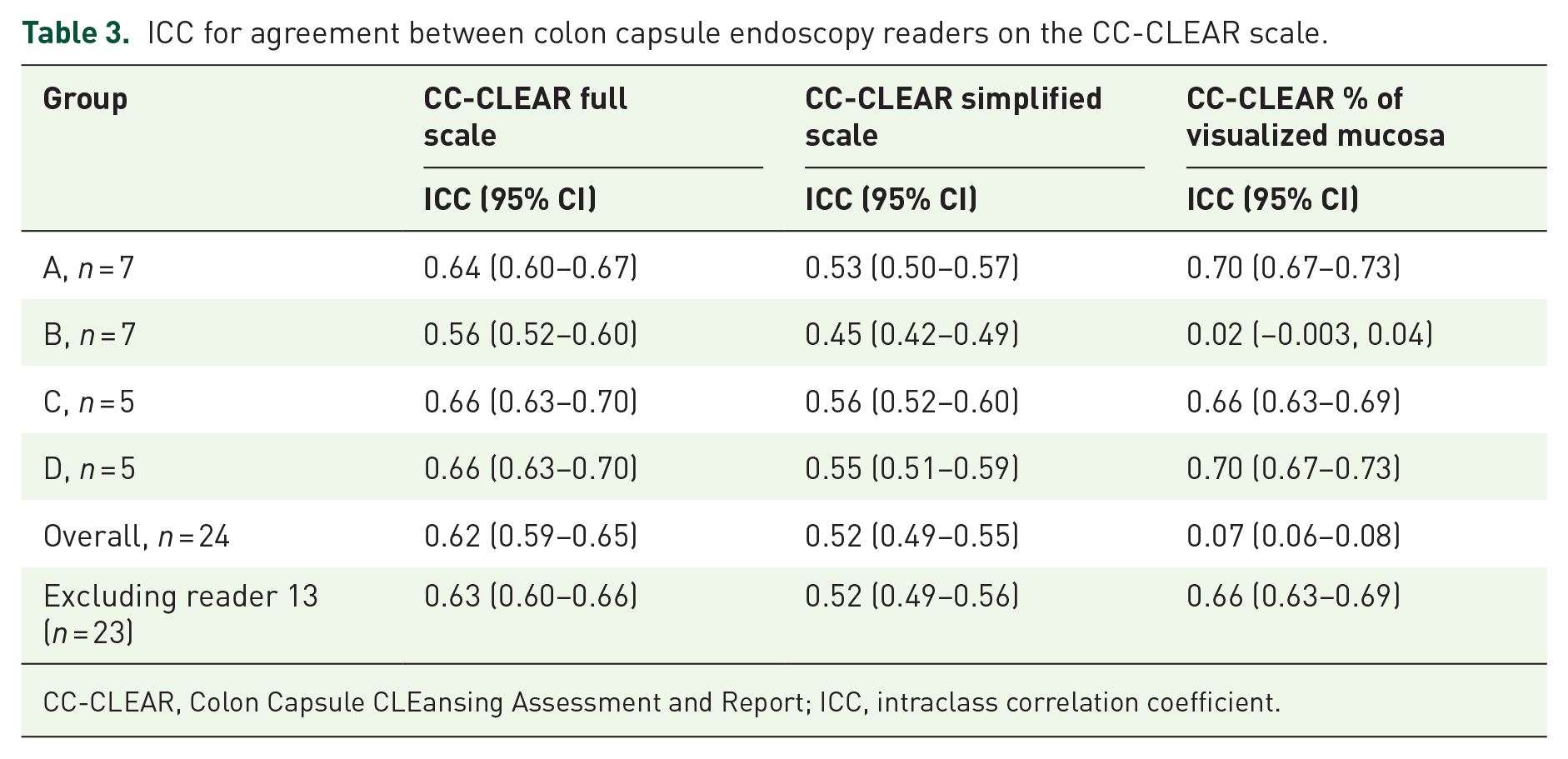
CC-CLEAR, Colon Capsule CLEansing Assessment and Report; ICC, intraclass correlation coefficient.
Results for analysis on subsets of images for evaluation of the percentage of visualized mucosa in group B.

CC-CLEAR, Colon Capsule CLEansing Assessment and Report; ICC, intraclass correlation coefficient.
Results for analysis on subsets of readers for evaluation of the percentage of visualized mucosa in group B.

CC-CLEAR, Colon Capsule CLEansing Assessment and Report; ICC, intraclass correlation coefficient.
Discussion
The expert opinion-based standard of agreement was possible to set for poor and excellent bowel cleansing but not for the spectrum in between. We found that the agreement on the extremes, that is, images with large amounts of fecal matter, debris, etc., or images depicting a completely clean bowel, was much higher in the expert group than the images showing bowel cleansing of a more moderate quality. This is not surprising but leaves us with the problem of distinguishing between the cleansing grades that separate adequate from inadequate cleansing.
The overall interobserver agreement on the Leighton–Rex full scale was good and remained so when stratified by experience level. On the CC-CLEAR scale, divided into four grades, the interobserver agreement was moderate both overall and when stratified by experience level. We found a deviation in the results when looking at CC-CLEAR in group B separately, specifically the results for the evaluations on a continuous scale from 0% to 100%. A subgroup analysis showed that one reader in group B greatly affected the results. When this reader was excluded from the analysis, interobserver agreement improved from poor to moderate. The explanation for this could lie in a technical problem that may have caused a faulty response from one reader. The issue was corrected, which can explain why the interobserver agreement on the last 200 images in the dataset is much higher than what we see when including the entire dataset.
To sum up, we found moderate to good interobserver agreement. The agreement depended on the scale used but not the readers’ experience level in CCE or colonoscopy. Readers with extensive colonoscopy experience and no experience in CCE (group B and D) could potentially tend to apply an evaluation strategy similar to that in colonoscopy. Still, the agreement within each group was similar.
In previous studies where good interobserver agreement was reported, a session where the readers evaluated CCE investigations in collaboration or reached a consensus on the bowel cleansing quality was carried out before the individual evaluations.1,2 This practice will inherently calibrate the readers and lead to a unified understanding of the different bowel cleansing grades. We need the grading scales to be applicable in both a clinical and research setting and to enable us to compare results between readers, centers, and countries. The interobserver agreement should be studied without the calibration of readers since that is the reality we face. In a study by Buijs et al., where readers were not calibrated, the interobserver agreement on bowel cleansing quality was poor. 3 In our study, we presented the readers with a short description of the grading scales and referred them to the articles presenting the Leighton–Rex and CC-CLEAR scales. Even though we report a moderate to good interobserver agreement, the middle part of the cleansing quality spectrum still seems to pose a problem. On an image level, the cleansing quality scales do not lend the readers a strong enough support to yield a sufficient agreement. A short electronic introduction or a transferable teaching module between different settings could be a viable tool for creating a better background for using a specific scale and improving consensus.
As CCE is a younger modality on the endoscopy scene than small bowel (SB) capsule endoscopy, many issues related to capsule endoscopy have been discussed for years. Several cleansing quality grading scales have been proposed for SB capsule endoscopy, but no single scale has been accepted as the reference standard.8–12
Evaluating the cleansing quality is, unfortunately, not the only place where manual capsule reading faces obstacles. A recent meta-analysis on inter/intraobserver agreement in capsule endoscopy found that the agreement was suboptimal across various parameters in manual capsule endoscopy reading. 13 Often, AI is proposed as a solution to this issue. 14 By using AI, we can obtain a consistent result, minimizing the effect of observer variation. However, AI does need training based on inputs from human evaluations to establish the capabilities required to deliver a clinically relevant output. In this study, we aimed to create a standard of agreement for the cleansing quality in CCE, using the evaluations from an expert panel (group A). Several algorithms have been developed to classify bowel cleansing in SB capsule investigations15–19 as well as in colonoscopy.20–22 AI solutions specifically for CCE cleansing quality on a video level are still underway, but results on a machine learning approach have been published. 4 When comparing bowel cleansing quality evaluations by an AI to that of medical experts, the agreement is suboptimal in SB capsule endoscopy 23 and minimal in CCE. 24
Cleansing quality is not the only parameter determining whether a CCE investigation can be considered adequate in terms of colon visualization. Such an evaluation requires assessment of the transit and possible technical interruptions. Furthermore, the information needed for further patient management includes a report on CCE findings and a characterization of those. The algorithm for cleansing quality evaluations is, therefore, only one piece of the puzzle in AI supported CCE reading. Several tasks are candidates for AI solutions such as cancer and polyp detection, size estimation of detected lesions, and localization of landmarks and findings. In the large AICE (AI-supported Image Analysis in Large Bowel Camera Capsule Endoscopy) project, a set of nine algorithms is being developed. 25 They are planned to work in collaboration to provide a thorough support for manual reading.
A strength of this study is the large number of capsule readers representing different nationalities and levels of experience in both capsule endoscopy reading and conventional endoscopy. This provides us with an impression of the challenges in using these grading scales in a real-world setting, where experience varies and doctors, as well as researchers, cross borders to carry out their work. We do acknowledge some limitations to our study. Because we carried out the study based on single CCE images instead of entire investigations, the results are not directly transferable to the experience in clinical practice. The scales we use are developed for videos and not for single images, which is a limitation to the setup of this study. However, in our opinion evaluating images can be seen as a necessary skill to master before assessing full CCE videos. One would assume that reaching a good agreement on images is much easier than videos. Considering this, the reported results do not underestimate the interobserver agreement on bowel cleansing quality, and the agreement might be lower if moving from single images to videos.
So the question remains: What is the reference standard for bowel cleansing quality in CCE? Further steps could involve expert group consensus where disagreements are resolved in a discussion on both CCE images and videos. Another approach could be to let the findings in CCE guide us toward a threshold for a cleansing quality that is adequate for detecting significant pathology. Coming to an agreement is paramount for elevating the quality of CCE and developing AI support for cleansing quality evaluations.
Conclusion
With input from an international selection of capsule readers and endoscopists, we found moderate to good interobserver agreement on bowel cleansing quality evaluations using the currently available cleansing scales for CCE. This agreement might, to some degree, be carried by agreement on the extremes in the spectrum of bowel cleansing and image-based evaluations as opposed to full-length investigations. The attempt by this study to create a standard of agreement for cleansing quality that we could utilize in training capsule readers and calibration of AI algorithms based on expert evaluations was not successful.
Supplemental Material
sj-docx-1-tag-10.1177_17562848241290256 – Supplemental material for Bowel cleansing quality evaluation in colon capsule endoscopy: what is the reference standard?
Supplemental material, sj-docx-1-tag-10.1177_17562848241290256 for Bowel cleansing quality evaluation in colon capsule endoscopy: what is the reference standard? by Benedicte Schelde-Olesen, Anastasios Koulaouzidis, Ulrik Deding, Ervin Toth, Konstantinos John Dabos, Abraham Eliakim, Cristina Carretero, Begoña González-Suárez, Xavier Dray, Thomas de Lange, Hanneke Beaumont, Emanuele Rondonotti, Uri Kopylov, Pierre Ellul, Enrique Pérez-Cuadrado-Robles, Alexander Robertson, Irene Stenfors, Alejandro Bojorquez, Stefania Piccirelli, Gitte Grunnet Raabe, Reuma Margalit-Yehuda, Isabel Barba, Giulia Scardino, Salome Ouazana and Thomas Bjørsum-Meyer in Therapeutic Advances in Gastroenterology
Footnotes
Acknowledgements
We would like to acknowledge the extensive work of the CAREforCOLON study group.
Declarations
ORCID iDs

Supplemental material
Supplemental material for this article is available online.
References
Supplementary Material
Please find the following supplemental material available below.
For Open Access articles published under a Creative Commons License, all supplemental material carries the same license as the article it is associated with.
For non-Open Access articles published, all supplemental material carries a non-exclusive license, and permission requests for re-use of supplemental material or any part of supplemental material shall be sent directly to the copyright owner as specified in the copyright notice associated with the article.
