




Abstract
Up to 13% of KIT and PDGFRA wild-type (WT) gastrointestinal stromal tumours (GIST) harbour a BRAF mutation, mostly involving the exon 15 V600E hot spot. Even if BRAF mutation is recognized as druggable target in other solid tumours, currently advanced BRAF-mutant GIST share the same therapeutical algorithm of KIT/PDGFRA mutants.
We report a complete radiological response in a 51-year-old woman with V600E BRAF-mutated metastatic GIST who was treated with regorafenib (REG) as first-line therapy.
REG represents the standard third-line therapy for advanced GIST patients progressing on or failing to respond to imatinib and sunitinib. However, according to its wide spectrum of action, with MAPK signalling pathway blockade at different levels, metastatic KIT/PDGFRA WT, including BRAF mutants, may benefit from REG upfront in first line.
Background
Up to 13% of KIT and PDGFRA wild-type (WT) gastrointestinal stromal tumours (GIST) harbour a BRAF mutation.1–4 As other tumour types in which BRAF mutations have been described, BRAF mutations in GIST mostly involve the exon 15 V600E hot spot.1–4 Generally, BRAF-mutated GIST seem to occur predominantly in the small intestine, sharing the same clinical and pathological characteristics of KIT/PDGFRA-mutated GIST.5,6 The clinical impact of this mutation in the natural history of GIST has not yet been established, because of the small number of cases presenting with this alteration. However, available data indicate that BRAF mutations may have a positive prognostic effect. 7
Even if BRAF mutation is recognized as druggable target in other solid tumours, and treatment with a BRAF inhibitor has shown promising antitumor activity in a single case, 8 currently advanced BRAF-mutant GIST share the same therapeutical algorithm of KIT/PDGFRA mutants. 9
Herein, we report a complete radiological response in a patient with BRAF-mutated metastatic GIST who was treated with regorafenib (REG) as first-line therapy.
Case presentation
A 51-year-old woman presented in December 2017 with abdominal pain. An abdominal ultrasound and a computed tomography (CT) revealed a 13 cm solid and polylobulated mass in the left abdominal side. In March 2018, the patient underwent en-bloc surgical resection of the mass, together with an ileal resection and omentectomy. The histological examination revealed a spindled cell GIST, positive for CD34 and CD117 by immunohistochemistry with 9 mitoses per 50 high-powered fields, with a positive omental nodule. At the beginning the sample was not suitable for the molecular analysis, therefore due to the high-risk of relapse according to the Miettinen’s classification, in May 2018 the patient started adjuvant imatinib therapy (400 mg once daily), with poor tolerance. The subsequent molecular analysis did not identify mutations in either the KIT or PDGFRA genes. Conversely the pyrosequencing showed the exon 15 V600E hot spot BRAF mutation (Figure 1). According to the molecular status, together with the prominent toxicity, the adjuvant imatinib was stopped and the patient continued with the follow-up program.

The pyrosequencing analysis showed the exon 15 V600E hot spot BRAF mutation.
In November 2018, following the CT-scan detection of a small nodular lung lesion, weakly positive at the Fluorodeoxyglucose Positron Emission Tomography (FDG-PET) scan, she underwent left lower lung lobectomy. The histological examination revealed a typical carcinoid tumour of the lung, with a ki67 <5% and without necrosis and mitoses.
In March 2019 a CT-scan revealed in the left hypochondrium, close to the surgical clips, a solid nodular formation delimited with a central hypodense area measuring 39 × 36 mm in size, involving an ileal loop, associated with an increase in density with thickening of the intestinal loops, suggestive for relapse (Figure 2a). Both subsequent FGD-PET and 68Gallium-DOTA-NOC PET were negative for pathological uptakes.
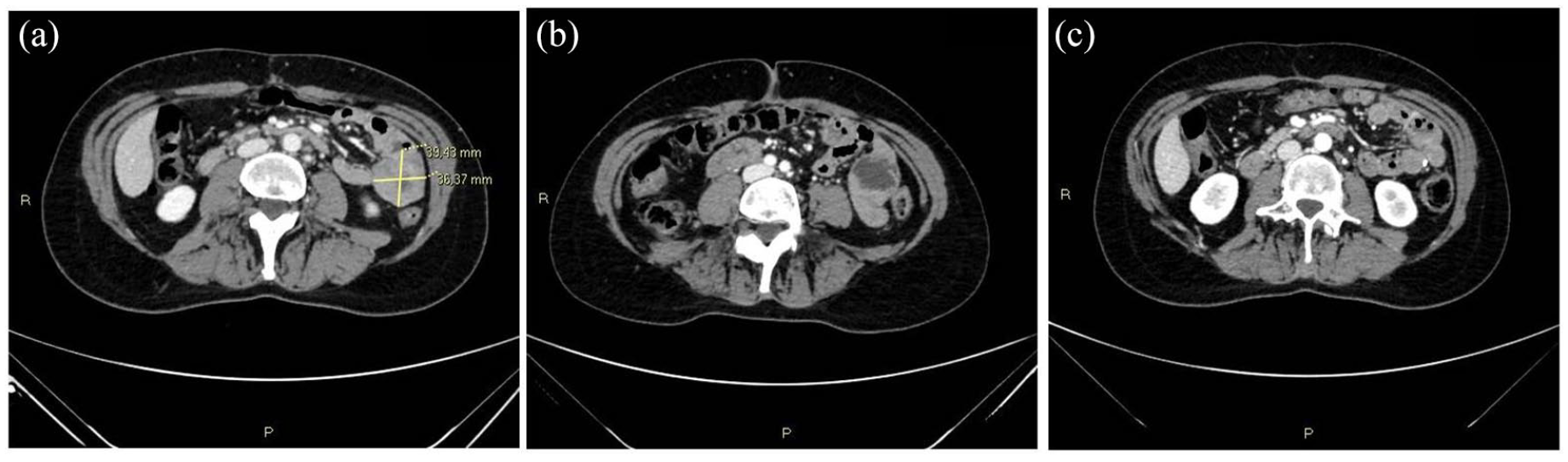
CT-scan at base line (a), after 2 months of regorafenib (b) and after 5 months of regorafenib (c).
According to the lack of KIT and PDGFRA mutations and the previous relevant toxicity to imatinib, in May 2019 a first-line therapy with REG was started at a dose of 120 mg (1-21d, q28).
A first restaging CT-scan performed after 2 months of treatment showed a decrease of the thickening of the intestinal loops and a complete necrosis of the solid nodular formation described previously (Figure 2b). A second CT-scan performed after 5 months of treatment showed a complete radiological response (Figure 2c).
During the first cycles the patient experienced iatrogenic hypothyroidism with secondary alopecia and grade 3 hand–foot syndrome. Thus, REG schedule was changed to 120 mg (1-14d, q21) with an overall improvement of symptoms. The patient is still on treatment and tolerating the personalized dose and schedule of REG fairly well.
At the last disease revaluation, performed in February 2020, the complete radiological response was maintained.
Discussion and conclusions
BRAF mutations are recognized as an alternative molecular event of a small subset of GIST WT for KIT and PDGFRA mutations.1–4 However, advanced BRAF-mutant GIST still share the same therapeutical algorithm of KIT/PDGFRA mutants, even if the lack of conventional KIT and PDGFRA mutation unavoidably confer low sensitiveness to imatinib. To our knowledge, no data are available on antitumor activity of standard tyrosine kinases inhibitors (TKIs) in this rare molecular subgroup of GIST.
As is widely known, REG is an oral TKI against the activity of several protein kinases involved in the regulation of tumour angiogenesis (VEGFR1–3 and TEK), oncogenesis (KIT, RET, RAF1, BRAF and BRAFV600E) and the tumour microenvironment (PDGFR and FGFR). 10 In preclinical models, REG potently inhibited BRAF and its oncogenic mutant BRAF V600E. However, no correlation between the efficacy of REG in inhibiting either tumour cell proliferation in vitro or tumour growth in vivo and the mutation status of BRAF was observed. 10 Consistent with this finding, BRAF status was not predictive for the response to REG in advanced colon cancer. 11 Similarly, no data on REG in BRAF-mutated melanoma are available.
Currently, REG represents the standard third-line therapy for advanced GIST patients progressing on or failing to respond to imatinib and sunitinib.9,12 BRAF V600E mutation in GIST has been shown to confer resistance to sunitinib. 13 According to its wide spectrum of action, with MAPK signalling pathway blockade at different levels, there is the biological rational that metastatic KIT/PDGFRA WT, including BRAF and FGFR mutants, may benefit from REG upfront in first line. This is what the ongoing REGISTRI, a phase II, single arm, multicentre clinical trial of REG in the first-line setting for metastatic and/or unresectable KIT/PDGFRA WT GIST (NCT02638766), is still evaluating. 14 Unfortunately, the slow patient accrual due to the rarity of the studied population does not allow us to draw any conclusions to date.
We report for the first time a complete radiological response to REG as first-line treatment in a BRAF-mutant GIST patient.
Despite this, single cases usually do not change clinical practice because of the low quality of evidence. However, such single clinical experiences in rare cancers may be relevant, especially in those small molecular subsets of diseases still lacking of valid treatment options. Indeed, more pragmatic solutions compared with conventional studies are needed to build some level of evidence-based medicine for patients with rare cancers. 15
Therefore, our single experience, though anecdotal, may be a suggestion for maximizing in future the usefulness of each relevant clinical evidence for rare cancers, as BRAF-mutant GIST are.
Footnotes
Acknowledgements
Research programs on GIST are supported by Associazione Italiana GIST (A.I.G.)
Authors’ contributions
MN, AB, MS MAP treated and followed the patient. VDS performed CT scan. EG and AA performed molecular analysis. MN and AB wrote the first draft of the manuscript. MN, AB and MAP made critical revisions and approved final version. All authors reviewed and approved of the final manuscript. All authors read and approved the final manuscript.
Funding
The authors received no financial support for the research, authorship, and/or publication of this article.
Conflict of interest statement
The authors declare that there is no conflict of interest.
Consent for publication
The patient provided written informed consent
Ethics approval and consent to participate
This study was approved by the local institutional ethical committee of S. Orsola-Malpighi hospital (approval number 113/2008/U/Tess). The patient provided written informed consent.
