




Abstract
There is increasing recognition of the impact of being overweight and obese on the development of cancers at diverse sites including the gastrointestinal tract. Large epidemiological studies indicate that up to 14% of tumours may be related to obesity. Pathophysiological mechanisms underpinning this association are not well understood and so are discussed in this review.
The obesity problem
The rapidly increasing prevalence of obesity is a major public health concern. The overweight or obese body habitus has now become the norm. In the United States, 71% of men and 62% of women are overweight or obese [Ogden et al. 2006]. Rates are increasing in a similar fashion in Western Europe with 65% of men and 56% of women being overweight or obese in the United Kingdom [Zaninotto et al. 2006]. Obesity prevalence shows no signs of decreasing.
Adipose tissue is principally deposited in two compartments: subcutaneously and centrally. It is thought that centrally deposited, or visceral, fat is more metabolically active than peripheral subcutaneous fat [Galic et al. 2010; Kershaw and Flier, 2004; Vohl et al. 2004]. Visceral adipose tissue is largely composed of omental adipose tissue but also includes other intra-abdominal fat sources such as mesenteric fat. Visceral adipose tissue secretes a number of adipokines and cytokines leading to a pro-inflammatory, procoagulant and insulin-resistant state collectively known as metabolic syndrome [Despres and Lemieux, 2006] (Figure 1).
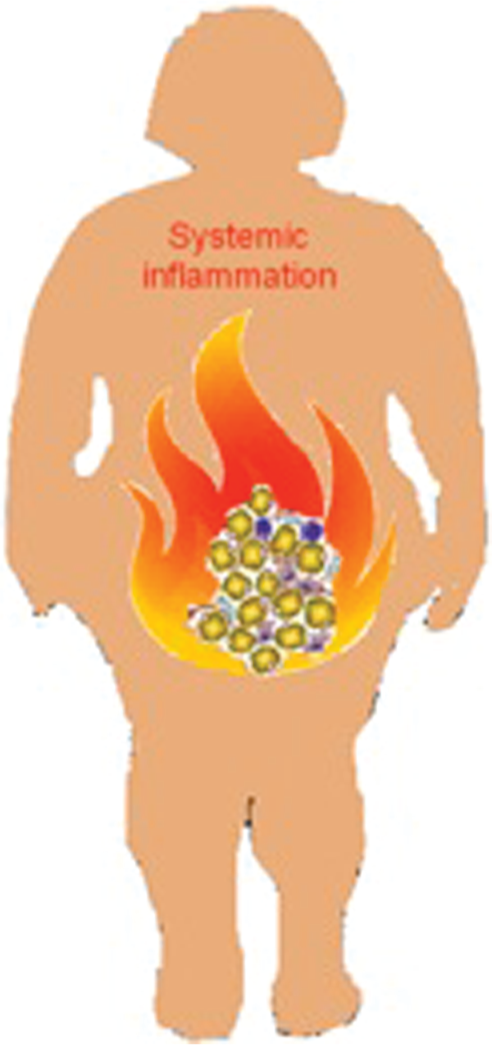
Excess visceral adipose tissue results in systemic inflammation. The expanded adipose tissue mass in patients who are viscerally obese is infiltrated with macrophages and activated T cells. These cells, as well as the increased number of adipose cells, produce factors which result in a state of systemic inflammation which is thought to increase tumourigenesis.
The importance of adipose tissue location in terms of dysmetabolism risk is evident as central obesity is more strongly associated with increased risk of insulin resistance, metabolic syndrome and cardiovascular diseases than body mass index (BMI) alone [Nedungadi and Clegg, 2009]. For any given amount of total body fat, the subgroup of individuals with excess visceral fat (versus subcutaneous fat) is at higher risk of developing insulin resistance [Kissebah et al. 1982] and the features of metabolic syndrome [Despres et al. 1990]. Visceral fat remains more strongly associated with an adverse metabolic risk profile even after accounting for the contribution of other standard anthropometric indices [Snijder et al. 2006]. These systemic effects exerted by visceral adiposity are putatively involved in cancer biology [van Kruijsdijk et al. 2009]. In patient studies it can be difficult to ascertain the differential effects of visceral versus subcutaneous adipose tissue as most humans possess deposits of both albeit in differing ratios. A recent mouse study involving Apc 1638N/+ female mice which are genetically predisposed to the early development of colonic adenomas and, hence, cancers sought to determine whether visceral fat independent of other confounders is causally linked to colonic tumourigenesis [Huffman et al. 2013]. In order to do so, the visceral fat was surgically removed from these mice and the outcomes of three groups, ad libitum fed, visceral fat removal and ad libitum fed or visceral fat removed and caloric restriction, were compared. Macroadenoma rate was attenuated by removal of visceral fat but not affected by calorie restriction indicating an independent effect of visceral fat on tumourigenesis.
The simplest direct measure of central obesity is waist circumference (WC). Over the past decade in the United States mean BMI and WC measurements have increased, particularly amongst men with the mean BMI in 2008 of 28.5kg/m2 and mean WC of 100.8cm [Ford et al. 2011]. The prevalence of abdominal obesity (WC >102 cm in men and >88 cm in women) was 43.7% in men and 61.8% in women [Ford et al. 2011].
Obesity rates are increasing amongst children [Troiano and Flegal, 1999] and overweight children tend to become overweight adults [Serdula et al. 1993]. Obesity rates are increasing exponentially: rates have doubled in Australia over the last 20 years [Dunstan et al. 2002] and in the United States over the last 30 years (see the 1971–1974 and 2003–2006 National Health and Nutrition Examination Surveys at http://www.cdc.gov/nchs/fastats/overwt.htm). Over the same time period, European childhood obesity rates have tripled [WHO, 2000].
Obesity and cancer: the epidemiological association
Epidemiological studies have demonstrated a robust link between obesity and cancer development at numerous sites, in particular the oesophagus, pancreas, colorectum, breast (postmenopausal), endometrium and kidney [Calle et al. 2003; Renehan et al. 2008b]. The World Cancer Research Fund estimates up to 28% of gallbladder cancers, 35% of pancreatic, and 35% of oesophageal cancers are attributable to obesity [World Cancer Research Fund, 2007]. This association carries relative risk (RR) estimates of 1.1–1.6 per 5 kg/m2 incremental increase in BMI [Calle and Kaaks, 2004]. Obesity also increases cancer-related mortality with studies reporting that obesity could account for 14% of all deaths from cancer in men and 20% in women [Calle et al. 2003]. Furthermore, emerging clinical research suggests weight loss following bariatric surgery leads to a reduction in cancer incidence [Adams et al. 2009; Christou et al. 2008; Sjostrom et al. 2009]. Thus, the potential mechanisms by which obesity increases both the incidence of certain malignancies, and cancer deaths, have become the focus of considerable research.
There appears to a sex differential with respect to risk of cancer development with men having a higher risk of developing cancer at increased BMI than women [Moore et al. 2004; Renehan et al. 2008b]. This may be due to the differing hormonal milieu in females or it may reflect the fact that BMI poorly reflects central adiposity in females. Since females generally only deposit central adipose tissue once total fat volumes are raised, overweight BMIs do not correspond with visceral fat volume in females as they do in males, which may account for the differences in cancer risk seen when BMI is used to determine obesity status.
In studies which use measures of visceral adiposity such as WC or visceral fat area (VFA), visceral adiposity is associated with increased risk of cancer development [Moore et al. 2004; Steffen et al. 2009; Wang et al. 2008], is a stronger predictor of cancer risk than BMI [Moore et al. 2004] and the cancer risk is similar in men and women [Moore et al. 2004; Wang et al. 2008]. Further, larger studies using measures of visceral adiposity across cancer sites are awaited in order to clarify whether there is a clear differential effect of visceral versus subcutaneous obesity.
Obesity has been strongly implicated in the pathogenesis of oesophageal adenocarcinoma. [Brown et al. 1995; Calle et al. 2003; Chow et al. 1998; Engel et al. 2003; Lagergren et al. 1999b; Renehan et al. 2008b; Ryan et al. 2006; Vaughan et al. 1995]. Centrally located fat, independent of overall BMI, is associated with increased risk of developing gastro-oesophageal reflux, Barrett’s oesophagus and oesophageal adenocarcinoma (OAC) [Corley et al. 2007a; Lagergren et al. 1999a]. Intuitively, the raised intra-abdominal pressure due to visceral adiposity places mechanical pressure on the stomach to increase reflux. However, after adjustment for gastro-oesophageal reflux, rates of OAC remain increased amongst those with obesity. Certainly, Barrett’s oesophagus seems to be more closely correlated with increased WC [Akiyama et al. 2009; Cook et al. 2008; Corley et al. 2007b; Edelstein et al. 2007] than raised BMI [Cook et al. 2008]. Several studies have reported a high prevalence of obesity amongst patients with the only recognized precursor of OAC, Barrett’s oesophagus [Corley et al. 2007a; Healy et al. 2010].
In pancreatic cancer, the risk of malignancy increases as BMI increases >30 kg/m2. Whilst in earlier studies there was a degree of inconsistency in correlations between obesity and pancreatic cancer, recent research has shown a more consistent pattern of association, with meta-analyses reporting a RR of 1.07-1.19 [de Gonzalez et al.; Larsson et al. 2007; Renehan et al. 2008b]. In addition, research by Li and colleagues reported that patients who are obese in early adulthood have a greater risk of developing pancreatic cancer and do so at an earlier age than their nonobese counterparts [Li et al. 2009].
A number of meta-analyses have reported a modest but consistent relationship between the incidence of colon cancer and obesity, with a relative risk of 1.24–1.59 in obese men and 1.09–1.22 in obese women [Bergström et al. 2001; Dai et al. 2007; Guh et al. 2009; Harriss et al. 2009; Larsson and Wolk, 2007a; Moghaddam et al. 2007; Renehan et al. 2008b]. The risk is greater for cancer of the colon than of the rectum. Colonic adenomas, the colorectal cancer precursor lesions, have also been associated with increased BMI [Kono et al. 1999; Ya-Yu et al. 2005] and abdominal obesity [Giovannucci et al. 1996; Kim et al. 2009]. The majority of studies have reported a stronger association between obesity and colorectal cancer in men than in women, which has been hypothesized to be due to differential adipose tissue distribution, with increased levels of visceral adiposity observed in man compared with women [Calle, 2007]. However, there is evidence that when WC, rather than BMI, is used to determine obesity status the apparent sex difference is greatly reduced [Pischon et al. 2006].
Epidemiological evidence concerning the association between gastric adenocarcinoma and obesity are limited in number but the most recent meta-analysis there was no association. Gallbladder and biliary carcinomas may be associated with obesity although whether this factor directly mediates an effect or whether the effect is mediated by the increase prevalence of gallstones in obese patients is not clear [Larsson and Wolk, 2007b]. Data concerning hepatocellular carcinoma are subject to many confounding factors which may be difficult to control for including alcohol, infectious agents and the uncertain significance of nonalcoholic hepatosteatosis. Overall there appears to an association with obesity with a population attributable rate of approximately 30% [Larsson and Wolk, 2007c].
Mechanisms underpinning the association between obesity
To date the mechanisms which mediate the obesity-driven effect on cancer development and progression in humans have been poorly understood. Difficulties arise in controlling for confounding factors such as systemic energy balance, physical activity and nutrition and most of the relevant data on mechanisms rely on animal or in vitro studies. Hypothesis relevant to the question and explored in this review, are whether obesity affects tumours via alterations in the systemic cytokine, hormonal and growth factor milieu and whether this is aligned to the presence of systemic inflammation in obesity and, second, whether obesity results in the upregulation of oncogenic pathways represented by increased activity of signalling pathways such as phosphoinositide 3-kinase (PI3K), mitogen-activated protein kinase (MAPK) and signal transducer and activator of transcription 3 (STAT3) pathways.
Obesity is a state of chronic systemic inflammation
Obesity is characterized by increased storage of fatty acids in an expanded adipose tissue mass [Galic et al. 2010]. Increased adipose tissue mass, especially visceral adipose tissue, is associated with insulin resistance, hyperglycaemia and dyslipidemia. Mobilization of free fatty acids (FFAs) is more rapid from visceral than from subcutaneous fat cells because of the higher lipolytic activity in visceral adipocytes, in both nonobese and obese individuals, particularly in the latter, which probably contributes significantly to the FFA levels in the systemic circulation of obese individuals [Snijder et al. 2006]. The higher lipolytic activity in visceral fat in comparison with subcutaneous fat can be attributed to regional variation in the action of the major lipolysis-regulating hormones, catecholamines and insulin; the lipolytic effect of catecholamines being more pronounced and the antilipolytic effect of insulin being weaker in visceral than in subcutaneous adipose tissue [Wajchenberg, 2000]. In addition, specific proteins and hormones produced by omental and mesenteric adipose tissue, such as inflammatory molecules, angiotensinogen and cortisol can also contribute the systemic inflammatory condition associated with obesity. Excess adipose tissue results in elevated levels of pro-inflammatory adipokines, resulting in an imbalance between increased inflammatory stimuli and decreased anti-inflammatory mechanism leading to persistent low-grade inflammation [Das, 2001; Esposito and Giugliano, 2004; Wajchenberg, 2000] (Figure 1).
Insulin resistance and type 2 diabetes mellitus (T2DM) have been recently recognized as intimately associated with the presence of systemic inflammation. Obesity is associated with an increased risk of developing insulin resistance and T2DM. Nutritionally induced insulin resistance develops as a metabolic adaptation to increased circulating levels of FFAs, which are constantly released from adipose tissue, especially from visceral fat stores [Calle and Kaaks, 2004]. Increased FFA levels force liver muscle and other tissues to shift towards increased storage and oxidation of fats for their energy production [Bergman and Ader, 2000]. The compensatory effect is a reduced capacity of these tissues to absorb, store and metabolise glucose. In tandem, markers and mediators of systemic inflammation including acute phase reactants such as fibrinogen, C-reactive protein, interleukin (IL)-6, plasminogen activator inhibitor-1 (PAI-1) and white cell count are raised in patients with newly diagnosed T2DM [Shoelson et al. 2006].
Increased numbers of adipocytes releasing FFAs alone are not sufficient for the development of insulin resistance. In addition to increased FFA levels, high concentrations of cytokines produced by adipose tissue, such as tumour necrosis factor (TNF)-α, IL -6 and IL-1β, and low concentrations of adiponectin are required for deleterious effects on glucose homeostasis [Greenberg and McDaniel, 2002]. The cellular and molecular mechanisms leading to insulin resistance includes a reduction in cellular insulin-receptor levels and reduced responsiveness of some intracellular transduction pathways mediating the effects of insulin binding to its receptor [Moller and Flier, 1991]. Insulin resistance leads to increased insulin production and insulin can act as a mitogen and has been associated with several cancers [Colangelo et al. 2002; Schoen et al. 1999; Trevisan et al. 2001]. The tumourigenic effects of insulin could be directly mediated by insulin receptors in the preneoplastic target cells, or might be due to related changes in endogenous hormone metabolism, secondary to hyperinsulinaemia [Calle and Kaaks, 2004].
The mitogenic and potentially procarcinogenic effects of insulin have been hypothesized but unproven for decades [Donohoe et al. 2011]. The most exciting development with respect to the this field of study in recent years is the observation that biguanide medications, such as metformin, have been associated with a reduction in the insulin levels of patients with T2DM and appear to be associated with a decreased risk of cancer incidence. It is not understood whether this is mediated via the reduction in insulin and, hence, its direct effects or also via the alteration in signalling and metabolism induced by these medications [Pollak, 2012].
The obese state represents an altered immunological milieu
Visceral adipose tissue, in addition to being more metabolically active, is also an immunologically enriched environment. Cytokines secreted by adipose tissue include the following pro-inflammatory cytokines: TNF- α, IL-6, IL-8, IL-10, IL-1 receptor agonist (IL-1Ra), macrophage inflammatory protein 1(MIP-1) and monocyte chemoattractant protein 1 (MCP-1). These cytokines are directly influenced by the degree of immune infiltrate in adipose tissue, which in turn is influenced strongly by the degree of adiposity of the expanded fat mass. In obese patients, the increased size and number of adipocytes in adipose tissue results in areas of hypoxia within the tissue. This hypoxia induces the secretion of inflammatory factors in order to promote angiogenesis [Feldser et al. 1999; Fukuda et al. 2002; Trayhurn and Wood, 2004]. Inflammatory cytokines attract infiltrating immune cells which in turn produce more inflammatory cytokines. In fact, the overall level of adipokine production from adipose tissue is strongly influenced by the degree of immune cell infiltration present in adipose tissue [Kershaw and Flier, 2004; Schaffler et al. 2006; Weisberg et al. 2003; Xu et al. 2003]. Adipose tissue in obese people is infiltrated with macrophages and the number of macrophages correlates with the degree of adiposity [Neels and Olefsky, 2006]
Peripheral monocytes are recruited by MCP-1 and TNF-α, and can differentiate into activated macrophages [Curat et al. 2004]. The products of activated macrophages can have an impact on adipocyte function and are postulated to be involved in altering adipose tissue glucose handling and thus contribute to insulin resistance [Sartipy and Loskutoff, 2003; Wellen and Hotamisligil, 2003]. Research has shown that coculture of adipocytes with macrophage-conditioned media causes increased adipokine and inflammatory cytokine production by adipocytes [Bassols et al. 2009], further supporting this hypothesis. Increased release of inflammatory cytokines by obese adipose tissue had a profound influence on immune cells both locally and systemically.
T-cells may also be key regulators of adipose tissue inflammation. Nishimura and colleagues demonstrated a significant increase in CD8+ T-cell infiltration into expanding visceral adipose tissue, which preceded macrophage infiltration. These T cells were found to be responsible for both the establishment and maintenance of adipose tissue inflammation in obesity [Nishimura et al. 2009]. Further work by Lysaght and colleagues investigated human omentum harvested from OAC patients and demonstrated that it is a particularly rich source of CD8+ T cells. A high percentage of CD4+ and CD8+ omental T cells were activated with an inflammatory T-helper 1 phenotype (CD69+ CD45RO+ IFN-γ+). Of particular interest was the finding that there were significantly more interferon-γ+ T cells present in the omentum of cancer patients compared with noncancer controls [Lysaght et al. 2011]. The role of T cells in adipose tissue inflammation and cancer has not received much attention so far but offers potential immunotherapeutic targets for obesity-associated morbidities
Obesity is also associated with an alteration in the function of circulating immune cells. Studies have found decreased T- and B-cell function, increased monocyte and granulocyte phagocytosis and oxidative burst, and raised total leukocyte counts [Mendall et al. 1997; Nieman et al. 1999]. Circulating mononuclear cells from obese subjects have been shown to exhibit increased nuclear factor b (NFB) nuclear binding with decreased levels of NFκB inhibitor and increased mRNA expression of IL-6, TNF-α and migration inhibition factor. Markers of macrophage activation correlate with plasma levels of FFAs [Ghanim et al. 2004].
Adipokine levels in obese individuals
Systemic chronic inflammation and an altered immune profile may exert effects on the tumour microenvironment. Obese rat models have increased inflammatory transcription factor expression (TNF-α and NFκB) in their tumours [Jain and Bird, 2010]. Adipokines produced (including IL-6, leptin and vascular endothelial growth factor [VEGF]) from obese fat reservoirs differ from those produced from the fat of patients with normal body weight [Lysaght et al. 2011]. There is interplay between different adipokines with possible positive feedback loops increasing pro-inflammatory adipokines. For example, insulin can modulate adipokine production and including two of the most abundant adipokines: leptin and adiponectin. Insulin is a positive regulator of leptin and increases its gene expression to suppress appetite [Yamauchi et al. 2001]. Circulating levels of leptin positively correlate and adiponectin levels negatively correlate with all measures of obesity (BMI, WC and VFA) [Cummings and Foster, 2003; Howard et al. 2010; Kadowaki and Yamauchi, 2005]. Adiponectin acts as an insulin sensitizing agent [Yamauchi et al. 2001]. In addition to modulation of insulin sensitivity, these adipokines can directly affect tumour cells [Schaffler et al. 2005]. Adiponectin is antitumour: it increases apoptosis [Dieudonne et al. 2006], inhibits proliferation, inflammation and angiogenesis [Brakenhielm et al. 2004] and can prevent the interaction of growth factors with their receptors [Wang et al. 2007]. There is a consistent inverse relationship with cancer incidence and circulating adiponectin [Roberts et al. 2010]. The protumour effects of leptin are the direct opposite of those of adiponectin [Roberts et al. 2010], although the epidemiological association between circulating levels and cancer risk is less consistent [Renehan et al. 2008a].
Another of the differentially expressed adipokines in obesity is insulin-like growth factor (IGF). Serum levels of IGF-1 (in both free unbound and total bound forms) are increased in OAC patients who are viscerally obese versus those who are of normal weight [Donohoe et al. 2012]. IGF-1, similar to other adipokines, can have protumourigenic properties either by binding to and influencing tumour cells directly or by stimulating cells in the tumour’s micro-environment which in turn may have an influence on the survival of tumour cells.
Species of the IGF-1 axis family are expressed in immune cell populations [Oberlin et al. 2009] and tumour-associated macrophages are a source of IGF-1 [Kodelja et al. 1997; Kopfstein and Christofori, 2006; Sunderkotter et al. 1994]. There is an increase in CD68+ cells, a cell surface macrophage marker, in the stromal tissue surrounding the invasive edge of oesophageal tumours [Doyle et al. 2012]. Furthermore, there was increased expression of the insulin-like growth factor receptor in OAC tumour’s invasive edge, which may indicate that there is a paracrine mechanism involving interplay between tumour-associated macrophage-derived IGF-1 and tumour cells which express insulin-like growth factor (IGF1R). Circulating levels of free and total IGF-1 are increased in patients with OAC who are viscerally obese versus their normal-weight counterparts [Donohoe et al. 2012] and IGF1R expression in OAC tumours is a poor prognostic marker [Donohoe et al. 2012]. Whether stimulated by macrophage-produced IGF-1 or systemic circulating IGF-1 species, activation of IGF1T has a proliferative, anti-apoptotic role in cancer cell growth and development.
Signalling pathways and alterations in obesity
Cancers which develop within an obese environment may become selectively altered to signal via specific pathways. For examples, in patients with non-small cell lung cancer, only a subset (approximately 10–20%) respond to the epidermal growth factor receptor (EGFR)-targeted therapy gefitinib, and these patients often have an activating mutation of EGFR [Lynch et al. 2004]. Patients with activating mutations are more likely to have adenocarcinomas, and to be female, nonsmokers and Japanese [Taron et al. 2005]. Similarly, obesity-related cancers may have a specific set of targets (malfunctioning molecules or pathways) which may be exploitable in clinical practice. Certainly a number of the putatively dysregulated adipokines and growth factors in obesity do signal via the same intracellular signalling pathways (Figure 2).

The obese state of systemic inflammation upregulates intracellular pathways which promote functional aspects of cancer cell. Cancers which develop within an obese environment may become selectively altered to signal via specific pathways. Many of the factors upregulated systemically in the obese state including leptin, interleukin(IL)-6, insulin, tumour necrosis factor and insulin-like growth factor (IGF)-1 all signal via similar candidate pathways include the phosphoinositide 3-kinase (PI3K), mitogen-activated protein kinase (MAPK) and signal transducer and activator of transcription 3 (STAT3) pathways. Activation of these pathways leads to multiple downstream effects including cell proliferation and cell survival. Illustration courtesy of Alessandro Baliani © 2013.
Candidate pathways include the PI3K, MAPK and STAT3 pathways. Activation of these pathways leads to multiple downstream effects which underpin cancer progression and metastasis [Aggarwal et al. 2009; Huang et al. 2010; Yu et al. 2009]. Importantly, inhibitors of these pathways are under development at present in order to provide new therapeutic avenues [Jing and Tweardy, 2005; Liu et al. 2009; Sebolt-Leopold and Herrera, 2004].
One of the hypothesised pathways strongly implicated in mediating the effect of the obese environment is the PI3K pathway. Activation of PI3K pathway signalling leads to a number of functionally relevant prosurvival effects including growth, proliferation, differentiation, motility, survival and intracellular trafficking [Engelman, 2009]. Many of the factors upregulated in the obesity signal via the PI3K pathway. These include leptin, IL-6, insulin, TNF and IGF-1. Is there any evidence that cancers which develop within the obese milieu are ‘addicted to’ or preferentially signal via these pathways?
Whole-genome analysis of breast cancer tumours divided according to BMI demonstrate that an obesity-associated gene signature pattern is associated with a shorter time to metastasis and is associated with IGF signalling signature in multiple publically available breast cancer genome arrays [Creighton et al. 2012]. There is a high degree of overlap between the genes in this IGF signature with those of constitutive PI3K activity signatures. No such studies to date have been performed in gastrointestinal cancers.
Most data to support this hypothesis are derived from mouse models. PI3K activity (measured by pAkt and mTOR protein levels) is increased in diet-induced obesity in mice and is associated with an increased level of circulating IGF-1 compared with controls [Moore et al. 2008]. Mice fed a high-energy diet have twice the volume of tumours 17 days after colon cancer cell injection versus controls. PI3K pathway activity was demonstrated by increased phosphorylated Akt protein levels. The tumour growth effect was abrogated by metformin treatment, which led to decreased pAkt levels [Algire et al. 2010]. In a mouse model of obesity-related skin cancer, obese mice had higher PI3K activity after UV exposure than lean mice [Sharma and Katiyar, 2010]. Activity of MAPK phosphorylation and NF-kB signalling were also higher following UVB irradiation in leptin-deficient obese mice [Katiyar and Meeran, 2007]. In an obesity-associated hepatoma model, IL-6 and TNF-alpha induce the development of cancer via activation of STAT3 pathway [Park et al. 2010].
Excess energy balance associated with the obesity may have an influence on tumour growth. Mouse tumour xenografts have decreased incidence and slower growth in mice fed a calorie restricted diet. Tumours which are resistant to dietary restriction have constitutive activation of the PI3K pathway [Kalaany and Sabatini, 2009].
The JAK–STAT pathway transmits information received from extracellular polypeptide signals through transmembrane receptors and is thought of as a signal transducing pathway for inflammatory cytokines. JAK–STAT activation stimulates cell proliferation, differentiation, cell migration and apoptosis [Quesnelle et al. 2007; Schindler and Darnell, 1995; Weerasinghe et al. 2007; Yue and Turkson, 2009]. Ligands which lead to activation of this pathway include many of the factors which are known to be upregulated in the obese state; IL-6, VEGF and leptin (37-40). These factors have been shown to be upregulated in visceral adipose tissue versus subcutaneous fat and serum concentrations of these ligands are increased in patients with visceral obesity versus lean controls [Lysaght et al. 2011]. Many of the tyrosine kinase receptors which are current or investigational therapeutic targets under trial at present such as IGF1R and EGFR signal through the STAT3 pathway. Aberrantly active STAT3 is also implicated in tumour formation [Spiotto and Chung, 2000; Yu et al. 2009; Yue and Turkson, 2009]. In contrast to the transient nature of Stat activation in normal cells, many human solid and haematological tumours harbour constitutive STAT3 activity [Yue and Turkson, 2009]. STAT3 promotes invasion and metastasis [Haura et al. 2005; Kortylewski et al. 2005; Turkson, 2004] and persistently active STAT3 functions as a master regulator of molecular and biological events that promote tumourigenesis [Siddiquee et al. 2007]. Extensive surveys of primary tumours and tumour cell lines indicate that inappropriate activation of specific STATS occur frequently in a wide variety of human cancers [Garcia and Jove, 1998]. Specific analysis of this pathway’s activity in tumours from obese patients, from obese mouse models or even in vitro cell line studies using conditioned media are lacking to date.
Conclusions
Obesity is a complex alteration in the normal metabolic and immunological environment. Altered adipokine production by adipose tissue, and in particular inflamed visceral adipose tissue, infiltrated with activated immune cells, may have an influence on the tumour and its microenvironment in a number of potential ways. First, systemic inflammatory cytokines are increased in obesity. This may affect the tumour either directly by stimulating the development of protumourigenic cancer cell properties by stimulating procarcinogenic signalling pathways. Systemic inflammation could equally alter the immune cells within the tumour’s micro-environment. Finally, systemic inflammation in obesity leads to circulating immune T cells with decreased antitumour activity, which may, in itself contribute to the relative tolerance of tumour cells. Uncovering the mechanisms underpinning this important health issue is the first step in uncovering new disease treatment and prevention paradigms.
Footnotes
Funding
This work is funded by an Irish Cancer Society research scholarship and an Irish Research Council for Science, Engineering and Technology scholarship.
Conflicting of interest statement
The authors have no conflicts of interest to declare.