




Abstract
In this article, we advance a framework that highlights the relational nature of rivalry emergence and its ongoing manifestations, before illustrating this framework in practice through an analysis of the rivalry between Serbs and Albanians over the issue of Kosovo. We argue that the locus of rivalry lies in the inherently social character of human desire and the destructive reciprocity elicited by human mimetic behaviour. The manner in which rivals portray their plight, and legitimise their cause, is, we argue, a function of their desire to acquire that which they imagine the other has. As such, rather than adhering to the conventional view that rivalries are characterised by difference, we argue that rivals share a set of common goals/desires. Thus, though rivalries are characterised by mutual antipathy – and the attendant devotion to constructing self-serving myths – this is but a superficial manifestation of an underlying mimetic dynamic. To focus only on how myths are constructed and instrumentally employed, is not sufficient when seeking to explain the persistence of rivalries. Rather, we must understand the underlying desires the respective rivals seek to fulfill through the proliferation of these myths if we are to truly understand the nature of the rivalry.
Introduction
In this article we apply Girard’s (1987) theory of ‘mimetic desire’ to argue that the concept of mimetic rivalry sheds fresh light on the process by which rivalries emerge and develop. Following Brighi and Cerella’s (2015) claim that Mimetic Theory can, ‘channel, contextualize, and ultimately go beyond the insights advanced by social constructivism’ (p. 18), we demonstrate that while existing research into the ‘constructed’ nature of rivalries accurately describes the manner in which rivals manipulate the past – particularly through the proliferation of myths and mistruths – these accounts do not explain the dynamics behind the emergence of rivalries or explain their persistence, as they overlook their mimetic character; the underlying shared desires the respective rivals seek to fulfil through the proliferation of their respective myths.
Thus, rather than adhering to the conventional view that rivalries are characterised by difference, we argue that rivals share a set of common goals/desires, and thus that the locus of rivalry lies in the inherently social character of human desire and the destructive reciprocity elicited by mimetic behaviour. The emergence of rivalry has endogenic-relational origins, which result from a destructive mimetic process where the intractability of the issue(s) at stake reflects the actors’ mimetic polarisation. The manner in which rivals portray their plight, and legitimise their cause, is, we argue, a function of desire; while these desires manifest as a determination to acquire possessions – material resources, land, technology etc – the true aim is to acquire a particular status the other is deemed to possess. Thus, though traditional approaches present rivalries as characterised by mutual antipathy – and the attendant devotion to constructing self-serving myths – this is but a superficial manifestation of an underlying mimetic dynamic which these perspectives overlook.
We illustrate our argument by analysing the rivalry between Serbs and Albanians over Kosovo, widely regarded as amongst the most intractable in contemporary international politics (Bellamy, 2002: 3; Di Lellio, 2009: 8; Glenny, 2000: xxi; Hehir, 2019a; Independent International Commission on Kosovo, 2000: 33; Newman and Visoka, 2019; Winchester, 1999). 1 We agree with existing analyses which demonstrate that the rivalry has been stoked by ‘memory entrepreneurs’ who have consciously distorted past events to fabricate a ‘perennial’ fissure between their communities, and thereby legitimise particular policies in the contemporary era (Jelin, 2003: 33; see also, Gligorov, 2017; Mertus, 1999; Norris, 2016: 11–18; Pavković, 2001; Petersen, 2011: 14). However, while these analyses are accurate, they are limited; identifying the potency of politicised historiographies – and the various ways in which discussing the history of Kosovo has become ‘war by other means’ (Judah, 2000: 1) – may explain how the rivalry has been constructed, but it does not explain why. To explain only how rivalries are stoked is, by definition, a limited endeavour which focusses only on the superficial manifestation and periodic eruption of rivalries rather than providing insight into the underlying dynamics which impel the perennial tension.
To fully understand why there has been a steady proliferation of rival historiographies about Kosovo, necessitates an appreciation of the fact that these alternative accounts, owing to the fundamentally mimetic nature of the rivalry, derive from a shared – though unacknowledged – determination to acquire identical goals. Therefore, we go beyond existing analyses on the use of myths and mistruths to foment conflict in Kosovo by demonstrating why the myths – in particular those relating to the 1389 Battle of Kosovo – have been employed in the contemporary era, namely, to cohere with each rival’s desire to acquire identical goals; particular statuses related to indigeneity and victimhood.
Theories of rivalry
Rivalry in international relations and peace and conflict studies
After the end of Cold War, many International Relations (IR) scholars questioned the a-priori assumption that states have a similar propensity to go to war (De Mesquita, 1981; Singer and Small, 1982). They demonstrated that in the context of rivalry, war dynamics become intelligible only if studied as a long-term multiple-event process embedded in a psychologically charged context (De Rouen and Bercovitch, 2008; Diehl and Goertz, 2000; Thompson, 1995; Vasquez, 2009). IR literature on rivalry developed into two distinct research approaches: the dispute-density approach (Diehl and Goertz, 2000) and the interpretivist approach (Thompson, 2001). The dispute-density approach emerged to distinguish ‘enduring rivalries’ from wars, that is to identify those dyadic interstate conflicts more prone to violent clashes (Diehl and Goertz, 2000). The interpretivist approach emerged to identify the distinctive qualities of ‘strategic rivalries’ before the occurrence of a militarized clash (Thompson, 2001: 559–562).
Overall, these approaches focussed on the enduring – or protracted – characteristic of rivalry. They did so by examining securitized rivalries, that is, conflict-prone dyadic competitions between adversaries, who perceive, and treat, each other as a threat; their resultant hostility in turn influences their expectations about their future relationship (Huddleston, 2013). As a result, less attention has been dedicated to the status of the dyadic relationship before it becomes ‘securitized’, that is, how contested issues actually become a matter of ‘national security’ prompting the emergence of the rivalry. For instance, Diehl and Goertz (2000) maintain that the origin of an enduring rivalry lies in its ‘punctuated’ development, whereby long periods of stability follow punctuated changes, moments of immense stress induced by external environmental shocks (pp. 138–140). However, the means by which these ‘occasional, unpredictable and dramatic’ external shocks emerge are unclear (p. 136).
While rarely defining it as ‘rivalry’, Peace and Conflict Studies (P&CS) scholars have also focussed on the equivalent phenomena of protracted and intractable conflicts. Going beyond the state as the ultimate referent object (Bar-Tal, 2007; Coleman, 2006), they emphasize the relevance of psychological, social, and cultural factors – such as identity and self-esteem – in turning intergroup conflicts into intractable rivalries (Azar, 1990; Burton, 1987; Kriesberg, 1993). According to their approach, rivalry is an extreme form of conflict, where intractability is caused by a scarcity of resources, and further fuelled by extreme identity differences, culminating in widespread affect-loaded polarisation. For instance, Burton’s (1987) ‘Basic Human Needs’ model highlights how conflict becomes protracted due to the rise of negative emotions (fear, anger, depression, identity threat) caused by the dissatisfaction or oppression of basic primary material needs (see also, Sites, 1990: 9). As a result, while bound to materialist ontology, P&CS approaches added valuable insights on the role of cognition and emotion in protracting rivalry’s deeply rooted intractability.
Both IR and P&CS approaches, therefore, conceive of rivalry as a competition between a plurality of actors, either with different economic interests/preferences, or different cultures, values and identities (Brigg, 2008; Ramsbotham et al., 2011). They suppose that difference begets conflict and ultimately rivalry. We argue, however, that, in the context of rivalry, claims of extreme difference obscure the deeper dynamic that produced them, namely the profound similarity of the goals and desires pursued by the putative rivals.
Similarly, although they rarely focus directly on conflict, constructivist explanations of identity-based rivalry correctly point out how the ‘rationality’ or ‘psychology’ of intractable conflict is a social construction (Jackson, 2008). The rivals’ expectations and interests depend less on exogenously determined logics of utility or pre-existing preferences, and more on whether they perceive, and/or construct, their rival’s identity as friendly or threatening (Kapferer, 1988). Following the constructivist paradigm, cooperation and war are both social practices whose meaning is substantiated by actors’ norms, ideas, values and beliefs (Checkel, 1998). In other words, the relations between rivals in the long term depend on the meaning they give to their reciprocate identity (Hopf, 1998; Kaufman, 2001). Consequently, rivalry becomes a quasi-permanent structure due to the practices of actors perceiving the threatening ‘Other’ as irreconcilably different. However, constructivist accounts are fundamentally limited. They portray rivals advancing antagonistic claims that produce the structure of rivalry; in fact, reciprocal claims of extreme difference obscure what is the true nature of the relationship between ‘rivals’: mimetism by comparison.
Mimetic theory of rivalry
The approaches noted above assume that rivalry constitutes an extreme form of conflictual difference, thereby downplaying the extent to which ‘difference’ itself can be a product of rivalry. Highlighting the emergence of rivalrous difference, however, sheds light on an issue typically overlooked in conventional approaches: the origin of ‘securitised’ rivalries (Huddleston, 2013: 3). We argue that the moment of origin, in this case of rivalrous behaviour, never exists outside a historically determined event (Cerella, 2016: 224), but it is nonetheless mythical. Rivalry is, in fact, an inherently relational product, as the process of reciprocity itself sets in motion the (re)production of extreme difference between rivals (Dupuy, 2002), and thus entrenches their positions to intractable levels. Ultimately, this process crystallizes in its securitized form, in which victimhood mentality, mutual hatred, mistrust and resentment sustain a rivalry’s characteristic intractability.
Girard (2001) regards mimetic rivalry as ‘the principal source’ of violence and defines it as the result of the competitive ‘imitation of a model who becomes a rival or of a rival who becomes a model’ (p. 11). In line with post-Darwinian scholarship (Potolsky, 2006), and before discoveries in social psychology (Hurley and Chater, 2005), Girard (1987) hypothesized that imitation was a pervasive factor in human behaviour; ‘all learning is based on imitation’ he argued, with imitation serving as a learning tool upon which ‘all forms of culture’ are based (p. 7).
Girard’s unique intuition was to discern that when imitation is left unchecked, it can lead to rivalry; in contrast to conventional approaches, Girard (1977) postulates that rivalry does not emerge from unsatisfied material needs, since they are object-oriented and, once they satisfy the ‘body’, they cease to be a source of violence. As Brighi and Cerella (2015) noted in the special issue on ‘Mimetic Theory in IR’ in this journal, humans are ‘homo desiderans’, and their desires are ‘non-deterministic’ and ‘non-instinctual’, meaning they are ‘not an instinct satisfiable by itself but require a direction, a model, to be formed, this means that the nature of desires is not subjective or objective but always mediated by the Other’ (p. 8).
It is from this constant and ubiquitous mimetic fascination or suggestion that rivalry emerges; the fascination with the ‘Other’s’ perceived superiority prompts the subject to compare itself to the model and to desire what it itself lacks and which the model seems to possess (Girard, 1987: 145–146). Hence, mimetic emulation is an attempt to acquire the same role or status possessed by the model; literally to replace the model. Through a fear of losing its status and relative benefits, the roles of the two actors are inverted: the model imitates the subject. The model’s resistance transforms the emulative relationship into competition and, in extreme cases, rivalry. Building on the work of Gabriel Tarde and interpreting key concepts in the works of Sigmund Freud, and Jacques Lacan, Girard (1977) argues that the process of self-formation or identification develops around the pre-conscious desire to be like the model, ‘by taking over the things [or objects] that belong to it’ (p. 170; see also, Oughourlian, 2011). Therefore, an individual’s identity is neither fixed, nor original; it is, rather, an ever-changing product of an ongoing mimetic process mediated by the others’ suggestive goals.
Driven by this underlying mimetic dynamic, rivalry may arise over objects, but it is never bound to them. The acquisition of material objects does not satisfy the source of rivalry, namely the desire of both rivals to become like the other, that is to overthrow the ‘rival’ model (see Figure 1 below). The competition over the object appears to be the main issue at stake, especially for the actors themselves (Lanza, 2016). In fact, Girard’s (1977) mimetic triangle emphasizes how the saliency or desirability of the object is constructed: ‘the mediator [i.e., model] himself desires the object, or could desire it: it is. . .this very desire, real or presumed. . .[making] this object infinitely desirable in the eyes of the subject’ (p. 7). Ultimately, mimesis can lead rivals to the extreme, but the actor’s real target is always the status ostensibly acquired by possessing the contended object.
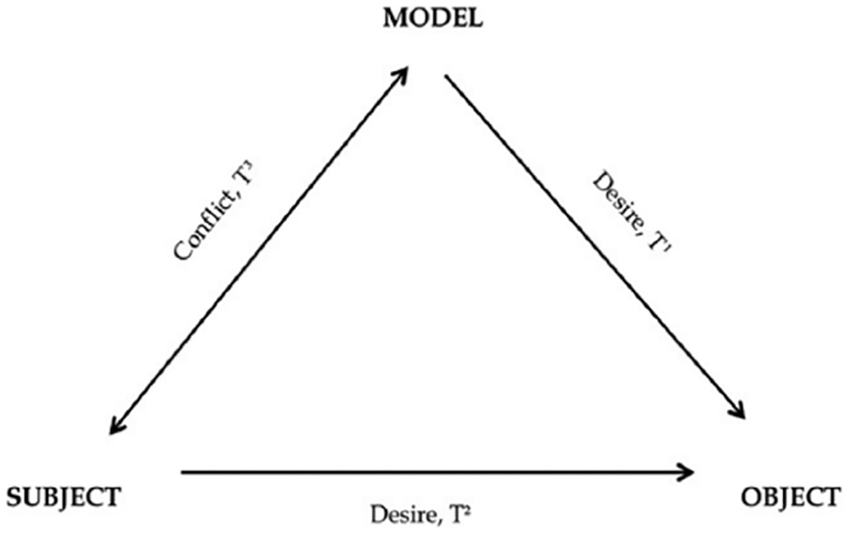
Girard’s mimetic model in Brighi and Cerella (2015: 9).a
At the same time, actors persistently misrecognize the role of imitation in their behaviour and desires. Believing in their right to pursue their genuine and original desires, they see no justification for the rival’s threatening behaviour; this produces greater resentment and anger on both sides, until each perceives the other as the only obstacle to satisfying their desires, an actual threat to their own identity (Brighi, 2016: 2).
In fact, in the context of rivalry, exclusionary identity is a marker of false difference. First, because it is the comparison with a superior ‘other’ that actually produces a ‘sense of lacking’, a ‘difference between the other and me, which my desire seeks to acquire’ in the first place (Dumouchel, 2014: 172). In other words, difference is an artefact of mimetic fascination of the model over us, despite being perceived as real by the actor’s own subjective experience. Second, because claims of identity difference usually come after, not before, the actual conflict (Farneti, 2015: 89–94). Ultimately, the transitory moment that divides the ‘before’ and the ‘after’ has historically specific and temporally determinate backgrounds, whose constitutive power can be observed in the myth purporting to explain the origin of the rivalry.
The origin myth
Myths emphasising the rivals’ illusory difference which evoke and sustain an exclusionary communal identity are invariably based on a historically determined moment held to have been the catalyst of the rivalry. In fact, this moment has been retrospectively manipulated to cohere with a particular narrative justifying the actor’s desires. These moments play a crucial role in crystalizing the rival’s destructive relations, contributing to the intractable saliency of any contended issue. The mythical narrative of irreducible difference originating at a particular time purposely masks the perfect symmetry of the rival’s desires and legitimizes its revengeful violence. Indeed, in justifying the originality of their desire and the defensive nature of their violence, rivals quickly become trapped in a vicious cycle of reciprocal blame, though neither side is in fact solely culpable for initiating the violence (Girard, 2007: 18). 2
The proliferation of these victimhood narratives reinforces the rivalry’s intractability in two ways. First, it legitimizes more ferocious retaliatory actions by the ‘victim’ to defend their status. The victim must not be held responsible for the harm it suffers in order to claim the legitimate authority to retaliate; that is why the aggressor always claims to have been previously attacked and/or threatened (Dumouchel, 2015). As Wydra (2015) notes, ‘self-attributed collective victimhood provides a moral right for the initiation of hostilities against others’, justifying the killings on the basis of the ‘uniqueness, righteousness and legitimacy of one’s own cause’ (p. 104).
Secondly, it bolsters the rivals’ zeal and paves the way for greater, systematic logics of persecution. The status of victim unifies the community internally; Dumouchel (2015), in fact, claims that there is no community without victims (p. 132). When casualties are regarded as collective or ‘communal victims’, thereby generating the requisite sense of community, rivals are turned into scapegoats (Girard, 1986). The ‘other’ is portrayed as solely responsible and, once portrayed as such, must be eliminated (Denike, 2015: 114).
A mimetic perspective brings to the fore the generative role of the victims. They shape the future of the affected community by means of a symbolic value retroactively added; they thus become symbols of the future of the community. Rivals constantly (re)evaluate their present and the past from the future they project. Trapped in this state of liminality that is the mimetic rivalry, ‘people do not really cognitively ‘know’ what occurs’ (Wydra, 2015: 107). Without noticing it, this process slowly transforms the past, through a new narrative that fosters victims’ authority; every community blames their victimiser, and mourns and cherishes their own victims (Dupuy, 2002).
As a consequence, the origin of a rivalry is, in fact, mythical; the moment of origin never exists outside a historically determined event (Cerella, 2016: 224). It is the process of reciprocity itself that sets in motion the extreme identities and victimhood mentality through the production of actual casualties (Cristini and Lanza, 2017). At the same time, this is not what actors subjectively experience. In the context of mimetic rivalry, exclusionary discourses of victimhood, and the proliferation and adoption of a victimhood mentality, legitimize the sacrifices of other members of the community for the unity brought by the victims themselves.
In sum, in contrast to constructivist accounts of rivalry based on extreme identity difference, we argue that the social fabric of rivalry is extreme mimetism. Where constructivists portray rivals advancing competing myths to bolster their antagonistic claims, we argue that these reciprocal claims of extreme difference obscure what is the true nature of the relationship between ‘rivals’: mimetism by comparison. As such, we argue that the concept of mimetic rivalry explains what traditional models of rivalry have only hinted at; the distinctive emergence and the development of rivalry. Rivalry is identity-based and desire-oriented; the false framing of ‘extreme difference’ that rivalry produces, casts the shadow of the present on the past, so that rivals can create and sustain scapegoat narratives and mythical origins. By shifting the blame to a threatening ‘Other’, rivals create a new, but fundamentally illusory, sacred ontology that ultimately defines their collective identity and rivalrous relationship.
1389 and the Serbian/Albanian rivalry over Kosovo
One of the most widely noted rivalries in the contemporary era is that between Serbs and Albanians over the territory of Kosovo (Independent International Commission on Kosovo, 2000: 33–67; Judah, 2000: 1–33; Mazower, 2000: 137–138). It is not our contention that the rivalry does not exist; rather, our aim is to demonstrate that the process of emulation which characterises and sustains it, illustrates the mimetic theory of rivalry in practice.
When the Socialist Federal Republic of Yugoslavia (SFRY) began to implode in the early 1990s, the Kosovo Albanians – constituting some 90% of the population of Kosovo – pursued a strategy of peaceful secession. Having failed to win international support for their cause, and in the face of increasing oppression, support amongst the Albanian community began to switch from civil disobedience, to the Kosovo Liberation Army’s (KLA) campaign of guerrilla warfare; by 1998, a full-scale civil war raged (Judah, 2000: 124; Malcolm, 1998: xxvii–xlii). In March 1999 NATO intervened in support of the Kosovo Albanians, eventually routing the Yugoslav army, and the province was thereafter placed under UN administration (Hehir, 2019a; Independent International Commission on Kosovo, 2000: 99–130; Musliu and Visoka, 2019). Despite twenty years of international engagement, relations between the Albanian and Serb communities in Kosovo, and between Serbia and Kosovo themselves, remain poor (Hehir, 2019b; Newman and Visoka, 2019).
Some explanations for the rivalry have emphasised the geo-strategic importance of Kosovo, the two community’s linguistic/religious differences, and, in particular the long-standing trope that the people of Balkans are plagued by ‘ancient ethnic hatreds’. 3 This latter explanation, however, have been repeatedly dismissed as ‘Balkans primordialism’ (Mertus, 1999: 5) which relies on misinterpreting constructed differences as genuine, thereby overlooking the very modern origins of the crisis (Di Lellio, 2009: 8; Independent International Commission on Kosovo, 2000: 33; Mazower, 2000: 14). As Mertus (1999) argued, ‘. . .the war in Kosovo cannot be attributed to ancient hatreds. Rather, the conflict is a result of recent hatreds fuelled by recent propaganda campaigns’ (p. 4).
Yet, while many international observers advanced superficial accounts based on the ancient ethnic hatreds notion, this framing was also perpetuated by local elites on both sides. These ‘memory entrepreneurs’ proliferated myths and mistruths to promote particular historical narratives which facilitated exclusionary nationalist discourses emphasising perennial antipathy and an identity-based incompatibility between Serbs and Albanians (Jelin, 2003: 33). Thus, contemporary Serb and Albanian historiographies differ markedly not just in their accounts of the ‘true’ nature of current events, but also with respect to seminal historical moments (Judah, 2000: 1; Mertus, 1999: 2; Pavković, 2001: 4).
While the details of the 1389 Battle of Kosovo are disputed it can be said with some certainty that it was fought between an Ottoman army and a multi-national Balkan coalition of Christian forces, which ended with significant losses on both sides, and no clear winner, though the Ottoman forces eventually subjugated the Balkan resistance (Di Lellio, 2009: 4; Malcolm, 2002: 61; Pavković, 2001: 13). The facts of the battle have come to be far less important, however, than the myths surrounding it; as Mertus (1999) notes ‘what actually happened has been remembered to suit the conveniences of the day’ (p. 184). Given how it has become a central – and powerful – motif within contemporary Serbian and Albanian nationalist discourse, the myths about the battle make it an archetypal example of how particular moments in history are retrospectively framed, portrayed as the ‘origin’ of the contemporary rivalry, and manipulated for propaganda purposes. While – as is explored below – this is well reflected in the existing literature, the mimetic nature of the mythology surrounding 1389 has not been identified to date. In the following sections, we go further than the existing analyses which prove that the 1389 myths have been constructed and employed instrumentally, by demonstrating that these myths reflect and facilitate the symmetrical claims of extreme identity difference made by each party to satisfy particular mimetic desires.
The Serbian version
The power of the Serbian myth of 1389 – more widely known than the Albanian version – has been extensively noted (Di Lellio, 2009: 3; Malcolm, 2002: 58). As Vasquez (2009) reflects, ‘[The battlefield] stands not for a parcel of land or the memory of a battle fought long ago in 1389, but for the very soul of the Serbian nation, for the heart of their identity – an intangible stake that must be kept at all costs’ (p. 356). While Serbian folk tradition kept an account of the battle alive for many centuries after 1389 (Kotur, 1977; Mertus, 1999: 184), the Serbian myth of 1389 – as presently understood – was only developed at beginning of the 19th century (Di Lellio, 2009: 15). Illustratively, though the annual 15th June celebration of the battle is portrayed as a tradition dating back to 1390 it was actually, ‘a nineteenth-century invention’ (Malcolm, 2002: 78–79).
The invention of the myth of 1389 in the 19th century was a function of political expediency; it was at this point that a certain victimhood narrative regarding the battle – and the mythical role played by Prince Lazar – who led the army that fought the Ottomans – and Miloš Obilić – who assassinated Sultan Murad the leader of the Ottoman forces after the battle, and was then killed by Ottoman troops – was created to serve a particular aspirational desire; Lazar and Obilić were consolidated – if not in fact invented in the case of Obilić (Judah, 2000: 8) – to inspire Serbian independence from the Ottoman Empire and the establishment of a Serbian nation-state (Pavković, 2001: 7). The articulation of this myth in the early 19th century ‘focussed attention on the enemy and reminded Serbs of a glorious and pre-Ottoman past’ (Malcolm, 2002: 79).
Lazar and Obilić have been used to personify key features of the Serbian nationalist narrative (Pavković, 2001: 6–7). The Serbian version of events portrays Lazar as a Christ-like figure who, prior to the battle, is said to have been offered a ‘heavenly covenant’; a choice between an earthly kingdom and a heavenly one (Malcolm, 2002: 80). Lazar refused to betray his nation; his army was defeated, and he was killed on the battlefield due to an act of betrayal by the Judas-like Vuk Brankovic (Sells, 1996: 24). Thus, his divinely sanctioned struggle against foreign oppression and local mendacity is heralded as exemplifying the Serbian nation’s independence, bravery and selflessness (Mertus, 1999: 184). Obilić – a figure who in fact ‘probably never existed’ (Di Lellio, 2009: 18) – is heralded as signifying selfless Serbian patriotism, resilience even in defeat, and the Serb’s implacable resistance to foreign rule. The 1389 myth thus ‘embodies the spirit of patriotism and active resistance of the Serbian nation’ (Di Lellio, 2009: 23).
Crucially, this myth is used not just to bolster the Serb’s self-image and nationalist desire, but also to advance Serbian superiority and exceptionalism by portraying the Serb’s as uniquely independent guardians of ‘important civilisational values’ (Ramet, 2005: 149). Other nationalities in the Balkans were, by contrast, cast as willing to bend to foreign domination (Malcolm, 2002: 59; Pavković, 2001: 7). This is particularly the case with respects to the portrayal of Albanians as craven ‘collaborators’ who connived with Ottoman rule, as ostensibly illustrated in particular by their conversion to Islam (Malcolm, 2006a). Thus, in terms of the relations between Serbs and Albanians, the Serbian nationalist portrayal of 1389 casts the Serbs as deserving of their own independent state due to their being indigenous victims/martyrs, and heroic defenders of independence and Christianity, in contrast to their ‘perennial enemies’ the Albanians who are portrayed as servile facilitators of foreign oppression undeserving of self-rule/statehood (Blumi, 2006b; Daskalovski, 2003).
In the Serbian nationalist account, the army which fought the Ottomans is ‘almost always presented as only Serbian’ and even when there is some minor concession to the involvement of other nationalities, Albanians are always excluded (Di Lellio, 2009: 15). In reality, the army which fought against the Ottomans was comprised of many different nationalities, including Albanians (Ramet, 2005: 204; Vickers, 1998: 25). This is clear from references in the earliest Ottoman accounts from the 15th century to Albanians being part of the Balkan army, and also Serbian accounts written soon after the battle (Malcolm, 2002: 62–69). Additionally, the conceptual identity-based binary between Serbs as ‘resisters’ and Albanians as ‘collaborators’ is at odds with historical facts; many Albanians – most notably George Castriot, better known as ‘Skanderbeg’ – resisted Ottoman rule for centuries after 1389, while some Serbian leaders cooperated with Ottoman forces prior to and after the battle (Malcolm, 2002: 30 & 60). Acknowledging the truth would, however, blur the binary identities of Serbs and Albanians established by the myth and, importantly, the political implications of this binary relating to their respective mimetic claims to being uniquely deserving of sovereignty.
Of particular salience for the purpose of exploring the mimetic nature of the rivalry between Serbs and Albanians over Kosovo, is the fact that the Serbian myth of 1389 received renewed stimulus in the late 1980s as Serbian nationalists came to increased prominence – and power – within the SFRY (Judah, 2000: 7; Mertus, 1999: 185). Slobodan Milošević – the then President of the SFRY – used the 600th anniversary of the battle to draw a direct parallel between the contemporary struggles of the Serbs with those they ostensibly endured in 1389 (Di Lellio, 2009: 24; Pavković, 2001: 7). Addressing a rally of a million Serbs at the site of the battle in June 1989, he declared, The Kosovo heroism does not allow us to forget that at one time we were brave and dignified and one of the few who went into battle undefeated. Six centuries later, again we are in battles and quarrels. They are not armed battles, though such things cannot be excluded yet. (Judah, 2000: 56)
The revival of the myth ‘provided the rhetorical framework for a systematic political mobilisation of the Serbs’ (Pavković, 2001: 7). Thereafter, upon the pretext of defending Serbs against Albanian ‘oppression’, Milošević formally revoked Kosovo’s autonomous status within the SFRY and implemented a series of laws designed to undermine Albanian identity in Kosovo and increase the power of Serbs in the province (Independent International Commission on Kosovo, 2000: 41; Williams and Ober, 2006: 115). The myth was revived precisely at this moment to bolster a particular set of identity claims; given it combined all the various strands of the Serbian nationalist narrative then being proliferated – victimhood, indigeneity and righteous struggle – the 1389 myth was employed by Serbian nationalists to devastating effect, as a means of ‘sacralising the entire Serbian national project’ (Ramet, 2005: 150; see also, Judah, 2000: 56; Pavković, 2001: 7).
The Albanian version of 1389
The mimetic understanding of rivalry asserts that identity-based antagonistic relationships are characterised by a contestation over shared goals and/or desires; as such we should expect to see that the Albanian/Serb rivalry manifests in a mirroring process whereby the antagonists clash over issues because they have been acquired by – or are deemed to be desired by – the other. This is precisely what has happened with respects to the Albanian’s articulation of an alternative ‘true’ version of the 1389 battle which complemented their political project throughout the 1980s and 1990s, predicated on mimetically assuming the mantle of indigenous victims of foreign oppression (Judah, 2000: 84; Mertus, 1999: 41–46).
As with the Serbian narrative of the battle, the contemporary Albanian version has been employed instrumentally to highlight certain features of Albanian national identity deemed to be politically expedient in their pursuit of their own nation-state (Pavković, 2001: 8–9). These are precisely the characteristics the 1389 myth has imbued the Serbs with; contemporary Albanian versions of the 1389 battle thus compete to challenge the Serb’s appropriation of the status of autochthonous victims/resisters of oppression, and defenders of Christianity.
Like the evolution of the Serbian depiction of 1389, the Albanian version derives from an oral tradition of epic poetry; Anna Di Lellio demonstrates that it has been contrived to illustrate certain ostensibly intrinsic traits, and revived to support a set of contemporary political aims specifically the Kosovo Albanian’s desire for independence. This has been particularly apparent, she notes, with respects to the characterisation of the assassin who killed the leader of the Ottoman army Sultan Murat; while in the Serbian version he is the Serb ‘Miloš Obilić’, in the Albanian he is the Albanian knight ‘Millosh Kopiliq’. Kopiliq is crucial – though not unique – insofar as he embodies various attributes desired by the Albanians in response to the acquisition of these identity traits by the Serbs through the proliferation of their version of the 1389 myth.
In the Albanian version, Kopiliq is said to have been born in Drenica, in central Kosovo, thus ‘proving’ the existence of Albanians as a settled, and established, community in Kosovo at the time of the battle. This supports the broader identity claim that Albanians settled in Kosovo ‘first’ and are thus the victims of a Serbian ‘invasion’ with the right to ‘retaliate’ (Pavković, 2001: 9). The role of ‘Millosh Kopiliq’ is, thus, presented within the broader context of the modern attempt by Kosovo Albanians to counter the notion that they are interlopers in Kosovo and not ‘true’ Europeans by virtue of their Islamic identity; the alternative version of 1389 presents the Albanians as not just established in Kosovo, but also Christian, and in fact Christians before the Serbs (Di Lellio, 2009: 32).
Di Lellio (2009) additionally notes that Kopiliq only emerged in Albanian historiographies during the liberation struggles in the 1990s as it suited the ‘national narrative centred on heroic Albanian resistance against foreign oppressors’ (pp. 24–25). Just as Milošević revived the 1389 myth to inspire Serbs to take up arms, the Albanian version of 1389 was similarly used as a means to justify the use of force. Illustratively, in 1998 prominent KLA commander Adem Jashari was killed by Serbian forces during a siege of his home; also from Drenica, the Albanian framing portrayed Jashari as ‘the latest in a long roster of local resistance figures starting with Kopiliq’ (Di Lellio, 2009: 7). Thus, in addition to fitting within ‘a pan-Albanian master narrative centred on resistance unto death against foreign oppression’ (Di Lellio, 2009: 28) the contemporary rendering of the Albanian epic of 1389 is employed as a means to ‘prove’ continued Albanian settlement in Kosovo, and to portray the Albanians as both historically resistant to foreign rule and the only legitimate victims in Kosovo. Thus, the Albanians ‘parallel myth’ was ‘conveniently created to justify the struggle for the independence of Kosovo itself’ (Pavković, 2001: 8–9).
As is clear, therefore, each identity claim made by the Serbian version of the 1389 myth, and more importantly each identity attribute or status desired by those perpetuating this myth, is mirrored exactly in the Albanian counter-narrative. Thus, while the Serbian and Albanian versions of the 1389 battle appear to be characterised by difference, they are in fact identical in terms of the impetus driving these respective myths and the goals sought through their proliferation. The manner in which the contestation surrounding both indigeneity and the status of ‘true victim’ – integral to the differing accounts of the 1389 battle – have become central to the ongoing rivalry between Serbs and Albanians, and the reasons underlying this contestation, are explored further in the following section.
Status contestation and mimetic competition
The following sub-sections focus on how contestation over the status of indigeneity and victimhood continues to sustain the rivalry between Serbs and Albanians. The desire to exercise exclusive ownership over these particular identities – both central to the contrived historical narratives of 1389 – demonstrates that the rivalry is neither based on difference, nor a determination to acquire material resources; rather, the contemporary rivalry, though sustained by myths emphasising difference, is characterised by mimetic emulation, high negative reciprocity, and mimetic competition.
Indigeneity
The mimetic contestation surrounding who first settled in Kosovo – as manifest within the Battle of 1389 myth – is of significance precisely because both parties have sought legitimacy for their cause by portraying themselves as autochthonous (Daskalovski, 2003). These competing claims of autochthony – which continue to feature in the contemporary debate between Serbs and Albanians (Diocese of Raska-Prizren, 2020) – legitimise a particular discourse and framing related to ‘victims’ and ‘foreign oppressors’ (Di Lellio, 2009: 8; see also, Mertus, 1999: 10; Pavković, 2001: 6–8).
When the SFRY began to implode, a substantial majority of the population in Kosovo were Albanians; according to Serbian nationalists, this was a consequence of Albanian immigration, and the forced displacement of Serbs by Albanians (Blumi, 2006a; Limani, 2017: 273). The modern demographics, therefore, were portrayed as a temporary phenomenon illustrative of the plight of the supposedly besieged Serbs in the face of the ‘invasion’ of Albanians, coupled with the Albanian’s ostensibly rapacious capacity to breed once settled in Kosovo (Mertus, 1999: 11; Nikolić, 2003: 54).
The Serbian view is that Slavs – from whom the Serbs derive – established themselves in the region in the 6/7th century. The Albanians are portrayed as either a nomadic tribe which arrived later (Deretic, 2012), or ‘Albanianized Serbs’ (Malcolm, 2006b: 20). Before the arrival of the Albanians, Kosovo was supposedly home to many more Serbs and in fact the ‘cradle’ of Serbian civilisation (Blumi, 2006a; Vasquez, 2009: 356). The various Orthodox monasteries throughout Kosovo are cited as compelling evidence of the Serb’s uniquely long settlement in Kosovo, and their perennial refusal to accept ‘foreign’ rule and customs (Daskalovski, 2003: 14; Mertus, 1999: 11).
The Albanians alternative account of settlement in Kosovo has profound political significance as it relates directly to their determination to have their sovereignty over Kosovo recognised. Despite having declared independence in 2008, Kosovo has struggled to consolidate its status and only achieved limited international recognition (Hehir, 2019a). Serbia has, in fact, successfully managed to convince powerful external actors that Kosovo is undeserving of independence precisely because Kosovo, though now ‘occupied’ by Albanians, legitimately belongs to Serbia, given the Serb’s historical presence in Kosovo (Newman and Visoka, 2019; Seymour, 2017). Kosovo’s quest for international recognition has also suffered from a perception that Albanians are not really European; their links with the Ottoman Empire and Islam are portrayed as evidence of their ‘otherness’ in contrast to the Christian Serbs, and their long struggle to preserve European values in the face of ‘Eastern’ encroachment (Püttmann, 2020). Kosovo Albanians have sought to change the prevailing perception of their identity to emphasise precisely those elements of their history and character that the Serbs proclaim to possess.
The Albanian narrative regarding the evolution of human settlement in Kosovo presents the Serbs/Slavs as ‘a hostile enemy occupier of the Albanian land’ (Pavković, 2001: 4). According to these claims the Illyrians – from whom the Albanians claim descent – inhabited the region before the Slavs (Ismajli, 1993; Kepuska, 2009; Vickers, 1998: 4–5). These identity claims rest on Greek and Roman depictions of tribes living in the area who – by virtue of similarities in the placenames used by these tribes and modern Albanians – are cited as being the Albanian’s ancestors (Juka, 1984).
Additionally, Kosovo Albanians have increasingly sought to highlight their own Christian heritage, an endeavour which clearly mirrors the Serbian strategy of proffering their Christian credentials as evidence of their ‘Europeanness’ (Alpion, 2020). This contemporary determination to highlight the long history of Christianity amongst Albanians, can be seen in the modern architecture of Kosovo’s capital; the largest statue in Pristina – erected in 2001 – is that of the Skanderbeg, a Christian Albanian who fought against Ottoman rule; the main street is named after Saint ‘Mother’ Theresa (of whom there is also a statue); and in 2011 a large Catholic Cathedral was built in the city centre – at the government’s expense – despite the negligible number of practising Catholics in the city (Erebara, 2010). These efforts, Di Lellio (2009) notes, are designed to compete with Serbia’s depiction of itself as Christian, and to demonstrate ‘that Albanians were Christians earlier [than the Serbs]’ (p. 32).
Victims?
A dominant theme characterising the mimetic rivalry between Albanians and Serbs is the contestation over who can legitimately claim the mantle of ‘victim’. Acquiring the status of ‘victim of past injustices’ imbues one with great power in the present; indicatively, in her reflections on the origins of the conflict in Kosovo, Mertus (1999) noted, The most dangerous identity is that of victim. Once we see ourselves as victims, we can clearly identify an enemy. Steeped in our own victimhood, we no longer feel bound by moral considerations in becoming perpetrators. (p. 3)
As such, within any mimetic rivalry, contestation over the status of victim makes strategic sense, because it is driven by the pre-conscious desire of being like the model ‘by taking over the things [or objects] that belong to it’ (Girard, 1977: 170).
As noted earlier, the Kosovo Albanians had, since the establishment of the SFRY, portrayed themselves as the victims of oppression by ‘foreigners’ – the Serbs/Slavs – who had ‘invaded’ and ‘occupied’ their lands (Blumi, 2006b; Daskalovski, 2003). By the mid-1980s the Kosovo Serbs, however, had responded to these identity claims by declaring that they were in fact the ‘real’ victims and were discriminated against by Albanians, driven from their (ancestral) homes, and even subjected to genocide (Judah, 2000: 49; Mertus, 1999: 186). Figure 2 illustrates the ‘mimetic shadow’ behind the claims of Serbs and Albanians over the status of indigenous victim and how they feed into the rivalry.
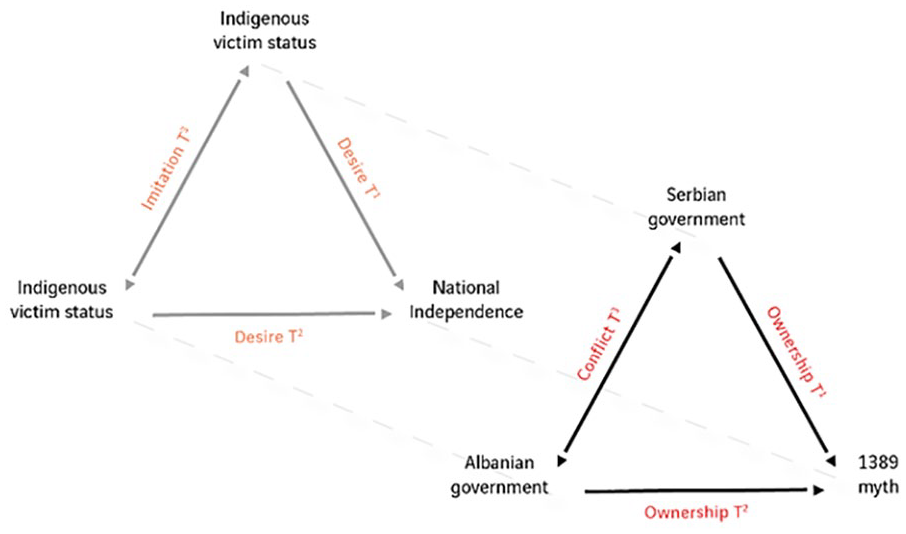
The Mimetic Shadow applied to the Kosovo case.a
The Kosovo Serb’s claims – and their broader nationalist discourse – in the early 1980s ultimately came to have a devastating impact on the cohesion of the SFRY. The start of the dissolution of the SRFY is indeed attributed to the remarks made by Milošević on a visit to Kosovo in 1987 (Judah, 2000: 53; Pešić, 1996: 33); speaking to a crowd of Serbs protesting against their treatment by Albanians, Milošević promised, ‘no-one has the right to beat you’ (Limani, 2017: 289). Thereafter, the fate of the Kosovo Serbs became a means by which Milošević rose to power; casting the Serbs – rather than the Albanians – as oppressed, and valiant guardians of the ‘cradle of Serbian civilisation’, Milošević presented himself as their protector, and indeed the protector of all Serbs, who – so the narrative went – had for too long been subjugated by other nationalities within the SFRY (Judah, 2000: 33; Pavković, 2001: 7).
As Milošević and the Serbian nationalists championed their nationalist cause – rather than adhere to the official Yugoslav ‘brotherhood and unity’ motto – other nationalities throughout the SFRY emulated the Serbs by articulating previously forbidden nationalist grievances and independence aspirations (Magas, 1992: 117). A cycle thus began whereby nationalists throughout the SFRY vied to assume the mantle of ‘victim’ in order to legitimise their separatist aims, and the use of force in so doing (Independent International Commission on Kosovo, 2000: 39; Mertus, 1999: 8). When Milošević rescinded Kosovo’s status as an autonomous province in 1989 – ostensibly to halt Albanian oppression of Serbs – this led to a dramatic revival of Albanian separatism within Kosovo, itself predicated on the claim that the Albanians were now the victims of Serbian oppression (Malcolm, 2002: 342–345). This ‘we are victims’ discourse continued throughout the 1990s and was employed to great effect by the KLA, culminating ultimately in the civil war (Judah, 2000: 135; Di Lellio, 2009: 7; Mertus, 1999: 110).
NATO’s justification for intervening in Kosovo in 1999 was explicitly premised on an acceptance of the Albanian’s claims to be victims of Serbian aggression (Bellamy, 2002; 157; Hehir, 2019a). There was, of course, much evidence to substantiate these claims, but of more relevance to the mimetic nature of the rivalry is the fact that in the aftermath of the intervention the Serbs immediately sought to (re)claim the mantle of victim (Dobruna, 2006a; Saggau, 2019). Indeed, since 1999 Kosovo’s Serbs – and the Serbian government’s official narrative – have emphasised the oppression they endure within the new Kosovo (Dragojlov, 2020; Newman and Visoka, 2019). Much like the Albanian’s claims to be victims won them international support in the 1990s, the contemporary Serbian victimhood discourse has affected traction on international opinion; Kosovo’s attempts to join certain international organisations – such as Interpol and UNESCO – have been thwarted by successful counter campaigns launched by Serbia claiming Kosovo’s Serbs are victimised by the Albanian-dominated government (Hehir, 2019a; Newman and Visoka, 2019).
Conclusion: Pursuing the same desires
We have argued that the concept of mimetic rivalry explains what traditional models of rivalry have only hinted at; how rivalries emerge and are perpetuated through a process of mimesis. While IR models primarily examined securitised rivalries, neglecting to examine how the rivalry becomes securitised, P&CS models conceptualised rivalry as an intractable form of difference-based conflict. In contrast, we argued that rivalry is mimetic-based and desire-oriented; it emerges through the generative mechanism of acquisitive imitation, rather than difference (Dupuy, 2002: 142). Eventually, the mimetic dynamic produces an altered rationality and identity. Fascinated by their rival and obsessed with acquiring the same status, resentful rivals may clash over one of more objects, but rivalry is never bound to them. So long as rivalrous desires guide their behaviour, rivalry persists, fed by new contentious objects and well-crafted narratives of extreme identity difference, the latter aimed at concealing the underlying similarity of desires.
We have additionally demonstrated that constructivist explanations of rivalry are accurate, but limited. Our mimetic approach endorses the constructivist view that rivalries are sustained by the wilful misrepresentation of history which perpetuates victimhood narratives and provide groups with the legitimacy to take extreme action against the aggressive ‘other’ (Mertus, 1999: 184). Yet, we go beyond this by explaining both why the manipulated narratives surrounding historical events are employed in a particular way, and by demonstrating how these narratives belie the underlying mimetic reciprocity of the rivalry. Constructivist accounts portray rivals as advancing different myths to bolster their antagonistic claims; in fact, reciprocal claims of extreme difference obscure the true nature of the relationship between ‘rivals’, one comprised of competition, but also fascination, and mimetic desire. Thus, rivals – in Kosovo and beyond – cast the shadow of the present on the past to create and sustain scapegoat narratives through the invention both of particular moments when the rivalry ostensibly ‘began’, and ‘victims’ related to these moments who thereafter become pillars of the new sacred, but fundamentally illusory, community identities.
We illustrated how this extended understanding of mimetic theory manifests in the rivalry between Serbs and Albanians over Kosovo, thereby providing a unique empirical illustration of mimetic theory in practice. As we demonstrated, the myth of the 1389 battle was reintroduced by Serbian nationalists in the 1980s as a means to justify a narrative regarding the plight of Kosovo’s Serbs and the need to respond to Albanian ‘aggression’ in a particular way. As forecast by the mimetic theory of rivalry, Albanians have sought to acquire that which the Serbs possess, and thus they advanced their own version of the myth. While the Serbian and Albanian versions present different ‘facts’ about 1389, these alternative accounts in fact derive from an identical desire among both groups to acquire the status they believe the other has. This is primarily orientated around a contestation over two key statuses; who ‘first’ inhabited Kosovo (and thus who is the ‘invader’); who is the victim of foreign intervention/subjugation (and thus who has the right to ‘retaliate’ in defence of ‘independence’). These are both central to the 1389 myths proliferated by each side, but crucially, each continues to serve as the basis for the contemporary rivalry. As such, the foundation upon which the rivalry is based and proliferated, remains; therefore, though the rivalry over Kosovo is no longer violent, so long as the underlying dynamic persists, new objects of rivalry will re-emerge, making the prospect of a renewed cycle of violence impossible to rule out
The persistence of this underlying dynamic is all the more remarkable given that Kosovo has been subjected to over 20 years of invasive international intervention and statebuilding, much of which was designed specifically to promote reconciliation between Serbs and Albanians (Hehir, 2019b). The failure of these initiatives, and the rationale which underpins them, serves as a salutary lesson as to the limitations of the current approach towards not just conflict resolution, but rivalry itself. The rivalry over Kosovo, therefore, demonstrates a much broader truth of significance to all those engaged in research on rivalries and conflict resolution; rivalries persist not because of difference but because of imitation. At the core of a rivalry there exists a desire on the part of the putative rivals to acquire what they believe the other has. This extends far beyond material acquisitions; this desire is, indeed, at its most insatiable with respects to status. This conflict over status so evident in Kosovo is not unique to the Serb/Albanian rivalry, and will be identifiable within other rivalries worldwide; identifying the precise statuses and desires which perpetuate other rivalries – as we have done here with respects to Kosovo – constitutes an array of important future research avenues for those who seek to fully understand – and ultimately resolve – contemporary rivalries and actual conflicts such as in Israel, Bosnia and Herzegovina, Ukraine, and Ethiopia. Ultimately, efforts to understand the true cause of rivalries, and to reconcile rivals in any given context, are futile if the dynamics of mimetic rivalry are not understood, and the specific desires over which the rivals compete are not identified and ameliorated.
