




Abstract
In Serbia, political elites have long propagated narratives of historical injustice and foreign hostility, strategically mobilizing victimhood as a framework for national identity. Promoted by the ruling regime to ostensibly restore pride, these narratives serve to justify foreign policy and obscure domestic dysfunction. But why and how do these narratives resonate? Drawing on original focus group data with university students, this article shows that university students across Serbia adopt victimhood not as a nationalist reflex, but to articulate intersectional marginalization across political, economic and generational lines. Victimhood, in this sense, is not just remembered – it is lived. Framed as a strategic ontological narrative, it functions as an interpretive lens through which they make sense of their vulnerabilities and exclusions. By rethinking victimhood in ontological terms, this article offers new insights into its emotional and political appeals. It also moves beyond simplistic explanations of victimhood’s resonance rooted in essentialized notions of Serbian nationalism.
Introduction
Victimhood is a political force to reckon with. From Russia to the US, strategic leveraging of positions, narratives and experiences of victims has become an effective method for mobilizing public support and justifying policies. As Gray and Kubin (2024: 143) argue, victimhood underpins moral orders as it prevents the most vulnerable from becoming victims of the more powerful. As such, victimhood has a strong unifying human function to bring people together in solidarity – or, conversely, deepen divisions. However, in today’s digital era, scholars caution against the rise of polarizing victimhood politics, noting how powerful actors ‘weaponize’ (Chouliaraki, 2024), ‘appropriate’ (Subotić, 2020) and ‘hijack’ (Barton Hronešová and Kreiss, 2024) the pain and stories of the vulnerable. Paradoxically, victimhood has transformed from a position of vulnerability into a tool frequently exploited by the powerful, using narratives, myths and conspiracies (Armaly et al., 2022). It has even become a source of immoral social practices (Cole, 2006), shifting blame, masking policy failures, scapegoating opposition and fuelling politics of fear and anger (Wodak, 2021). In this way, victimhood narratives can serve as a strategic means to advance political agendas that often have little to do with addressing the genuine harm experienced by victims.
The burgeoning uses of victimhood create a need to grasp it conceptually and empirically to understand its dynamics and appeals. While victimhood in certain contexts continues to serve as a pathway to justice, it is increasingly overshadowed by defensive politics and repurposed as a weapon for political attacks (Chouliaraki, 2024). To understand how victimhood functions through narratives, we must examine its sources and production as well as its audiences. This involves how victimhood is ‘forged’ as a set of ‘strategic narratives’ about the past, present and future (Miskimmon et al., 2017) and how and why it resonates. While most of the existing literature on victimhood focuses on the production of victimhood either in post-war and transitional contexts or as a tool of populism in the West, there is a dearth of knowledge about its public appeals and dynamics in situations where the transitional and populist intersect. Yet, without understanding resonance in complex settings, we cannot fully comprehend the growing power of victimhood.
To fill these gaps, this study focuses on a case of contemporary victimhood politics par excellence – the case of Serbia. Since the 1980s, elite and public discourse in Serbia has hinged upon narratives of unjust historical oppressions (Dragović-Soso, 2002), narratives of Western domination and the need to protect Serbia from multifaceted threats. Such narratives are rooted in Serbia’s history of resisting Ottoman domination, Nazi oppression and the 1990s atrocities, while also reflecting contemporary debates on international recognition and the perceived injustice of Kosovo’s loss. As such, victimhood functions as the foundational theme of national political mythology. Yet – as I argue here – victimhood also acts as Serbia’s strategic ontological narrative framework, as a politically crafted understanding of Serbia’s past and present that provides a ‘basis upon which normative assessments’ are made (Lerner and O’Loughlin, 2023: 5). Stories of suffering and maltreatment belong to strategic ontological narratives that shape and define the fundamental nature of reality. They are ‘ontological’ because they influence how people understand who they are and their place in the world, and they are ‘strategic’ because they are constructed and mobilized to achieve specific goals. In Serbia, victimhood represents a framework of an amalgam of strategic ontological narratives, which shape how individuals interpret their experiences and perceive reality.
While vigorously propagated by the Serbian ruling elite, how does victimhood appeal to the public? In particular, how does it resonate among the most cosmopolitan and – arguably – educated sections of Serbian society, its university students? Focusing on young people is a reasonable place to start to understand the power of victimhood. Generational change not only brings more inclusive views and emancipatory values (Welzel and Inglehart, 2009) but also distance from past traumas. In Serbia, students have historically been important drivers of change, notably playing a pivotal role in bringing down the regime of Slobodan Milošević. At the time of writing in early 2025, they are once again at the forefront of a social movement advocating for the rule of law and justice. Understanding Serbian students’ worldviews is thus a highly consequential endeavour. Yet, existing studies present a mixed picture, with some highlighting the ‘radicalization’ of Serbian youth due to nationalist public discourse (Taleski and Hoppe, 2015), while others point to non-ethnic identifications (Trost, 2017). While some recent survey research suggests that the younger generations know little about Serbia’s role in the break-up of Yugoslavia and myopically focus on war crimes committed on ethnic Serbs (Ivanović et al., 2024; Jovanović, 2023), surveys rarely unpack the whys and hows of such positions. Using focus groups with undergraduate and graduate university students across disciplines and across Serbia in 2021, I study these wider dynamics of victimhood and its resonance.
As I argue, the respondents generally adopt victimhood as an explanatory framework; however, they do so for reasons that reach beyond national exculpation and pride that have been promoted by Serbia’s elites and in the public sphere. Instead, victimhood enables them to articulate intersectional marginalization grounded in political, intergenerational, socio-economic and geopolitical inequalities. Such ‘intersectional victimhood’ captures the precarities of and exclusions from social and political affairs that the respondents report, offering deeper insights into foundational ontological narratives. Moreover, I demonstrate that victimhood resonates not because of support for nationalist politics in contemporary Serbia per se but due to young people’s complex personal trajectories, socialization and experiences. By framing victimhood as a response to intersectional inequalities, I move beyond simplistic explanations rooted in essentialized notions of Serbian nationalism.
Victimhood as a strategic pursuit and ontology
Since the 1970s, the ages of ‘regret’ (Olick, 2007), ‘apology’ (Gibney et al., 2008), ‘witness’ (Wieviorka, 1998) and ‘memory’ (Pisanty, 2019) have been accompanied by the ‘age of victimhood’ grounded in social recognition of vulnerability (Towle, 2018). With the proliferation of human rights, victims of crimes, wars and violations of rights have started featuring in politics as vocal and morally important actors, notably in transitional justice (Druliolle and Brett, 2018), memory politics (Olick, 2007) and international affairs (Lerner, 2022). In politics, victimhood has operated as an experiential and discursive construct – one that is often strategically leveraged to achieve political or social objectives (Horwitz, 2018; Vandermaas-Peeler et al., 2022). The rise of digital technologies has amplified this dynamic, creating ‘echo chambers of popular resentment and collective grievance’ (Chouliaraki and Banet-Weiser, 2021: 4), which has allowed for the strategic weaponization of victimhood narratives by powerful actors (Chouliaraki, 2024). Right-wing actors, in particular, have integrated victimhood into their foundational playbooks, intertwining fears over national self-understandings and historical traumas, and rewriting histories to ensure national ontological securities (Ejdus, 2020; Steele, 2008; Zarakol, 2010).
Victimhood, in this sense, can be expressed more than claims to injury – it can be deployed via ontological narratives to form a deep interpretive framework that reconfigures how subjects, objects and relations in politics are imagined and experienced. These narratives shape who ‘we’ are (e.g. a wounded nation), who ‘they’ are (e.g. external aggressors or internal traitors) and what is at stake (e.g. survival, justice, sovereignty). As ontological narratives, they provide a stable sense of self amid uncertainty and perceived threats. Importantly, while such narratives are experienced as ‘true’, they are also malleable – adaptable to shifting political needs and capable of being deployed strategically. Thus, while victimhood narratives may be strategically employed, they are not merely fabricated. Grievances born of war, forced displacement, or territorial loss are real and transmitted through memory, emotion and – importantly – narratives.
In settings saturated with such narratives, interpretive frameworks like ‘collective conspiracy’ or ‘siege mentality’ often arise, fostering beliefs that the group is perpetually under threat from external forces, leading to a state of constant vigilance and hyperscepticism (Bar-Tal, 2013; Bilewicz, 2024). This can hinder efforts for developing inter-group trust and reconciliation. Similarly, polarization can arise from competition over victim status, where groups vie for recognition of their suffering and claim ‘exclusive victimhood’ (see also Szabó, 2020). Yet, those who have experienced violence can also demonstrate more inclusivity and compassion than the wider population (Shnabel et al., 2018), highlighting the complex power dynamics inherent in the practice and dynamics of victimhood. Herein lies the double-edge nature of victimhood: identifications with victimhood can either unite various victim groups in solidarity or deepen societal polarization. Victimhood is thus an intersectional phenomenon that consists of a set of ontological narratives, which are often shaped and strategically mobilized by political elites to justify and guide state affairs (see Lerner and O’Loughlin, 2023). Both political and social actors can use it strategically, utilizing narratives of suffering, harm and other discursive methods as a normative basis to justify political actions.
Following from this, engaging in victimhood politics first necessitates some experiential basis with sources of harm – victimization. These can range from experienced traumas, historical narratives of collective suffering, to a sense of marginalization and even ‘misrecognition’ that manifests as ‘the gap between an individual or a group’s desired identity’ and how they are ‘seen by others’ (Adler-Nissen and Zarakol, 2021: 614). Second, victimhood is a relational concept (Gray and Kubin, 2024): it inherently requires a hierarchy of actors, involving the establishment of victims, perpetrators and other participants, even if these roles remain unnamed or implicit. Victimization needs to be attributed to perpetrators and victims. Finally, victimhood can be used to ‘elicit particular behavior’, ‘influence development of policies’ and justify political positions through strategic narratives, ordered stories about relationships in the past, present and future (Miskimmon et al., 2017: 1–4).
Depending on the constellation of the sources of harm and the actors within a system, victimhood can be used to attain specific objectives – such as justice, truth, empathy, recognition, policy or to undermine the opposition. While individuals and groups claiming victimhood may do so to make sense of their experiences without any strategic intentions – as a coping mechanism – in the public domain, victimhood is generally communicated out of utility (even if that utility is the prevention of similar harms for the future, the familiar ‘never again’). The aim may be for victims to be recognized and legitimized (by authorities or external actors), to change wider ontological understandings of morality (understandings of right and wrong norms within a society), to justify policies or to wield accusations of victimization against opposition or the out-group (e.g. cast them as victimizers or traitors). Claiming victimhood strategically means to change ontological understandings of the collective self, change positions of moral superiority of in-groups and/or justify policies.
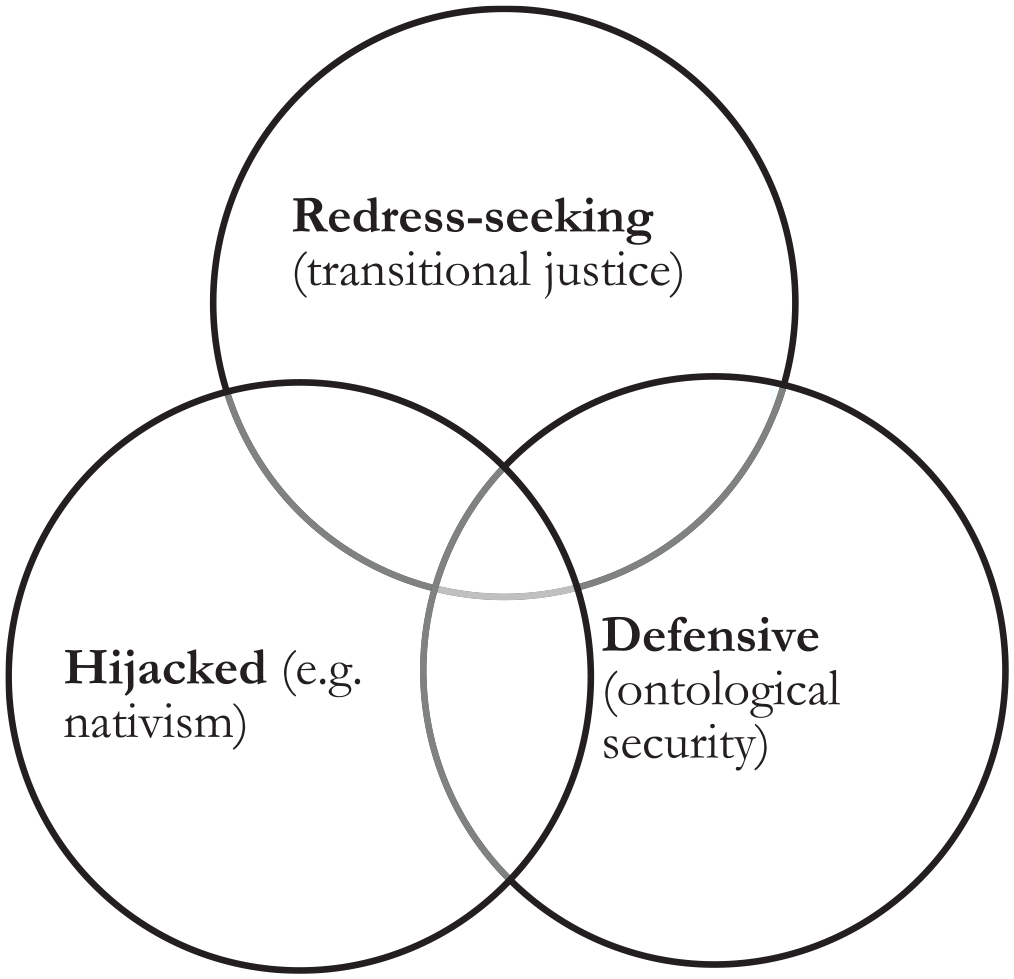
I conceptualize strategic victimhood as a framework of ontological narratives that consists of three utilitarian aims (see Figure 1), which intersect and shift over time and context. First, victimhood claims may be linked to educating the wider public about the past, prosecuting perpetrators and seeking redress and rights such as reparations. They are often pursued by the vulnerable (victims) and their defenders, commonly through mechanisms of transitional justice (e.g. civil society, see Barton Hronešová, 2020; Druliolle and Brett, 2018). Second, public usage of victimhood may also be based on the defence of narratives of injustice and wrongdoing, which may be indirect and transmitted across generations, especially in cases where such victimhood is poorly recognized externally (Barton Hronešová, 2022; Bilewicz, 2024). Here the main objective is an anchoring of a sense of ontological security and a stable identitarian understanding of the collective self, which may be (but may not be) connected to ideas of national pride (Ejdus, 2020). Finally, strategic victimhood may also be based on an inverted positioning of the claimant’s agency through ‘hijacking’ positions of groups marginalized within a context and weaponizing vulnerability of victims (Chouliaraki, 2024). Unlike defensive victimhood, which does not inherently appropriate suffering of others and is commonly driven by a yearning for recognition, ‘hijacked victimhood’ seeks to diminish (or deny) victimhood of others too (Barton Hronešová and Kreiss, 2024). It often contains hate speech against others such as refugees or non-nationals and expressions of nativism.
Strategic victimhood (utilitarian logic).
Nonetheless, as motivations of actors are inherently difficult to ascertain and are rarely driven by one factor, various types of strategic victimhood narratives overlap. Therefore, these varieties are not discreet but co-exist. As I show next, Serbian political elites have strategically elevated victimhood to an ontological framework, using a variety of narratives that hijack victimhood of others, seek recognition for collective suffering in Serbia as a defence of victimhood, and only rarely ask for redress for victims. For any political goal, victimhood can be mobilized through different narratives – many of which already exist in the wider pool of victimhood narratives. Consequently, a narrative’s position in Figure 1 depends on its structure and objectives. For instance, the narrative surrounding the loss of Kosovo shifts between defensive and hijacked victimhood (rarely redress-seeking), depending on political utility and purpose. Its salience can also be strategically heightened, as seen during Aleksandar Vučić’s rule, where Kosovo emerged as a key existential issue in public opinion polls (Bjeloš and Elek, 2021).
Strategic victimhood in Serbia
Serbia, with an ample range of grievances linked to violence and injustice, provides a suitable setting to study the varieties of victimhood as an ontological framework that is leveraged strategically. The existing scholarship demonstrates a sense of Serbian ‘perennial victimhood’ at the hands of foreigners and historical occupiers – be they ‘Turks’, Germans or – increasingly – the ‘international community’ (see, for example, Čolović, 2002; Jovanović, 2014). Historical narratives of collective suffering have been strategically disseminated in public while discussions about non-Serb victims and their victimhood have been muted (Djureinović, 2021; Ejdus, 2020; Golčevski et al., 2013; Subotić, 2019). Especially since the rise of Aleksandar Vučić and his Serbian Progressive Party (SNS) in 2012, 1 the discursive focus has been on the lack of recognition of Serbian suffering and the need to push back against accusations of guilt and crime perpetration. The current semi-authoritarian regime of Aleksandar Vučić has skilfully utilized the existing traumas, resentment towards perceived stigmas and scepticism of the West, and advanced strategic narratives of Serbian victimhood as unfairly forgotten and unrecognized, in need of defence but also belittling the victimhood of others. Through its centralized media control, the regime’s political communication has relied on the defence of Serbia’s honour and recognition of its past suffering but also forcefully hijacking positions of the most vulnerable victims. Serbian victimhood has thus consisted of a set of narratives, disseminated in presidential media appearances and across the pro-regime media.
The first aim is to defend the recognition of Serbian suffering and show an unfair treatment of Serbia, that is defending victimhood. The 1990s wars in the former Yugoslavia – while predominantly waged outside of today’s Serbian territory – were accompanied by hard-hitting economic sanctions and territorial changes. While Yugoslavia was on the brink of economic collapse already in the late 1980s, the subsequent wars have ruined its economy (Djokić, 2023: 501). Additionally, over 200,000 ethnic Serbs were expelled from Croatia during the US-aided Operations Flash and Storm in 1995. The 1999 NATO strikes on Yugoslavia resulted in massive infrastructure damage and the deaths of 452 civilians, 206 of which were of Serbian or Montenegrin nationality (Stakić, 2022). Kosovo’s secession from Serbia – the gradual process lasting from the 1980s to Kosovo’s 2008 declaration of independence – has been felt as a particularly unjust loss. By 2008, 71 percent of Serbs reported ‘siege mentality’ (Ejdus, 2020: 107). Evidently, these victimizations have some legitimate experiential basis that the regime deliberately leverages in the public sphere without providing any context to what preceded this devastation.
The official discourse presents these victimizations myopically, inflating Serb casualties, shifting blame to others and silencing stories of non-Serb victimization. The 1990s wars dominate the public discourse with a clear focus on the suffering of Serbs and the erasure of non-Serb victims in Kosovo, Croatia and Bosnia and Herzegovina (BiH). The hegemonic narrative about Yugoslavia’s break-up is that the ‘West’ (especially Germany) benefited from the wars and economically ‘colonized’ the region. While Serbs were certainly victims of the 1990s violence too, the gravest crimes were mostly committed on non-Serb groups outside of Serbian territory (see Cohen and Dragović-Soso, 2008). Places connected to major war crimes by (ethnically) Serb groups – such as the genocide of Srebrenica – are repeatedly minimized by equivalencing them with places of atrocities on Serbs such as Jasenovac 2 or simply denied (Gordy, 2013). Similarly, Operation Storm is portrayed as ‘a pogrom’, implying equivalence between Serbs and persecution of Jews (Djureinović, 2021: 28). The 1999 NATO strikes are called an unprovoked ‘aggression’ where Russia sided with Serbia and casualties are inflated (Fridman, 2016).
Most prominently, Kosovo’s independence is presented as a ‘theft’ of an integral Serbian territory (Ejdus, 2020). Moreover, although Kosovo’s recognition de facto conditions Serbia’s accession to the European Union, five EU members do not recognize it, leading to accusations of hypocrisy. Both the strikes as well as the subsequent independence of Kosovo have been granted a sui generis status in international politics (Ker-Lindsay, 2010), naturally leading to disgruntlement from Belgrade to Moscow (whose veto of the strikes was ignored). While it is reasonable to debate the legality of the strikes and the casualties, the Serbian regime has combined its pursuit for recognition of the problematic legal nature of the strikes with hijacking the events as Serb martyrdom and marginalizing both non-Serb victims and the pretext to the strikes. Indeed, the victimhood narratives stemming from Kosovo have become key mobilizing tools for the regime that has been effective in its foreign policy (Ivanov and Laruelle, 2022). Since Russia’s full-scale invasion of Ukraine in February 2022, the regime’s media have also started using analogies between crimes in Ukraine and Kosovo. The aim has been to suggest that, just as Western media allegedly exaggerated events in Kosovo to demonize Serbia, they are doing the same with Ukraine. For instance, when reports of war crimes in Bucha, near Kyiv, surfaced, Serbian tabloids labelled Bucha as ‘another Račak’, 3 implying that it has been staged to demonize Russia (Bandović, 2022).
Positioning Serbia as an unrecognized victim, unfairly demonized and reprimanded by Western actors, enables the elites to externalize guilt for past actions and domestic failures, such as economic struggles and corruption. It also allows them to dismiss Western criticism as hypocritical posturing by former colonial powers. As such, the Serbian strategic ontological narrative framework of victimhood efficiently debunks external criticism and justifies policy choices, including an inflated emphasis of the importance of economic relations with Russia (which pale in comparison to the EU), cultural affinity with Russians and business ties with China (which are indeed strong). It combines defensive and hijacked victimhood, although there are some instances when transitional justice is called upon to seek redress for Serb victims (e.g. families of the killed during the bombing).
Resonance of victimhood: Intersectional inequalities
How and why does it resonate among the public, if at all? Specifically, how do young students – a key demographic with a stake in the future – understand it? University students are particularly significant, not only in Serbia, where they have led mass protests since 2024, but also more broadly as future leaders whose views and understandings shape societal directions. Students are also prime targets of institutionalized victimhood narratives through museums, curricula and policies, and already have a well-established sense of identity, worldviews and experiences. Current Serbian students also only have indirect experiences with the 1990s. Additionally, they have broader access to diverse resources and are more likely to seek independent understandings of the past (Petersen and Merunka, 2014) as a more progressive and digitally connected generation (Duffy, 2021), which may make them less susceptible to rigid, defensive, or hijacked victimhood narratives.
The groups at study were students of the post-1999 ‘generation’ – between the ages of 19 to 30 – who have limited or no recollections of the pre-1999 period. They were invited to take part in focus group discussions (FGDs) as a useful method to understand how meanings are made collectively. Rather than isolated opinions, FGDs allow for sense-making in an interactionist fashion (Hollander, 2004). They are also well-suited for complex topics that participants might feel reluctant to discuss individually but can be prompted by ‘braver’ individuals (Cyr, 2019: 19). Group dynamics allows reflection on circulating public narratives on difficult, emotional topics such as victimhood. When conducted online, FGDs are a convenient method when fieldwork is challenging due to travel restrictions. However, FGDs have limitations, such as social desirability bias and issues of anonymity during the debate, and the forced nature of discussion may omit some topics. These limitations were managed by sensitive approaches to communication.
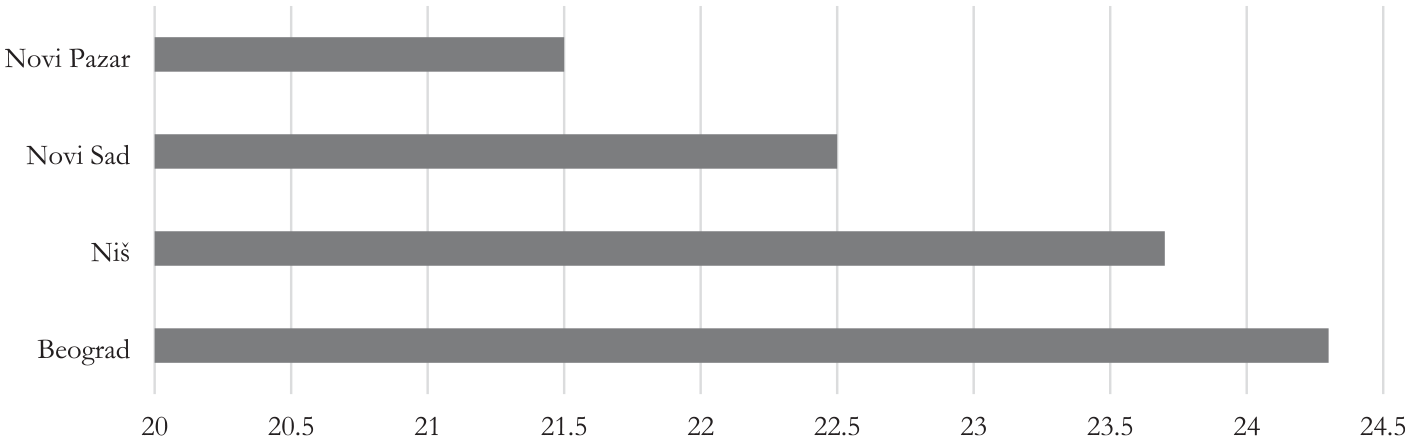
The data collection took place online at the tail end of the COVID-19 pandemic in 2021. Participants were recruited by the local research organization CESID from students of both SHAPE and STEM fields (equally represented) from universities in main Serbian cities (Belgrade, Novi Sad, Niš Novi Pazar) and incentivized by approximately €25. While Belgrade is the intellectual and economic hub of Serbia, this study was interested in resonance across the country and included smaller universities such as in Novi Pazar where there is a Muslim community. While there are discrepancies in the mean age of the groups (see Figure 2), this study was interested in group outlooks rather than regional differences. 4 Each group consisted of six students of various ages, genders and fields of study. In total, 30 students participated (see Appendix 1 online). 5 Students were asked to choose names to be used during the discussion, but these names were later pseudonymized in the transcripts and the analysis, though I have chosen equivalently symbolic names, for example, opting for Bakir to denote the fact that he identified as Muslim.
Groups by location and mean age.
The discussions were structured and guided by a script (see Appendix 2 online). Questions focused on students’ views about victimhood, injustice and Serbia’s politics and history. A pre-selected Serbian moderator (via the organization CESID) led the discussion to avoid a perceived foreigner (myself) to increase the chances of social desirability bias. The discussion started with associations regarding the term žrtva/pozicija žrtve (victim, victimhood), before moving to more political and historical topics in generic terms. There were no specific names of crimes or places mentioned in the questions. Despite the lack of concreteness, the students would inevitably turn to the main victimhood narratives discussed above. After the focus groups, I transcribed and translated the recordings and thematically analysed them with the help of NVivo according to victimization, victimhood types and main arguments for the resonance of victimhood (see Appendix 3 for codebook online). The coding followed the conceptual framework developed in section 2 above as well as the script, focusing on instances of various types of victimhood and victimizations.
Victimization and actors: Sources and the relational aspects of victimhood
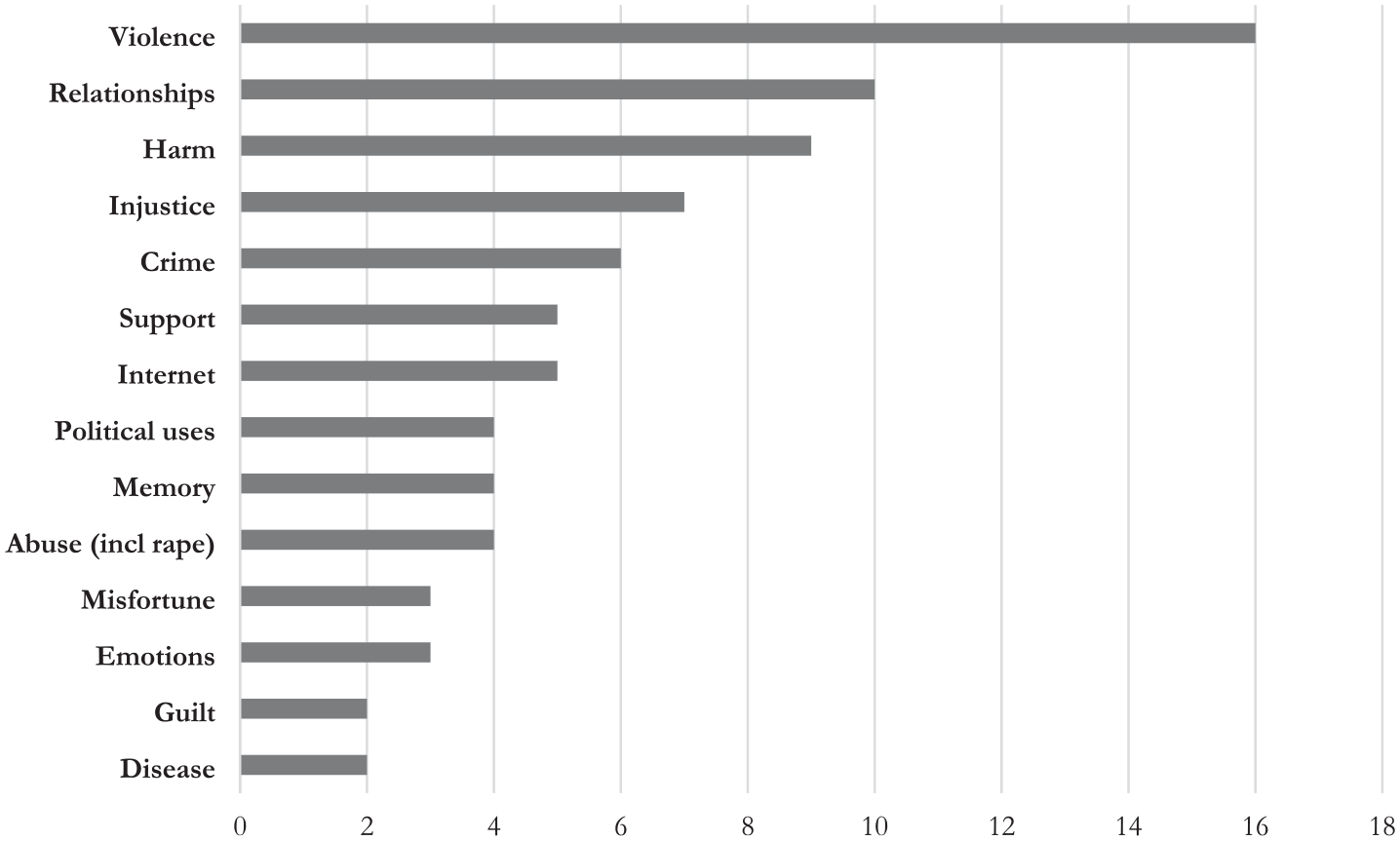
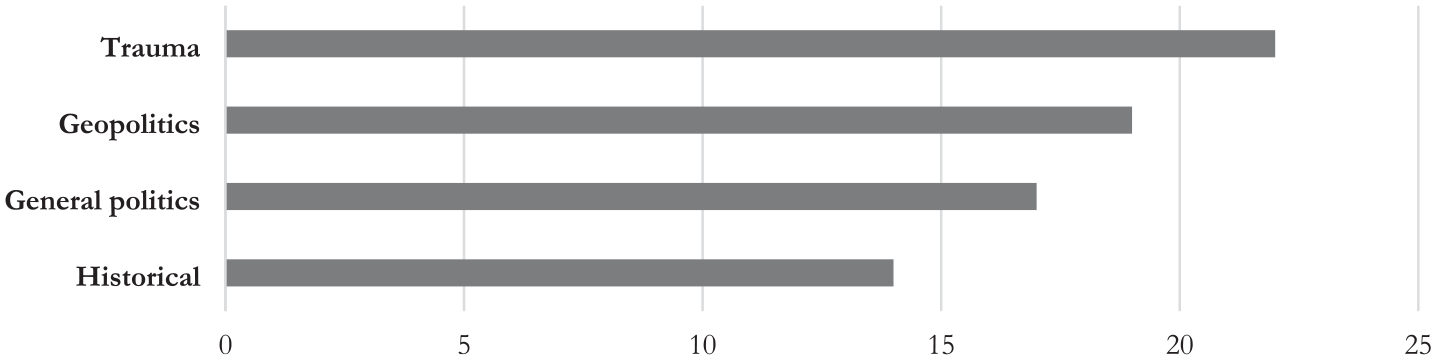
The first associations students had with the term victimhood were linked to violence, harms and injustice but also relationships between abusers/attackers and victims (see Figure 3). Strikingly, 80 percent of all respondents identified as victims of multi-levelled injustice and as ‘victims of the system’, that is politics that marginalizes and excludes them. In other words, being a victim was a key part of their sense of self. The main types of victimization were personal (rather than collective) traumatic experiences, geopolitics and politics in general (see Figure 4). Importantly, victimhood based on history without any links to personal experiences and politics was less common. As Sasha from Novi Sad put it: ‘we are victims of corruption rather than wars’. However, some students highlighted that the current situation was the result of the 1990s, which cannot be separated from their daily struggles – offering a reinforcing set of grievances. Both individuals as well as Serbia collectively were marked as victims – even if comparable to others in the region and other ‘small states’ (see below). Students named the West, ‘Great Powers’, NATO and the USA but also Kosovo as the key victimizers. Such notions extended beyond the 1999 bombing and encompassed current international approaches towards Serbia, with two-thirds of students agreeing that the West treated Serbia disrespectfully – a common trope in the public sphere, thus creating fertile ground for the resonance of defensive victimhood.
First associations with the term victim and position of a victim (victimhood).
Main mentioned sources of victimization.
Importantly, respondents presented personal victimhood as a relational concept ‘based on unfair use of power over other people’, as a ‘relationship between strong and weak’ and ‘those who have and do not have money’. Inequalities of social, political and economic character featured prominently. For example, a student of sociology from Belgrade noted that victims are always in inferior positions, later implying that Serbia was in such a position too. Once discussions turned to collective victimhood, a philosophy student from Niš noted that victimhood is ‘a social status of the whole society in relation to the world system’. Serbia as a ‘victim of the world system’, ‘victim in a geopolitical sense’ and ‘victim of politics’ were the most common answers to whether and how Serbia has ever been a victim. Notions of victimhood from a world-system perspective where Serbia was located at the (semi-)periphery was mentioned in all groups but in Novi Pazar, suggesting a strong empirical basis for notions of crisis of the liberal world order (see Bilewicz and Liu, 2020). This would suggest that the historically framed victimhood tropes (e.g. linked to World War II) disseminated by the regime have been less resonant than assumed; however, the personal associations and the top-down critiques of the international order struck a chord.
The importance of recognition and responsibility
In parallel, defensive victimhood clearly resonated: students frequently cited a lack of recognition of Serbian suffering (18 out of 30), particularly the 1999 bombing and the loss of Kosovo. As Dimo from Novi Sad remarked, ‘we would feel better as a nation if someone took responsibility for it [the bombing]’, denoting a yearning for recognition. Especially outside Belgrade, Serbia was seen as at the behest of more powerful countries that have victimized it through violence and territorial losses. But, even in Belgrade, the idea that ‘we as citizens [of Serbia] were victims of really bad policy of Great Powers in the 1990s’, as Ilja, a doctoral student of politics, put it, resonated. Kata from Belgrade noted that ‘the question is how plausible it is for a small Balkan state – that once used to be larger – to actually self-manage its politics, without doing what G8 and others tell us’, hinting both at the loss of ‘past glory’ and the ‘misery of the small nations’ idea present in the region for at least a century (see Adler-Nissen and Zarakol, 2021; Barton Hronešová, 2022). Bakir from Novi Pazar even claimed that Serbia was so weak in the 1990s that it ‘could never have harmed anyone’, effectively implying a form of absolution from guilt.
The 1999 bombing was the most-mentioned narrative of Serbian victimhood, again framed in terms of personal traumas. Ilja was deeply influenced by the 1999 bombing: ‘the emotional reaction to all these events [1999] over the years created a feeling in me that I was a victim of something – although in a collective sense.’ He also added that ‘everyone probably went through hiding in basements and shelters’, leading him to ‘identify as a victim of something that I had nothing to do with’. Ilija entertained many dubious theories about the past in Serbia, and later described Serbia as wrongly accused of war crimes and violence that other countries and ‘some individuals’ have committed, starting an animated discussion about responsibility, showcasing common denial strategies of individualizing guilt (see Gordy, 2013). However, his interventions also illustrated the intersections of traumatic memories and resentment toward the current world order. He combined defensive and hijacked victimhood in many of his assertions as an ontological framework.
The events surrounding the territorial loss of Kosovo were the second most prevalent victimhood narrative that cut deep into the students’ ontological understanding. Andjelka, a 23-year-old management student in Belgrade, reflected on her time as a child refugee from Kosovo. She saw these events as the outcome of the politics of a small country that cannot ‘lead politics the way it wants to’ due to its size. With the rest of the group, she noted that history must be learned properly to understand both the scale of suffering of Serbia as well as that of others, stressing how little her generation has been taught about it. Also, Marina, another child refugee from Kosovo, was affected by being called a shiptar (a derogatory term for Albanian) in Belgrade and empathizing with Serbs ‘living under terror’ in Kosovo, referring to the current political tensions in northern Kosovo. Yet she mainly blamed Serbian leadership rather than external actors, seeing Serbia in a ‘historically interesting’ position on the crossroads of ideologies and noting that ‘we have degraded ourselves through history.’ In these experiences, there was a palpable yearning for recognition of the pain, which ranged from Miro’s appreciation of Donald Trump’s ‘apology’ for the 1999 bombing (which in fact never happened but was falsely reported in Serbia) to Kata’s grievance that Serbia always becomes ‘collateral damage’ and is ‘never taken seriously’. ‘We were an experiment of these bombs and this Western system’, Dimo noted, clearly upset about the lack of responsibility for the harm of 1999.
Victimhood was also defended to counter accusations of collective and intergenerational guilt. ‘It is bad to assign collective guilt’, Aleksandra from Belgrade said, feeling hurt that she is still being labelled as responsible for Serbian crimes of the past. ‘We have not bloodied our hands with war’, another student from Novi Sad asserted. Ilja berated the sanctions of the 1990s, arguing ‘you cannot punish a whole people for crimes of their political elites’, thus fully rejecting any notions of co-responsibility for regime selection. Five students were ready to take responsibility ‘for politics today but not for the past’, as Lazar, a doctoral student of politics in Belgrade asserted. Interestingly, he also added that he has become more ‘right-wing’ as a reaction to the pressures by pro-Western organizations to atone collectively, which he saw as ‘counter-productive’ and antagonizing, hinting at the dynamics of a backlash. Therefore, while collectivizing Serbian guilt was resisted (that is, only some Serbs are guilty), collectivizing Serbian victimhood was mostly accepted.
Only one student understood victimhood as a redress-seeking tool rather than a generalized identity position. To Tea, a 23-year-old sociology student from Belgrade, victimhood should be claimed as a tool of justice for those affected by violence. She also took a radically different view from her peers by refusing to see Serbs collectively as victims: ‘Serbia actively participated – financed and economically influenced its development . . . I do not think that we as periphery are victims of the center because we participate in those or even allow these events to happen, through our politics’, she explained. Despite her opposing views from the rest of the group, it was striking how respectful the discussion that followed was, in contrast to the often charged public debates. Overall, it was defensive victimhood that resonated as an ontological framework and the students clearly adopted many of the strategically leveraged narratives of the current regime, especially those related to Kosovo and 1999.
Conspiracies and mal-intent
While defensive victimhood dominated, there was a large minority – a third of all respondents – who essentially hijacked victimhood of other groups. While most of the respondents clearly opposed Aleksandar Vučić politically, a dozen students mimicked the dominant language of relativization and denial when describing past conflicts in the region of the 1990s, which the current regime propagates. They also aligned with assertions that the West was ruining the local traditional way of life, a common practice of right-wing East European elites that has animated much of the political discourse in Hungary and Russia in particular (Enyedi and Whitefield, 2020; McGlynn, 2023). As Sasha from Novi Sad noted, ‘Western ideas and way of life have a devastating and degrading impact on education, culture, tradition and economy in this region.’ Mentioning Christian Orthodoxy, he further asserted that Russia represented a bastion for traditional values, a common rhetoric among radical right-wing politicians. Similarly, during discussions about Kosovo, there was a prevailing agreement on equivalence that ‘as much as Kosovo hurt us, we hurt them’ as Nela from Novi Pazar put it and that ‘everyone committed crimes’ as another student noted when the discussion turned to war crimes. Isabela even suggested that ‘Kosovo victimizes us to get independence and into the EU’, shifting the blame for the current political impasse over Kosovo squarely on Prishtina.
Discussing the full-scale invasion of Ukraine in 2022, Miro, a 26-year-old philosophy student from Niš with a tendency towards conspiratorial thinking, explained Serbian siding with Russia as follows: We will never forget the innocent victims, the little children, that NATO killed in 1999 because we defended ourselves against Albanian terrorists. NATO bombed Serbia without the consent of the Security Council and killed thousands of innocent people for no reason.
His statement clearly repeated key tenets of Aleksandar Vučić’s annual commemorative speeches of 1999 that focus on dead Serbian children (whose numbers are inflated) and the usage of the term ‘terrorists’ (Čongradin, 2022). Although students acknowledged their limited knowledge about the events of the 1990s, most agreed that international law was violated, Serbs in Kosovo suffered and Kosovo’s independence was unjust.
The term ‘genocide’ was most contested. The issue of genocide and the lack of recognition of the term is politicized, particularly regarding Srebrenica. While Serbian elites deny responsibility for genocide in Srebrenica, they argue that Serbs have been the main victims of genocide, stressing the Jasenovac camp during World War II and the political oppression of Serbs in Kosovo. Only three students – Tea, Stevan and Lazar – explicitly accepted the label genocide to describe the massacre of over 8,000 Muslim men in Srebrenica in July 1995 by the Bosnian Serb army. There was no question in anyone’s mind that a crime was committed. However, the qualification of the crime was discussed as a matter of opinion rather than investigations. Three students argued that the number was ‘too low’ to qualify as genocide while two others noted that when ‘only’ men were killed, it could not have been genocide, again repeating some of the top-down discourse. ‘The injustice we suffer is the genocide in Srebrenica’, Ana from Belgrade noted, adding ‘a genocide is a destruction of a people and the destruction of 8,732 victims is not an ethnic destruction of a nation.’ She further stated that, unlike Turkey’s killing of a ‘million and half Armenians’ and Croatia’s camps for children during World War II, Srebrenica ‘was not genocide, I know as much’, refusing to be associated with that label but being able to cite the exact number of victims. As Tea later explained, ‘we may not know what happened, but we most certainly claim to know what didn’t.’ The students thus mimicked the official strategies of denial that have been well studied previously (Gordy, 2013).
Importantly, Srebrenica was conceived as part of a wider global injustice on Serbia, a political game (igrarija) and a conspiracy. Ivica argued that ‘some things [about Srebrenica] were inflated precisely because of Kosovo . . . Serbia is presented as aggressor around the world.’ Among the students who were highly sceptical of any sources of information, there was a belief that genocide was ‘imposed’. ‘We should not accept the imposed label of genocide and the numbers’, Mila argued. As Milan noted, ‘there are more people in the big countries who claim it is genocide than those who say it was not but we are small so no one listens to us.’ Ilja suggested that Yugoslavia fell apart due to ‘interests from the outside’ – a common public narrative – and that the 1999 bombing was ‘attempted genocide’ because of the use of depleted uranium, implying its intentional deployment for its alleged carcinogenic effects. ‘We do not act in the way that the Great Powers want us to . . . And we do not accept what they impose on us and that is why we suffer’, said Kata from Belgrade. This was an expression of a well-researched sentiment that Serbia has refused ‘to toe the line’ (Djokić, 2023: 518) and has thus been punished for it. A sense of being demonized and punished for defiance thus resonated.
In these discussions, the victims of the Srebrenica genocide and other crimes of the 1990s became abstract and unnamed, reduced to ideas rather than individuals with families. Their victimhood was also reframed as part of a conspiracy to demonize Serbia. In May 2024, when the UN General Assembly considered a resolution to commemorate Srebrenica, Serbia’s government launched a nationwide campaign under the slogan ‘We are not a genocidal nation’, reinforcing narratives of external malice and collective demonization. 6 Given that conspiracy theories offer a sense of certainty, control and group-based identity, it is unsurprising that these narratives resonated, reinforcing a perception of historical repetition and analogies. Considering Serbia’s complex history, such conclusions may be understandable: as Johana from Novi Sad noted, ‘the first thing we learn is that history repeats itself, especially here’, implying a cycle of recurring conflict and victimhood.
Left behind
As the previous sections outlined, most respondents identified as victims, showcasing the ontological significance of victimhood and thus its applicability as a strategic political resource. Victimhood’s resonance, though, must also be understood as an expression of precarity. As Tea – who often dissented – explained, she understands why victimhood appeals to her peers as it provides explanations of why their lives are difficult. While most respondents generally identified with what sociologists denote as progressive values when discussing gender, there was also a clear strife for more traditional (and basic) values such as security. When faced with a hypothetical choice between ‘two Serbias’ whereby Serbia 1 is based on a fairly stable economic performance and security (though not exceptional performance) but where citizens cannot live freely and have limited ability to choose political representatives, and Serbia 2 that is based on full political rights, but where the economy and security depend on electoral outcomes (hence its performance will vary), 30 percent of the interviewed students opted for Serbia 1 (see Figure 5). Notably, students with high levels of scepticism towards the West opted for Serbia 1, stressing the need for stability as the main motivating factor. Expressing mistrust of both domestic and external authorities, Milan noted neither option was good, but Serbia 2 is worse as it would pave the way for ‘the EU and the US to meddle in our affairs’, again reinforcing the deep scepticism towards external actors in the West.
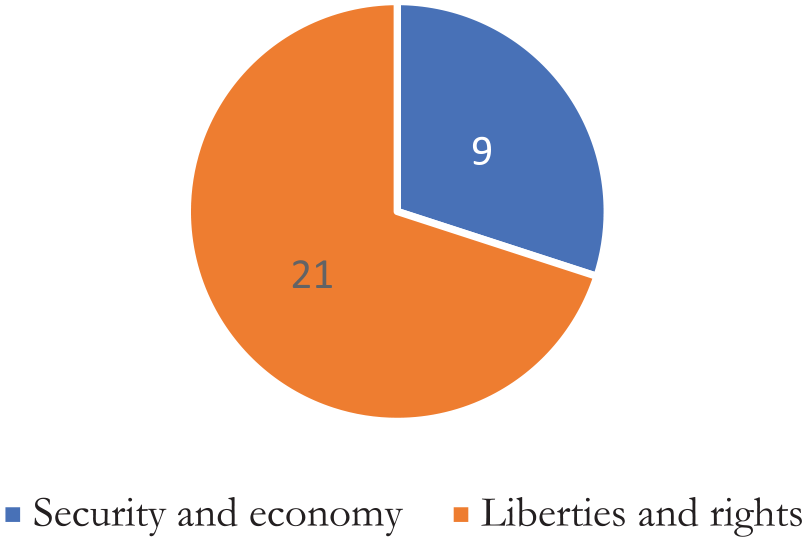
Preferences when choosing key features of political regimes (N = 30 students).
Importantly, all respondents exerted staggeringly low levels of trust in authorities and the media, largely citing personal contacts and social media as more accurate sources of information – a common source of knowledge reported in much of the survey research in the region (Jovanović, 2023). Most agreed that they trusted personal contacts and experiences. Notably, one student argued he would never know what happened in Srebrenica because he ‘was not there’. In total, 28 out of 30 students agreed that the current levels of democracy in Serbia have been dropping, using examples of media that ‘are censored’ and ‘told what to report’. Most students equally lamented poor history education and a general lack of knowledge about the past. ‘We do not learn about the 1990s at school and so we rely on our parents’ stories’, a student explained. The knowledge base for historical facts has been reduced to family experiences, word of mouth, or independent research for which ‘we frankly have neither the time nor energy’, a student quipped.
Overall, there was a strong sense that, as information is controlled, young people are excluded from Serbia’s political affairs and left behind. Tea argued that there are ‘structural constraints on young people that prevent them from engaging in politics’, enumerating political and economic pressures. ‘In a way they [the authorities] are delegitimizing young people by telling us “what do you know, you were not here in the 1990s”’, she continued. This silencing of young voices was a grave source of frustration across the focus groups. Several students saw Aleksandar Vučić as an ‘authoritarian leader’, ridiculing his ‘theatrical speeches’ and calling him gospodar ‘master’, suggesting a very weak level of general support for the current regime among the studied groups. Yet, despite the shared opposition to the current regime, there were many instances of direct discursive adoptions of the official narratives (and disinformation). Despite the shared opposition to the government and feeling left behind, the regime rhetoric on victimhood resonated because victimhood addressed deep-seated views about what has gone wrong in Serbia in the past, and how Serbia has been unfairly treated, thus mostly aligning with defensive but at times also hijacked victimhood.
Conclusion
Serbia has been victimized at multiple levels: from the center and semi-periphery perspective . . . by previous authorities, governments, and in world affairs . . . But we have also always [od malih nogu] been taught that we have not done anything to anyone [mi nikome ništa], that we have always defended ourselves . . . Sure, we are victims – we are so much [ite kako] – because we really are every day. I think the question is what to do next.
As this quote by Mila from Belgrade suggests, victimhood as an intersectional experience and explanatory framework resonated among the studied student groups in Serbia. The overlapping and reinforcing perceptions of power inequalities, traumas, lack of recognition of Serbia’s difficult past and personal socioeconomic precarity explain the relevance of victimhood as an ontological framework in their lives. This intersectional experience of victimhood was not a reflection of hijacking experiences of others and competing with their suffering (in most cases), but a way for students to navigate the contemporary social and political environment, and defend their positions. The long history of political and social upheaval, including the wars of the 1990s as well as ongoing economic and political challenges have also inspired conspiratorial thinking among some respondents, linked to a deep mistrust in authorities. Concurrently, the perception that Serbia is treated as a pariah state, dismissed by the West, fuels a desire to reclaim national dignity and honour, which the leadership strategically mobilizes, especially during political crises (e.g. the war in Ukraine or the Covid-19 pandemic). Victimhood thus fulfils the role of an ontological framework that the Serbian elites strategically mobilize via narratives of injustice and suffering, and that resonate among the studied groups.
However, a disconnect exists between students’ understanding of victimhood as an intersectional, daily experience and the elites’ use of strategic victimhood narratives rooted in history. For the elites, victimhood is often a tool to delegitimize opposition, consolidate power and stoke nationalist sentiment by hijacking the victimhood of groups from the 1990s. For students, victimhood largely serves as a defence against intersectional injustice. For instance, the experience of misrecognition is not just an intellectual critique of international politics; it is a lived reality that shapes their opportunities for travel, study and careers, and touches on deeply personal questions about their existence and future. Therefore, the resonance of victimhood among the studied groups should not be confused with blind allegiance to the current regime’s hijacking of suffering of others. On the contrary, many students perceive the Serbian state itself as a victimizer, even within the broader context of victimhood.
Genuine progress requires open debate that includes not only political elites but also those whose voices have too often been left out of national conversations about victimhood – such as students. The groups under study identified as intersectional victims but were equally eager to move beyond this position and contribute to a new, forward-looking narrative. This vision is vital as it offers a way out of the entrenched cycles of victimhood that have long shaped Serbian politics. While political elites have weaponized strategic victimhood, the form expressed by participants stems from personal trauma and a collective sense of injustice. Acknowledging these lived experiences is the first step toward fostering dialogue that transcends polarization. Rather than dismissing Serbian victimhood or countering it with facts alone, recognizing its emotional and human dimensions may help reduce alienation and open space for mutual understanding. Engaging young people – especially young women, who are often excluded from such conversations – is essential to this process. A finding underscored by the eruption of student protests in November 2024, that is after the submission of this article. Creating inclusive spaces where they can help shape how Serbia confronts its past and imagines its future is key to moving beyond one-sided narratives.
Footnotes
Funding
The author disclosed receipt of the following financial support for the research, authorship, and/or publication of this article: This article has been funded by a grant from the University of Oxford’s Department of International Development (grant no VGR00890).
