



Abstract
During apparatus dismounts gymnasts land from up to 4 m above the landing surface. The gymnast needs to withstand high impact forces and the use of landing mats allows gymnasts to attenuate the forces with their landing strategy and interaction with the landing mats. Competition landings from various gymnastics apparatus involve the use of a 200 mm thick landing mat, with an additional 100 mm thick mat placed on top. The purpose of this research was to investigate the experimental protocols for measuring forces using force platforms during landings on competition mats. Three experimental protocols were compared, each of which used a force platform underneath landing mats in various set-ups. In Protocol 1 the mats were placed directly onto the force platform; in Protocol 2 the mats were placed on an enlarged raised extension; in Protocol 3 smaller mats were used with the extension. Differences between the vertical landing velocities calculated from kinematic data and from force platform data were used to assess how much impulse was transferred to the force platform in each of the protocols. Protocol 3 was the preferred method for collecting landing forces and resulted in a mean percentage velocity absolute difference of less than 2% for both one-mat and two-mat conditions. This study demonstrates the importance of keeping the landing mats clear of the force platform surroundings during the whole of the landing phase.
Introduction
In vaulting, gymnasts have been reported to reach peak heights during flight of up to 3 m above the landing surface. 1 Similar heights are reached in dismounts from the rings and asymmetrical bars, with somewhat lower heights for dismounts from parallel bars and beam, and peak heights of up to 4 m for high bar dismounts. 2 Competition landing mats are 200 mm thick and are used with an additional 100 mm thick mat placed on top for some apparatus. 3 During landings gymnasts need to withstand high impact forces and there is a possible connection between landing forces and injury. 4 Values of 10 bodyweights have been reported for landings without mats from only 1.28 m 5 and 14 bodyweights for landings from double backward somersaults onto landing mats on top of force platforms. 6
The International Gymnastics Federation (FIG) apparatus norms 3 state that the purpose of the landing mat is ‘to absorb motion energy in order to reduce the reaction transmitted to the body of the landing gymnast to a tolerable proportion’. There has been previous research on landing forces without the use of mats, 5 with landing mats, 6 with the use of modified landing mats 7 and with the use of computer simulation modelling of modified landing mat data. 8 For ecological validity of gymnastics dismount performances, competition landing mats will be used in this study.
Although force data can be collected via a force platform underneath the mat, this is not the same as the force between the mat and the gymnast’s feet. In order to determine the foot-mat interface force from force platform measurements below the mat, a suitable model of the mat structure could be used. 9 Alternative approaches are to measure the interface force directly using pressure insoles which typically underestimate the force on the feet, 10 or to use body mounted inertial sensors which estimate the external force with limited accuracy, 11 or optical marker systems that have the issue of obtaining accurate centre of mass (CoM) accelerations 12 using double differentiation of noisy displacement data.
If force is measured using a force platform beneath the landing mat it is important that most (if not all) of the force is transmitted by the mat through the force platform and not to the surroundings by cross-bridging. The purpose of this research is to investigate and compare the experimental protocols for measuring forces using force platforms during landings on competition mats.
Methods and results
To investigate methods for measuring forces using a force platform during landing on competition mats in gymnastics, three experimental protocols were compared. Details and key experimental results for each protocol are detailed below.
All protocols collected force data using an AMTI BP6001200-400 force platform (AMTI Force & Motion, MA, USA), with a surface area of 1200 mm × 600 mm operating at a sampling frequency of 1000 Hz. The force plate was attached to a custom-designed concrete block separated from the remainder of the concrete floor foundation. Kinematic data was collected using a Vicon MX13 18-camera system (Oxford Metrics plc, Oxford, UK) operating at 500 Hz. Static and dynamic calibration was carried out and a full body marker set (PlugInGait) comprising 33 markers on the gymnast was used. A male gymnast performed six landings for each of the two mat conditions and each of the three protocols. All procedures were approved by the Loughborough University ethics committee and written informed consent was obtained prior to any protocol testing.
In order to calculate the vertical landing velocity using the motion analysis data, the CoM vertical displacement/time data in the flight phase prior to impact was fitted using a quadratic function. The difference in quadratic function vertical displacement values between the two frames just prior to and just after contact was divided by the time difference to give the initial vertical velocity at mat contact.
In order to obtain the vertical landing velocity using the force platform data equation (1) was used. Since the gymnast’s mass is known and the final CoM vertical velocity will be zero when the gymnast has come to rest, the initial vertical velocity at mat contact can be calculated.
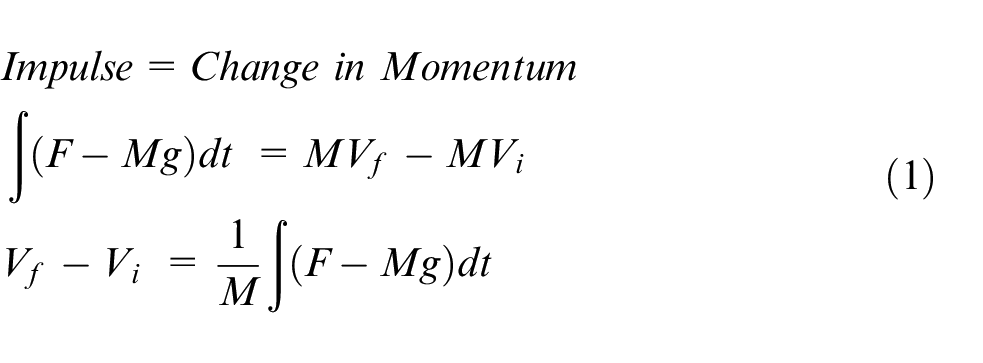
where F = vertical reaction force from the force platform, t = time, M = mass of gymnast, Vf = final vertical velocity and Vi = initial vertical velocity.
In order to compare the three protocols the initial vertical velocity at mat contact calculated from the force time history using was compared with the velocity calculated from the motion analysis CoM data. Each protocol investigated one and two mat landing conditions. Differences in mean velocities calculated by the two methods were tested for significance using paired t-tests.
Protocol 1
A full-size gymnastics landing mat measures 3000 × 2000 × 200 mm3. A supplementary landing mat placed on top is 100 mm in depth. 2 The landing mats were placed (Figure 1) on an 18 kg worktop base attached to the force platform which raised the surface to the level of the floor matting. The dimensions of the platform were marked out on top of the mats (Figure 2). The gymnast hung from a trapeze 3.5 m directly above the force platform and was instructed to land in a manner that represented a competition landing. Vertical velocity landing values for elite male gymnasts in vaulting competition typically range from 4.95 to 6.28 m s−1. 1 Analysis of the Vicon camera data revealed that the gymnast landed with a mean vertical velocity of 4.98 ± 0.04 m s−1 onto one mat and 4.97 ± 0.04 m s−1 onto two mats. The mean percentage difference in the calculated vertical velocity for the force platform data relative to the velocity from the motion capture data was −27.9% ± 2.3% when landing on one mat (p < 0.001) and −28.8% ± 1.8% (p < 0.001) for two mats. The mean absolute percentage differences were 27.9% and 28.8%.
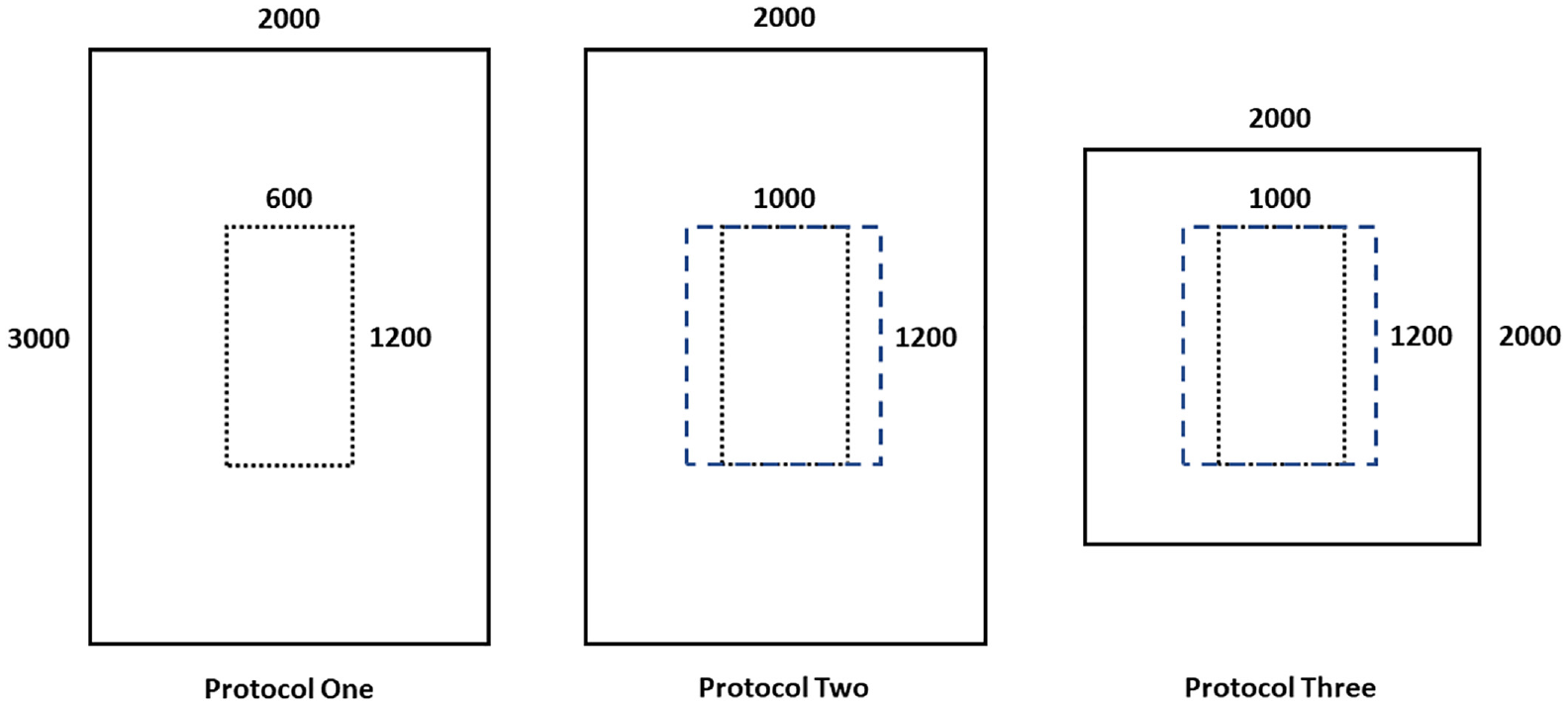
Plan view of each protocol arrangement showing force platform (600 × 1200), platform extension (1000 × 1200), competition landing mat (3000 × 2000) and small landing mat (2000 × 2000) with all measurements in mm.
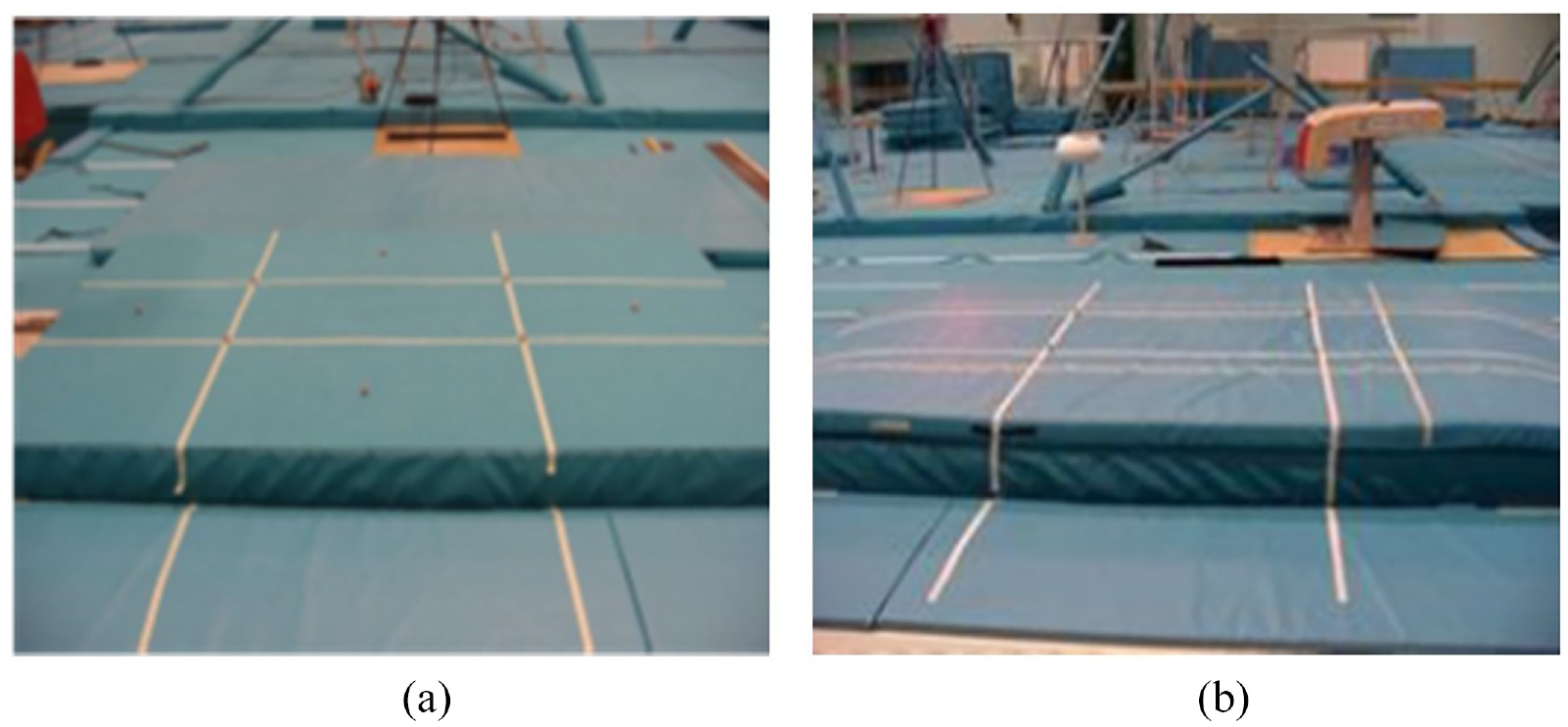
Landing mats placed on force platform with the dimensions of the supporting surface marked out on top of the mats: (a) one mat on force platform and (b) two mats on force platform extension.
Protocol 2
The landing mat was placed on top of a force platform extension (Figure 1) comprising two rigid worktop pieces (each 15 kg) on top of the worktop base bolted through to the force platform, elevating the surface 40 mm above the surrounding floor matting (Figure 3). All other factors remained the same as in Protocol 1 except that the trapeze was raised by 0.5 m to achieve landing velocities closer to the upper limit of the range found in competition. The mean vertical velocity was 5.80 ± 0.08 m s−1 onto one mat and 5.81 ± 0.05 m s−1 onto two mats. The mean percentage difference in the velocity calculated from the force platform data relative to that from the motion analysis data was −1.2% ± 0.8% (p < 0.001) onto one landing mat and −2.5% ± 0.8% onto two landing mats (p < 0.001). The mean absolute percentage differences were 1.3% and 2.5%. At the end of each force trace there was an increase in weight when compared to the known weight of the gymnast. The extension elevated the centre of the landing mats above the floor level and the edges of the ends of the mat rested on the floor matting. It was speculated that once the gymnast had made contact with the mat, the edges were raised off the floor which created extra weight at the end of the trials.
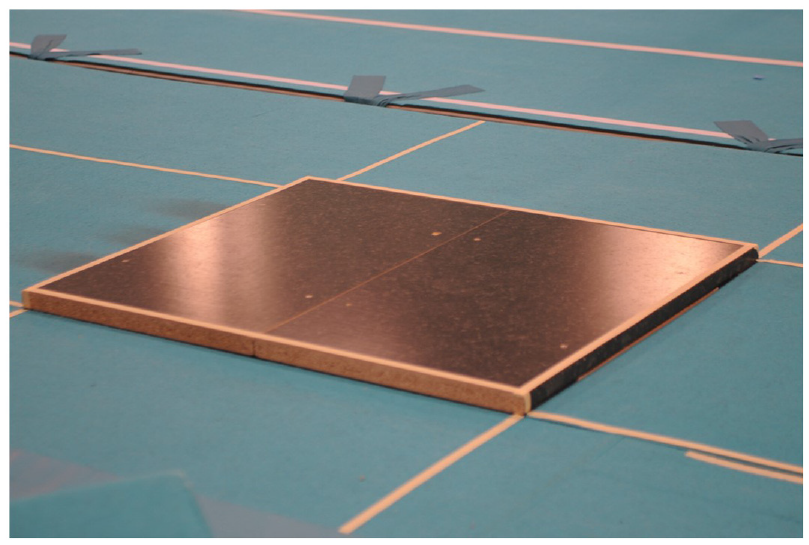
Force platform extension comprising a 600 × 1200 × 38 mm3 worktop base with two 1000 × 600 × 38 mm3 worktop pieces on top bolted through to the force platform.
Protocol 3
Protocol 3 collected data on gymnast landings using a smaller landing mat (2000 × 2000 × 200 mm3) and this was placed on top of the force platform extension (Figure 1). All other factors remained the same as Protocol 2. Vertical landing velocities were 5.64 ± 0.05 m s−1 onto one mat and 5.72 ± 0.07 m s−1 onto two mats. The mean percentage velocity difference was +1.0% ± 1.7% onto one mat and +0.3% ± 2.4% onto two mats; neither of these differences was significant (p > 0.2). The mean absolute percentage differences were 1.7% and 1.8%. At the end of each landing the measured force was equal to the weight of the gymnast.
Discussion
The purpose of this research was to compare three experimental protocols for measuring forces during landing on competition mats in gymnastics. In each protocol the vertical velocity during impact calculated from the impulse measured from the force platform was compared with the CoM velocity calculated from the motion analysis data.
Protocol 1 comprised gymnast landings onto full-size competition landing mats with a force platform underneath and this resulted in a 27.9% and 28.8% difference for the one-mat and two-mat landing conditions, respectively. Protocol 2 employed gymnast landings onto full-size competition landing mats with a custom-built raised force platform enlargement and resulted in a 1.2% and 2.4% difference for the one-mat and two-mat landing conditions, respectively. However, Protocol 2 also introduced error into the experimental data due to the movement of the mat on top of the force platform. Protocol 3 used gymnast landings onto smaller landing mats and resulted in a mean percentage velocity absolute difference of less than 2% for both one-mat and two-mat landing conditions.
A comparison of the force-time histories of the three protocols (Figure 4) shows the reduced peak in Protocol 1 arising from cross-bridging and lower initial velocity. The profiles of Protocol 2 and Protocol 3 force are similar.
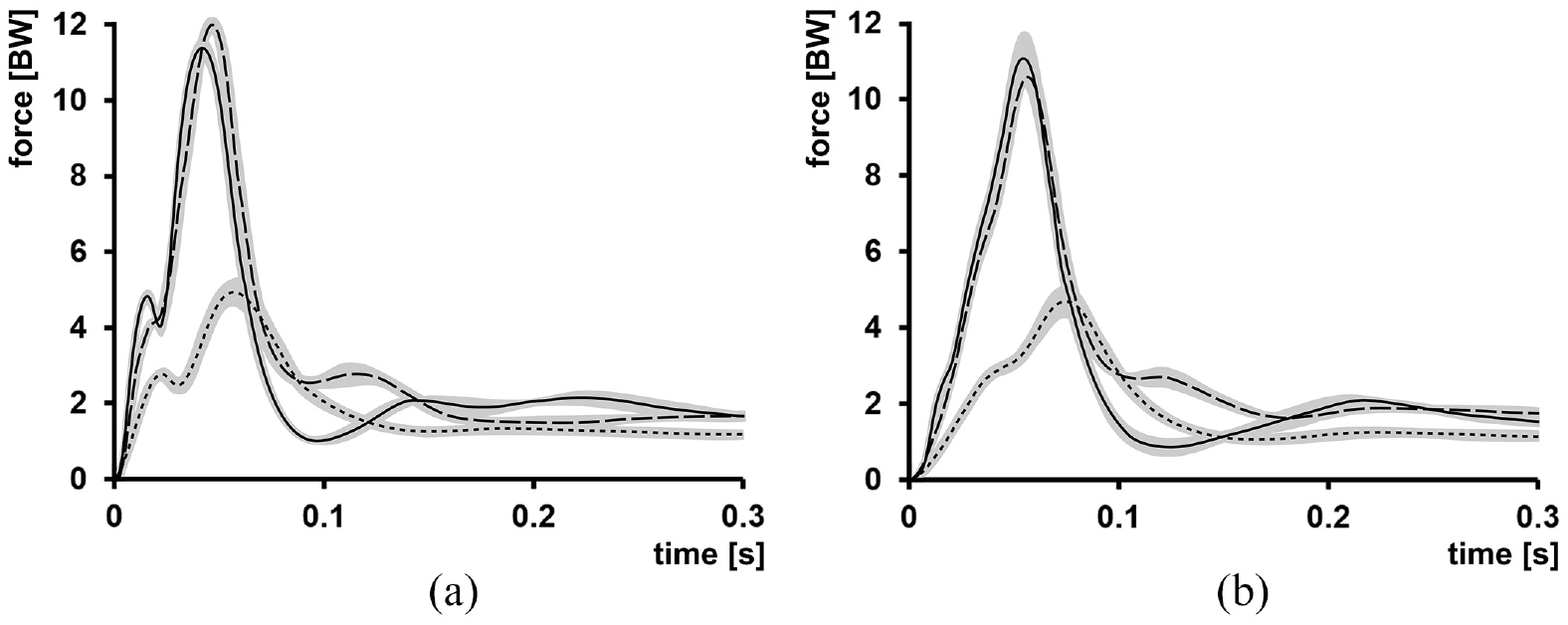
Mean force-time histories in bodyweights (BW) with ± one standard deviation area for (a) one mat landings and (b) two mat landings with Protocol 1 (dotted line), Protocol 2 (dashed line) and Protocol 3 (solid line).
This study demonstrates the importance of developing accurate and reliable experimental set-ups as it is much more difficult to remove errors once data has been collected. The aim of developing such a protocol is to establish the most valid method for collecting ground reaction forces arising from the gymnast contact at the landing mat surface.
In conclusion, the preferred protocol for measuring ground reaction forces during gymnastics landings on competition mats is with a gymnast landing onto a smaller 2000 × 2000 mm2 landing mat with a custom-built raised force platform enlargement underneath so that the mat remains clear of the floor. This results in less than a 2% difference between the change in velocity / impulse during landing determined from motion analysis and force platform measurements. If a full-size 3000 × 2000 mm2 competition landing mat is used it should be raised sufficiently so that it remains clear of the floor before, during and after impact. This protocol may be used to record forces with a force platform beneath a landing mat together with a suitable mat model in order to analyse landings in gymnastics dismounts.
Footnotes
Declaration of conflicting interests
The author(s) declared no potential conflicts of interest with respect to the research, authorship, and/or publication of this article.
Funding
The author(s) received no financial support for the research, authorship, and/or publication of this article.
