The bouncing motion of a spherical ball following its repeated inelastic impacts with a horizontal flat surface is analyzed. The effect of air resistance on the motion of the ball is accounted for by using the quadratic drag model. The effects of inelastic impacts are accounted for by using the coefficient of restitution, which is assumed to remain constant during repeated impacts. Also presented is an extension of the analysis allowing for a velocity-dependent coefficient of restitution. Closed-form expressions are derived for the velocity, position, maximum height, duration, and dissipated energy during each cycle of motion. The decrease of successive rebound heights in the presence of air resistance is more rapid for higher values of the launch velocity, because the drag force is stronger and acts longer. Air resistance can significantly affect the value of the coefficient of restitution determined in a dropping ball test. For a given number of rebounds, the energy dissipated by inelastic impacts is greater than the energy dissipated by air resistance, if the launch velocity is sufficiently small. The opposite is true for greater values of the launch velocity. The derived formulas are applied to analyze the bouncing motion of a ping pong ball, tennis ball, handball, and a basketball.
This paper is devoted to the analysis of bouncing motion of a spherical ball in the presence of air resistance, following its inelastic impacts and rebounds from a horizontal flat surface. The ball is launched from the ground in the vertical direction with an initial velocity , or released from a height above the ground. The air resistance is represented by the drag force whose magnitude is proportional to the square of the velocity of the ball (). The damping coefficient is , where is the experimentally determined aerodynamic drag coefficient for a spherical ball, is the air density at the given temperature, and is the mid-cross-sectional area of the ball whose diameter is . This type of drag, known as quadratic or Newton’s drag, applies in the range of the Reynolds number , where is the kinematic viscosity of air. The impacts of the ball with a horizontal flat surface are assumed to be instantaneous, with the coefficient of restitution , where are the velocities of the ball just after (+) and just before (−) the impact of the ball. The coefficient is assumed to remain constant during repeated impacts, corresponding to given material and structural properties of the ball and the rebound surface, and environmental conditions. An extension of the analysis to include the velocity-dependent coefficient of restitution is discussed. Closed-form expressions are derived for the velocity, position, maximum height, duration, and dissipated energy during the bouncing motion of the ball. It is shown that the determination of the coefficient of restitution (from a dropping ball test) can be significantly affected by air resistance. Additional dissipation effects caused by inelastic impacts and air resistance on the motion of the ball are also evaluated and discussed. The results are expressed in terms of the coefficient , the parameter , having the dimension , where is the mass of the ball, and the terminal velocity of the ball , which represents the velocity at which its weight is balanced by the drag force during the descending motion of the ball (). The gravitational acceleration is denoted by . The derived formulas are applied to analyze the bouncing motion of sports balls. The presented analysis is important when studying the velocity-dependent coefficient of restitution and the durability of sports balls, affected by abrasion and other damage. The latter involves the analysis of time and temperature dependent stiffness changes of the material of the wall under repeated impacts/bounces of the ball.1,2 The analysis is also important for the study of granular materials, where inelastic collisions among particles give rise to energy dissipation which is qualitatively similar to the dissipation during repeated bouncing of a single ball from the flat surface,3 with regard to the normal component of impacts. The study is furthermore useful for the analysis of collisions in mechanical milling processes of powder technology.4,5 In geomechanics, most theoretical analyses of rockfall collisions incorporate the velocity-dependent coefficient of normal restitution, determined from an experimental setup in which marble spheres are dropped from different heights onto a marble plate.6 The presented analysis can be extended to analyze more involved bouncing problems. For example, the analysis of a mechanical oscillator, which consists of a spherical ball bouncing on a vibrating table, is important for the studying of chaotic motion in nonlinear dynamical systems, as well as the performance of impact dampers used for vibration attenuation.7–9
Vertical motion of the ball in the presence of quadratic drag
There are a large number of publications devoted to the study of vertical and oblique projectile motions, with a focus on the effects of ambient drag on the motion of the ball. The drag force in these works was commonly assumed to be either quadratic or linear in velocity.10–16 The quadratic drag model applies to the motion of sports balls, stones, arrows, cannonballs, and other mechanically shot projectiles. The linear drag model is used in the study of sedimentation of pollutants or settlements of very light and small particles, such as silt in water or mist in the atmosphere. It is also utilized in the analysis of motion of very small respiratory droplets and in the related study of the spread of disease.17 A brief summary of the classical analysis of the ascending/descending motion of a spherical ball of mass , launched from the ground vertically up with initial velocity is presented in this section. If the air resistance is assumed to be quadratic in the velocity (), the equation of motion is
where denotes the time. If a spherical ball is a solid ball, then ; if a ball is a thin spherical shell with the wall-thickness , then , where is the mass density of the material of the ball. Equation (2.1) can be integrated to obtain the well-known solution
with the initial condition imposed . The time to reach the maximum height is obtained from the condition , which gives .
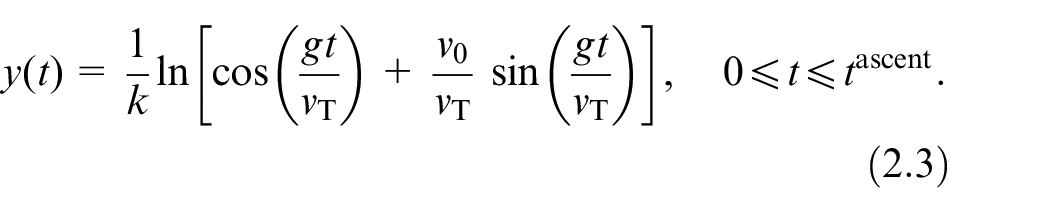
The position of the ball is determined by integrating the velocity , with . It follows that
The maximum height of the ball is found from , which gives
Because of its frequent use in the subsequent analysis, the inverse relationship, expressing in terms of , is also included in (2.4).
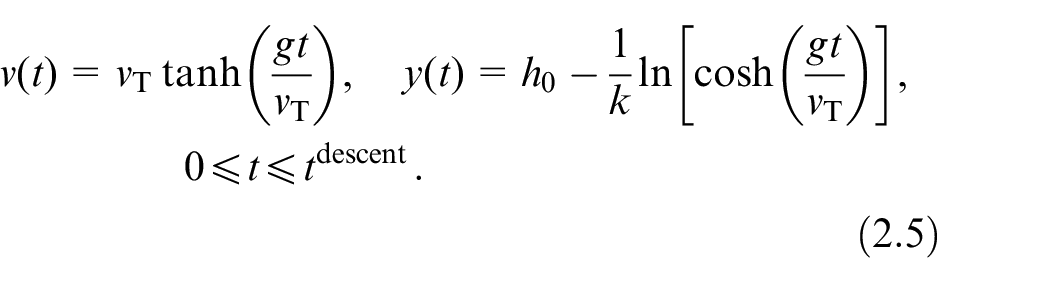
After reaching its maximum height , the ball falls back toward the ground. The corresponding equation of motion is , where is now positive downwards. Since the net force acting on the ball during its fall cannot be upward, one must have , that is, . Upon integration, measuring time during the fall of the ball from the instant when the ball is at the position of maximum height, it follows that
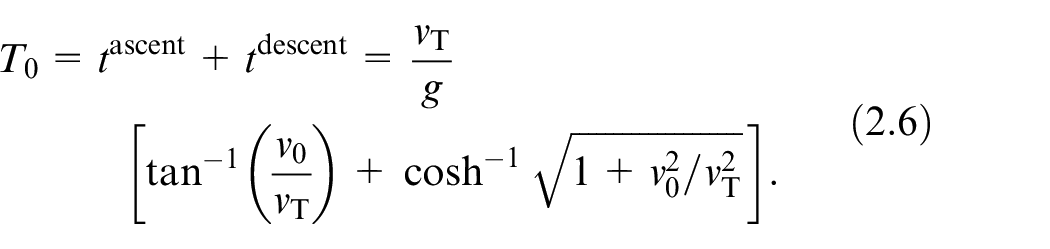
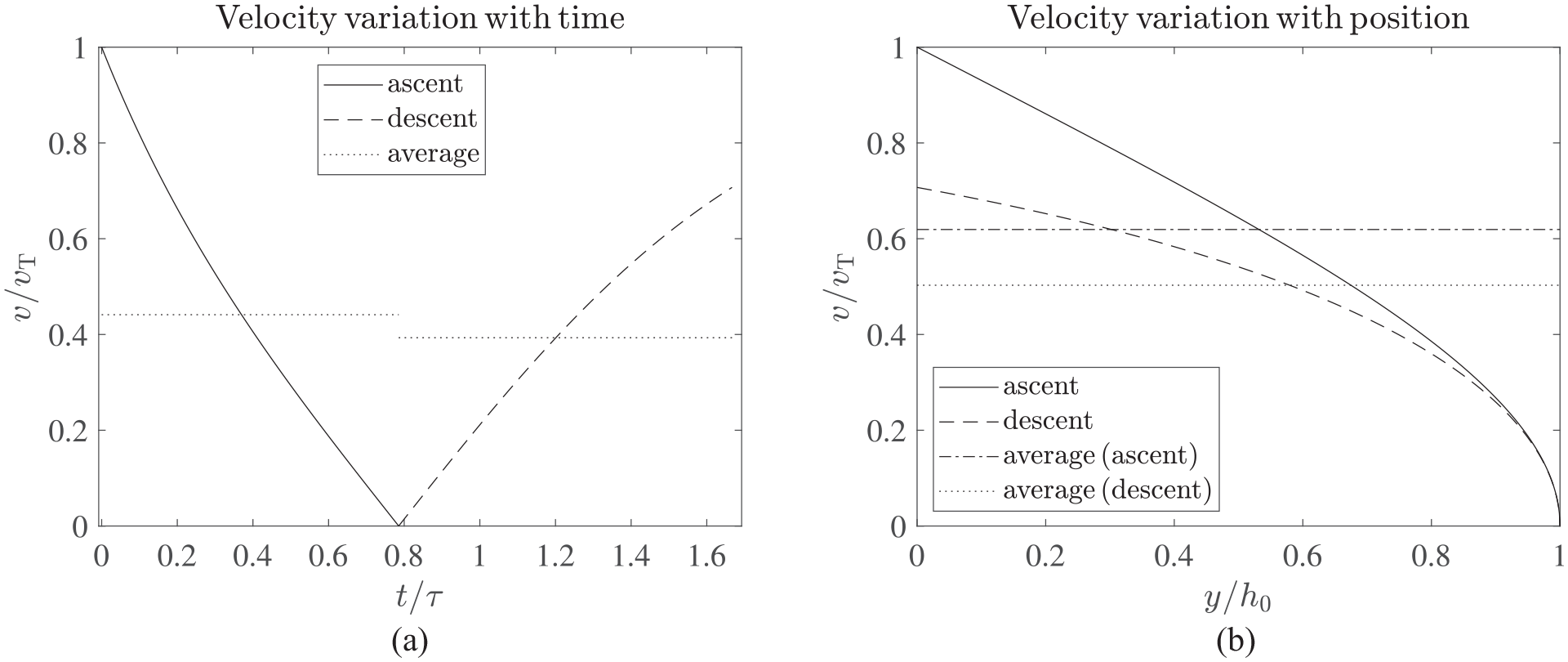
The time to reach the ground is . The time is greater than the time , because the average kinetic energy and thus the average velocity during the descent of the ball is lower than the average velocity during the ascent of the ball, due to dissipation. The determination of the average velocities is presented in the Appendix of this paper. The total duration of the ascending/descending cycle of motion of the ball is
For any launch velocity , both and are smaller than , thus the duration of the ascending/descending cycle in the presence of quadratic air resistance is shorter than in vacuum (). This was discussed for other types of drag in10.
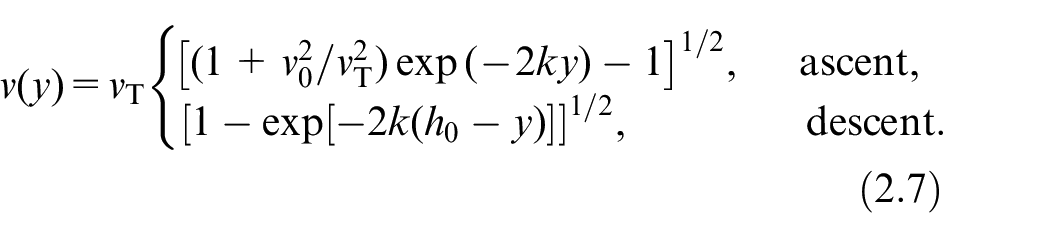
By using the identity , the differential equations of motion, such as (2.1), can be cast in the form , where the plus sign applies to the ascending, and the minus sign to the descending portion of motion. It readily follows that the velocity depends on the position according to
The plots of and are shown in the case of the launch velocity in Figure 1.
The variation of the normalized velocity with (a) normalized time () and (b) normalized distance during the ascending and descending portions of motion. The launch velocity is . Shown also are the average velocities. For a given , the velocity is smaller on the way down than on the way up.
In the case when the ball is dropped from a given height with zero initial velocity, the kinematic and kinetic quantities of interest are expressed in terms of , rather than . This is most conveniently accomplished by eliminating (in the previous expressions) in terms of using the second expression in (2.4). If the density of the ball is comparable with the density of the surrounding fluid, buoyancy force becomes important, and should be incorporated in the analysis by replacing the gravitational acceleration with the effective gravitational acceleration .
Finally, when the ball is dropped from a height with an initial velocity , its velocity at the height , and its time-dependence , are defined by
Bouncing of the ball
This section is devoted to the analysis of the bouncing motion of the ball after its repeated inelastic impacts with a horizontal flat surface of the ground. It is an extension of previous studies of bouncing motion involving inelastic impacts, with and without the effects of air resistance.3,18 The velocity of the ball just before its first impact with the ground is obtained from the second expression in (2.7) when ,
An alternative representation of (3.1), used in13,19, is . The velocity approaches the terminal velocity as the launch velocity becomes much greater than .
Upon impact of the ball with the horizontal flat ground, the ball bounces vertically up, with the initial rebound velocity , where is the (kinematic) coefficient of restitution. The value of depends on the material and structural properties of the ball and the ground, the impact velocity,19–26 the gauge pressure in the case of pressurized balls,27,28 and environmental conditions.29–35 For a perfectly elastic impact (ignoring energy converted to elastic wave propagation following the impact), for a perfectly plastic impact (no rebound), and for an elastoplastic impact . Temperature affects the value of the coefficient of restitution by its effect on the internal pressure and the change of elastic stiffness of the material of the ball. For example, the temperature rise of a squash ball during the game raises its coefficient of restitution.29,30 Tennis balls also bounce higher on a hot day than on a cold day. Bouncing of tennis and squash balls depends on both the wall stiffness and air pressure inside the ball36; on the other hand, bouncing of ping pong balls is mostly affected by the wall stiffness.
For a given value of , all results from the previous section can be used to describe the motion of the ball during the second ascending/descending cycle of motion by replacing with . For example, the velocity of the ball at the end of the second cycle, just before the second impact with the ground, is .
Subsequent rebound velocities
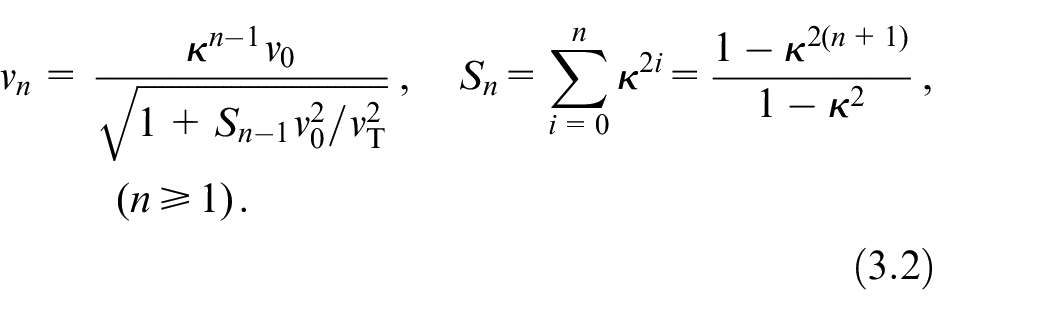
If it is assumed that the ball keeps bouncing vertically and that the coefficient of restitution remains the same for all impacts with the perfectly flat horizontal ground, the velocity of the ball at the end of the cycle of motion, that is, at the end of the rebound cycle just before the impact with the ground, is
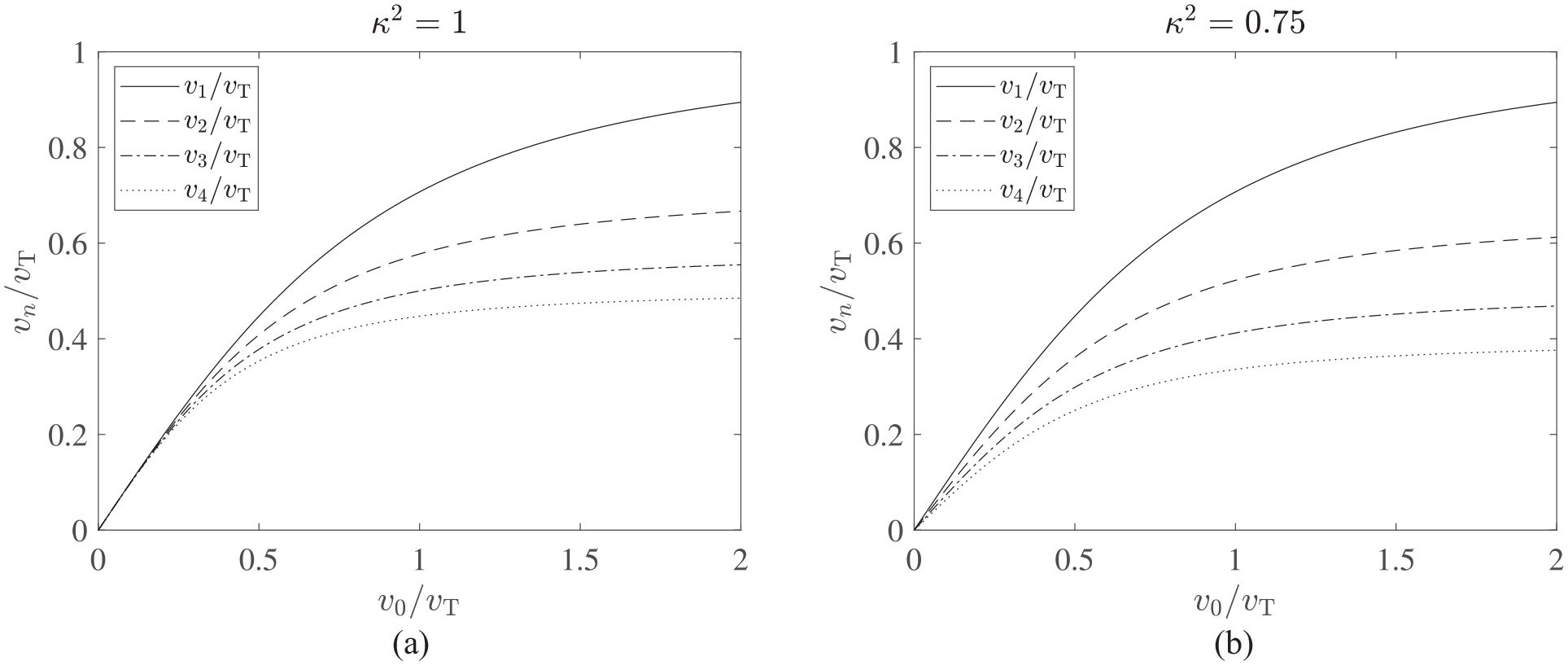
The coefficient can be expressed recursively as , with . If there would be infinitely many rebounds, . In the case of repeated perfectly elastic impacts, . The variation of versus for is shown in Figure 2(a) for repeated perfectly elastic impacts, and in Figure 2(b) for inelastic impacts with . Because of dissipation during inelastic impacts, for . The quadratic air resistance is assumed to hold for all bounces of the ball. When the rebound velocity decreases so that the Reynolds number falls below the threshold for the quadratic damping model, a nonquadratic drag force can be used instead.
The variation of the non-dimensional velocities at the end of the ascending/descending cycle of motion () with the normalized launch velocity in the case (a) and (b) . For , the inequality holds .
Variable coefficient of restitution
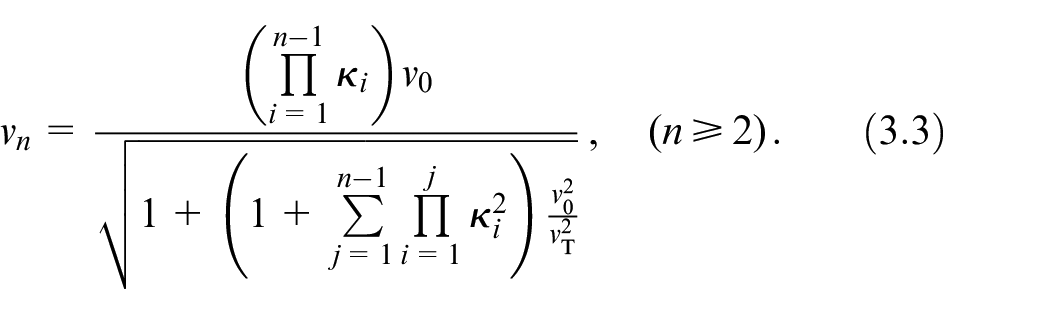
The dependence of on the impact velocity (severity of impact) can be readily included in the rebound analysis, provided that such dependence is known for the material and structural properties involved, from either experimental or theoretical considerations of the impact process. In general, the higher the impact velocity the greater the extent of possible inelastic deformation, thus the greater the dissipation and smaller the coefficient of restitution.37 If the coefficient of restitution of the impact is denoted by (), the velocity of the ball just before the impact with the ground can be expressed as
For instance, for , the expression under the square-root of the denominator on the right-hand side of (3.3) is . The analysis in the sequel is restricted to the case of constant coefficient of restitution, whose value may be considered to be an average value of for the considered number of rebounds and the expected range of impact velocities, provided the range of values is sufficiently narrow. This assumption will be further discussed in the section Bouncing with a Variable Coefficient of Restitution. The experimental determination of the velocity-dependent coefficient of restitution in differently manufactured tennis balls and from different rebound surfaces has been reported, inter alia, in25. An investigation of the values for a ping pong ball dropped on a hard surface from different heights has been reported in38.
Maximum rebound heights
The maximum height of the ball during the rebound cycle is obtained from expression (2.4) for by replacing with . After using expression (3.2) for , it follows that
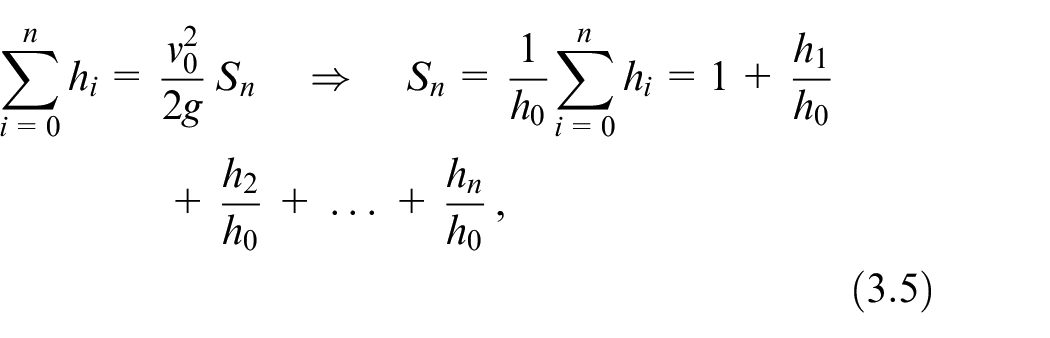
If air resistance is absent or ignored the maximum heights are , for . In this case,
which provides a simple physical interpretation of in terms of the sum of the normalized rebound heights. For very large values of , rebound heights become very small. This means that the ball is effectively on the ground, vibrating with a decreasing infinitesimal amplitude, which is much smaller than the radius of the ball and which may be comparable to the depths of indentation of the ground or the deformation of the ball caused by repeated impacts in an actual test.
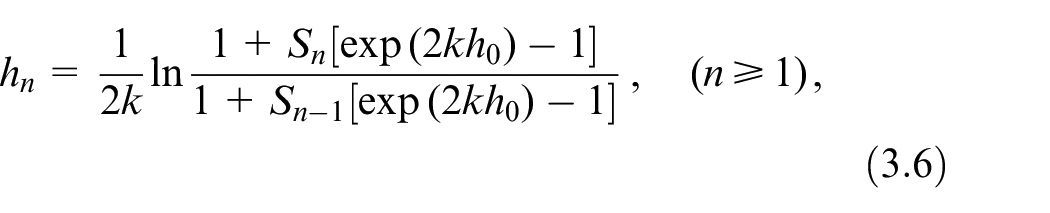
In determining the coefficient of restitution from a dropping ball test, a ball is dropped from a given height with zero initial velocity. The maximum rebound heights are then calculated from
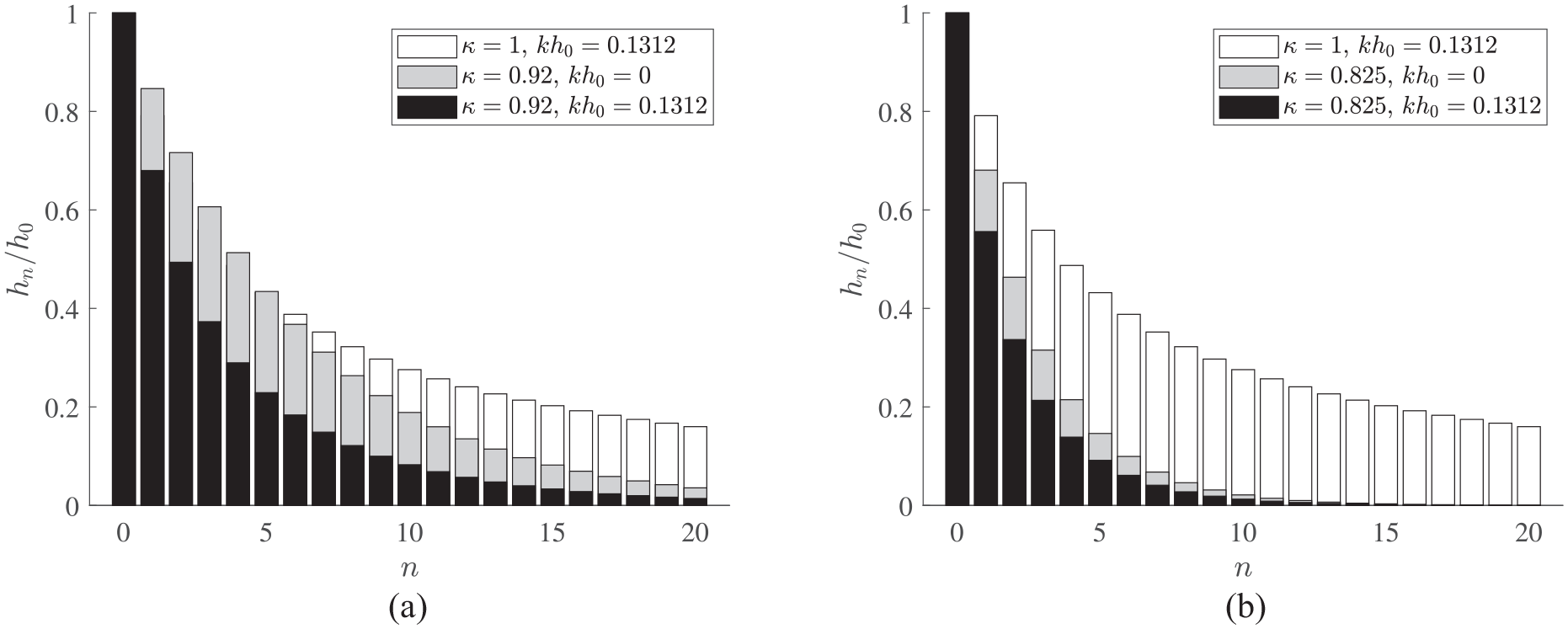
which is obtained from (3.4) by using (2.4) to eliminate in terms of . If air resistance is ignored, (3.6) reduces to , (). For example, Figure 3(a) shows the maximum rebound heights during repeated impacts of a ping pong ball ( cm, g) released from the height m. In the presence of air resistance () and with the coefficient of restitution (as determined in the section On the Determination of from a Dropping Ball Test), it takes 9 rebounds for the maximum rebound height to decrease below 10% of the initial height ( cm). If air resistance were ignored, it would take 14 rebounds for the maximum rebound height to decrease below 10 cm ( cm). Finally, if air resistance is included but rebounds are assumed to be perfectly elastic (), it would take 35 rebounds for the maximum height to fall below 10 cm ( cm). If the coefficient of restitution was , the decrease of the successive maximum rebound heights would be much more rapid, as shown in Figure 3(b). In an actual experiment, however, a slight spin of the ball, either initial or induced by a small non-sphericity of the ball and/or a nonsymmetric air flow, or a small roughness or tilt of the rebound surface, would quickly cause a departure from perfectly vertical rebounds.
Maximum rebound heights during repeated impacts of a ping pong ball with a horizontal flat surface of a ping pong tabletop. The ball is released from the height m. In part (a) the coefficient of restitution is , while in part (b) . Shown also are the maximum rebound heights in the case of elastic impact with air resistance (, ), and inelastic impact without drag ( or , ).
Time-dependent position of the ball
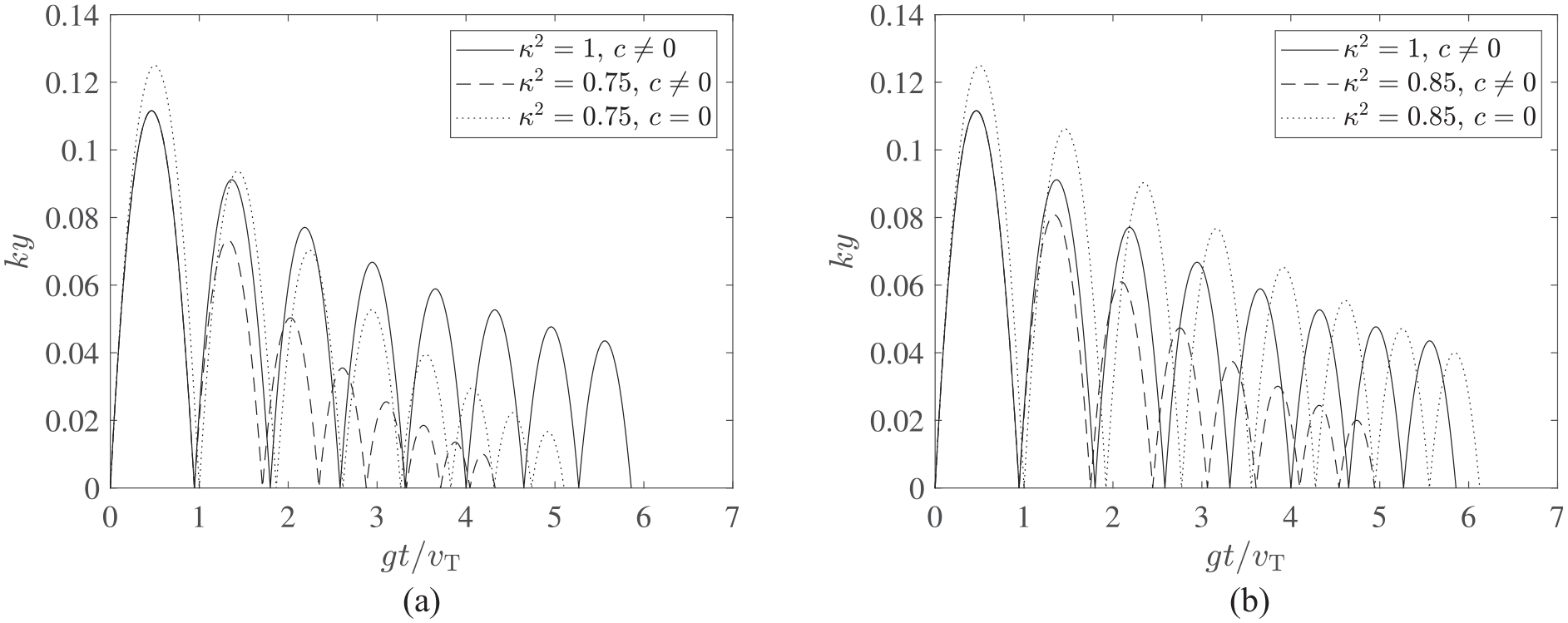
The plots of the non-dimensional position of the ball versus the non-dimensional time during the first eight rise-and-fall cycles of motion of the ball initially launched from the ground with velocity are shown in Figure 4(a) for and in Figure 4(b) for (dashed curves). These curves are obtained from (2.3) and (2.5) by replacing and with and (), where and are defined by (3.2) and (3.4), respectively. The solid curves correspond to perfectly elastic impacts. The decrease of rebound heights in the presence of air resistance is more rapid for higher values of the launch velocity , because the drag force is stronger and acts longer. The dotted curves in Figure 4 depict the position of the ball in the case of inelastic impacts with and , but in the absence of air resistance (). The position of the ball during the cycle of motion is then specified by , where for .
The non-dimensional position of the ball versus the non-dimensional time during the first eight cycles of motion of the ball initially launched from the ground with velocity . The dashed curves correspond to inelastic impacts with(a) and (b) , in the presence of air resistance (). The dotted curves correspond to inelastic impacts in vacuum (). The solid curves correspond to elastic impacts ) in the presence of air resistance ().
The duration of the rebound cycle is
which is obtained by the generalization of expression (2.6) for . The duration of the first cycles of motion is . If , this sum is bounded as , that is, the duration of infinitely many cycles of motion is finite (assuming that quadratic air damping continues to hold even for infinitesimally small rebounds). For example, if , the bound is for , and for . However, once the cycle time (3.7) decreases to the order of the velocity-dependent duration of the impact process itself, the latter needs to be included in the analysis of the bouncing motion. Furthermore, once the rebound velocity becomes so sufficiently small that the Reynolds number falls below , the drag coefficient becomes a nonlinear function of the Reynolds number, and the quadratic damping model ceases to apply. If , the time monotonically increases with the increase of without a bound, in spite of the presence of damping by air. This means that the duration of the cycle decreases much more rapidly with the increase of in the presence of inelastic deformation during impacts. For example, for and , the duration of the rebound cycle of motion is , while for it is , about 26 times greater. The duration of the first cycle of motion, preceding the first rebound cycle, is .
If air resistance is absent or ignored, the durations of the corresponding cycles of motion are (for ). The duration of cycles is , assuming that all impacts are instantaneous. If there are infinitely many cycles, then , which represents the upper bound for the total duration of motion in the absence of air resistance. The bouncing frequency thus tends to infinity. This singular behavior can be remedied by including in the analysis the finite duration of compression and restitution phases of the impact processes, once becomes of that order. In the context of an inelastic bead bouncing off a stationary flat surface, such phases have been analyzed in3.
On the determination of from a dropping ball test
Expression (3.6) can be conveniently used to determine the coefficients of restitution during repeated rebounds from the flat surface by measuring the rebound heights . For example, the coefficient of restitution after the first rebound () can be determined from the measured height as
where is the height from which the ball was dropped with zero initial speed. If air resistance is ignored (), the expression in (3.8) reduces to the well-known result in vacuum .39 One can similarly estimate from the condition , and likewise for the coefficients of restitution of subsequent impacts. Measuring the time of flight between rebounds has also been used to determine the coefficient of restitution (“listening to the coefficient of restitution”40–43).
We performed a dropping ball test with new (unused) plastic (non-celluloid) ping pong balls (ITTF approved Butterfly and Nittaku Premium 40+balls), that were dropped on a recreational Butterfly ping pong table. Six tests were conducted by dropping a ball from the height of 100 cm and by measuring the rebound height using a vertically placed measuring tape and a video recorder. The average rebound heights for both brands of ball were almost equal to each other (68.12 cm for Butterfly and 69.04 cm for Nittaku balls). The calculations reported in the sequel apply to Butterfly balls, having an average measured rebound height of cm. If air resistance is ignored, the calculated coefficient of restitution is . If air resistance is included in the analysis, the damping coefficient for the ball of radius cm is kg/m, and the parameter , where g is the mass of the ping pong ball. Thus, from (3.8) it follows that in this case . Consequently, there is a difference of more than 10% in the calculated value of the coefficient of restitution, depending on whether the air resistance was included in the calculation or not.
The velocity of the ping pong ball just before its impact with a table is, from (3.1), m/s in the case of air resistance, versus m/s. The terminal velocity of the ball is m/s; it would take about 2 s to nearly reach this velocity, provided that the dropping height is sufficiently large. It should be noted that very accurate measurements of the initial and rebound heights are needed to determine the value of . For example, if the average rebound height was found to be m, rather than m, the value of the coefficient of restitution calculated from (3.8) would be rather than 0.921. An appealing extension of the analysis would be to measure the rebound heights of a ball dropped from different initial heights, thus having different impact velocities, and from these measurements (and the analysis presented in this paper) estimate the dependence of the coefficient of restitution on the impact velocity. The so-estimated velocity-dependent coefficient of restitution could then be used to perform an improved analysis of inelastic bouncing of the ball, and a more accurate calculation of the maximum rebound heights and rebound times. A comparative study of the bouncing performance of celluloid versus plastic ping pong balls is reported in44. There is also a slight temperature dependence of the coefficient of restitution of ping pong balls. In contrast to rubbery squash balls, the plastic material of ping pong balls is such that the rebound height and the coefficient of restitution decrease with the increase of temperature.34,35
Bouncing with a variable coefficient of restitution
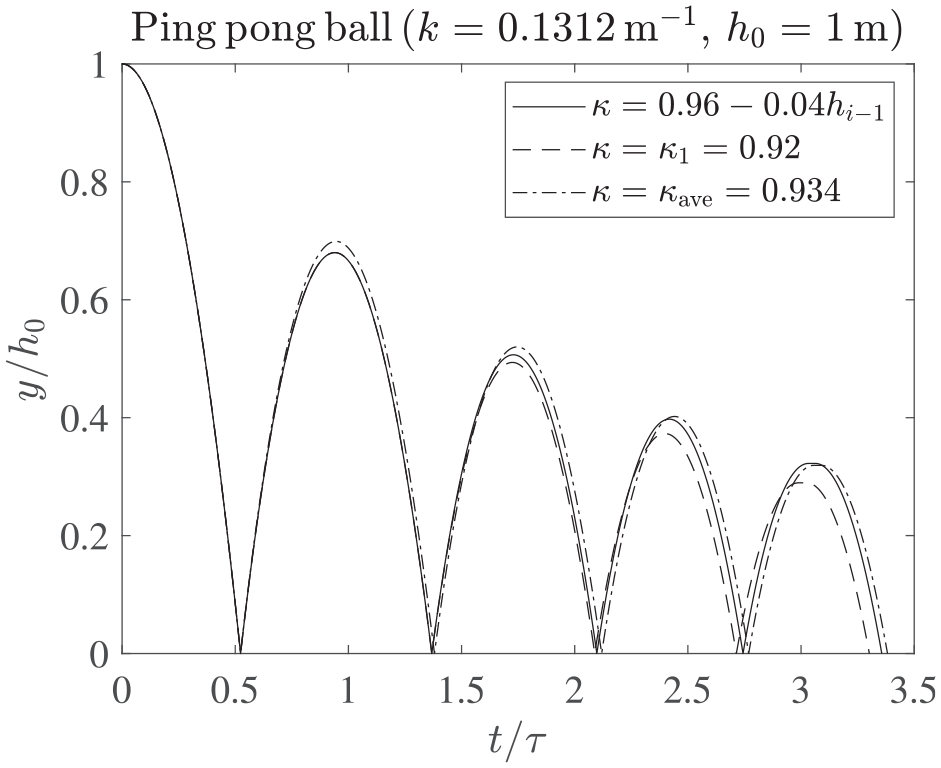
The effect of a variable coefficient of restitution on the bouncing motion of a ping pong ball with , as specified above, is quantified in this section. Based on an average rebound height of 68.1 cm when the ball is dropped from the height 100 cm, and an average rebound height of 25.1 cm when the ball is dropped from the height 30 cm, the coefficient of restitution was calculated to be and , respectively. If linear interpolation is adopted so that the coefficient of restitution for the () impact is , the objective is to determine the maximum rebound heights and the durations of the ascending/descending cycles of motion. Figure 5 shows the time-dependent position of the ball dropped from the height m during the first four rebound cycles of motion (solid curve). The maximum rebound heights are cm, cm, cm, and cm, while the durations of the rebound cycles are , , , and , where s. The corresponding coefficients of restitution are , , , and . If, instead of a variable coefficient of restitution, a constant coefficient of restitution was used, the time-dependent position of the ball would be as shown in Figure 5 by the dashed curve. Finally, the dash-dotted curve in Figure 5 shows the position of the ball corresponding to a constant coefficient of restitution , which is the average value of the coefficients of restitution obtained from the dropping ball tests with the heights of 30 cm and 100 cm. In the latter case, the maximum rebound heights are cm, cm, cm, and cm, while the durations of the rebound cycles of motion are , , , and . Thus, the use of the average value of the coefficient of restitution in the considered range of rebound heights is reproducing the bouncing motion of the ping pong ball with a variable coefficient of restitution reasonably well.
The normalized position of a ping pong ball versus the non-dimensional time during the first four rebound cycles, following the initial drop of the ball from the height m. The solid curve corresponds to a variable coefficient of restitution, the dashed curve corresponds to constant value , while the dot-dashed curve corresponds to the average value , obtained in the dropping ball tests from heights m and m.
Dissipated energy
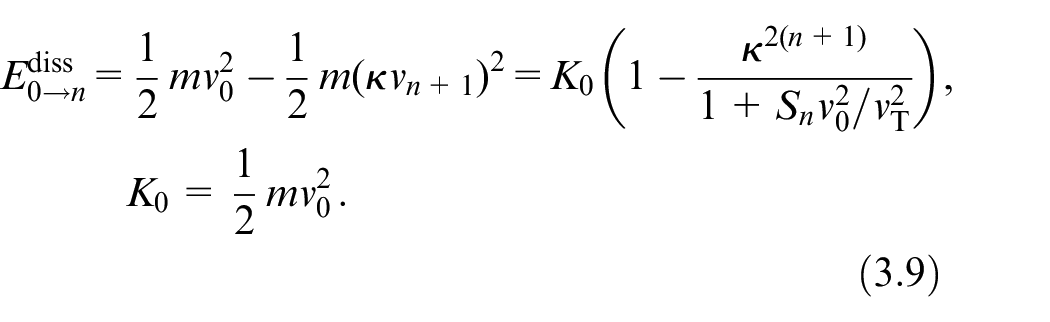
The total energy dissipated during the first cycles of motion (the initial ascent/descent cycle and the subsequent rebound cycles, just after the impact) is
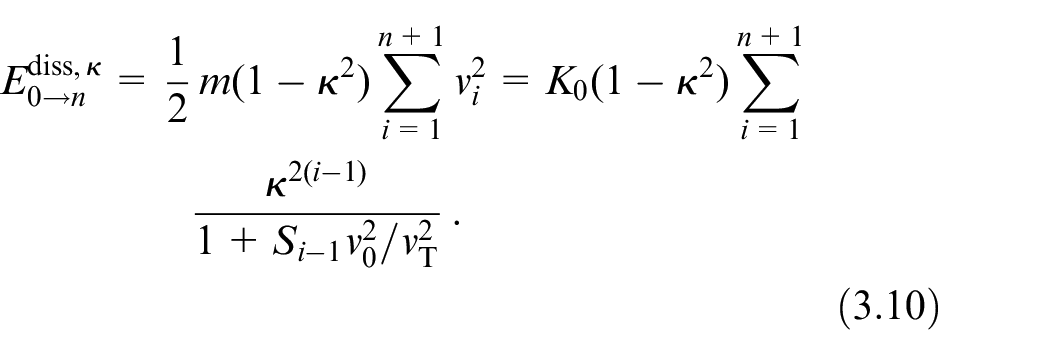
The portion of the dissipated energy due to inelastic impacts only is
The portion of the dissipated energy due to air resistance is then .
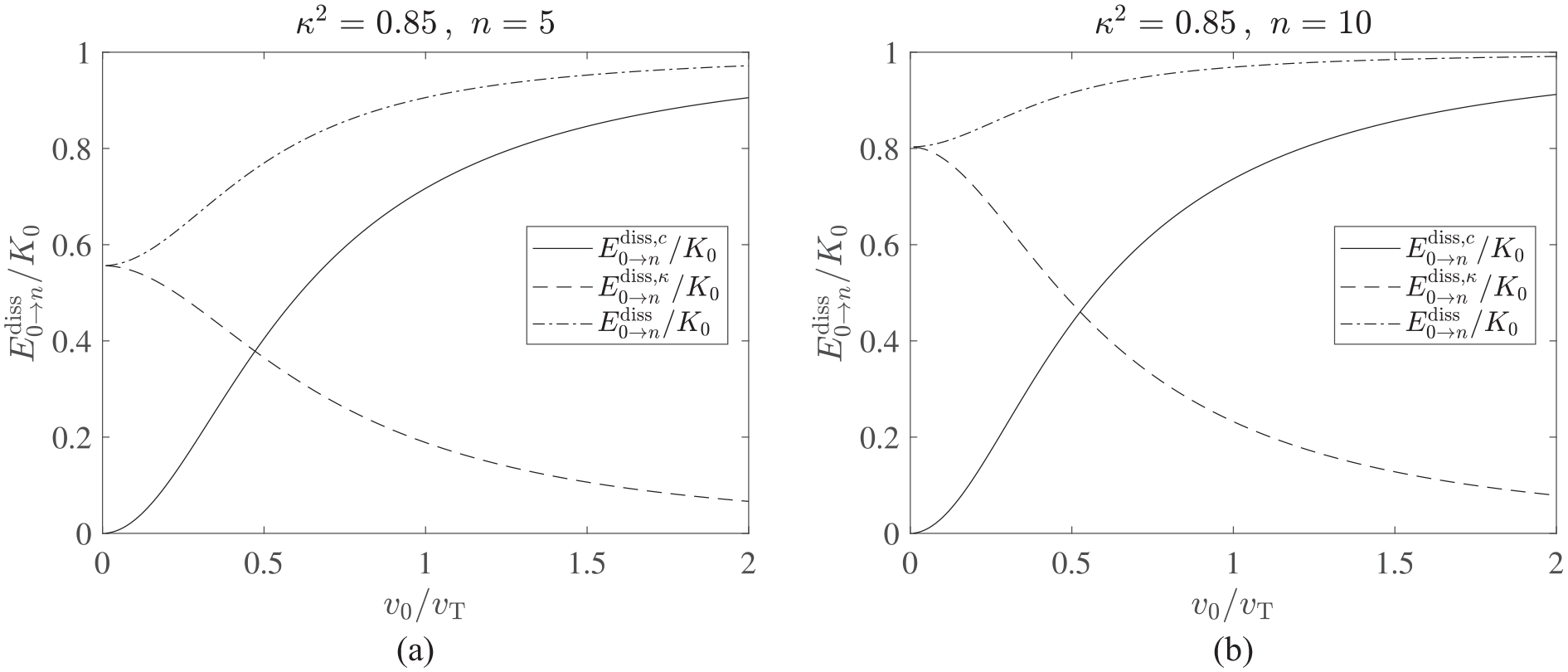
For a given number of rebound cycles of motion , the portion of energy dissipated by inelastic impacts is greater than the portion of energy dissipated by air resistance for smaller values of the launch velocity , but beyond a certain value of the dissipated energy due to air resistance becomes increasingly greater than that dissipated by inelastic impacts. This is shown in Figure 6 for and , and for the coefficient of restitution corresponding to . The considered range of launch velocity is . For , 55.65% of is dissipated after rebounds, and 80.32% after rebounds. For , 97.2% of is dissipated after rebounds, and 99.12% after rebounds. The initial energy is more rapidly dissipated for higher launch velocities, because the ball stays in the air longer which increases the dissipation due to air resistance.
The portions of energy dissipated by air resistance () and by inelastic impacts (), and the total dissipated energy (all normalized by the initial kinetic energy ), versus the normalized launch velocity , in the case of (a) and (b) rebounds. The square of the coefficient of restitution is .
In a single dropping ball test, the total dissipated energy is . The portion of this energy dissipated by inelastic impact is , where expressions (3.1) and (3.8) for and have been used.
Bouncing of sports balls
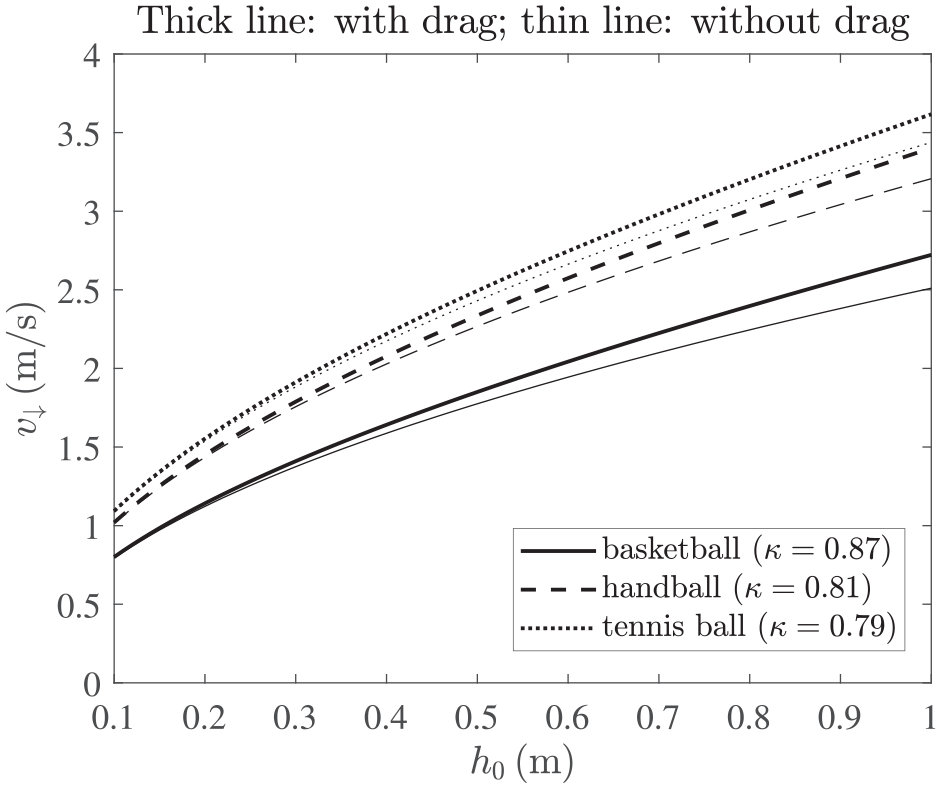
The obtained results may be applied to analyze the bouncing of sports balls. For example, it is of interest to determine the velocity () that a ball player needs to impart to the ball by his or her hand at a given height (), if the ball is to bounce back to the same height with a zero return velocity. From (2.8), the velocity of the ball just before it hits the ground is obtained from . If the ball, after its impact with the ground, is to bounce back to the height , having zero velocity at that height, one requires that , where is the launch velocity from the ground required to reach the height ; see (2.4). Thus, it follows that
In particular, if (no air resistance) and , this velocity is . If (elastic impact) and (air resistance), then . In the latter case, therefore, there is a simple but remarkable relationship .
Figure 7 shows the variation of with for a basketball ( cm, kg, , m/s), a handball ( cm, kg, , m/s), and a tennis ball ( cm, g, , m/s). The utilized coefficients of restitution, shown in the figure legend, are adopted from.45 For example, if m, a tennis player bouncing the ball off the surface of the court in preparation of a serve requires a velocity m/s to the ball in order that it bounces back to the same height, while handball and basketball players need velocities of only 2.4 and 2.72 m/s, respectively. The thin curves in Figure 7 are the corresponding results in the case when air resistance is ignored. By examining different values of the coefficient of restitution, it is also found that inelastic impacts have a more pronounced effect on the velocity than air resistance, at least in the range of heights that is of interest for the considered ball games. According to the International Tennis Federation, a tennis ball dropped from a height of 254 cm (100 in) onto a concrete court must rebound to a height of no less than 135 cm and no more than 147 cm.25,39 By using (3.8), this implies that as long as the wear of the ball and the court, the gauge pressure of pressurized balls, and the ambient conditions are such that the coefficient of restitution is in the range , the ball will pass the approval test. If air resistance is not taken into account, the coefficient of restitution would have to be in the range . According to the International Table Tennis Federation, a non-celluloid ping pong ball dropped from a height of 305 mm (12 in) onto a standard steel plate must rebound to a height of no less than 237 mm and no more than 265 mm. By using (3.8) again, this implies that the coefficient of restitution should be in the range . If air resistance is not taken into account, the coefficient of restitution would have to be in the range . If the ball is dropped from the same height with the same initial velocity many times, once it does not bounce back to the height it means that the coefficient of restitution has decreased due to damage caused by repeated impact with the ground.
The variation of with for a basketball, handball, and tennis ball. Thick curves are obtained with air resistance included, while thin curves are obtained when air resistance is not included. The corresponding coefficients of restitution are shown in the figure legend.
It is also of interest to compare energies dissipated due to air resistance and due to inelastic impact in a dropping ball test. If a ping pong ball is dropped from a height m, and if it rebounds to the height m, the total dissipated energy is J. Since the calculated coefficient of restitution in this case is approximately (section On the Determination of from a Dropping Ball Test), the portion of the energy dissipated as a consequence of inelastic impact is J, where m/s and m/s. Thus, 42.35% of the dissipated energy is due to inelastic impact, while 47.65% is due to air resistance. If a ping pong ball is dropped from a height m, and rebounds to the height m, the total dissipated energy is J. Since the coefficient of restitution in this case is , as determined in the previous section, the portion of the energy dissipated due to inelastic impact is J, that is, 59.58% of the dissipation is from inelastic impact and 40.42% from air resistance. On the other hand, if a tennis ball is dropped from the height m and if it rebounds to the height m, the total dissipated energy is J. Since the coefficient of restitution in this case is , the portion of the energy dissipated due to inelastic impact is J, that is, 87% is dissipated owing to inelastic impact and only 13% owing to air resistance. Finally, if a basketball ball is dropped from a height m and if it rebounds to the height m, the total dissipated energy is J. Since the calculated coefficient of restitution in this case is , the portion of the energy dissipated due to inelastic impact is J, that is, 89.6% is dissipated due to inelastic impact and only 10.4% due to air resistance. From the point of view of the physics of the impact process itself, a basketball with a soft shell tends to flatten when it bounces, while the bouncing of a ping pong ball with a stiffer shell wall may involve local buckling at higher impact velocities.36,46 Various dynamic sources of energy loss during bounce of tennis balls have been examined in47.
Conclusion
An analysis of the ascending/descending cycles of motion of a spherical ball bouncing inelastically from a horizontal flat surface was presented. The effect of air resistance is accounted for by using the model of quadratic drag, while the coefficient of restitution accounts for inelastic impacts. The latter is assumed to be constant during repeated impacts, dependent on the properties of the ball and the rebound surface. The extension of the analysis to include the velocity-dependent coefficient of restitution is also outlined. Air resistance can significantly affect the experimentally determined value of the coefficient of restitution in a dropping ball test. The decrease of rebound heights in the presence of air resistance is more rapid for higher values of the launch velocity, because the drag force is stronger and acts longer. For a given number of rebounds, the energy dissipated by inelastic impacts is found to be greater than the energy dissipated by air resistance, provided that the launch velocity is sufficiently small; the opposite holds for greater launch velocities. The derived expressions are applied to the analysis of the bouncing motion of sports balls. The obtained results may be important for the studying of the durability of sports balls, the mechanics of granular materials, sand and rock falls, powder technology, dynamical systems with impact dampers, and for other structural mechanics problems. In addition to being of research and technological interest, the analysis has a pedagogical appeal. It involves theoretical, computational, and experimental considerations in the fields of dynamics, solid and fluid mechanics, and materials science, which are well suited for coverage in engineering courses or incorporation in individual or group project assignments.36,43,48,49
Footnotes
Appendix: Average velocities
The average velocity of a ball during its ascent and descent can be defined with respect to time or position. The average velocity with respect to time during the ascent of the ball is fond from , and similarly for the descent. This gives
The average velocity with respect to position is found from , and is given by
It can be readily verified that the time average of the square of the velocity is . From Fig. 1 of the section Vertical Motion of the Ball in the Presence of Quadratic Drag it is observed that , thus the descent time is longer than the ascent time. As pointed out in12, at any given position (same potential energy), the kinetic energy is smaller on the way down than on the way up, because of dissipation due to air resistance. Consequently, the velocity at any given height is smaller on the way down than on the way up, which also means that the average velocity during descent is smaller than during ascent. If air resistance is ignored, then , , and , for both ascending and descending portions of motion.
Acknowledgements
Valuable comments and suggestions by anonymous reviewers are gratefully acknowledged.
Author contribution statement
The authors contributed equally to the contents of the paper.
Declaration of conflicting interests
The author(s) declared no potential conflicts of interest with respect to the research, authorship, and/or publication of this article.
Funding
The author(s) received no financial support for the research, authorship, and/or publication of this article.
ORCID iD
Marko V. Lubarda
References
1.
BurbankSDSmithLV. Dynamic characterization of rigid foam used in finite element sports ball simulations. Proc IMechE, Part P: J Sports Engineering and Technology2012; 226:77–85.
2.
SmithLKensrudJ. Mechanical and aerodynamic behaviour of baseballs and softballs. In: FussFSubicAStrangwoodM, et al. (eds) Routledge handbook of sports technology and engineering. London: Routledge, 2013, pp.386–398.
3.
FalconELarocheCFauveS, et al. Behavior of one inelastic ball bouncing repeatedly off the ground. Eur Phys J B1998; 3:45–57.
4.
MauriceDCourtneyTH. Milling dynamics: Part II. Dynamics of a SPEX mill and a one-dimensional mill. Mettal Mater Trans A1996; 27:1973–1979.
5.
KharazAHGorhamDASalmanAD. An experimental study of the elastic rebound of spheres. Powder Technol2001; 120:281–291.
6.
YeYZengYThoeniK, et al. An experimental and theoretical study of the normal coefficient of restitution for marble spheres. Rock Mech Rock Eng2019; 52:1705–1722.
7.
HolmesPJ. The dynamics of repeated impacts with a sinusoidally vibrating table. J Sound Vib1982; 84:173–189.
8.
TufillaroNBMelloTMChoiYM, et al. Period doubling boundaries of a bouncing ball. J Phys I1986; 47:1477–1482.
9.
DuncanMRWassgrenCRKrousgrillCM. The damping performance of a single particle impact damper. J Sound Vib2005; 286:123–144.
10.
LeknerJ. What goes up must come down; will air resistance make it return sooner, or later?Math Mag1982; 55:26–28.
11.
CrossR. The bounce of a ball. Am J Phys1999; 67:222–227.
12.
TimmermanPvan der WeeleJP. On the rise and fall of a ball with linear or quadratic drag. Am J Phys1999; 67:538–546.
13.
MunganCE. Energy-based solution for the speed of a ball moving vertically with drag. Eur J Phys2006; 27:1141–1146.
14.
WhiteC. Projectile dynamics in sport: principles and applications. London: Routledge, 2010.
15.
CrossR. Vertical bounce of a spinning ball. Phys Educ2021; 56:023002. 4pp.
16.
LubardaMVLubardaVA. An analysis of pendulum motion in the presence of quadratic and linear drag. Eur J Phys2021; 42:055014 (18 pp).
17.
LubardaMVLubardaVA. On the motion of an evaporating respiratory droplet. Proc Monten Acad Sci Arts2021; 25:1–26.
KharazAHGorhamDA. A study of the restitution coefficient in elastic-plastic impact. Philos Mag Lett2000; 80:549–559.
24.
ZhangXVu-QuocL. Modeling the dependence of the coefficient of restitution on the impact velocity in elasto-plastic collisions. Int J Impact Eng2002; 27:317–341.
25.
WuCYLiLYThorntonC. Rebound behaviour of spheres for plastic impacts. Int J Impact Eng2003; 28(9): 929–946.
26.
HaakeSJCarréMJGoodwillSR. The dynamic impact characteristics of tennis balls with tennis rackets. J Sports Sci2003; 21:839–850.
27.
GeorgallasALandryG. The coefficient of restitution of pressurized balls: a mechanistic model. Can J Phys2016; 94:42–46.
28.
SchneiderFMacDonaldKReimerD, et al. Analysis of mechanical properties of different volleyballs. Proc IMechE, Part P: J Sports Engineering and Technology2019; 233:292–300.
29.
ChapmanAEZuyderhoffRN. Squash ball mechanics and implications for play. Can J Appl Sport Sci1986; 11:47–54.
30.
LewisGJArnoldJCGriffithsIW. The dynamic behavior of squash balls. Am J Phys2011; 79:291–296.
31.
WiartNKelleyJJamesD, et al. Effect of temperature on the dynamic properties of soccer balls. Proc IMechE, Part P: J Sports Engineering and Technology2011; 225:189–198.
32.
SmithLFaberW. The effect of temperature and humidity on the performance of baseballs and softballs. Procedia Eng2011; 13:200–206.
33.
AllenTBowleyAWoodP, et al. Effect of temperature on golf ball dynamics. Procedia Eng2012; 34:634–639.
34.
ChangY. Temperature and coefficient of restitution of a table tennis ball. Int Schol J Sci2016; 10: 1–3.
35.
HikmatiarHIshafitIWahyuniME. Determination the coefficient of restitution in object as temperature function in partially elastic collision using phyphox application on smartphone. Sci Tech Indonesia2019; 4:88–93.
36.
CrossR. Impact behavior of hollow balls. Am J Phys2014; 82:189–195.
BarlasBC. Investigation of the coefficient of restitution of different balls dropped on floating rectangular prism. GiDB|DERGi2019; 15:13–26.
39.
HaronAIsmailKA. Coefficient of restitution of sports balls: A normal drop test. IOP Conf Ser Mater Sci Eng2012; 36:012038 (8 pp).
40.
BrodyH. The tennis-ball bounce test. Phys Teach1990; 28:407–409.
41.
StensgaardILægsgaardE. Listening to the coefficient of restitution - revisited. Am J Phys2001; 69:301–305.
42.
AguiarCELaudaresF. Listening to the coefficient of restitution and the gravitational acceleration of a bouncing ball. Am J Phys2003; 71:499–501 (13 pp).
43.
GonzálezMÁGonzálezMÁVegasJ, et al. Measuring the coefficient of restitution and more: a simple experiment to promote students’ critical thinking and autonomous work. Phys Educ2017; 52:055002.
44.
InabaYTamakiSIkebukuroH, et al. Effect of changing table tennis ball material from celluloid to plastic on the post-collision ball trajectory. J Hum Kinet2017; 55:29–38.
45.
PerssonJ. Measure the coefficient of restitution for sports balls. Phys Educ2012; 47:662–663.
46.
HubbardMStrongeWJ. Bounce of hollow balls on flat surfaces. Sports Eng2001; 4:49–61.
47.
AshcroftADCStrongeWJ. Dynamic dissipation during bounce of tennis balls. In: HubbardMMehtaRDPallisJM (eds) The engineering of sport 5, Vol 1. Winfield: ISEA, 2004, pp.386–392.
48.
LinnMCPalmerEBarangerA, et al. Education. Undergraduate research experiences: impacts and opportunities. Science2015; 347(6222):1261757.
49.
ParkerJ. Undergraduate research, learning gain and equity: the impact of final year research projects. High Educ Pedagog2018; 3:145–157.