




Abstract
This study aimed to investigate the validity of a boxing-specific test to predict anaerobic threshold (AT) using the heart rate deflection point (HRDP) in boxing athletes with mobile technology. Ten male boxing athletes performed the boxing-specific incremental test (TBOX). Maximal heart rate (HRMAX), HRDP, pace, maximal punch frequency (FPMAX), and punch frequency relative to HRDP (FPAT) were measured. Participants also performed an incremental running test on a treadmill (IT) as a reference test. Paired t-tests were performed to verify differences between the mean values of HRMAX and HRDP during TBOX and IT. Pearson linear correlation was applied to test correlations and the Bland and Altman visual analysis was used to verify the level of agreement. A significant level of p < 0.05 was adopted. The average HRDP was 174 ± 7 bpm, which corresponded to 92% of the observed HRMAX. FPAT and FPMAX presented values between 39 ± 4 and 73 ± 8 blows, respectively. No differences were found, and strong correlations were evidenced between TBOX and IT for HRMAX (p = 0.281; r = 0.73) and heart rate response related to HRDP (p = 0.096; r = 0.85). The 95% limits of agreement for the differences between TBOX and IT for HRMAX should be considered with bias by 2.1 ± 9.7 found between −7.65 and 11.85, as well as the 95% limits of agreement for the differences between TBOX and IT for HRDP with bias −2.3 ± 7.68 found between −9.98 and 5.38. HRMAX and HRDP obtained during TBOX leads us to infer that the test was well founded to estimate parameters associated with the aerobic power and aerobic capacity of boxing athletes. In addition, TBOX shows significant applicability for the aerobic assessment of boxers based on real competition movements and can be useful to determine and control training intensities.
Keywords
Introduction
Boxing is a combat sport with a significant role in sports history, 1 and it still has great worldwide recognition. 2 Currently boxing is divided into amateur/Olympic and professional levels. An amateur boxing match consists of three rounds, 3-min each with a 1-min rest in-between. At the professional level, competition is composed of 4–12 rounds of 3 min each and interposed by 1 min of passive interval for each round. The number of rounds is defined by the fighter’s category, but, combat may end early via a knockout or technical knockout. 3
Considering the duration of combat, in addition to strength and power, a boxer must develop a solid foundation of aerobic fitness. Aerobic fitness is vital in boxing to tolerate the physiological demands during the match and to allow recovery during and between rounds of competitions.4,5 Boxing is considered an intermittent sport due to the occurrence of high-intensity efforts alternating with recovery periods, that is, characterized by an effort/pause relationship (E:P) of 3:1 – both round and interval duration times are taken into account. 6 However, if we consider only the effective round times, E:P observed is 18:1 among elite boxers and 9:1 among novices. 7 During the round per se, energetic pathway alterations occur between aerobic predominance (e.g. displacements, distance adjustments, and hopping) and anaerobic demands (e.g. sequences and combinations of punches).6,8 Taken together, the data indicates that performance assessment of such combat sports must obey the practice of specificity. It has been a great challenge to reproduce the demands of combat due to the inherent technical and tactical complexity of these sports disciplines.9–11 Although evaluation of mechanical parameters has been successfully done in boxing,2,12 there is a lack of information regarding cardiorespiratory parameters. 13
Therefore, it is important that when evaluating aerobic performance in boxing athletes, external and internal load indicators, aerobic power-related parameters, and indicators of aerobic capacity must be included as the anaerobic threshold (AT). In this context, internal load heart rate-based parameters corresponding to the maximum intensity (also known as maximal heart rate – HRMAX) and the anaerobic threshold (HRAT) have been used, with good ecological validity and applicability, both for evaluation, prescription, and also monitoring training intensities in the practical routines of athletes. 14 Furthermore, the AT is known as an important physiological parameter to discriminate exercise intensity domains, 15 which, when determined by sport-specific protocols, can contribute to the elaboration of pace training strategies and induce the expected internal load responses without compromising the athlete’s neuromuscular performance and motor actions. 16
To the best of our knowledge, only one study has presented a compatible, valid, and sensitive protocol to assess boxing physical and physiological demands. 17 This protocol presents similar physiological responses previously observed in other studies performed with boxing athletes. 18 However, the protocol does not consider an individual’s capacity as it establishes the external load and motor actions based on the average of motor action parameters observed by the authors, 19 precluding to identify individual aerobic power and capacity parameters. Conversely, striking sports such as karate 20 and taekwondo 11 have presented protocols that allow individual assessment of aerobic capacity and aerobic power parameters. Therefore, this indicates a clear possibility of carrying out specific evaluations in combat sports, which could be applied to determine indicators of aerobic capacity and aerobic power in boxing athletes.
Furthermore, the use of mobile and wearable technology emerges as an innovative solution for fitness assessments, specifically, for combat sports. These technologies are compose what is referred to as the 4.0 Industry and they enable the acquisition and processing of data in real-time at low cost and great applicability through algorithms that incorporate scientific methods and protocols in mobile applications. The exponential development of new mobile technologies for diagnosing and controlling athletes’ training intensities supports the need for algorithms that are applicable for regular 21 and combat sports. 22 This technology is widely accessible with fast data processing and low cost. An example is the ITStriker app (ETS4ME, São José, SC, Brazil) used to determine internal and external load parameters during the incremental taekwondo test. 16
However, boxing athletes are often assessed using nonspecific incremental tests (IT) like running on a treadmill.5,6,18,23 Considering that there are severe divergences for muscle groups, movement patterns, and physical effort characteristics between boxing and running, the present study proposes the boxing-specific incremental test (TBOX) to assess aerobic capacity and power in boxing athletes. TBOX was adapted from the already validated progressive-specific taekwondo test. 19 Thus, this study aimed to investigate the validity of the TBOX to predict maximal and submaximal aerobic parameters and the AT using the heart rate deflection point (HRDP) in boxing athletes.
Methods
Experimental approach to the problem
Participants underwent two testing sessions for data collection. On the first day, anthropometric measurements (body mass, height, and skinfold thickness) and IT were performed. On the second day, after a 48-hour interval, participants performed the TBOX. Athletes were instructed to avoid demanding physical efforts 24 h before data collection, pharmacological or nutritional ergogenic resources, and any stimulant substance in the 3 h before the tests. This study was conducted according to the guidelines defined in the Declaration of Helsinki and all procedures involving human subjects were reviewed and approved by the Ethics Committee on Human Research of the Federal University of Santa Catarina (protocol number: 01821612.8.0000.0121). All the athletes were informed of the procedures, risks, and benefits of participating in the study and were asked to sign the Informed Consent Form.
Subjects
Ten male competitive athletes (mean ± SD: 27.5 ± 5.6 years, 1.70 ± 0.1 m, 75 ± 12.7 kg, 11.6 ± 2.2%, body fat, 8.7 ± 3.0 years of practice) composed of three professional and seven amateur boxers volunteered for this study. Participants were selected based on the following requirements: (a) regular participation in regional and national level competitions, and (b) performed specific training at least three times a week and with a minimum duration of 1-h training.
Procedures
Anthropometric assessment
Body mass and height were measured with a stadiometer and scale Micheletti® (São Paulo, SP, Brasil) with 0.1 kg and 0.1 cm resolution, respectively. Body fat percentage was calculated using the equation proposed by Faulkner 24 with the following skinfolds measured: supra iliac, abdomen, triceps, and subscapularis using a caliper (Cescorf, Porto Alegre, Brazil) with constant pressure of 10 g/mm2 and 1 mm resolution. Measurements were performed three times for each point, from the right side, recording the average value or the value that was repeated twice. All measurements were performed by a single experienced evaluator.
Heart rate deflection point identification
The HRDP, an indirect indicator of the lactate threshold, was identified using the DMAX method. 25 According to a previous study, the DMAX method does not present significant differences from maximal lactate steady state velocity and showed high agreement when comparing the methods (Bland and Altman analysis). 26 The HRDP identified by DMAX method was determined using the heart rate curve points adjusted versus the speed imposed at each stage of the IT and the punch frequency (FP), or pace, at each stage of the TBOX, using a third-order polynomial function. Only equal to or greater than 140 bpm values were used to estimate the HRDP.26,27 The FP and the velocity of the stage relative to the HRDP were called punch frequency of the anaerobic threshold (FPAT) and velocity of the anaerobic threshold (VAT), respectively. The same procedure was used for both tests (TBOX and IT). For the heart rate data acquisition, a monitor (Polar H7 ® Kempele, Finland) was used. Two specific mobile phone apps for data processing for TBOX (ITStriker app) and IT (Safe Runner app, ETS4ME, São José, SC, Brazil) were used.
Boxer specific incremental test
The TBOX was performed on a tatami mat and the participants were instructed to equip themselves for an official fight (i.e. hand bandages, boxing gloves, mouth guard, and it was optional to use a genital protector). Participants were asked to position themselves in front of an assistant who held a pair of punch pads. Both moved as in a conventional fight performing small steps to avoid crossing legs. Participants executed two punches (a Jab and a Cross) against the punch pads at each beep and were instructed to punch always at their maximal power, with the punch pads positioned at the athlete’s face height.
Participants began the first stage of TBOX performing six beeps (12 punches), alternating hands, and then progressively increasing to 4 beeps on each stage (Table 1). The punch pace was guided by sound beeps with fixed intervals and became shorter at each new stage. During the test, the following variables were recorded using the ITStriker app: (i) HRMAX, which was the heart rate peak reached during the test; (ii) maximal punch frequency (FPMAX), for both Jab and a Cross; (iii) maximal amount of motor action (PaceMAX), iv) HRDP; v) FPAT for both Jab and a right cross; (vi) pace at anaerobic threshold (PaceAT); (vii) the total number of punches (NPTOTAL), and; (viii) time to exhaustion (Figure 1(a)). The criteria to finish the test were voluntary exhaustion, inability to maintain the pace of the beep, or when there was a significant technical pattern decrement of the blows. The cumulative duration column observed in Table 1 and the adjusted time value occur because they correspond to the moment when automated heart rate acquisition and recording occurs by the APP algorithm paired with a Polar Bluetooth H7.
Delineation of the boxing specific incremental test (TBOX).
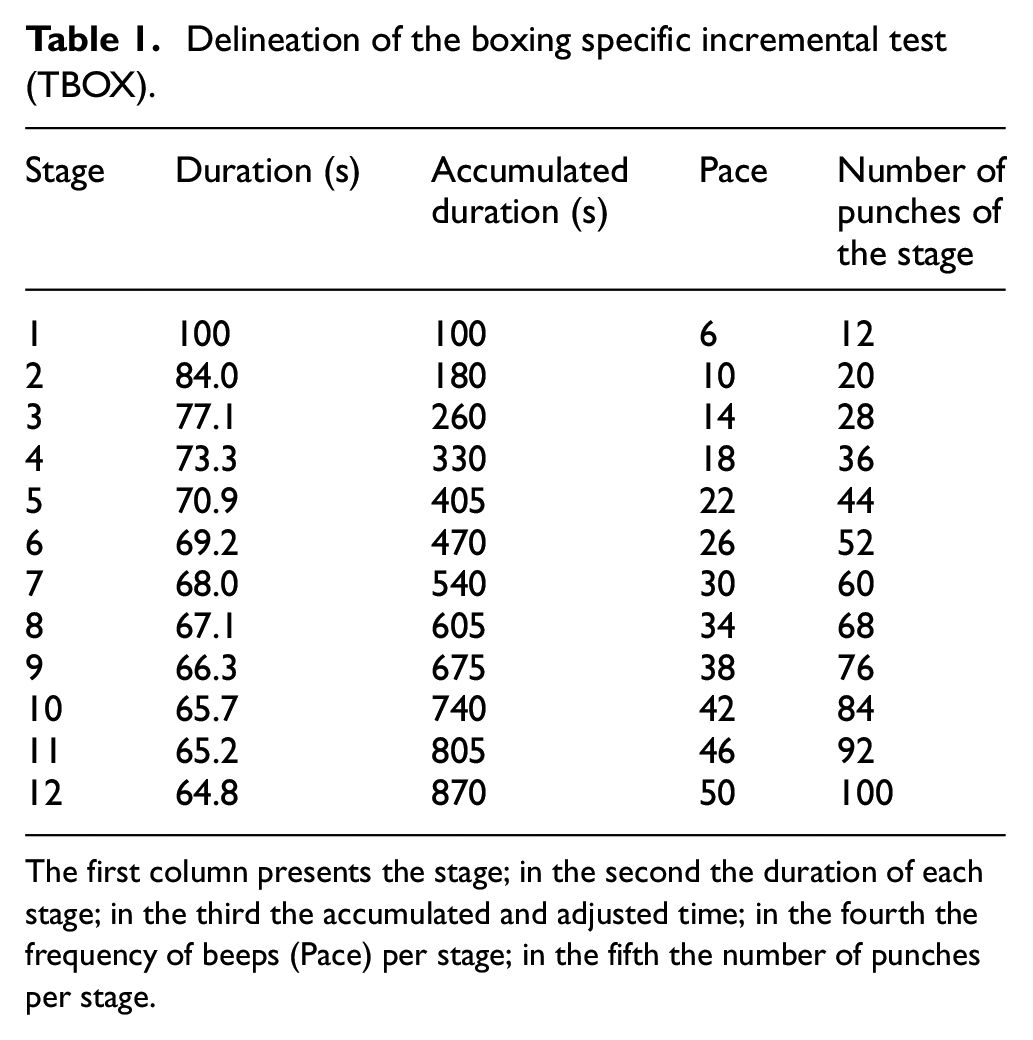
The first column presents the stage; in the second the duration of each stage; in the third the accumulated and adjusted time; in the fourth the frequency of beeps (Pace) per stage; in the fifth the number of punches per stage.
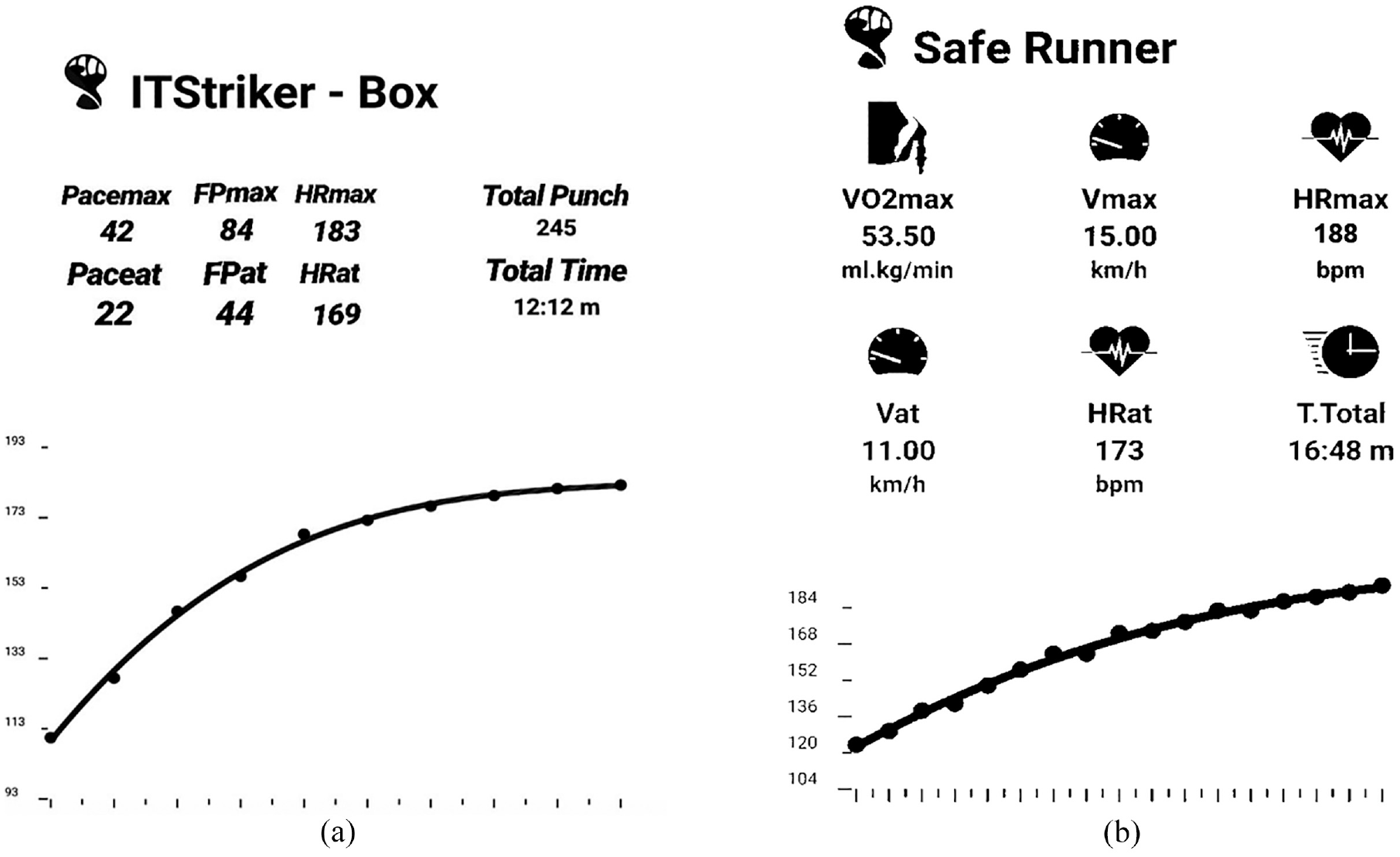
Interface of heart rate kinetics results and the parameters identified when performing the TBOX using APP ITStriker (a) and IT using APP Safe Runner (b).
Non-specific incremental test
Participants also performed an incremental running test on a treadmill (Progress TRG, Blumenau-SC-BR). The test began with a speed of 7 km·h−1 and a fixed inclination of 1%. The speed increased by 0.5 km·h−1 at the end of each 1-min stage until voluntary exhaustion or in case of heart rate plateau occurrence. From the Safe Runner app, the following variables were obtained: (i) HRMAX; (ii) maximal speed reached (VMAX); (iii) exhaustion time; and (iv) heart rate and velocity at anaerobic threshold intensity (HRAT and VAT, respectively), both corresponding to the HRDP (Figure 1(b)).
Statistical analysis
The results are presented by mean and standard deviation. Data normality was verified using the Shapiro–Wilk test. To compare the mean of the differences, values for the parametric data during the TBOX and IT the Student’s t-test were applied. When data was non-parametric the Wilcoxon test was applied to compare the mean of the differences. Pearson’s linear correlation was applied to relate the variables obtained during the tests and correlations were described as trivial (0.0–0.1), small (0.1–0.3), moderate (0.3–0.5), large (0.5–0.7), very large (0.7–0.9), or extremely large (0.9–1.0). 28 The agreement between the methods was verified by the Bland-Altman 29 graphic analysis, but the graph was only constructed when the mean difference between TBOX and IT was close to zero. Thus, the t-test for one sample with p-values comparing the differences with zero and simple linear regression were used in the Bland-Altman analysis simultaneously with the calculation of the limits of agreement and bias. The heteroscedasticity of error was defined as R2 > 0.10. 30 The inter-test coefficient of variation (CV) was performed using the common means of the IT and TBOX test and the Fisher-Snedecor test to compare the variances. Data processing and analysis were performed using Microsoft Office Excel 2007 (Microsoft Corporation, Redmond, WA, USA), SPSS 20.0 (SPSS Inc., Chicago, IL, USA), and GraphPad Prism 5.01 (GraphPad Software, Inc., La Jolla, CA, USA). The statistical significance level was set at p < 0.05.
Results
Table 2 presents the mean and standard deviation values of the physiological variables identified during the TBOX and IT. HRDP during TBOX corresponded to 92% of HRMAX, and FPAT was 53% of FPMAX. There was a significant correlation between both tests for HRMAX (r = 0.73) and HRDP (r = 0.85). External load obtained during the IT and TBOX, VMAX versus FPMAX and VAT versus FPAT did not present correlation (r = −0.06; r = −0.19, respectively). The HRMAX values obtained in the tests showed no statistical difference (p = 0.281) between the maximum values reached and the predicted HRMAX (p = 0.086). The HRDP also showed no significant difference between IT and TBOX (p = 0.096).
Physiological variables obtained during the boxing specific incremental test (TBOX) and the incremental treadmill run test (IT) (n = 10).
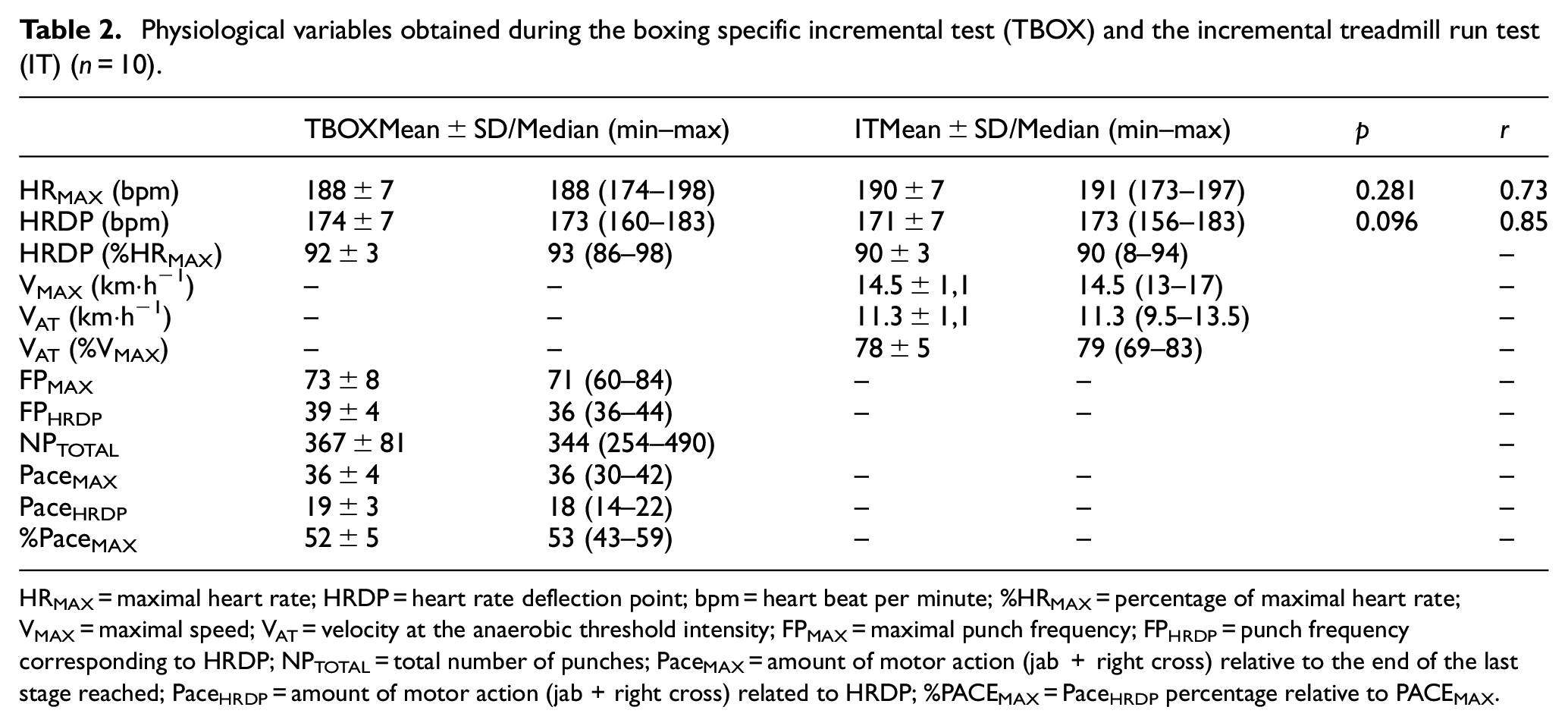
HRMAX = maximal heart rate; HRDP = heart rate deflection point; bpm = heart beat per minute; %HRMAX = percentage of maximal heart rate; VMAX = maximal speed; VAT = velocity at the anaerobic threshold intensity; FPMAX = maximal punch frequency; FPHRDP = punch frequency corresponding to HRDP; NPTOTAL = total number of punches; PaceMAX = amount of motor action (jab + right cross) relative to the end of the last stage reached; PaceHRDP = amount of motor action (jab + right cross) related to HRDP; %PACEMAX = PaceHRDP percentage relative to PACEMAX.
Figure 2 displays the Bland and Altman plots describing the agreement of HRMAX measurements obtained during TBOX and IT with means of the differences related to zero not presenting significant differences (p = 0.215). The CV of the common means of IT and TBOX test was 3.6% (3.5; 3.7). HRMAX presented a bias of 2.1 bpm. The 95% limits of agreement for the differences between TBOX and IT for HRMAX should be expressed by 2.1 ± 9.7 found between −7.65 and 11.85 indicating that the differences between the two measurements can reach 5.1% for HRMAX and these differences probably occur due to the specificity of the technique involved in the TBOX compared to IT protocols. The Bland-Altman analysis did not show heteroscedasticity for mean values and differences between the TBOX and the IT for HRMAX (R 2 = 0.003, p = 0.881).
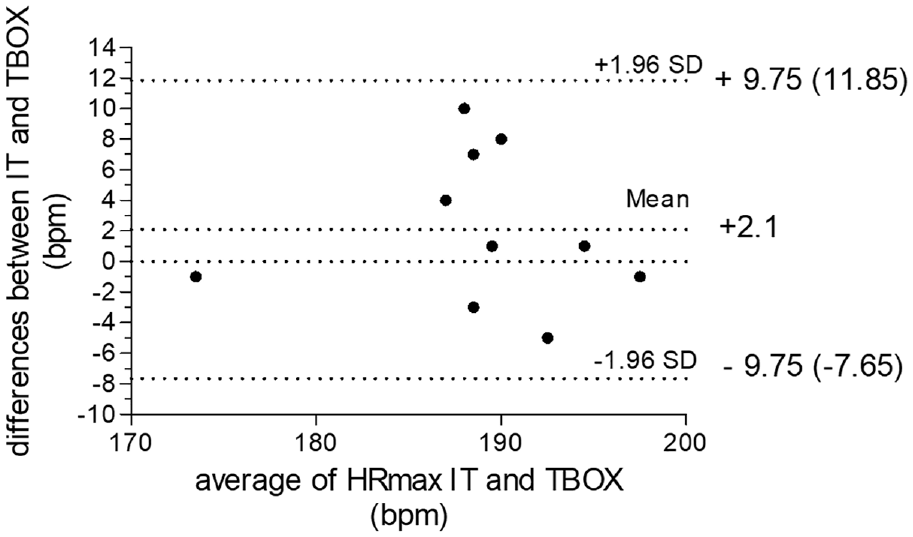
Bland & Altman of the differences of intra-individual maximal heart rate (HRMAX) during the incremental treadmill run test (IT) and boxing specific incremental test (TBOX).
Figure 3 displays the Bland and Altman plots describing the agreement of HRDP measurements obtained during TBOX and IT with means of the differences related to zero not presenting significant differences (p = 0.096). The CV of the common means of IT and TBOX test was 4.2% (4.3; 4.0). HRDP presented a bias of −2.3 bpm. The 95% limits of agreement for the differences between TBOX and IT for HRDP should be expressed by −2.3 ± 7.68 found between −9.98 and 5.38 indicating that the differences between the two measurements can reach 4.5% for HRDP and these differences probably occur due to the specificity of the technique involved in the TBOX compared to IT protocols. The Bland-Altman analysis did not show heteroscedasticity for means values and differences between the TBOX and the IT for heart rate response related to HRDP (R 2 = 0.015, p = 0.733).
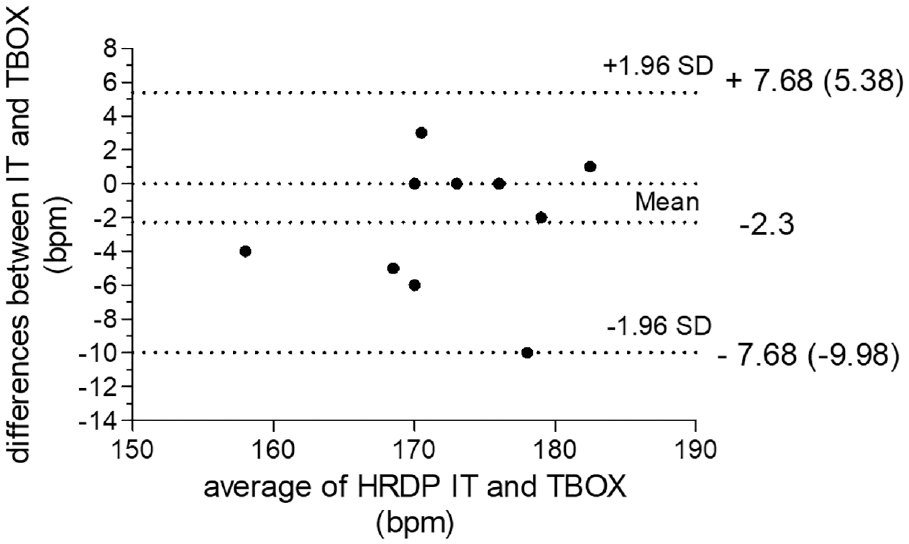
Bland and Altman of the differences of intra-individual heart rate deflection point (HRDP) during the incremental treadmill run test (IT) and boxing specific incremental test (TBOX).
Discussion
This study aimed to investigate the validity of a boxing-specific test to predict AT using the HRDP in boxing athletes. In addition, it was also the objective of this study to verify whether the proposed protocol could be an option to evaluate aerobic power (using the intensity corresponding to the HRMAX) and aerobic capacity (using the intensity corresponding to the HRDP) in boxing athletes. The main finding was that the measured variables during the TBOX did not show significant differences and presented a very large correlation when compared to IT measures; so it could be considered as a valid possibility to determine the maximal and submaximal indicators in this sport. Despite the evidence of an agreement, it should be considered that the limits of agreement for HRMAX and HRDP indicated that the differences between both measurements could reach 5.2% for HRMAX and 4.4% for HRDP. These differences probably are related to different motor gestures and muscle groups involved in TBOX when compared to running. A previous study has found these differences during incremental protocols performed on treadmills compared to other different exercise modes (i.e. cycle, skier, and shuffle skier) 31 and when compared IT with the specific incremental protocol for combat sports. 11
Analyzing the concurrent validity of the heart rate corresponding to the HRDP for both TBOX and IT, significant differences were not observed, with a very large correlation between the protocols (p = 0.096; r = 0.85). However, it is necessary to observe with caution the intra-individual differences when verified values for HRDP are within the limits of agreement as shown in Figure 3. These differences must be considered especially if the internal load (HRDP) is used to direct the prescription of training in boxing athletes. Comparable results were observed in a study with taekwondo athletes using a sport-specific protocol, 11 whose results did not present differences when comparing IT and specific tests. In addition, the relative value of heart rate at HRDP observed during the TBOX (92% ± 3% of the HRMAX) is in line with the literature for other sports as running and cycling (between 88% and 94% of the HRMAX), 32 supporting the possibility of such method to determine the AT.
Besides the HRDP identified during the TBOX, the corresponding FPAT and PaceAT can be used to determine the specific intensity and used to individualize training parameters. The athletes evaluated in the present study show values of the HRMAX and FP (Table 2) similar to those observed in a study involving experienced male amateur boxers (91.7% ± 4.3% of the HRMAX and 34.9 ± 7.1 punches·min−1, respectively), 33 reinforcing the applicability of the findings.
There are divergences in the literature regarding the validity and reproducibility of the HRDP to detect the intensity of exercise associated with the AT. 32 For example, a study involving cycle ergometer performance showed a strong correlation between HRDP and AT determined by ventilatory threshold (r = 0.90, p < 0.001), with no significant differences. 34 As well, when HRDP was compared with AT verified by blood lactate during a running test, it also showed a strong correlation (r = 0.84, p < 0.0001) without significant differences between both methods (p > 0.05). 26 This relation has been reinforced by the absence of differences during repeated tests, which suggests that it is a reliable method to find the HRDP, 32 which can be easily identified in individuals with higher training levels. 35 However, it is necessary to carry out future test-retest studies to verify the reliability and reproducibility of the TBOX.
Additionally, in a study involving 32 men performing a maximal test in a cycle ergometer, HRDP could not be identified in 9 subjects (28%) using the linear method. In contrast, when using the DMAX method, which was used in the present study, HRDP was easily detected in all subjects. 25 In summary, these divergences are normally associated with the protocols and the different analyzes used, which can influence the results obtained. Therefore, when validating a measuring instrument that aims to investigate the efficiency of a tool used, the criteria, parameters, and inferential methods must be standardized and appropriated to the purpose.
Our findings suggest that the external load obtained during the IT did not correlate with the performance parameters during the TBOX, as well as the percentages of intensity corresponded to the HRDP are well distinct when comparing IT and TBOX. However, these results are like those observed during incremental tests with taekwondo athletes.11,27 It is worth mentioning that at the end of TBOX 40% of the participants presented higher HRMAX values than those reached during the IT. A similar pattern was observed in a study involving senior England international amateur boxers. 12 According to the authors, in the last few moments of the boxing combats (i.e. 4 × 2 min) athletes presented higher values of heart rate compared to those found during IT until exhaustion. It reinforces the importance of considering the motor actions specificity in incremental tests for more reliable verification of aerobic assessment of boxing athletes. Evidence has shown that during field tests the HRMAX is up to 10 bpm higher than laboratory tests. 36 This finding reinforces the importance of ecological validity in evaluating combat sports to better determine the relative effort intensities.
Finally, TBOX can be a viable and practical proposal to estimate the aerobic power and capacity of boxing athletes using the heart rate responses. In addition, the test shows great applicability for aerobic assessment of boxing athletes based on real competition movements and variables (FPMAX and FPAT) that can be useful to prescribe and control training intensities. For example, to perform high-intensity specific training boxer should perform bouts at 120% of his PaceAT. On the other hand, in the case of active recovery, this same athlete could reduce his pace to 80%.15,16,37 Also, when the individual intensity is known for each athlete, technical-tactical training could be performed to match the ideal pace for each opponent but respecting the fighter’s aerobic fitness to avoid under or overtraining. In summary, TBOX allows a desirable reduction in subjective decisions and offers a more objective approach instead.
Moreover, it should be considered that TBOX is not an invasive test. The use of the ITStriker app allows obtaining relevant and specific information of aerobic capacity and power (i.e. maximal punch frequency, punch frequency at HRDP, and the pace) simpler and cheaper for coaches and athletes. Finally, we believe that our findings are important to encourage coaches and trainers to securely manage training and prescription. In practical terms, baseline diagnostic evaluations, transitions between periodization periods, comparisons between athletes’ levels, responsivity to training, fatigue monitoring, and specific training intensities prescription would all become easier with TBOX and help to manage and make decisions.
Some limitations and strengths should be considered while interpreting our findings. First, a test-retest of TBOX would be of interest to verify the reliability of the parameters determined by the test and its sensitivity, both for future intervention studies and to establish the standard errors of measurement and minimum detectable changes, which would be useful for further interpretations. Second, the reduced sample size; however, there was an effort to maintain a concise and homogeneous sample based on restricted inclusion criteria. Third, despite the lack of gold standard assessment (e.g. lactate or ventilatory thresholds) we chose to investigate a protocol with higher external validity to give more importance to its practical applicability. For us, this is important due to its proximity to coaches and trainers’ practice. Finally, since the TBOX was compared to a standardized IT, all limitations of the IT would also be considered.
Conclusion
The TBOX is the first test specifically designed to evaluate the aerobic performance of boxing athletes. The test can be considered a valid method to assess both internal and external load and as a tool with practical applicability, using mobile technology with low cost to evaluate specific individual motor actions and approaching at maximum the characteristics of the sport.
Footnotes
Appendix
Acknowledgements
The authors thank the National Council of Scientific Research (CNPq) Brazil for the provision of scholarship for FD and Programa de Bolsas Universitárias de Santa Catarina (UNIEDU) for the provision of scholarship for JS.
Declaration of conflicting interests
The author(s) declared no potential conflicts of interest with respect to the research, authorship, and/or publication of this article.
Funding
The author(s) received no financial support for the research, authorship, and/or publication of this article.
