




Abstract
Some studies have reported considerable errors in the movement velocity measurement when using the My Lift app. This study aimed to investigate whether these errors may be related to the use of a range of movement (ROM) statically measured prior to the movement (ROMMYLIFT) instead of ROM dynamically monitored. Ten young adults performed two repetitions of the bench press exercise on a Smith machine with loads that allowed two velocity conditions (above and below 0.6 m s−1). The exercises were monitored by the My Lift app, a magnet and a rotary encoder. After, 15 older adults performed the same exercise at different percentages of 1RM, monitored by the My Lift app and a magnet. The results revealed that ROM dynamically obtained by encoder (reference method) with the mean velocity above (0.497 ± 0.069 m) and below (0.450 ± 0.056 m) 0.6 m s−1 were quite different (p < 0.05; large effect) from the ROMMYLIFT (0.385 ± 0.040 m). These errors provided highly biased and heteroscedastic mean velocity measurements (mean errors approximately 22%). The errors observed in adults were also observed in the older participants, except for loads equal to 85% of 1RM. The magnet method proved to be valid, presenting measurements very close to the encoder (mean errors approximately 1.7%; r > 0.99). In conclusion, the use of ROMMYLIFT is inadequate, as the higher the movement velocity, the higher the errors, both for young and older adults. Thus, to improve the measurement of the My Lift app, it is recommended that the magnet method be used in conjunction with the app to more accurately determine the ROM.
Introduction
Monitoring resistance exercises based on movement velocity, a method known as velocity-based training (VBT), has gained importance in recent years, both in the field of academic research, as well as the market for physical assessment devices. 1 VBT has been successfully used for estimating one-repetition maximum (1RM), periodic load control and monitoring acute and cumulative fatigue in different types of resistance exercise.2,3 The main advantages seem to be related to allowing precise and real-time control of the effort level while saving time, both in the execution of the test and duration of the training session (e.g. reduction of the total volume of repetitions performed).4,5
Different tools are used for the acquisition of movement velocity and their validity and reliability vary according to the physical principles (types of sensors) and the technology applied.6–13 Among the instruments that use video capture to measure movement velocity, the smartphone application My Lift (My Jump Lab, Spain) is widespread. Basically, when recording videos at high speed with a smartphone camera (e.g. 240 fps), the My Lift app measures the mean velocity (MV) according to a statically pre-established range of motion (ROM) and the duration of the recorded repetition (usually the concentric phase). 7
High correlation values (r ≥ 0.94) have been observed between MV measurements obtained from the My Lift app and other equipment,11–14 and its validity has been confirmed by several studies. 15 However, despite the practicality offered by the My Lift app and its likely widespread use by professionals in field situations (given the high number of downloads), three important points must be highlighted. First, although the validity and reliability of the My Lift app are assumed by some researchers, 15 other similarly well-conducted studies reported considerable errors in the MV measurements, which can compromise its use for the application of VBT.8,16,17 Second, to the authors’ knowledge, there have been no studies that verify whether it is appropriate to apply a ROM measured statically to be used under dynamic conditions (as My Lift’s default procedure), besides assuming such ROM is invariable regardless of the load intensity of lifts. Lastly, no study has verified the validity of the My Lift app for MV measurements in older adults. Considering that older people are typically less likely to accelerate the barbell and generate mechanical power output,18,19 and that the second reason previously noted is correct, it could be expected that there are different magnitude of errors between the young and older population when comparing the static measurement with the actual displacement.
Thus, the present study aimed to: (a) verify whether a difference exists between the ROM measured statically and the ROM measured dynamically under different load and movement velocity conditions for the bench press exercise; (b) present a low-cost, effective method to correct the ROM determined statically and corresponding MV measurements when using the My Lift app; (c) analyze whether the measurements provided by the My Lift app present similar magnitude of errors among young adults and the older population. The authors hypothesized that assuming the ROM measured statically to be invariable, rather than a dynamically measured ROM, can become an error source for My Lift app MV measurements. These errors can probably be caused by larger actual ROMs, especially with light loads.
Materials and methods
Experimental approach
To test the hypothesis, a two-step cross-sectional study was carried out. In the first step, a group of young adults was invited to perform two sets of one repetition at maximal intended velocity with loads that allowed two velocity conditions (above and below 0.6 m s−1). ROM measured statically (ROMMYLIFT) with a measuring tape was compared with ROM obtained by a rotary encoder (ROMENC), which was used as the reference method. At the same time, the ROM of each repetition was also verified by the displacement of a Neodymium magnet (ROMMAGNET) coupled to the guided barbell system and pushed during the barbell’s movement. The validity of this here named “magnet method” was verified by comparing ROMMAGNET and ROMENC measurements, as well their corresponding mean velocities (MVMAGNET and MVENC). In the second step, the magnet method was applied to a group of older participants to verify the variation of ROMMYLIFT with different percentages of 1RM (% of 1RM) and the corresponding effect on My Lift app MV measurements (MVMYLIFT). All older participants performed the repetitions at maximal intended velocity.
Participants
Ten young adult males (age: 34.9 ± 9.5 years; height: 1.73 ± 0.11 m; body mass: 79.7 ± 19.4 kg; time practicing strength training: 11.8 ± 7.1 years) participated in the first step of this study, while 15 older male adults (age: 65.2 ± 4.9 years; height: 1.73 ± 0.6 m; body mass: 75.8 ± 10.3 kg; strength training experience: at least 6 months) participated in the second step. All participants volunteered and provided written informed consent. The study protocol was approved by the Institutional Ethics Committee for Research on Human Subjects (register no. 25932519.3.0000.0118) and was performed according to the Declaration of Helsinki. For the young people and older adults, the inclusion criteria included the following: at least 18 years old (older adults, at least 60 years old), a minimum of 6 months experience with resistance training and previous experience with the bench press exercise. The exclusion criteria for both adults and older adults included no history of injuries, pain or discomfort in the shoulder and elbow joint 6 months prior to data collection.
Procedures
Before performing the procedures and tests corresponding to each step of the study, all individuals participated in a session to collect anthropometric measurements and review movement familiarization. The participants were considered familiarized with the maximal intentional velocity for the bench press exercise when they were able to perform three consecutive repetitions (loads ∼70% of 1RM) with velocities that did not differ more than 10%. Moreover, they were instructed on body positioning during lifts. Participants were asked to keep their head, back, and buttocks pressed against the bench. A footrest was used to minimize accentuation of the physiological lordotic curvature.
Before each assessment, a standardized warm-up was performed by all participants. This protocol consisted of 5 min of exercise on the cycle ergometer (∼70 rpm; light load), exercises for shoulder articular mobility (without charge), as well as external and internal rotations using a TheraBand. Additionally, each participant performed one set of five repetitions at maximal intentional velocity without additional load (barbell weight-free), followed by one set of 10–12 repetitions with 18 kg in total.
Bench press execution
All tests were performed on a Smith machine (Aura Series Smith Machine G3-PL62, Matrix, Johnson Health Technologies, USA) with a horizontal bench placed just below the barbell. Participants were instructed to perform concentric phases of the exercise, pushing the barbell vertically as fast as possible until reaching the full extension of the elbows (avoiding protruding shoulders with consequent scapular abduction). Standardized verbal command was provided by the evaluator to the participants during the trials.
The participants performed the lifts only concentrically. They were placed on the bench in the supine position, with the barbell mechanically sustained (by hooks) just over the chest. The distance between the hands (grip width) was self-selected 20 and conditioned to an internal elbow angle close to 90º at the end of the eccentric phase.
Measuring tape
Using an anthropometric measuring tape (1 mm of resolution), the ROMMYLIFT was measured statically (prior to the movement). With the participant on the bench and the barbell mechanically sustained (by hooks) just over the chest, a first point was demarcated with a pencil on the Smith’s guide. After a complete barbell lift (without additional load), a second point was then demarcated. The distance between the first and second points was considered as the subject’s ROMMYLIFT. This process was conducted for each participant.
Rotary encoder (linear position transducer)
Each repetition was dynamically monitored with a rotary encoder (Ergonauta I, Ergonauta®, Brazil), presenting 400 pulses/revolution, 1 mm/pulse resolution, and sampling frequency of 1 μs of resolution. The encoder’s retractable cable was attached to one of the sides of the barbell. ROM and MV data were collected in real time and sent to a smartphone Samsung J2 – Android 7 (Samsung® Electronics Co., Ltd, South Korea).
Likewise, MV was simultaneously calculated by the My Lift app (version 8.3), installed on a smartphone iPhone 7 Plus – iOS 12.4.1 (Apple®, Inc., USA), from the time recorded in a video obtained at 240 fps and 720 p. The smartphone was supported by a tripod, placed 1.5 m away from the Smith machine. My Lift’s MV acquisition procedures are widely presented elsewhere.7,11,14,16,21 The ROM obtained by the measuring tape was used as a reference for the MV calculation in My Lift (MVMYLIFT).
Magnet method
A neodymium magnet (11 mm in diameter and 2 mm in thickness) was placed in the vertical lateral guides of the Smith machine, approximately 5 cm below the demarcation of the ROMMYLIFT. The proposed method works analogously as a hydraulic dynamometer dead pointer. During the execution of each repetition, the guided system of the Smith machine pushes the magnet vertically, while the barbell is moved to the maximum point. When the barbell returns, the magnet remains at the maximum point registered (maximal distance). The difference between ROMMYLIFT and the last magnet position (diffROM) was considered as ROMMYLIFT corrected by the magnet method (ROMMAGNET) (Figure 1).
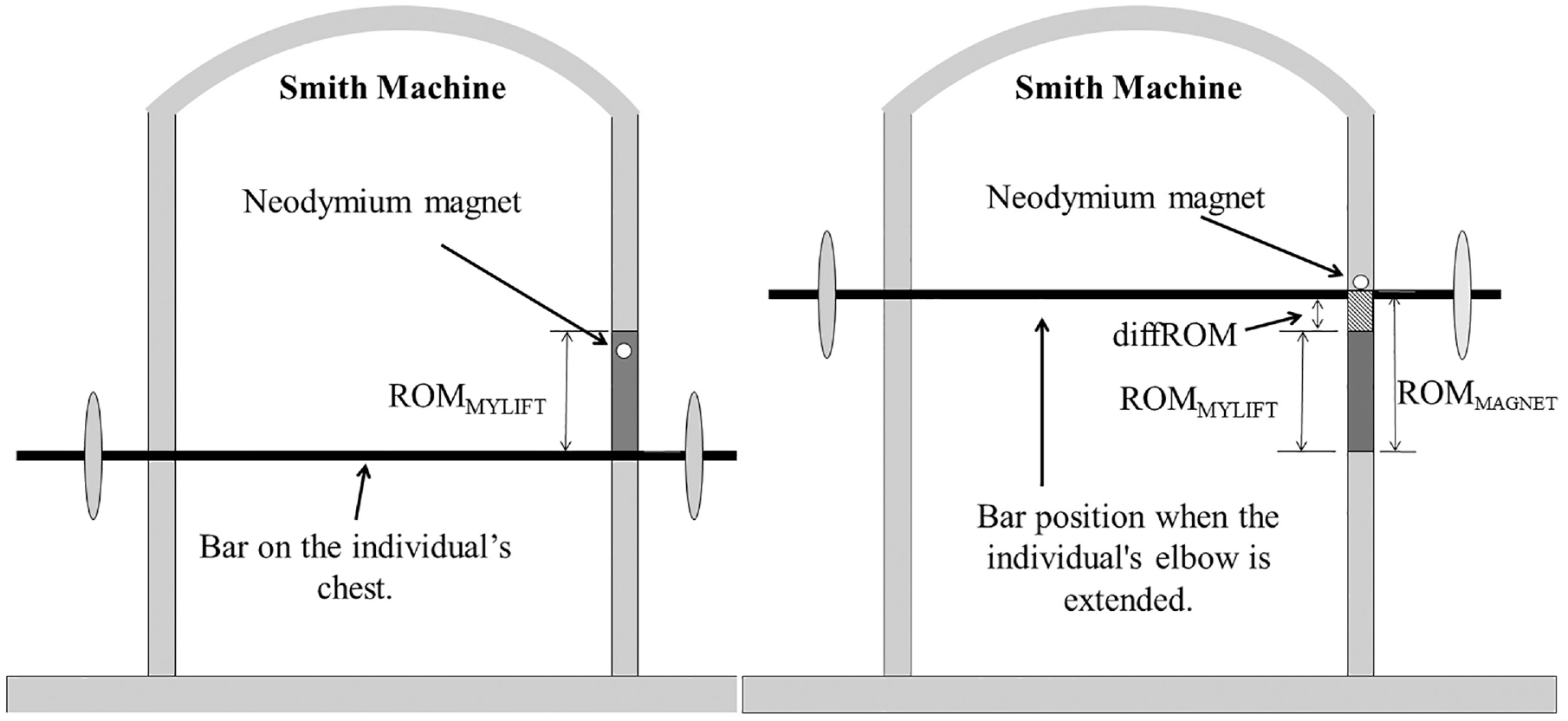
Illustration of the magnet method set-up.
To measure MV with the magnet method (MVMAGNET), an inverse calculation was necessary to obtain the concentric elapsed time. This was performed by dividing the MV provided originally by the My Lift app (MVMYLIFT) using ROMMYLIFT. Knowing the elapsed time, the MVMAGNET was achieved by simply dividing the ROMMAGNET by the elapsed time.
Second step of the study: Magnitude of measurement errors in older adults
This step was planned to verify whether the hypothesis assumed in the first step would also be confirmed in a group of older adults, applying the magnet method as a reference. Different loads were used to verify the effect of intensity on the ROM variation in relation to the ROMMYLIFT. Relative loads corresponding to 55%, 65%, 75%, and 85% of 1RM were used. The 1RM tests were performed at the beginning of the sessions based on the trial-and-error method, which was defined as the ability or inability to lift the loads within the assumed technical standard. Attempts with progressively higher loads were carried out using 5–10 kg per attempt until the maximum dynamic load was determined. 22 The first load of this progressive series was established as the one that allowed a MV of approximately 0.3 m s−1. As an immediate reliability criterion, only 1RM loads obtained with MV below 0.2 m s−1 were considered valid. 2 A new 1RM test performed with each individual, on average 48 hours later, confirmed the reliability of the measurements (R2 = 0.99; t = −0.663; p > 0.05; ES = 0.14).
After a recovery interval of at least 5 min, each participant was invited to perform two repetitions with each load (randomly defined) at a maximal intentional velocity. For further analysis, only the highest velocities were selected. These analyses involved comparisons of ROM and MV obtained according to the procedures and the My Lift app algorithm, with the measurements observed after correction based on the magnet method.
Statistical analyses
Data were reported as mean ± SD. The hypothesis of difference between ROMMYLIFT and ROMENC under two MV conditions was tested with analysis of variance (ANOVA one-way). The validity of the magnet method was carried out comparing means of ROMENC and ROMMAGNET through the Student’s t-test, as well as differences between MVENC and MVMAGNET via ANOVA one-way. Games-Howell’s post-hoc test was applied. To verify the difference between the My Lift app measurements in comparison to the magnet method with the older group, the means of ROMMYLIFT and ROMMAGNET and the means of MVMYLIFT and MVMAGNET were compared by the ANOVA factorial (methods and ROM/MV as factors). The effect of the loads’ progressive intensity on the ROM and MV measurements was verified by ANOVA’s repeated contrasts. Additionally, the differences of MV and ROM obtained by the My Lift app and magnet method were verified by the Student’s paired t-test. Bland-Altman analyses, coefficient of determination (R2) and Pearson’s correlation (r) were used to verify the level of agreement and correlation among the methods of measurements. Effect size (ES) was presented as Cohen’s 23 “r”, and interpreted as trivial (ES < 0.1), small (0.1 ≤ ES < 0.3), moderate (0.3 ≤ ES < 0.5), and large (ES ≥ 0.5). All statistical analysis was performed with the Statistical Package for Social Sciences (v.20.0; SPSS Inc., Chicago, IL, USA). Statistical power was calculated a posteriori, resulting in greater than 80% for all tests considering sample size, effect size, and p < 0.05.
Results
ANOVA one-way revealed a large and significant difference (F(2,75) = 19.70; p < 0.05, ES = 0.62) between ROMMYLIFT (0.385 ± 0.040 m) and ROMENC with loads allowing MV above (0.497 ± 0.069 m) and below (0.450 ± 0.056 m) 0.6 m s−1. Although the linear correlation between both measurements was significant (r > 0.7; p < 0.05), the coefficients of determination demonstrated that less than 60% of the ROMENC variation could be explained by the ROMMYLIFT variation in both MV conditions (Figure 2).
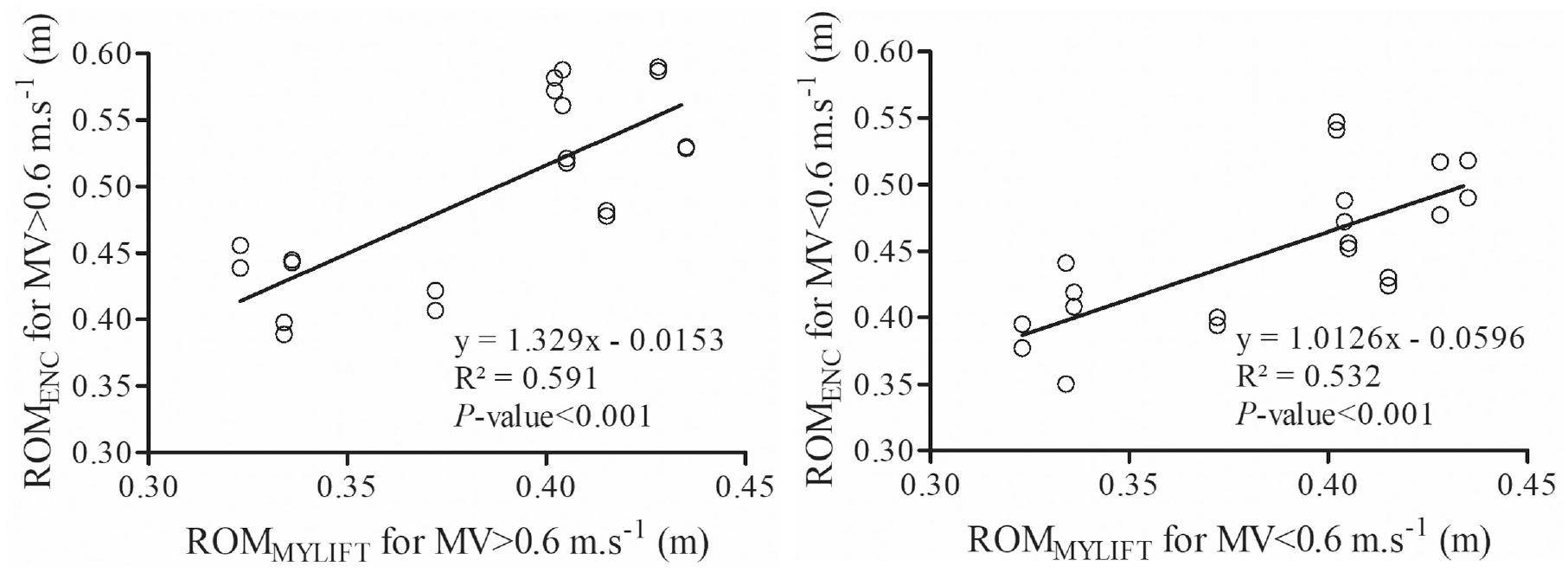
Relationship between range of motion of My Lift app (ROMMYLIFT) and encoder (ROMENC). Left = high MV (>0.6 m s−1). Right = low MV (<0.6 m s−1).
The absence of concordance between the ROMMYLIFT and ROMENC is still more evident considering the large limits of agreement observed (Figure 3). Furthermore, with smaller loads (high velocity), individual errors were strongly and significantly correlated to the means (F(1,18) = 14.56; p < 0.05, ES = 0.67). These heteroscedasticities provided biased residuals where the greater the ROM, the greater the error. With the heavier loads (low velocity), the correlation between individual errors and mean values presented itself on the limit of significance with the effect size classified as moderate (F(1,18) = 4.28; p = 0.53, ES = 0.44), suggesting heteroscedastic residuals as well.
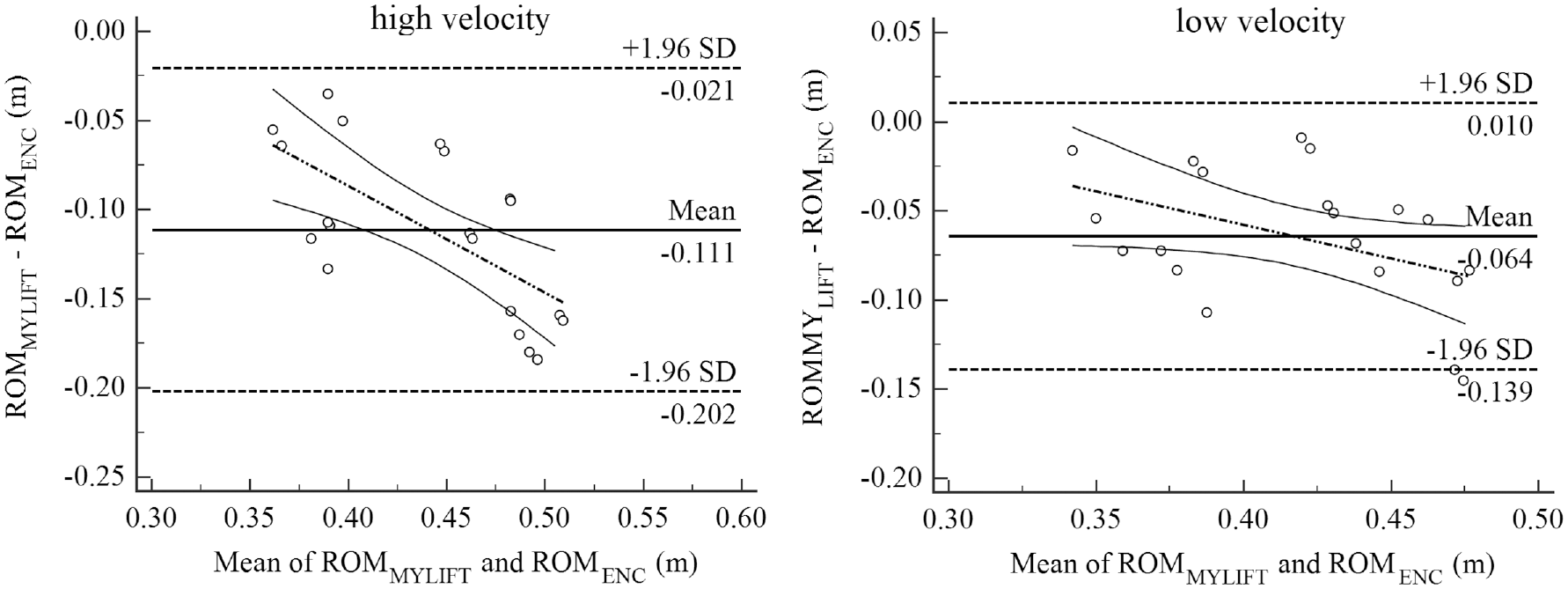
Bland-Altman plot between My Lift app range of motion (ROMMYLIFT) and encoder range of motion (ROMENC) at different velocities.
The magnet method allowed for a nearly perfect adjustment of ROMMYLIFT, presenting a practically absolute correlation between ROMMAGNET and ROMENC, with a correspondingly high coefficient of determination (Figure 4).
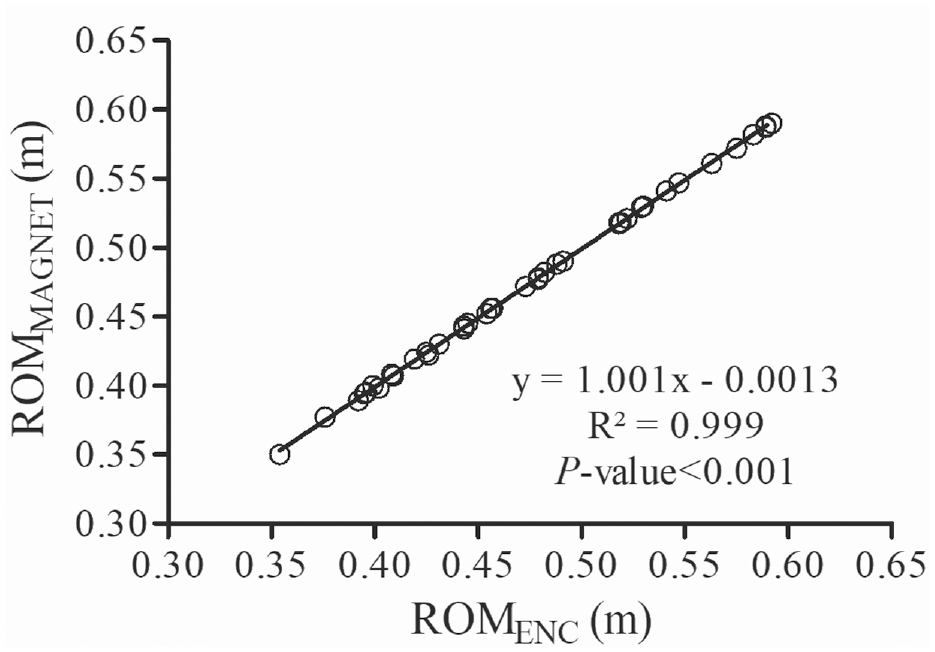
Correlation between magnet method range of motion (ROMMAGNET) and encoder range of motion (ROMENC).
The paired-mean comparison revealed differences between measurements (t(40) = 5.31; p < 0.05; ES = 0.64), although the averages of ROMMAGNET and ROMENC were 0.4723 ± 0.01 m and 0.4712 ± 0.01 m, respectively. However, the paired-mean comparison seems not to be adequate for this data, since the Bland-Altman analysis demonstrated an average error between methods equal to 1 mm (less than 1%) and random errors no higher than 4 mm. Additionally, individual errors presented a truly random distribution around averages, revealing adequate homoscedasticity and unbiased residuals (F(1,39) = 0.078; p > 0.05, ES = 0.04) (Figure 5).
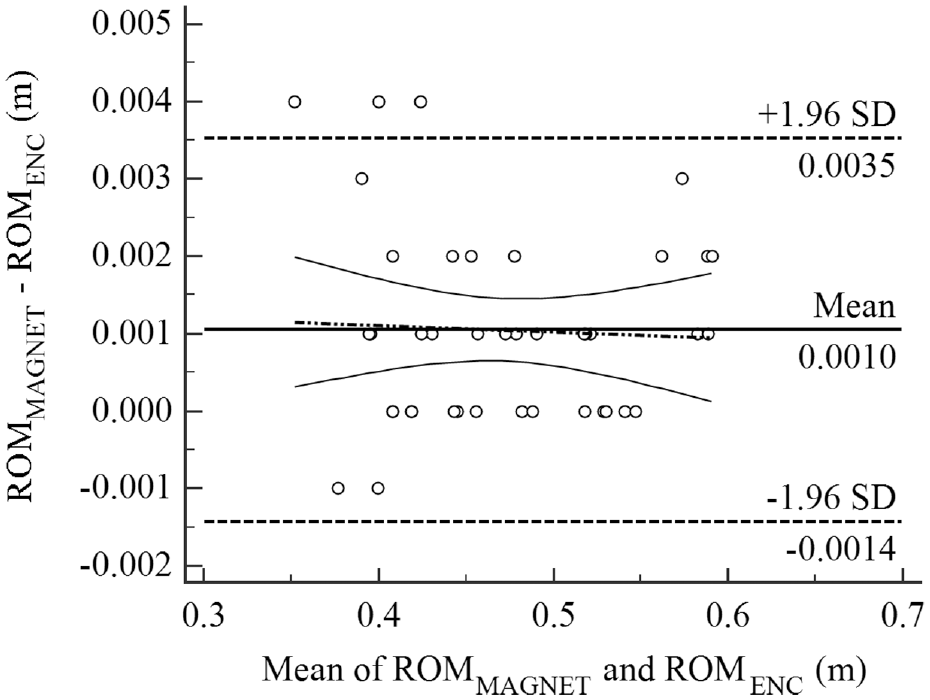
Bland-Altman plot between magnet method range of motion (ROMMAGNET) and encoder range of motion (ROMENC).
Considering MV, the results show that the magnet method presented a nearly perfect correlation between MVMAGNET and the measurements provided by the encoder (MVENC; r = 0.994; p < 0.01), with a correspondingly high coefficient of determination (Figure 6– right panel). These magnitudes of correlation are greater than those observed between MVMYLIFT and MVENC (r = 0.942; p < 0.001) (Figure 6– left panel).
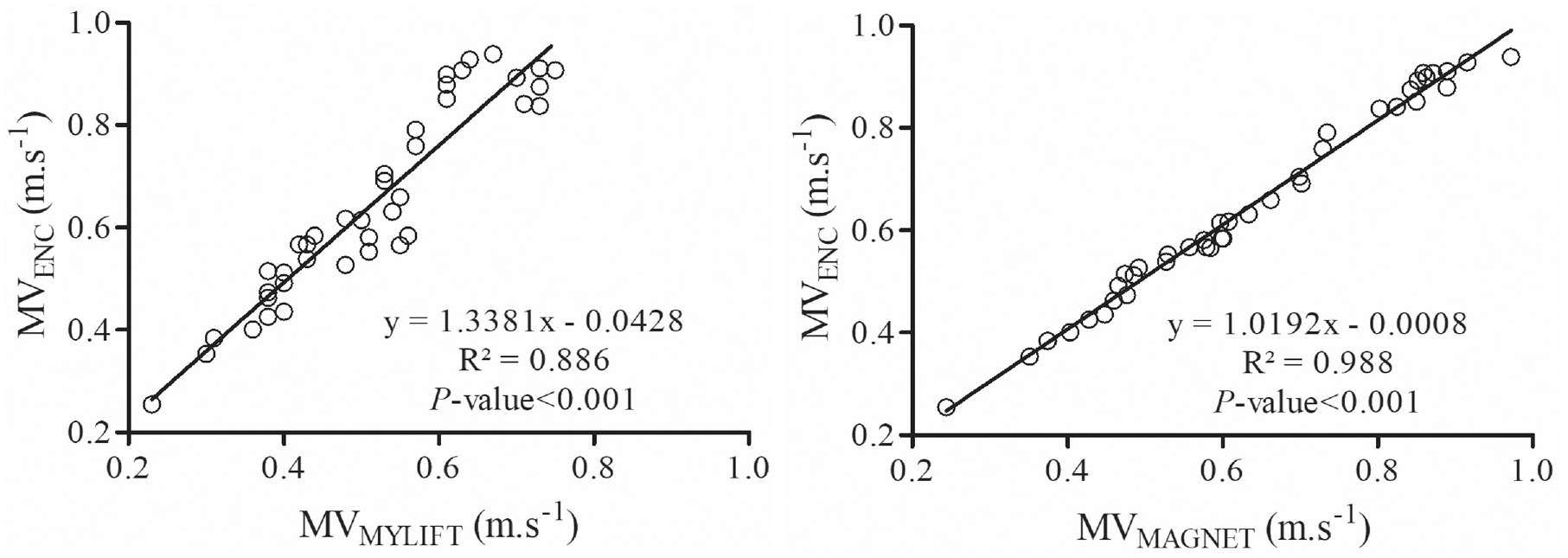
Correlation among mean velocity of My Lift app (MVMYLIFT), encoder (MVENC), and magnet method (MVMAGNET).
ANOVA one-way demonstrated no difference between MVMAGNET (0.65 ± 0.19 m s−1) and MVENC (0.64 ± 0.18 m s−1), but both differed from MVMYLIFT mean measurement (0.52 ± 0.13 m s−1), although the effect size was only moderate (F(2,12) = 7.24; p < 0.05, ES = 0.31). Bland-Altman analyses confirmed relevant differences among MVMYLIFT, MVENC, and MVMAGNET. Furthermore, individual errors were systematic and heteroscedastic when compared to MVMYLIFT and MVENC (F(1,38) = 43.13; p < 0.05, ES = 0.73). Whereas, the individual errors were random and homoscedastic when compared to MVMAGNET and MVENC (F(1,38) = 2.04; p > 0.05, ES = 0.23). The biased and heteroscedastic MV residuals provided by the My Lift app (Figure 7) indicate that the greater the MV, the greater the error when using the ROM measured statically under dynamic conditions.
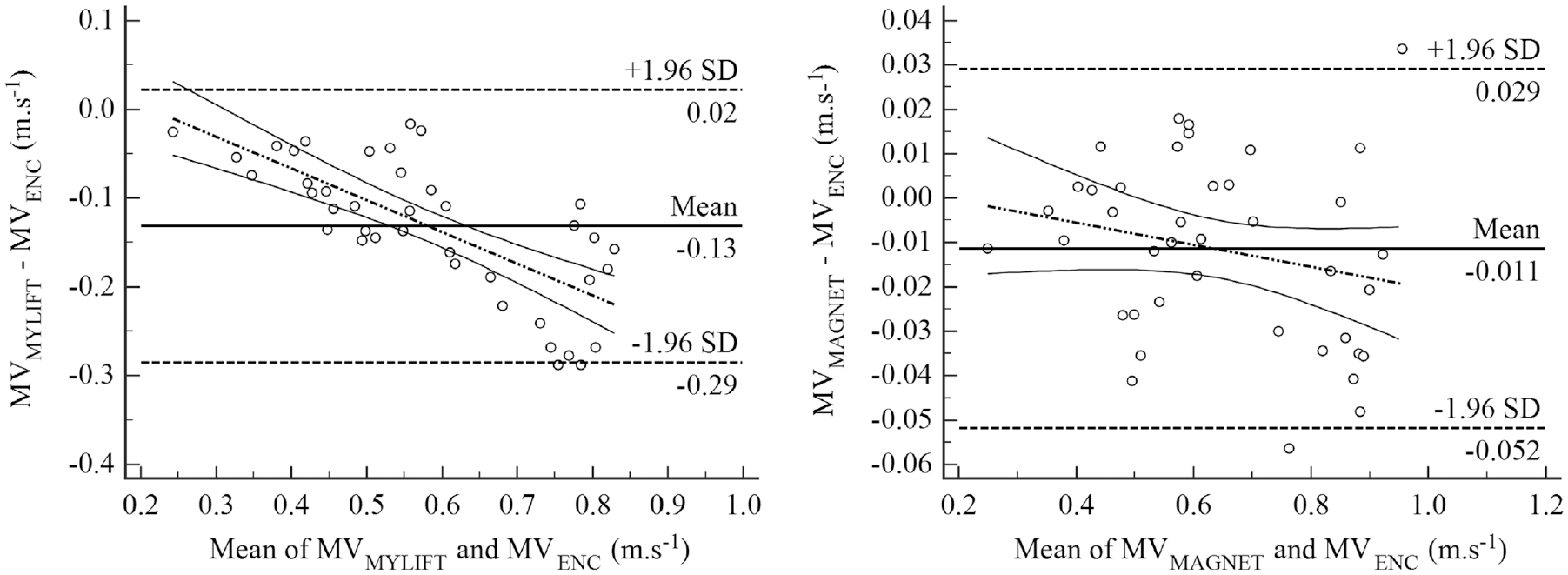
Bland-Altman plot among mean velocity of My Lift app (MVMYLIFT), encoder (MVENC), and magnet method (MVMAGNET).
ANOVA two-way resulted in a significant effect on method, intensity (percentage of load) and interaction for both ROM and MV in older adults. These differences, as well as the levels of correlations, were strongly and significantly affected by the load intensities (except at 85% of 1RM), which demonstrated that the higher the MV of older adults, the higher the errors (Tables 1–3; Figure 8).
Effect of load and method in range of motion (ROM) and mean velocity (MV) measurement comparing the My Lift app and magnet method.
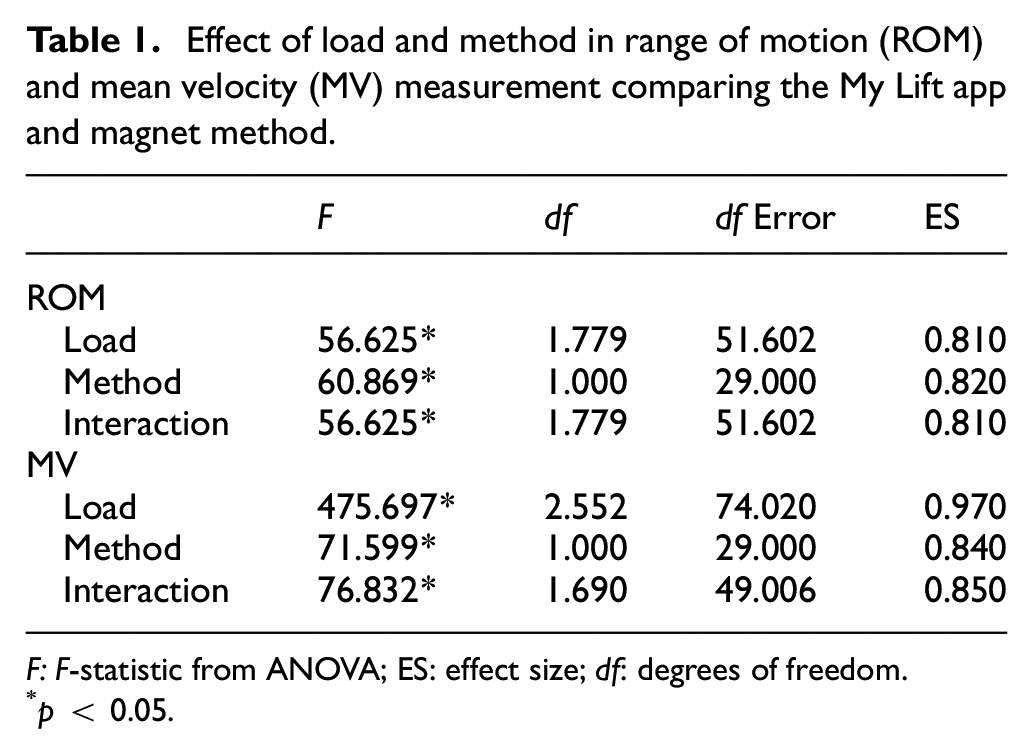
F: F-statistic from ANOVA; ES: effect size; df: degrees of freedom.
p < 0.05.
Means, standard deviations, Pearson’s correlations, effect sizes, and levels of agreement of ROMMYLIFT and ROMMAGNET under different load conditions.
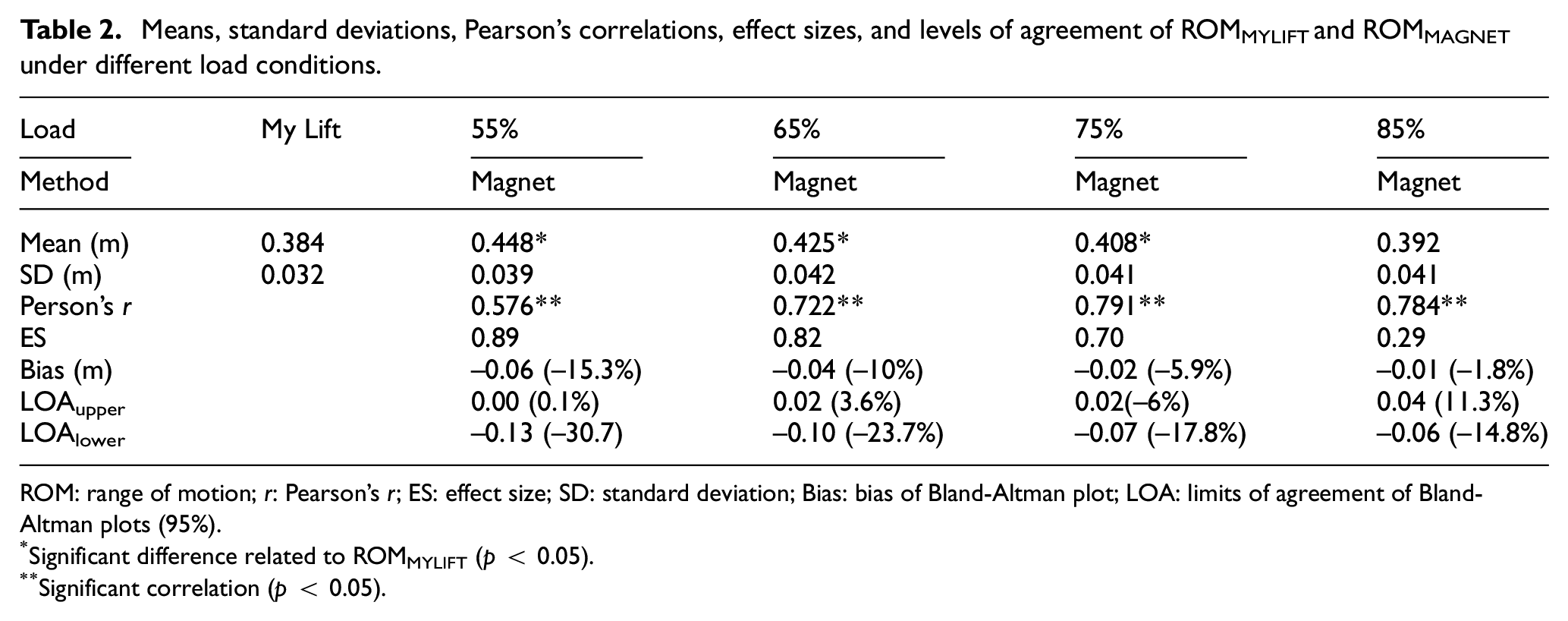
ROM: range of motion; r: Pearson’s r; ES: effect size; SD: standard deviation; Bias: bias of Bland-Altman plot; LOA: limits of agreement of Bland-Altman plots (95%).
Significant difference related to ROMMYLIFT (p < 0.05).
Significant correlation (p < 0.05).
Means, standard deviations, Pearson’s correlations, effect sizes, and levels of agreement of MVMYLIFT and MVMAGNET under different load conditions.
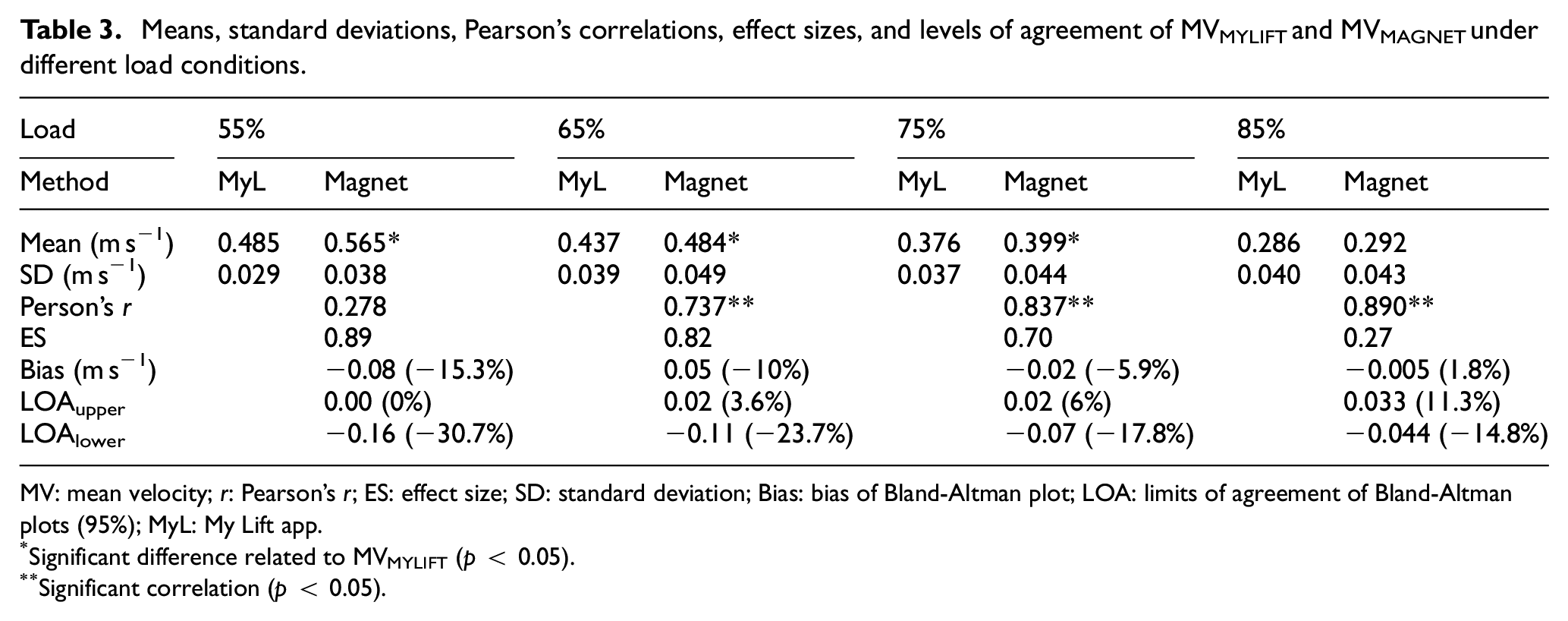
MV: mean velocity; r: Pearson’s r; ES: effect size; SD: standard deviation; Bias: bias of Bland-Altman plot; LOA: limits of agreement of Bland-Altman plots (95%); MyL: My Lift app.
Significant difference related to MVMYLIFT (p < 0.05).
Significant correlation (p < 0.05).
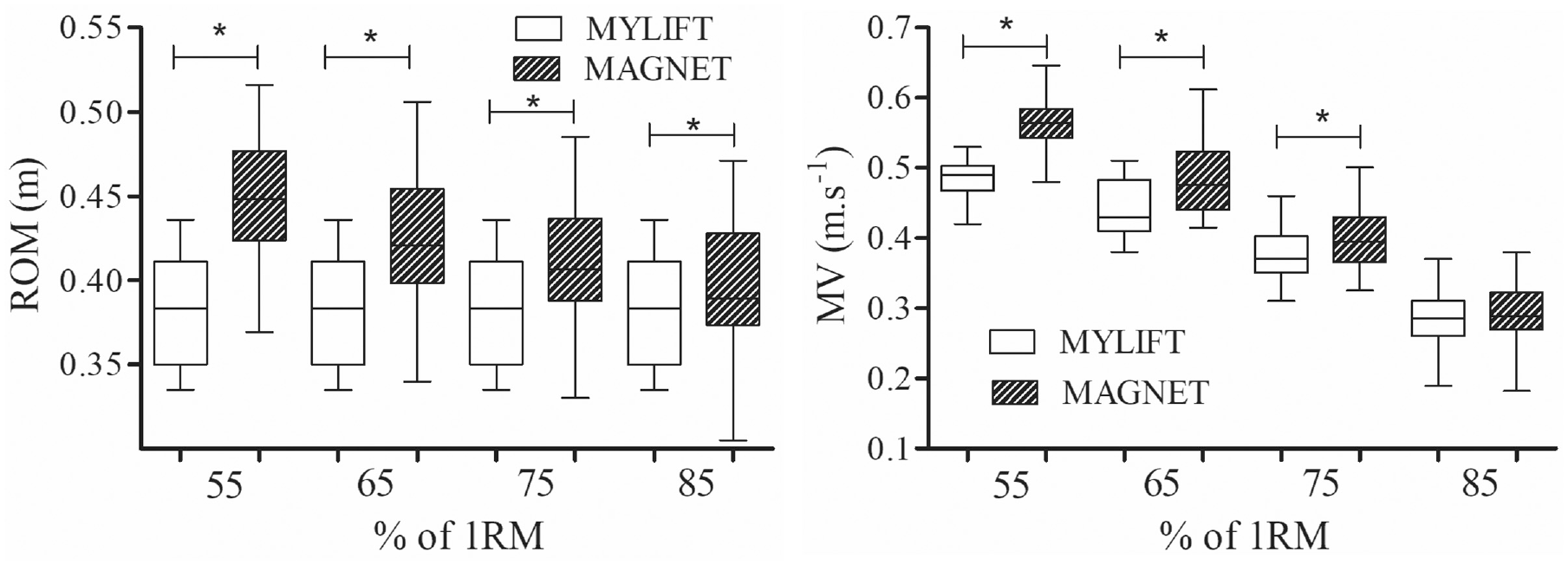
Range of movement (left panel) and mean velocity (right panel) of My Lift app and the magnet method at different percentages of 1RM.
Discussion
To the best of the authors’ knowledge, this is the first study to investigate the inappropriateness of assuming a ROM statically measured for MV measurement under dynamic conditions, as suggested by the My Lift app developers as default. The results confirm the main hypothesis and revealed that it is not appropriate to use ROM measured statically to measure the MV in the bench press exercise. The farther the load is away from the individual 1RM, the greater the difference between My Lift app MV measurements and the concurrent methods (encoder and magnet methods). The results of the present study also confirm that the magnet method allowed an effective and low-cost measurement of MV for both young adults and older adults when using the My Lift app.
Until now, there were no investigations to provide assurance that the MV and individual errors observed in previous research involving young adults evaluated by the My Lift app would also be reproduced with older adults. The present results confirm that both biased and heteroscedastic errors were present, leading to inadequate MV measurements in the older group, except for loads equal to 85% of 1RM. The errors identified were slightly smaller for the older group than the younger adult men, although they were far higher than those presented in some studies that considered the My Lift app valid for MV measurements,7,11,14 as well as being similar to other studies that did not recommend the My Lift app for MV measurements. 8
By applying the magnet method, the results with young men identified that the mean underestimation of approximately 25% and 22% for ROMMYLIFT and MVMYLIFT, respectively, compared to a rotary encoder were reduced for mean errors smaller than 1% and ∼1.7%, respectively. ROM and MV individual errors were slightly reduced as well, making the correlation between My Lift and the applied position transducer almost perfect (r = 0.99 to MV; r = 0.999 to ROM). Even though the MV values observed for the older adults with 85% 1RM loads were not different in relation to the MV provided by the magnet method (systematic bias = −0.005 m s−1; p > 0.05), applying the method is still suggested given the elevated limits of agreement (upper and lower) observed (>10%). Considering the small and non-significant correlation (r = 0.278; p > 0.05) with the concurrent and validated magnet method, it is also necessary to highlight that loads of 55% or smaller must not be used for MV measurements from ROM measured statically as proposed by the My Lift developers. By applying the magnet method instead, the use of smaller relative loads can be encouraged, which could especially benefit older adult assessments.
Although numerous publications have indicated relevant arguments for and against the validity of the My Lift app to measure 1RM and MV,7,8,11,12,14,21,24 surprisingly, no one has dedicated enough attention to the main limitation of the My Lift app, which is applying a ROM measurement performed statically prior to the movement in dynamic conditions. Pérez-Castilla et al. 21 may have noticed this problem first, considering the My Lift valid to measure 1RM in “Lat pull-down” and “Seated cable row” exercises when using a ROM dynamically measured by a position transducer. Furthermore, authors have not raised the hypothesis that the current authors confirmed, where ROM varied according to the load intensity, which certainly can distort results if disregarded.
The first investigation of My Lift’s validity was published by Balsalobre-Fernández et al. 7 and they concluded that it was a “highly valid, reliable and accurate” instrument to measure MV and the 1RM for the bench press exercise. However, they highlighted the existence of systematic bias, where the PowerLift app (another name for the My Lift app) should not be used interchangeably with a linear transducer. In the same year, Balsalobre-Fernández et al. 14 concluded that the My Lift app was “highly valid, reliable, and accurate” for MV measurements and “highly suitable” for analysis of the load-velocity profiles in the full squat, bench press, and hip thrust exercises, compared to a linear transducer measurement. In these studies,7,14 high linear coefficients of correlation for MV related to encoder measurements for the bench press (r = 0.94 and r = 0.973) were found, similar to that observed in the present study for young adults. However, the absolute bias detected in the present study was much greater for both young and elderly compared to what was observed by Balsalobre-Fernández et al.7,14 A simple visual inspection of graphic analysis of their data,7,14 as well as the data from the present study, reveals limits of agreement that can compromise individual evaluations when using the My Lift app.
Pérez-Castilla et al. 11 reported a high linear correlation (r = 0.97) and adequate reliability (CV = 3.97%; ICC > 0.73) between My Lift’s barbell velocities and a reference method (Trio-OptiTrack – V120, NaturalPoint, Inc.). However, again, the limits of agreement provided substantial doubts regarding the quality of My Lift’s MV measurements. Courel-Ibáñez et al. 8 analyzed the reproducibility and repeatability of five different technologies for barbell velocity measurement and concluded that the My Lift was not recommended as a monitoring tool for VBT applications, considering their substantial errors and uncertain outcomes. A sequence of a “Letter to the Editor,” 25 followed by a “Technical Note”, 16 were published to continue the discussion. In the technical note, Courel-Ibáñez et al. 16 presented additional data, which once more confirmed that MV underestimation when using the My Lift app varied in a magnitude-based way, where the greater the MV, the greater the errors. Also, Thompson et al. 26 reported individual errors from My Lift, where the greater the MV, the greater the error when compared with a 3d motion capture system as reference. This characteristic of errors was confirmed in the present study, and is certainly related to the lower capacity to accurately measure 1RM by the My Lift app, as presented by some researchers. 8 Despite the magnitude of errors reported here and elsewhere,8,16,17 a systematic review was recently published, 15 suggesting adequate validity and reliability of My Lift (and other mobile applications) for barbell movement velocity measurements during lower and upper body resistance exercises.
Unfortunately, the data from the present study does not allow the authors to identify why ROM varies according to load intensities. However, it seems reasonable to assume that because lower intensities allow higher velocities and accelerations, that in turn generates more kinetic energy and mechanical force. Thus, the higher the barbell velocity, the harder it is to brake, which overcharges the joints system to be able to stop the movement exactly at a statically defined point (necessary for the My Lift app procedure). Hence, higher velocities make it more difficult to avoid scapular abduction and shoulder protrusions, leading to greater ROM values compared to lower velocities (higher loads).
Although only the performance of the guided-barbell bench press was tested here, the authors are convinced that the same magnet method procedure could be applied to any resistance training equipment with a similar guided system (e.g. weight plate machines). This assumption should be tested in future research. Furthermore, a limitation of the magnet method is that it cannot be used with free-weight exercises, commonly performed by athletes, as there is no surface to attach the magnet during these exercises.
Conclusion
The results from the present study demonstrated that the default procedure used in the My Lift app is inadequate because it assumes a ROM defined statically, prior to the movement, to evaluate a dynamic condition. Using this reference, the app has significant errors in measuring MV. Therefore, to solve this problem, a simple, inexpensive, and easy-to-use method, the magnet method, has been presented to ensure safe use of the My Lift app for VBT application.
Footnotes
Declaration of conflicting interests
The author(s) declared no potential conflicts of interest with respect to the research, authorship, and/or publication of this article.
Funding
The author(s) received no financial support for the research, authorship, and/or publication of this article.
