




Abstract
Velocity-based training is a contemporary resistance training method, which uses lifting velocity to prescribe and assess the effects of training. However, the high cost of velocity monitoring devices can limit their use among strength and conditioning professionals. Therefore, this study aimed to examine the reliability and concurrent validity of an affordable linear position transducer (ADR Encoder) for measuring barbell velocity during the Smith machine bench press exercise. Twenty-eight resistance-trained males performed two blocks of six repetitions in a single session. Each block consisted of two repetitions at 40%, 60%, and 80% of their estimated one-repetition maximum. The mean velocity of the lifting phase was simultaneously recorded with the ADR Encoder and a gold-standard linear velocity transducer (T-Force® System). Both devices demonstrated high reliability for measuring mean velocity (ADR Encoder: CVrange = 2.80%–6.40% and ICCrange = 0.78–0.82; T-Force® System: CVrange = 3.27%–6.62% and ICCrange = 0.77–0.81). The ADR Encoder provided mean velocity at 40%1RM with a higher reliability than the T-Force® System (CVratio = 1.17), but the reliability did not differ between devices at higher loads (60%1RM–80%1RM) (CVratio ≤ 1.08). No fixed or proportional bias was observed for the different loads using least-products regression analysis, while the Bland–Altman plots revealed low systematic bias (0.01 m·s−1) and random errors (0.03 m·s−1). However, heteroscedasticity of the errors was observed between both devices (R2 = 0.103). The high reliability and validity place the ADR Encoder as a low-cost device for accurately measuring mean velocity during the Smith machine bench press exercise.
Introduction
Velocity-based training (VBT) is a resistance training method, which uses lifting velocity as a supplement to or in some situations as a replacement for more traditional methods of prescribing and assessing the effects of resistance training. 1 The basic premise of VBT is that the external loads are lifted at maximal intended velocity. Under this premise, the recording of lifting velocity may provide valuable information to prescribe the loads2,3 or the repetition volume4,5 according to daily changes in an athlete’s fitness and fatigue status through a training cycle. However, it is very important that strength and conditioning professionals have access to accurate velocity monitoring devices that can be checked for acceptable reliability and validity. 6 A high validity is important to ensure that velocity outputs are comparable to the measurements obtained by other devices, while a high reliability is of vital importance to track changes in individual performance. 7 Therefore, it is important to elucidate whether the different commercially available velocity monitoring devices have appropriate reliability and validity.
Among the different velocity monitoring devices that are available on the market (e.g. linear position/velocity transducers, inertial measurement units, mobile phone applications, or optics devices), a recent systematic review 6 showed that the linear velocity/position transducers are the most accurate and reproducible systems to record lifting velocity during multiple compound exercises. Both systems consist of a sensor with a cable that is attached directly to the collar of the barbell. Specifically, the linear velocity transducer measures barbell velocity by recording electrical signals proportional to the cable extension velocity, while the linear position transducer measures barbell velocity from the differentiation of the cable displacement with respect to time. 8 Although these systems are becoming more affordable, 9 their cost may still continue to restrict their use by many strength and conditioning professionals. Recently, a new linear position transducer named ADR Encoder (ADR Encoder, Toledo, Spain) that has not yet been scientifically validated has appeared on the market with a considerably lower price (200–240 US dollars) than other commercially available linear position/velocity transducers. Therefore, the objective of this study was to examine the intra-day reliability and concurrent validity of the ADR Encoder with respect to the T-Force® System (i.e. the gold-standard in the present study) for the recording of mean velocity (MV) at three different relative loads (40%1RM, 60%1RM, and 80%1RM) during the Smith machine bench press exercise.
Methods
Experimental approach to the problem
This study was designed to explore the intra-day reliability and concurrent validity of the ADR Encoder for the measurement of MV during the Smith machine bench press exercise. In a single session, participants performed two blocks of six repetitions (12 repetitions in total). Each block consisted of two repetitions against the 40%, 60%, and 80% of their estimated one-repetition maximum (1RM). The MV of all repetitions was simultaneously recorded with the ADR Encoder and the T-Force® System.
Participants
Twenty-eight resistance-trained males (mean ± standard deviation (SD); age = 23.4 ± 3.8 years (range: 18–31 years); body mass = 77.3 ± 14.7 kg; stature = 1.78 ± 0.08 m; Smith machine bench press 1RM = 82.9 ± 15.1 kg) participated in this study. All participants were physically active and had 3.9 ± 3.0 years of resistance training experience with the Smith machine bench press exercise. Participants did not have any chronic disease or recent injury that could compromise Smith machine bench press performance. All participants were informed of the study procedures and signed a written informed consent form before initiating the study. The study protocol adhered to the tenets of the Declaration of Helsinki and was approved by the University of Granada Institutional Review Board (IRB approval: 988/CEIH/2019).
Procedures
Body mass using TBF-171 300A (Tanita Corporation of America Inc., Arlington Heights, IL, USA) and stature using Seca 202 (Seca Ltd., Hamburg, Germany) were assessed at the beginning of the session. The general warm-up consisted of dynamic stretching and joint mobilization exercises. Thereafter, participants performed an incremental loading test consisting of four repetitions with 45%, two repetitions with 65%, and one repetition with 85% of the self-reported 1RM. The lifting phase (i.e. upward movement of the barbell) of all repetitions was performed at maximal intended velocity and the MV of the lifting phase was recorded by the T-Force® System. The MV collected under all loading conditions were modeled by a linear regression model, and the Smith machine bench press 1RM was estimated as the load associated with a MV of 0.17 m·s−1. 10
After warming-up, participants completed two identical blocks of six repetitions. Each block consisted of two repetitions with 40%, 60%, and 80% of the previously estimated 1RM. The sequence of the loads was randomly assigned to each participant, but the same order was maintained in the two blocks. The rest period between the blocks, loads of the same block, and repetitions of the same load were set to 5 min, 3 min, and 10 s, respectively. Participants received velocity performance feedback immediately after completing each repetition to encourage them to perform the lifting phase of all repetitions as fast as possible. 11 The bench press exercise was performed on a Smith machine (Technogym, Barcelona, Spain) using the standard 5-point body contact position (head, upper back, and buttocks placed firmly on the bench with both feet flat on the floor) and touch-and-go technique. The bench press was used in the present study because it is probably the most commonly prescribed upper-body exercise for the general population and athletes of different disciplines in order to increase muscle strength and mass. 12 In addition, the bench press performance also discriminates between elite and subelite athletes. 13
Data acquisition and analysis
The MV of all repetitions were simultaneously recorded with the ADR Encoder and the T-Force® System (Figure 1). The specific characteristics of each device are provided below.
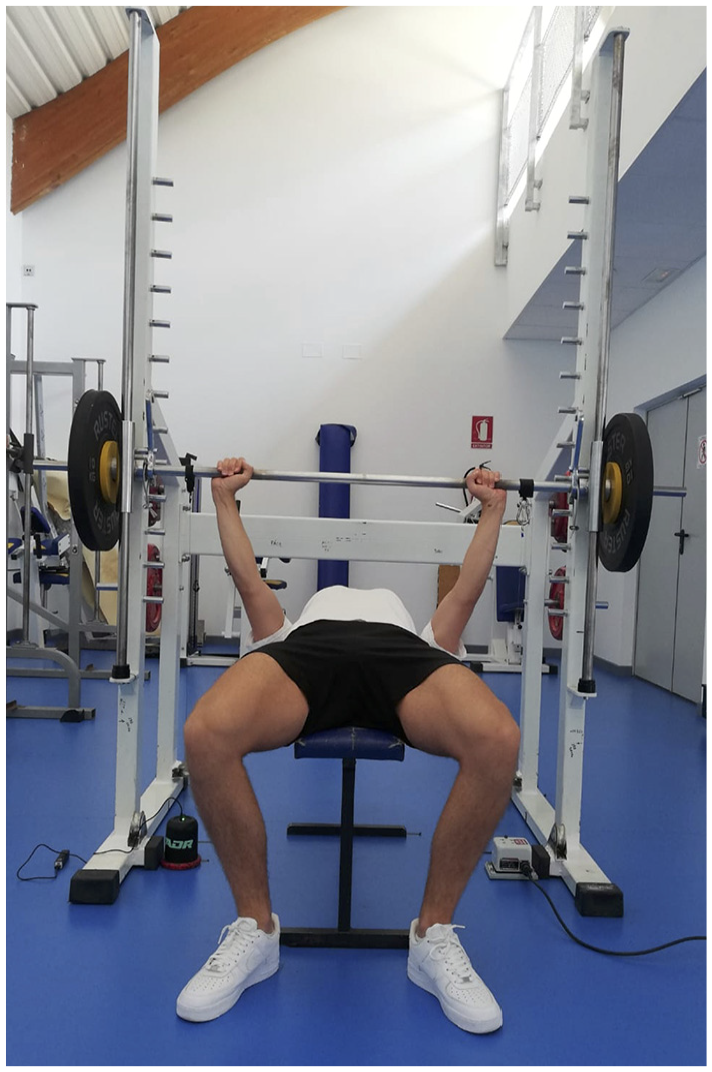
Participant performing the Smith machine bench press exercise with the ADR Encoder and T-Force® System attached to the left and right side of the barbell, respectively.
ADR Encoder (ADR Encoder, Toledo, Spain) is an isoinertial dynamometer that consists of a cable-extension linear position transducer attached to the barbell. Data were directly recorded by the differentiation of the displacement data with respect to time at a sampling rate of 1000 Hz, with an error of ±2.5 mm of displacement (data provided by the company). The data were transmitted via Bluetooth connection to an iPhone 8 smartphone (Apple, Inc., Cupertino, CA, USA) using the proprietary ADR Encoder application (firmware version 5.3).
T-Force® System (Ergotech, Murcia, Spain) is an isoinertial dynamometer that consists of a cable-extension linear velocity transducer interfaced with a personal computer by means of a 14-bit resolution analog-to-digital data acquisition board and custom software (version 2.28). Instantaneous velocity was sampled at a frequency of 1000 Hz and subsequently smoothed with a fourth order low-pass Butterworth digital filter with no phase shift and 10 Hz cut-off frequency. The T-Force has been used in previous studies as the gold-standard to validate other velocity monitoring devices.14,15
Intra-day reliability was calculated independently for the ADR Encoder and T-Force® System, considering the repetition with the highest MV of each load, whereas for validity analyses, the same repetition was considered for both devices (the repetition with the highest MV recorded by the T-Force® System).9,14 Specifically, the data from both blocks were used to address the first objective (intra-day reliability), but only the data from the first block was used to address the second objective (concurrent validity).
Statistical analyses
Data are presented as means and SD. The normal distribution of the data was confirmed using the Shapiro-Wilk test (p > 0.05). Intra-day reliability was assessed by the standard error of measurement (SEM), coefficient of variation (CV = standard error of measurement/participant’s mean score × 100), and intraclass correlation coefficient (ICC; model 3.1) with their corresponding 95% confidence intervals. The ratio between two CVs was used to compare the reliability outcomes between both devices. The smallest important ratio between two CVs was considered to be greater than 1.15. 16 The concurrent validity of the ADR Encoder with respect to the T-Force® System was examined through ordinary least-products regression using log transformed data because the Bland-Altman plots, which were constructed with the raw data, showed heteroscedasticity of the errors (R2 > 0.1). The strength of the regressions was examined through the Pearson’s product-moment correlation coefficients (R), while the slope and intercept with their 95% confidence intervals were used to assess fixed and proportional bias.17–19 If the 95% confidence interval for the intercept did not include 0, then fixed bias was present. If the 95% confidence interval for the slope did not include 1.0, then proportional bias was present. Heteroscedasticity of the errors in the Bland-Altman plots was defined as a coefficient of determination (R2) > 0.1. 7 Statistical significance was accepted at p < 0.05 level.
Results
Intra-day reliability
The MV was recorded with high reliability by both the ADR Encoder (CVrange = 2.80%–6.40%; ICCrange = 0.78–0.82) and T-Force® System (CVrange = 3.27%–6.62%; ICCrange = 0.77–0.81). The ADR Encoder provided MV with a higher reliability than the T-Force® System for the 40%1RM (CVratio = 1.17), but no important differences in reliability (CVratio ≤ 1.08) were observed at higher loads (60%–80%1RM) (Table 1).
Intra-day reliability of the mean velocity recorded by the ADR Encoder and the T-Force® System at different relative loads during the Smith machine bench press exercise.
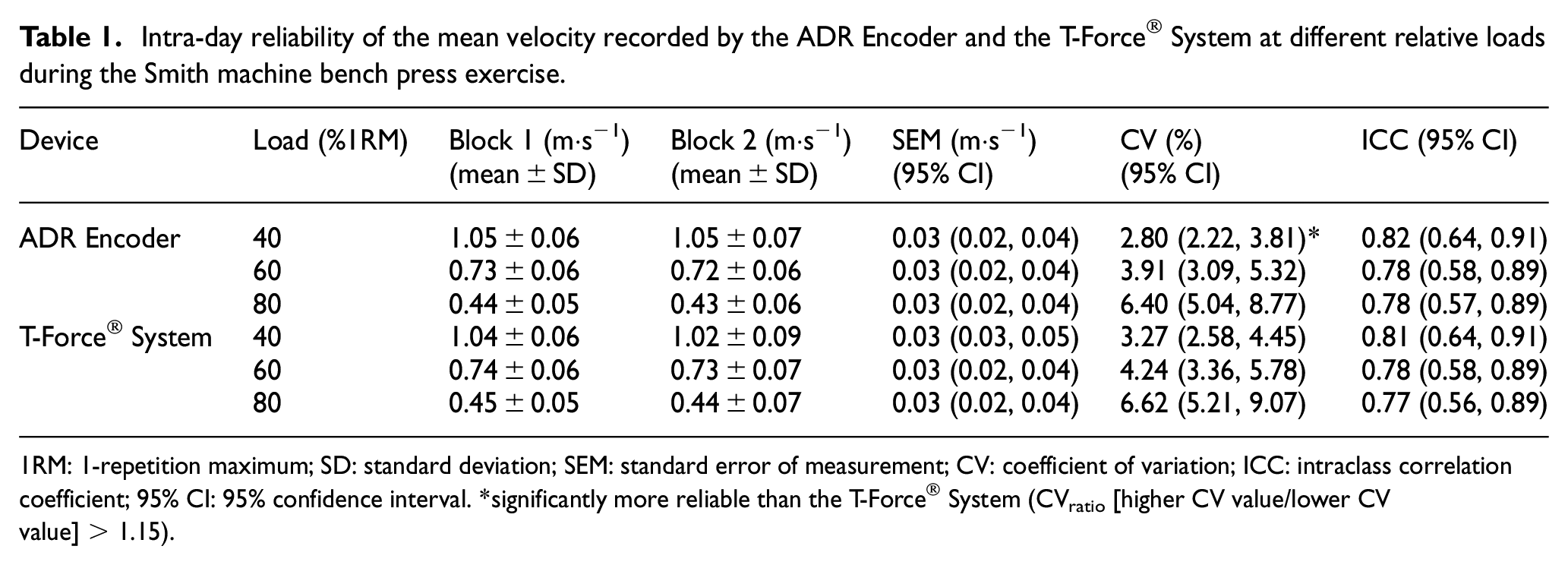
1RM: 1-repetition maximum; SD: standard deviation; SEM: standard error of measurement; CV: coefficient of variation; ICC: intraclass correlation coefficient; 95% CI: 95% confidence interval. *significantly more reliable than the T-Force® System (CVratio [higher CV value/lower CV value] > 1.15).
Concurrent validity
No fixed or proportional bias was observed for the different relative loads, as shown by R2 values that ranged from 0.667 to 0.929 (Figure 2). The Bland–Altman plots revealed low systematic bias (0.01 m·s−1) and random errors (0.03 m·s−1) (Figure 3). However, heteroscedasticity of the errors was observed (R2 = 0.103) due to higher MV values for the T-Force® System at low velocities and the higher MV values for ADR Encoder at high velocities.
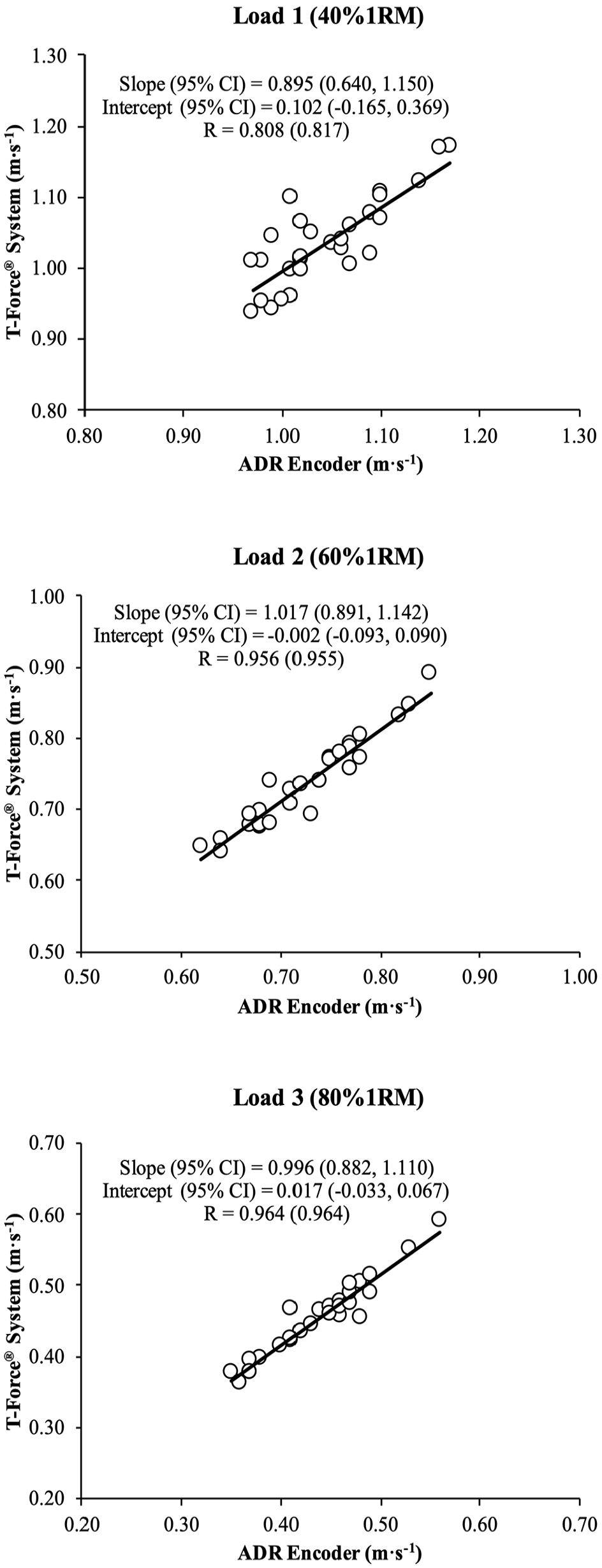
Least-products regression analysis for the mean velocity values recorded by the T-Force® System and the ADR Encoder at different relative loads during the Smith machine bench press exercise. 1RM, 1-repetition maximum; 95% CI, 95% confidence interval; R, Pearson’s product-moment correlation coefficients. The R values indicated in parentheses were log transformed. No fixed or proportional bias was observed for any relative load.
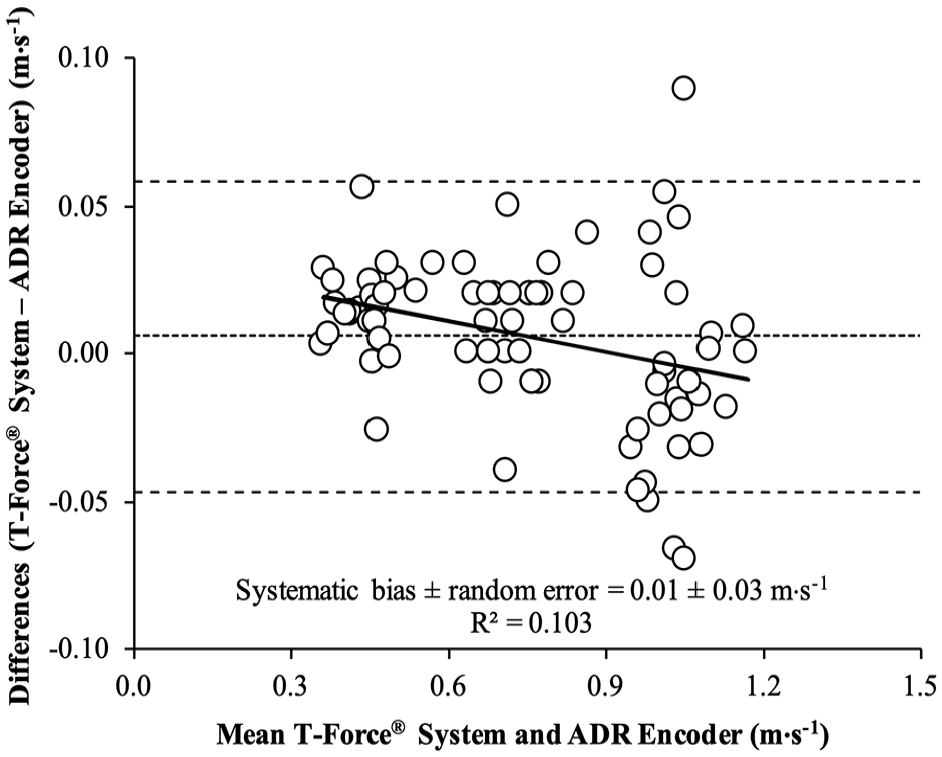
Bland–Altman plots showing the differences for the mean velocity values recorded by the T-Force® System and the ADR Encoder during the Smith machine bench press exercise. The plot depicts the systematic bias and 95% limits of agreement (±1.96; dashed lines), along with the regression line (solid line). The systematic bias ± random error together with strength of the relationship (R2), are depicted on the plot.
Discussion
This is the first study to explore the intra-day reliability and concurrent validity of a new linear position transducer, called ADR Encoder, to measure barbell velocity during the Smith machine bench press exercise. The present results have shown that the ADR Encoder provides MV with high reliability against a range of relative loads (40%–60%–80%1RM) during the Smith machine bench press exercise. These results are in line with previous studies that have observed an acceptable test-retest reliability for other brands of linear position transducers, such as Chronojump (Chronojump Boscosystem, Barcelona, Spain) (CV ≤ 6.24%; ICC ≥ 0.72) or Speed4Lifts (Speed4Lifts, Madrid, Spain) (CV ≤ 3.92%; ICC ≥ 0.81).9,20 More importantly, this new system provided MV with comparable (60%1RM–80%1RM) or greater (40%1RM) reliability than the T-Force® System, which is a device commonly used as the gold-standard in the scientific literature. 20 Therefore, the high intra-day reliability of the ADR Encoder suggests that this device represents a low-cost and versatile alternative for evaluating velocity performance. It is worth noting that the use of a Smith machine may limit the ecological validity of the current findings because athletes typically perform the bench press with free-weights. Therefore, since reproducibility of velocity outcomes during free-weight can by affected by the horizontal movements of the barbell, 21 future studies should examine the intra-day reliability of the new ADR Encoder to measure the barbell mean velocity during the free-weight bench press exercise. Furthermore, although intra-session reliability provides valuable information on the correct preparation routine, future research should explore the reproducibility of this new ADR Encoder in an applied athlete monitoring setting (i.e. inter-day reliability).
The present results have also shown that the ADR Encoder provides MV with a high concurrent validity (no fixed or proportional bias) with respect to the T-Force® System for loads ranging from 40% to 80% of 1RM. In addition, Bland-Altman plots revealed low systematic bias and random errors between both systems. These results are also in line with a previous study that found a high concurrent validity for other similar linear position transducers (Chronojump: systematic bias = −0.03 m·s−1 and random error = 0.03 m·s−1; Speed4Lifts: systematic bias = −0.04 m·s−1 and random error = 0.02 m·s−1) with respect to the “gold-standard” 3D motion capture during the Smith machine bench press exercise. However, it is worth noting that the heteroscedasticity of the errors observed between the two systems compromised their interchangeability. Specifically, the T-Force® System provided higher MV values at low velocities and the ADR Encoder revealed higher MV values at high velocities. Notwithstanding this, the present study supports the use of the ADR Encoder as a valid tool to measure the barbell’s velocity during the Smith machine bench press exercise. However, although the T-Force® System has been recommended as the gold-standard to identify measurement errors from other velocity monitoring technologies, 20 future studies should explore the concurrent validity of the ADR Encoder with respect to a 3D high-speed motion capture system in order to reduce additional errors in the validation process. 6
Practical applications
The ADR Encoder is a reliable and valid device to measure the barbell velocity during the Smith machine bench press exercise. Therefore, the velocity data recorded through this novel device can be used not only to provide velocity performance feedback, but also to evaluate performance or prescribe training stimulus (readers are directed to the study by Weakley et al. 1 for a review of the practical applications of VBT). These results along with its low-cost (~220 US dollars) and versatility (the software is installed in a smartphone application that is wirelessly connected with the hardware), make the ADR Encoder a viable alternative for strength and conditioning professionals.
Footnotes
Acknowledgements
We would like to thank all the subjects who selflessly participated in the study.
Declaration of conflicting interests
The author(s) declared no potential conflicts of interest with respect to the research, authorship, and/or publication of this article.
Funding
The author(s) received no financial support for the research, authorship, and/or publication of this article.
